
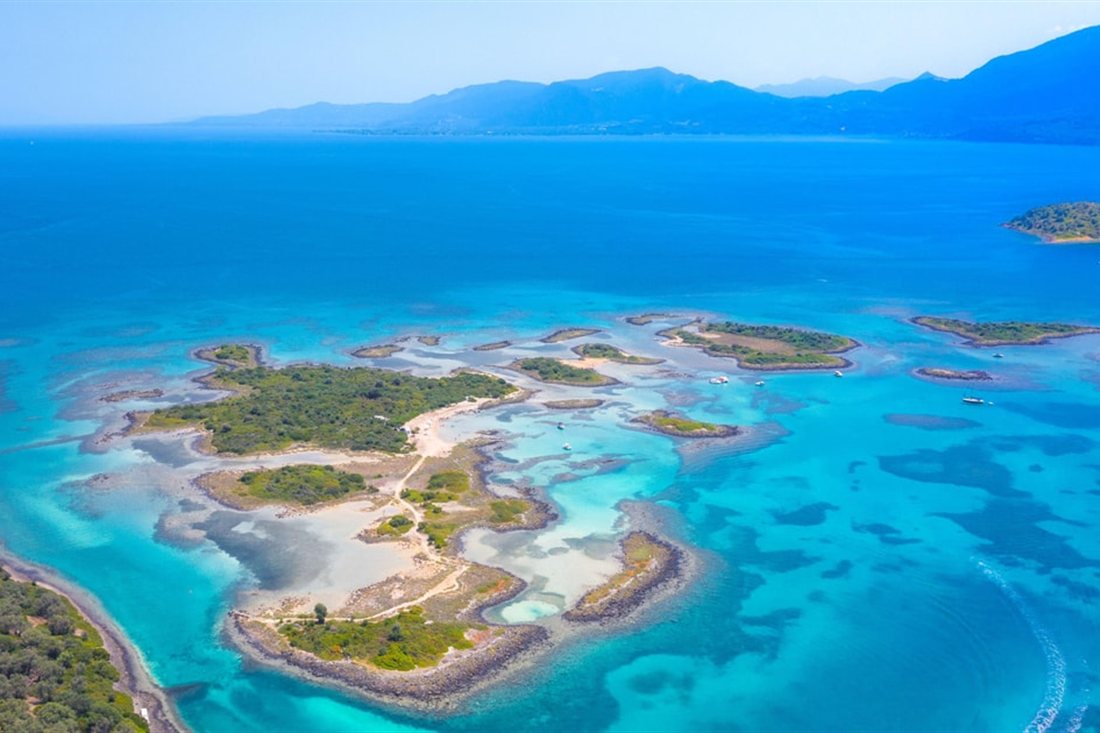
A Lichadonisia boat trip is a short sea crossing to a cluster of small green islets off the north-west tip of Evia, with swimming in shallow, clear water. Boats leave from the Evia coast, and day trips run from Athens. Tours across the rest of the country are listed on Greece Tours.
The sections below cover the trips, the islets, how they formed, the myth, the beaches, the shipwreck, the ports, the Athens day trip, who it suits, inclusions, timing and booking, with links into the Evia tours pages. The tour shown is checked on GetYourGuide.
What is a Lichadonisia boat trip?
A Lichadonisia boat trip is a short sea crossing to a group of seven green islets off north-west Evia. Boats carry visitors to a sandy beach for swimming and back the same day. The islets have no hotels and no residents.
Greek tourism sources call the islets the “Greek Seychelles”. The name refers to their green slopes, light sand and clear blue water. No one lives there, so a Lichadonisia boat trip is the only way to visit.
The Lichadonisia boat trip mixes a sea crossing, a swim and a short loop past the islets. Crews point out a sunken ship and, with luck, monk seals. Then the boat lands at the main beach on Monolia.
The islets lie at the far north-west of Evia, Greece’s second largest island. The wider island has its own Evia tours, from mountain villages to sandy beaches.
Which Lichadonisia boat trips can you book?
You can book a Lichadonisia boat trip as a full day from Athens or as a local crossing. The Athens day trip leaves from Larissis Station. Local boats leave from Kamena Vourla on the mainland and from Kavos and Agios Georgios on Evia.
The Athens option appears on GetYourGuide as “Athens: Lichadonisia Islets Beach Day with Short Boat Ride”. The tour firm Visit Meteora runs it. The day lasts 13 hours, and the Lichadonisia boat trip starts at Kamena Vourla after a coach ride.
- Athens day trip: coach from Larissis Station, then a boat from Kamena Vourla
- Lichadonisia I and Lichadonisia III: glass-floored boats from the marina of Kamena Vourla
- Lichadonisia II and Lichadonisia IV: boats from Kavos, at the tip of Cape Lichada
- Caique, a traditional Greek boat: daily summer runs from Agios Georgios harbour
Each Lichadonisia boat trip ends at an organised beach with loungers and a bar. The Athens trip adds the coach, a sunbed, an umbrella and two bottles of water. A separate Evia day trip from Athens covers other parts of the island by road.
Where are the Lichadonisia islets?
The islets of a Lichadonisia boat trip lie off the north-west tip of Evia. They face Cape Lichada on Evia and the mainland town of Kamena Vourla. They sit where the North Euboean Gulf meets the Maliakos Gulf.
The islets belong to the municipality of Istiaia-Aidipsos, in Evia. Cape Lichada ends a green peninsula of fishing villages and pine woods. Kavos village sits at its very tip, facing the islets across a narrow stretch of sea.
- Athens to Kamena Vourla: 177 kilometres, about 1 hour 55 minutes by car
- Athens to Kavos: about 4 hours by car, on slower roads
- Kavos to the islets: about 500 metres of open water
- Agios Georgios to Lichada: 3 kilometres along the coast
- Kavos to the spa town of Loutra Aidipsou: 32 kilometres by road
A Lichadonisia boat trip from Kamena Vourla crosses the gulf from the mainland side. From Evia, the crossing is much shorter. Chalkida, the capital of Evia, has its own walking tour.
Which islets does a Lichadonisia boat trip pass?
A Lichadonisia boat trip passes seven named islets and a cluster of smaller rocks. The group includes Monolia, Megali Strongyli, Mikri Strongyli, Steno, Vagia, Voreia and Limani. Small rocky islets called the Pontikonisia complete the group.
- Monolia (also spelled Manolia): the largest islet, with a 10-kilometre coastline
- Megali Strongyli: the second largest, steep and green, with a lighthouse
- Mikri Strongyli: a smaller islet, also called Mikro Lichadonisi
- Steno, Vagia, Voreia and Limani: four small islets in the group
- Pontikonisia: a cluster of tiny rocky islets
Monolia covers about 3.5 square kilometres. It is the only islet that once had a village. Its last residents left because it had no power and no water supply. Excursion boats tie up in its small bay, a natural harbour.
Megali Strongyli is the southern end of the group. It rises steeply and is thought to be the top of an underwater volcano. Its stone lighthouse flashes white and red every ten seconds.
A Lichadonisia boat trip also passes ruins of a Byzantine monastery on Megali Strongyli. Remains of a Roman water channel stand on the same islet.
How did the islets visited on a Lichadonisia boat trip form?
The islets seen on a Lichadonisia boat trip formed after a huge earthquake in 426 BC. The quake made the land between them sink into the sea. The pieces of high ground left above the water became the islets.
The islets are volcanic in origin. Before the quake, they were joined to the Lichada peninsula. The shaking cut them off and pulled part of the cape under the waves.
The ancient Greek historian Thucydides mentions this earthquake. One source dates it to 427 or 426 BC. The quake also caused a tsunami, a giant sea wave, in the Malian Gulf. Archaeologists have dug at an ancient site at Kastri, on Cape Lichada.
On a Lichadonisia boat trip, dangerous shoals, or rocky shallows, still break the surface near the islets. The peak of Prophetia on Cape Lichada gives a full view of the group. Walkers find more trails on the Evia hiking page.
Which myth gives the Lichadonisia boat trip its name?
A Lichadonisia boat trip takes its name from Lichas, the servant of the hero Heracles. In the myth, Heracles threw Lichas into the sea in anger. The broken pieces of his body became the small islets you pass.
The story starts with Deianira, the wife of Heracles. She grew jealous of Iole, another woman Heracles loved. To win him back, she smeared a robe with the blood of Nessus. This centaur, half man and half horse, had lied: his blood was poison.
Lichas carried the robe to Heracles, and it stuck to his skin and burned him. In his pain, Heracles blamed Lichas and hurled him into the sea. Sophocles, an ancient Athenian playwright, told this story in Women of Trachis.
Poseidon, god of the sea, then turned the pieces into islets. Legend says Megali Strongyli, the round islet in the south, is his head. A Lichadonisia boat trip around the group passes close to it.
Which beaches and swim stops does a Lichadonisia boat trip use?
Every Lichadonisia boat trip lands at the beach on Monolia, also spelled Manolia. It is the largest islet in the group. The beach has golden sand and warm, shallow water, so the swim starts gently from the shore.
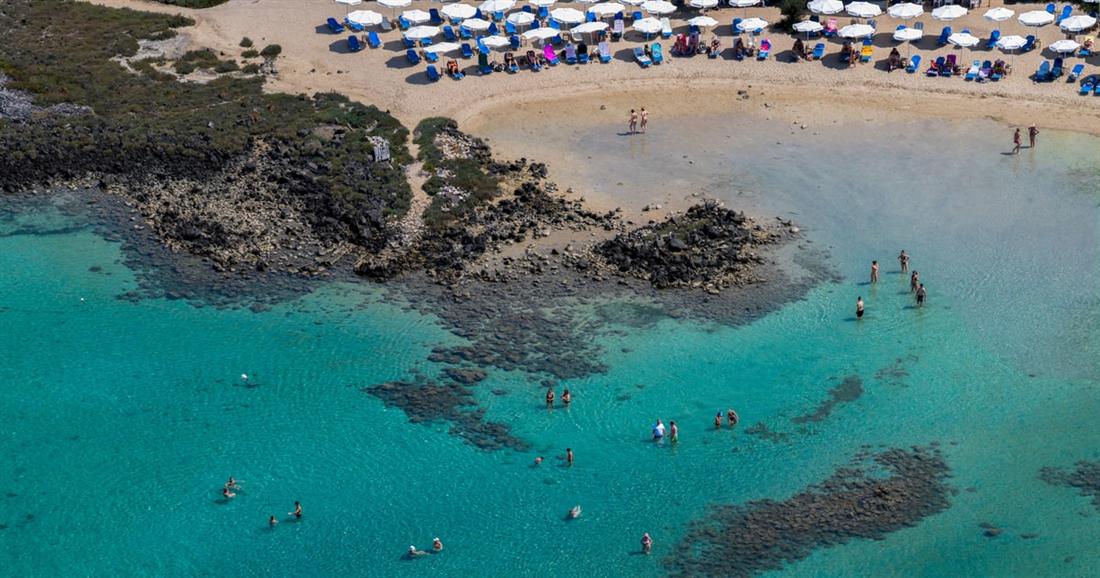
On a Lichadonisia boat trip, swimming is allowed only at the organised beaches. There are two in the group. Shallow rocks ring the smaller islets, and private boats rarely risk landing there.
The church of Agios Georgios, a short walk from the beach, still hosts weddings. Empty houses nearby recall the families who once lived on Monolia. They left because the islet has no drinking water or electricity.
On the Evia side, Kavos beach lies about 1 kilometre from Lichada village. Its shallow water faces the islets and suits a swim after the crossing. For a day away from the sea, try canyoning in Evia.
What is the shipwreck seen on a Lichadonisia boat trip?
The wreck seen on a Lichadonisia boat trip is the Pioneer I. It was a German ship built of concrete during the Second World War. It lies in shallow water west of Monolia and Mikro Lichadonisi.
Ships of this kind were built to supply occupied lands and German troops. The Pioneer I was sailing from Chalkida to Halkidiki, with a planned stop in Volos. It ran aground near the islets and sank, though other accounts say it was bombed.
The hull rests less than 10 metres down, so you see it from the boat without diving gear. Divers explore it with the diving centre in Agios Georgios. A Lichadonisia boat trip around the group also shows these sights:
- Mediterranean monk seals, a protected species living around the islets
- Dolphins swimming in the gulf between Evia and the mainland
- The 9-metre stone lighthouse on top of Megali Strongyli
- Ruins of a Byzantine monastery around the lighthouse
- The seabed seen through the glass bottom of Lichadonisia II
Where does a Lichadonisia boat trip leave from?
A Lichadonisia boat trip leaves from three ports. Kavos and Agios Georgios lie on Cape Lichada in Evia. Kamena Vourla sits on the mainland opposite. The crossing lasts from 5 to 30 minutes, depending on the port.
From Kavos, on Lichada beach, the boats Lichadonisia II and IV run every half hour. They sail from 10am to 6.30pm and reach Monolia in 5 to 10 minutes. Agios Georgios, a fishing harbour 3 kilometres away, also sends boats across.
One Lichadonisia boat trip from Agios Georgios leaves at 9am and lands on Monolia at 9.45am. A coach collects guests from Pefki, Istiaia, Orei, Neos Pirgos and Loutra Edipsou. Guests staying on in north Evia add wine tasting in Evia.
On the mainland, the boats Lichadonisia III and V leave the Kamena Vourla marina. The crossing takes 25 to 30 minutes, with a 40-minute tour of the wreck on one boat. Further south, the Eretria boat cruise explores another Evia coast.
What does the day trip from Athens add to a Lichadonisia boat trip?
The Athens day trip adds a coach ride and Kamena Vourla to a Lichadonisia boat trip. The coach leaves Larissis Station at 8am. The full day lasts about 13 hours, with 5 to 6 hours on the islet.
Check-in at Larissis Station opens at 7.45am. The air-conditioned coach has free Wi-Fi and USB sockets. After a 2-hour drive, it reaches Kamena Vourla shortly after 10am.
From the drop-off point, a 10-minute walk leads to the marina. The local boat leaves by 10.45am for a 30-minute crossing of the North Euboean Gulf. This Lichadonisia boat trip lands guests on the beach for swimming and snorkelling.
At 13 hours, this is one of the longer day trips from Athens. The driver speaks English and Greek. The return time depends on the option booked:
- Spa option: the boat leaves the islet at about 3pm, before a thermal pool visit
- Beach option: the boat leaves at about 6pm, with no spa access
- Kamena Vourla: free time for a walk, shopping or a seaside dinner
- Coach back: leaves from outside Restaurant Camino at 8pm
- Arrival: Larissis Station in Athens at about 10.30pm
Who suits a Lichadonisia boat trip?
A Lichadonisia boat trip suits families, relaxed swimmers and snorkellers who want sand and calm water. The Athens day trip has infant seats and suits all fitness levels. It is not wheelchair accessible, and it is not advised for people with poor heart health.
On a Lichadonisia boat trip, families with young children like the beach on Mikro Lichadonisi. Its water is very shallow near the shore. The Monolia bay is calm, and buoys mark the swimming area.
Strong, cold currents start beyond the rocks that close the Monolia bay. Swimming past the buoys is banned for this reason. Weak swimmers stay inside the marked zone.
The spa option on the Athens tour is for adults only. Children can still use the hotel’s regular pool with an adult. For island swims nearer Athens, see Aegina boat trips and Hydra boat trips. An Agistri boat trip is another choice close to Athens.
How long does a Lichadonisia boat trip last, and what is included?
The Athens Lichadonisia boat trip lasts 13 hours in total. It includes the coach, the boat ticket, a sunbed and umbrella, and two bottles of cold water. From Kavos, the local crossing alone takes five to ten minutes each way.
The coach ride takes two hours each way. On the Lichadonisia boat trip, each crossing from Kamena Vourla lasts about 30 minutes. The listing gives five to six hours of beach time on the islets.
- Return coach from Athens in a modern, air-conditioned vehicle
- Boat ticket from Kamena Vourla to Lichadonisia and back
- Sunbed and umbrella on the island
- Two bottles of cold water per guest
- The coach ride from Athens and back
Meals, snacks and dinner in Kamena Vourla are not included in the Lichadonisia boat trip. No guide stays with the group all day, so parts of the day are self-guided.
A second option adds a 20-minute session in the thermal pool of the Galini Mitsis spa resort. The spa entrance is a 10-minute walk from the boat dock.
When do Lichadonisia boat trips run, and what do you bring?
Each Lichadonisia boat trip runs in the warm season, from late spring to early October, depending on the weather. Pack sun cream, water and snacks. Monolia has a canteen and beach bar, but shade and toilets are limited.
The Athens coach checks in at 07:45 and leaves at 08:00. The boat from Kamena Vourla sails between 10:30 and 11:00. Local Kavos boats run every half hour from 10:00 to 18:30.
On a summer Lichadonisia boat trip, Monolia’s sunbeds fill up by midday. Weekends in July and August are the busiest. The volcanic, stony ground makes it hard to fix an umbrella.
- A beach umbrella or sunshade, as natural shade is scarce
- Sun cream and a hat
- Extra drinking water beyond the two bottles provided
- Snacks, or money for the canteen and beach bar
- A towel and dry clothes, as there are no showers or changing rooms
How do you book and cancel a Lichadonisia boat trip?
You book the Athens Lichadonisia boat trip online on GetYourGuide. The provider is Visit Meteora. Free cancellation applies up to 24 hours before the start for a full refund. Local boats sell a return ticket for the crossing itself.
The Lichadonisia boat trip listing offers two options. One covers the boat and beach day. The other adds the thermal spa pool. You can reserve a place now and pay later.
If you cancel less than 24 hours before the start, you get no refund. Changes made inside that last 24 hours are not accepted either.
The coach leaves from Deligianni Street, across from Larissis Station in Athens. The stop faces the Everest café. Look for the bus with the Visit logo on its side.
Frequently Asked Questions
Can you see monk seals on a Lichadonisia boat trip?
Mediterranean monk seals have become permanent residents around the islets in recent years. A small family of them can be seen from the Kavos boat during its tour. Dolphins also appear in the waters near the islets. Keep a calm distance from all wild animals.
Are the Evia boats different from the Kamena Vourla boats?
Yes. The boats on the Evia side are small and carry around 15 people. The Kamena Vourla boats are larger and carry bigger crowds. Glass-bottom boats also work the route, so passengers can watch the seabed during the crossing. A glass-bottom tour around the island takes about 20 minutes.
Can you dive near the Lichadonisia islets?
Yes. The rich sea life makes the islets a sought-after spot for divers. The Lichadonisia Diving Centre in Agios Georgios organises dive trips in the area. Snorkellers on a Lichadonisia boat trip also enjoy the shallow, sandy water around Monolia. Bring your own mask and fins for the swim stop.
Why is the largest islet called Monolia?
The name comes from the wild olive trees that cover the islet. The ruins of its old settlement, Steni, still stand there today.
Is there a church to see on a Lichadonisia boat trip?
Yes. Metres from Monolia beach stands the small church of Agios Georgios Lichadonisias. It is in good condition and still hosts weddings. A short path marked with white stones leads there from the beach bar. The walk takes under two minutes. A lighthouse also stands on the green top of Megali Strongyli.