
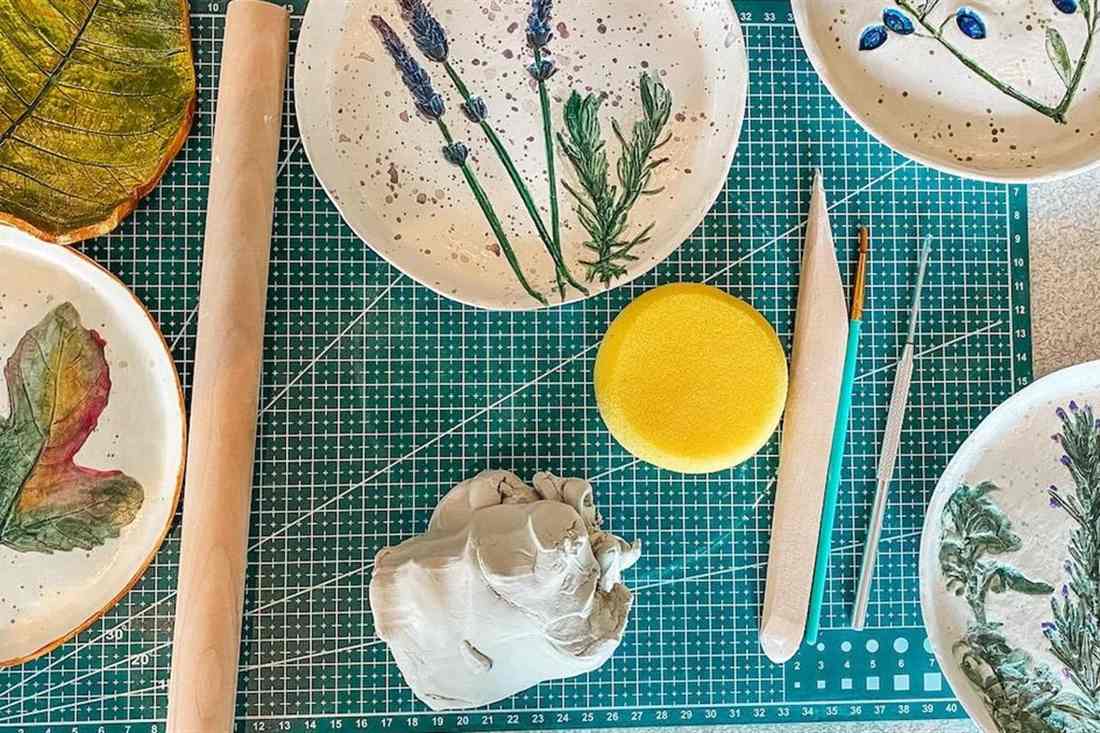
A Karpathos pottery class is a hands-on clay workshop on the Dodecanese island of Karpathos. Guests press leaves and herbs into soft clay to make plates and bowls in a vineyard above Pigadia. Tours across the rest of the country are listed on Greece Tours.
The sections below cover the workshops, the setting, botanical clay, the plants, the steps and the firing. They also cover who it suits, other creative workshops, inclusions, the season, getting there and booking, with links into the Karpathos pages. The class shown is checked on GetYourGuide.
What is a Karpathos pottery class?
A Karpathos pottery class is a short, hands-on clay workshop on the Greek island of Karpathos. The main one runs in a vineyard near Volada. You roll out clay, press local leaves into it and take home a plate.
Art and Walk Karpathos runs the class. Renate and Thom, two nature lovers, founded this local company after travelling the world. They also lead walks, hikes and farm tours on Karpathos, Kasos and the islet of Saria.
A Karpathos pottery class here is built for beginners. You need no earlier skill with clay, and no art training. The hosts teach in English, and the class is also offered in Dutch.
The result is a handmade souvenir shaped by island plants. A travel magazine described the session as guided but unhurried. It adds a slow, creative morning to the list of things to do on Karpathos.
Which Karpathos pottery classes can you book?
You can book one Karpathos pottery class format: the Botanical Clay Workshop by Art and Walk Karpathos. It takes place in Pini, a hamlet of Volada. GetYourGuide lists it as tour 918995, and the hosts sell it directly too.
The GetYourGuide title is “Karpathos: Botanical Clay Workshop & Pottery in a Vineyard.” The listing calls it beginner-friendly and asks you to try different leaves and plants for prints on clay. Its provider is Art and Walk Karpathos, the team that runs the vineyard.
- GetYourGuide tour 918995: the botanical clay class at the Art and Walk vineyard in Pini, Volada.
- Art and Walk website: the same Karpathos pottery class, booked directly with the hosts in Pini, Volada.
- Art and Walk home: a booking made in person at the vineyard in Pini, Volada.
- Tour operators: a booking through your holiday operator for the class in Pini, Volada.
- Karpathos Art Studio: the art brand of host Renate Mattsson, with art workshops based in Volada.
Renate Mattsson’s studio work covers paintings, mosaics, murals, clay and digital art. She also takes commissions for mosaics and paintings on wood, canvas or clay. Every online listing for a Karpathos pottery class leads back to this vineyard.
Where does a Karpathos pottery class take place?
A Karpathos pottery class takes place in the vineyard of Art and Walk at Pini, near Volada. Volada is a mountain village about 10 km northwest of Pigadia. It sits between the villages of Aperi and Othos.
Volada stands about 440 metres up and has around 240 residents. It is one of the inland Karpathos villages on the road to the west coast. Trails from the village climb to Kali Limni, the island’s highest point at 1,210 metres.
From the village, the view takes in the sea, Pigadia and Aperi. Pigadia, the island capital and main port, lies on the bay below the hills. Aperi is about 2.5 km away, and Othos about 1.5 km.
A Karpathos pottery class at Pini is a rural affair. Guests describe working among the vines with a wide view over the mountains. Volada lies in the southern half of the island, far from the northern village of Olympos.
What is botanical clay, and how does a Karpathos pottery class use it?
Botanical clay is clay marked with real plants. In a Karpathos pottery class, you press herbs, leaves or flowers into a soft clay slab. When you lift the plant away, its shape and veins stay printed in the clay.
The class uses air-dry clay, which hardens in the open air with no oven. It needs no firing, which means baking in a hot oven. The clay stays soft while you press in the plants.
A slab is a flat sheet of clay, rolled out like pastry. In a Karpathos pottery class, this slab becomes the base of a plate. This flat method needs no potter’s wheel, which is a spinning disc for shaping round pots.
Clay tools come with the session, along with acrylic paint for adding colour. Acrylic is a quick-drying paint that mixes with water. Each print keeps fine details, such as leaf veins and petal edges.
Which plants and leaves does a Karpathos pottery class use?
A Karpathos pottery class uses seasonal herbs, leaves and flowers picked around the studio. The hosts name no fixed list, because the choice changes with the season. Guests also pick flowers and herbs from the hosts’ garden.
Botanists have recorded 923 plant species on Karpathos, over 100 of them rare flowers. Nine grow only on Karpathos and the islet of Saria. Wild carnation, peony, iris and viola grow among the rarer flowers.
Low shrubs and herbs cover the island hills. Below are wild island plants with leaf shapes that suit a Karpathos pottery class. Their local Greek names are in brackets.
- Thyme (thymari): a low herb with tiny, oval leaves.
- Sage (faskomilo): a herb with soft, wide, wrinkled leaves.
- Oregano (rigani): a herb with small, rounded leaves.
- Rosemary (dendrolivano): a shrub with thin, needle-like leaves.
- Lavender (levandes): a shrub with narrow leaves and purple flower spikes.
- Caper (kapari): a trailing plant with round, fleshy leaves.
Guests gather herbs, leaves and flowers from around the vines and the garden. Each Karpathos pottery class therefore produces a plate tied to one season. No two plates come out the same.
What happens step by step in a Karpathos pottery class?
A Karpathos pottery class follows a simple order at the vineyard. You pick plants, roll out a clay slab, press the plants in and shape a plate. At the end, your plate goes into a box made for travel.
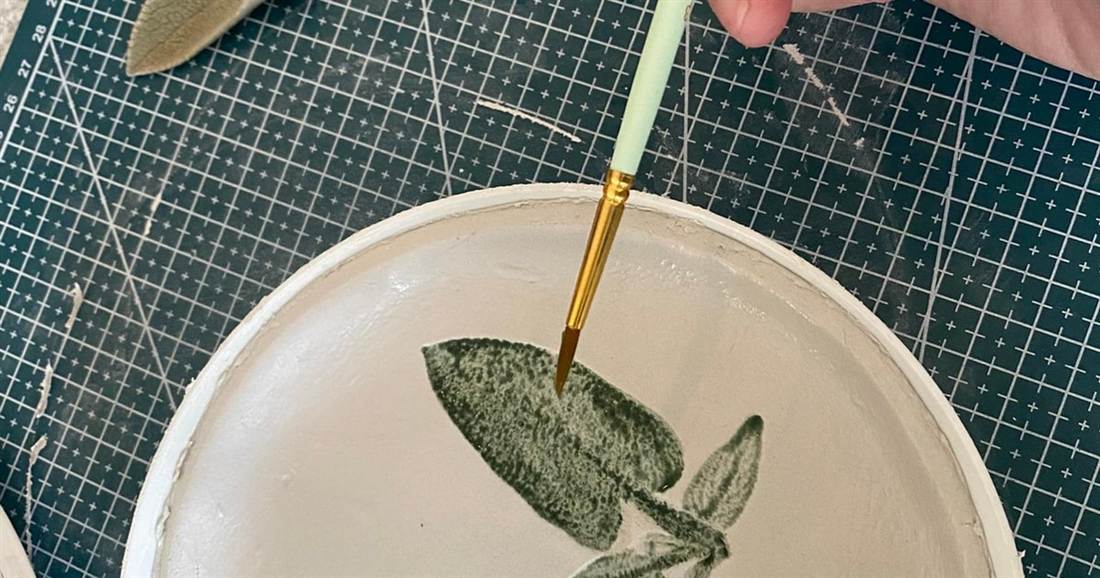
- Meet the teacher at the Art and Walk vineyard in Pini.
- Walk around the studio and pick seasonal herbs, leaves or flowers you like.
- Roll the air-dry clay into a flat slab.
- Plan your design and press each plant into the clay.
- Lift the plants away and shape the slab into a plate.
- Pack the finished plate in a box made for travel.
The teacher explains the method once everyone sits down. Guests name Renate as the guide for the clay work at the vineyard. Instructors speak English, and the pace stays slow and calm.
A plate is the standard piece in a Karpathos pottery class. The hosts say a bowl, a mug or a shape of your own also works. Guests report surprise at how easy the plate was to make.
Coffee or tea is served while you work at the table. Volada itself has traditional tavernas and cafés for after a Karpathos pottery class. Read about island dishes in the guide to Karpathos food.
How are the pieces dried, fired and taken home after a Karpathos pottery class?
The Art and Walk Karpathos pottery class uses air-dry clay. This clay hardens in open air, so no kiln is needed. A kiln is an oven that hardens clay with strong heat. Your finished plate leaves with you on the same day.
At the end of the morning, the host packs each plate in a box. The box is made to survive a trip in your luggage. The GetYourGuide listing of the Karpathos pottery class counts the finished piece as included.
Air-dry clay keeps hardening at home after the class ends. It does not turn as hard as kiln-fired pottery. Keep the plate dry and display it as a souvenir of Karpathos.
Who suits a Karpathos pottery class?
A Karpathos pottery class at Art and Walk suits complete beginners. No earlier experience with clay is needed. The minimum age is six, so families with young children can join. Groups stay small, and the hosts also arrange tailor-made group sessions.
- Beginners: the workshop is planned for first-time clay users.
- Children: the minimum age is six years.
- Families: the hosts describe their tours as family-friendly.
- Couples: a reviewer called the class great fun to share with a partner.
- Groups: the hosts take bookings for groups and tailor-made sessions.
The workshop sits on a vineyard plot on the road into the Lastos hills. Free parking lies by the road next to the property. Guests walk through a gate to reach the work area.
Listings for the Karpathos pottery class give no details on step-free access. The plants for printing grow around the garden studio, so guests walk outside to pick them.
Which other creative workshops sit beside a Karpathos pottery class?
Art and Walk runs mosaic, pebble mosaic and painting workshops beside its Karpathos pottery class. The mosaic workshops use the same vineyard in Pini, near Volada. A craft gallery in nearby Othos shows the local woodwork tradition.
- Mosaic workshop: tiles and glass go on a round wooden plate, then grout fills the gaps.
- Ancient Greek pebble mosaic: Renate teaches the old method with handpicked pebbles in a two-hour session.
- Painting workshop: the hosts run it on request.
- Mosaic retreat: a seven-day off-season mosaic holiday runs in November and December.
- Wood gallery in Othos: George Kostetsos carves vases and bowls from local olive and mulberry wood.
Pebble mosaics set in cement, which needs 24 hours to dry. You collect that piece the next day. Coffee, tea and water come with the pebble session.
Art and Walk also leads guided hikes such as the Lastos mountain hike and the Valley Walk of Pigadia. The hosts also run day trips to the nearby island of Kasos.
How long does a Karpathos pottery class last, and what is included?
The GetYourGuide Karpathos pottery class lasts 2.5 hours. The host’s own page lists the same workshop at 3 hours. Clay, tools, plants and teaching come in every booking. Each guest leaves with one finished botanical plate.
- An English-speaking instructor
- Air-dry clay for one slab plate
- Use of the clay equipment
- Seasonal herbs, flowers and leaves for printing
- Transport to and from the workshop (GetYourGuide booking)
- Food and drinks (GetYourGuide booking)
The host’s timetable sets aside three hours, from 09:30 to 12:30. Choosing plants, rolling the slab and pressing the leaves all fit inside that morning.
The printing plants are seasonal, so the leaves on offer change through the year. Guests pick them fresh around the studio on the day of the Karpathos pottery class.
When does a Karpathos pottery class run, and how do you get there?
The Karpathos pottery class runs every Wednesday morning. In July and August, a Monday class is added. The workshop starts at 10:00 at the vineyard in Pini. Guests booked with transfer meet at 09:30 in Pigadia.
The transfer meeting point is AutoTour on Pigadia’s main street, facing the Miramare Hotel. Guests based in Pigadia reach it on foot; compare bases in where to stay on Karpathos. Flights and ferries to the island are covered in how to get to Karpathos.
Drivers follow the road from Pigadia through Aperi, winding uphill for about 10 km to Volada. Keep driving towards Lastos, between Volada and Othos. The Art and Walk gate lies on the right, just past the water source.
The sister mosaic workshop runs from April to October. Weather by month is covered in when to visit Karpathos. Off-season visitors can ask the hosts for a workshop on another day.
How do you book and cancel a Karpathos pottery class?
You can book a Karpathos pottery class on GetYourGuide as tour 918995. Art and Walk also takes bookings on its website, by e-mail and at its Pini base. Cancelling four or more days ahead brings a full refund.
- Four days or more before: full refund.
- Between 48 and 96 hours before: half the price back.
- Under 48 hours before: no refund.
- No-show on the day: no refund.
These refund rules come from Art and Walk’s own terms. Tour operators can also reserve a Karpathos pottery class for their guests. The clay workshop can be booked with a transfer from Pigadia or without one.
Private tours and sessions follow stricter rules. The deposit is lost on any cancellation. Within six days of the date, the full price is charged.
Frequently Asked Questions
What do you need to bring to a Karpathos pottery class?
Bring cash and wear clothes you do not mind getting dirty. The GetYourGuide listing names both items for its Karpathos pottery class. Clay dust and slip mark fabric as you roll and press. Slip is clay thinned with water into a soft paste.
Which languages does the instructor speak?
The GetYourGuide Karpathos pottery class runs in English, Dutch and Spanish. Renate leads the creative workshops. She and Thom founded Art and Walk as two nature lovers who travelled the world. They then settled on Karpathos and now share its landscapes and culture with guests.
Can the host cancel a Karpathos pottery class?
Yes. The host can cancel when under five people sign up. Poor weather or other events beyond control also stop a session. In those cases, guests get a full refund or a new date. Anyone unable to attend the new date still receives the full amount back.
Can you change the date after booking?
Date changes need written notice at least 96 hours before the activity. Send the request to Art and Walk by e-mail. If the new date does not work, the hosts treat the request as a cancellation. The normal refund steps then apply to your Karpathos pottery class.
What else is near a Karpathos pottery class in Volada?
Volada has about 240 residents. Its Church of Panagia Plagia holds a feast on 8 September. Ruins of three castles stand above the village. Klimataria is the village tavern. Achata beach, one of the nearer Karpathos beaches, lies 8 km away.