
Karpathos sits in the open sea between Rhodes and Crete, and its isolation is the reason the island still feels unhurried. The second-largest of the Dodecanese runs 48 kilometres north to south, with a spine of mountains that climbs above 1,200 metres at Kali Limni. That geography shapes everything a visitor does here: sheltered coves on the east coast, a wind-battered surf bay in the south. A green belt of terraced villages across the middle. A single ridge road that links them to the medieval world of Olympos in the far north. Plan the whole trip with Greece Tours.
This guide ranks the experiences that define a trip. From the award-winning cove of Apella to the loom-and-windmill village of Olympos. It groups them by coast so you can build a realistic route. Alongside the sights it covers windsurfing at Afiartis, boat trips to the uninhabited islet of Saria, hikes on the old stone footpaths. The ancient and Byzantine sites, the summer festival calendar. Where to taste makarounes, the hand-rolled Karpathian pasta. Read it beside the wider Karpathos travel guide to plan ferries, dates and a base.
What are the top things to do in Karpathos?
The signature experiences are Olympos village, Apella beach, windsurfing at Afiartis, a Saria boat trip, and a walk through Pigadia. Together they cover mountain culture, swimming, water sport and history.
A first visit works best as a loop that touches each coast. The east side holds the postcard coves of Apella, Kyra Panagia and Achata, reached by a winding road above the sea and by the daily boat from the capital. The south around Amoopi and Afiartis has flat, sandy shallows and the steady meltemi wind that draws surfers from June to September. The centre keeps a ridge of terraced villages. The north belongs to Olympos and the port of Diafani. Two hours from Pigadia by road but far closer in feel to the nineteenth century.
Distances look small on a map yet the terrain slows every drive. Pigadia to Olympos covers roughly 55 kilometres of mountain switchbacks and takes about two hours behind the wheel. Most itineraries treat the north as a full day or an overnight. The paved ring only reaches the middle of the island. The far north is served by one high road and by the daily boat from Pigadia to Diafani. Which turns the journey into a scenic two-hour cruise past cliffs and empty inlets. A hire car or scooter is close to essential, since buses run only a handful of times a day.
Pair the headline sights with the quieter pleasures that give Karpathos its character. Sample dark red wine in the highland village of Othos, follow an old stone footpath between hamlets. Watch the sails cross the surf bay. Time dinner for a taverna in Pigadia where the day boat unloads its catch. The sixteen experiences below set out each in turn, with the practical detail you slot it into a week. Arranged so you can build days around a single coast rather than criss-crossing the island.
Why is Olympos village the must-see of Karpathos?
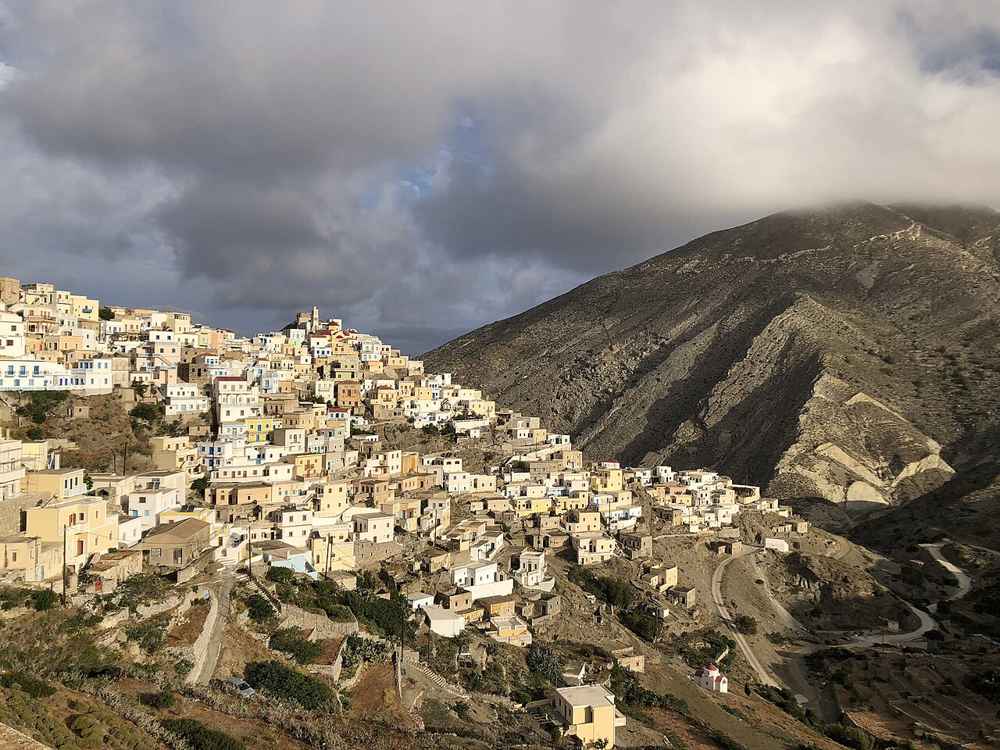
Olympos is a living medieval village where older women still wear embroidered dress and speak an archaic Doric dialect. Its stone houses, working windmills and cliff-edge setting make it the cultural heart of Karpathos.
Perched on the ridge of Profitis Ilias in the far north. Olympos was built inland and hidden from the sea to escape pirate raids. That seclusion preserved traditions lost elsewhere in Greece. The dialect spoken here retains sounds of ancient Doric Greek. Inheritance passes through the eldest daughter rather than the son. On feast days women dress in the full embroidered costume with a headscarf, an apron and gold jewellery. The effect is a village that reads as an open-air museum yet remains fully inhabited, with children in the school and bread in the ovens.
Walk the single stepped lane and you pass bakeries firing wood ovens. Weavers at floor looms turning out the striped cloth of the region. A restored windmill that still grinds grain for visitors. The church of the Dormition anchors the top of the village, its interior dense with frescoes and hanging silver lamps, and a carved wooden iconostasis. From the terraces the ground falls away to the sea a thousand metres below. With the port of Diafani a white smudge on the coast and the islet of Saria closing the horizon to the north.
Reach Olympos by the mountain road from Pigadia in about two hours. Or take the morning boat to Diafani and ride the connecting minibus up the last eight kilometres of hairpins. Arrive before the day-trip crowds around midday. Or stay overnight in one of the small guesthouses to see the village empty at dusk when the light turns gold on the stone. Either way, allow time for a plate of makarounes and a glass of local wine at a terrace taverna. Buy honey or a length of woven cloth before the light goes.
What are the best beaches to visit in Karpathos?
Apella and Kyra Panagia lead the east coast for turquoise water, while Diakoftis in the south has powder-white sand. Achata, Amoopi and Lefkos round out the choice for families and swimmers.
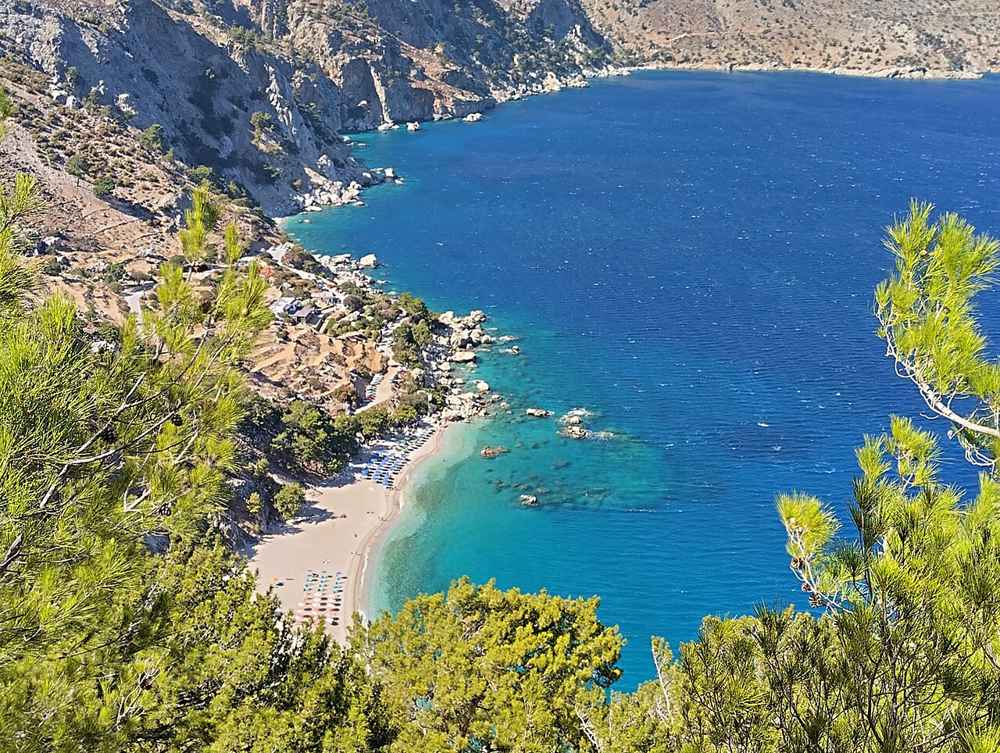
The east coast concentrates the famous coves. Apella lies at the foot of a pine-clad slope. Its white pebbles dropping into water so clear the seabed shows metres down. A taverna above the beach and a short stair down the cliff make it reachable but never crowded early. Kyra Panagia, kilometres south, pairs golden sand with a blue-domed chapel and two tavernas, and it is the most photographed strip on the island. Achata, the first cove north of Pigadia, adds a quiet pebble bay with a single taverna at the road’s end.
The south trades drama for space. Diakoftis, near the airport, spreads fine pale sand along a shallow lagoon that glows a Caribbean blue on a calm day, while Amoopi gathers a cluster of small sandy bays that suit families with young children and weak swimmers. On the west coast, Lefkos scatters three linked coves around a low headland. Sheltered enough to swim when the meltemi churns the other side of the island. The town beach of Vrondi runs three kilometres of sand right at Pigadia.
For a full rundown of every cove, the road access, the sand-versus-pebble split and which bay to pick on a windy day, see the dedicated guide to Karpathos beaches. Several of the eastern coves have no road at all and are reached only by the small boats that leave Pigadia each morning. A beach-hopping cruise is often the easiest way to string several together in one day and to reach the wilder inlets beyond the road’s end.
Where can you windsurf and kitesurf in Karpathos?
Afiartis bay in the south is the island’s wind capital, with three linked spots for every level. The reliable summer meltemi makes it one of the top windsurfing and kitesurfing destinations in the Mediterranean.
The south-eastern plain of Afiartis funnels the meltemi into steady force-five and force-six wind through July and August, and the bay is split into three areas that match rising skill. Gun Bay offers flat, shallow water and onshore wind that lets beginners water-start in safety. Devil’s Bay sits further out with stronger gusts and small swell for intermediates. And the open speed strip suits advanced riders chasing pace. Several centres line the shore with rental kit, board storage, wetsuits and lessons for every stage from first water-start to carving gybes.
Afiartis has hosted the Professional Windsurfers Association speed events, and the combination of dependable wind, warm water and a sandy bottom explains why riders return each summer. Boards, rigs and wetsuits rent by the day or the week, and kitesurfers use a separate zone to keep lines clear of the windsurf fleet. The season runs from May into October. With the strongest wind at the height of summer. The shallow entry means even a dropped rig drifts back to a standing depth rather than out to sea.
Even without a board the bay is worth the short drive from Pigadia to watch a hundred sails cross the water at once. Best seen from a beach bar with the airport runway just behind. The airport sits right beside Afiartis, so the wind that thrills surfers occasionally delays flights, a trade-off the island accepts. Non-riders can combine a morning at the flat southern beaches of Diakoftis or Amoopi with an afternoon of watching the speed strip. Then cross to a calmer coast when the wind eases at dusk.
What is there to do in Pigadia, the capital of Karpathos?
Pigadia is the island’s port and main town, with a curving waterfront of tavernas, a long town beach at Vrondi, and the ruins of an early Christian basilica. It is the base for boats, buses and evening strolls.
The town wraps around a natural harbour on the south-east coast, and its life runs along the seafront promenade where fishing boats, ferries and the day cruisers all tie up. Cafes and tavernas fill the quay, the daily catch comes ashore in the late afternoon, and the shops behind stock local thyme honey, herbs, woven cloth and barrel wine. Pigadia holds no grand monuments, and that plainness is its appeal: it works as a real Greek port rather than a resort. And it stays lively into the night without ever feeling packed.
North of the centre the sweep of Vrondi beach runs for nearly three kilometres of sand and shingle. Backed by tamarisk trees and easy to reach on foot from the harbour. Halfway along stand the low walls and mosaic floor of the sixth-century basilica of Agia Fotini, a reminder that this bay held a substantial early-Christian town. A short climb behind the harbour reaches the acropolis hill of ancient Potidaion. Where scattered blocks and a stretch of wall mark the classical settlement and the view opens over the whole gulf.
Use Pigadia as the hub for everything else on the island. The bus station and taxi rank sit near the harbour. Car-hire desks line the front. The ticket kiosks for the Saria and beach boats stand on the quay beside the ferry berth. The small archaeological collection gathers finds from the island’s ancient sites. Evenings settle into an easy rhythm of a waterfront dinner. An ice cream along the promenade, and a slow walk past the moored yachts as the harbour lights come on.
Which traditional villages you explore in Karpathos?
Beyond Olympos, the highland villages of Menetes, Aperi, Othos, Volada and Piles reward a slow drive. Each keeps its own church, dialect and vantage point over the terraced hills or the sea.
A ridge of old villages strings across the middle of the island above Pigadia, and a half-day loop links them on good roads. Menetes climbs a rock spur in tiers of white and ochre houses. With a folklore museum and a balcony church looking south to the airport plain, its lanes so steep they run as stairways. Aperi, the former capital, sits amid walnut and cypress in a green valley and shows off the grand mansions that returning emigrants built with money earned in America.
Othos crowns the highest inhabited point at around 500 metres and is known for its dark red wine. Poured young in the village tavernas. For a small house-museum that recreates a traditional Karpathian home with its loom, hearth and painted chests. Neighbouring Volada and Piles complete the loop, the latter tumbling down a west-facing slope toward the sunset over the sea, its gardens heavy with figs and pomegranates. Each village guards its own feast day, dialect quirks and recipes, a legacy of the isolation that once kept them apart.
Drive the loop in the late afternoon when the light softens the stone and the tavernas open for the evening. Park at the edge of each village, since the lanes are narrow and stepped, and walk in to find the platia where older residents gather under a plane tree. The villages sit only kilometres apart on a well-surfaced ring. An unhurried circuit with a wine stop in Othos and a dinner in Menetes or Aperi fills a single relaxed evening without a long drive.
How do you reach Apella and the east-coast coves?
Apella, Kyra Panagia and Achata sit below a cliff road north of Pigadia, each reached by a steep side lane and a short walk down. A morning boat from Pigadia is the easy alternative to driving.
The east-coast road climbs north out of Pigadia and hangs above the sea, with signed turn-offs peeling down to each cove. Achata comes first after about nine kilometres, a pebble bay with a single taverna at the road’s end. Kyra Panagia follows, its lane dropping past the blue-domed chapel to the sand. Apella lies furthest, where a car park above the pines feeds a stepped path down to the beach in five minutes. Each turn-off is signed from the main road, but the descents are sharp and the surface patchy.
The lanes are narrow, steep and often single-track. A small hire car or a scooter handles them better than a large vehicle. And you check the fuel and brakes before setting out. There are no fuel stations north of Pigadia until Spoa, so top up in town before you leave. Parking at each cove is limited to a rough gravel area that fills by late morning in high summer. Another argument for an early start. The walk back up the steps from Apella is steep in the midday heat.
The car-free option is the daily excursion boat that leaves Pigadia harbour around nine. Calling at the coves in turn and giving swimmers an hour or more at each before returning by late afternoon. This suits anyone nervous of the cliff lanes and turns the day into a cruise with lunch at a beach taverna. It reaches inlets that have no road at all. Tickets sell from the quayside kiosks and from the wider range of trips on the island’s boat and tour listings.
What day trips can you take from Karpathos?
The classic day trip is a boat to Saria, the wild islet off the north tip, with its Byzantine ruins and empty beaches. Diafani, Olympos and the neighbouring island of Kasos fill out the options.
Saria is separated from the northern cape by a narrow channel and has been uninhabited for generations, which is exactly its draw. Excursion boats from Diafani cross in twenty minutes to the sheltered bay of Palatia. Where the stone ruins of a Byzantine settlement stand behind a shingle beach and the water runs a deep, clear blue. Some trips add a stop at Papa Mina cove and time to snorkel over the seagrass meadows where monk seals occasionally shelter. A walk up to the ruined domes of the old village.
The port of Diafani itself makes a rewarding half-day. The morning boat from Pigadia lands you at the quiet northern harbour in about two hours. Leaving time for a swim off its own beaches, a seafood lunch on the quay and the minibus up to Olympos before the afternoon return. Walkers use Diafani as the trailhead for the old signed footpath that climbs through pine and terraces to Olympos in roughly two and a half hours. One of the finest walks in the Dodecanese.
The small island of Kasos lies half an hour south by ferry and offers a glimpse of an even quieter Dodecanese. With a working fishing harbour, a sea cave at Selai and empty beaches. Larger neighbours are a longer hop: fast ferries link Karpathos with Rhodes to the north-east and with Crete to the west, though both work better as onward legs of a wider island route than as single-day returns given the sailing times.
Where can you hike in Karpathos?
Karpathos keeps a network of old stone footpaths, and the finest is the Diafani-to-Olympos trail in the north. Routes also climb Kali Limni, the island’s summit, and cross the terraces around Aperi and Avlona.
A web of paved mule paths linked every settlement, and several are now cleared and waymarked for walkers. The classic is the route from the port of Diafani up to Olympos, about seven kilometres through pine woods. Terraced fields and past ruined chapels, climbing steadily for two and a half hours to arrive at the village from below. Many walkers ride the boat to Diafani, hike up, and take the minibus back down, turning it into a half-day on foot.
For height, the path to Kali Limni rewards the effort with the widest view on the island. At 1,215 metres it is the highest peak in the Dodecanese outside Rhodes. The trail from Volada or Menetes climbs through holm oak and open ridge to a summit chapel that looks across both coasts at once. Spring brings wildflowers and endemic plants to the northern slopes, drawing botanists to the area around Avlona, a farming hamlet north of Olympos that empties out of season.
Shorter walks suit a half-day between beaches. A path climbs from Pigadia to the acropolis and the coastal chapels. Gentle circuits cross the walnut terraces around Aperi. The northern trail from Olympos leads out to the ancient tombs of Vroukounta above the sea. Carry water, a hat and sturdy shoes, since shade is scarce and the sun fierce by midday. Start early in summer to finish the climb before the heat builds on the exposed rock.
What water sports can you try in Karpathos besides windsurfing?
Karpathos offers diving and snorkelling in its clear coves, sea-kayaking and stand-up paddleboarding on calm bays, and boat rental for reaching hidden beaches. The clarity and marine life reward anyone who takes to the water.
The water around Karpathos runs exceptionally clear, and diving centres in Pigadia and Amoopi run trips to reefs, caves and shallow wrecks along the south and east coasts. Beginners take introductory dives in the sheltered bays, while certified divers explore drop-offs and the underwater rock formations near the southern capes, where visibility often exceeds thirty metres. The same clarity makes snorkelling rewarding straight off the rocky edges of coves like Apella and Achata, where fish shelter among the boulders.
For calmer sport, sea-kayaks and stand-up paddleboards rent by the hour at the organised southern beaches and at Lefkos on the west coast. Best used in the morning before the wind builds. Paddling along the coast reaches small pebble inlets that have no road, and the flat water inside the bay at Amoopi suits first-timers and children. Some operators run guided kayak tours that trace the shoreline to a swim stop and a sea cave.
Renting a small motorboat, which needs no licence for the lowest-powered class, opens up the coast on your own schedule and reaches coves the excursion boats skip. Fishing trips leave Pigadia for a morning on the water with local skippers, and the harbour cruisers combine beaches with lunch and snorkelling gear. Whatever the craft, the warm, calm mornings of June and September are the easiest conditions on the water, before the meltemi builds through the afternoons of high summer.
What ancient and historical sites can you visit in Karpathos?
Karpathos holds the acropolis of ancient Potidaion at Pigadia, the rock-cut tombs of Vroukounta in the north, early-Christian basilicas at Vrondi and Arkasa, and a small archaeological museum. Its history stretches from Minoan times through Byzantium.
The island was settled from the Bronze Age. Four ancient cities are named in the classical sources: Potidaion at modern Pigadia. Arkesia at Arkasa, Vrykous in the north near Vroukounta, and Nisyros on Saria. Above Pigadia the acropolis hill keeps stretches of wall and scattered blocks from Potidaion, a short climb from the harbour that pairs a modest ruin with a wide view. The small archaeological collection in town gathers pottery, inscriptions and statuary found across these sites.
The far north holds the most atmospheric ruins. Vroukounta, reached on foot from Avlona, spreads rock-cut chamber tombs along a headland above the sea. With a cave-church of Agios Ioannis hollowed into the cliff that fills for its August festival. On the uninhabited islet of Saria, the ruins at Palatia mark the Byzantine village of Nisyros, its domed houses still standing behind the beach where the excursion boats land.
Early Christianity left clear traces too. The sixth-century basilica of Agia Fotini on Vrondi beach preserves a mosaic floor beside the sand. At Arkasa on the west coast the low cape of Paleokastro holds the mosaics and walls of the basilica of Agia Anastasia above ancient Arkesia. These sites are open, unfenced and free, so a morning of history slots easily between beaches, needing only a little care on the rough ground.
When do the village festivals happen in Karpathos?
The great festivals fall in summer, peaking around the Dormition on the fifteenth of August when Olympos fills with islanders in full costume. Saints’ days from June to September bring lyra music, dancing and feasting to the villages.
A panigiri is a village feast held on a saint’s day, and Karpathos keeps the tradition at full strength. The calendar runs through the summer: Agios Ioannis at Vroukounta in late August draws a pilgrimage to the cliff cave-church. Diafani and the coastal villages hold their own days. The highland villages each mark their patron saint with an all-night celebration. Music comes from the lyra and laouto, dancing follows the slow local syrto, and tables fill with goat, makarounes and barrel wine.
The peak is the Dormition of the Virgin on the fifteenth of August, when returning emigrants pack the island and Olympos in particular becomes a sea of embroidered costume, gold jewellery and traditional song that lasts past dawn. Booking a bed anywhere near that date is difficult, so plan well ahead if you want to witness it, and expect the ferries and flights to run full. The celebration is genuine rather than staged, a family homecoming as much as a spectacle.
Even outside the great feasts, weddings and baptisms in the villages spill into public celebration, and visitors are welcomed to watch and often to join the dancing. Easter brings its own solemn processions and midnight liturgies. If your dates fall on a saint’s day, ask at your guesthouse which village is celebrating. Go: a panigiri is the surest way to see Karpathian culture as the islanders live it rather than as a performance for tourists.
Where can you watch the sunset in Karpathos?
The west coast and the west-facing villages own the sunset. Lefkos, the hill village of Piles and the tavernas of Othos look straight out over the sea as the sun drops, while Olympos catches a high, wide evening light.
The best evening light is found by crossing to the other side of the island. Lefkos, on the sheltered west coast, lines its coves with tavernas that look straight out over the water. Dinner there times naturally to the sun sinking behind the offshore islets. The calm western bays hold their colour long after the eastern shore has fallen into shadow. A meltemi day that spoils the east often ends in a perfect western sunset.
In the hills, the village of Piles tumbles down a west-facing slope and its terrace cafes frame the sea below, a short drive from Pigadia on the village loop. Othos, the highest village, catches the light from above and pairs it with its own dark red wine poured straight from the barrel, while the balconies of Menetes look south and west across the airport plain to the sea. Any of the three turns the evening village circuit into a sunset outing.
For height and drama, the terraces of Olympos hang a thousand metres above the north coast and take a long. Golden evening light that flares off the whitewashed houses and the old windmills on the ridge. Staying overnight in the village is the way to see it, since the day-trippers leave by late afternoon and the sunset belongs to the handful who remain. Bring a jacket, as the ridge cools quickly once the sun is down.
Where can you eat traditional Karpathian food?
The signature dish is makarounes, hand-rolled pasta with fried onion and local sitaka cheese, served in village tavernas. Pigadia’s waterfront handles fresh fish, while Olympos and Othos keep the mountain recipes and barrel wine.
Karpathian cooking grew out of a self-sufficient mountain economy, so it leans on grain, goat, cheese and herbs rather than the seafood of the ports. Makarounes head every menu: short twists of pasta rolled by hand, boiled, and topped with sweet fried onion and sitaka, a soft sour cheese made from goat’s milk. Alongside come byzantine-era dishes such as artolakano bread baked in a wood oven, goat slow-cooked with rice, wild-greens pies, and honey-soaked sesame sweets for a festival table.
For fish, eat on the Pigadia quay where the boats land. Ask what came in that morning. Grilled bream. Octopus dried on the harbour rails, and shrimp saganaki are the safe orders. In the highland villages the tavernas of Othos and Menetes pour their own red wine straight from the barrel, a dark. Dry pour that partners the goat dishes and rarely leaves the island. Many of the same tavernas make their own cheese and bread on the premises.
Save one dinner for a terrace in Olympos, where the wood ovens still bake bread and the makarounes arrive with a view over the north coast. Honey, thyme and oregano from the mountains fill the village shops, and a jar of Karpathian thyme honey travels home well alongside a bottle of the barrel wine. Prices stay modest by Greek-island standards, a reflection of how little the island trades on tourism and how much it still feeds itself.
What you buy in Karpathos?
The island’s best buys are thyme honey, barrel wine from Othos, hand-woven cloth from Olympos, and herbs like wild oregano and thyme. These carry the mountain economy home better than any souvenir.
Karpathos still makes much of what it sells, so the shopping is genuinely local. Thyme and wildflower honey from the mountain slopes is dense and aromatic, sold in village shops and at roadside stalls, and it travels home sealed without trouble. The dark red wine of Othos, pressed from vines on the highland terraces. Fills reused bottles straight from the barrel. A stop at a village taverna is often the easiest place to buy a bottle to take away.
Olympos is the place for weaving. The women of the village still work floor looms. Their striped cloth, table runners, bags and the trimmings of the traditional costume sell from small shops along the single lane. The embroidery and the bright woven bands are unlike anything made elsewhere in Greece. A direct link to the costume you see worn on feast days. Buying from the makers keeps the craft alive.
Fill the rest of a bag with the mountain pantry: wild oregano and thyme cut on the slopes. Dried herbs and herbal teas, sitaka cheese where it can be carried. The sesame-and-honey sweets sold in Pigadia. The town’s waterfront shops gather all of it in one place if you leave buying to the end. The villages sell it fresher and cheaper. And meeting the maker is half the pleasure of the purchase.
How days do you need in Karpathos?
Five to seven days let you cover both coasts, the north and the villages without rushing. A short three-day stay covers Pigadia, the east-coast beaches and one trip to Olympos.
The island’s size and slow roads make it a poor fit for a hurried stop. A three-day minimum handles the essentials: a day on the east-coast coves by boat or car. A full day north to Diafani and Olympos. A third split between Pigadia and the southern beaches at Amoopi or Diakoftis. That leaves the windsurf bay, the village loop, the hikes and the Saria trip for a return, so treat three days as a taste rather than the full island.
A week is the sweet spot. It absorbs a weather day when the meltemi shuts the exposed coast, adds the Saria boat trip. A village wine circuit and a mountain walk. Leaves room for an unplanned afternoon on a favourite beach. Walkers add a day for the Diafani-to-Olympos path. Surfers often base the whole stay near Afiartis and treat the rest of the island as day trips from the south.
Getting to Karpathos eats into a short break, since the island lies far out in the Aegean. Flights connect through Athens or Rhodes to the small southern airport, while the direct ferry from Piraeus runs long overnight legs of fourteen hours or more. Factor a travel day at each end. Plan the trip around the ferry and flight schedule rather than assuming daily links, especially outside the peak weeks when services thin out.
Frequently Asked Questions
Is Karpathos worth visiting?
Karpathos rewards travellers who want an authentic, uncommercial Greek island with dramatic scenery. It offers award-winning beaches, the living medieval village of Olympos, world-class windsurfing and genuine mountain culture, all with far fewer crowds than Rhodes or Santorini. The trade-off is the effort of reaching it and the need for a hire car to explore. For travellers who value scenery, tradition and quiet over nightlife and easy access. It ranks among the most rewarding islands in the Aegean. It repays the extra day of travel each way.
How do you get around Karpathos?
A hire car or scooter is close to essential, since the beaches and villages spread across a large. Mountainous island and buses run only a handful of times a day between Pigadia and the main villages. The east-coast coves are reached by narrow cliff lanes or by the daily boat from Pigadia, and the far north is linked by one high road and the Diafani ferry.
What is Karpathos famous for?
Karpathos is famous for the traditional village of Olympos, where older women still wear embroidered dress and speak an archaic dialect. For the beach of Apella. For the windsurfing bay of Afiartis. It is also known for its hand-rolled makarounes pasta, its isolation between Rhodes and Crete, and its strong living folk culture.
When is the best time to visit Karpathos?
Late May, June and September bring warm, calm weather and thinner crowds, making them the ideal months for beaches and sightseeing. July and August are hottest and busiest, and the meltemi wind blows strongest then, which delights windsurfers but can churn the exposed coast. The island quiets sharply from late October as ferries and flights thin out.
Can you do a day trip to Saria island?
Yes. Excursion boats run from Diafani in the north across a narrow channel to Saria, an uninhabited islet with Byzantine ruins at Palatia, empty beaches and clear water for snorkelling. The crossing takes about twenty minutes, and trips usually combine a swim stop with a walk to the ruins before returning in the afternoon.
Is Karpathos good for families?
Karpathos suits families who want beaches and nature over resort entertainment. The shallow, sandy bays at Amoopi and Diakoftis in the south are calm and safe for young children, and boat trips, village festivals and easy walks fill the days. The main considerations are the winding roads, the need for a car, and the long journey to reach the island. Older children take readily to the windsurf lessons at Afiartis and the snorkelling off the rocky coves. The Saria boat trip turns a beach day into a small adventure that keeps teenagers engaged.