
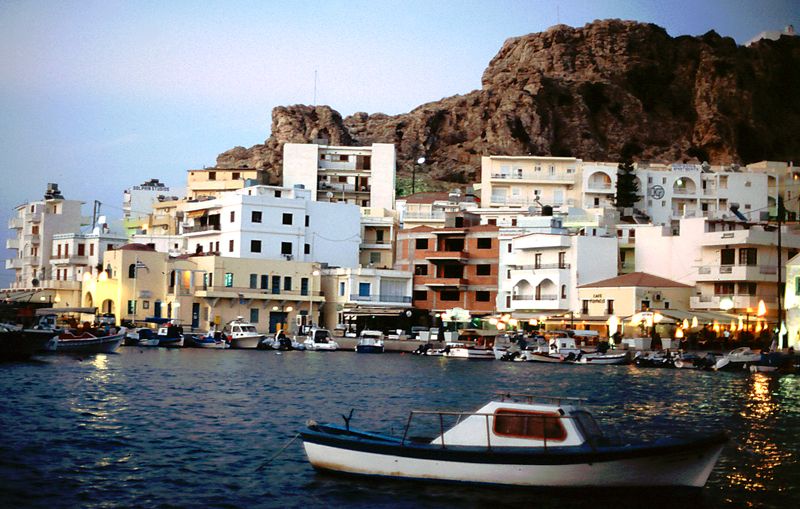
Pigadia is the capital and main port of Karpathos, a working Greek harbour town set against rugged hills on the south-east coast. Built on the site of the ancient city of Poseidion, it is where the ferries dock, the excursion boats leave, and most visitors are based. It holds no grand monuments, and that plainness is its charm: Pigadia is a real port that gets on with island life rather than a polished resort. Plan the whole trip with Greece Tours.
This guide covers what Pigadia offers: the harbour promenade and its tavernas, the long town beach of Vrondi. The ancient acropolis and the early-Christian basilica, the boat trips that leave from the quay. Where to eat, stay and catch onward transport. Read it beside the wider guide to things to do in Karpathos to see how the capital fits into a trip.
What is Pigadia in Karpathos?
Pigadia is the capital, main town and principal port of Karpathos, on the south-east coast. Built on the ancient site of Poseidion, it is the island’s hub for ferries, boat trips, restaurants, shops and services.
Pigadia wraps around a natural harbour on the south-east coast, backed by rugged hills, and it is the beating heart of the island. As the capital it holds the bulk of the shops, restaurants and services. As the main port it is where the long-distance ferries tie up and the excursion boats depart. For most visitors it is both the point of arrival and the base from which the rest of Karpathos is explored.
The town is built on the same site as the ancient city of Poseidion, later called Potidaion, and traces of that long history survive on the hill above the harbour. Today it is a bustling but unpretentious place, its life running along the seafront where fishing boats, ferries and day cruisers all share the quay. Its narrow back streets lined with shops selling local honey, herbs, barrel wine and woven cloth from the mountain villages.
Pigadia’s appeal lies precisely in being a genuine working town rather than a manufactured resort. It has enough life, choice and convenience to serve as a comfortable base. It keeps the feel of a real Greek port, busy in the evenings without ever being packed. The sections below cover what there is to see and do, and how to use the town as a hub for the island.
What is there to do in Pigadia?
In Pigadia you can stroll the harbour promenade and its tavernas, explore the pedestrian streets and shops, visit the church of Panagia Evangelistria, and walk to the chapel of Agios Nikolaos at the edge of town.
The heart of a visit is the seafront. The harbour promenade curves around the bay, lined with cafes, tavernas and bars. It is where the town gathers for the evening stroll. The volta, as the fishing boats unload and the light softens over the water. Behind it, the pedestrian streets and narrow alleys hold souvenir shops, bakeries and stores selling local produce, easy to explore on foot in an hour or two.
The town’s main church, Panagia Evangelistria, is worth stepping into. A walk to the far end of the seafront reaches the small chapel of Agios Nikolaos. Set on the coast with views back over the harbour. Neither is grand, but both are part of the fabric of the town, and the walk out to Agios Nikolaos strings together the promenade. The marina and the start of the town beach in a single easy stroll.
Beyond the sightseeing, Pigadia is a place to slow down. The pleasure of the town is an unhurried rhythm of a coffee on the quay. A swim off the town beach, a browse through the shops and a long waterfront dinner. It works as a relaxed base rather than a checklist of monuments, and its convenience is its main attraction. In the evenings the promenade fills with families out for the volta and diners settling in along the quay. The town keeps a lively but easygoing atmosphere well into the night without ever feeling crowded.
What is Pigadia beach, Vrondi, like?
Vrondi is the long town beach of Pigadia, a sweep of golden sand and shingle running about three kilometres along the bay. It is organised with sunbeds, beach bars and watersports, and shelves gently for easy swimming.
Just north of the town centre, the beach of Vrondi stretches for roughly three kilometres along the bay, an easy walk from the harbour. It is the capital’s main beach, a broad band of fine golden sand and shingle backed by tamarisk trees. It shelves gently into clear water. Making it safe and comfortable for swimming and for families. Being within walking distance of the town, it is the beach most visitors to Pigadia use daily.
The beach is well organised along much of its length, with sunbeds and umbrellas for hire. Beach bars and tavernas behind the sand. Space to spread out even in high summer. Its size and exposure make it popular for watersports too, with windsurfing and parasailing among the activities on offer when the wind allows, though the town end stays calm and easy for a simple swim.
Halfway along Vrondi stand the low walls and mosaic floor of the sixth-century basilica of Agia Fotini, a reminder that this bay held a substantial early-Christian town. The combination of a long sandy beach. Facilities within reach and a scrap of ancient history on the sand makes Vrondi an unusually convenient town beach. One of the reasons Pigadia works so well as a base.
What historical sites are in Pigadia?
Above Pigadia stand the acropolis of ancient Poseidion, with stretches of cyclopean wall, and on the shore the early-Christian basilica of Agia Fotini on Vrondi beach. A small archaeological collection gathers finds from across the island.
The hill behind the harbour carries the remains of the ancient acropolis of Poseidion, the classical settlement on which the modern town is built. Parts of the fortified walls, including sections of massive cyclopean masonry. Survive on the summit. The short climb rewards you with a wide view over the whole gulf and the town below. It is a modest ruin, but an atmospheric one, and it roots the town in a long past.
On the shore, the basilica of Agia Fotini sits halfway along Vrondi beach. Its low walls and mosaic floor dating to the sixth century and marking a substantial early-Christian community that once occupied the bay. Open and unfenced beside the sand, it is easily combined with a beach day, needing only a little care on the fragile ground.
For a fuller sense of the island’s past, the small archaeological collection in the town gathers pottery. Inscriptions and finds from sites across Karpathos, from the ancient cities to the Byzantine settlements of the north. Together with the acropolis and the basilica, it gives Pigadia enough history to fill a morning between swims. A reminder that this quiet port has been inhabited for thousands of years. The setting on a natural harbour that drew ancient settlers is the same one that makes the town so pleasant today. With the ruins, the beach and the seafront all within an easy walk of one another.
Where can you eat in Pigadia?
Pigadia’s harbour front is lined with tavernas serving fresh seafood landed at the quay, alongside traditional Karpathian dishes like makarounes. The town has the widest choice of restaurants, cafes and bars on the island.
The seafront is the place to eat. Tavernas line the harbour and the promenade. Because the fishing boats land their catch here, seafood is the natural order: grilled fish, octopus, calamari and the small, sweet local shrimp. Ask what came in that morning and eat it simply grilled, with a view over the moored boats and the bay, which is the classic Pigadia dinner.
Alongside the fish, the tavernas serve the island’s traditional cooking, headed by makarounes, the hand-rolled Karpathian pasta with fried onion and local cheese. Slow-cooked goat, wild-greens pies and other mountain dishes appear on the menus, and the town’s bakeries turn out fresh bread, cheese pies and honey sweets. The full range of the island’s food, covered in the guide to things to do in Karpathos, is easiest to sample in the capital.
Pigadia also has the widest choice of cafes and bars, from morning coffee on the quay to an evening drink by the harbour after dinner as the lights come on around the bay. The atmosphere stays relaxed and unpretentious in keeping with the town, and prices are modest by Greek-island standards, so eating well in Pigadia is both easy and good value. Many of the tavernas make their own bread and cheese. The barrel wine served with a meal often comes from the highland vineyards of Othos and the central villages. Giving even a simple dinner a genuine local character that reflects the produce of the island’s interior.
Can you take boat trips from Pigadia?
Yes. Pigadia is the main departure point for boat trips in Karpathos, with daily cruises from the inner harbour to the east-coast beaches and the uninhabited islet of Saria through the summer.
The inner part of the Pigadia harbour, next to the rocky hill, is where the excursion boats moor, and in summer several line up to offer daily trips. These cruise north along the east coast to beaches that no road reaches, such as Kato Lakos, Achata, Kyra Panagia and Apella. Giving swimmers time at each. Longer trips run up to the wild islet of Saria off the northern cape.
This makes Pigadia the natural base for exploring the island’s finest coastline by sea, much of which is inaccessible by car. Tickets are sold in an old-fashioned way, with the boat crews advertising the next day’s trips along the quay in the evening. The day out combines swimming. Snorkelling and often lunch on board or at a beach taverna.
For the full picture of the routes, the Saria excursion and what to expect, see the guide to Karpathos boat trips. Being able to step from the town onto a boat and reach hidden beaches for the day is one of the practical advantages of basing yourself in Pigadia over the quieter corners of the island.
What beaches are near Pigadia?
The town beach of Vrondi is within walking distance, while Amoopi, a cluster of sheltered sandy coves, lies about five to seven kilometres south. The east-coast coves are reached by boat from the harbour.
Closest of all is Vrondi, the long town beach a short walk north of the centre, which handles most day-to-day swimming for anyone based in Pigadia. For a change of scene, the beach resort of Amoopi lies kilometres south, a cluster of small. Sheltered sandy coves with calm, shallow water that suits families and swimmers, reached in a short drive or by bus.
The famous coves of the east coast, Apella, Kyra Panagia, Achata and the wilder inlets beyond, are north of the town. Reached either by the winding cliff road or, more easily and without the steep lanes, by the daily boats that leave the harbour each morning. This gives Pigadia access to both the convenient town beach and the island’s most celebrated coves, all from a single base.
For the full rundown of the coves, which are sand or pebble, which are organised and which are wild, and how to reach each, see the guide to Karpathos beaches. Being central and close to both Vrondi and the boat departures, Pigadia keeps the island’s beaches easier to reach than any other base.
Where you stay in Pigadia?
Pigadia offers the widest range of accommodation on the island, from simple rooms and studios to beachfront hotels along the Vrondi shore. Its central position makes it the best base for a first visit.
Accommodation in Pigadia spans the full range. From inexpensive rooms and self-catering studios in the town to more comfortable hotels along the seafront and the Vrondi beach shore, some with pools and sea-view balconies. This spread of choice, wider than anywhere else on the island, means the town suits most budgets and travel styles, from backpackers to families.
The town’s central position is its great advantage as a base. From Pigadia you can walk to the beach, step onto the boats. Catch the buses to the villages and pick up a hire car. It keeps the whole island within easy reach without long daily drives. For a first visit in particular, it is the most convenient and flexible place to stay.
For a comparison of Pigadia with the beach resorts, the quiet west coast and the traditional north, and advice on matching a base to your plans, see the guide to where to stay in Karpathos. Most visitors, especially first-timers and those planning to tour widely, find the capital the easiest and most practical choice.
How do you get to Pigadia and around?
Pigadia is the island’s main port, and the airport lies about fourteen kilometres south.
Pigadia is where the ferries from Piraeus, Rhodes and Crete arrive, tying up right in the town. The island’s airport sits about fourteen to sixteen kilometres to the south, roughly twenty minutes away by road. There is no reliable scheduled bus, so most travellers reach the town from the airport by taxi, a pre-booked transfer, or a hire car collected on arrival.
Within the town everything is walkable, from the harbour and the shops to the beach and the boat departures. For the rest of the island, the bus station and taxi rank sit near the harbour. Buses run times a day to the main villages, while car-hire desks line the seafront. The daily excursion boats reach the east-coast coves that the roads cannot.
For touring the island properly, a hire car or scooter is close to essential, since the buses are too infrequent to rely on. A stay focused on the town. Its beach and the boat trips can manage without one, using the buses for the occasional village outing. For the full picture of ferries, flights and transfers, see the guide to how to get to Karpathos.
Frequently Asked Questions
What is Pigadia in Karpathos?
Pigadia is the capital, main town and principal port of Karpathos, on the south-east coast of the island. Built on the site of the ancient city of Poseidion, it is where the ferries dock and the excursion boats depart. It holds the bulk of the island’s shops. Restaurants and services, which makes it the usual base for visitors to the island.
Is Pigadia a good place to stay in Karpathos?
Yes, especially for a first visit. Pigadia has the widest choice of accommodation, restaurants and services on the island. The long town beach of Vrondi within walking distance. The easiest access to buses, car hire and boat trips. Its central position keeps the whole island within reach, making it the most convenient and flexible base.
What is there to do in Pigadia?
In Pigadia you can stroll the harbour promenade and its tavernas, swim at the long town beach of Vrondi. Explore the pedestrian streets and shops. Visit the church of Panagia Evangelistria and the chapel of Agios Nikolaos. Above the town stand the ancient acropolis and cyclopean walls, and boat trips to the east-coast beaches and Saria leave from the harbour. It is also the island’s hub for buses, car hire and ferries, making it an easy base for exploring the rest of Karpathos.
Does Pigadia have a beach?
Yes. The long town beach of Vrondi runs about three kilometres along the bay just north of the centre, an easy walk from the harbour. It is a sweep of golden sand and shingle, organised with sunbeds and beach bars, shelving gently for easy swimming. With the ruins of the sixth-century basilica of Agia Fotini halfway along the sand.
How far is Pigadia from Karpathos airport?
Karpathos airport lies about fourteen to sixteen kilometres south of Pigadia, roughly a twenty-minute drive on a good road. There is no reliable scheduled bus between them, so most travellers reach the town by taxi, a pre-booked transfer, or a hire car collected at the airport on arrival.