
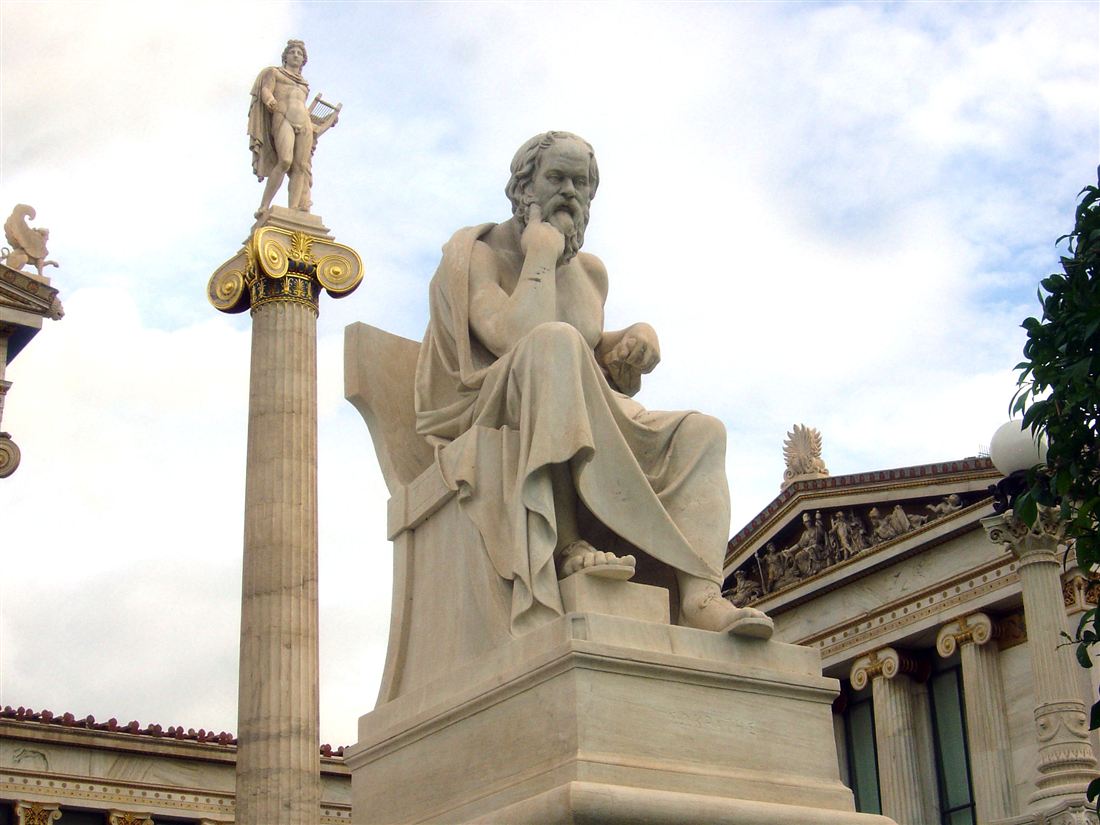
An Athens philosophy tour is a guided walk through the places where Socrates, Plato, Aristotle and the Stoics taught, from the Ancient Agora to Plato’s Academy, with the ideas explained at each stop. Tours across the rest of the country are listed on Greece Tours.
The sections below cover the tour formats, the sites on the route, the Ancient Agora, Plato’s Academy, Aristotle’s Lyceum, philosophy and democracy on the Pnyx, the Stoic evening, the Socrates challenge walk, who the tours suit and booking, with links into the Athens pages. The tours shown are checked on GetYourGuide and Viator.
What is an Athens philosophy tour?
An Athens philosophy tour is a guided walk that uses the city’s ancient streets, hills and ruins as the setting for Greek thought. A guide links Socrates, Plato, Aristotle and the Stoics to the exact places where they taught, argued and died.
Walks on an Athens philosophy tour run on foot and last between two and three and a half hours. Groups stay small, from six people on a Spanish-language walk to fifteen on a small-group tour. Guides are licensed local historians, philosophy graduates or working teachers. Admission to the Ancient Agora is charged separately on the tours that enter it.
An Athens philosophy tour also introduces Athenian democracy, because the same squares served both. The Pnyx held the citizens’ assembly, the Areopagus judged homicide cases, and the Agora was market, court and debating floor at once. A guide ties each argument to the building that hosted it, which makes abstract ideas easier to hold.
Which Athens philosophy tour formats can you book?
Five Athens philosophy tour formats are booked online: a philosophy and democracy walk, a Socrates challenge walk, a workshop at Plato’s Academy Park, a Stoic evening with wine, and a Spanish-language walk. Each lasts between one hundred minutes and three and a half hours.
The philosophy and democracy walk is the longest format on an Athens philosophy tour, at three and a half hours, and it runs in English. The Socrates challenge walk runs for two hours and is offered in English, Spanish, French and Italian. The Plato’s Academy Park workshop takes two hours in English or French, with a private option.
A sixth option for an Athens philosophy tour, the small-group philosophy and democracy tour, matches the three-hour format and caps the group at fifteen travellers. The Spanish-language version is the only Athens philosophy tour of its kind in the city, and it limits numbers to six, closing at a cafe or a tavern in Petralona.
- Philosophy and democracy walk: three and a half hours, English only.
- Socrates challenge walk: two hours, offered in four languages.
- Plato’s Academy Park workshop: two hours, private or shared.
- Stoic philosophy evening: one hundred minutes, seated indoors.
- Spanish-language philosophical walk: three hours, capped at six people.
Which sites does an Athens philosophy tour visit?
A full Athens philosophy tour covers the Ancient Agora, the Stoa Poikile, the Pnyx, the Areopagus, Kerameikos, Plato’s Academy and Aristotle’s Lyceum. Listings rarely combine all seven, so the route depends on the format you pick.
The three-hour walks on an Athens philosophy tour stay inside the archaeological core and pass the Ancient Agora, the Roman Agora, Hadrian’s Library, the Tower of the Winds and the Pnyx. The Spanish-language route begins at the gates of the Kerameikos cemetery on Melidoni Street, then climbs the Pnyx and crosses the Areopagus. The Plato’s Academy workshop stays north.
The Lyceum sits apart from the others. It lies east of the ancient city wall, on Rigillis Street beside the Athens War Museum, a short walk from the Greek Parliament. No standard Athens philosophy tour reaches it. Distances are short: the Pnyx is under a kilometre west of the Acropolis, and the Academy lies 1.5 kilometres north of the Dipylon Gate.
- Ancient Agora: flat ground beside the Panathenaic Way.
- Stoa Poikile: on the north side, across modern Hadrian Street.
- Pnyx: carved steps up to the assembly terrace.
- Areopagus: bare rock with a view down over the Agora.
- Kerameikos: riverside ground at the city’s north-west edge.
What does an Athens philosophy tour show at the Ancient Agora?
At the Ancient Agora, an Athens philosophy tour points out where Socrates questioned Athenians, the Stoa Poikile where Zeno taught, and the state prison where Socrates was executed. Guides tie each spot to a specific argument.
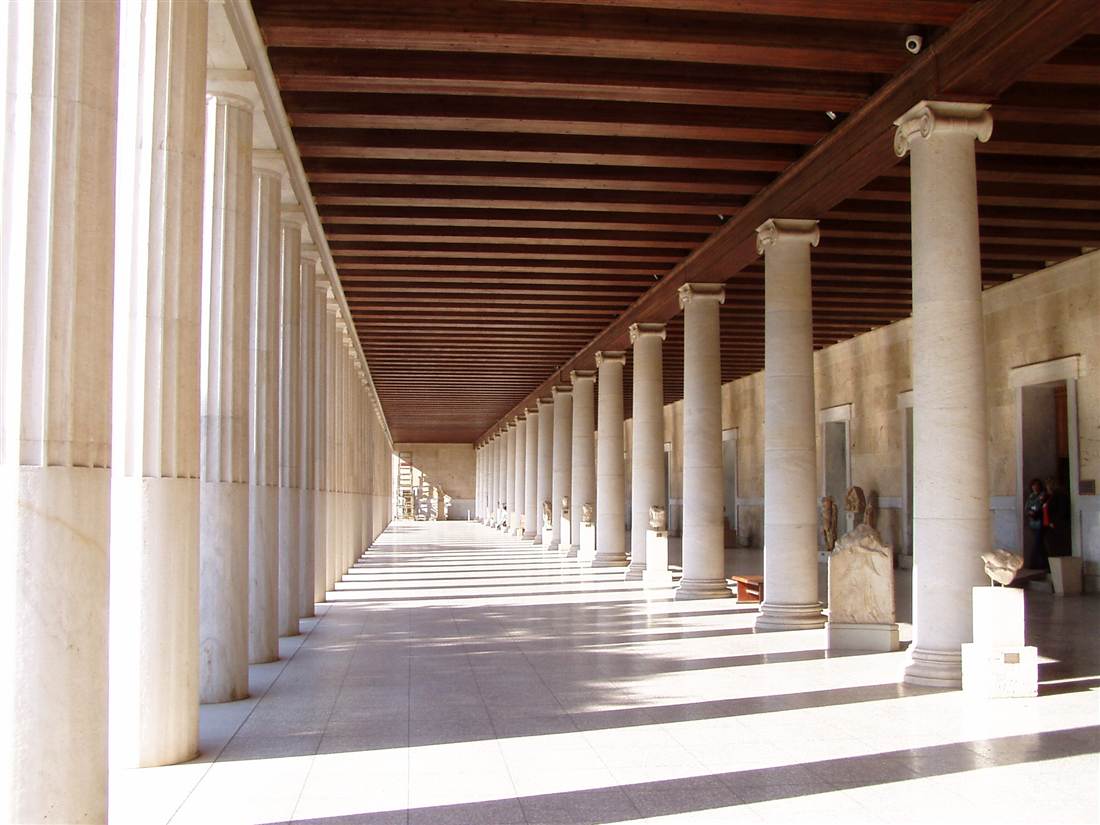
The Ancient Agora of Athens was the heart of the city, holding the market, the courts, the mint and the council chambers. Socrates met pupils by the house of Simon the cobbler, near a boundary stone that marked the edge of the square. Excavators identify a north-west building as the state prison where he was executed. An Athens philosophy tour starts there.
The Stoa Poikile, or Painted Portico, stood on the north side of the square, and it gives Stoicism its name on an Athens philosophy tour. It was built around 460 BC and hung with panel paintings, including a Battle of Marathon scene, plus bronze shields taken from Sparta. Zeno of Citium taught under its roof from about 300 BC until his death, and his followers took the name Stoics from the building.
Listeners sat on benches along the back wall while the philosopher walked up and down. Cynics and sophists used the same porch, and the comedian Theognetus joked about “trifling arguments from the Poikile Stoa”. An Athens philosophy tour closes the Agora stop here by setting Socratic questioning beside Stoic self-control.
- The boundary stone of the Agora, found near the house of Simon the cobbler.
- The Tholos, headquarters of the fifty prytaneis of the Boule.
- The Monument of the Eponymous Heroes and its ten bronze statues.
- The Stoa of Zeus Eleutherios, raised after the Persian wars.
- The Stoa of Attalos, rebuilt as the site museum.
What happens on the Plato’s Academy Athens philosophy tour?
The Plato’s Academy Athens philosophy tour is a two-hour workshop in the park at Akadimia Platonos. It opens with Plato’s Academy Digital Museum, walks the archaeological park, then runs dialogues on the Allegory of the Cave and closes with a short debate.
The Athens philosophy tour workshop is built around Plato’s Allegory of the Cave and uses Socratic questioning, the maieutic or midwife’s art, to draw answers out of the group. Participants gather facts about Plato in the digital museum at the park at Akadimia Platonos, then share them on the ruins of the ancient Gymnasium.
The session on this Athens philosophy tour ends with a debate game on a modern case study, judged by Plato’s view of how a philosopher acts. An optional extra hour adds Aristotle’s philosophy and a virtue-choice game. The digital museum opens Tuesday to Friday, from 10 am to 4 pm; on other days the visit is replaced by a discussion. Excavation work continues in the park, so on working days the ruins are viewed from a short distance. No prior reading is needed.
Which Athens philosophy tour stops at Aristotle’s Lyceum?
No standard Athens philosophy tour includes Aristotle’s Lyceum as a stop. The site lies east of the ancient city wall, on Rigillis Street by the Athens War Museum, away from the Agora route. A private tour or a separate visit covers it.
Aristotle’s Lyceum was a grove and gymnasium outside the Gate of Diochares, named after Apollo Lykeios, the god who guarded flocks from wolves. Aristotle founded his school there in 335 BC and taught for about twelve years. Rescue excavations on Rigillis Street uncovered the palaestra, a wrestling ground of fifty by forty-eight metres.
The foundations were laid in the second half of the fourth century BC, and the complex was repaired and used for around seven hundred years. Aristotle left Athens in 323 BC, and Sulla’s troops destroyed the school in 86 BC. The remains came to light during building work in the nineteen-nineties, and no Athens philosophy tour covers them without a private booking.
The site sits beside the Athens War Museum and the National Conservatory, a short walk from Evangelismos metro station, and the entrance is wheelchair accessible. Opening hours run from 8 am to 8 pm in summer and 8 am to 3 pm in winter. An Athens philosophy tour adds the Lyceum as a private extension.
How does an Athens philosophy tour connect philosophy and democracy?
An Athens philosophy tour joins the two through the Pnyx and the Areopagus. The Pnyx was the assembly hill where citizens voted; the Areopagus was the homicide court. Guides show how open debate and written law grew side by side.
The Pnyx assembly hill sits under a kilometre west of the Acropolis and forms the democracy half of an Athens philosophy tour. From 507 BC the Athenians met there as the ekklesia, and the presiding officer opened each debate with the words “Who wishes to speak to the Popular Assembly?” That invitation expressed isegoria, the equal right of every citizen to speak.
The terrace was rebuilt three times. In the third phase, finished around 326 BC, a retaining wall of large quarried blocks supported a new speakers’ platform, and two long stoas were begun to shelter the crowd in bad weather. Pericles and Demosthenes spoke from the bema, and the altar cutting above it honoured Zeus Agoraios.
The Areopagus, a bare outcrop north-west of the Acropolis, took its name from Ares and handled homicide, wounding and religious offences. Its members were former archons, and its power rose again in the fourth century BC. The Apostle Paul spoke there, and four late Roman houses on the slope are called the philosophical schools. An Athens philosophy tour pauses on the rock for that view.
- Isegoria: the equal right of every citizen to speak.
- Isonomia: equality of all citizens before the law.
- Isopoliteia: an equal vote and an equal chance to hold office.
- Apophasis: the Areopagus inquiry that charged Demosthenes.
What is the Stoic philosophy evening in Athens?
The Stoic philosophy evening in Athens is a seated, indoor session of one hundred minutes, limited to ten participants. An instructor introduces Stoic ideas, and the group talks over wine and nibbles. It is not an Athens philosophy tour on foot.
The format suits travellers who want philosophy without walking, and it pairs well with an Athens philosophy tour taken on another day. The session includes an introduction to Stoic philosophy, two Greek wines of your choice, four nibbles, crusty bread and extra virgin olive oil. The meeting point is a Japanese jazz bar in central Athens, and the listing bars anyone under nineteen.
Stoicism began in the Stoa Poikile, where Zeno of Citium taught from about 300 BC. Its central claim is that judgement lies within a person’s control while events do not. The evening applies that idea to ordinary problems, with questions rather than a lecture. The same material appears on an Athens philosophy tour at the Stoa Poikile, but here the setting is a table.

How does the Socrates challenge Athens philosophy tour work?
The Socrates challenge Athens philosophy tour is a two-hour walk built on questions. At each stop the guide poses a dilemma, the group answers, and a Socrates figure pushes back. It runs in English, Spanish, French and Italian.
Questions come from the Socratic method, the backbone of an Athens philosophy tour that wants argument rather than dates. An answer is offered, then tested from another direction. Topics include justice, morality and truth. The guide asks what makes a person good, whether an unjust law deserves obedience, and whether it is better to be unhappy and know the truth than happy and deceived.
Two further puzzles ask whether one innocent person can be sacrificed to save five, and whether a life built on a lie is worth having. Answers are not marked right or wrong on an Athens philosophy tour. The route uses ancient locations to give each question a setting. Groups stay together on foot for the full two hours.
Who suits an Athens philosophy tour?
An Athens philosophy tour suits students, adult travellers, families with teenagers and anyone curious about Greek thought. No prior reading is needed, and guides work in plain English. Walks cover two to three and a half hours on uneven ground, so reasonable mobility helps.
Language options on an Athens philosophy tour are wider than they look. The philosophy and democracy walks run in English. The Socrates challenge walk is offered in English, Spanish, French and Italian. The Plato’s Academy workshop runs in English and French. The philosophical walk in Spanish is described as the only philosophy walk in Spanish in Athens.
Children and teenagers do well on the interactive formats of an Athens philosophy tour. The Plato’s Academy workshop uses games, dialogues and a closing debate, and it is pitched at people with no philosophy background. The Socrates challenge walk turns each stop into a question, which keeps younger walkers involved. The Stoic evening admits adults of nineteen and over.
Steady walking and one climb to the Pnyx are part of the three-hour routes on an Athens philosophy tour, so comfortable shoes matter. The Spanish-language route is wheelchair accessible, and so is the Plato’s Academy Park workshop. The small-group philosophy and democracy tour is not. A reader who wants gods and heroes instead of arguments can look at an Athens mythology tour.
- Students and adult learners: the two-hour Socrates challenge walk.
- Families with teenagers: the Plato’s Academy Park workshop.
- Spanish speakers: the three-hour walk from the Kerameikos gates.
- Slow walkers: the seated Stoic evening, which needs no walking.
How do you book and cancel an Athens philosophy tour?
You book an Athens philosophy tour through the operator’s own listing, choosing a date, a start time and a language. Each walk allows free cancellation up to twenty-four hours before the start, and payment can be deferred until the day.
Free cancellation on an Athens philosophy tour covers all six formats, from the three-and-a-half-hour walk to the hundred-minute Stoic evening. Tickets for the Ancient Agora and other charged sites are bought separately and are not part of the tour fee. The Spanish-language walk enters no paid site, and the Academy site is free.
Arrive five to ten minutes early for an Athens philosophy tour. The Plato’s Academy workshop holds a strict ten-minute window, after which late arrivals are not admitted. Opening hours shape the timetable: the Ancient Agora runs from 8 am to 7.30 pm in summer and 8 am to 4.30 pm in winter, Kerameikos from 8 am to 8 pm in summer, and the Lyceum from 8 am to 3 pm in winter.
Groups on an Athens philosophy tour are capped, so early booking helps in summer. The Spanish walk takes six people, the Stoic evening ten, and the small-group democracy tour fifteen. Private versions are sold for the Academy workshop and the Spanish walk. A longer look at the city on foot is covered by a general Athens walking tour.
Frequently Asked Questions
How long does an Athens philosophy tour last?
Formats run from one hundred minutes to three and a half hours. The Stoic philosophy evening is the shortest, at one hundred minutes, and it takes place indoors. The Socrates challenge walk lasts two hours, and the philosophy and democracy walks three to three and a half hours. Add travel time between stops.
Do you need to book an Athens philosophy tour in advance?
Yes. Group sizes are capped at six, ten or fifteen people, and the walks fill quickly in summer. Booking ahead also fixes the language and the start time, because the Socrates challenge walk runs in four languages and the Academy workshop in two. Free cancellation up to twenty-four hours before the start keeps the plan flexible.
Are museum or site tickets included in an Athens philosophy tour?
They are not. Admission to the Ancient Agora and other charged sites is bought separately, and the tour fee covers the guide’s time rather than entry. The Spanish-language walk deliberately enters no paid site, and Plato’s Academy is free to visit. The Plato’s Academy Park workshop does include the facilitator and all materials.
Can you take an Athens philosophy tour with children?
Yes, on the interactive formats. The Plato’s Academy Park workshop uses games, dialogue and a closing debate, and it is written for people with no philosophy background. The Socrates challenge walk asks a question at each stop, which holds younger walkers. The Stoic philosophy evening is for adults of nineteen and over.