
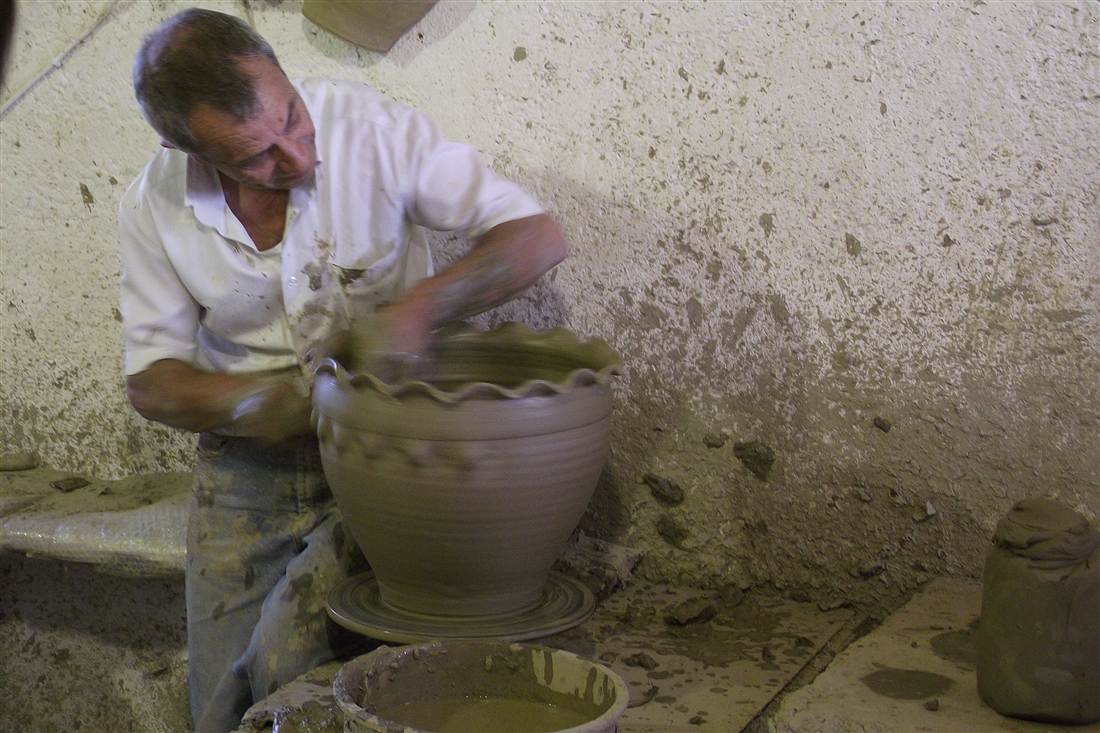
A Crete pottery class is a workshop where visitors shape clay with a Cretan potter, on the wheel or by hand, in a village studio or a town workshop on the island. Tours across the rest of the country are listed on Greece Tours.
The sections below cover the class formats, the villages and towns, wheel throwing, raku firing, classes with cooking, tours that add pottery to Knossos or Lasithi, the pottery traditions, children, taking your work home and booking, with links into the Crete pages. The classes shown are checked on GetYourGuide and Viator.
What is a Crete pottery class?
A Crete pottery class is a hands-on session in a working studio where a potter teaches you to shape clay into a cup, bowl or plate, using a wheel or hand-building tools, with materials provided and your piece fired afterwards.
Sessions run from two hours in a studio to a full day inside a guided tour. Complete beginners are welcome, and no experience with clay is needed. Instructors teach in English, and studios in Margarites and around Heraklion also work in French or Greek. Clay, tools and aprons come with the booking.
You finish with a fired piece rather than a lump of clay. What you make stays behind for drying, then firing, and the studio tells you when it is ready for collection or shipping. A Crete pottery class fits a rainy morning, a rest day away from the beach, or an afternoon between two archaeological sites.
Which Crete pottery class formats can you book?
You can book a Crete pottery class on a wheel, a hand-built ceramic cup session, a raku firing evening with a master potter, a pottery and cooking day, or a pottery stop folded into a Knossos and Lasithi tour.
Wheel sessions are the shortest and the messiest. You sit at a spinning wheel, centre a ball of clay and pull up a wall. A studio 16 km from Heraklion runs a two-hour Crete pottery class for five people, each with a dedicated wheel, in a garden surrounded by olive trees.
Hand-building suits anyone who wants more control. In Agios Nikolaos a two-hour workshop for six people uses the slab-building technique to make a ceramic cup, with a handle shaped by hand and a glaze chosen from the studio collection at the end. The studio glazes and fires the cup for you.
- Wheel throwing: two hours, your own wheel, five participants.
- Hand-built cup: two hours, slab technique, six participants, glazing included.
- Raku firing: two and a half hours in the evening, one plate to take home.
- Pottery with cooking: a full day, pickup and meal included.
- Pottery inside a tour: a stop of 45 minutes to an hour and a half.
Where does a Crete pottery class take place?
A Crete pottery class takes place in working studios and pottery villages across the island, above all in Margarites, Thrapsano, Agios Nikolaos and Mirsini, in ateliers near Heraklion, and in the villages of the Lasithi plateau.
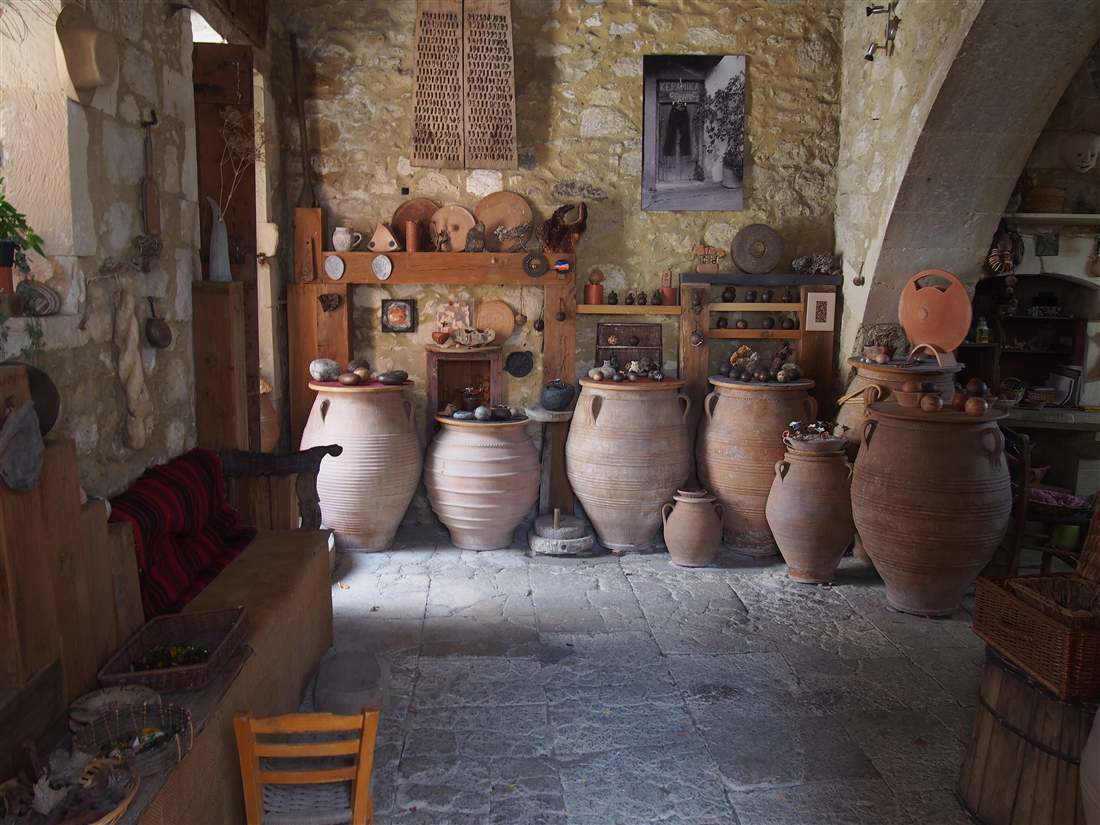
Margarites holds around 16 workshops, 26 km south-east of Rethymno and 30 to 40 minutes away by car. The lanes are narrow, the studios are family run, and the pottery village of Margarites keeps its kilns and showrooms beside the tavernas. A Crete pottery class here lasts about two hours.
Thrapsano, 30 km south-east of Heraklion at an altitude of 340 metres, still fires pithos jars in permanent workshops rather than seasonal kilns, and Thrapsano sends those jars far beyond Crete. A Crete pottery class in the centre of Agios Nikolaos works in stoneware clay, with instruction in English and Greek.
Mirsini sits on the coastal road about 25 km from Sitia and 44 km from Agios Nikolaos, where Nikos Makrynakis has worked with clay for more than forty years. Near Heraklion, an atelier 16 km from the city teaches among olive trees, and the Lasithi plateau has a pottery workshop in Psychro.
What happens in a wheel-throwing Crete pottery class?
In a wheel-throwing Crete pottery class you centre a ball of clay on a spinning wheel, open a hole with your thumbs, pull the wall upwards and shape a cup, bowl or vase, then leave the piece to dry.
Centring comes first and takes the longest. Clay has to sit exactly in the middle of the wheel before anything else works, and a wobble at this stage returns as a wobble in the finished pot. In a Crete pottery class the potter beside you presses your hands down until the lump is stable.
Then you open the clay and pull the wall in three or four passes, with wet hands and a sponge. Water is the only lubricant. After that the pot is trimmed, given a foot ring and set aside on a shelf with your name on it. Long fingernails and large rings make the work harder.
- Wedge and centre the clay on the wheel head.
- Open the middle with both thumbs.
- Pull the wall up in three or four passes.
- Shape the rim and trim the base.
- Sign the pot and leave it on the drying shelf.
What is the raku Crete pottery class with a master potter in Mirsini?
The raku Crete pottery class with a master potter in Mirsini is a two and a half hour evening with Nikos Makrynakis, who has worked with clay for more than forty years, decorating a plate that is fired and pulled glowing from the kiln.
Raku began in Japan as a way of making tea bowls by hand, with the pot lifted out of the kiln while it is still hot. The western version, developed by studio potters in the twentieth century, puts the glowing piece into a container of straw, sawdust or paper, where smoke stains the glaze.
The firing is short, under 980 °C, and the results are unpredictable. Glazes crackle, colours shift, and a piece can break from thermal shock. You decorate a pre-made plate with Nikos, then watch it go into the kiln. While the kiln works, the rest of the Crete pottery class turns to wet clay.
Sessions run from Tuesday to Sunday, 17:00 to 19:30, in English and Greek, with coffee and water on site. The plate goes home with you the same evening. Extra clay pieces need glazing and firing, and can be collected about five days later or shipped at an extra charge. The workshop is wheelchair accessible.
Can a Crete pottery class be combined with a cooking class and a meal?
A Crete pottery class can be paired with a cooking class and a meal in Margarites, where a full-day experience starts with clay, moves into a kitchen and ends with lunch shared around a table.
A Crete pottery class opens the day, with local artisans guiding you through a handmade ceramic piece. The morning then moves to traditional Cretan recipes, cooked with fresh local ingredients, and finishes with a meal together. Pickup is included, and the day suits all ages. The instructors speak English and French.
Food and clay work well in the same day because both are slow. Dough needs resting time, clay needs drying time, and the waiting is filled with talk and the smell of an oven. A cooking-only session is shorter, and the Cretan cooking class options on this site run without the studio visit.
Which tours add a Crete pottery class to Knossos or the Lasithi plateau?
A Crete pottery class is added to Knossos and Lasithi tours as a stop of 45 minutes to an hour and a half, with a master potter guiding you through one pot before the tour moves on.
The palace stop takes about an hour and a half and the pottery village about 45 minutes. On the eastern version, pickup covers Heraklion, Hersonissos, Malia, Sissi, Agios Nikolaos, Elounda, Istron and Ierapetra, and eight travellers share a Land Rover Discovery. Entry to the palace and the clay are charged separately, so check Knossos palace tickets first.
A seven-hour safari from the Heraklion area adds a pottery village in the mountains to the same palace, with six guests in one vehicle and hotel pickup included. The ticket line at Knossos is skipped, lunch at a local restaurant comes with wine or water, and the afternoon ends at an olive oil factory.
The ten-hour route to the Lasithi plateau climbs to 840 metres, past windmills and 18 villages, with the Cave of Zeus near Psychro, where a Crete pottery class forms the craft stop of the day. Kera Kardiotissa monastery and Tzermiado fill the hours around it. The cave closes for maintenance at times.
Which pottery traditions stand behind a Crete pottery class?
Behind a Crete pottery class stand four thousand years of Minoan pottery and the pithos jars of Thrapsano and Margarites, where jar makers worked in teams and fired their work in wood-burning kilns built on the hillside.
Kamares ware takes its name from finds in a cave sanctuary on Mount Ida and counts as the first polychrome pottery of Minoan Crete, painted in white, red and brown on a dark ground. The potter’s wheel, the same tool you use in a Crete pottery class, arrived from the Levant in the Middle Minoan period. The story of Minoan pottery covers the styles in depth.
Pithoi, the large storage jars, appear just before the Middle Minoan period. About 400 were found at Knossos, where the palace magazines held oil, grain and wine, and an average pithos carried about half a tonne of fluid. The jars stood at ground level in long storerooms, because they were too heavy for upper floors.
Thrapsano potters travelled in teams on summer campaigns, and more than 167 kilns were recorded there over the century up to the mid-nineties, alongside more than 101 permanent workshops. The seasonal system ended at the close of the sixties, and the village square hosts the Earth, Water, Fire pottery festival on the first weekend of July.
- Kamares ware: polychrome painting on a dark ground.
- Eggshell ware: walls thin enough to ring when tapped.
- Barbotine ware: applied clay ridges and knobs in relief.
- Pithoi: storage jars for oil, grain and wine.
- Larnakes: painted clay coffins.

Can children join a Crete pottery class?
Children can join a Crete pottery class in family formats, but age limits apply: one Agios Nikolaos studio takes nobody under 15, while the raku evening in Mirsini offers a discount for young children and pottery-and-cooking days welcome all ages.
A Crete pottery class for families means hand-building rather than the wheel, because a slab or a coil responds at once and a small pair of hands can shape a cup without fighting the spinning clay. The Margarites pottery and cooking day is open to all ages, and the Crete with kids pages list family activities.
Check the age rules before booking. The ceramic cup workshop in Agios Nikolaos is not suitable for children under 15, and wheel work asks for arm strength and patience. Sessions of two hours are long enough for young potters, and small groups mean an instructor can sit beside a child.
Can you take your work home after a Crete pottery class?
You cannot take your work home the same day after a Crete pottery class: pieces dry for three to four days, are fired, then glazed, and are either collected from the studio or shipped to your address.
A Crete pottery class near Heraklion leaves your piece drying for three to four days before the first firing, and collection is arranged afterwards. Glazing is optional and charged on top, and the finished pot is collected from the workshop or shipped home at your own expense. International rates depend on the destination.
The cup workshop in Agios Nikolaos includes glazing and firing, and the cup is ready in three to four weeks and posted to your home, with postage paid at the studio. The raku evening is the exception: the plate travels with you the same night. Extra clay pieces are fired and collected about five days later.
- Drying: three to four days before the first firing.
- Firing: the studio fires the piece once it is bone dry.
- Glazing: optional near Heraklion, included in the Agios Nikolaos cup.
- Collection: from the studio, within a month after firing.
- Shipping: to your address at your own cost.
How do you book and cancel a Crete pottery class?
You book a Crete pottery class online in advance, choosing a date, a language and a start time, and you can cancel free of charge up to 24 hours before the session begins, reserving your place now and paying later.
Read the meeting point carefully. The atelier near Heraklion asks drivers to head for Voutes rather than Petrokefalo, because satellite navigation sends cars along dirt tracks, and there are two marked parking spaces at the green door. The Agios Nikolaos studio stands on Argirokastrou street, and guided tours collect from hotels.
Confirm that the pottery element is hands-on. A full-day culture tour from Rethymno visits Arkadi monastery, the Museum of Ancient Eleftherna, the Tsikalario workshop in Margarites, an olive oil manufactory and Melidoni Cave, and on that route the pottery can be a demonstration rather than a Crete pottery class with your hands in clay.
- Check the group size, capped at five to eight people.
- Check the language of instruction.
- Check whether hotel pickup is included.
- Check what the booking covers, from clay to firing.
- Check the free cancellation window of 24 hours.
Frequently Asked Questions
How long does a Crete pottery class last?
Studio sessions run for two hours, the raku evening in Mirsini for two and a half hours, and pottery and cooking days for a full day. A stop inside a guided tour lasts from 45 minutes to an hour and a half. Two hours is enough for one wheel-thrown piece or one hand-built cup.
Do you need experience to join a Crete pottery class?
No experience is needed. Studios state that beginners are welcome, and the instructor demonstrates each step before you try it. A Crete pottery class begins with centring the clay, which is the hardest part, and the teacher corrects your hands until the clay behaves. Children and adults work side by side in family formats.
What do you wear to a Crete pottery class?
Wear comfortable clothes that can take clay dust, and leave long nails, large rings and loose bracelets at home, because they interfere with the wheel. Aprons are provided at the studios. Flat shoes are a sensible choice for the walk from a village car park to a workshop door in the village.
Which languages are used in a Crete pottery class?
English is the standard language, and French and Greek appear on the schedules of studios in Margarites and near Heraklion. The raku evening in Mirsini runs in English and Greek, and guided tours add German, Russian, Dutch, Spanish and Romanian on selected departures. Ask when you book a Crete pottery class if you need another language.