
Tirana tours start in Tirana, the capital and largest city of Albania. The routes cover Skanderbeg Square, the Et’hem Bey Mosque, Bunk’Art and the communist sites, Blloku and the Grand Park, the cable car to Mount Dajti, and the day trips to Krujë, Durrës and the lakes of Bovilla and Komani. Greece Tours lists the trips that cross into Albania from Corfu and northern Greece.
This page covers what Tirana tours see in the city and on the mountain above it, which day trips leave the capital, what food the tours taste, how visitors reach Tirana from Greece, and which season suits each route. The tours below are checked on GetYourGuide and Viator and leave from Tirana and Durrës.
What do Tirana tours cover?
Tirana tours cover the centre of the Albanian capital on foot: Skanderbeg Square, the Et’hem Bey Mosque, the communist-era bunkers and museums, the Blloku quarter and the Grand Park. The city centre is small, so one walking route links every stop.
Tirana is the capital and largest city of Albania, set in the centre of the country. It hosts the official residences of the President and the Prime Minister and the Parliament of Albania, so Tirana tours pass ministries and the Bank of Albania on Skanderbeg Square.
Florestano Di Fausto and Armando Brasini, architects of the Mussolini period in Italy, designed the ministries, and the communist years from 1944 to 1991 added the Soviet-styled Palace of Culture. Tirana tours read both eras along Dëshmorët e Kombit Boulevard, built in 1930 as King Zog I Boulevard.
A free walking tour leaves daily from the front of the Opera house. Tirana tours of this kind stay inside the capital; for the City of Stone in the south of the country, see our Gjirokaster tours.
- Founded: in 1614, by Sylejman Pasha Bargjini around the Old Mosque.
- Capital: proclaimed the temporary capital by the Congress of Lushnjë on 8 February 1920.
- Residents: 598,176 in the municipality at the 2023 census.
What do Tirana tours see on Skanderbeg Square?
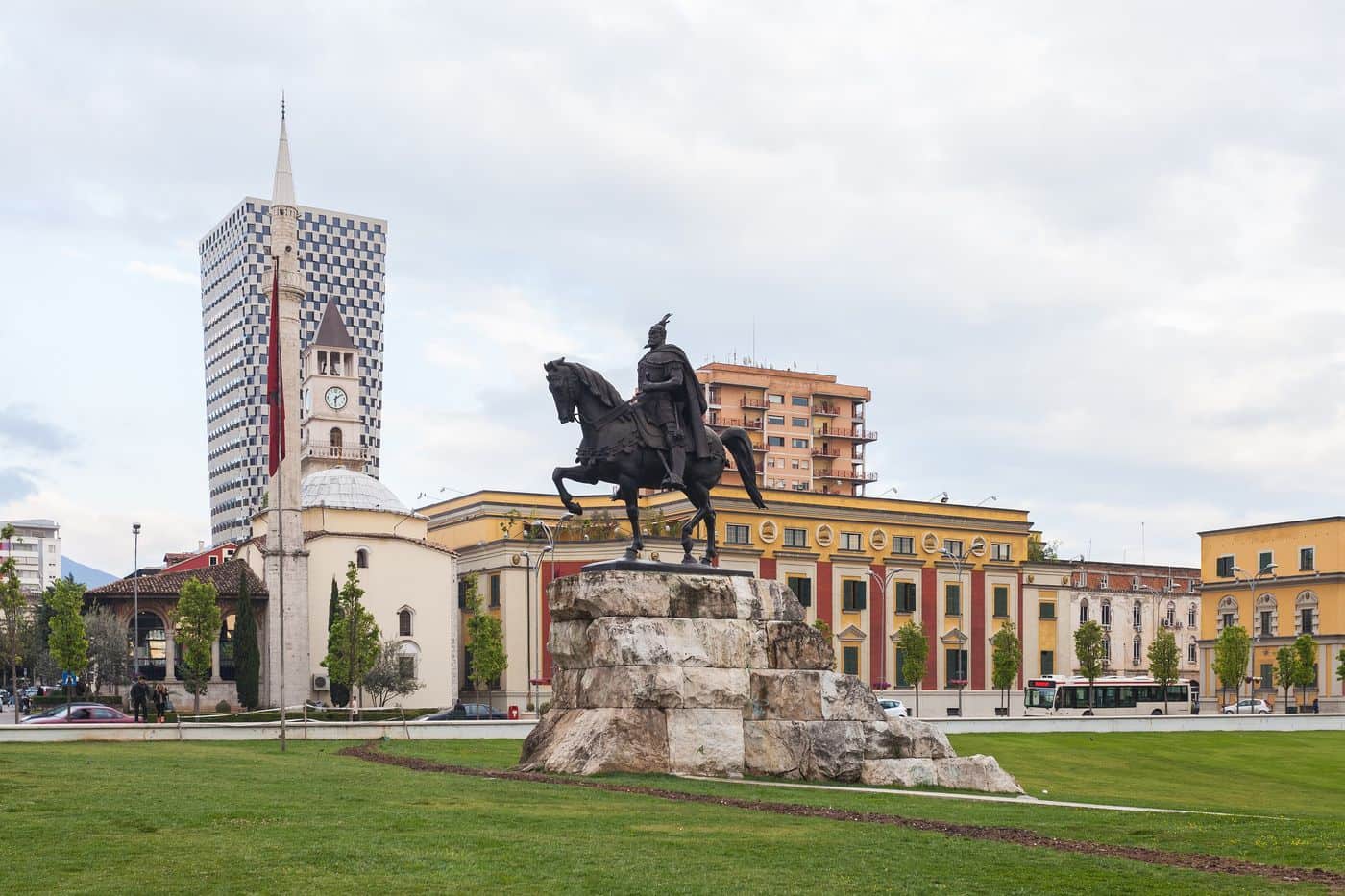
Tirana tours on Skanderbeg Square see the 11-metre Skanderbeg Monument, the Et’hem Bey Mosque with its painted portico, the Clock Tower, the mosaic façade of the National History Museum and the Palace of Culture, which holds the National Library and the Opera.
Skanderbeg Square is the main plaza of Tirana, covering about 40,000 square metres. Designed by 51N4E and Anri Sala, it opened to the public in June 2017 as part of the biggest pedestrian zone in the Balkans and won the European Prize for Urban Public Space in 2018.
Odhise Paskali created the Skanderbeg Monument, inaugurated in January 1968 on the 500th anniversary of the death of Skanderbeg, the national hero who resisted the Ottomans. A statue of Joseph Stalin stood on the same spot before it.
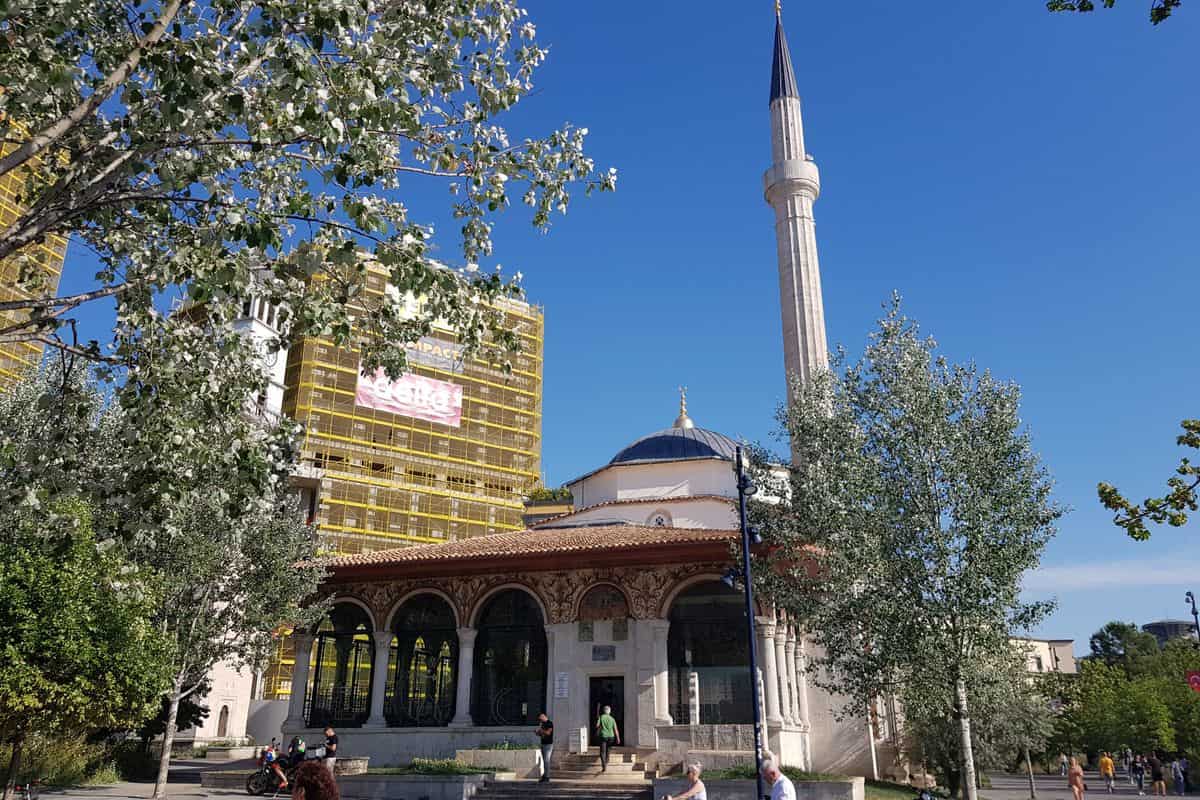
Tirana tours enter the Et’hem Bey Mosque outside prayer times, with shoes off before the inner room. Haxhi Ethem Bey finished the mosque in 1819 or 1821, and on 18 January 1991, 10,000 people entered it carrying flags, ending its closure under communist rule. He also built the Clock Tower beside it, completed in 1822, which stands 32.5 metres high with 90 spiral steps.
- Mosaic: The Albanians, about 11 metres high and 40 metres long, with 13 figures above the museum entrance.
- Museum: opened on 28 October 1981 across 27,000 square metres, now closed for renovation.
- Palace of Culture: first stone laid by Nikita Khrushchev in 1959.
Which Tirana tours visit Bunk’Art and the communist sites?
Tirana tours on the communist trail visit Bunk’Art 1, the five-storey nuclear shelter built for Enver Hoxha, Bunk’Art 2 under the Interior Ministry, the House of Leaves museum of the secret police, and the Pyramid, the former Enver Hoxha Museum.
Tirana tours reach Bunk’Art 1 on Fadil Deliu Street, on the outskirts of the city. Built for the political elite of Albania in the 1970s, the bunker holds almost 3,000 square metres underground and opened to visitors in November 2014 with exhibits that combine modern Albanian history with contemporary art.
Bunk’Art 2, on Abdi Toptani Street, sits in a bunker and tunnel system below the Ministry of Interior Affairs and follows the police and security services of Albania through the 20th century. Both recall a capital ringed by thousands of bunkers in fifty concentric circles.
The House of Leaves, named after the climbing plant on its facade, is a 1931 villa that was originally the first private obstetrics clinic in Albania and later the interception headquarters of the Sigurimi until 1991. Tirana tours see its 31 rooms, open as the Museum of Secret Surveillance since 2017.
The Pyramid opened on 14 October 1988 as the Enver Hoxha Museum, co-designed by his daughter Pranvera Hoxha. It served as a NATO base in the 1999 Kosovo War, and after a renovation by MVRDV it reopened in October 2023 as TUMO Tirana, a youth centre for computer programming and robotics; visitors walk up the stairs to its peak.
- Bunker total: more than 750,000 across Albania, built from the 1960s to the 1980s.
- Bunker design: the dome-shaped QZ type by military engineer Josif Zagali.
- Surveillance exhibits: a darkroom for developing film and a fingerprint laboratory.
What do Tirana tours see in Blloku and the Grand Park?
Tirana tours walk through Blloku, the former restricted quarter of the communist politburo, then the Grand Park and its artificial lake in the south, the Lana river, the Ottoman stone Tanners’ Bridge and the New Bazaar market east of the central boulevard.
Blloku, or Ish-Blloku, lies in the Tirana e Re neighbourhood of southwestern Tirana. Under communism it was a restricted residential area for members of the Albanian politburo, closed to ordinary Albanians, and the residence of Enver Hoxha still stands there. Tirana tours reach it in 10 to 15 minutes on foot from the centre.
The Grand Park covers 289 hectares in the south of the city. It was built in 1955 and 1956 on a Bulgarian plan, and volunteers raised a 400-metre dam to hold the 55-hectare artificial lake. Tirana tours in the park pass the St. Procopius Church, the Presidential Palace and the tombs of the Frashëri brothers.
The Tanners’ Bridge, an 18th-century Ottoman stone footbridge, carried the road from the eastern highlands across the Lanë stream until the river was diverted in the 1930s. The New Bazaar (Pazari i Ri), built in 1931 on the site of the Old Bazaar, holds the Kokonozi Mosque and a market renovated in 2017.
- Lana river: about 29 kilometres long, in a concrete-lined channel through the city.
- Botanical Garden: 14.5 hectares at the southern end of the Grand Park.
- Holocaust memorial: unveiled in 2020 at a park entrance near Mother Teresa Square.
Which Tirana tours ride the Dajti Express to Mount Dajti?
Tirana tours to Mount Dajti ride the Dajti Ekspres, an Austrian-built cable car that leaves from the eastern edge of Tirana. The 15-minute ride climbs to the Llarka Plateau in Dajti Mountain National Park, a viewpoint known as the Balcony of Tirana.
Dajti is the mountain just east of the capital, part of the Skanderbeg Mountains range. It stretches 8 km from Shkalla e Tujanit to Qafa e Priskës and is 5 km wide. Tirana tours look up at a bare limestone summit that serves as the base for the central antenna of RTSH.
The cable car runs 4,354 metres, the longest cableway in the Balkans. Tirana tours reach the lower station on a 15-to-20-minute public bus ride from the city centre, on blue line 11 toward Porcelani. Hikers start a trail at the Thesari bus stop and walk to the upper station in 2 to 3 hours.
Tirana tours enter a national park set up in 1966 that has covered 293.84 km² since 2006, and the IUCN lists it as Category II. The western slope carries Mediterranean shrubs up to 600 metres, oak forest up to 1,000 metres, and beech and conifer trees above 1,400 metres. Wild boar, Eurasian wolf, red fox, brown bear and European wildcat live in the park.
At the top, Tirana tours find the Dajti Tower Hotel, the cliff-top restaurant Ballkoni Dajtit and Dajti Mini Golf, the only 18-hole mini-golf course in Albania. Locals go up to escape the city rush over a spit-roast lamb lunch.
- Peaks: Maja e Dajtit reaches 1,613 m, Maja e Cem Rrumit 1,571 m and Maja e Tujanit 1,531 m.
- Dajti Castle: the ruins of a Roman fortification, built over an earlier Illyrian castle, lie 1.5 km south of Dajt Xhori.
- Winter: snow covers the mountain, a retreat for Tirana residents who rarely see snowfall.
Which Tirana tours visit Krujë?
Tirana tours visit Krujë, a mountainside town 20 km north of the capital, where Skanderbeg’s fortress held off three Ottoman sieges. Inside the castle walls stand the Skanderbeg Museum and the Ethnographic Museum, and the old bazaar climbs to the castle gate.
The Fortress of Krujë, built in the 5th or 6th century, was the centre of Skanderbeg’s rebellion against the Ottoman Empire. Skanderbeg took the town on 28 November 1443 and raised the first Albanian flag the same day. Tirana tours follow the sieges of 1450, 1466 and 1467, which the fortress withstood; Mehmed II took it only in 1478, 10 years after Skanderbeg’s death.
The Skanderbeg Museum opened on 1 November 1982. Architects Pirro Vaso and Pranvera Hoxha drew its design from traditional Albanian stone towers and medieval Romanesque architecture. Tirana tours walk past paintings, armour and a replica of Skanderbeg’s goat head-topped helmet, whose original is in the Kunsthistorisches Museum.
The Ethnographic Museum fills the house of the Toptani family, built in 1764 on the south side of the fortress. Its main exhibits are objects of artisanship aged 60 to 500 years. Tirana tours see how tools, food, drink and furniture were made in a typical household.
Below the castle, the Old Bazaar, known locally as Derexhiku, dates to the 17th century and once held about 200 shops. Tirana tours shop there for carpets, handicrafts and antiques, and pass the Bazaar Mosque, completed in 1533. A trail climbs from the town to the Sari Salltik shrine, a cave at the top of Mount Krujë held sacred in the Bektashi faith.
- Dollma Tekke: a Bektashi shrine inside the castle walls, built in 1789–99 by the Dollma family.
- Watch tower: rises 16 m above the castle walls; its bell, which announced Skanderbeg’s death, is now in the Skanderbeg Museum.
- Hammam: a steam bath from the end of the 15th century, a first-degree cultural monument since 1963.
Which Tirana tours visit Durrës?
Tirana tours to Durrës drive just over half an hour on the SH2 to the Adriatic coast. The city, founded as Epidamnos and renamed Dyrrachium under Rome, holds the largest Roman amphitheatre in the Balkans, a Venetian tower and the largest archaeological museum in Albania.
Greek colonists from Corinth and Corcyra founded Epidamnos around the 7th century BC with the Illyrian Taulantii. After the Illyrian Wars in 229 BC the Romans chose Dyrrachium as the sole name, since Epidamnos recalled damnum, the Latin word for loss or harm. Tirana tours reach the city where the Via Egnatia started, the road that led east to Constantinople.
Construction of the Amphitheatre of Durrës began under the emperor Trajan in the 2nd century AD, and it once held 20,000 people. Its ellipse measures 132.4 by 113.2 metres, and an early Christian chapel with mosaics is preserved on the site. Tirana tours see a monument discovered only in late 1966 and now on the tentative list of Albanian UNESCO World Heritage Sites.
Emperor Anastasius I, a native of the city, built its walls in the late 5th century, and Anna Komnene wrote that they were wide enough for four horsemen to ride abreast. The Venetians, who held Durrës from 1392 until 1501, added guard towers. Tirana tours climb the steep stairs of the round Venetian Tower, the Rotonda, where a multimedia presentation plays inside the dome.
The Archaeological Museum of Durrës, founded in 1951, holds 3,204 artefacts from ancient Dyrrhachium, among them Roman funeral steles, stone sarcophagi and miniature busts of Venus, but it is temporarily closed. The Port of Durrës is one of the largest on the Adriatic Sea, and Golem, south of the city, is the main seaside resort, where Tirana residents keep beach houses and villas.
- The Beauty of Durrës: a colourful elliptical mosaic of 5 by 3 metres in the museum collection.
- King Zog’s Villa: the former royal summer residence, completed in 1937 on a hill above Durrës.
- Railway: the 38 km Durrës–Tirana line, begun in 1947, was the first railway in Albania.
Which Tirana tours go to Lake Bovilla and the mountains?
Tirana tours to the hills head about 14 km northeast to Lake Bovilla, a 4.6 km² reservoir inside Dajti Mountain National Park, or 15 km south to Petrelë Castle, a hilltop fort with views over the Erzen valley, olive groves and the surrounding mountains.
Lake Bovilla supplies the bulk of the drinking water for Tirana, and swimming in it is forbidden, so Tirana tours view it from the shore. A 91 m dam on the Tërkuzë, a tributary of the Ishëm, stands at the entrance to the deep Shkallë e Bovillës canyon, which runs between Maja e Gomtitit, 1,268 m high, and Mali i Bjeshit, 1,239 m high.
Hiking Tirana tours set off from Zall-Bastar, a municipal unit of Tirana and the base for walks near the lake, reached by bus from the Myslym Keta stop. The cliff faces around the canyon and the dam suit rock climbing.
The lake on these Tirana tours is young. Work on the dam began in 1988, stopped with the collapse of communism and resumed in October 1993 with support from the Italian state. Building ended in 1996, and the lake filled by 1998. About 400 families were resettled to create it.
South of the city, Tirana tours climb to Petrelë Castle, 329 m above sea level. The Byzantine emperor Justinian I built it in the 6th century, and the present triangular building with two observation towers dates from the 15th century. Mamica Kastrioti, sister of Skanderbeg, commanded it, and a restaurant now fills its wooden structure.
- Depth: Surveys from 2006 to 2008 put the greatest depth of Lake Bovilla at around 45 m.
- Erzen river: The 109 km river rises at 1,200 m in Mali me Gropa and flows through Petrelë to the Adriatic Sea.
- Persqopi: An ancient city near the castle, with an outer wall 7 m high and a bastion 12 m high.


Which Tirana tours go to Lake Komani and the Shala river?
Tirana tours to Lake Komani travel north to the Koman Reservoir on the Drin River, then board the ferry from Koman to Fierzë through narrow mountain gorges, while small boats leave the route for the blue water of the Shala river.
On Tirana tours, Lake Koman fills a narrow valley between forested hills, vertical slopes and deep gorges. The lake covers 34 km², spans 400 m across and takes in the Shala and Valbona rivers. The Koman Hydroelectric Power Station, second of the three dams on the Drin, created it.
Tirana tours cross on the Lake Koman Ferry, Trageti i Komanit in Albanian, which runs daily from Koman to Fierzë in about two and a half hours. The boats make unscheduled stops for locals and carry animals on board, and the Dragobia Boat, its cabin converted from a bus, has sailed the lake since 1994.
The Shala river rises near Theth, close to the border with Montenegro, and runs 37 km south into Lake Koman near the village of Telum. Its crystalline water drops an average of 22 m per kilometre, and trout is the main fish. Small boats on the ferry route carry Tirana tours to the river.
The ferry docks at Fierzë, near the 167 m rock-fill dam of the Fierza Hydroelectric Power Station. From there, Tirana tours continue through Bajram Curri to Valbonë, a village of around 30 houses, mostly stone towers, at about 1,000 m. The valley became a national park in 1996, and the journey from Tirana takes around five hours.
- Lake wildlife: Golden jackal, red fox, European badger and Eurasian otter are the main predators around Lake Koman.
- Shala flow: The river averages 34 m³ per second, with 52 m³ in November and 9 m³ in August.
- Valbona river: One of the cleanest rivers in Albania, it joins the Drin near Fierzë.
Which local food do Tirana tours taste?
Tirana tours taste fërgesë, the signature dish of Tirana and Central Albania, made of peppers, tomatoes, onions and gjizë cheese, plus tavë kosi of baked lamb and rice, layered byrek, qofte meatballs and raki, the national spirit, with grape, plum and blackberry versions.
Fërgesë leads the table on Tirana tours. Cooks sauté the vegetables in olive oil, stir in garlic and the salted curd cheese, then bake the mix in a clay bowl into a dense sauce. The version with liver counts as more traditional in Tirana and goes by fërgesë tirane.
Tavë kosi, also called tavë Elbasani, bakes mutton and rice under a mix of yogurt, eggs, butter and flour. The dish is thought to come from Elbasan, and Greece, Kosovo, North Macedonia and Turkey know it as Elbasan tava. Lunch, the biggest meal of the day in Albania, adds a salad of tomatoes, cucumbers, green peppers, onions and olives.
Byrek became a staple after the Ottoman conquest in the 15th century, and it is the street snack of Tirana tours. Street vendors called byrektore sell small triangles, the byrek trekendësh; the other main type is the house byrek, byrek shtëpie. Qofte, fried meatballs of minced meat, herbs and spices, are the speciality of qofteri, shops that serve them with beer.
Raki turns up even at breakfast, beside bread, cheese, olives and coffee, and older people take it heated and sweetened with honey or sugar. On Tirana tours, Komiteti Kafe Muzeum, a café crammed with communist-era relics, pours 25 varieties. In 2016 Albania passed Spain to lead the world in coffee houses per capita, with 654 per 100,000 inhabitants.
For produce, Tirana tours walk through the Central Market of the New Bazaar, which sells fresh fruit and vegetables, nuts, beans and traditional cooking utensils.
- Flia: Crêpe-like layers brushed with cream, a northern dish eaten on Flia Day, 17 March.
- Tarator: A cold side of cucumber, garlic, olive oil, salt and yoghurt for the hot summer months.
- Petulla: Fried dough of wheat or buckwheat flour, served with powdered sugar or feta cheese and raspberry jam.
How do visitors reach Tirana on Tirana tours?
Visitors on Tirana tours land at Tirana International Airport Nënë Tereza at Rinas, 11 kilometres northwest of the city, or arrive by road from Greece. Aegean Airlines and Sky Express fly from Athens, while Ioannina buses and Corfu ferries serve travellers without a flight.
The airport, code TIA, is the only one in Albania with scheduled commercial passenger flights and handled a record 11.6 million passengers in one year. Athens ranks ninth among its busiest routes, with 374,627 passengers on Aegean Airlines, Sky Express and Wizz Air. Both Greek airlines also fly from Heraklion, and Aegean adds a seasonal Rhodes route for Tirana tours from the Greek islands.
An airport bus links the terminal with central Tirana 24 hours a day, with a departure every hour. Taxis and rental cars cover the drive in 20 to 25 minutes along the SH60 road, which joins the SH2 highway. A new electrified railway line with a dedicated airport station is under development.
Drivers on Tirana tours from northern Greece cross at Kakavia, a major road border crossing between the Greek village of Ktismata, in the Ioannina regional unit, and the Albanian village of Kakavijë. The EO22 road, part of European route E853, links the crossing with the EO20 at Kalpaki. North of the border, the E853/SH4 road from Ioannina to Tirana is the main north–south route between Greece and Montenegro.
Without a car, nine buses a day run from Ioannina to the Kakavia border in one hour, and a short walk links the Greek and Albanian checkpoints. Ferries sail from Corfu to Saranda every day, and a hydrofoil serves the same crossing. Direct coaches from Athens reach Tirana in 12 hours, and Thessaloniki coaches by Liko & Kosta Tours, Alpar and Start Travel use the East Bus Terminal.
- Airport name: the airport honours Mother Teresa (1910–1997), the Albanian Roman Catholic nun and missionary.
- Other airlines: Air Albania, British Airways, ITA Airways, Lufthansa, Austrian and Ryanair serve the airport.
- Second crossing: buses run from Igoumenitsa to the Mavromati border 3 times a day in 45 minutes.
When do Tirana tours run best?
Tirana tours run best from April to October, when average highs range from 19 °C to 31 °C. Tirana has a humid subtropical climate, and the majority of its 1,266 mm of yearly precipitation falls from November to March, with less in June to September.
For Tirana tours, the average temperature climbs from 6.7 °C in January to 24 °C in July, and the city receives close to 2,500 hours of sun a year. The Köppen class is Cfa, and Tirana ranks among the wettest cities in Europe.
July and August bring average highs of 31 °C and lows of 17 °C, with 42 mm and 46 mm of rain, and the free city walking tour adds an evening departure in the summer period. November is the wettest month at 172 mm. Autumn Tirana tours enjoy highs of 27 °C in September and 22 °C in October.
Tirana tours in March meet Dita e Verës, the Summer Day, every year on 14 March, when Albanians celebrate the end of winter and the arrival of spring. The Summer Festival takes place every year in Rinia Park, and the city also celebrates Christmas, Eid, Hanukkah and Nowruz, with Nevruz Day on 22 March.
The Tirana International Film Festival, created in 2003, was the first international cinema festival in Albania and is an Academy Awards qualifying event. Its jury awards the Golden Owl for Best Feature Film, and the Albanian National Center of Cinematography organises it every year in the cinemas of Tirana.
- Film spin-offs: DocuTIFF covers documentaries, AnimaTIFF animation and ExpoTIFF experimental films.
- November holidays: Independence Day falls on 28 November and Liberation Day on 29 November.
- Other holidays: Mother Teresa Day falls on 5 September and Youth Day on 8 December.
- Winter roads: snow chains with summer tyres are allowed from 1 November to 30 April.
Frequently Asked Questions
Do Greek visitors need a passport for Tirana tours?
No passport is required for Greek citizens on Tirana tours, because Greece sits on the visa-free list of Albania and its citizens enter with an identity card. Albania no longer charges a visa fee to any foreigner. Holders of a Schengen, United Kingdom or United States residence permit or multi-entry visa stay up to 90 days without a visa.
Which language and currency do Tirana tours use?
Tirana tours run in a country whose official language is Albanian, a separate branch of the Indo-European family, like Greek and Armenian. Italian is the leading foreign language, taught extensively in Albanian schools during the 1930s, and English is a second language for younger residents of Tirana. The currency is the Albanian lek, code ALL.
Can visitors drive their own car from Greece on Tirana tours?
Yes, Tirana tours by car need a Green Card (International Motor Insurance Card) valid for Albania, the vehicle registration and a power of attorney when the car belongs to someone else. Border guards check strictly and prefer printed copies to phone PDFs. Highways carry no fees except the A1 Rruga e Kombit, with tolls near the airport and Morinë.
Where do visitors pick up maps for Tirana tours?
The Tourist Information Office on Rruga Ded Gjo Luli, just north of Skanderbeg Square behind the National Historic Museum, serves Tirana tours with English-speaking staff. It hands out city and public transport maps, gives directions to hostels and hotels, and supplies free copies of the Tirana in your Pocket guide with bus and furgon schedules.
How do visitors on Tirana tours get around the city by bus?
Buses are the only public transport in Tirana, with 16 urban lines and 14 suburban lines. The urban network combines 8 radial, 5 diagonal and 3 circular or semi-circular lines across 451 stops, and buses ran every 9 minutes on average in 2018. Traffic slows them, since the city had only 7 kilometres of dedicated bus lanes in 2020.