
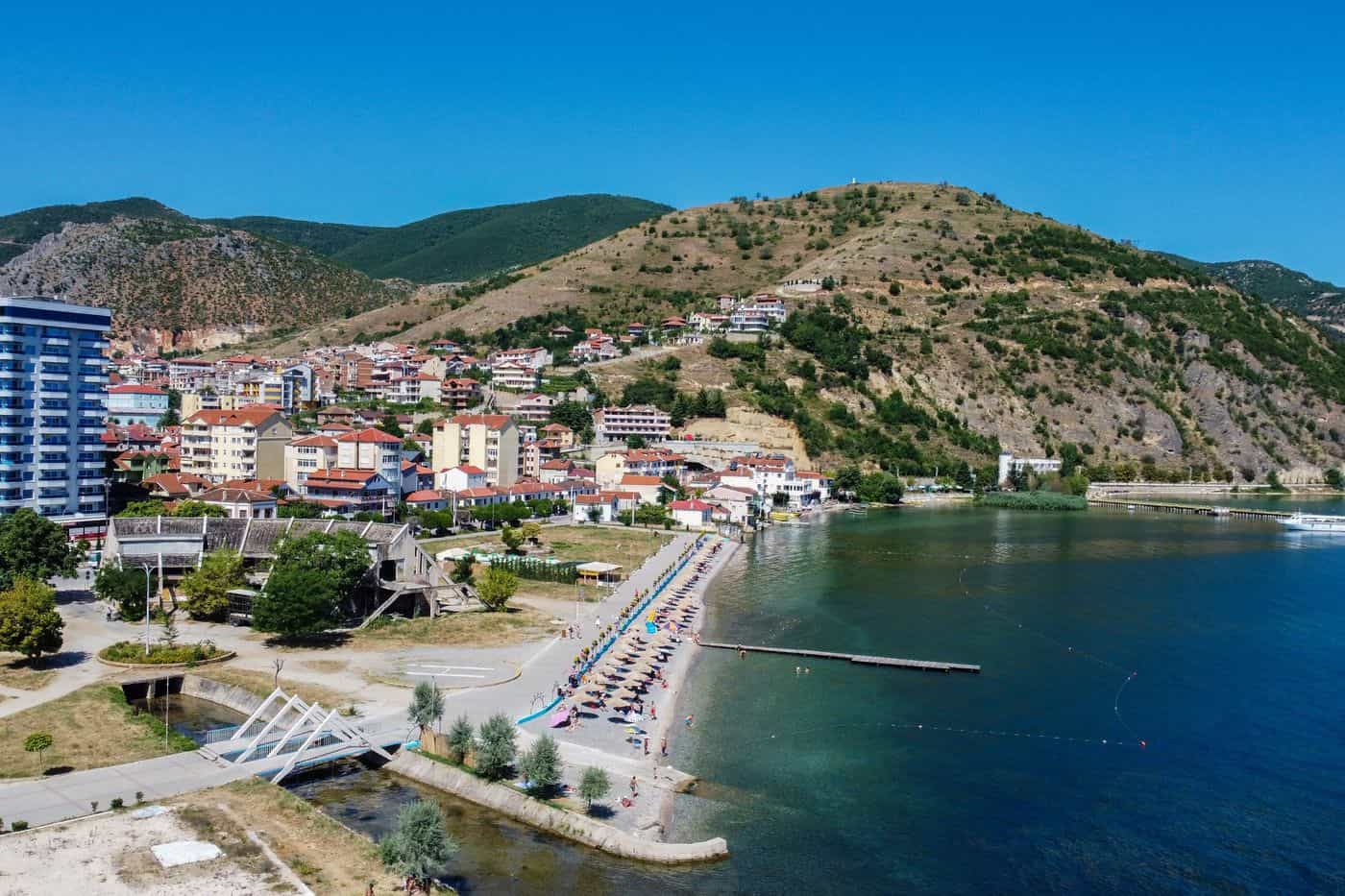
Pogradec tours start in Pogradec, the town of Korçë County on the southern shore of Lake Ohrid in eastern Albania. The routes cover the lakefront and the castle hill, the Drilon springs, Tushemisht, the boat and kayak trips on the lake, the mosaics of Lin and the royal tombs of Selcë e Poshtme. Greece Tours lists the trips that cross into Albania from Florina and Kastoria.
This page covers what Pogradec tours see in the town and along the shore, which trips reach the villages and ancient sites around it, how visitors reach Pogradec from Greece and Korçë, and which season suits each route. The tours below are checked on GetYourGuide and Viator and leave from Pogradec, Korçë, Tirana and Ohrid.
What do Pogradec tours cover?
Pogradec tours cover the lakeside town of Pogradec, the eleventh city of Albania by population, on the southwestern shore of Lake Ohrid. Routes take in the 1 Maji promenade, the castle hill, the Drilon springs, the village of Tushemisht and boat trips on the lake.
Pogradec sits on a narrow plain between two mountain chains, 700 metres above sea level. It belongs to Korçë County, and Korçë, the county seat, lies 40 km to the south; Korce tours covers that city. Pogradec tours start from a town of 17,371 residents, out of 46,070 in the whole municipality at the 2023 census.
The area counts 24 natural and 36 cultural monuments on the official record. Pogradec tours draw on that list: the 19th and 20th century historical centre, the castles of Blace and Zemçë, and St. Marina’s Monastery in Llëngë.
Beyond the town, Pogradec tours run 8 km north to the lakeside resorts near Hudenisht and the karstic cave with a small lake above the village. The Roman Via Egnatia crossed the Mokra villages, and the 17th-century Golik bridge over the Shkumbin river is a trace of that road.
Pogradec tours also follow the town’s resort past: after the Second World War, communist officials, Enver Hoxha above all, spent summers here in residences sealed off from the public.
- Municipality: 584.77 km² in eight administrative units.
- Twin towns: Ohrid in North Macedonia and Wismar in Germany.
- Visitor centre: the Pogradec Tourist Information Center on Rr. Reshit Collaku.
What do Pogradec tours see along the lakefront and in the town?
Pogradec tours in town walk the 1 Maji promenade, a 5 km boulevard along the lake, then climb to the castle ruins 205 metres above Lake Ohrid. Stops include the museum, the art gallery and statues of the writers Lasgush Poradeci and Mitrush Kuteli.
The promenade borders the city beach of fine to medium sand and holds bars with live music, hotels, cafes and restaurants, busy until midnight on summer nights. Rental bicycles follow the shore, and walkers continue into the Toplec district, compared to Tuscany.
Pogradec Castle, Kalaja e Pogradecit, crowns the hill in the western part of town. People lived there from the 5th century BC, and defensive walls followed in the 4th century BC. The town’s name means “under the city”, after this Illyrian hilltop settlement. A project financed by the European Union plans a panoramic balcony and an archaeological museum there.
Pogradec tours with a history theme cover the Ottoman town of İstarova, a centre of craftsmen and fishermen that Evliya Çelebi found in 1662 with four mosques and six hundred houses. Greek troops held the town from 30 November 1940 to 14 April 1941.
Pogradec tours with a literary theme follow two native writers. Lasgush Poradeci, born in 1899, studied at the Lycée Léonin in Athens and praised his hometown in the poem Poradeci. Mitrush Kuteli, born Dhimitër Pasko in 1907, studied at a Romanian commercial college in Thessaloniki; his first book, Netë shqipëtare (1938), holds eight tales of village life from Pogradec.
- Museum: exhibits from antiquity and from the war years.
- Churches: the old Orthodox church of Saint Maria and the new Church of the Resurrection.
- Mosques: one in the centre and one in the Goricë quarter.
Which Pogradec tours visit Drilon and Tushemisht?
Pogradec tours reach Drilon, 4 km east of town, and the neighbouring village of Tushemisht near the North Macedonia border. Drilon is a protected park around limestone springs that feed Lake Ohrid; Tushemisht is a lakeside resort village with a long, flat beach.
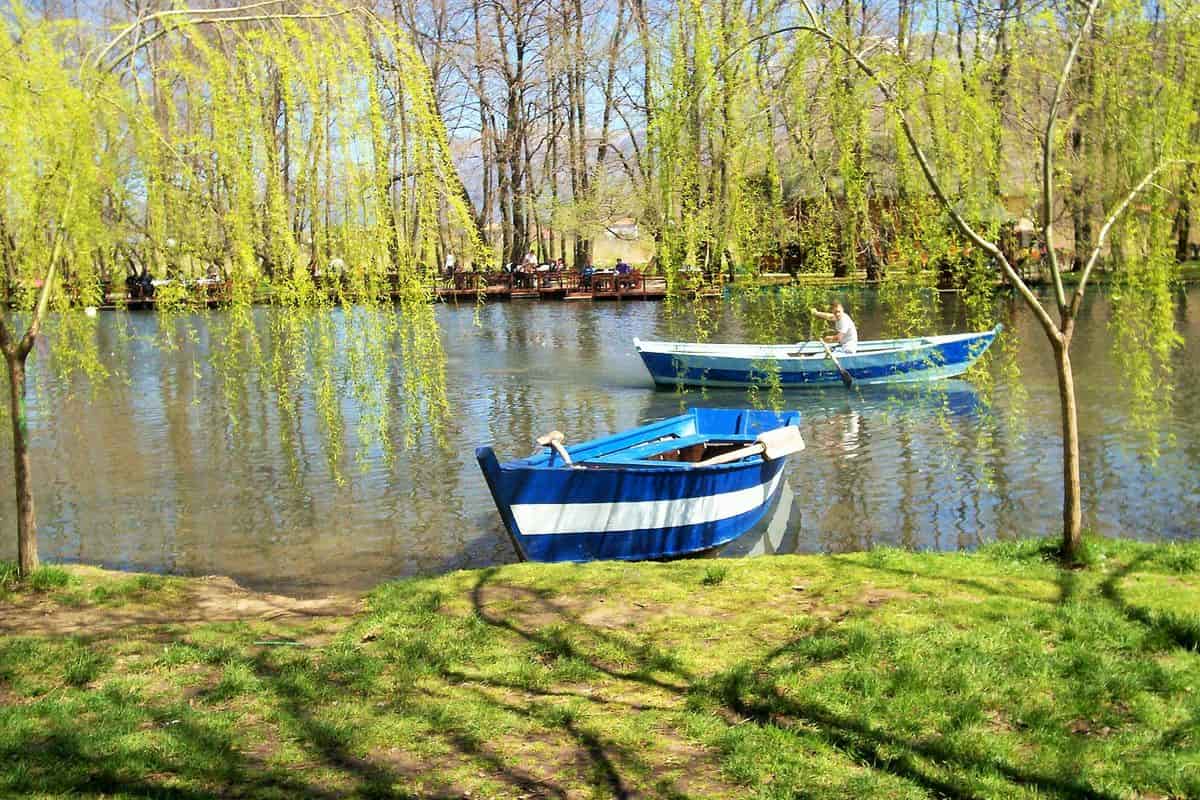
Drilon is a protected natural monument beside Tushemisht. Its large limestone spring rises vertically at the foot of a limestone block and flows into Lake Ohrid at 7 m³ per second, with water from Lake Prespa that crosses the Mali i Thatë mountain.
Pogradec tours to Drilon take 5 minutes by car or 30 minutes on foot from the centre, with boat rides at the springs. King Zog and Enver Hoxha both holidayed here, and Hoxha’s former house is now a hotel and restaurant.
Tushemisht joined Pogradec municipality in the 2015 reform and, with Pogradec, forms the tourism centre of the Albanian shore. Summer guests stay mainly in private houses in Tushemisht and Drilon, and small hotels, restaurants and beach bars have opened since the start of the millennium. The village is part of the 100 Villages rural tourism programme.
Pogradec tours with a film theme stop here too: Tushemisht was the main location of the 1976 comedy Zonja nga qyteti (The Lady from the City), directed by Piro Milkani, which shows its canals and the Drilon springs.
- Gurras: the second village beside the Drilon springs.
- Small lake: a pool in the park fed from Lake Ohrid.
- Mosaic: a listed mosaic in the village of Tushemisht.
- Beach: coarser sand than the town beach.
Which Pogradec tours go out on Lake Ohrid?
Pogradec tours on Lake Ohrid mean boat trips and canoeing from the shore and swimming off the 8 km Pogradec beach. The Albanian side holds 31% of the lake’s surface and 36% of its shoreline, inside a protected landscape set up in 1999.
Pogradec tours on the water start from the town shore, with canoes, boat trips and fishermen landing their overnight catches. The beach runs 8 km from the town pier to the eastern edge of Tushemisht, the largest lake beach in Albania, and its water is very clean.
A tourist ferry to Ohrid started on 15 June 2014, but the service is sporadic and unreliable, so Pogradec tours plan lake time from the Albanian shore. That shore runs 32 km past Memëlisht, Buqezë and Piskupat to Pogradec, with small bays and sandy shores.
Pogradec tours sail through protected water. The Pogradec Protected Landscape, established on 18 February 1999, guards land and water ecosystems. UNESCO extended its Ohrid region World Heritage Site to the Albanian part of the lake in 2019, and the lake has belonged to a transboundary biosphere reserve since 2014.
- Depth: 288 m at the deepest point, the deepest lake in the Balkans.
- Birds: common goldeneyes, red-crested pochards and black-necked grebes on the Albanian side.
- Mammals: wolf, wild cat, otter, brown bear and chamois in the region.
- Lake Day: a joint festival of Pogradec, Ohrid and Struga each 21 June.
Which Pogradec tours visit Lin and its mosaics?
Pogradec tours reach Lin, a village on a small peninsula of Lake Ohrid 22 km north of the town, to see the foundation walls and mosaics of a 6th-century early Christian Byzantine church on the hilltop above the modern village.
Excavations in 1969 brought the Lin mosaics to light and traced an Illyrian settlement from the Iron Age to the early Middle Ages. Albanian sources date the basilica and its mosaic to the 6th and 7th centuries AD. On Pogradec tours, the decoration shows animal, plant and geometric motifs in multicoloured mosaic, in a style that links Lin with Dyrrachium, Stobi and Thessaloniki.
The church is a Cultural Monument of Albania. In 2019 UNESCO extended the Natural and Cultural Heritage of the Ohrid Region to the Albanian part of the coast, where Lin stands. Pogradec tours to the village cover three monuments of the Pogradec area: the paleo-Christian church and mosaics, a Byzantine church and the prehistoric settlement of Zagradie.
Near Lin, archaeologists from Albania and Switzerland excavate a prehistoric pile-dwelling on the shore and underwater, and specialists of the University of Bern confirmed it as the oldest of its kind in Europe. Pogradec tours learn that the settlement is over 8,500 years old and predates similar Swiss sites by over 2,000 years.
Lin Beach, a small lake beach with crystal-clear water at the foot of a mountain, starts at the peninsula and has hotels and a grill. Pogradec tours add views of the lake and mountains from the hill above Lin.
- Border: Lin lies just south of the Qafë Thanë pass, a border crossing between Albania and North Macedonia.
- Treaty: The Treaty of London (1913) planned Lin for the Kingdom of Serbia, but the Conference of Ambassadors assigned it to Albania on 9 November 1921.
- Language: Lin is the only place in Albania where the Vevčani-Radožda dialect of Macedonian is spoken.
Which Pogradec tours visit the royal tombs of Selcë e Poshtme?
Pogradec tours drive 29 km northwest to the village of Selcë e Poshtme in the Mokra area, where five Illyrian royal tombs lie on the right bank of the Shkumbin river at 1,040 metres, under the acropolis of an ancient Illyrian city.
The settlement reached its height in the later Iron Age under the Illyrian tribe of the Enchele, a name thought to mean “eel people”. Strabo recorded Sesarethii as another name for the Enchele around Lake Ohrid, a variant of Dassaretii. In the 4th and 3rd centuries BC the city was the administrative centre of the Illyrian region of the Dassaretae, and from the 4th to the 1st century BC it was the royal residence of Illyrian kings.
Pogradec tours see tombs carved into the rock during the reign of those kings, in the 4th to 3rd centuries BC. Neritan Ceka excavated the site from 1969 to 1972 and traced five phases of occupation. In the 4th century BC a wall of well-cut stone ringed the acropolis, and the city covered 30,000 m2. The Via Egnatia later bypassed the city, which led to its decline.
Tomb III, the central burial, held 10 burials, and its grave goods are on display in Tirana: golden earrings, necklaces, pins and rings of the Hellenistic type, armour, spear points and 30 ceramic vessels. Pogradec tours also reach Tomb IV, the grandest of the five, with a 5 m high facade, two Ionic columns, the entablature and tympanum of a temple, and seven niches with inscriptions from the 1st century BC.
Albanian archaeologists, Neritan Ceka among them, identify Selcë e Poshtme with Pelion, where Alexander the Great attacked the Illyrians under Cleitus, son of Bardylis, and Glaukias of the Taulantii in 335 BC. Other proposals place Pelion at Zvezde near Korçë or at Goricë, and Vujčić (2021) judges the site too far from the Macedonian border, so on Pogradec tours Pelion stays a debated name.
- Tomb I: A barrel-vaulted chamber 2.10 m high with two rock-cut couches and a facade of Doric pilasters with traces of paint.
- Tomb V: An antechamber and a burial chamber built of ashlar in the shape of a Macedonian tomb, with three couch-shaped sarcophagi.
- UNESCO: Albania added the royal tombs to its UNESCO World Heritage list of proposals in 1996.
Which local food do Pogradec tours taste?
Pogradec tours taste koran, the Albanian name of the Ohrid trout (Salmo letnica), an endemic fish of Lake Ohrid and its outlet, the Black Drin, served baked or in soups, plus baked belushka, a second endemic salmonid, and homemade local wine.
Pogradec tours meet koran as a specialty of both Albanian and Macedonian cooking, and the fish tastes like a brown trout crossed with an Atlantic salmon. Extensive fishing has driven it to the verge of extinction. Its high market value means the lake rules are not always obeyed, and illegal fishing remains a problem on the Albanian side.
The rules that protect koran differ across the border. Since 2003 Albania’s state law on fisheries bans fishing during the spawning period only, with no restrictions for the rest of the year, while the government of Macedonia imposed a fishing ban from 2004. Lake regulations also set a minimal mesh size and allow only a limited number of licensed fishermen. Pogradec tours in January and February fall in the breeding time of the Salmo letnica form.
Fish lunches on Pogradec tours follow the Albanian style: fresh fish served whole, grilled, boiled or fried, dressed only with freshly squeezed lemon juice. Baked carp or eel with olive oil and garlic is widely eaten across Albania. Belushka, the Albanian name of Salmo ohridanus, is a relatively small fish that farms have bred for over 50 years, and its stock remains abundant.
A local saying goes that the Ohrid trout is born in the lake and dies in the wine, and Pogradec tours can time a meal with the town’s food festivals.
- Lake Day: On 21 June the towns around Lake Ohrid gather in a festival that showcases local delicacies.
- Fishermen’s Festival: Pogradec hosted the first Albanian Fishermen’s Festival over three nights, from 2 to 4 August, with koran at its centre.
- Koran Festival: A cultural and tourist event in Pogradec that ran for the first time on 14 September.
- Wine Fest: Every December, Pogradec families compete for the best homemade wine, with food and live music.
How do visitors reach Pogradec on Pogradec tours?
Pogradec tours from Greece cross the border at Krystallopigi, 50 km from Florina, and enter Albania at Kapshticë. The SH3 road then runs through Devoll to Korçë and on to Pogradec, 40 km beyond Korçë on the southwestern shore of Lake Ohrid.
Pogradec tours from Thessaloniki follow the E86 European route, which links Gefyra with the Albanian frontier by way of Vevi and Florina and runs on the A27 expressway between Florina and Levaia. Travellers who start on Florina tours take the EO2 road west from Florina to Krystallopigi. The Albanian post, Kapshtica, lies 9 km east of Bilisht in the Devoll municipality.
Inside Albania, Pogradec tours stay on the SH3, which also links Pogradec with Tirana, 139 km away, by way of Librazhd and Prrenjas. Wikivoyage puts Korçë 45 minutes from Pogradec by car or public transport. A bus or furgon minibus from Tirana takes 3 to 4 hours, on roads that the same guide calls largely good in the east.
Pogradec tours cannot use the railway today. Pogradec was the last station on the Tirana–Durrës–Elbasan–Librazhd–Pogradec line, but trains now terminate at Elbasan, and parts of the track beyond it lie derelict. Proposals exist to revive the line and extend it to the Greek railway network.
From North Macedonia, Pogradec tours enter Albania at Qafë Thanë or Tushemisht. Qafë Thanë is a mountain pass on the shores of Lake Ohrid, and its border post is a primary gateway between the two countries. The Tushemisht post lies 5 km from Pogradec, and travellers cross there on foot or by car.
A bus from Ohrid serves that southern route, with a stop at Saint Naum before the border. Ohrid lies 25 km from Pogradec on the far side of the lake, its airport is the closest one to Pogradec, and our Ohrid tours page covers that shore.
- Lake road: a minor road circles Lake Ohrid and carries the border crossings between Albania and North Macedonia.
- Greek frontier: the Albania–Greece border runs 282 km, from the strait east of Corfu to the tripoint with North Macedonia.
- Border village: Krystallopigi was resettled with Aromanians from Epirus after the Greek Civil War and counted 145 residents in 2021.
- Route history: the E86 dates from 1983 and has ended at Gefyra, not Thessaloniki, since 12 September 1986.


When do Pogradec tours run best?
Pogradec tours run best from June to September, the season for swimming in Lake Ohrid and for the town’s summer festivals. Pogradec sits 700 m above sea level under a mountain Mediterranean and partly continental climate, with hot, dry summers and cold winters.
Pogradec tours meet a mean annual temperature of about 12.3 °C, with January the coldest month and August the hottest. November is the wettest month, at 108 mm of rain on average, out of a yearly total of 730 mm. Around the lake, the climate counts as local-continental, a microclimate under Mediterranean influence.
Summer Pogradec tours centre on the water. Springs under the surface feed the lake with cool, oxygen-rich water, and its clarity reaches down to 22 m. Beach volleyball takes over the town in summer, and teams from Albania and other Balkan countries play a championship that lasts about two weeks.
Evenings on Pogradec tours stay fresh even in midsummer. Albania’s interior basins see very high daytime maximums, but their nights are almost always cool. Wikivoyage advises a jacket for morning coffee and a swimsuit for the afternoon beach, and notes that a quilt is normal bedding in the middle of summer.
Winter Pogradec tours trade swimming for birdwatching. The lake’s reed beds and wetlands shelter hundreds of thousands of wintering water birds, among them the Dalmatian pelican and the ferruginous duck. The Albanian shore forms an Important Bird Area for coots and pygmy cormorants among other species.
- Dita e Verës: 14 March, a spring festival of bonfires and family gatherings.
- Puppet Theater Festival: every June, with participants from national to European level.
- Lake Day: 21 June, a festival shared by the towns around Lake Ohrid.
- Balkan Film Food Festival: September, with Balkan films, documentaries and cooking.
Frequently Asked Questions
Which travel documents do visitors need for Pogradec tours?
Albania asks every visitor for a passport valid for at least 3 months, and citizens of certain countries can enter with a national ID card instead. Nationals outside the visa-exempt list apply for an e-Visa. Holders of a residence permit from any Schengen Area state can stay without a visa for up to 90 days within any 180-day period.
Which currency do visitors use on Pogradec tours?
Visitors on Pogradec tours pay in the Albanian lek, code ALL and sign L. Albania introduced the lek in February 1926 as its first national currency, and it was historically divided into 100 qindarka. Before that, in 1923, the Greek drachma circulated at Korçë, while Italian paper money circulated at Shkodër, Durrës, Vlorë and Gjirokastër.
What time zone do Pogradec tours follow?
Albania keeps Central European Time, UTC+01:00, while Greece keeps Eastern European Time, UTC+02:00. Both countries move their clocks one hour ahead from the last Sunday in March to the last Sunday in October, so watches go back one hour on entering Albania from Greece. Albania adopted CET in 1914, and Greece adopted EET in 1916.
Which Roman road crosses the area of Pogradec tours?
The Via Egnatia, the Roman road from Durrës on the Adriatic through Thessaloniki on the Aegean to Byzantium, passed through the Pogradec region, and the whole road covered about 1,120 km.
Can Pogradec tours add a day in Shebenik-Jabllanicë National Park?
Yes. Wikivoyage places the edge of the park 45 minutes from Pogradec, about 50 km to the north. Shebenik covers 34,507.9 hectares of mountains between 300 m and over 2,200 m, with 14 glacial lakes. Brown bears, gray wolves and the rare Balkan lynx live there, and researchers took the first photo of a live lynx in the park on 21 April 2011.