
Korce tours start in Korçë, the largest city of eastern Albania and the seat of Korçë County, on a plateau close to the Greek border at Krystallopigi. The routes cover the Old Bazaar, the museums, the cathedral and the Mirahori Mosque, the brewery, and the villages of Voskopojë, Dardhë and Vithkuq. Greece Tours lists the trips that cross into Albania from Florina and Kastoria.
This page covers what Korce tours see in the city and the villages, which tours climb Mount Morava and reach the prehistoric sites, how visitors reach Korçë from Greece and Tirana, and which season suits each route. The tours below are checked on GetYourGuide and Viator and leave from Korçë, Pogradec, Tirana and Ohrid.
What do Korce tours cover?
Korce tours cover Korçë, the largest city of eastern Albania, on a plateau 850 m above sea level ringed by the Morava Mountains. The routes take in the Old Bazaar, the museums, the cathedral and mosque, the brewery and the mountain villages around the city.
Korçë, Korça in its definite form, is the eighth largest city of Albania by population and the seat of Korçë County. The city counted 51,152 people at the 2011 census, and the municipality around it 75,994 across 806 km². Korce tours start in a city known as the intellectual capital of southern Albania and as the city of museums.
The city goes by other names across the region. Greeks call it Korytsa, the Aromanians Curceaua, the Italians Coriza and the Turks Görice. The current name is of Slavic origin, from gorica, meaning hill, a diminutive of gora, mountain, and Korce tours hear the same root in place names such as Podgorica in Montenegro.
The Greek border lies close to the east. The crossing at Kapshticë faces Krystallopigi, a village of the Florina regional unit 50 km from the town of Florina, which has its own Florina tours page. Korce tours from Greece start on that road, while the city also links by road with Tirana, Pogradec and Berat.
- Altitude: 850 m, on a plateau below the Morava Mountains.
- Population: 51,152 in the city at the 2011 census.
- County: the seat of Korçë County in south-eastern Albania.
- Consulates: Greece and Romania both keep consulates in the city.
Korce tours combine the city on foot with day trips by car, because the old villages of Voskopojë, Dardhë and Vithkuq and the slopes of Mount Morava all lie within a short drive of the centre.
What do Korce tours see in the Old Bazaar?
Korce tours walk through the Old Bazaar, an Ottoman-era market established about 500 years ago and rebuilt in 1879 after an extensive fire. It holds 138 first-category culture monuments, among them old shops, guesthouses and the inns known as hans.
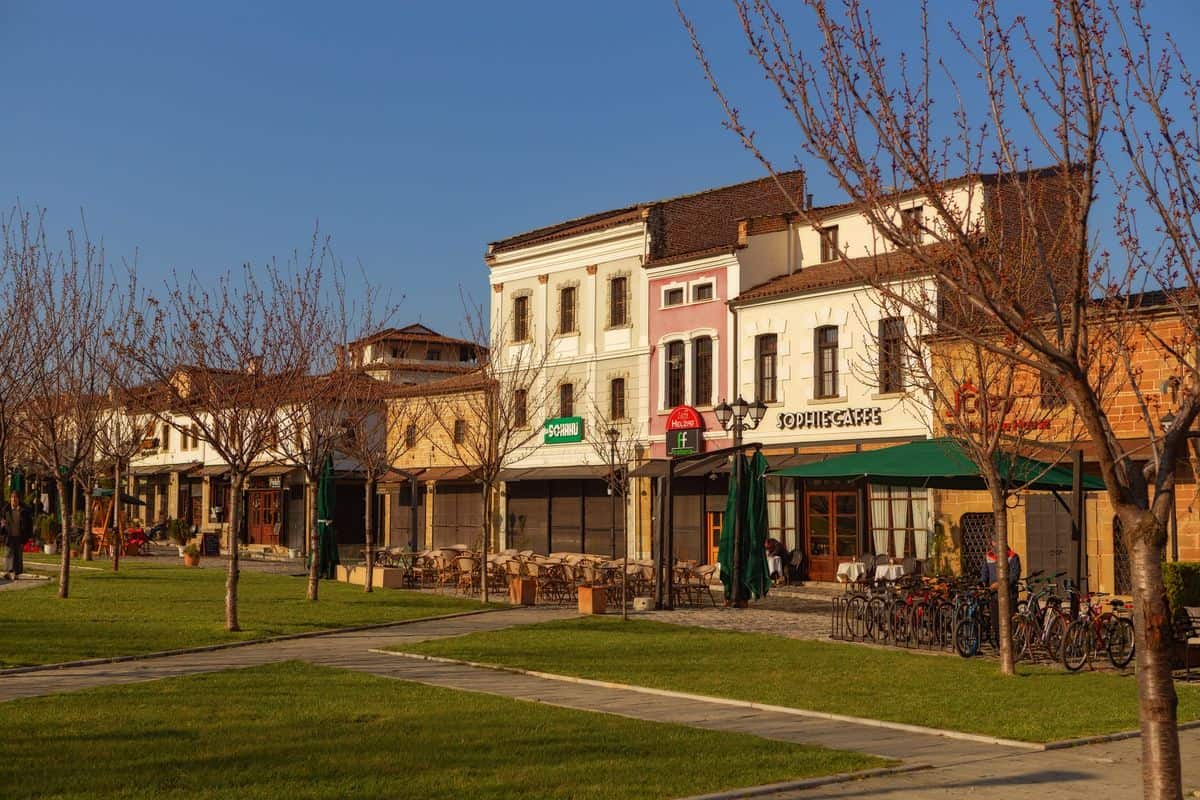
The bazaar, together with the Mirahori Mosque, forms the urban core of Korçë. Its buildings mix Ottoman and Roman architectural styles, and for centuries they served as shops, guesthouses and khans. The Old Bazaar played a dominant role in the market history of Albania, and Korce tours treat it as the place where the story of the city begins.
Locals also call it the Bazaar of the Serenades. The name recalls the songs that people composed and sang for centuries while walking with a guitar over its round cobblestones, and Korce tours learn that serenata songs remain the musical signature of Korçë.
A large restoration turned the bazaar into a hub for visitors. The project, announced in 2015, was financed by the Albanian Development Fund and the Albanian American Fund for Development, and Korce tours now find a mix of modern and traditional shops in the restored streets.
- Crafts: wooden, copper and stone decorations made by local artisans.
- Textiles: traditional woollen rugs and embroidery.
- Workshops: antique shops and a blacksmith at work.
- Market: a daily fruit and vegetable market in the morning.
Korçë has a long record as a centre of handmade rugs with their own motifs and symbols, and Korce tours that end in the bazaar find those patterns in the textile shops.
Which museums do Korce tours visit?
Korce tours visit the National Museum of Medieval Art, with more than 7,000 items, mainly icons, the National Museum of Archaeology, the Bratko Museum of Oriental Art and the Gjon Mili Museum of Photography, all within walking distance of the centre.
The National Museum of Medieval Art opened on 24 April 1980 and stands on Fan Noli Boulevard in the south-east of the city. Its building was reconstructed in 2016 with the city and a fund of the Greek Government. Korce tours see works by anonymous painters of the 13th and 14th centuries and by masters such as Onufri, Onufër Qiprioti, Teacher Kostandini, Jeromak Shpataraku, David Selenica and the Zografi Brothers.
The Archaeological Museum holds about 1,200 artefacts, mainly from the prehistoric period, and prepares Korce tours for the burial mound at Kamenica outside the city. The residence and gallery of the painter Vangjush Mio also work as a museum.
The Bratko Museum opened in June 2003 as the first museum of Asian art in the Balkans. It holds the collection of George Dimitri Boria, an Albanian-American photographer who spent 14 years in post-war Japan as a photographer for General Douglas MacArthur, and it carries the name of his mother, Viktoria Bratko, who waited for him in Korçë. On 1 December 2020 the museum received the Commendation of the Japanese Foreign Minister for promoting Japanese culture in Albania.
The Gjon Mili Museum of Photography, in a building known as the Romanian House, shows 240 photographs by one of the great photographers of the 20th century, born in Korçë in 1904. Korce tours with an interest in photography end the museum walk there.
Which churches and mosques do Korce tours see?
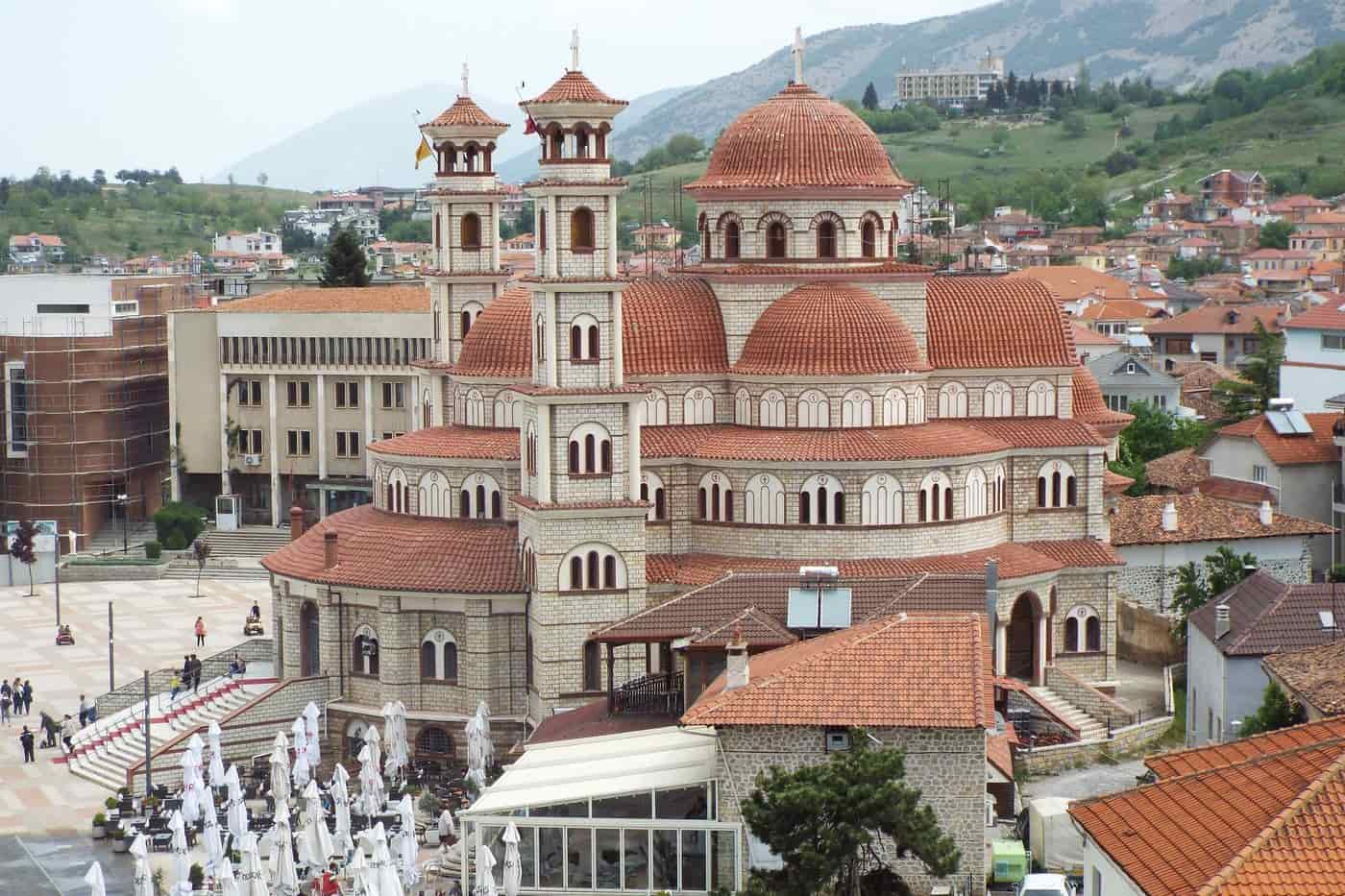
Korce tours see the Resurrection of Christ Cathedral, the main Albanian Orthodox church of the city, painted in pink, blue and brown, and the Mirahori Mosque, built in 1494 and 1495 by Iljaz Bey Mirahori, the founder of the town.
The cathedral was built in 1995. Inside, a modest white interior is dominated by a huge carved wooden iconostasis. It replaced an earlier cathedral named after Saint George, a city landmark that the Communist authorities destroyed in 1968 during their campaign against religion, and Korce tours meet the new building on Demokracia Boulevard in the centre.
The Mirahori Mosque is one of the oldest in Albania, second only to the Sultan’s Mosque of Berat. An inscription over the entrance dates it to 1494 and 1495. It has a square prayer hall under a single dome, a three-domed porch and finely crafted cloisonné masonry, and Korce tours learn that its minaret, lost in an earthquake in the early 1960s, was rebuilt after 2006.
The mosque was the core of a larger complex with an imaret, a bakery, storage rooms, a han, a hamam and a school. According to the writer Sami Frashëri, it stands on the foundations of an earlier monastery of Saint Paraskevi, and Albania lists it as a religious Cultural Monument.
- St. Sotir Church: the church of the Aromanian community, built from 1995 to 2005 on the site of a church of 1925.
- Turan Teqe: the main centre of the Bektashi community of the area.
- Bishopric: the seat of an Orthodox bishop from the early 17th century, a metropolis from 1670.
Korce tours that compare the two buildings see five centuries of the city’s faiths side by side, from the Ottoman mosque of the founder to the Orthodox cathedral of the 1990s.
What do Korce tours see at the first Albanian school?
Korce tours stop at Mësonjëtorja, the first secular school in the Albanian language in Ottoman Albania, which opened on 7 March 1887. Its building on St. George Boulevard is now the Museum of Education, and Albanians mark the date as Teachers’ Day.
The school grew out of the Albanian National Movement. In 1885 Naim Frashëri, a civil servant in the Ottoman education ministry, his brother Sami Frashëri and other members of the Society for the Publication of Albanian Writings won permission from the sultan for a private Albanian elementary school for boys in Korçë. Korce tours learn that lessons in Albanian had until then been given only in private and in secret.
Money came from Drita, meaning the Light, an Albanian society based in Bucharest, and Albanians in Istanbul sent Pandeli Sotiri to run the school as its first director. For lack of books, the Frashëri brothers and other writers wrote the first Albanian textbooks for it. Pandeli Sotiri left Korçë in 1887, and the school passed to Petro Nini Luarasi and Thanas Sina.
The Ottoman permit covered only Christian children, but the founders admitted Muslim children as well, and in its first years the school had about 200 pupils of both faiths. Korce tours also hear of the first Albanian school for girls, opened in 1891 by Sevasti Qiriazi with her sister Parashqevi Qiriazi and Polikseni Luarasi.
- Opening day: 7 March 1887, kept as Teachers’ Day across Albania.
- Founding society: Drita of Bucharest, with support from Istanbul.
- Alphabet: Naum Veqilharxhi created an Albanian alphabet around 1850 that briefly flourished in Korçë.
- Closure: the Ottoman authorities closed both the boys’ and the girls’ schools between 1902 and 1904.
The museum shows documents of the school and the history of the Albanian language, so Korce tours that start there understand why the city is called the intellectual capital of the south.
What do Korce tours see on the boulevards and in the old quarters?
Korce tours walk the boulevards and the old quarters of a city known for its low houses and villas on cobblestone streets. The walk links St. George Boulevard, Fan Noli Boulevard, the Rinia park and the Andon Zako Çajupi Theatre, the city theatre since 1950.
The city is easy to see on foot, with its churches, historic buildings and cultural sites close to each other. The Visit Korça Region Info Center on St. George Boulevard runs walking tours of the city and organises skiing, hiking and biking trips, and Korce tours by bicycle are possible because bikes can be rented in town.
Parku Rinia, the main park, fills with couples and families in summer. Locals keep the Albanian tradition of xhiro, a slow evening walk around the centre and the pedestrian streets, and Korce tours that end at dusk join the same stroll.
The Andon Zako Çajupi Theatre, named after the writer and playwright, opened in 1950 with 10 professional and 15 amateur actors and has worked without interruption since. It was reconstructed in 2016 as a modern theatre, and its stage has carried Othello, Besa, 8 Femmes and The House of Bernarda Alba.
- KOKO Fest: the Korça Comedy festival, held at the theatre since 2013.
- Digital art: the Gallery of Digital Art in Korçë, with immersive installations.
- Painters: the city is the birthplace of Androniqi Zengo Antoniu and Sofia Zengo Papadhimitri, the first women in Albania to work as professional painters.
- Icon painting: their father, Vangjel Zengo, was a noted icon painter.
Korce tours that cover the boulevards in one walk pass the cathedral, the museums and the brewery on the same route, since Fan Noli Boulevard holds both the medieval art museum and the Bratko Museum.
Which Korce tours visit the brewery and the Beer Festival?
Korce tours visit Birra Korça, founded in 1928 as the first brewery of Albania, on Fan Noli Boulevard. The brewery hosts a beer festival every August, the largest in the region, and draws its water from the natural springs of Morava Mountain.
An Italian investor, Umberto Umberti, and a local investor, Selim Mboria, founded the company with an initial capacity of 20,000 hectolitres a year. Its first range included a Blonde Ale, a Dark Ale, bottled water named Kristal and ice. The first award came in 1928 in Thessaloniki, an early link with Greece that Korce tours from the Greek side still mention.
After the communist regime took power on 11 January 1946, the brewery became state property, and it was rebuilt and renovated in 1955, 1957 and 1965. A group of businessmen bought it at auction in April 1994, and since 2004 it has belonged to the IHB group under Irfan Hysenbelliu, who renovated it with Czech and Italian technology.
The brewery now produces 120,000 hectolitres of beer a year, ten times the output of the original plant, while keeping its traditional design. It is the third largest beer producer in Albania, and Korce tours meet its two classic beers:
- Blonde Ale: a European-style pilsner of 4.8 to 5% alcohol.
- Dark Ale: a Euro dark lager, or dunkel, of 5 to 5.2% alcohol.
- Formats: 0.5-litre and 0.33-litre bottles and 30-litre and 50-litre kegs.
- Festival: a week of tastings, music and food in early August.
Korce tours timed for August combine the festival with the city walk and the bazaar.
Which local food do Korce tours taste?
Korce tours taste lakror, the regional Albanian pie that Korçë and its surroundings keep as a local specialty. Thin layers of filo dough wrap fillings of vegetables or meat, and the pie is baked in a saç, a pan covered with hot embers.
The name comes from the Albanian word lakër, meaning cabbage or leafy vegetable, the original filling of the pie. Fillings now include cabbage, nettle, spinach, orache, squash, onions and leeks, as well as beef or lamb, tomato with onion or pepper, and spinach with cheese or eggs. Korce tours learn that women have traditionally made the dough by hand, rolling it into thin layers.
A richer version, brushtul lakror, uses eggs, butter and a filling of feta and cottage cheese. Orthodox Albanians also prepare lakror to commemorate Saint Basil’s day, and Albanian communities in southern Italy, south-western North Macedonia, the United States and Australia keep the pie as well.
The city celebrates the dish each summer. The municipality organises the Lakror Festival, held in Korçë or in a village of the wider area, where cooks bake lakrors in the saç for locals and visitors, and Korce tours in summer plan a stop there.
- Lakror: the signature pie of Korçë, savoury and baked under embers.
- Byrek: the related filo pastry, celebrated at the same festival.
- Raki and meze: a tasting dinner in Korçë pairs seven raki with local meze.
Visitors compare lakror to a byrek pastry or to an American pie, and Korce tours treat a slice of it as the taste of the city.
Which Korce tours go to Voskopojë?
Korce tours go 21 km to Voskopojë, known as Moscopole, a mountain village at 1,160 m that was the cultural and commercial centre of the Aromanians in the 18th century. At its peak it ran the first printing house in the Ottoman Balkans outside Constantinople.
In the middle of the 17th century its people were still largely herders who moved their flocks from summer pastures at Moscopole to the Sanjak of Avlona in winter, but by 1728 the geographer Meletios, writing at its peak, called it a town. The printing press was founded by the monk Georgios Konstantinidis and produced religious literature and school textbooks in Greek. The town also had an Academy, the Hellenikon Frontistirion, sponsored by wealthy foreign merchants, which became a leading centre of learning for Orthodox Christians in the western Balkans, and Korce tours hear that its high level of learning earned it the nicknames New Athens and New Mystra.
The town kept an orphanage, possibly the first in the post-Byzantine Orthodox world, a hospital and a total of 24 churches. In 1770 the priest Daniel Moscopolites published here the first dictionary of four modern Balkan languages, Greek, Albanian, Aromanian and Bulgarian, and the merchants of Moscopole traded in Greek as the language of regional commerce.
The decline came with raids. Irregular bands attacked and nearly destroyed the town in 1769, and the troops of Ali Pasha of Ioannina razed it in 1788. The flight of its people made Moscopole the original homeland of much of the Aromanian diaspora, and Korce tours learn that its trade shifted in part to Korçë itself.
- Distance: 21 km from Korçë by road.
- Altitude: 1,160 m in the mountains of south-eastern Albania.
- Population: 1,058 at the 2011 census.
- Monastery of Saint Prodrome: built in 1630, according to its own codex.
Today Voskopojë is a small mountain village that local Orthodox Christians, along with a handful of nearby settlements, regard as a holy place. Korce tours that combine the city walk with a Voskopojë visit run as one guided tour from Korçë.
Which Korce tours visit Dardhë?
Korce tours visit Dardhë, a mountain village 18 km from Korçë in the former municipality of Drenovë, whose name means pear and which has been a ski area since the 1920s. The first ski tow in Albania opened in 2012 at the Bigell Ski Resort nearby.
Orthodox Albanians fleeing into the mountains to avoid the Ottoman administration founded Dardhë after the death of Skanderbeg. Unlike the villages of the Gramos mountains, it suffered no serious destruction under Ottoman rule, and Korce tours walk through a village that escaped the destruction of its neighbours.
Education came early. A Greek school was founded in 1810 by Ikonomou Isidoros, and in the school year 1901 to 1902 a total of 150 pupils attended the Greek schools, supported by the community fund and the local church. The first Albanian school opened in 1917 with 20 pupils, on the initiative of Leonidha Çika and with money from Vatra.
Dardhë has a long history of emigration. Families from the village formed the first Albanian communities in the United States and Romania, and Sotir Peçi, Josif Pani and Gjergj Konda helped unite the Albanian-American societies into a single federation, Vatra. Korce tours meet a village that now lives mainly on visitors from inside Albania.
- Zografi brothers: Kostandin and Athanas Zografi, 18th-century painters from Dardhë who worked in Ardenica Monastery, Vithkuq, Moscopole and Mount Athos.
- Polycarpos of Larissa: an Orthodox bishop of Larissa who died in 1821.
- Thomas Nassi: a musician born in the village.
- Churches: Shën Pjetër and Shën Gjergji, the two churches of the village.
- Earth Day Festival: an annual festival of the environment, music and food in April.
The Albanian politician Edi Rama has family roots in Dardhë, and Korce tours in winter come for the ski slopes above the village.
Which Korce tours visit Vithkuq?
Korce tours visit Vithkuq, a village that was a centre of culture and trade in the 17th and 18th centuries on the road between Berat and Korçë. Tradition dates its first church, Saint Athanasios, to 1162, and churches and monasteries of its prosperous era survive.
Vithkuq was one of the seven villages of the Korçë area that Sultan Bayezid II granted in 1484 to Ilias Bey Mirahori, the founder of Korçë. A 19th-century report by Thimi Mitko for the French consul of Thessaloniki recorded that the village had 8,000 inhabitants at the fall of Constantinople, and Korce tours find a far smaller settlement today, with 1,519 people at the 2011 census.
The village shaped the schools of the region. In 1724 its residents sponsored the founding of the first Greek school in Korçë, and the village gave its name to the Vithkuqi script, a particular Albanian alphabet. Naum Bredhi, known as Veqilharxhi, whose family stayed in Vithkuq after its decline, became the first figure of the Albanian National Awakening.
At the end of the 18th century raids destroyed Vithkuq along with other settlements of the region, and families moved away to Macedonia and Thrace. In 1792 it still had twelve neighbourhoods, from Borisha and Tataçi to Rusasi and Dukasi, and Korce tours learn that the first hydroelectric plant of Albania was built here in 1936.
- Former municipality: Vithkuq, Leshnje, Gjanc, Lubonjë, Rehovë, Roshanj, Trebickë and six more villages.
- Residents today: Orthodox Albanians and Aromanians, who settled after earlier inhabitants left.
A five-day tour of the hidden places of the Korçë region is listed under Vithkuq, so Korce tours with more time take in the village as part of a longer route.
Which Korce tours climb Mount Morava and visit Drenovë?
Korce tours climb Mount Morava, the range that rings the city, 18 km from the centre, for views over Korçë and its surrounding landscape. On the way they visit the Fir of Drenovë National Park, with fir trees hundreds of years old, and Drenovë.
The Morava Mountains surround the plateau on which Korçë stands, and their trails cross a landscape known for its varied flora and fauna, with panoramic views from the top. Korce tours reach the start of the trails by car or van, since the mountain and the nearby parks lie outside the walking range of the centre.
The Fir of Drenovë National Park protects a forest of ancient fir trees near the city. It offers clean air and quiet surroundings in a mountain ecosystem, and Korce tours treat it as the green half of a day that starts in the bazaar.
The village of Drenovë gave the park its name and was the home of the poet Aleksandër Stavre Drenova, the author of the national anthem of Albania. Its Aromanian name is Ndãrnova. The French cartographer Alexandre Synvet counted 660 Greek Orthodox inhabitants there in 1878, and Georgi Traychev recorded 140 households and 678 inhabitants in 1911.
Linguists of the early 20th century recorded a local Slavic dialect in Drenovë and in nearby Boboshticë, and families from the village of Cerja in the Pustec municipality later settled in Drenovë. Korce tours that pass through the village meet a mixed community of Orthodox Albanians and Aromanians.
Which Korce tours visit Mborje and Boboshticë?
Korce tours visit Mborje, a south-eastern suburb of the city with the Holy Resurrection Church of 1389, and Boboshticë, a village of the former Drenovë municipality whose churches date back to the 13th century and to 1503, with a Greek donors’ inscription.
On Korce tours, the Holy Resurrection Church of Mborje, known in Albanian as Kisha e Ristozit, dates from 13 November 1389 and is one of the leading cultural monuments of the settlement. The old castle of Mborje dominated the new town of Korçë at the end of the 15th century, and the Ottomans maintained it through the 15th century and into the 16th.
An Ottoman register of 1519 records a community of Christian müsellems in the castle and counts 88 Christian and 18 Muslim households in the village. Korce tours also hear the names of two sons of Mborje: Dhimitër Mborja, a signatory of the Albanian Declaration of Independence, and Thanas Viso Mborja, an activist of the Albanian National Awakening.
Korce tours hear that Boboshticë has a Slavic name, Bubushtitsa in Aromanian, and a legend that Polish settlers left behind after a Crusade founded it. Its church of Saint John the Forerunner is believed to date from the 13th century and was rebuilt and expanded later. In 1503 a new church went up in the nearby monastery of Saint Nicholas, where a Greek inscription on the western wall names the donors Bogdan, Chelko, Valcho and Telche.
- Paintings: the frescoes of the Saint Nicholas church were a gift of Petros Chartophylax.
- Village council: a council of elders, led by a member of one of the richest families.
- Neighbourhoods: five in 1873, from Popchìshche and Chelkoveàne to Bùnar and Dòlno Bùnar, with 150 houses.
- Greek War of Independence: six men of the village fell at the Siege of Messolonghi.
Boboshticë opened a Greek elementary school by 1873 and added a kindergarten in 1888, and in 1873 the villagers named its rivers the Big River, the Little River and the Pòvrok, as Korce tours hear in the village.
Which Korce tours visit the prehistoric sites?
Korce tours visit the Kamenica Tumulus, 8 km from Korçë on the southern side of the plain, the largest burial monument of its kind among 200 tumuli excavated in Albania and its Balkan neighbours, with its own museum of prehistory.
Korce tours learn that the central grave dates from the 13th century BC, in the Bronze Age, and two large concentric circles surround it, unlike any other tumulus found in Albania. The mound grew to 40 graves in the Late Bronze Age, from 1200 to 1050 BC, and to 200 in the Early Iron Age, from 1050 to 750 BC, until by the 7th century BC it took an elliptical shape of 70 by 50 m.
Excavations from 2000 to 2002 by the Albanian Institute of Archaeology, the Albanian Rescue Archaeology Unit and the Museum of Korçë found more than 400 graves, 440 skeletons and 3,500 archaeological objects. One grave held the skeleton of a pregnant woman and her unborn child, dated to 3000 BC, and Korce tours see two replica graves with original remains in the museum.
The museum is a wooden building in portico style, with panels on the excavation. A highlight is the illustration of surgery on a male skull performed in the 6th century BC, evidence of advanced medical knowledge in the community that lived here. The site hosts classical concerts, and every year on 29 September it celebrates the National Cultural Heritage Day of Albania.
- Maliq: a town 14 km from Korçë with early Bronze Age sites.
- Maliq IIIa: pottery designs influenced by the styles of Bronze Age Greece.
- Bridge and paths: a stone bridge, a wall and lime paths built in 2007 to lead visitors to the mound.
Maliq grew in later times around a sugar-beet factory built in 1951 with Soviet aid, and the factory closed in the 1990s; Korce tours that cover the plain pass both its prehistoric sites and its industrial past.
What history do Korce tours tell?
Korce tours tell how Ilias Bey Mirahori, an Ottoman Albanian nobleman born in Panarit, founded the town at the end of the 15th century, and how it grew into a trading city of Orthodox and Muslim quarters that stayed under Ottoman rule until 1912.
Korce tours learn that Ilias Bey was Master of the Stables to Sultan Bayezid II and took part in the Ottoman capture of Constantinople as the first equerry and conqueror of Psamathia. In 1484 the sultan rewarded him with seven villages of the area, Leshnjë, Vithkuq, Peshkëpi, Boboshticë, Panarit, Treska and Trebicka, granted through four decrees. A decree of 1497 set the bounds of the locality of Piskopiye between Mborje, Barç and Bulgarec, the ground of today’s city.
The town split into two great neighbourhoods. Christians lived in Varosh, divided into Upper and Lower Varosh, while the Muslim quarter of Kasaba, with its smaller districts of Çarshi, Ratak, Qoshk and Dere, held the institutions of Ilias Bey. In the 16th century Muslims made up 21% of the population, and Korce tours still walk the streets of both old quarters.
The city grew fast in the 19th century. The French diplomat François Pouqueville counted 1,300 families in 1805, two thirds of them Christian, and the population rose from 8,200 in 1875 to 18,000 in 1905. Aromanian merchants in commerce, crafts and international trade became one of the wealthiest communities of Epirus and Macedonia, and the townspeople spoke both Albanian and Greek.
- Greek education: a school for girls was operating by 1857, and 2,115 pupils attended Greek schools on the eve of the Balkan Wars.
- Lasso fund: set up in 1850 by the Orthodox bishop Neophytos to support Greek cultural life.
- Emigration: Orthodox craftsmen left for Romania, Greece and Bulgaria, Muslims for Istanbul, and late in the century families left for the United States.
- End of Ottoman rule: Greek forces took Korçë from the Ottomans on 6 December 1912, and the city became part of Albania in 1913.
Under the communist government after the Second World War, Korçë added a large industrial base to its role as a trading and farming centre, a legacy that Korce tours still see in the city.
What do Korce tours tell about the French years?
Korce tours tell how French troops took Korçë on 29 November 1916, during the First World War, and set up the Autonomous Albanian Province of Korçë, which lasted until 1920. Its legacy includes the French Lyceum and a French military cemetery with 640 crosses.
The city came under French control because of the Macedonian Front. Fourteen representatives of Korçë and the French Colonel Descoins signed a protocol that proclaimed the province under the military protection of the French army, with Themistokli Gërmenji as Prefect of Police, a period that Korce tours trace through its schools and its cemetery.
Korce tours hear that the new authorities made Albanian and French the official languages. Across the region 200 Albanian schools opened, among them four primary schools and one secondary school in the city itself, and a plebiscite showed that voters wanted the Albanian schools to stay open. Months later the Greek schools reopened as well, after Greece joined the Entente alongside France.
The opening of the Albanian National Lyceum in 1917 was the lasting step of those years, and the building, known as the French Lyceum, still stands on Sotir Gura Street. The French school in Korçë counted Enver Hoxha, the future communist leader of Albania, among its students and later among its teachers.
- French Military Cemetery: on Rilindasit Boulevard.
- Graves: 640 crosses for French soldiers who died there in the First World War.
- Languages: Albanian and French, both official under the province.
- Duration: from 1916 to 1920.
Korce tours that follow the French years end at the cemetery, the last trace of the Macedonian Front in the city.
Which festivals, music and sport do Korce tours catch?
Korce tours catch the largest carnival in Albania, held each year before Orthodox Easter, and the serenata songs for which the whole city is known. Football fans follow Skënderbeu Korçë, the city club founded in 1909 and Albanian champion eight times.
Korçë and its surroundings are culturally distinct among the ethnographic regions of Albania and keep a rich variety of traditional and urban music. The local songs, the serenata, are the sound of the city that Korce tours carry home.
The carnival brings parades, costumes and music to the streets before Orthodox Easter, a tradition that dates back 40 years. It is the largest carnival in the country, and Korce tours timed for the weeks before Orthodox Easter join it.
Korce tours with football fans learn that Skënderbeu Korçë was formed on 15 April 1909 under the name Vllazëria by the politician and poet Hilë Mosi. The club won the Albanian title in 1933 and again in 2011, 2012, 2013, 2014, 2015, 2016 and 2018. In 2015 it became the first Albanian side to reach the play-off round of the UEFA Champions League, where it lost to Dinamo Zagreb, and the first Albanian club to reach the group stage of a European competition, in the Europa League.
- Stadium: Stadiumi Skënderbeu, 1 km north of the centre, with 12,300 seats.
- Serenata: the traditional song of Korçë, sung with a guitar.
Korce tours on a match day add the stadium to the city walk, since it lies within easy reach of the boulevards.
How do visitors reach Korce on Korce tours?
Visitors from Greece reach Korce tours over the Krystallopigi and Kapshticë border crossing, a major road crossing between the Florina regional unit and Albania. From the Albanian side the road runs through Bilisht, 9 km west of the border, on the way to Korçë.
Krystallopigi, called Smardesi until 1926, takes its modern name from a crystal spring. An Ottoman register of 1530 lists it as Ismirdesh with 53 households, it had 1,780 inhabitants in 1900, and its church of St. George was built in 1891. After the Greek Civil War, Aromanians from Epirus resettled the village, and they still form the majority of its people. It belongs to the municipality of Prespes, and its land borders the Kastoria regional unit to the east and south-east, so the crossing is the natural route from Kastoria, the lake town covered on our Kastoria day trip from Thessaloniki page.
Bilisht is the seat of the Devoll municipality and the south-easternmost city of Albania, at an average altitude of 925 m, second only to Ersekë among the high towns of the country. It had 7,287 people at the 2023 census and holds the tomb of the Sufi saint Qazim Baba, and Korce tours from Greece pass it on the way to the city.
Inside Albania, Korçë lies 175 km from Tirana and about 40 km from Pogradec. The car is the easiest way to arrive, and drivers from Tirana choose between the old road and the new one from the Elbasan Highway. Vans called furgons run to Tirana and Pogradec, buses leave for Sarandë in the early morning from the central bus depot opposite the bazaar, and a bus links the city with Berat.
- Border: Krystallopigi in Greece, Kapshticë in Albania.
- First town: Bilisht, in the Devoll valley.
- From Tirana: 175 km by the old road or the Elbasan Highway.
- From North Macedonia: day tours from Ohrid that take in Pogradec and Korçë.
Korce tours from the north start on the Macedonian shore of the lake, and that lake town has its own Ohrid tours page.


When do Korce tours run best?
Korce tours run best from late spring to early autumn, when the plateau is warm and dry. Korçë has an average yearly temperature of 10.4 °C, August averages 21.3 °C, January averages −0.8 °C, and rain falls mainly in winter.
The city lies on the edge of the warm-summer Mediterranean climate, close to the continental type. It receives about 766.7 mm of rain a year, with a minimum in summer and a maximum in winter, and about 2,800 hours of sunshine. Because of its altitude, Korçë stays cooler than western Albania, and Korce tours in the heat of August find milder days than on the coast.
The festivals fill the warm months, while Korce tours in winter turn to the museums of the city and the ski slopes of the mountain villages.
The border area shares the climate of the plateau. Bilisht, at 890 m, has a continental climate with cool summers and cold winters, the same pattern that Korce tours from Greece meet at the border.
Frequently Asked Questions
Is Korçë twinned with Thessaloniki on Korce tours?
Yes. Korçë is twinned with Thessaloniki in Greece, as well as with Los Alcázares in Spain, Cluj-Napoca in Romania and Mitrovica in Kosovo, and it cooperates with Verona in Italy and Wolfsberg in Austria. Korce tours that start in Thessaloniki therefore link two partner cities on either side of the border.
Is there a university on the route of Korce tours?
Yes. Fan Noli University, founded in 1971, offers degrees in the humanities, the sciences and business, and its schools cover agriculture, teaching, business, nursing and tourism. In 2009 a madrassa, an Islamic high school, was also built in the city, run by the Muslim Community of Albania, so Korce tours meet a city of students of more than one faith.
Do Korce tours meet a Greek community in the city?
Yes. Korçë was one of the two main centres of the Greek minority in southern Albania, with Gjirokastër, and a Greek minority still lives in the city. The first bilingual Greek and Albanian school opened in April 2005, after 60 years without Greek education, and 17 Greek language tutoring centres now work in Korçë.
Which other communities do Korce tours meet?
Aromanians live mainly in one neighbourhood, hear the liturgy in Aromanian and keep links with Romania and Greece. Romani families live in the Kulla e Hirit neighbourhood, having come in the early 20th century from Turkey by way of Florina. The city is a centre for Orthodox, Sunni and Bektashi believers, with smaller Catholic and Protestant groups.
Which industries do Korce tours pass in the city?
Local industries include knitwear, rugs, textiles, flour-milling, brewing and sugar-refining. Official reports place the unemployment rate of Korçë among the lowest in Albania, and the majority of foreign investment comes from Greek or joint Albanian and Greek companies, a link with Greece that Korce tours from the Greek side recognise.