
Rila Monastery tours start at the Monastery of Saint John of Rila, founded in the 10th century in the Rila Mountains of south-western Bulgaria and listed by UNESCO. The routes cover the main church and its frescoes, Hrelyo’s Tower, the museum, the founder’s cave, Boyana Church, the Seven Rila Lakes, Melnik and Plovdiv. Greece Tours lists the trips that cross into Bulgaria from northern Greece.
This page covers what Rila Monastery tours see inside the monastery, which day trips pair it with churches, lakes, towns and hot springs, how visitors reach it from Sofia and Greece, and which season suits each route. The tours below are checked on GetYourGuide and Viator and leave from Sofia, Plovdiv and Bansko.
What do Rila Monastery tours cover?
Rila Monastery tours cover the Monastery of Saint John of Rila, the largest Eastern Orthodox monastery in Bulgaria, in the Rilska River valley 117 km south of Sofia. Day trips add the church, Hrelyo’s Tower, the museum, the saint’s cave and the lakes.
The monastery stands at 1,147 m above sea level in the south-western Rila Mountains, inside the Rila Monastery Nature Park and close to the Rila Monastery Forest Nature Reserve. Rila Monastery tours reach a working community of about 60 monks and a place of pilgrimage for Orthodox Christians.
Rila is the highest mountain range of Bulgaria, of the Balkan Peninsula and of Southeast Europe. It spans 2,629 km² with an average elevation of 1,487 m, and Rila Monastery tours treat the monastery as the range’s best-known landmark, founded in the 10th century and still in use today.
The crowds match that fame. In 2008 alone the monastery attracted 900,000 visitors, and the yearly count now passes one million. Rila Monastery tours start in Sofia, while visitors from Thessaloniki in northern Greece join the same tours after a drive north through the Struma valley into Bulgaria.
- Founder: the hermit Saint Ivan of Rila, whose name the monastery bears.
- Nature park: 252 km² of forests, meadows, alpine ground and 28 glacial lakes around the monastery.
- Status: a UNESCO World Heritage Site and a national historical monument.
- Banknote: the monastery appears on the reverse of the 1 lev banknote issued in 1999.
What do Rila Monastery tours see in the main church?
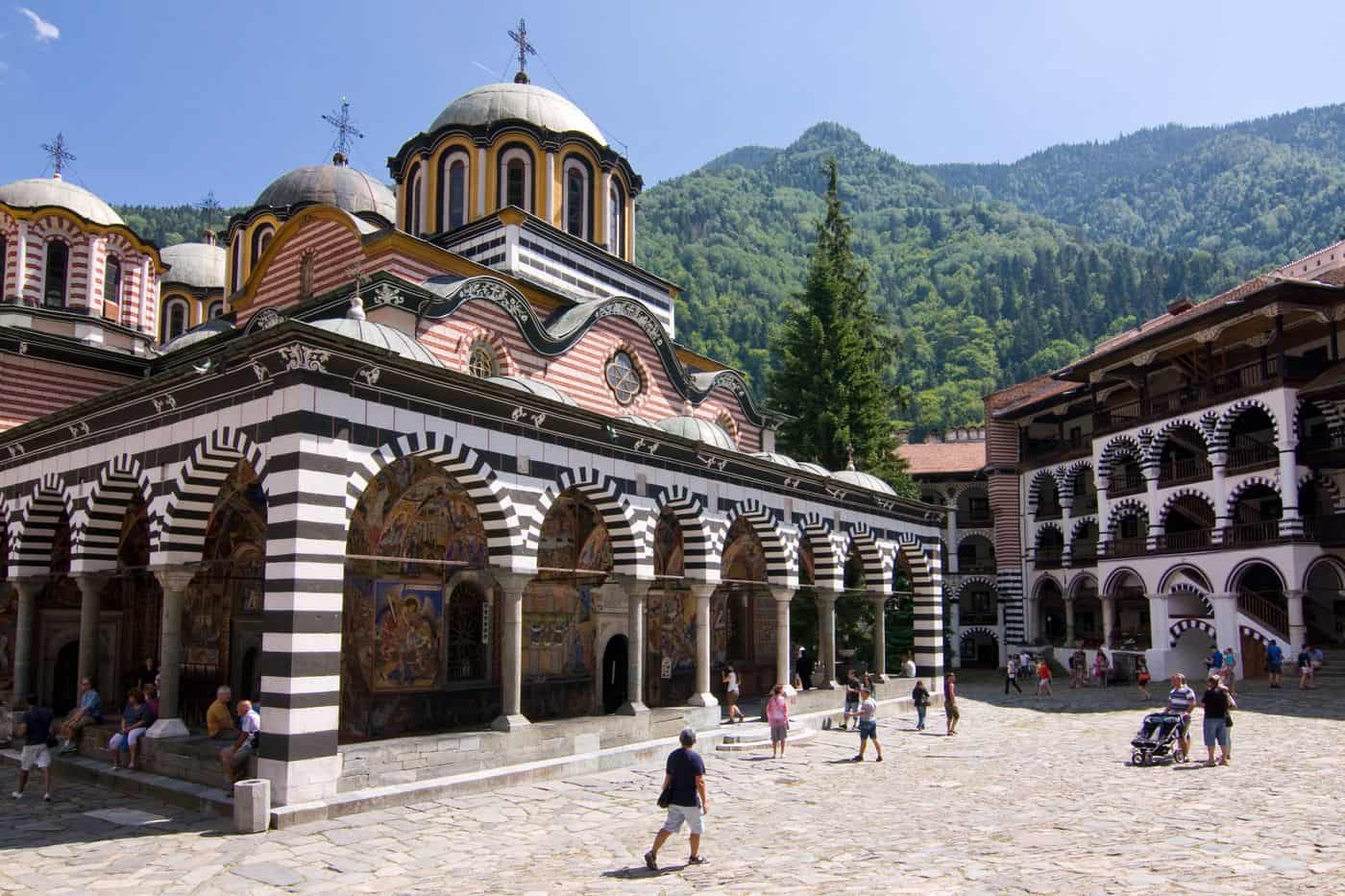
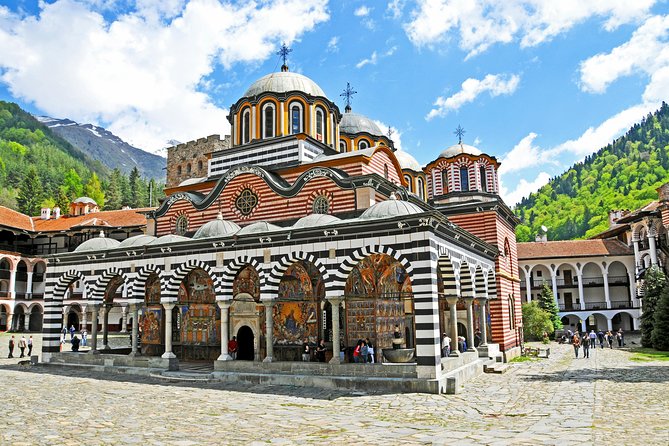
Rila Monastery tours enter the main church in the courtyard, built from 1834 to 1837 by the architect Pavel Ioanov. It has five domes, three altars and two side chapels, a gold-plated carved iconostasis and frescoes that painters completed in 1846.
The iconostasis is the prize of the interior. Four craftsmen, Atanas Teladur, the brothers Petar and Georgi Dashini and Dimitar Stanishev, spent five years carving it, and Rila Monastery tours stop before its gilded wood-carving, the treasure of the church.
The frescoes are the work of masters from Bansko, Samokov and Razlog, led by the brothers Zahari Zograf and Dimitar Zograf. Zahari, born in Samokov in 1810 and trained by his brother Dimitar after their father died early, is regarded as the founder of secular art in Bulgaria, because he brought scenes of everyday life into church painting.
Rila Monastery tours show the frescoes that count among his best known works, beside those he painted in the Bachkovo and Troyan monasteries. Zahari Zograf later worked on Mount Athos in 1851 and 1852, where he decorated the outer narthex of the Great Lavra, and he died of typhus on 14 June 1853.
The church also keeps icons dating from the 14th to the 19th century. Outside, Rila Monastery tours point out the porticos around the church, with their striped painting and domes, a Mamluk influence that grew popular in the Ottoman Empire after its conquest of Egypt.
What do Rila Monastery tours see in Hrelyo’s Tower and the courtyard?
Rila Monastery tours cross a courtyard of 3,200 m² to Hrelyo’s Tower, built in 1334 and 1335 by the feudal lord Hrelja. It is the oldest building of the complex, together with a small church beside it dated to 1343.
Hrelja re-erected the monastery at its present place in the first half of the 14th century, and the bishop’s throne and the richly engraved gates also date from his time. A belfry was added to the tower in 1844, and Rila Monastery tours see the tower and its belfry from every side of the yard.
The whole complex covers 8,800 m² in a rectangle around the inner yard, where the tower and the main church stand. From outside, its high stone walls and little windows make it look more like a fortress than a monastery, a contrast that Rila Monastery tours notice as they pass the gate.
The residential wings rise four storeys above a basement and hold 300 chambers, four chapels, the abbot’s room and a donor’s room. Their construction began in 1816. Rila Monastery tours also look into the old kitchen, known for its uncommonly large cooking vessels.
- Hrelyo’s Tower: 1334 to 1335, the oldest standing building.
- Small church: 1343, beside the tower.
- Belfry: 1844, added on top of the tower.
- Residential wings: from 1816, four storeys around the yard.
What do Rila Monastery tours see in the museum?
Rila Monastery tours visit the Church History Museum, whose star piece is Rafail’s Cross, carved from a single piece of wood 81 by 43 cm. The cross holds 104 religious scenes and 650 miniature figures, each cut by one monk.
That monk was Rafail, who worked with fine burins and magnifying lenses. The work lasted no less than 12 years, and he finished the cross in 1802, the year he lost his sight. The museum is famous above all for this cross, and Rila Monastery tours plan their time inside around it.
The museum shares the complex with an Icon Gallery, and the monastery library holds 250 manuscripts and 9,000 old printed books. Rila Monastery tours reach the library through the residential wings, where it sits among the chambers and chapels.
Shops inside the monastery sell religious items, and souvenir shops stand outside the east entrance. Rila Monastery tours end the visit there before the drive to the cave of the saint or back to Sofia.
What do Rila Monastery tours tell about Saint John of Rila?
Rila Monastery tours tell the story of Saint Ivan of Rila, the first Bulgarian hermit, born around 876 in Skrino at the foot of the Osogovo mountain. He died on 18 August 946 and is honoured as the patron saint of the Bulgarians.
Saint Ivan lived in the time of Tsar Boris I, of his sons Vladimir and Simeon I the Great, and of Simeon’s son Peter I. He began life as a herder. At 25 he became a priest in the St. Dimitrii monastery below Ruen peak, then left it for a life of solitude and prayer. After other retreats he settled in the caves of the Rila Mountains, the setting that Rila Monastery tours visit today.
Legend says wild animals came up to him freely and birds landed in his hands. Word of his miracles reached Great Preslav, the capital, and Tsar Peter I travelled 450 km to seek his advice. The hermit refused to meet the ruler face to face, so the two bowed to each other from a distance, a scene that Rila Monastery tours retell.
The tsar sent a soldier with gifts. Saint Ivan kept a small portion of food and returned all the gold, telling the tsar that rulers need gold to protect the country and help the poor. Shortly before his death he wrote his Testament, a moral message to his followers and to the Bulgarian people.
His relics travelled for more than five centuries before they came home, and Rila Monastery tours trace the route:
- Sofia: under Tsar Peter I, shortly after the saint’s death.
- Esztergom: from 1183, after King Béla III of Hungary took Sofia, for four years.
- Sofia again: from 1187.
- Veliko Tarnovo: from 1194, on the order of Tsar Ivan Asen I.
- Rila Monastery: from 1469, at the request of Sultana Mara Branković.
His followers founded churches in his honour across the country, and one of them, a church of Saint John of Rila in Veliko Tarnovo, was discovered only in 2008. His dormition is commemorated each year on 18 August and 19 October, the feast days that Rila Monastery tours mark in the monastery calendar.
Which Rila Monastery tours walk to the cave of Saint John?
Rila Monastery tours that add the cave of Saint John leave the courtyard for a hike of about 20 minutes on foot. The cave is the place where the hermit lived before his followers built the monastery in the valley below.
Saint Ivan lived in the cave without any material possessions, not far from the site of today’s monastery. His fame drew young believers who set up camps around the cave to seek his blessing, and those camps grew into the community that Rila Monastery tours visit in the valley. The complex itself was built by his students, who came to the mountains to receive their education.
The hermit chose the place for its hardship. The hagiographies describe his dwelling as so hard to reach over the rough ground that Tsar Peter I was unable to approach it,, and Rila Monastery tours that make the climb retell that meeting on the way.
Two places near Boboshevo mark the start of his story. The St Dimitar Monastery near Boboshevo hosted Saint Ivan in his early years as a monk, before he moved to live as a hermit in a nearby cave. Near the village of Skrino, where he was born, a new monastery named after him went up in 2002 and 2003, and a steep path climbs from it into the mountains to a cave where he once lived.
- Group day trips: from Sofia, with the cave as an optional stop after the monastery.
- Cave and pyramids: a day from Sofia that pairs the cave walk with the Stob Earth Pyramids.
Rila Monastery tours with the cave stop add time on foot to the day, and the walk shows the solitude that the hermit sought before his followers arrived.


What history do Rila Monastery tours tell?
Rila Monastery tours tell a history of more than a thousand years, from the hermit’s followers in the 10th century to the rebuilding after the fire of 1833. The monastery kept Bulgarian language and culture alive through the ages of foreign rule.
Tradition dates the founding to the reign of Tsar Peter I, who ruled from 927 to 968. Bulgarian rulers backed the monastery from the start, and almost every tsar of the Second Bulgarian Empire made large donations until the Ottoman conquest. Rila Monastery tours describe the 12th to the 14th centuries as its high point, when it stood as a cultural and spiritual centre of Bulgarian national consciousness.
The arrival of the Ottomans at the end of the 14th century brought raids, and the monastery was destroyed in the middle of the 15th century. Three brothers from the region of Dupnica rebuilt it at the end of that century, with donations from Sultana Mara Branković, widow of Sultan Murad II, the Russian Orthodox Church and the Rossikon monastery of Mount Athos.
During the Bulgarian National Revival of the 18th and 19th centuries, fire destroyed the monastery in 1833. Wealthy Bulgarians from the whole country paid for the reconstruction from 1834 to 1862 under the architect Alexi Rilets, and Neofit Rilski founded a school inside the walls. Rila Monastery tours also name the revolutionaries who hid here, among them Vassil Levski, Gotse Delchev and Peyo Yavorov.
- 1976: declared a national historical monument.
- 1983: listed as a UNESCO World Heritage Site.
- 1991: placed entirely under the Holy Synod of the Bulgarian Orthodox Church.
- 2002: visited by Pope John Paul II during his pilgrimage to Bulgaria.
The papal visit closes the story that Rila Monastery tours tell. The igumen, Bishop Ioan, who had been an observer at the Second Vatican Council, greeted John Paul II at a monastery regarded as one of the foremost works of Bulgarian National Revival architecture.
Which Rila Monastery tours also visit Boyana Church?
Rila Monastery tours that also visit Boyana Church stop on the outskirts of Sofia, in the Boyana quarter, at a medieval church on the UNESCO list since 1979. Its frescoes of 1259 rank among the best-preserved monuments of medieval art in the Balkans.
The church grew in three stages. The eastern church, a small one-apse building, dates from the late 10th or early 11th century. The Sebastocrator Kaloyan and his wife Desislava added the two-storey central wing in the middle of the 13th century, with a family tomb below and a chapel above, and the local community paid for the western wing in the middle of the 19th century.
The walls carry 89 scenes with 240 human images. Eighteen scenes in the narthex tell the life of Saint Nicholas, and in The Miracle at Sea the ship and the sailors’ hats recall the Venetian fleet. Rila Monastery tours stop before the portraits of Kaloyan and Desislava and of Tsar Constantine Tikh and Tsaritsa Irina on the north wall, counted among the finest and liveliest frescoes in the church.
Conservation shapes every visit. An Austrian and a Bulgarian specialist restored and cleaned the frescoes from 1912 to 1915, and the work was repeated in 1934 and 1944. The church closed in 1954 for restoration, reopened in part in 2006 and fully on 2 October 2008. Air-conditioning keeps the interior at 17 to 18 °C under low-heat lighting, and groups of up to 8 visitors stay inside for 10 minutes, so Rila Monastery tours enter in small groups in turn.
- First layer: frescoes of the 11th and 12th centuries, kept in fragments.
- Second layer: the murals of 1259 that gave the church its world fame.
- Later layers: paintings of the 14th, 16th and 17th centuries and of 1882.
- Manager: the National Historical Museum of Bulgaria.
Boyana sits on the Sofia side of the drive, so Rila Monastery tours visit it either at the start of the day or on the way back into the city.
Which Rila Monastery tours go to the Seven Rila Lakes?
Rila Monastery tours that go to the Seven Rila Lakes spend the day in the north-western Rila Mountains, at glacial lakes between 2,100 and 2,500 m. No group of lakes in Bulgaria draws more visitors, and small streams and waterfalls link them.
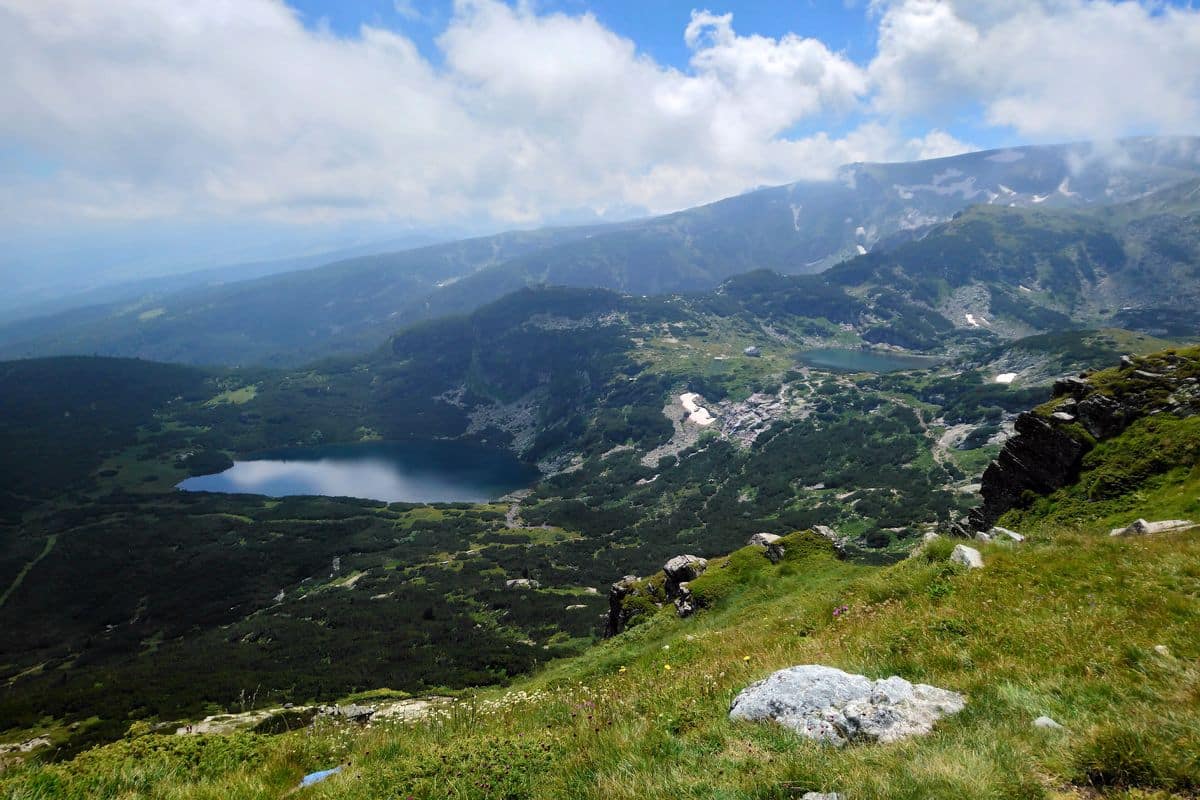
The lakes are tarns, formed by glaciers in cirques, and each carries a name taken from its character. They sit one above the other, and the water flows down from lake to lake through cascades. Rila Monastery tours that pair the lakes and the monastery in one day treat the lakes as the mountain half of the trip and the monastery as the cultural half.
- Salzata (The Tear): the highest, named for its clear water.
- Okoto (The Eye): almost perfectly oval, the deepest cirque lake in Bulgaria at 37.5 m.
- Babreka (The Kidney): the lake with the steepest shores.
- Bliznaka (The Twin): the largest by area.
- Trilistnika (The Trefoil): irregular in shape, with low shores.
The last two lie lowest. Ribnoto Ezero (The Fish Lake) is the shallowest, and a chalet on its north-eastern shore stands at 2,196 m. Dolnoto Ezero (The Lower Lake) gathers the water of the others and gives rise to the Dzherman River, which flows down to the Struma valley that Rila Monastery tours follow from Sofia.
The lakes keep a short season. The best months are July and August, when the temperature passes 10 °C and the risk of sudden storms is lower. The lakes freeze in October and do not melt before June, and the ice can reach 2 m in thickness, so Rila Monastery tours to the lakes keep to the summer months.
Which Rila Monastery tours hike in Rila National Park?
Rila Monastery tours that hike in Rila National Park walk inside the largest national park in Bulgaria, 810.46 km² of mountain from 800 m near Blagoevgrad to 2,925 m at Musala. Trails from the monastery reach glacial lakes, meadows and the Malyovitsa peak.
The park was established on 24 February 1992 and holds 120 glacial lakes, among them the Seven Rila Lakes. Rivers such as the Maritsa and the Iskar rise inside it, and forests cover 534.81 km², or 66% of its area. It spreads over 4 of Bulgaria’s 28 provinces, Sofia, Kyustendil, Blagoevgrad and Pazardzhik, and includes four nature reserves: Parangalitsa, the Central Rila Reserve, Ibar and Skakavitsa. The IUCN lists the park in Category II, and its four reserves belong to the World Network of Biosphere Reserves of the UNESCO Man and Biosphere Programme.
Musala is the highest peak of Bulgaria and of the whole Balkan Peninsula, at 2,925.42 m, with a prominence of 2,473 m. From the top, walkers see Vitosha, Sredna Gora, the Balkan Mountains, the Rhodopes, Pirin and Osogovo. Rila Monastery tours point to it as the roof of the range.
Malyovitsa is the peak that rises above the monastery itself. It stands 2,729 m high, and the Rila Monastery sits at its southern foothills facing the valley of the Rilska River. The usual start is Malyovitsa Hut at 1,700 m, about 2 hours from the summit, and the area is the cradle of Bulgarian rock climbing: the north wall was first climbed in 1938 by Konstantin Savadzhiev and Georgi Stoimenov.
The monastery is itself a trailhead. Rila Monastery tours on foot follow these routes through the Rila Monastery Nature Park:
- Kirilova polyana: Rila Monastery to Kirilova polyana, the Dry Lake and Kobilino branishte.
- Ribni Lakes: Rila Monastery to the Ribni Lakes and Smradlivo Lake.
- Malyovitsa: Rila Monastery to the Malyovitsa area.
- Seven Rila Lakes: Rila Monastery to the lakes on foot.
- E4: the European long-distance path, which crosses the park.
The park also protects about 1,400 species of vascular plants, 48 species of mammals and 99 species of birds, and Rila Monastery tours on these trails learn that the forests on the middle slopes of Musala hold Macedonian pine and Bulgarian fir.
Which Rila Monastery tours continue to Melnik and Rozhen?
Rila Monastery tours that continue to Melnik drive south to the smallest town in Bulgaria, home to 385 people at 440 m in the Pirin foothills, ringed by the Melnik Earth Pyramids. The Rozhen Monastery, 6 km to the north-east, completes the long day.
Melnik keeps its town status for historical reasons, and the whole place is an architectural reserve in which 96 buildings are cultural monuments. Rila Monastery tours walk past the Byzantine House, one of the oldest civilian buildings in the Balkans, built in the 12th or 13th century, and the Pashov House of 1815, which holds the Historical Museum of Melnik.
Wine is the other reason Rila Monastery tours come this far south. The town has been known for strong wine since at least 1346, and the local Broad Leaf Melnik Vine was reportedly a favourite of Winston Churchill. The Kordopulov House, named after the merchant Manolis Kordopulou, has one of the largest wine cellars in Melnik, and new wineries such as Villa Melnik, Sintica and Orbelus now work the slopes around the town that Rila Monastery tours reach in the afternoon.
The Melnik Earth Pyramids cover 17 km² and reach a height of up to 100 m. Rain and bedrock wear shaped the sandstone into forms that resemble giant mushrooms, ancient towers and obelisks, and the area was declared a natural landmark in 1960. It lies 180 km south of Sofia and 65 km south of Blagoevgrad.
Rozhen is the biggest monastery in the Pirin Mountains and among the medieval Bulgarian monasteries still well preserved today. Its church was built before the 15th century and painted in 1597; a fire between 1662 and 1674 destroyed the library, and the rebuilding ran from 1715 to 1732. The grave of the revolutionary Yane Sandanski lies near the monastery, and Rila Monastery tours stop at both on the same visit.
- St Nicholas: a church of the 13th century in Melnik.
- St Nicholas the Thaumaturge: a church of 1756.
- SS Peter and Paul: a church of 1840.
- Pasha’s House: built by Ibrahim Bey during Ottoman rule.
The town has a Greek past as well. At the start of the 20th century its people were primarily Greeks, and after the Second Balkan War in 1913 they moved to Greece, settling mainly in Sidirokastro and also in Serres and Thessaloniki.
Which Rila Monastery tours stop at the Stob Pyramids and Boboshevo?
Rila Monastery tours that stop at the Stob Earth Pyramids walk among rock pillars up to 12 m high on the Klisura ridge above the Rilska River, 83 km south of Sofia. Boboshevo, in the Struma valley, adds medieval churches and the St Dimitar Monastery.
The Stob pyramids span 0.7 km² less than one kilometre east of the village of Stob, in the Kocherinovo municipality of Kyustendil Province, at 600 to 750 m above sea level. They stand 18 km north of Blagoevgrad on a ridge facing the Rilska River valley, the valley that Rila Monastery tours follow up to the monastery.
Rila Monastery tours learn that rainfall shaped them. The rain washes away the lightly bound sediment, while stones lodged in it protect the layers below, and about half of the pillars are crowned by rocks whose area is sometimes two to three times the cross-section of the pillar below. A coat of hardened, sun-burned clay about 1 cm thick protects the soft sandstone and slows the erosion.
Boboshevo lies 75 km south of Sofia, in the lowest part of the south-western Rila ridge, where the Dzherman River meets the Struma. Together with the region of Ohrid, it carries the name “Bulgarian Jerusalem” for its role as a cultural centre from the 15th to the 17th century, and Rila Monastery tours find churches and monasteries from that period around the town.
The St Dimitar Monastery is the best known of them. It has existed since the First Bulgarian Empire, around the 10th century, and was destroyed in the Ottoman invasion of the late 14th century. Its church, rebuilt in the last quarter of the 15th century, has one nave, a round apse and a semi-spheric vault, and its wall paintings of 1488 cover the walls, the ceiling and the western facade.
- Shapes: sharp, conical or mushroom-like, with flat stones on top of certain columns.
- Base: up to 40 m thick.
- St Dimitar church: a monument of national importance.
- Wine: day tours from Sofia that pair the monastery with tastings at Boboshevo.
The southern part of the Bulgarian Struma valley is an important wine region, which Rila Monastery tours cross on every drive between Sofia and Melnik.
Which Rila Monastery tours also visit Plovdiv or Bansko?
Rila Monastery tours that also visit Plovdiv cover the second-largest city in Bulgaria, 144 km south-east of Sofia, in one long day. Guided tours also start in Bansko, the resort town at the foot of the Pirin Mountains, south of the Rila range.
On Rila Monastery tours, Plovdiv is presented as the oldest continually inhabited city in Europe, with settlements dating back to about 6000 BC. It grew on seven syenite hills on the two banks of the Maritsa River, which give it the name “The City of the Seven Hills”. Philip II of Macedon founded it as Philippopolis in 342 BC, settling Thracians and 2,000 Macedonians there, and the city was the European Capital of Culture in 2019.
Rila Monastery tours that add Plovdiv stop at the Roman theatre of Philippopolis, one of the best-preserved Roman theatres in the world. It dates from the 1st century AD, with the reign of Domitian as the favoured date, and still holds performances for 5,000 to 7,000 spectators. Its 28 rows of marble seats face south over the city towards the Rhodope Mountains, in a semi-circle with an outer diameter of 82 m. The stage wall rises three floors, and the proscenium in front of it, 3.16 m high, carries an Ionic marble colonnade with triangular pediments.
Bansko lies at 925 m in the valley of the Nestos River, about 160 km from Sofia and 220 km from Thessaloniki. Once a town of stockbreeders and travelling merchants, it is now a centre for winter and summer tourism, and Rila Monastery tours from Bansko cross back over to the Rila side for the day.
- Ski area: 75 km of runs and 14 lifts and drags.
- Gondola: built from the town in 2003 to Banderishka Poliana.
- Top station: 2,600 m above sea level.
- Banya: a village 5 km away with 27 thermal mineral springs.
Bansko is also a stop on the narrow-gauge line from Septemvri to Dobrinishte, and buses link it with Sofia, Plovdiv, Blagoevgrad, Razlog and Gotse Delchev, so Rila Monastery tours that start there suit visitors staying in the Pirin resorts.
Which Rila Monastery tours add hot springs or Borovets?
Rila Monastery tours that add hot springs stop at Sapareva Banya, 15 km east of Dupnitsa, where the mineral water reaches 103 °C and a geyser rises in the town centre. Borovets, the oldest winter resort in Bulgaria, lies on the northern slopes of Rila.
Sapareva Banya, a stop on Rila Monastery tours from Sofia, sits at the north foot of the Rila Mountains in Kyustendil Province. Its spring is the hottest in South-eastern Europe, and the geyser in the centre sprang forth in 1957. Rila Monastery tours with a spa stop pair the monastery with a hot mineral bath complex on the same day.
Rila Monastery tours that stop here also hear of a long past. The Roman town of Germania stood here, an important town of the province of Dacia Mediterranea in the 3rd century, and it is one of two places named as the birthplace of the Byzantine general Belisarius. In the 11th century it appears as Germaneia in a charter of Emperor Basil II.
Borovets stands at 1,350 m, about 10 km from Samokov and 70 km from Sofia. Its history as a resort dates back to 1896, when it began as a hunting ground for the Bulgarian rulers: General Tantilov built the first villa, and Ferdinand I of Bulgaria built the Tsarska Bistritsa palace. Day tours from Sofia treat Borovets as a mountain lunch stop or a ski day.
- Old name: Chamkoria, used until the middle of the 20th century.
- World Cup: Alpine Skiing rounds in 1981 and 1984.
- Biathlon: the World Championships of 1993.
- Climate: long, cold and snowy winters and short, warm summers with cool nights.
How do Rila Monastery tours run from Sofia?
Rila Monastery tours from Sofia follow the Struma motorway south past Pernik and Dupnitsa, leave it near Kocherinovo and climb the Rilska River valley through the town of Rila, 20 km below the monastery. Day tours run as group coaches, private cars and shuttle buses.
The motorway is named after the Struma River and carries two asphalt lanes and an emergency lane in each direction, 29 m wide in all. Dupnitsa, about 50 km south of Sofia at the foot of the Rila Mountains, is the second largest town in Kyustendil Province, and Rila Monastery tours pass its hill crowned by a giant cross for the Bulgarians who died in the Balkan Wars and the First World War.
Kocherinovo, 70 km south of Sofia and 2 km off the motorway, sits on the way to the monastery, and its southern neighbourhood of Levski lies where the Rilska River joins the Struma. From there Rila Monastery tours turn east up the Rilska valley to the town of Rila, 34 km from Dupnitsa, which stands at the entrance of the Rila Monastery Nature Park.
Public transport covers only part of the way. Buses run to Rila town from Sofia, Dupnitsa and Blagoevgrad, but no public bus goes all the way to the monastery. A daily shuttle, the Rila Monastery Bus, runs round trips from Sofia, and certain departures also stop at Boyana Church or drop passengers in Blagoevgrad and Dupnitsa.
- Group day tours: full days from Sofia with hotel pick-up and a guide.
- Morning half-day tours: an early start that returns to Sofia by the afternoon.
- Private tours: day trips for one party, offered beside the shared coaches.
- Shuttle bus: a daily round trip for visitors who explore on their own.
Dupnitsa itself has a long record as a stop on this road: the German traveller Arnold von Harff visited it in 1499 and called it a “beautiful town”, and Rila Monastery tours pass it before the turn at Kocherinovo.
Where do Rila Monastery tours eat and sleep?
Rila Monastery tours eat at the monastery bakery, a small and popular stand that sells monastery bread, mekitsa and locally produced yogurt. Visitors who stay on sleep inside the walls, because the monastery lets guests stay overnight in humble monks’ quarters.
Mekitsa is a traditional Bulgarian dish of kneaded dough made with yogurt and deep fried. The dough is made with flour, eggs, yogurt, a leavening agent, water, salt and oil, then torn into small balls, spread into flat rounds and fried. Rila Monastery tours stop at the stand for this breakfast dish, served with icing sugar, jam, honey or sirene, the white cheese of Bulgaria.
The name comes from the Slavic root mek, meaning soft, after the texture of the dough. The same fried bread is known as mekike in Serbia and mekica in North Macedonia, and the dish is popular across the Bulgarian, Macedonian and Serbian regions that Rila Monastery tours draw visitors from.
A night at the monastery changes the visit. Guests sleep in the chambers of the residential wings, and one day tour from Sofia includes a visit to a monk room. Rila Monastery tours that stay overnight wake inside the monastery walls.
- Monastery bread: the house loaf of the bakery stand.
- Yogurt: produced locally and sold beside the bread.
- Mekitsa: fried dough, a breakfast favourite of Bulgaria.
- Sirene: white cheese, one of the toppings for mekitsa.
Full restaurants close to the monastery are limited in number, so the bakery stand serves as the quick meal of Rila Monastery tours.
How do visitors reach Rila Monastery tours from Greece?
Visitors from Greece reach Rila Monastery tours over the Promachonas and Kulata border crossing, where the E79 road and the Sofia to Thessaloniki railway enter Bulgaria. From the border the Struma motorway runs north up the Struma valley to Blagoevgrad and the Rilska River road.
Kulata, whose name means “the tower”, is a village of Petrich Municipality in Blagoevgrad Province and a major checkpoint on the border with Greece. Promachonas, in the Serres regional unit, lies opposite. The Greek village took its present name in 1927, and five kilometres to the south, next to the highway from Thessaloniki at Kleidi, a monument honours the Byzantine emperor Basil II.
The road follows a river with two names. The Struma, called Strymonas in Greece and Strymon in antiquity, rises on Vitosha, runs 415 km in all and enters Greece near Promachonas. In Greece it feeds and drains Lake Kerkini, a centre for migratory wildfowl covered on our Kerkini tours page, before it reaches the Strymonian Gulf near Amphipolis. The Rilska River that Rila Monastery tours follow up to the monastery is one of its tributaries.
The motorway is part of the Pan-European Corridor IV and of the E79, which runs from Miskolc in Hungary to Thessaloniki, with a planned length of 172.8 km between Sofia and Kulata. Blagoevgrad, 101 km south of Sofia in the Struma valley, is the economic and cultural centre of south-western Bulgaria, and the Bulgarian Men’s High School of Thessaloniki moved there in 1913.
- Border: Promachonas in Greece and Kulata in Bulgaria.
- River: the Strymonas in Greece, the Struma in Bulgaria.
- Old town names: Blagoevgrad was Gorna Dzhumaya, and Irakleia in Greece was Dolna Dzhumaya.
- From North Macedonia: day tours and transfers from Skopje that stop at the monastery.
Skopje, the capital of North Macedonia, is the start of those Rila Monastery tours from the west, and its own sights are covered on our Skopje tours page.
When do Rila Monastery tours run best?
Rila Monastery tours run all year to the monastery, which opens every day, while the high trails keep a short summer season. Above the monastery, snow covers the summit of Musala for about 200 days a year, and summer there lasts only 2 months.
Musala is the coldest place in Bulgaria and in the whole Balkan Peninsula, with an average annual temperature below freezing. Temperatures stay below 0 °C for about 8 months a year, and about 45% of the yearly precipitation falls as snow. Between 1931 and 2013, the highest temperature recorded there was 20.0 °C and the lowest was −31.2 °C, so Rila Monastery tours that add a summit hike plan for mountain weather even in August.
Borovets, on the northern slopes, has a humid continental climate, and winter there is a ski season. The Malyovitsa Ski Centre, north of the peak above the monastery, has two downhill tracks and two ski drags for Rila Monastery tours that add a winter day.
The valleys to the south are warmer. Melnik, at the southern end of the longer Rila Monastery tours, has a Mediterranean climate with hot summers and cool winters.
- Summer: the season for the lakes, the peaks and the cave walk.
- Winter: snow at the resorts of the northern slopes and on the high trails.
- Feast days: the commemorations of Saint Ivan in the monastery calendar.
Frequently Asked Questions
Which coins show the saint of Rila Monastery tours?
An icon of Saint John of Rila appears on the reverse of the Bulgarian 1 lev coin issued in 2002, and on the obverse of the former 1 lev banknote. The tradition continued after Bulgaria joined the eurozone: the saint is depicted on the national side of the Bulgarian 1 euro coin, so Rila Monastery tours meet his image before they reach the monastery.
Where else do Rila Monastery tours find churches of Saint John of Rila?
One of the two Bulgarian Orthodox churches of Chicago, in Portage Park, is dedicated to him, and the Ioannovsky Convent, the largest convent in St. Petersburg, honours him too. The St. John of Rila Chapel, built in 2003 at St. Kliment Ohridski Base on Livingston Island, is the first Eastern Orthodox building in Antarctica and the southernmost Orthodox place of worship in the world.
What does the name of Rila Monastery tours come from?
The mountain takes its name from the river of the same name, which comes from the Old Bulgarian verb for “to grub”. Rila is the sixth highest mountain range in Europe, after the Caucasus, the Alps, the Sierra Nevada, the Pyrenees and Mount Etna, and the highest between the Alps and the Caucasus, as Rila Monastery tours explain.
Do Rila Monastery tours stop in the town of Rila?
Yes, the road passes through it. In antiquity Thracians and Romans lived here, and the place was known as Sportela and then Roligera. In the 14th century the village was a feudal possession of the Rila Monastery, and Ottoman tax registers of 1576 list it as İrlie. Today it is the centre of Rila Municipality and the last town before the monastery on Rila Monastery tours.
Which Bulgarian poet worked on the road of Rila Monastery tours?
Nikola Vaptsarov worked in the 1930s as a stoker and technician in a Kocherinovo factory near the village of Barakovo. Kocherinovo takes its name from the dialect word kocherina, a section of a shed, was first mentioned in 1878 and became a town in 1974. Rila Monastery tours pass it 2 km off the motorway on the way to the monastery.