
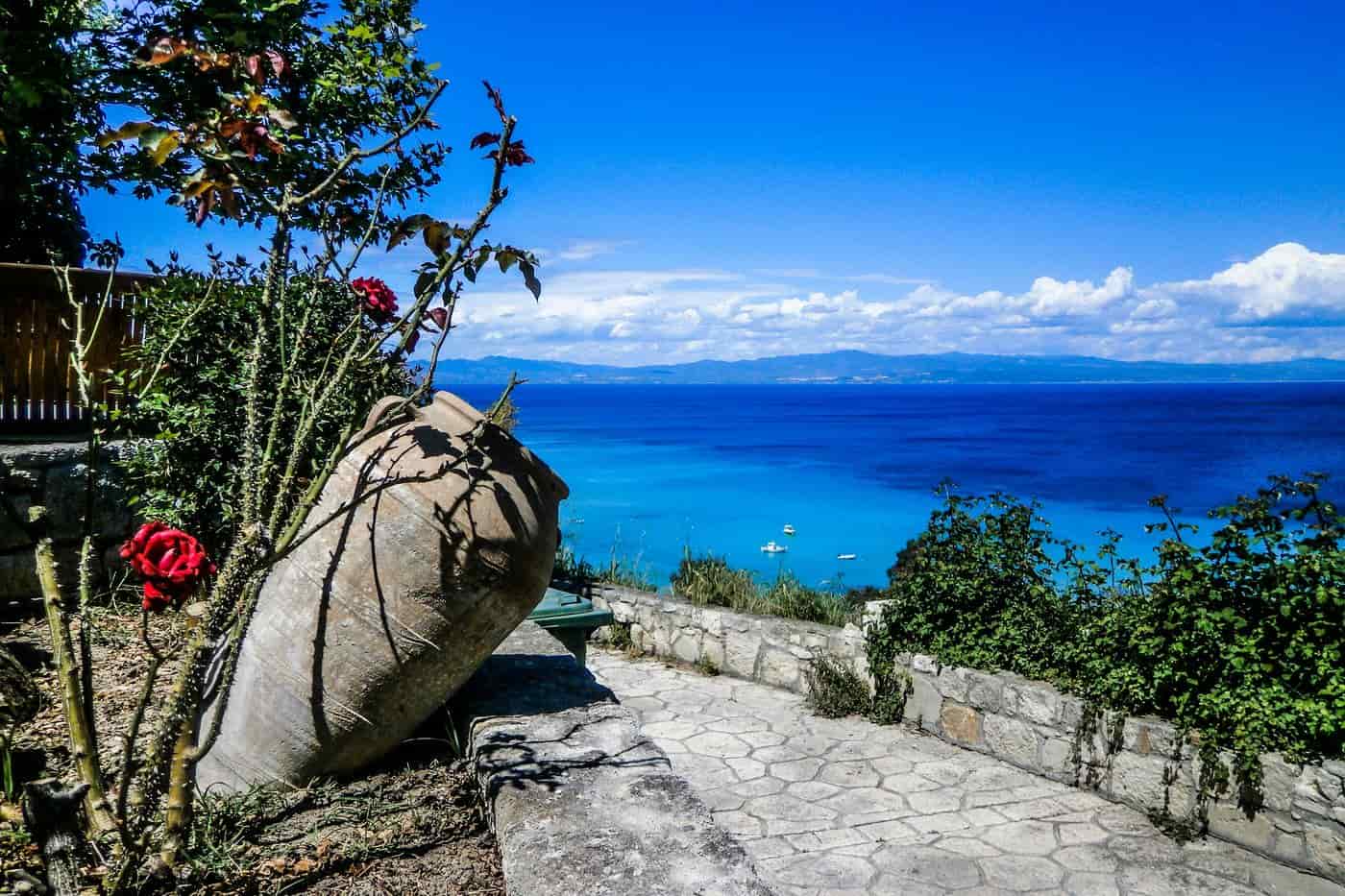
Afytos tours start in a stone-built village on the northeast coast of the Kassandra peninsula in Halkidiki, which overlooks the Toroneos Gulf. The routes cover the old village and its square, the sanctuary of Zeus Ammon at Kallithea, the story of ancient Aphytis, the Petralona cave and the beaches of Kassandra. Greece Tours lists the day trips and experiences that start in Afytos and Thessaloniki.
This page covers what Afytos tours see in the old village and at the sanctuary, the history of the village, the Petralona cave, the beaches, the day trips, how visitors reach Afytos and which season suits each route. The tours below are checked on GetYourGuide and leave from Afytos and Thessaloniki.
What do Afytos tours cover?
Afytos tours cover a stone-built village on the northeast coast of the Kassandra peninsula in Halkidiki, the sanctuary of Zeus Ammon at Kallithea, the story of ancient Aphytis and the Petralona cave, where a fossil human skull came to light.
Afytos is a seaside village in the municipality of Kassandra, whose seat, Kassandreia, lies 6 km to the southwest. The village stands 50 m above sea level on the Kassandra peninsula, the westernmost of the three peninsulas of Halkidiki. The 2021 census counted 1,178 residents.
The name also appears as Afitos, and the village was earlier known as Athytos. Low hills of farmland surround it, and its economy rests on farming and tourism. Afytos tours read the place through four themes, from the old lanes to a skull of the Middle Pleistocene.
- Old village: stone houses, cobbled lanes, the church of Agios Dimitrios and the folklore museum.
- Sanctuary: the temple of Ammon Zeus and the older cult place of Dionysus at Kallithea.
- Ancient Aphytis: Euboean settlers, city coins, the Athenian League and the Roman colony of Cassandreia.
- Petralona cave: stalactites, fossil animals and the Petralona skull.
The village overlooks the Toroneos Gulf, also called the Kassandra Gulf, which separates Kassandra from Sithonia. Herodotus noted the gulf for its fish.
What do Afytos tours see in the old village?
Afytos tours see a traditional settlement of stone houses and cobbled lanes, the village square with the church of Agios Dimitrios from 1857, a view over the Toroneos Gulf and a folklore museum inside a listed building from 1889.
Afytos is on the Greek list of traditional settlements, a legal status held by more than 900 places. Restored buildings now serve as guesthouses, cafes and cultural spaces, and local craft markets draw visitors from the surrounding region.
Agios Dimitrios is the main church of the village. From its square the view opens over the Kassandra Gulf, and Afytos tours pause there between the lanes and the museum.
The Folklore Museum of Afytos was founded in 1980 on the initiative of Nikos Paralis and the local folklore association. Villagers donated the objects, and the Aletras family gave a listed building of 1889 in the centre of the village. The collection covers:
- Household items: domestic utensils from village homes.
- Farm tools: implements for ploughing, sowing, reaping and harvesting.
- Pottery: work from a craft with a long tradition in Afytos.
- Shadow theatre: Karagiozis puppets owned by the puppet master Evgenios Spatharis.
- Library: a folklore library, part of the same museum.
Afytos tours that enter the museum see the farm and household tools of old Afytos.
What do Afytos tours see at the sanctuary of Zeus Ammon?
Afytos tours see the sanctuary of Zeus Ammon at Kallithea, south of Afytos: the remains of a large Doric temple from the middle of the 4th century BC, its altar area, a rock-cut stair, a cult cave of Dionysus and Roman baths.
Ammon Zeus joined the Greek Zeus with Amun, the Egyptian god whose name means the hidden one. His worship here dates back to at least the 5th century BC. Afytos tours retell a story from Pausanias: Ammon Zeus, the patron of Aphytis, appeared to the Spartan general Lysander in a dream and urged him to lift his siege of Aphytis, and Lysander obeyed.
Dionysus came first. A stair cut into the rock and a cave used for his rites show his worship here from the 8th century BC, and the sanctuary also honoured the Nymphs. Xenophon, in his Hellenica, described the sanctuary of Dionysus at Aphytis as a place of shady shelters and clear, cold waters.
The ruins came to light in the 1960s, when a hotel was built next to the site. Afytos tours walk past these features:
- Altar: the altar of the sanctuary and other cult features.
- Roman baths: the balneum the Romans built on the site, whose excavation began in 2005.
- Agios Panteleimon: a Russian-style church near the sanctuary, from the time when Russian monks of Mount Athos owned a farm in the area.
Afytos tours that continue to Polygyros, 31 km north, see a 4th-century BC marble head of Dionysus from ancient Aphytis in its Archaeological Museum.
What history do Afytos tours tell?
Afytos tours tell a story that runs from ancient Aphytis, a city of Pallene settled by Euboeans in the 8th century BC with coins showing Ammon Zeus, through Roman rule and the Ottoman period to the village fighters of the revolution of 1821.
A settlement stood in the area of Afytos from 3000 BC, long before Euboean colonists arrived. Pallene was the ancient name of Kassandra. Aphytis sent its own ships to the Persian Wars, then joined the Athenian League and later the Chalkidian League.
Aristotle cites the agricultural law of the Aphytians in his Politics. During a siege of Torone, the Spartan king Agesipolis I was carried to the sanctuary of Dionysus at Aphytis, where he died in 380 BC. His body travelled home in a jar of honey. After 43 BC Aphytis became a dependent village of the Roman colony of Cassandreia.
Documents of Mount Athos name the village again in the 14th century. Under Ottoman rule, Afytos paid its taxes to the vakf of Gazanfer Agha and belonged to the nahiye of Kalamaria. In 1821 Kassandra rose against the Ottomans, and Ottoman forces burnt the whole peninsula. Afytos tours name local fighters of that war and the later Macedonian Struggle:
- 1821 fighters: Dimitris Karavasilis, Triantafyllos Garoufallou, Georgios Panagiotou, Anastasios Kyriazis and Garyfallos Grigoriou.
- Macedonian Struggle: the chieftains Theocharis Sarikas, known as kapetan Zarkadas, and Andreas Karatasos.
- Union with Greece: Kassandra became part of Greece in 1912.
- Tourism: visitor numbers rose after the Second World War.
Which Afytos tours visit the Petralona cave?
Afytos tours with an inland stop visit the Petralona cave, a karst cave 300 m above sea level on the western foot of Mount Katsika, 1 km east of Petralona village, where a villager found a fossil human skull in 1960.
The cave lies 35 km southeast of Thessaloniki, so it also fits a Halkidiki day trip from Thessaloniki. A local shepherd, Filippos Chantzaridis, discovered the cave in 1959 while he searched for a spring. The skull came to light the next year in a small chamber, stuck to the wall and coated in brown calcite.
Stalactites and stalagmites line corridors that run for about 2,000 m through Jurassic limestone, at a steady 17 °C all year. The skull is classed as Homo heidelbergensis, a Middle Pleistocene species. A uranium-series study of its calcite crust placed it at around 300,000 years.
- Fossil animals: more than 50 species, led by cave bears and spotted hyenas.
- Herbivores: horses, ibexes and deer, part of them food for Palaeolithic people, as tool marks on the bones show.
- Stone tools: more than 1,500 finds, mainly of quartz and bauxite, from near the ancient entrance.
- Visitors: more than 50,000 a year, second for visits among the ancient monuments of northern Greece.
The Ephorate of Palaeoanthropology–Speleology continues the research in the cave. Afytos tours that add Petralona pair the coastal sanctuary with the oldest human skull found in Greece.
Which beaches do Afytos tours reach?
Afytos tours reach the beach of Afytos on the Toronean Gulf and Vothonas beach between Afytos and Nea Fokea. The Kassandra road axis also passes within 15 km of the beaches of Nea Poteidaia, Nea Fokea, Kallithea, Siviri, Posidi, Fourka and Sani.
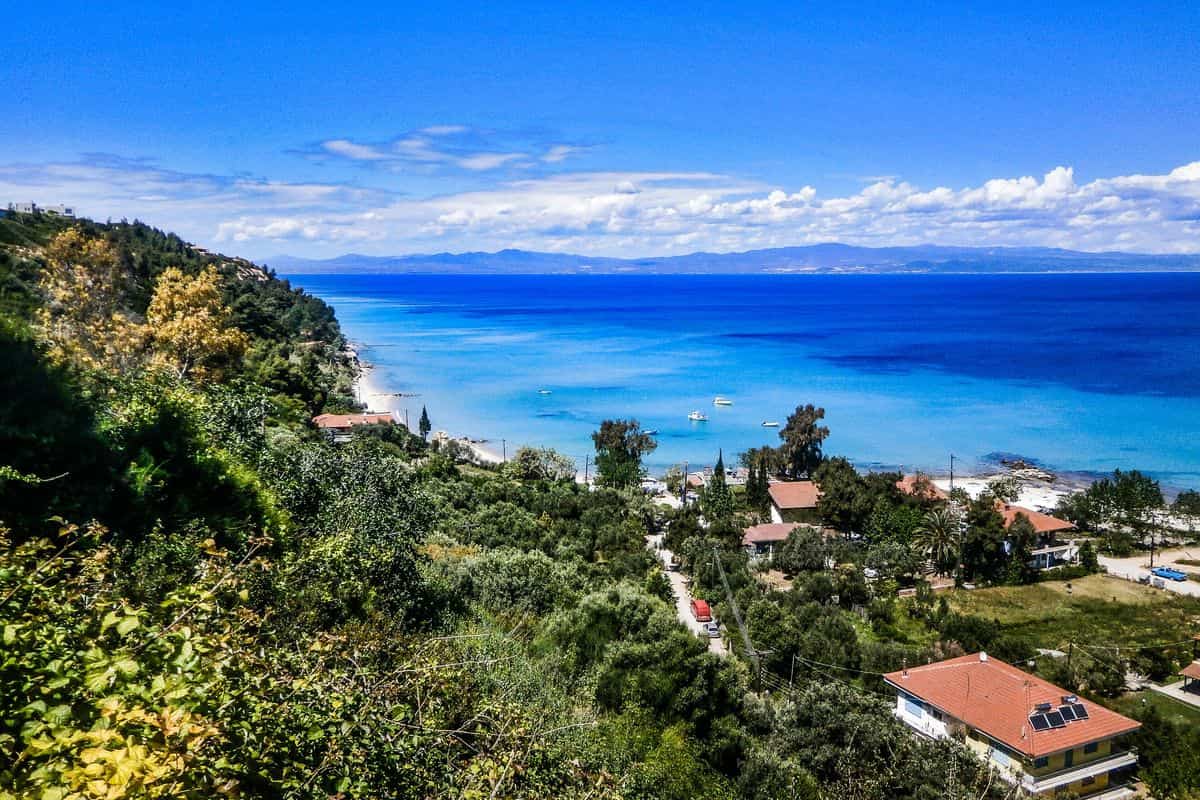
The Kassandra peninsula stretches between the Thermaic Gulf to the west and the Gulf of Kassandra to the east, so Afytos tours cover beaches on both gulfs. Afytos and Kallithea sit on the eastern coast, while Posidi faces the Thermaic Gulf from the western side.
Pine forests cover the peninsula and reach down to the sea. The land stays low: Livadakia, the highest point of Kassandra, rises to 353 m. The cape at Posidi formed from deposited sand, and its low ground covers one square kilometre.
- Nea Poteidaia: a seaside town at the narrowest point of Kassandra, visited mainly for its beaches and wildlife.
- Kallithea: a village on the eastern coast that draws tourists every year for its beaches and tourist infrastructure.
- Posidi: a summer settlement on the cape, with holiday homes, hotels and campsites.
- Siviri: a seaside settlement with tourist development in the municipality of Kassandra.
Afytos tours that add a day at sea continue on Halkidiki boat tours.
Which day trips combine with Afytos tours?
Afytos tours combine with the Potidea canal at the entrance to Kassandra, the 15th-century tower of Nea Fokea 2 km away, the tower and marina of Sani, the resort villages of Kassandra, and the Sithonia peninsula across the Toronean Gulf.
The Potidea canal cuts the isthmus at Nea Poteidaia, the only land access to the Kassandra peninsula, and links the Thermaic Gulf with the Toronean Gulf. The road crosses it on the new Potidea bridge, 165.5 m long and the first composite bridge in Greece built by incremental launching. Nea Poteidaia lies 6 km south of Nea Moudania.
Nea Fokea keeps a 15th-century tower on its beach. The tower guarded an estate of the Agios Pavlos Monastery, and the village stands on the site of old Mount Athos estates. Its Agiasma of Saint Paul is an underground chamber where, by tradition, the Apostle Paul baptised Christians in secret.
- Sani: a tower dated to 1543, built to protect an estate of the Stavronikita Monastery, and a marina for 120 boats.
- Kallithea: a village founded in 1925 by refugees from Asia Minor, now known for its nightlife.
- Pefkochori and Chanioti: summer resorts of Kassandra; the eastern coastal strip from Kallithea down to Pefkochori is built up with resorts.
- Sithonia: the middle peninsula of Chalkidiki, with Porto Koufo, the largest natural harbour in Greece, and Mount Itamos at 817 m.
Afytos tours that cross the gulf continue on Sithonia tours. Ouranoupolis, the summer resort at Mount Athos on the easternmost peninsula, has its own Ouranoupoli tours.
How do visitors reach the start of Afytos tours?
Afytos tours begin 73 km southeast of Thessaloniki. Visitors land at Thessaloniki Airport Makedonia, drive the A24 motorway to Nea Moudania and follow the Kassandra road axis to the junction at Nea Fokea, a village 2 km from Afytos, or ride KTEL Chalkidikis buses.
Thessaloniki Airport Makedonia (SKG) lies 13 km southeast of the city, in Thermi. It is the main airport of northern Greece and serves Chalkidiki, which has no railways or airports of its own. Taxis wait outside the terminal building, and a car rental service operates at the terminal.
The A24 motorway links Thessaloniki and the airport with Nea Moudania, the largest town of Chalkidiki. From the end of the A24 at Nea Moudania, the Kassandra road axis runs 5.2 km to the Potidea bridge, then 17.7 km on two lanes in each direction to Kassandreia. The old road ran through Nea Fokea, Afytos and Kallithea; the axis follows a new line for 11.5 km and has a grade-separated junction at Nea Fokea.
- KTEL Chalkidikis: the bus network that serves the major towns of Chalkidiki, based at the 9th kilometre of the Thessaloniki–Nea Moudania road.
- Route search: Afytos tours by bus look for Athytos, the older name of the village, in the KTEL route list.
- Local coaches: KTEL coaches link Kallithea with Nea Moudania, Afytos and Chanioti.
- Tickets: cash at the counters, e-tickets by computer or mobile app, and open return tickets valid within the next month.
When do Afytos tours run best?
Afytos tours run best from June to September, when Chalkidiki has hot, relatively dry summers. Thessaloniki Airport normals show July highs of 32.2 °C and 325.7 hours of sunshine, and the season brings the Nea Fokea feast and the Toroneos Gulf swim marathon.
The climate of Chalkidiki is mainly Mediterranean (Köppen Csa), with cool, wet winters. At Thessaloniki Airport, 2 m above sea level, the 30-year normals give mean highs of 29.9 °C in June, 32.1 °C in August and 27.2 °C in September, with rain on 6.7 days in July and 5.1 days in August.
Afytos tours in summer follow a pattern that began in the late 1950s, when Thessaloniki residents started spending their summer holidays in the coastal villages of Chalkidiki. Visitors from Austria and Germany followed in the 1960s, and the tourist boom of the 1970s turned the whole region to tourism.
- 29 June: Nea Fokea holds its village feast for the Apostles Peter and Paul.
- July: the Toroneos Gulf Marathon, a 25 km international swimming race first held in 1971, runs from Kallithea to Nikiti in Sithonia.
- Kassandra Festival: held every year since 1993, with events at the open-air theatre of Kassandra in Siviri.
- Sunshine: Thessaloniki Airport logs 296.4 hours in June and 295.8 in August, against 102.6 in December.
Frequently Asked Questions
Which local products appear on Afytos tours?
Chalkidiki is known for its olive oil and green olives, and it also produces honey and wine. Nea Fokea grows vegetables and produces honey, while its residents work in tourism and fishing. The agricultural prison of Kassandra, part of the Nea Fokea community, is known for its cheese products.
Are Afytos tours possible outside summer?
Afytos tours outside summer face cool, wet winters, and snowfalls in Chalkidiki do not last long. October still averages highs of 21.4 °C at Thessaloniki Airport, with rain on 9.3 days. Arnaia, a village of Chalkidiki, is popular in winter for its architecture and mountain scenery.
How do Afytos tours connect with Mount Athos?
Mount Athos lies on the easternmost of the three peninsulas of Chalkidiki, east of Sithonia. A chrysobull of 885 proclaimed it a place of monks, and Athos with its monasteries has been self-governing since Byzantine times. Its highest peak reaches 2,033 m, and KTEL Chalkidikis lists Ouranoupoli among its bus destinations.
Which islands lie in the gulfs around Afytos tours?
Kelyfos, an uninhabited island, lies in the Toronean Gulf off the west coast of Sithonia, across the water from the Kassandra shore. Ammouliani and Diaporos are inhabited islands in the Singitic Gulf, east of Sithonia, and Diaporos lies off the east coast of that peninsula. KTEL Chalkidikis lists Ammouliani among its bus destinations.