
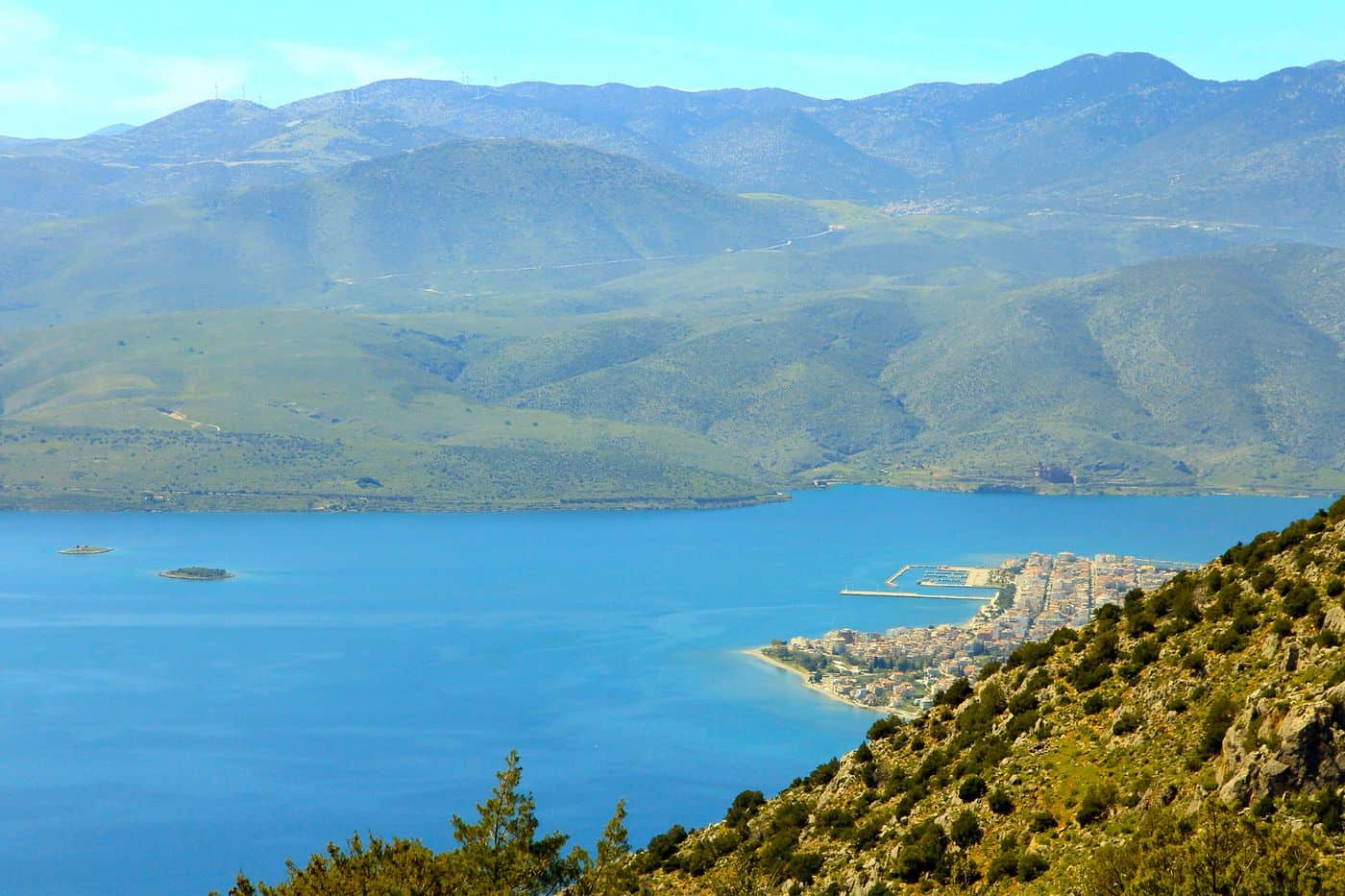
Itea tours start in the port town on the Gulf of Itea, an inlet of the Gulf of Corinth in Phocis, which serves as the port of Delphi. The routes cover the road up to the sanctuary of Apollo, the olive grove of Amfissa, ancient Kirra, the islets of the bay and the coast toward Galaxidi. Greece Tours lists the boat trips and Delphi tours that start in Itea.
This page covers which Itea tours visit Delphi, the olive grove and Kirra, the sea trips, the history of the town, the beaches, the day trips, how visitors reach Itea and which season suits each route. The tours below are checked on GetYourGuide and leave from Itea, Galaxidi and Delphi.
What do Itea tours cover?
Itea tours cover the port town on the north coast of the Gulf of Itea, an inlet of the Gulf of Corinth in Phocis. Itea belongs to the municipality of Delphi, had 4,546 residents at the 2021 census and serves as the port of Delphi.
Itea is the second largest town of Phocis and holds the largest port in the regional unit. The name means willow in Greek: a willow once grew here beside the only spring of fresh water in the area, between the ancient towns of Kirra and Chalaion.
Behind the town spreads the Crisaean plain, framed by Mount Giona and Mount Parnassus, with Delphi and Chrisso on the slopes of Parnassus. From the seafront, the view reaches Galaxidi and the Peloponnese. Itea tours move between three settings: the harbour, the olive plain and the mountain sanctuary.
- Municipality: the 2011 reform made Itea a municipal unit of Delphi, a municipality of 24,165 residents in 2021 with its seat at Amfissa.
- Municipal unit: the communities of Itea, Kirra and Tritaia, over 26.351 square kilometres.
- Kirra: the seaside village 2 km east, with 1,392 residents in 2021; the two form one built-up area.
- Amfissa: the capital of Phocis, about 13 km north of Itea, with 6,334 residents in 2021.
Itea tours of the town pass the church of the Transfiguration of the Saviour, begun in 1890; the Transfiguration is also the feast of the town.
Which Itea tours visit Delphi from the port?
Itea tours to Delphi follow the road that runs about 17 km from Itea to the sanctuary of Apollo on Mount Parnassus. The port serves cruise ships, and the tours cover the UNESCO-listed sanctuary and the Delphi Archaeological Museum.
Delphi was the seat of the Pythia, the major oracle of the ancient Greek world, and the stone Omphalos marked the centre of the world in Greek belief. The precinct lies on the south-western slope of Mount Parnassus and has been part of Parnassos National Park since 1938. Itea tours cover the sanctuary in brief, and the Delphi page sets out the site in depth.
Pilgrims who came by sea landed at Kirra, the nearest port to Delphi, and went up on the ancient Kirra–Delphi path. Under Ottoman rule, travellers to Delphi landed at Itea or Naupactus and went on by road with pack animals. Itea tours to Delphi now start from a port and marina that also serve commercial shipping and private boats.
- Museum: the Delphi Archaeological Museum opened in 1903 and fills fourteen rooms on two levels, with more than 2,270 square metres of halls.
- Exhibits: the Charioteer of Delphi, the frieze of the Siphnian Treasury and the Sphinx of Naxos.
- Operator: the Ephorate of Antiquities of Phocis, under the Greek Ministry of Culture.
- Road link: the Greek National Road 48 connects Itea with Delphi, Livadeia and Naupactus.
What do Itea tours see in the olive grove of Amfissa and at Kirra?
Itea tours inland cross the olive grove of Amfissa, about 5,500 hectares with more than 1.2 million trees, and reach ancient Krisa at Chrisso and the castle of Amfissa. On the coast, Itea tours stop at Kirra, the ancient port of Delphi.
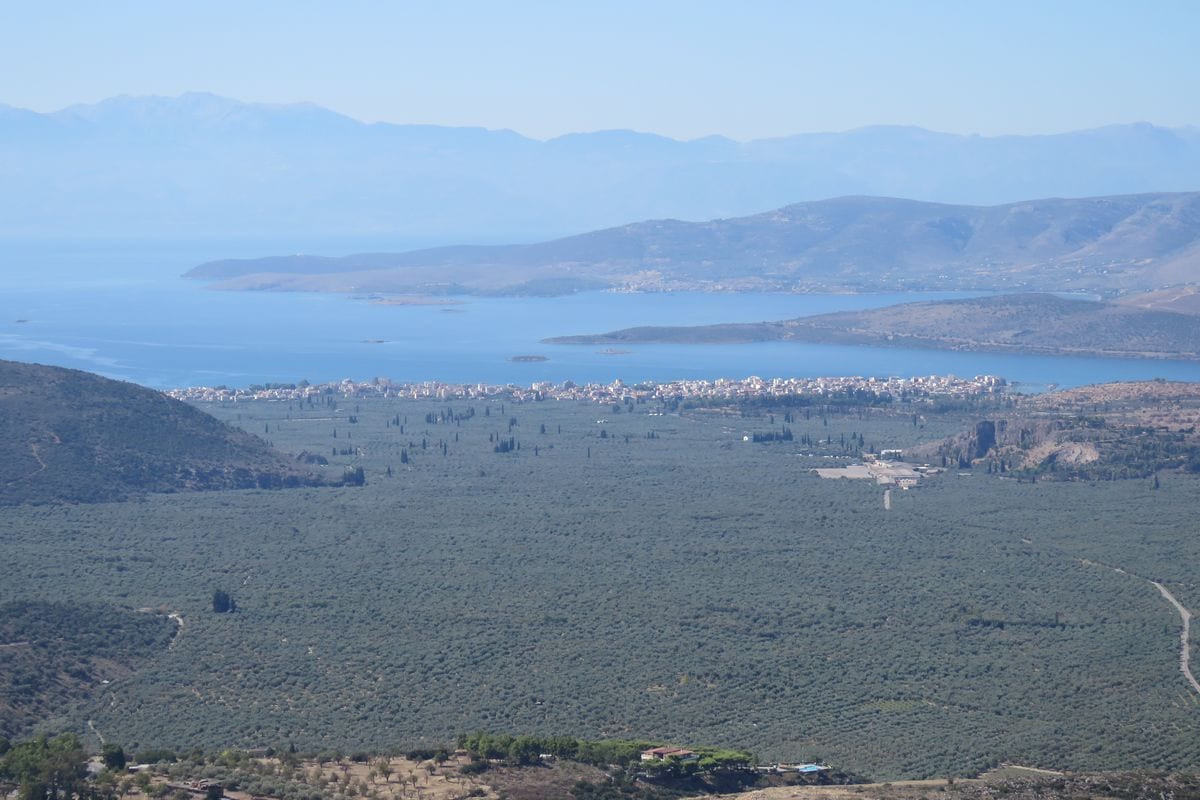
The Greek Ministry of Culture puts the traditional grove at about 55,000 stremmata. It belongs to the Delphic landscape, which runs from the site of Delphi down to Itea, has been protected since 1981 and bans building in its Zone A.
The trees grew from wild olives grafted with the Amfissa variety, and the bulk of them are centuries old. The Konservolia of Amfissa, a large table olive with rich flesh, holds EU Protected Designation of Origin status. Itea tours on foot or by bicycle follow paths between stone terraces, and the Delphi–Chrisso–Kirra trail takes about 2 hours.
At Kirra, the best preserved monument is a set of shipsheds from the 5th century BC, at least five long bays where small ships were dragged from the sea for repair. Inland, the walls of Krisa, the divine Crissa of the Iliad, surround the chapel of Agios Georgios in Chrisso.
- Sanctuary at Kirra: a precinct of Apollo, Artemis and Leto, 160 by 130 metres; its clay figurines are in the Archaeological Museum of Amfissa.
- Chrisso: a protected village at 200 metres above the olive grove, with 590 residents in 2021.
- Castle of Amfissa: built by Thomas d’Autremencourt, the first Frankish lord of Salona, on the ancient acropolis; the first fortress to fall to the Greeks, on 10 April 1821.
Which Itea tours go to sea?
Itea tours at sea sail the shallow Gulf of Itea, less than 100 metres deep, among the seven islets of the bay. Agios Athanasios and Agios Konstantinos lie opposite the harbour of Itea, and Agios Dimitrios stands almost midway to Galaxidi.
Agios Konstantinos carries a basilica-type chapel with a small belfry, built under Ottoman rule. A school worked on the islet in 1720, and the Chronicle of Galaxidi records a hospital for wounded fighters there during the revolution of 1821. On the feast day of the chapel, the faithful cross on local fishing boats.
Between Agios Konstantinos and Agios Athanasios, the remains of a stone bridge about 210 metres long lie under the water. Agios Athanasios, a private islet with pines and olive trees, sits closest to the harbour entrance. Farther out, Itea tours pass Agios Dimitrios, about 3 nautical miles from the port, 8 metres high and known as Venizelos’s hat.
Galaxidi stands 7 km south-west of Itea, on a natural double harbour on the west coast of the gulf. Itea tours toward that shore link with the Galaxidi boat tour.
- Marina: berths for 250 boats, in addition to the passenger and cargo port.
- Nautical Club of Itea: distinctions in open-sea championships, and men’s and women’s water polo teams in the national divisions.
- Kirra: known for camping and water sports on the shore east of Itea.
- Epiphany: at the blessing of the waters on the harbour pier, young swimmers dive into the icy sea and race for the Holy Cross.
What history do Itea tours tell?
Itea tours tell of Kirra, the ancient port of Delphi that the First Sacred War destroyed, of the naval Battle of Itea in September 1827, and of the modern town that grew from Skala Salonon, the Ottoman landing stage of Amfissa.
Itea tours begin the story at Kirra, which commanded the sea approach to Delphi and levied tolls on the pilgrims who landed there. The Amphictyonic League fought the First Sacred War against Kirra from 595 to 585 BC. Cleisthenes of Sicyon blockaded the port, and the besiegers poisoned its water with hellebore. Kirra was razed, its plain was dedicated to Apollo, and the spoils paid for the first Pythian Games.
Under Ottoman rule, the settlement of Skala Salonon grew up here, with a wooden pier, a customs house, huts and storehouses. In September 1827, the British philhellene Frank Abney Hastings led the steam warship Karteria against an Ottoman fleet anchored off the town. Karteria, the first steam-powered warship to see combat, sank nine Ottoman ships, and Itea tours recall the raid as a catalyst for the Battle of Navarino.
- Founding decree: Ioannis Kapodistrias signed a decree on 13 August 1830 for a town at Skala Salonon, to be named Krissa.
- Town plan: planned building began in 1852, on the plan that Panagiotis Papanaoum drew up in 1836.
- First World War: Itea served as an Entente base, and the French Moles survive at the town exit toward Galaxidi.
- Hippodrome: Professor Panos Valavanis places the hippodrome of Delphi at Gonia, in the Itea farmland behind the hill of Agioi Anargyroi.
- Anniversary: a presidential decree of 4 April 1990 set the last Sunday of September as the public celebration of the naval battle.
Which beaches do Itea tours reach?
Itea tours reach the town beaches of Trokadero, Vrachakia, Miami and Anagneika, the shore of Kirra next door and the beach of Agioi Pantes in the Galaxidi area. The national Blue Flag list names five beaches in the Delphi municipality.
Itea and Kirra now form one built-up area on the north shore of the Gulf of Itea. Kirra lies at the mouth of the Pleistos river and is known for its beaches, camping and water sports. On the west coast of the gulf, Galaxidi keeps a pine forest on the rocky shore beside its larger harbour, planted by schoolchildren in the early twentieth century.
The Hellenic Society for the Protection of Nature runs the Blue Flag programme in Greece. On the current list, Greece holds 624 Blue Flag beaches and ranks second in the world. The list names five Delphi municipality beaches within reach of Itea tours:
- Miami: an Itea beach with a Blue Flag since 2014.
- Trokadero: flagged since 2014 and listed as Trokandero/Angali.
- Vrachakia: a town beach of Itea with a flag on the current list.
- Agioi Pantes: a beach in a community of the Galaxidi municipal unit.
- Kalafatis: the fifth flagged beach of the municipality.
Further west, the same list names nine beaches in the Dorida municipality of Phocis. Among them are Monastiraki, Skaloma and Chiliadou, a strip of beach villages outside Nafpaktos.
Which day trips combine with Itea tours?
Itea tours combine with Galaxidi, 17 km away on the west side of the gulf, with Arachova and the slopes of Mount Parnassus, with the Hosios Loukas monastery near Distomo, and with the harbour town of Nafpaktos, 52 km to the west.
Galaxidi stands on a natural double harbour on the west coast of the Gulf of Itea. In the 1860s and 1870s its fleet of over 400 ships made it the second-largest shipping centre in Greece after Syros. The Maritime and Historical Museum, the first naval museum in the country, shows sailing-ship portraits, nautical objects and the Chronicle of Galaxidi.
Arachova sits at 970 m on the southern slope of Mount Parnassus, 8 km east of Delphi. Parnassus rises to 2,457 m at Liakoura, its highest peak, and its national park dates from 1938. The Corycian Cave on its slopes was linked with Hermes and the Bee Maidens, and later became sacred to Pan and the Muses.
The Hosios Loukas monastery near Distomo has been a UNESCO World Heritage Site since 1990, together with Nea Moni and Daphnion. Its Katholikon is the earliest surviving domed-octagon church and holds the best-preserved mosaics of the Macedonian Renaissance. Nafpaktos, the western stop on Itea tours, sits on a bay on the north coast of the Gulf of Corinth.
- Castle and port: both keep Venetian remains, and two cafés stand inside the castle walls.
- Lepanto monuments: the port marks the Battle of Lepanto, fought on 7 October 1571.
- Cervantes statue: a work by the Mallorcan artist Jaume Mir at the port.
- Psani and Gribovo: the two beachfronts west and east of the port.
How do visitors reach Itea for Itea tours?
Itea tours start in a port town on National Road 48, 13 km south of Amfissa, the base of the KTEL Fokidas bus company. Cruise ships call at the Itea port, and flights land at Athens International Airport or at Araxos, the airport of Patras.
Itea tours by car use National Road 48, which links Itea with Nafpaktos, Delphi and Livadeia. National Road 27 runs north through Amfissa to Lamia. Galaxidi, 17 km from Itea, sits a 2.5–3 hour drive from Athens.
KTEL Fokidas buses from Athens to Amfissa and Delphi leave the Liosion bus station, close to the Kato Patisia stop on Metro Line 1. Liosion is the second-busiest bus station in Athens.
The Itea port is the largest in Phocis. With its marina, it serves commercial shipping, cruise ships and private boats, and the marina has berths for 250 boats.
- Athens International Airport: the largest international airport in Greece and the main base of Aegean Airlines, 20 km east of central Athens and 30 km by road.
- Araxos Airport: the airport of Patras, 45 km west of the city, with civilian flights to European destinations in the summer months.
- Rio–Antirrio Bridge: a 2,380 m crossing, opened on 12 August 2004, that links Rio on the Peloponnese with Antirrio on the mainland.
- Thermopylae–Antirrio road: its western part runs from Antirrio via Nafpaktos and Itea to Chrisso.
When do Itea tours run best?
Itea tours suit summer for the Blue Flag beaches, when the Amfissa station 13 km north records average highs of 30.6–34.6 °C from June to September, and winter for skiing on Parnassus and the Epiphany ceremony at the port.
The Amfissa weather station stands at 168 m. January brings an average high of 12.3 °C, an average low of 2.2 °C and 134 mm of rain, while June is the driest month with 9.9 mm. The Arachova station, at 1,069 m, records a July average high of 26.7 °C, against 34.1 °C at Amfissa. On Parnassus, the Vathistalos station at 1,780 m records a July average high of 20.3 °C.
In the summer months the population of Phocis nearly doubles with visitors, and Itea hosts cultural and sports events. Parnassus trails serve hikers in the three warm seasons. In winter the whole range opens to skiing, especially from the resorts of Arachova. The calendar of Itea tours also follows these local feasts:
- 6 January: the Epiphany blessing of the waters on a platform at the port pier, where young swimmers dive for the cross.
- Carnival: the Neratz Itias festival in Itea on the last Carnival weekend and the Flour War in Galaxidi on Clean Monday.
- Easter Tuesday: a festival at Agios Ioannis Theologos, the small basilica at the east entrance of Itea.
- 23 April: Arachova honours its patron, Saint George.
- Last Sunday of September: the anniversary of the naval battle of Agkali, a public feast day set by presidential decree in 1990.
Frequently Asked Questions
Do Itea tours include skiing on Mount Parnassus?
Itea tours in winter pair with the Parnassos Ski Centre, which has two areas, Kelaria and Fterrolakas, and 19 ski runs with a total length of 36 km. The slopes climb from 1,600 m to 2,250 m. The centre has no accommodation, and the nearest beds lie in Arachova, Kalyvia, Lilaia, Eptalofos and Amfikleia.
When do Itea tours catch the Galaxidi Flour War?
Itea tours catch the Flour War on Clean Monday, the first day of Great Lent and the end of the Carnival season. Around noon, locals and visitors in old clothes collect coloured flour, march to the harbour and throw it at each other until supplies run out. The custom has kept its present form since the mid-19th century.
Which local foods turn up on Itea tours?
On Itea tours, Arachova offers Formaela, a cheese with protected designation of origin status, and its black wine. At the Neratz Itias festival, the Itea community serves bitter-orange spoon sweet and halva prepared on the spot. Arachova is also known for colourful textiles, carpets, rugs, handicrafts and woodcut creations.
What do Itea tours find in the Hosios Loukas crypt?
Itea tours that reach Hosios Loukas find a burial crypt beneath the domed Katholikon, entered by a stairwell on the south side. Its frescoes show the Passion and Resurrection of Christ in eight lunettes, along with forty medallion portraits of apostles, martyrs and abbots. The Greek Archaeological Service cleaned the crypt in the 1960s.