
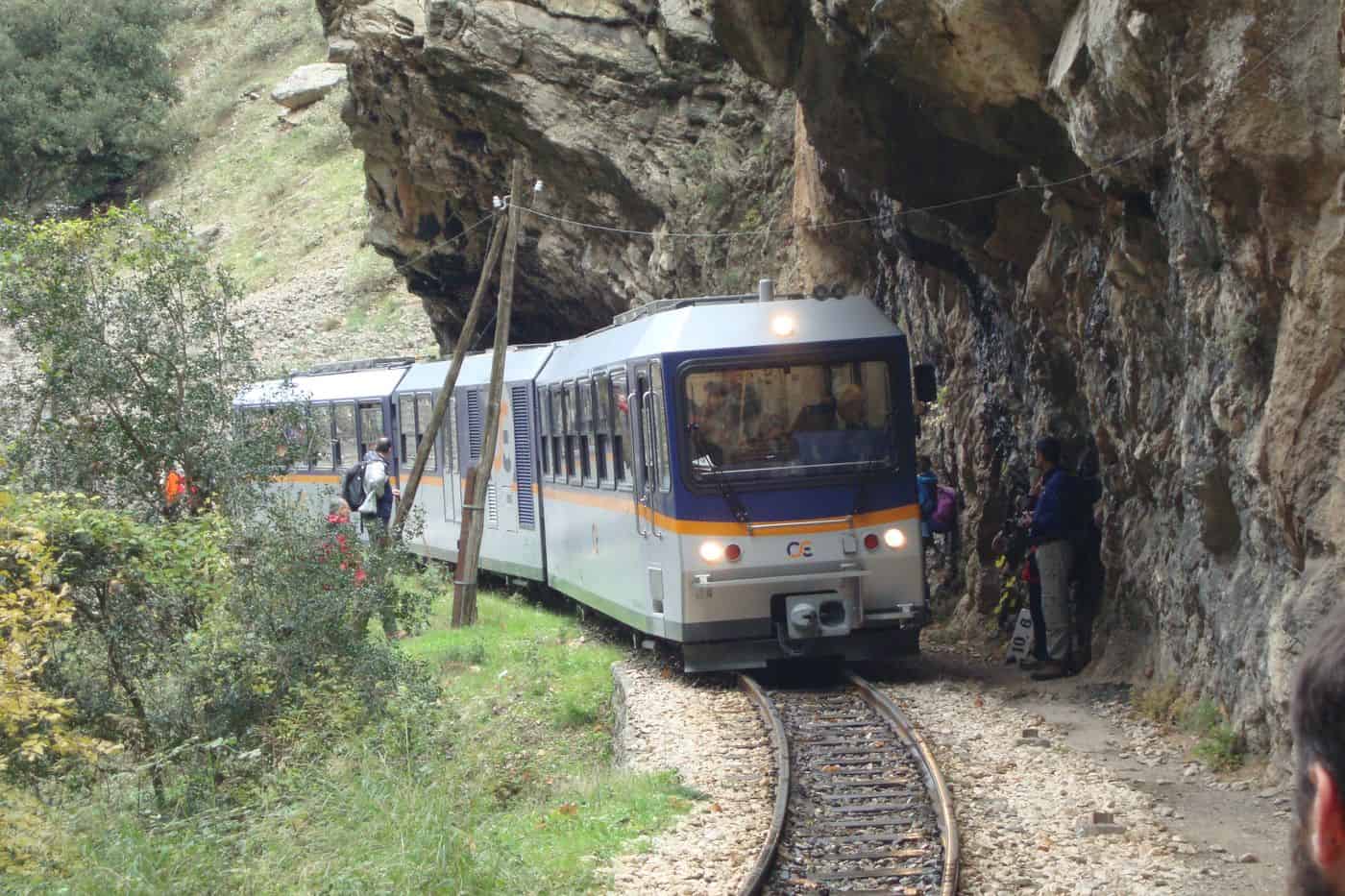
Diakopto tours start in a coastal town of Achaea on the Gulf of Corinth, the lower terminus of the Odontotos rack railway to Kalavryta. The routes cover the railway line and the Vouraikos gorge, the Mega Spilaio monastery above Kato Zachlorou, the mountain town of Kalavryta and the beaches of the gulf. Greece Tours lists the day tours that reach Kalavryta from Athens, Diakopto and Olympia.
This page covers the rack railway and the current status of its services, the gorge, the monastery and Kalavryta, the beaches, the day trips, how visitors reach Diakopto and which season suits each route. The tours below are checked on GetYourGuide and leave from Athens, Diakopto and Olympia.
What do Diakopto tours cover?
Diakopto tours cover a coastal town of Achaea on the Gulf of Corinth, the lower terminus of the rack railway to Kalavryta. Diakopto is a municipal unit of Aigialeia, and the 2021 census counted 1,977 residents in its community and 5,603 in the unit.
The town lies near the mouth of the Vouraikos river, at the lower end of the Vouraikos Gorge, 15 km southeast of Aigio. In everyday speech the name is Diakofto.
Three ancient cities stood in the area: Boura, Helike and Keryneia. Ottoman rule lasted from 1460 to 1821, apart from Venetian rule between 1687 and 1715. The municipality was created in 1835 and was known as Voura.
Diakopto tours start at the railway station, which opened on 10 March 1896 and reopened on 22 June 2020 on the extended Athens Airport–Patras railway. The sheds and workshops of the rack trains stand at Diakopto.
- Municipal unit: 103.932 square kilometres in 12 communities, among them Eliki, Keryneia, Mamousia, Trapeza and Zachloritika.
- Aigialeia: the municipality formed in 2011 from Aigeira, Aigio, Akrata, Diakopto, Erineos and Sympoliteia, with its seat at Aigio.
- Census trend: the community of Diakopto had 2,290 residents in 2001, 2,183 in 2011 and 1,977 in 2021.
- Two gauges: the new standard-gauge main line tunnels under the station yard, beside the 750 mm rack line.
Diakopto tours leave the coast here and climb inland to Zachlorou, the Mega Spilaio monastery and Kalavryta.
What do Diakopto tours ride on the Odontotos rack railway?
Diakopto tours ride the Odontotos, the Diakopto–Kalavryta rack railway, a 750 mm narrow-gauge line that runs 22 km from the coast to Kalavryta. It climbs from sea level to 720 m and engages a toothed rail on three rack sections.
The line that Diakopto tours ride was laid between 1889 and 1895 and opened on 10 March 1896 as a branch of the Piraeus, Athens and Peloponnese Railways. The French company ATON built it with Italian craftsmen who had worked on similar projects in the Alps.
The Odontotos is the steepest railway in Greece, with a maximum gradient of 17.5%. Where the gradient exceeds 10%, gear wheels on the train engage a toothed rail in the centre of the track, on three Abt rack sections of 3.8 km in total. Top speed is 40 km/h on plain track and 12 km/h on the rack.
Two days after the line marked 130 years of operation, Hellenic Railways suspended traffic indefinitely. The 2023 fire in the Vouraikos gorge had weathered the soil, and landslides and rockfalls hit the track. Regular services stay halted until the line reopens, with no replacement buses.
- Niamata and Triklia: the first stops in the gorge; an older halt at kilometre 8.14 closed in 1960.
- Kato Zachlorou: the halfway stop at kilometre 12.6, listed as Mega Spilaio, which serves Diakopto tours to the monastery.
- Pliatsikoureika and Kerpini: the upper stops, with Kerpini below its village at kilometre 18.2.
- Trains: four three-car diesel-electric sets from Stadler Rail, Class 3107, in service since 2009.
What do Diakopto tours see in the Vouraikos gorge?
Diakopto tours see the Vouraikos gorge, about 20 km long, on the river that flows past Kalavryta down to the sea at Diakopto. Dense vegetation, steep cliffs, waterfalls and caves line the river, and the rack railway crosses the gorge through tunnels and over bridges.
Diakopto tours follow a river that rises in the Aroania mountains near Priolithos and runs 37.5 km to the Gulf of Corinth. Strabo called it the Erasinos, and Pausanias mentions it in his Description of Greece. The name comes from Boura, a daughter of Ion and Helice. In the legend, Hercules loved her and opened the gorge to reach her.
Legend places an oracle of Hercules in a cave on the river bank, where pilgrims threw knucklebones and read their fate on the Tables of Knowledge. Diakopto tours reach Kato Zachlorou halfway up the line, a village at 623 m on the left bank of the river, with 38 residents in 2011 and taverns and guesthouses around its station.
- Geopark: the gorge lies in the Chelmos-Vouraikos UNESCO Global Geopark, a territory of 654 square kilometres with UNESCO status since 2015.
- Geosites: Niamata, a tectonic window of the Tripolis zone, and Portes-Triklia, a stretch of thin platy limestones.
- Folklore: the legend of the Unwed Bride of Zachlorou, who vanished while searching for her fiancé, lost on their wedding day, and appears on foggy nights.
The Zachlorou station, opened in 1896, is the rail stop for the Mega Spilaio monastery, a short distance above the village.
What do Diakopto tours see at the Mega Spilaio monastery?
Diakopto tours see Mega Spilaio, the Great Cave, a male monastery of the Dormition of the Theotokos set in a 120 m cliff above Kato Zachlorou. Its eight-storey complex stands at about 900 m, at the mouth of a natural cave in the Chelmos range.
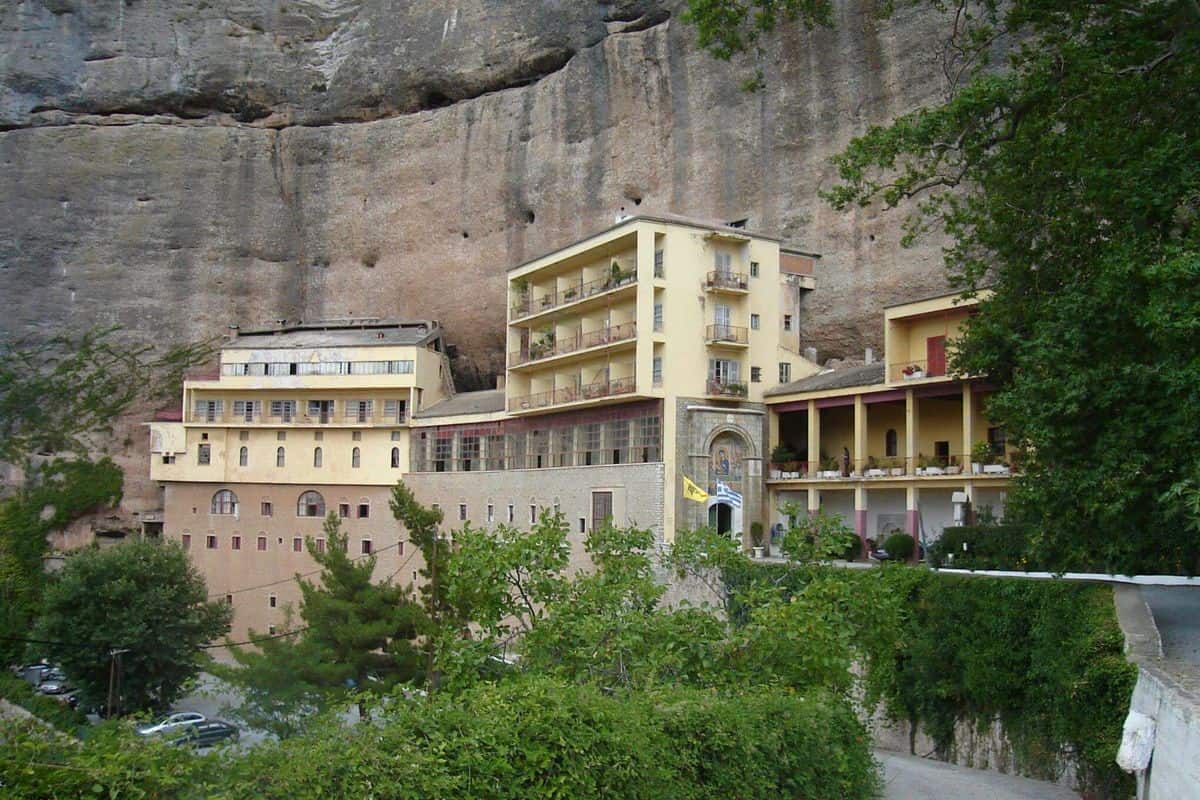
Diakopto tours retell a founding tradition dated to 362. Two brothers from Thessaloniki, Symeon and Theodore, came in search of an icon of the Virgin made by Luke the Evangelist. Euphrosyne, a shepherdess from Zachlorou, had found it in the cave by following a goat to a spring. That spring, the Spring of the Maiden, still serves as holy water, and Euphrosyne is honoured as a saint.
Fires struck the monastery in 1400, 1640 and 1934. On 24 June 1827, the forces of Ibrahim Pasha fell back from the monastery after a hard battle. On 8 December 1943, five days before the massacre of Kalavryta, the German 117th Jäger Division destroyed the monastery and executed monks and visitors. Diakopto tours today see the complex rebuilt after the war.
- Icon: the Panagia Megalospilaiotissa, a relief 3 cm thick of wax, mastic and other materials, darkened by the fires.
- Museum and library: relics of the War of Independence, a banner with three Byzantine emperors, Gospels on parchment and more than 3,000 volumes.
- Feast days: 15 August for the Dormition, 14 September, and 18 October for Luke the Evangelist and the founders.
- Antiquity: Pausanias reports that the daughters of Proetus found refuge in the cave during their madness.
What do Diakopto tours see in Kalavryta?
Diakopto tours see Kalavryta, the mountain town at the upper end of the rack railway, at about 735 m on the right bank of the Vouraikos. The town stands near ancient Cynaetha, at the foot of Mount Chelmos, and holds the status of a martyr town.
Diakopto tours in Kalavryta stop at the Hill of Kappi, kept as a memorial to the massacre of 13 December 1943. That morning, soldiers of the German 117th Jäger Division shut the people in the school, then shot the men and older boys in the field of Thanasis Kappis above the town. Only 13 men survived, and the women and children escaped from the burning school.
Diakopto tours also visit the Museum of the Kalavryta Holocaust, housed since 2005 in that same school building, with maps, photographs and personal items of the executed. Agia Lavra, founded in 961, stands on a hill 4 km from the town, and Greek tradition places the start of the War of Independence there on 25 March 1821. German troops burned it on 14 December 1943.
- Agia Lavra treasures: the banner of the oath of 1821 and the vestments of Bishop Germanos.
- Cave of the Lakes: an old underground river on three levels near Kastria, 17 km from Kalavryta, which leaves 13 lakes when it dries in summer.
- Ski centre: pistes between 1,700 m and 2,330 m on Mount Chelmos, also called Helmos, about 14 km from town.
A day from the capital to Kalavryta and back is set out in the Kalavryta day trip from Athens.
Which beaches do Diakopto tours reach?
Diakopto tours reach the beaches of the Achaean shore of the Gulf of Corinth: the coast at the Vouraikos mouth by Diakopto, the organised beach at Elaionas, the pebble beaches of Trapeza and Pounta, and the shore of Akrata and Krathi.
Diakopto stands on the Gulf of Corinth, near the mouth of the Vouraikos, which meets the sea west of the town. In summer, clean, naturally formed beaches line the coast of the whole area. The gulf is 115 km long, and Giona and Parnassos rise across the water.
Elaionas, called Tripia until 1949, lies 12 km from Aigio and holds the largest olive grove in Aigialeia. Its beach has changing cabins, showers, a toilet, an accessible entry into the sea and lifeguards, and independent athletes practise kiteboarding, windsurfing and triangle sailing there.
East of the town, Diakopto tours pass Trapeza, a village on a cliff about 130 m above the gulf, 4 km southeast of Diakopto. The pebble beaches of Trapeza and Pounta form a popular holiday spot, and Pounta sits on the cape where the Ladopotamos reaches the sea. Further along the coast:
- Akrata: the town is known for its beaches, and the Krathis, which rises on Helmos, enters the gulf at Krathi, the former Paralia Akratas.
- Platanos: this hill village lies 1,800 m from the sea, with a wide horizon to Sterea Ellada.
- Psathopyrgos: towards Patras, 9 km northeast of Rio, this village has a small pebble beach and fish taverns.
Which day trips combine with Diakopto tours?
Diakopto tours combine with Aigio, 15 km to the northwest, the ancient theatre of Aigeira to the east, Patras and the Rio–Antirrio bridge to the west, and the Corinth Canal and ancient Corinth beyond Kiato, all on the A8 corridor.
Aigio, the second-largest city in Achaea, is known as the balcony of the Corinthian Gulf. Its church of Panagia Trypiti stands on a cliff almost 30 m high near the sea, reached by a stair of 150 steps. The Archaeological Museum fills the old municipal market, built in 1890 to plans by Ernst Ziller.
The modern town of Aigeira lies 26 km southeast of Aigio, and the ancient site sits about 6 km from it. Its theatre dates to around 280 BC and stands at 416 m. Archaeologists of the Austrian Archaeological Institute have excavated Aigeira since 1916.
On the western leg of Diakopto tours, Patras, the third-largest city in Greece, has a Roman Odeon built around 160 AD, a castle first raised under Justinian and the church of Saint Andrew; a Patras city tour covers them. The Rio–Antirrio bridge, 2,380 m long, links Rio with Antirrio on mainland Greece and opened on 12 August 2004. To the east:
- Corinth Canal: finished in 1893, the canal cuts 6.4 km through the isthmus at sea level, between rock walls that rise 90 m, about 4 km east of Corinth; it features on the Corinth Canal day trip from Athens.
- Temple of Apollo: built around 550 BC, it stands in ancient Corinth, about 5 km southwest of the modern city, below the rock of Acrocorinth.
- Kiato: the train change point lies 18 km northwest of Corinth, on Line A4.
How do visitors reach Diakopto for Diakopto tours?
Diakopto tours start 161 km from Athens and 54 km from Patras. Drivers take the A8 Olympia Odos toll motorway, and rail travellers ride the Athens Suburban Railway to Kiato, then the local train that calls at Diakopto on its way to Aigio.
Line A4 of the Athens Suburban Railway runs between Piraeus and Kiato, with up to one train per hour. At Kiato, rail-based Diakopto tours change to a Hellenic Train local service to Aigio, six trains a day in each direction. Travellers from Athens airport change at Ano Liosia and again at Kiato.
Diakopto station opened on 10 March 1896 and reopened on 22 June 2020 on the Athens Airport–Patras railway. It has two island platforms and is the northern terminus of the rack railway to Kalavryta. Rail replacement buses of Hellenic Train link Patras with the Kiato and Diakopto stations.
By car, the A8 is the 210 km toll motorway between Athens and Patras; its 120 km section from Corinth to Rio opened on 11 April 2017. The old National Road 8 runs through Diakopto, and the Kalavryta exit lies at Trapeza (Pounta). Other ways in:
- KTEL Achaias: frequent coaches run to Aigio and Patras, and regular services run to Diakopto.
- Athens airport: the terminal lies about 190 km from the centre of Diakopto.
- Araxos airport: about 79 km from the centre of Aigio, it receives scheduled flights in the summer seasons.
- Station access: the station lies just north of Diakopto, and no local bus stop serves it.
When do Diakopto tours run best?
Diakopto tours run best in summer for the beaches, when the coast has hot, dry weather, and in winter for the snow on Helmos. Between 17 January and Clean Monday, the Patras Carnival, the largest event of its kind in Greece, fills the calendar.
Trapeza, east of Diakopto, has a hot-summer Mediterranean climate (Köppen Csa), with hot, dry summers and mild, wet winters. Around Aigio, the mean monthly minimum falls to −0.7 °C and the mean monthly maximum reaches 37.7 °C in records from 1974 to 1997, with a mean annual temperature of 18 to 18.5 °C. Elaionas has recorded extremes of 41.3 °C and −4.5 °C.
Summer in Platanos, a hill village of the Akrata unit, stays cool under the northwesterly maistros winds. Snow is extremely rare on the coast near Patras but more common in the mountains. In winter, snow covers Helmos, at 2,355 m the highest mountain in Achaea, and its ski centre has runs between 1,700 m and 2,330 m. Dates for Diakopto tours:
- 17 January to Clean Monday: the Patras Carnival, first held in 1829, peaks on its last weekend with the parades and the burning of the carnival king.
- 26 January: Aigio marks the start of the Secret Assembly of Vostitsa as a local holiday.
- Friday after Easter: the icon of Panagia Trypiti goes in procession through the streets of Aigio.
- Summer: Keryneia, a village of the Diakopto unit, hosts the Elikeia–Poseidonia cultural events.
- Rack railway: on its return to service, the line ran 3 round trips 7 days a week, plus 2 more each weekend day; Hellenic Train has since suspended regular services until the line reopens.
Frequently Asked Questions
Which lake do Diakopto tours reach on Helmos?
Diakopto tours reach Lake Tsivlos, 11 km southwest of Akrata on the road to Zarouchla. The lake lies at about 700 m on the slopes of Helmos, where a landslide blocked the bed of the Krathis. It is about 80 m deep and takes its name from the village of Tsivlos, which it partly drowned.
Which local products do Diakopto tours taste?
Olive oil and olives star at the Oil and Olive festival at Elaionas, a stop on Diakopto tours, which also presents honey, raisins, local wines and traditional dishes of Aigialeia. Aigio, with Patras and Piraeus, has been one of the main export hubs for Corinthian raisins since the 19th century.
Which ancient cave do Diakopto tours visit near Elaionas?
Diakopto tours visit the Cave of Heracles, on the edge of the mountain near Elaionas. In antiquity it held a sanctuary of Heracles, and later a temple with a statue of the hero, who received worship there as a god. The site can be visited today.
How deep is the sea on Diakopto tours?
The Gulf of Corinth off Diakopto tours reaches about 900 m at its deepest point and 400 m west of Aigio. The gulf formed in a tectonic rift and widens by 10 mm a year. Fin whales and dolphins are known to enter its waters.