
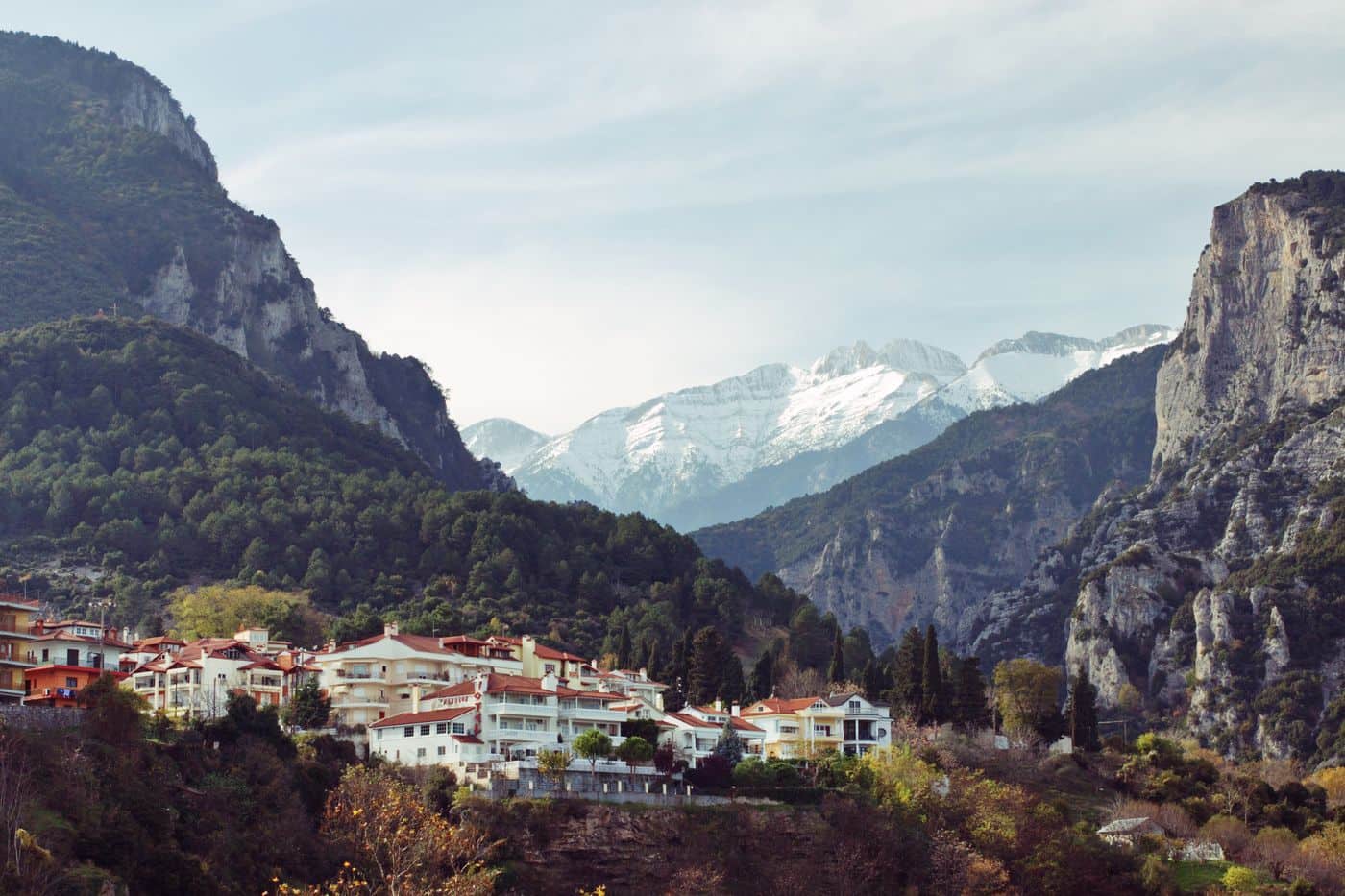
Litochoro tours start in the town at the eastern foot of Mount Olympus, in the Pieria regional unit of Central Macedonia, where the Enipeas river runs through the town. The routes cover the gorge trail to Prionia, the climb to Mytikas, ancient Dion and the Nautical Museum of the town. Greece Tours lists the hikes and day tours that start in Litochoro and Thessaloniki.
This page covers what Litochoro tours see in the Enipeas gorge and on Mount Olympus, the sanctuary of Zeus at Dion, the history of the town, the beaches of Pieria, the day trips, how visitors reach Litochoro and which season suits each route. The tours below are checked on GetYourGuide and leave from Litochoro, Thessaloniki and Athens.
What do Litochoro tours cover?
Litochoro tours cover the town at the eastern foot of Mount Olympus, in the Pieria regional unit of Central Macedonia. Litochoro is the seat of the municipality of Dion-Olympos, and its municipal unit counted 6,889 residents at the 2021 census.
The town lies on the eastern slopes of Olympus, above the western shore of the Thermaic Gulf, and its place at the foot of the mountain earned it the name City of Gods. Almost all climbing routes begin to its southwest. Over the town, the skyline of Olympus forms a V between two peaks of almost equal height: Mytikas on the left and Stefani, the Throne of Zeus, on the right.
Litochoro tours on foot reach the Olympus National Park Information Center, about one kilometre above the town on the road to the summits. Its exhibition, by the Goulandris Museum of Natural History, covers the seven zones of the mountain in seven areas, with boards in Greek and English on hiking, plants, animals, monasteries and myths.
- Administration: Dion-Olympos formed in the 2011 reform, when the former municipalities of Dion, East Olympos and Litochoro merged.
- Parish churches: Agios Nikolaos in the centre, Agios Dimitrios in the north and Agios Georgios.
- Plane tree chapel: a small church under a plane tree honours Saint Kosmas the Aetolian, who preached in its shade during Ottoman rule.
Beside the A1 motorway, Litochoro tours pass the Alexandreion, a building devoted to the life and military campaign of Alexander the Great.
What do Litochoro tours see in the Enipeas gorge?
Litochoro tours in the Enipeas gorge follow the river that flows through the town and cuts the Olympus massif in two. The trail climbs 12.5 km from the Myloi area of Litochoro, at 300 metres, to Prionia, where the river has its springs.
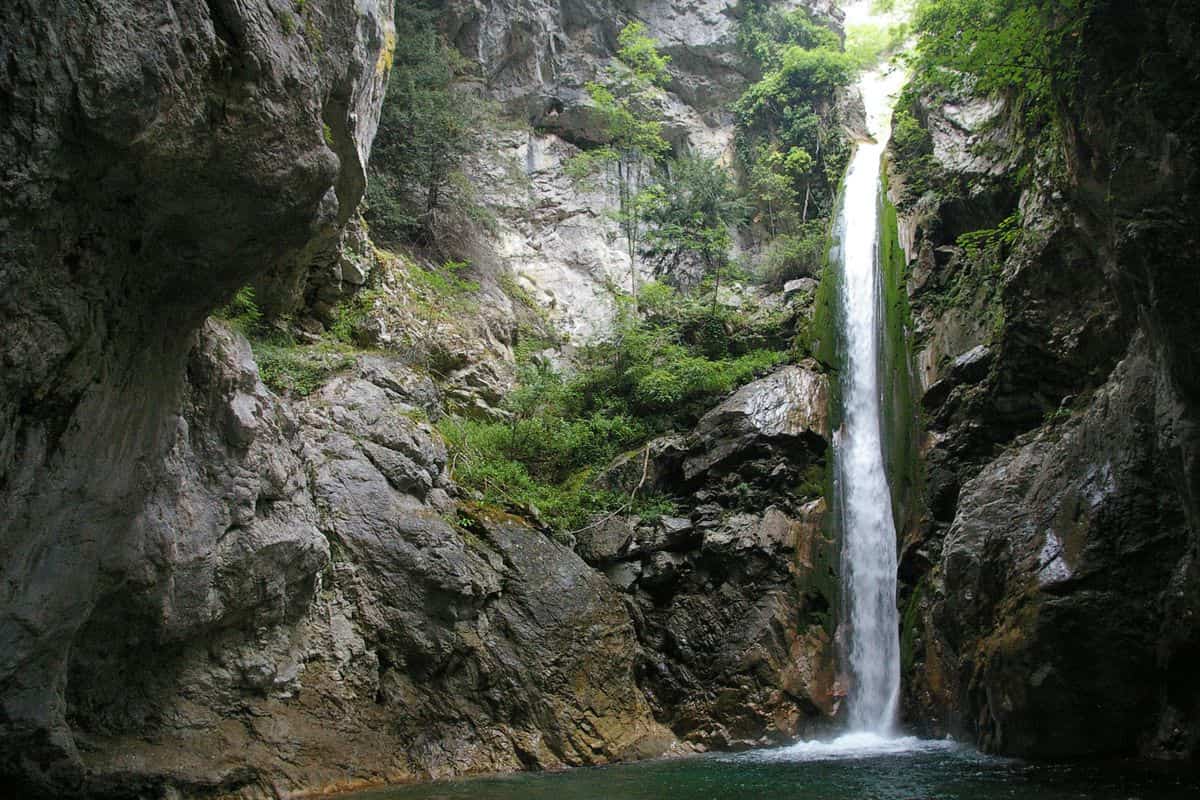
The river water is drinkable at almost every point and supplies the town. Natural pools called vathres line the bed, but the water stays just above zero degrees Celsius and swimming is banned.
At Vythos the gorge opens wide around a waterfall, with a view up to Mytikas and Stefani. Litochoro tours on this path reach Prionia in 5 to 7 hours at an average pace. The shaded route suits all ages and passes elm, yew, hazel, holly and maple, with oriental planes, willows and black alders in the ravines.
Litochoro tours by car stop at the ruins of the old monastery of Agios Dionysios, just off the road to Prionia. The partly restored site now serves the new monastery as a dependency. About twenty minutes away on foot, a chapel under an overhanging rock above a spring marks where the saint lived as a hermit.
- Myloi: the area takes its name from a watermill that still works and now forms a recreation spot.
- Stavros refuge: the Dimitrios Bountolas refuge, 9.5 km up the asphalt road at 930 metres, in the forest of the Dionysios monastery.
- River name: the first record of the name Enipeas for this river is a map by C. Cellarius from 1774.
Which Litochoro tours climb Mount Olympus?
Litochoro tours that climb Mount Olympus drive up the road to Prionia, where the hike starts at the bottom of the mountain. The route leads to Mytikas, the highest peak in Greece at 2,918 metres, inside the oldest national park in the country.
The hike is non-technical up to the Skala summit, and the last stretch to Mytikas is a class 3 rock scramble with high exposure. Over 10,000 people visit Olympus each year, and the majority stop at Skala and Skolio. Both paths to Mytikas, Skala-Kakoskala and Zonaria-Louki, belong to the European path E4.
Litochoro tours on the summit route retrace the first ascent. On 2 August 1913, the Swiss Frédéric Boissonnas and Daniel Baud-Bovy reached the top with Christos Kakkalos, a wild-goat hunter from Litochoro. Kakkalos climbed Mytikas first of the three and served as the official guide of Olympus until his death in 1976.
Olympus National Park dates from 9 June 1938, UNESCO named the area a biosphere reserve on 15 December 1981, and the wider area now stands on the UNESCO World Heritage List as a mixed site.
- Spilios Agapitos: the first refuge of the region, at 2,100 metres in the middle of Mavrologos.
- Petrostrouga: a refuge at 1,900 metres on path D10, run by the Hellenic Rescue Team.
- Giosos Apostolidis: room for 80 people at Diaselo, 2,760 metres up on the Muses’ Plateau.
Litochoro tours to the summit use these refuges, and the Mount Olympus hike page covers the climb in full.
What do Litochoro tours see at ancient Dion?
Litochoro tours at ancient Dion visit the sacred city of the Macedonians, about 8 km north of Litochoro at the foot of Olympus. The Archaeological Park of Dion and the Archaeological Museum of Dion show the sanctuary of Zeus and the ancient city.
The name comes from Dios, “of Zeus”, leader of the gods who lived on Olympus. Macedonian kings sacrificed here at the end of September to open the new year of their calendar, and King Archelaus I founded a nine-day festival of athletic and dramatic contests for Zeus and the Muses.
Litochoro tours retell how Alexander the Great gathered his army and sacrificed here in 334 BC, before his campaign to Asia. Aetolians destroyed the city in 219 BC, Philip V rebuilt it, and Rome took it in 169 BC. Dion later became the seat of a bishop, until earthquakes and floods left it abandoned.
Litochoro tours walk through a park of 150 hectares. Nearly 50 hectares hold the city, with houses, a market square, baths and workshops, and 50 more hold the sanctuaries. The sanctuary of Zeus Olympios came to light in 2000, near the Roman theatre.
- Sanctuary of Demeter: the oldest at Dion, from the 6th century BC.
- Museum: built in 1983, half a kilometre west of the park.
- Water organ: the hydraulis, the oldest organ of its kind found to date.
- Archaeotheke: a building behind the museum for the Dionysos mosaic, moved there in 2015.
Travellers without a base in Litochoro reach the same site on the Dion archaeological park day trip from Thessaloniki.
What history do Litochoro tours tell?
Litochoro tours tell the story of a mountain town of sailors. The first written record of Litochoro dates from the 16th century, when Saint Dionysios came to Olympus, and the Nautical Museum keeps the memory of its shipowners and seamen.
Saint Dionysios founded his monastery in 1542 and dedicated it to the Holy Trinity. Veli Pasha destroyed it in 1821, and in April 1943 the German army bombed it and blew it up. The monks moved to the Metochion, the estate near the town, which grew into the new monastery after the Second World War. Litochoro tours at its museum see three silver skulls with relics of saints and photographs that a German soldier, Karl Faber, took in secret just before the destruction.
Travellers recorded that the majority of residents were seamen, and the town was home to shipowners and sailors until steamships replaced sail in the 20th century. Litochoro tours visit the Nautical Museum in the municipal administration building, with anchors, buoys and a torpedo outside. Its displays open with a model of the torpedo boat that sank a Turkish warship off Thessaloniki in 1912. Two Litochoro sailors, Michail Kofos and Nikolaos Vlachopoulos, guided that attack.
- Name: the theory with the widest support derives Litochoro from Lithochoro, the stony place.
- Revolution of 1878: on 19 February, after 500 volunteers landed at Plaka, the town formed a Provisional Government of Macedonia under Evangelos Korovangos.
- Rigas Feraios: the revolutionary took refuge in Litochoro after killing a Turkish notable at Velestino.
Which beaches do Litochoro tours reach?
Litochoro tours reach Plaka Litochorou, the sandy coast east of the town that runs from Leptokarya in the south to Gritsa in the north. The nearest beach lies 5 km from the town, and Skotina, Paralia Panteleimonos and Platamonas extend the same Pieria shore.
Plaka gives Litochoro tours seaside resorts, hotels, campsites, restaurants and beach bars, which open mainly from June to September. Plaka also holds estates with olive trees and tobacco. Residents of Pieria, Thessaloniki and Larissa holiday here. North of Plaka, Gritsa, also called Limenas Litochorou, keeps sandy beaches with fewer facilities as far as Variko.
South of Plaka, Litochoro tours reach Leptokarya, a town of 3,612 people at the 2021 census that draws about 30,000 tourists in summer, holds a Blue Flag and houses the Olympus Geological History Museum. Paralia Panteleimonos fills a small cove directly below Platamon Castle, with 3 km of sandy shore and a Blue Flag every year. For a beach-only outing, the Pieria Riviera day trip from Thessaloniki covers the same coast.
- Platamonas: a resort of 1,896 permanent residents, known for natural springs, therapeutic spas, fish tavernas and award-winning beaches.
- Skotina: a village on the south-eastern edge of Olympus, facing the Thermaic Gulf, with its coastal settlement Paralia Skotinas.
- Kalyvia Varikou: one of the main beaches of Pieria, on the Variko coast where Gritsa ends.
- Paralia Katerinis: the closest beach to Katerini, 8 km east of the city centre, founded by refugee fishermen after 1922.
Which day trips combine with Litochoro tours?
Litochoro tours combine with Platamon Castle, a Crusader fortress built between 1204 and 1222 at the exit of the Tempe valley, and with the restored village of Old Panteleimonas. Katerini lies 22 km north, while Vergina and the Vale of Tempe extend the list.
A Lombard knight of Boniface of Montferrat built Platamon Castle to control the pass from Macedonia to Thessaly. Its walls stand 7.5 to 9.5 m high, and an octagonal keep rises 16 m. The church of Agia Paraskevi, the only one left of five, holds around 30 worshippers, and a 12-minute path climbs to the castle from Paralia Panteleimonos.
Old Panteleimonas gives Litochoro tours a stone village 3 km from Neos Panteleimonas and 7 km from Platamonas, home to 40 residents. Villagers left it from the 1950s, restoration followed in the 1980s, and it is now a listed traditional settlement. Its central square, with centuries-old plane trees, holds the church of Agios Panteleimon, built in 1914.
- Vale of Tempe: a 10 km gorge between Olympus and Ossa, as narrow as 25 m, where the Pineios River runs under cliffs nearly 500 m high.
- Tempe floods: Storm Daniel floods on 10 September 2023 brought down almost all of the footbridge to the cave shrine of Agia Paraskevi and destroyed its church.
- Katerini: the capital and main rail stop of Pieria, home to 59,189 people at the 2021 census, 7 km from the sea.
- Vergina: the site of Aigai, the first capital of Macedon, where Philip II was killed in the theatre in 336 BC and three tombs came to light in 1977.
Litochoro tours that add Vergina cross into Imathia, which borders Pieria to the north, and the Vergina day trip from Thessaloniki reaches the same site from the city.
How do visitors reach Litochoro for Litochoro tours?
Litochoro tours start in a town 90 km south-south-west of Thessaloniki and 420 km from Athens. Exits 70A and 71 of the A1 motorway serve it, the T1 regional line stops at Litochoro station, and KTEL Pierias buses link it with Katerini.
The A1, the second-longest motorway in Greece at 557 km, is a six-lane dual carriageway near Litochoro. Litochoro tours that fly in use Thessaloniki Airport Makedonia (SKG), the main airport of Northern Greece and the nearest international airport to Olympus, 13 km south-east of Thessaloniki in Thermi. Taxis wait outside the terminal 24 hours a day.
Litochoro station opened on 9 September 2007, 3.8 km south of the original stop, and sits about 130 m from the shoreline. On weekdays, line T1 calls there with up to eight trains a day in each direction between Thessaloniki and Larissa, where it meets the main line to Athens; the Athens–Thessaloniki Intercity does not stop. Bus 01X/01N links the airport with the Thessaloniki KTEL station around the clock.
- KTEL Pierias: buses run from the KTEL Pierias station in Katerini to the Litochoro intercity bus station.
- Coaches: the Litochoro KTEL station also serves Thessaloniki via Katerini, with weekly departures to Athens.
- Taxis: a taxi stand on the central square of Litochoro serves arriving tourists.
- Station services: a staffed ticket office, a buffet and forecourt parking, but no lifts.
Litochoro tours squeezed into one day match the Mount Olympus day trip from Thessaloniki, as the town is the usual starting point for the mountain.
When do Litochoro tours run best?
Litochoro tours run best from June to September, when Plaka’s beach bars operate, the Olympus Festival fills July and August and the high refuges open. Katerini, on the Pierian plain, records mean July highs of 33.3 °C and 18 mm of August rain.
In Litochoro and the foothills the climate is Mediterranean, hot and dry in summer and humid and cold in winter. Litochoro collects 1,088 mm of rain a year, from 55 mm in August to 126 mm in December. Above 2,000 m, snow covers Olympus for about nine months a year, starting in September, and the wind piles drifts 8 to 10 m thick.
Litochoro tours in early summer meet the Olympus Marathon, Ultra and Vertical on the last weekend of June. The marathon runs 43.8 km from Dion, at 3 m, over the Muses’ Plateau to Litochoro, at 295 m. The Olympus Mythical Trail of about 100 km follows on the first weekend of July.
- Summer refuges: Giosos Apostolidis, on the Muses’ Plateau at 2,760 m, opens from June to October and sleeps 80 people.
- Festival: the Olympus Festival, first held in 1972, stages ballet, theatre and concerts in July and August at Platamon Castle, the Dion theatre and the Litochoro Park amphitheatre.
- Autumn: Litochoro tours in October meet the chestnut festival in the square of Old Panteleimonas and the Fest of Honey in Katerini.
- Winter: the Stavros refuge, 9.5 km by asphalt from Litochoro at 930 m, opens all year as a restaurant for 30 guests.
Frequently Asked Questions
Can yacht crews join Litochoro tours?
Yes. The marina at Platamon takes vessels up to 65 ft, cruisers and megayachts, with a draft of up to 5 m, and lies 62 miles from Skiathos. It offers daily tours, water sports, fishing and diving. Gritsa, the port of Litochoro, has restricted capacity.
Which local products do Litochoro tours taste?
Villages around Katerini produce kiwis, cherries, strawberries, apples, olive oil, wine, truffles, mushrooms, honey and a mountain tea known in Pieria as Tea of Olympus. Seafood comes mainly from the port of Paralia. In Neos Panteleimonas, residents make tsipouro from grapes or from arbutus berries, with or without anise.
Where do Litochoro tours find winter skiing?
Winter Litochoro tours add skiing on the Pierian Mountains west of Katerini. The Elatochori ski centre, the only one in Pieria, spreads from 1,400 to 1,800 m on their south-eastern slopes, 36 km from the city. Its chalet at Papa Chorafi holds more than 400 people.
Which ancient sites besides Dion do Litochoro tours reach?
Leivithra, 9 km south of Litochoro, keeps an acropolis and the Leivithra Park, and tradition names it the home of Orpheus. Pydna, 16 km from Katerini, is where Perseus of Macedon lost the decisive battle against Rome in 168 BC. Platamon Castle stands on the site of ancient Herakleion.