
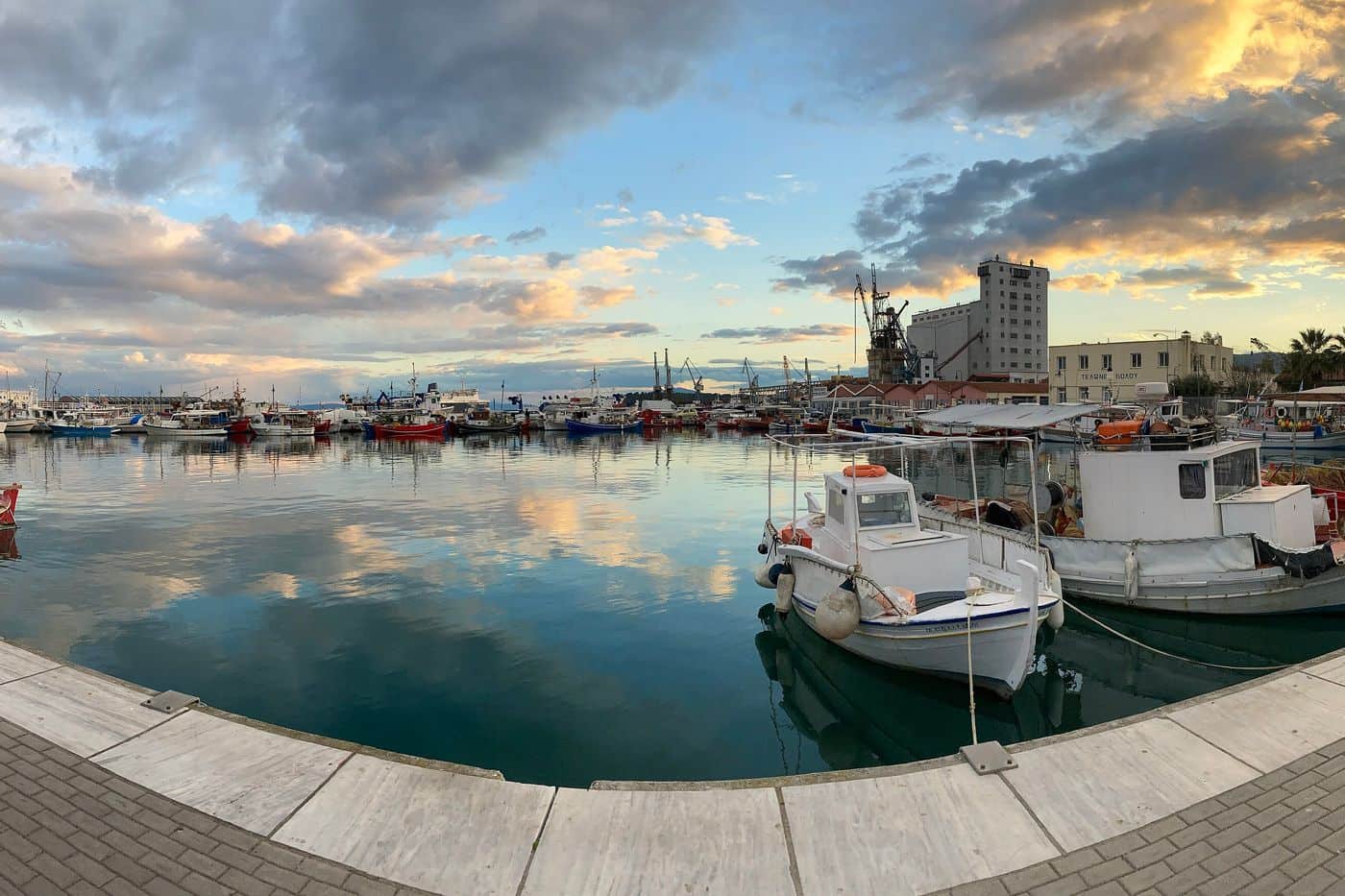
Volos tours start in the port city and capital of Magnesia in Thessaly, on the Pagasetic Gulf below Mount Pelion, where the myth of the Argonauts set sail from ancient Iolcos. The routes cover the waterfront and its museums, the Neolithic sites of Dimini and Sesklo, the Pelion villages and the steam train. Greece Tours lists the walking tours, Pelion trips and sailing days that start in the city.
This page covers what Volos tours see in the city and at its ancient sites, which routes climb into Pelion, ride the steam train and sail the gulf, what the tsipouradika serve, how visitors reach Volos and which season suits each route. The tours below are checked on GetYourGuide and leave from Volos and the Pelion villages.
What do Volos tours cover?
Volos tours cover the port city of Volos, capital of the Magnesia regional unit in Thessaly, with 85,803 residents at the 2021 census. Routes join Neolithic Dimini and Sesklo, the Athanasakeion museum, the waterfront, the Palia quarter and the city’s industrial past.
Volos stands at the innermost point of the Pagasetic Gulf, at the foot of Mount Pelion. It is the only outlet to the sea for Thessaly, the largest farming region in Greece. Its port ranks third in Greece for cargo, after Piraeus and Thessaloniki.
Modern Volos covers the ground of three ancient cities: Iolcos, Pagasae and Demetrias. Volos tours move from prehistory and myth to Macedonian kings, neoclassical merchant houses and old factories, all inside the Volos municipality.
- Location: midway on the Greek mainland, about 170 kilometres north of Athens and 140 kilometres south of Thessaloniki.
- Population: 139,670 in the Volos municipality at the 2021 census.
- Urban area: 129,737 residents across Volos, Nea Ionia, Iolkos, Aisonia and Agria.
- Tourist office: the Volos Info centre at Lambraki and Sekeri streets supplies maps and leaflets for Volos tours.
What myths and ancient sites do Volos tours visit?
Volos tours visit the land of ancient Iolcos, home of Jason and the Argo in Greek myth, the Neolithic settlements of Sesklo and Dimini west of the city, and Demetrias, which Demetrius Poliorcetes, King of Macedon, founded in 294 BC.
In the myth, Pelias seized the throne of Iolcos from his half-brother Aeson and sent Jason, Aeson’s son, to fetch the Golden Fleece from Colchis. The Argo, built at Pagasae, now a suburb of Volos, sailed with a crew of fifty. Jason lost a sandal in the river Anavros, which still runs through the city.
Municipal maintenance notices place a modern Argo, a prehistoric experimental penteconter, at the second pier of the port. On the Kastro hill in Palia, digs found a Mycenaean palace complex and two Linear B tablets. Newer finds place the seat of the kings of Iolcos at Dimini, then on the coast. Volos tours that follow the myth link both places.
- Sesklo: a settlement on the Kastraki hill, first lived in during the 7th millennium BC, that gives its name to the earliest known Neolithic culture of Europe.
- Dimini: a Neolithic hill ringed by six stone enclosures built in pairs, beside a Mycenaean town with a large megaron and two tholos tombs of the kings of Iolcos.
- Demetrias: called one of the three fetters of Greece by Philip V of Macedon, with a theatre, a palace, the Damokrateia basilica and Roman aqueduct remains known as the Dontia.
- Goritsa: a 200-metre hill east of the city, where Macedonians under Philip II built a fortified grid-plan town for 3,000 to 3,500 people.
On Volos tours to Sesklo and Dimini, an automatic guide system in Greek and English serves both sites.
Which museums do Volos tours visit?
Volos tours visit the Athanasakeion Archaeological Museum, built in 1909, the Tsalapatas brickworks museum in a factory founded in 1926, the Museum of the City of Volos in Palia, the Kitsos Makris Folklore Centre and the Giorgio de Chirico Art Centre.
Alexios Athanassakis, a merchant from Portaria, paid for the neoclassical building of the Athanasakeion. Its halls show finds from Sesklo and Dimini, Geometric figurines from the Volos castle and the painted grave stelae of Demetrias from the 3rd century BC. Whole tombs lie on display with the skeleton and grave goods in place.
The Tsalapatas brothers’ factory made bricks and roof tiles, employed 250 workers at its peak and closed in 1978. In 2004 the Piraeus Bank Group Cultural Foundation began work on a museum in the main factory, which opened two years later. Volos tours inside the museum follow the rebuilt production line, from the presses and clay tanks to the Hoffmann kiln.
The Museum of the City of Volos, the first modern city museum in Greece, fills a former tobacco warehouse in Palia, with part of the castle’s east wall in its yard. It tells the story of Volos and of Nea Ionia, the neighbouring refugee town.
- Kitsos Makris Folklore Centre: the folklorist’s house, owned by the University of Thessaly, with 4,000 volumes, 2,500 slides and 4,000 photographs.
- Giorgio de Chirico Art Centre: named after the painter born in Volos, it shows the Damtsas collection of about 500 paintings.
- Thessalia Typographic Museum: the newspaper has printed without a break since 1898; its museum keeps presses and an archive of more than 1,000,000 pages.
Volos tours that pair the Athanasakeion with Dimini and Sesklo show the finds next to the ground they came from.
What do Volos tours see on the waterfront and in the Palia quarter?
Volos tours on the waterfront pass the church of Agios Konstantinos, built in 1936 by Aristotelis Zachos, the former Papastratos tobacco warehouses and the 1884 railway station of Evaristo de Chirico. In Palia, they reach the castle of the mid-6th century AD.
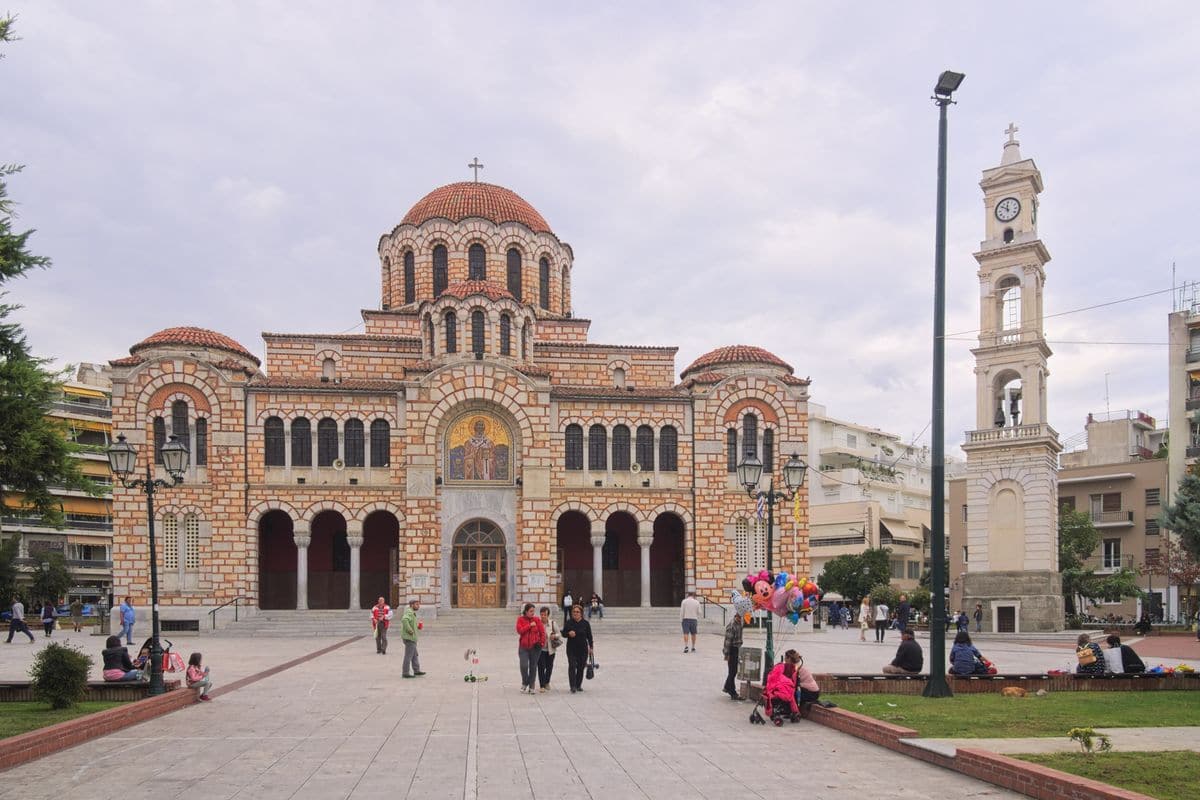
The promenade passes Agios Konstantinos Park, a former square laid out as a park in the 1920s to plans by the architect N. Kitsikis. The church of Agios Konstantinos and Eleni, on the seafront, is a landmark of the modern city. The Papastratos warehouses house University of Thessaly departments and two conference halls.
Volos tours stop at the railway station, opened on 22 April 1884 by King George. Evaristo de Chirico designed it and the lines of the Thessaly Railways. His son, the painter Giorgio de Chirico, was born in Volos on 10 July 1888. The station survived the earthquakes of the 1950s, and its first floor houses the Thessaly Railway Museum.
Palia, in the west of the city, holds the castle of Volos, built in the mid-6th century AD on the hill where earlier scholars placed ancient Iolcos. Under Ottoman rule the castle was reserved for Ottomans, and the modern town began to grow outside its walls shortly after 1830. Volos tours in Palia also see Roman baths in the underground garage of the Village complex.
- Agios Nikolaos: the cathedral of the city’s patron saint, completed in 1934 as the first of three Zachos churches in Volos.
- Achilleion: a cinema-theatre built in 1925 to plans by the Volos architect K. Argyris, still in use.
- City Hall: built in 1970 to plans by Dimitris Pikionis, who matched its style to the buildings of Pelion.
Volos tours on foot join these stops along the waterfront and through Palia, the ground covered by the Volos walking tour.
What modern history do Volos tours tell?
Volos tours tell how the Greek army entered Volos on 2 November 1881, how the port and factories grew, how the first labour union in Greece formed in 1908, how refugees settled Nea Ionia after 1922, and how earthquakes struck in April 1955.
In 1881 the town had only 4,900 inhabitants, but merchants, craftsmen and sailors moved in over the next four decades. The railway to Larissa opened in 1884, the Matsaggos tobacco factory in 1890, and port works began in 1892. In 1919 the port led Greece in tobacco exports, with a 30% share. Industry began to decline in 1937, and deindustrialisation took hold in the mid-1980s.
Refugees from Smyrna and the rest of Asia Minor arrived after the catastrophe of 1922. From late autumn 1924, the first refugee houses rose above the Krafsidonas torrent for about 2,000 people. A royal decree created the municipality of Nea Ionia in 1947.
On 19 April 1955 an earthquake of magnitude 6.2, centred in the Pagasetic Gulf, hit Volos. A second quake followed on 21 April. The two destroyed almost a quarter of the buildings. Volos counts as the newest of the Greek port cities, and Volos tours read this history in its post-quake buildings.
- Yellow Warehouse: a tobacco warehouse of 1926 that the German occupiers and their local collaborators used as a prison.
- Jewish community: Rabbi Moshe Pesach and the Greek authorities saved about 700 members from deportation, and the municipality raised a Holocaust memorial in the central square in 1998.
- Silk mill: founded in 1924 by the Etmektzoglou brothers as the first factory of refugee Nea Ionia.
- University of Thessaly: founded in 1984 with its seat in Volos.
Volos tours of the modern city also pass the former Bank of Athens, now the central library of the University of Thessaly.
Which Pelion villages do Volos tours reach?
Volos tours reach Makrinitsa, the “balcony of Mt. Pelion”, Portaria 12 km from the city, Hania at 1,190 metres, Zagora 47 km away, Tsagarada on the eastern slopes, Milies at the end of the old railway, and Vyzitsa, 2 km from Milies.
Volos tours to Makrinitsa and Portaria stay close to the city, on the western slopes of Pelion, with views over the Pagasetic Gulf. In Makrinitsa, a coffee house on the square keeps a wall painting by the folk painter Theofilos. Portaria lies 13 km from the Pelion ski centre, and its large mansions carry roofs of stone slabs.
Higher on the mountain, Hania takes its name from the old inns that sheltered travellers, and it is the highest settlement in Magnesia. Zagora keeps a public library founded in 1762, with about 3,500 old and rare books. On the Aegean side, Tsagarada spreads over four quarters named after their churches, and a plane tree of about 1,000 years shades the square of Agia Paraskevi.
Volos tours heading south end at Milies and Vyzitsa. Milies lies 28 km from Volos and keeps Psychis Akos, a school opened in 1814 by Anthimos Gazis and Grigorios Konstantas that now serves as a library. Vyzitsa sits at 500 metres, 29 km from Volos, and the whole village was declared a traditional settlement in 1976.
- Makrinitsa: 6 km northeast of Volos, with cobbled lanes and traditional water fountains.
- Hania: 26 km from Volos, on the provincial road from Volos to Zagora.
- Tsagarada: a single-arch stone bridge of 1728, 18 metres long, links the village with Xorychti.
The Pelion villages tour links these villages in one guided route.
What does the Pelion train show on Volos tours?
Volos tours that board the Pelion train ride the 600 mm narrow-gauge line from Ano Lechonia to Milies, 16 km of track with two tunnels, arched stone bridges and an iron bridge named after its designer, Evaristo de Chirico, at 25 km per hour.
Volos tours ride a line that Thessaly Railways built; it reached Milies in 1903. The engineer Evaristo de Chirico, father of the painter Giorgio de Chirico, designed it. The train is also known as Moutzouris. Service stopped in 1971, and the Ministry of Culture listed the line as a historic monument in 1985. The mountain section reopened in 1996 with steam engines, and diesel traction took over in 1999.
Volos tours join the train at Ano Lechonia, 11 km southeast of the city. After a short halt at Ano Gatzea, the train passes Agia Triada, Pinakates and Argyraiika before Milies. There, the engine is turned by hand on a turntable for the return run, and a cobbled path leads from the station to the main square and the Church of the Taxiarches.
- Gauge: 600 mm, against 1,000 mm on the Thessaly Railways lines from Volos to Larissa and Kalambaka.
- De Chirico Bridge: the iron bridge over the Taxiarchis stream, where the track curves across a straight deck.
- Coaches: two diesel locomotives pull wooden coaches with open balconies, and two of the old steam engines survive.
- Season: trains for Volos tours run on weekends and public holidays from mid-April to the end of October, and every day in July and August.
Which Volos tours sail the Pagasetic Gulf?
Volos tours by boat cross the Pagasetic Gulf, about 175 square kilometres of sea with an opening of only 4 km to the south, and sail to Trikeri, the islet of Palaio Trikeri, and the harbours of Agria, Milina and Agia Kyriaki.
The gulf lies between the Greek mainland and the hook of the Pelion peninsula, and Volos is its main port and largest city. At the mouth, the channel between Cape Trikeri and Cape Stavros connects the gulf with the Euboic Sea. Volos tours by yacht charter leave from this main port.
Volos tours to Trikeri reach a village on the hill of Fourtouna at the tip of the peninsula, right above its port of Agia Kyriaki. No road reached the village until the 1970s, so all contact came by sea, and in 1821 Trikeri held one of the largest merchant fleets. Agia Kyriaki still keeps a boatyard that builds and repairs boats, mainly fishing boats.
At the entrance of the gulf lies Palaio Trikeri, an islet of 2.476 square kilometres that rises to 109 metres. Olive groves cover its slopes, and the monastery of Panagia Evangelistria on the islet dates from the 19th century.
- Milina: 49 km southeast of Volos; off its harbour of Valtoudi lie the islets of Alatas and Prasouda, each with a monastery.
- Pythos: a small settlement on Palaio Trikeri, one of four on the islet, reached by footpath or by boat.
- Agia Kyriaki: about 73 km south-southeast of Volos, facing the Trikeri channel.
Which beaches do Volos tours reach?
Volos tours reach the Aegean beaches of east Pelion, such as Mylopotamos, Damouchari, Agios Ioannis and Papa Nero, and the calmer beaches of the Pagasetic Gulf on the west side, such as Kala Nera, with its Blue Flag, and the three beaches of Afissos.
Volos tours to the east coast cross the mountain. Chorefto, the port of Zagora, lies 53 km from Volos by the road over Hania and 85 km by the road through Tsagarada. Mylopotamos sits about 55 km east of Volos and 6 km southeast of Tsagarada. A rock splits its beach into two coves, a natural arch joins them, and steps lead down to the sand.
Damouchari, 46 km from Volos, is an old fishing village and the port of Mouresi. It has a natural harbour and the pebble beach of Palia Damouchari, and scenes of the film Mamma Mia! were shot there in September 2007. Agios Ioannis, about 70 km northeast of Volos, is a beach resort with a small port for fishing boats and yachts, and its beach runs on into Papa Nero.
On the gulf side, Volos tours stop at Kala Nera, whose name means “good waters”, 3 km southwest of Milies. Afissos, 25 km from Volos, rises in tiers above the gulf, and its three beaches are Kallifteri, Lagoudi and Ambovos.
- Sea conditions: gulf beaches get less wind, warmer water and fewer waves than beaches on the Aegean side.
- Damouchari castle: ruins of a Byzantine fort, later used by the Venetians, dating to at least the 11th century.
- Paou: a pebble beach on the eastern shore of the gulf, about 45 km southeast of Volos.
Which Volos tours ski or hike on Mount Pelion?
Volos tours ski at the Pelion Ski Centre on Agriolefkes, 27 km from the city and 2 km from Hania, and hike the stone kalderimi paths of Pelion, the mythical home of the Centaurs, whose summit, Pourianos Stavros, rises to 1,624 metres.
The Hellenic Mountaineering Club of Volos founded the ski centre in 1967, when its first lift began to run. The ski area spans 1,170 to 1,470 metres on the slopes of Agriolefkes, a peak of 1,471 metres. Four downhill runs hold approval from the International Ski Federation (FIS), and a 5 km cross-country trail runs through beech and chestnut forest with views of the Aegean. The ski season runs from Christmas to Easter.
Volos tours cannot reach the summit itself. Pourianos Stavros stands on the northern side of the mountain and stays closed to visitors because of military installations; radar stations went up there in the late 1960s. In the days of pack animals, the route from Volos to Pouri passed through Pourianos Stavros, and it remains the highest hiking route. Until the 1950s, the stone-paved kalderimi paths and the railway were the only links between the villages and Volos.
Volos tours on foot still use these paths across Mount Pelion, and local communities care for the old routes. In myth, Pelion was the home of Chiron the Centaur, tutor of Jason, Achilles, Theseus and Heracles, and the wedding of Peleus and Thetis took place near his cave.
- Ski school: ski and snowboard lessons, with classes for children from 3 years old, plus equipment rental and parking for more than 800 cars.
- Forest: beech, oak, maple and chestnut trees cover the slopes, inside a protected Natura site with the code GR1430001.
- Water: Pelion has 70 known springs and large ravines, but no river with a steady flow.
What do Volos tours taste?
Volos tours taste tsipouro, a grape-pomace spirit long sold only in Thessaly, poured in 50 ml bottles at about 400 tsipouradika with seafood meze. Local dishes include spetzofai with sausage and peppers, boubari, the dessert melachrini and spoon sweets of chestnut, figs and cherries.
The tsipouradiko began with refugees from Asia Minor who settled in Volos after the exchange of 1922, above all sea and port workers. At midday, after work, they met in the small harbour cafés, drank tsipouro and ate meze from small plates. Seafood stayed the leading flavour, as fish from the Aegean and the Pagasetic Gulf pushed meat off the table.
Tsipouro arrives in 50 ml bottles called eikospentaria, and each new bottle brings a different meze. The owner, not the guest, picks the plate, matched to the pace of the orders. Plates move from cheese and olives to more complex dishes such as mussels saganaki and crab croquettes. The Volos Info centre sums up the drink behind Volos tours in three words: Volos means tsipouro. The Volos food tour covers these tables in depth.
- Seafood meze: squid, cuttlefish, octopus, red mullet, sardines, anchovies, mussels, oysters, langoustines and crab from the grill, the pan or the pot.
- Cooked plates: crab salad, aubergine salad, shrimp saganaki, baked feta with tomato, stuffed squid, pickled octopus and mussel pilaf.
- Spetzofai: village sausage fried with long sweet peppers and simmered in tomato sauce; Greece knows a Pelion version and one with giant beans.
- Boubari: a sausage filled with finely chopped offal and rice.
- Spoon sweets: fruit preserves made from chestnut, firiki apples, figs or cherries.
Volos tours that reach Agria, 7 km east of Volos and part of the same municipality since 2011, find a town known for its tsipouradika, its olive growing and the EPSA lemonade, founded there in 1924.
How do visitors reach Volos for Volos tours?
Volos tours begin in a city 320 km north of Athens and 219 km south of Thessaloniki. Nea Anchialos National Airport lies 24 km south-west of the centre, KTEL Magnesia coaches run daily to both cities, and the A1 motorway joins Volos at Velestino and Mikrothives.
The airport, also called Central Greece Airport, carries the codes VOL and LGBL. Its 2,759 m runway ranks second in length among commercial runways in Greece, behind Eleftherios Venizelos in Athens, and a 9,000 m² terminal opened in September 2010. Charter flights carry tourists bound for Pelion and Meteora. A KTEL bus links the terminal with the Volos coach station and waits for each landing, while Volos airport transfers run door to door.
Rail travellers change at Larissa, which connects to Athens and Thessaloniki, for the 61.5 km branch to Volos. The regional train covers it in 48 minutes, but Storm Daniel damaged the line in September 2023, and a rail replacement bus runs along the route during the flood works. Rail-based Volos tours therefore cover the last leg by bus.
- Coach station: KTEL Magnesia, at the corner of Sekeri and Zachou streets, with daily routes to Athens, Thessaloniki, Larissa, Lamia, Ioannina and Patras.
- Airport bus: KTEL departures leave Volos 2 hours before each flight.
- Passenger pier: the central pier, about 200 m from the city centre, handles all passenger traffic and holds a car park.
- City transport: 12 urban bus lines and 334 grey taxis, each with a yellow roof light that is lit when the taxi is free.
Which day trips and ferries combine with Volos tours?
Volos tours combine with daily ferries and hydrofoils to Skiathos, Skopelos and Alonissos in the Northern Sporades, and with the Meteora monasteries near Kalabaka, which the EO6 road reaches through Larissa and Trikala. Delphi, on the south-western slope of Mount Parnassus, fits a longer trip.
The Northern Sporades belonged to the Magnesia prefecture until the 2011 reform, and the port of Volos serves as their main link with the mainland. Passenger-car ferries and hydrofoils sail from the central pier, which also serves Trikeri, Agios Konstantinos and Thessaloniki. Skiathos lies 2.4 nautical miles off the coast of south Pelion, with Skopelos 6 nautical miles to its east, and the Skiathos travel guide covers the island stop.
Inland, the EO6 national road starts in Volos and runs west through Larissa and Trikala to Kalabaka, the town beside the Meteora monasteries. KTEL Magnesia coaches leave Volos for Trikala every day. Volos tours that add Meteora cross Thessaly from its only outlet to the sea to the north-western edge of its plain.
- Skiathos: 47.94 km² and 5,802 residents at the 2021 census, with an airport named after the novelist Alexandros Papadiamantis.
- Skopelos: 96 km², larger than Mykonos or Santorini, where the film Mamma Mia! shot its wedding procession at the Agios Ioannis chapel near Glossa.
- Alonissos: 3 km east of Skopelos, with its port at Patitiri and a national marine park set up in 1992 to protect the Mediterranean monk seal.
- Meteora: 24 monasteries rose on the rock pillars, and the six that remain joined the UNESCO World Heritage List in 1988.
- Delphi: the seat of the Pythia oracle, on National Road 48 between Amfissa and Livadeia and 10 km from Arachova.
When do Volos tours run best?
Volos tours run best from June to September, when the city logs 2.7 to 5.3 rain days a month and mean highs of 27.0 °C to 31.0 °C. Winter adds skiing on Pelion from Christmas to Easter at Agriolefkes, 27 km from Volos.
Climate normals from the Hellenic National Meteorology Service give Volos 428.8 mm of rain a year over 89.2 rain days. July is the sunniest month, with 337.1 hours of sunshine and 15.1 mm of rain. The record high stands at 44.2 °C, and Magnesia summers peak at about 37 to 38 °C in August.
Winter Volos tours meet a January mean high of 11.3 °C, a mean low of 4.5 °C and 58.4 mm of rain over 10.5 days. Mount Pelion shields the city from north-easterly winds, so Volos receives less rain than the eastern side of the mountain. Above the city, the Agriolefkes ski centre sits at 1,471 m, 2 km from Chania, with five runs that total 15 km.
- Spring: the mean high climbs from 19.4 °C in April to 28.5 °C in June, and rain days fall from 8.2 to 5.2.
- Summer: humidity drops to its yearly low of 58.1% in July, and Agria marks the mid-summer new moon with a fishermen’s night of fresh kakavia fish soup.
- Autumn: September averages 22.9 °C with 45.0 mm of rain, and October cools to 17.7 °C.
- Winter: the record low reaches −8.2 °C, and substantial snow covers the mountains of Magnesia.
Volos tours in December and January meet the International Festival of Musical Theatre, a yearly programme of music and performing arts, while Agria stages folk art shows and local dancing in late July.
Frequently Asked Questions
Do Volos tours need a car?
No. KTEL Magnesia buses leave Volos for almost all Pelion villages, stopping near the main squares and at the best-known beaches. Pelion has no taxi ranks, so drivers based in the central villages collect passengers by arrangement. For Volos tours without a car, the coach network also covers Larissa, Trikala and the airport.
Can cruise passengers join Volos tours?
Yes. The port of Volos receives cruise ships, and in the summers of 2015 and 2016 more than 100 cruises brought over 100,000 visitors. Professional tourist boats are on hand at the port for trips to the beaches of Magnesia and the Sporades.
Which drink defines Volos tours?
Tsipouro defines Volos tours. The spirit holds 40 to 45% alcohol, comes pure or flavoured with anise, and gained protected designation of origin status in 2006. Producers recommend it straight from the fridge, while other drinkers add water or ice, which turns the anise version white.
Where do Volos tours find tourist information?
The Volos Info centre faces the KTEL coach station on the western side of town, at Lambraki and Sekeri streets. Its free services cover maps, regional brochures, internet access, transport schedules and news of local events, and its staff help plan stays and Volos tours across the city and the Pelion peninsula.