
Evia Canyoning
Evia canyoning is the descent of a river gorge on the island of Evia by rope, on foot and in the water, with rappels down waterfalls, jumps into pools and swims between rock walls. The bookable Evia canyoning tours on Greece Tours all run in the Manikia gorge near Kymi, where the route ends with a 25-metre rappel down the Manikiatis waterfall.
Two other gorges host Evia canyoning trips with local guide teams: Alimachi on Mount Kandili, a 4-kilometre descent to the sea with a 42-metre drop, and Havos near Kampia, with 14 rappels in 800 metres. Every route mixes approach walks, rope work and river sections, and the guides supply a harness, a helmet and personal rope gear.
What is Evia canyoning?
Evia canyoning is the descent of a gorge on the island of Evia along its riverbed, using ropes to rappel down waterfalls, jumping into pools, sliding down smooth rock chutes and swimming the flooded stretches between the walls, with a guide team leading each group.
Canyoning is the international name for a gorge crossing that follows a river from the top of its gorge to the bottom. Greek guide teams also call it gorge crossing, and the one word covers the rope work, the swims, the jumps and the slides together. Evia canyoning takes the sport into the gorges of central and northern Evia, where mountain streams cut down toward the Aegean and the North Evian Gulf. The Manikiatis river keeps its water all year, and the stream in the Havos gorge runs for almost the whole year, so both routes keep their pools and waterfalls outside the wet months.
The gorges used for Evia canyoning form a short, named list. Manikia near Kymi carries the bookable tours and ends at a 25-metre waterfall. Alimachi on Mount Kandili runs 4 kilometres from 300 metres of altitude down to a beach. Havos near Kampia fits 14 rappels into 800 metres. Around Mount Dirfys, the highest peak on the island at 1,743 metres, the Agali, Tsagaraki and Diaselo canyons add alpine waterfalls, and local teams also run descents at Dipotama in south Evia and at the Drimonas waterfalls in the north.
An Evia canyoning day follows the same shape in every gorge: a walk to the gorge entrance, a short lesson in rope handling, the descent itself and a walk out to the vehicles. At Manikia and Havos the entrance lesson lasts 20 minutes. The descent mixes technical stretches of rappels and jumps with open stretches of river walking between the pools. For Chalkida, Eretria and the rest of the island as a sightseeing trip, the Evia day trip from Athens page covers the towns and the beaches.
Which Evia canyoning tours can you book?
Four Evia canyoning tours are on sale, all in the Manikia gorge: a guided Manikia canyon canyoning adventure, a Manikia gorge canyoning day from Athens, a Manikia waterfall river trekking tour in private or shared format, and a Manikiatis waterfall hike and swim in central Euboea.
The first two listings are full canyoning trips with rope descents. The guided Manikia canyon adventure sits under Evia and centres on the canyoning day itself, while the From Athens listing folds the trip from the capital into the same descent of the Manikia gorge. Canyoning at Manikia means the closed section of the gorge, where the rappels, the slides and the pool jumps sit. For start times, meeting points, group size and the minimum age of each Evia canyoning tour, check the tour listing, since each operator sets those details on its own booking page.
The other two listings stay closer to the water level. The Manikia waterfall river trekking tour follows the river on foot and through its pools, and buyers choose a private group or a shared one. The Manikiatis waterfall hike and swim in central Euboea pairs a hike to the waterfall with a swim in its pool. Both titles describe walking and swimming rather than the rope descents of a full Evia canyoning day. Trail walkers who want more routes on the island find them on the Evia hiking page.
- Manikia canyon canyoning adventure – a guided canyoning day inside the Manikia gorge.
- Canyoning at Manikia gorge from Athens – the same gorge, with the trip from Athens in the listing.
- Manikia waterfall river trekking – river walking and pool swims, in a private or shared group.
- Manikiatis waterfall hike and swim – a hike to the waterfall with a swim in central Euboea.
What is the Manikia gorge canyoning route?
The Manikia gorge is the core Evia canyoning route. It follows the Manikiatis river from the edge of Manikia village near Kymi, through a closed section of rappels, slides and pool jumps, to a final 25-metre rappel down the Manikiatis waterfall.
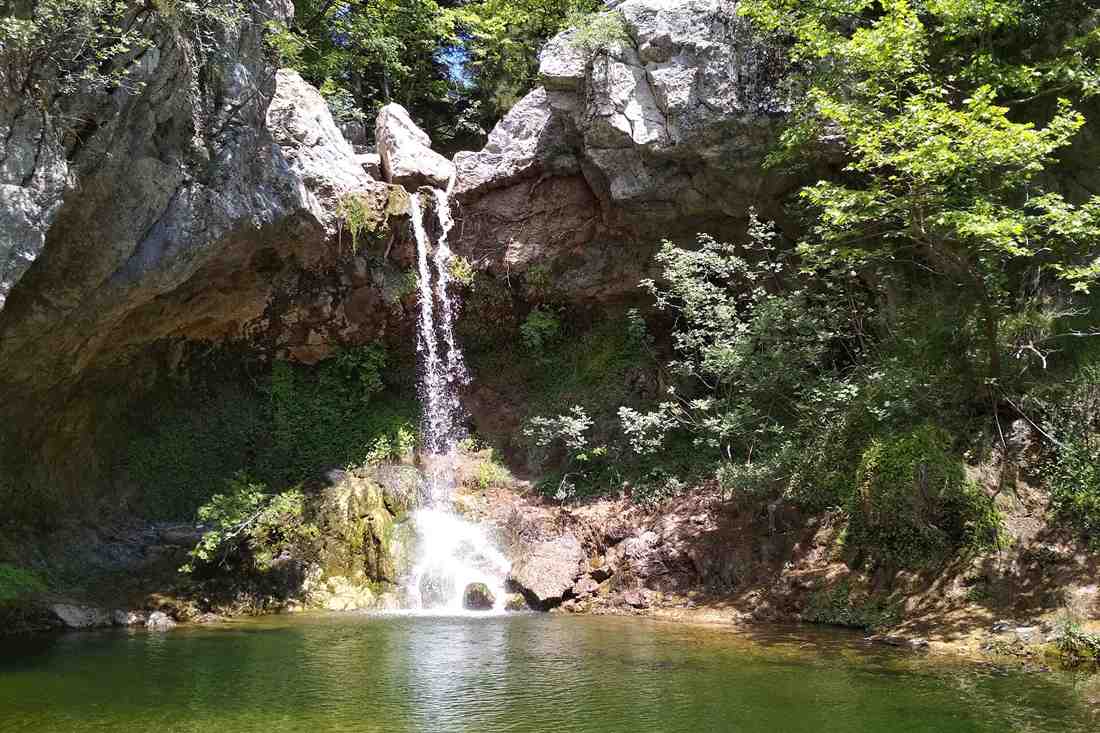
The Manikiatis river, known in older times as the Nedon, feeds this Evia canyoning route and keeps its water through all twelve months, so Manikia has a flowing stream even at the end of a dry summer. The gorge lies near Kymi in central Evia, and its walls and boulders are pale white rock that frames a chain of blue-green pools. Canyoning guides call these plunge pools: basins that form where the water falls over a ledge and scours the rock beneath. Around them the stream has carved the rock into sculpted formations and narrow wild channels.
The route opens on the outskirts of Manikia village with a walk to the river; one operator times the approach at about 15 minutes to the gorge entrance, another describes an easy half-hour trail. At the entrance the guides run a 20-minute lesson on the basic rope moves. The first part of the gorge is open, and the group covers it in about half an hour of river trekking. Then the walls close in, and the Evia canyoning work starts: rappels down smaller waterfalls, slides on smooth rock and jumps into the deep green and turquoise pools of the closed section.
The gorge keeps its largest feature for the end. The Manikiatis waterfall drops 25 metres into a huge pool, and the group rappels the full height of the fall, the maximum descent on the route. After the rope comes off, there is time to swim and dive in the clear water at the base of the fall. A last stretch of river trekking leads toward the exit; one operator quotes a 20-minute walk out to a waiting transfer, another quotes 45 minutes. For the exact timing of each Evia canyoning tour at Manikia, check the tour listing.
What is the Alimachi gorge canyoning route?
Alimachi is a demanding Evia canyoning route on Mount Kandili: a 4-kilometre gorge that starts at 300 metres of altitude and ends on a beach at the sea, with 10 rappels and a largest drop of 42 metres.
Mount Kandili is a long ridge in northwestern Evia that rises to 1,246 metres and faces the North Evian Gulf. Local tradition links the mountain to Makistos, son of Athamas, and to the fire-beacon towers said to have carried the news of the fall of Troy to Mycenae. The gorge takes its name from a local legend about a woman called Alimachi who lived near the area; the versions of the story differ, but each one paints her as bold and brave. Steep cliffs line this Evia canyoning route from its upper section down to the shore.
The day starts with an uphill walk of about 1 hour 30 minutes to the gorge entrance, and the climb gives the group a view down the line of cliffs before the first rope goes in. Inside the gorge the group faces 10 descents, and the three largest measure 42, 40 and 20 metres. Rocky, wild ground fills the stretches between the drops, and the final section opens onto the beach where the gorge meets the water. The walk out from the exit takes about 20 minutes, and the full Evia canyoning day at Alimachi lasts 6 to 7 hours.
Alimachi sits at the hard end of Evia canyoning: its operator asks for moderate to good fitness and sure movement over very rocky terrain, and keeps the groups small. The operator’s kit here is a harness, a helmet, gloves and personal rope gear, and each participant adds a windproof and waterproof jacket to the usual shoes, water bottle and spare clothes. Juice and a sandwich close the activity once the last descent is done.
What is the Havos gorge canyoning route?
Havos is a short, dense Evia canyoning route near the village of Kampia in central Evia: 800 metres of narrow gorge with 14 rappels up to 20 metres, plus water jumps and slides between vertical rock walls.
The gorge lies close to Chalkida, near Kampia in central Evia, and water and weather have shaped its narrow, vertical walls over time. Inside, the stream has cut deep pools into the rock, and small unexplored caves open in the walls along the way. Water runs through Havos for almost the whole year, so the pools and slides stay in use well beyond the summer months. The approach is the shortest of the three Evia canyoning gorges described here: about 5 minutes of walking to the entrance. Havos also hosts a night canyoning trip, which runs the same gorge after dark.
The guides open the day with a 20-minute lesson at the entrance, and the descent follows straight after. The 14 rappels sit close together along the 800-metre course, the largest at 20 metres, and the group links them with jumps into pools and slides down water-worn rock. The operator rates the gorge 2 out of 5 and lists it as suitable for beginners, so Havos works as a first Evia canyoning day with a high count of rope descents. The walk out from the exit takes about 15 minutes, and the whole activity lasts about 6 hours.
- Manikia – largest drop 25 metres, approach of 15 to 30 minutes, water all year.
- Alimachi – 10 rappels, largest drop 42 metres, 4 kilometres, 6 to 7 hours.
- Havos – 14 rappels, largest drop 20 metres, 800 metres, about 6 hours.
Which techniques does Evia canyoning use?
Evia canyoning uses five techniques: rappelling, or abseiling, down waterfalls on a rope; jumping from rock ledges into deep pools; sliding down smooth water chutes; swimming across flooded pools; and walking or down-climbing over rock along the riverbed between the technical drops.
Rappelling, also called abseiling, is the core rope skill. The canyoner sits back in a harness, runs the rope through a descender clipped to the harness and walks backwards down the rock or through the falling water, with one hand on the rope below the device to control speed. On Evia canyoning routes the rappels range from drops of 6 to 10 metres in the Agali canyon to 20 metres at Havos, 25 metres at the Manikiatis waterfall and 42 metres at Alimachi. The 20-minute lesson at the Manikia and Havos entrances teaches this movement before the first real descent.
Jumps and slides use the water instead of the rope. A jump takes the canyoner from a rock ledge into a deep pool, and a slide sends the body down a smooth, water-worn chute into the pool below. The Tsagaraki canyon on Mount Dirfys has jumps of 5 metres into natural pools, while Manikia and Havos both mix jumps and slides into their closed sections. In both moves the pool below takes the landing, so these stretches of an Evia canyoning route keep the whole group in the water.
Swimming links the pools where the gorge floor sits under water, and the neoprene suit keeps the body warm and adds buoyancy on the swims. Between the technical drops Evia canyoning turns into walking and down-climbing over boulders in the riverbed. At Manikia about half an hour of it comes before the rappels, and Alimachi fills its 4 kilometres with rocky ground between its 10 drops. The same five skills carry over to canyoning in Zagori in Epirus and to the Ha gorge in eastern Crete.
What equipment does an Evia canyoning trip provide?
An Evia canyoning trip provides a harness, a helmet and personal rope equipment on every route, a neoprene suit and neoprene socks at Manikia and Havos, and gloves at Havos and Alimachi; participants bring ankle-supporting shoes, water, a spare pair of shoes and a dry change of clothes.
The harness and the helmet appear on every Evia canyoning operator’s list, together with the personal equipment each canyoner uses on the rope, such as the descender and the connecting gear. The neoprene suit and neoprene socks come as standard in the water-rich gorges of Manikia and Havos, where the group swims between pools. At Havos the operator also supplies gloves, team safety and rescue equipment, and individual accident insurance, and one Manikia operator adds public liability insurance and photos of the day.
Footwear is the participant’s job on every route. Each operator asks for shoes that grip uneven ground and protect the ankle, plus a second pair of shoes and a full change of clothes to wear after the gorge, since everything gets wet on the descent. The Evia canyoning teams also ask for a personal water bottle in place of plastic bottles, and at Havos for a towel, a swimsuit, a spare pair of socks and an energy snack, with thermal clothing, top and bottom, in winter.
- Provided on every route – harness, helmet and personal rope gear.
- Provided in the wet gorges – neoprene suit and neoprene socks at Manikia and Havos.
- Provided at some gorges – gloves, accident insurance, rescue gear and photos of the day.
- Bring every time – ankle-supporting shoes, a water bottle, spare shoes and dry clothes.
- Bring for cold or wind – thermal layers at Havos in winter, a windproof jacket at Alimachi.
Who can join Evia canyoning?
Evia canyoning suits healthy adults and teenagers with moderate fitness and basic swimming skills. The beginner routes need no previous experience, while the highest and longest descents on the island are sold only to guests with good fitness and sure footing on rough rock.
Most first-timers start on a route with short rappels, open pools and a guide beside them at every step. The Manikia and Havos listings both state that no earlier canyoning experience is needed, and the Agali route on Mount Dirfys is sold as a first waterfall descent. What these trips ask for is moderate fitness, basic swimming ability and the calm to step backwards off a wet ledge while the rope takes the weight. A traveller who walks for a few hours at a steady pace and feels at ease in open water meets the bar for beginner Evia canyoning.
Age rules differ between operators. One Havos listing sets a minimum age of 15 years, and other routes set their own limits, so check the tour listing before booking a family day. Group formats vary as well: some trips run as a private outing for a single guest, and the Havos day takes groups of 4 to 20 participants. Private bookings suit couples and families who want the full attention of the guide, while shared departures place solo travellers with other guests at a similar level.
The advanced gorges draw a firm line. The Alimachi route on Mount Kandili is not open to beginners and asks for moderate to good fitness plus confident movement on very rocky ground, and the Tsagaraki and Diaselo canyons ask for comfort with heights. Travellers who want to build rope confidence before a harder day of Evia canyoning find a gentle start with rock climbing in Athens, where the harness, the belay and trust in the rope come into play on dry rock.
- Experience – none needed on the Manikia, Havos and Agali routes.
- Swimming – basic skills for crossing the deeper plunge pools.
- Fitness – moderate level for the approach walk and the wet riverbed.
- Age – 15 years minimum on one Havos listing, other limits set per tour.
When is the Evia canyoning season?
The Evia canyoning season runs across most of the year, because the Manikiatis river and the Havos stream carry water almost every month. Spring and autumn bring the strongest flow and mild air, and winter trips add thermal layers under the wetsuit.
Spring is the peak time in the gorges. The operators running the Mount Dirfys canyons name spring and autumn as the best months for a descent, with the highest water flow and the most comfortable temperatures. In spring the waterfalls run at full strength, the slides turn fast and the plunge pools sit deep and clear between the white rock walls. Autumn opens a second window after the first rains refill the streams, while the rock and the air still hold some of the summer warmth.
Summer trips still run on gorges with a year-round stream. The Manikiatis, known in ancient times as the Nedon, keeps flowing through the dry months, which makes the Manikia gorge a steady summer choice for Evia canyoning. The Alimachi route on Mount Kandili follows its own calendar and runs from January to July and again from September to December, with no departures in August. In the July heat the narrow walls of the gorges give shade, and one operator also lists a night canyoning trip in the Havos gorge.
Winter canyoning on Evia runs on routes with a steady stream, and the Havos listing asks guests to bring thermal clothing for the upper and lower body in the cold months, worn under the neoprene suit that the operator supplies. Short daylight in December and January leaves less time for delays on the longer routes. The weather decides the final gorge on the Dirfys trips, and heavy rain moves or cancels a gorge day, since a swollen stream turns an easy canyon into a dangerous one.
How are Evia canyoning routes graded?
Evia canyoning routes are graded by the number of rappels, the height of the tallest drop, the length of the gorge and the walk in and out. Listings label them beginner, intermediate or advanced, and one Havos listing gives a difficulty of 2 out of 5.
The tallest single drop is the clearest signal of difficulty. Beginner gorges on the island keep their rappels short, with the Agali route on Mount Dirfys topping out at 10 metres, while the Manikia day builds up to one 25-metre waterfall at the finish. Intermediate and advanced routes reach 22 to 42 metres, and a long rappel tests both technique and nerve. The count of drops matters too, because 10 or 14 descents in one day mean more time on the rope and more waiting at each anchor.
The walk in and out adds a second layer. Some gorges start close to the road, with a 5-minute walk to the Havos entrance, while the Alimachi route opens with an uphill hike of about 1 hour 30 minutes before the first rope goes down. Total time follows the same pattern: the Agali crossing takes 2.5 to 3 hours, the Tsagaraki descent 4 to 5 hours and a full Alimachi day 6 to 7 hours. A long approach in summer heat drains energy before the technical part even begins.
Water forms the third factor. Pools that need swimming, jumps of 5 metres into natural pools and fast rock slides raise the aquatic side of a route, and the same gorge becomes harder after heavy rain. For that reason the guide checks the flow and sets the final plan on the day. Anyone new to Evia canyoning books a beginner route first and steps up to an intermediate gorge once rappelling feels routine.
- Beginner – Agali, with 5 rappels up to 10 metres on the western slopes of Dirfys.
- Intermediate – Tsagaraki, with 10 rappels up to 22 metres and 5-metre jumps.
- Advanced – Diaselo, with 9 technical rappels up to 22 metres below 100-metre cliffs.
How do guides keep Evia canyoning safe?
Guides keep Evia canyoning safe through international certification, a short lesson before the first rappel, protective gear for every guest and a route choice that follows the weather. Operators switch gorges or cancel the trip when rain raises the water.
The canyoning guides on the island hold certification from the ICAN world organisation, which trains and certifies canyoning professionals, and the head guide on the Havos route holds the ICAN Canyoning Guide Level 1 qualification. A certified guide rigs the ropes, checks each guest’s harness before a descent and sets the pace through the gorge. Guests follow clear instructions at each drop instead of making technical choices on their own, which keeps every technical decision with a trained professional.
Beginner routes open with a 20-minute lesson at the gorge entrance, where guests practise the basic rappel moves on easy ground before the first real drop. Operators supply the protective kit, and the Havos listing adds individual accident insurance plus a team safety and rescue kit carried through the gorge. One Manikia listing includes public liability insurance instead. These inclusions change from tour to tour, so check the tour listing for the exact safety cover on each Evia canyoning trip.
Weather is the biggest risk in a gorge, and the operators plan around it. The Dirfys trips pick the final canyon on the day according to conditions, and operators keep the right to cancel for safety reasons in bad weather, offering an alternative tour or a full refund. Small groups keep every guest within sight of a guide, and the Havos operator asks guests to get in touch before the activity to confirm the plan. Checking the forecast and the flow before every trip is the core of safe Evia canyoning.
- Certified guides – ICAN-certified leaders who rig the ropes and run each descent.
- Beginner lesson – 20 minutes of practice at the entrance before the first rappel.
- Protective kit – helmet, harness and neoprene suit supplied by the operator.
- Weather call – a route switch or cancellation when rain raises the stream.
How do you reach Evia canyoning gorges from Athens?
Evia canyoning gorges are reached by road from Athens across the bridges at Chalkida. The drive to Chalkida and the nearby Havos gorge takes about 1.5 hours, and the Manikia gorge near Kymi lies about 2 to 2.5 hours from the capital.
The road leaves Athens on the national motorway heading north, turns off toward Chalkida, the main town of the island, and crosses one of the two bridges onto Evia. From Chalkida, local roads climb inland to the gorges of central Evia. The Havos gorge sits near the village of Kambia, a short distance from Chalkida, and the Diaselo canyon lies close to the town as well, which makes these two the quickest gorge trips from the capital. A rental car gives the most freedom on these roads.
The Manikia gorge sits further on, near Kymi on the eastern side of central Evia, with a drive of about 2 to 2.5 hours from Athens. The Alimachi route lies on Mount Kandili in the northwest of the island, where the gorge ends on the shore of the North Evian Gulf. The longer drives turn a day of Evia canyoning into an early start and a late return, so a night in Chalkida or Kymi suits travellers who want a slower pace and a fresh start at the gorge.
Transfers solve the driving question for guests without a car. One Manikia tour on sale departs from Athens, and the operators on the Havos and Dirfys routes arrange transfers from the capital on request. On the Manikia day, a vehicle waits near the gorge exit after the final 20-minute walk to take the group back. Travellers who prefer a ferry crossing to the north or south of the island find the port options through our day trips from Athens hub, next to the other Evia excursions from the capital.
How does Manikia river trekking differ from Evia canyoning?
Manikia river trekking follows the riverbed on foot, wading and swimming through the pools without rope descents, while Evia canyoning adds a harness, a helmet and rappels down the waterfalls, including the 25-metre Manikiatis fall. River trekking suits walkers who want the river without the drops.
Both activities share the same river and the same gorge, and the Manikia canyoning route itself mixes the two. One canyoning listing opens with half an hour of river trekking in the open part of the gorge before the group enters the narrow section with its rappels, slides and jumps, and another ends with a stretch of river trekking toward the exit after the last waterfall. A river trekking tour keeps to the walking and wading and leaves out the rope work, which is the step that turns a river walk into Evia canyoning.
The skills and the kit differ as well. River trekkers need sturdy shoes that grip wet rock, clothes that dry fast and basic swimming for the deeper pools, and they skip the rappel lesson. Canyoners wear the full technical kit and learn to lean back on the rope before the first drop. Both groups stay wet from start to finish, and both swim in the blue-green pools between the white rocks. The river trekking and hike-and-swim tours reach the Manikiatis waterfall on foot, while canyoning guests descend the 25-metre fall on a rope.
The choice comes down to the group and its comfort with heights. Mixed groups with one nervous member, travellers with no head for heights and anyone who wants a gentle water day pick river trekking, which is sold as a private or shared trip. Guests who want the full descent, the slides and the jumps into the pools choose canyoning, which asks for moderate fitness and basic swimming. River trekking also works as a first step toward Evia canyoning, because the pools, the current and the wet rock are the same on both days.
Is Evia canyoning worth adding to a trip to Greece?
Evia canyoning is worth adding to a trip to Greece for travellers who want a day of waterfalls, rope descents and wild gorges within a 1.5 to 2.5-hour drive of Athens. The gorges stay quiet, the guides are certified and beginners are welcome.
The island offers a rare mix in a country better known for beaches and ruins. Mount Dirfys rises to 1,743 metres above alpine canyons with up to 10 waterfalls each, the Manikiatis keeps flowing all year, and the Alimachi gorge ends on a beach of the North Evian Gulf. The operators describe these gorges as untouched wilderness that few tourists visit, so groups meet few other people between the rock walls and the pools, even in the busy summer months when the island beaches fill up.
Evia belongs to the administrative region of Central Greece, and it fits into an Athens-based trip as one active day between city sightseeing and island time. Travellers who plan a week of outdoor days around the capital pair a gorge descent with an Athens kayak tour on the sea, and those heading north add more of the mainland through our central Greece tours. Evia canyoning brings a different kind of water day to that plan, with fresh river pools and waterfalls in place of salt water and sandy coves.
The trade-offs are the early start and the long day. The Havos activity alone lasts 6 hours before the drive of about 1.5 hours each way is added, and the Alimachi day runs 6 to 7 hours on the mountain. Travellers with a fear of water or a recent knee injury pick a guided hike on Evia instead. Guests who enjoy a physical challenge, cold clear pools and the pull of a rope over a waterfall find that Evia canyoning shows them a side of Greece that the beach resorts never reveal.
Frequently Asked Questions
Do you need to be a strong swimmer for Evia canyoning?
No. Evia canyoning on the beginner routes asks for basic swimming skills and moderate fitness, not strong swimming. Guests swim across the plunge pools between the rappels, and the neoprene suit supplied by the operator adds buoyancy and warmth in the water.
Is Evia canyoning scary for a first-timer?
The first step backwards off a ledge feels tense, and beginner Evia canyoning routes are built to ease that moment. A 20-minute lesson at the entrance covers the basic moves, the early drops stay short and a certified guide runs every descent.
What do you bring on an Evia canyoning day?
Bring shoes with ankle support that grip on uneven ground, a refillable water bottle, a second pair of shoes, dry clothes for after the gorge, a towel, a swimsuit and an energy snack. The operator supplies the technical gear for Evia canyoning.
Can you try Evia canyoning with no experience at all?
Yes. The Manikia, Havos and Agali routes accept guests with no previous canyoning experience, and the Manikia and Havos days start with a 20-minute lesson. The advanced Alimachi route is the exception, since it asks for moderate to good fitness and confident movement on very rocky terrain.
How long does an Evia canyoning trip last?
An Evia canyoning trip fills most of a day. The Havos activity lasts 6 hours, the Alimachi route 6 to 7 hours and the Agali crossing 2.5 to 3 hours, plus the approach walk. The drive from Athens adds about 1.5 to 2.5 hours each way.