
Corfu Paragliding
Corfu paragliding is a tandem flight in which a certified pilot flies a paraglider wing while the passenger sits in a harness, so no experience is needed. On Greece Tours, three Corfu paragliding flights are on sale: a tandem flight above Pelekas town, a paragliding and paramotor flight at Lefkimmi, and a paramotor flight over the south coast.
A first flight starts with a short safety briefing, a few running steps downhill into the wind and a soft run-out landing. Wind, weather and time of day decide when Corfu paragliding flights run, and operators move a flight when the air is not suitable. Pelekas and Glyfada on the west coast and the long sandy beaches of the south are the main views from the air.
What is Corfu paragliding?
Corfu paragliding is a tandem flight under a paraglider wing, flown by a certified pilot while the passenger sits in a harness. No experience is needed, and flights run above Pelekas and over the south coast.
A paraglider is a fabric wing with no frame. Air flows into cells along the front edge and gives the wing its shape, and the pilot steers with brake lines held in each hand. On Corfu paragliding flights the passenger does no steering at all. The pilot reads the wind, picks the line along the ridge or coast and lands the wing, while the passenger looks at the island from above.
Corfu is the second-largest of the Ionian Islands, with green hills that drop to the sea on the west coast and long sandy beaches in the south. Both shapes suit flying: a hill gives a paraglider its take-off slope, and flat ground near the shore gives a paramotor room to start. Corfu paragliding therefore uses both coasts. The island’s towns, beaches and sights are listed on the Corfu travel hub.
Which Corfu paragliding flights can travellers book?
Three Corfu paragliding flights are on sale: a tandem paragliding flight above Pelekas town, a paragliding and paramotor flight at Lefkimmi in south Corfu, and a paramotor flight over the south coast. Each one is a tandem flight with a pilot.
The Pelekas flight is a paraglider flight from the hills of the west coast, with the sea and the beaches below the wing. The Lefkimmi listing names both paragliding and paramotor flying in its title, so check the listing for which type the booking covers. The south coast listing is a paramotor flight, which starts from flat ground. On all three Corfu paragliding listings, check the flight time and meeting point before booking.
The choice comes down to the view and the style of flight. A traveller staying on the west coast near Glyfada or Pelekas reaches the Pelekas flight with a short drive. A traveller based in the south, around Lefkimmi or Kavos, reaches the two south coast flights more easily. On a clear day, Corfu paragliding from either end of the island shows beaches, olive groves, villages and open sea below the harness.
- Pelekas – tandem paragliding flight above Pelekas town on the west coast.
- Lefkimmi – paragliding and paramotor flight in south Corfu.
- South coast – paramotor flight along the south coast of the island.
How does a first tandem flight work, and what does it feel like?
A first Corfu paragliding flight starts with a safety briefing and harness fitting, then a few running steps downhill into the wind lift the wing. The pilot flies, the passenger sits back in the harness, and the landing is a soft run-out.
On the hill, the pilot lays the wing out on the ground and clips the passenger harness to the pilot harness. When the wind is steady, the pilot calls the start and both people walk, then run, a few steps down the slope. The wing rises overhead, fills with air and lifts both feet off the ground within seconds. On Corfu paragliding flights the passenger keeps running until the pilot says to stop.
In the air, Corfu paragliding feels calm rather than fast. There is no drop in the stomach as on a fairground ride, because the wing flies at a slow, even speed. The passenger hears the wind in the lines and feels the harness hold the body like a seat. Nerves at the start fade once the wing is steady, and the passenger turns to take in the coast.
- Briefing – the pilot explains take-off, flight and landing.
- Harness – the pilot fits the harness and helmet.
- Take-off – both run a few steps downhill into the wind.
- Flight – the passenger sits back while the pilot steers.
- Landing – the pilot glides in for a soft run-out.
How does a paramotor flight differ from a tandem paraglider flight?
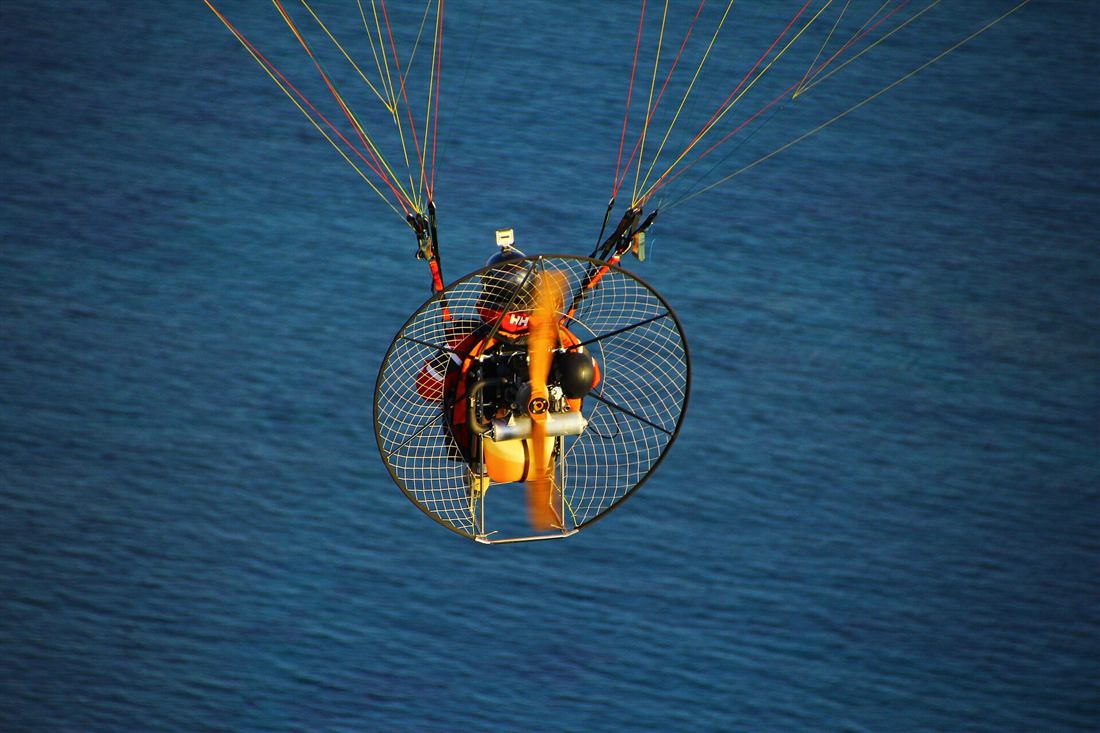
A paramotor is a paraglider wing with a small engine and propeller on the pilot’s back. It takes off from flat ground, climbs under power and can follow a coastline without a hill, while a paraglider glides on wind and rising air.
The engine changes the flight. A paramotor takes off with a short run on flat ground and climbs under its own power, so it needs no slope and no steady sea breeze to stay in the air. That lets the pilot trace the south coast of Corfu over sand, dunes and lagoon. The passenger hears the engine behind the harness during the flight, which makes the ride less quiet than a glide.
The choice between the two comes down to taste. A tandem paraglider flight is quiet and follows the ridge and the breeze, which suits travellers who want the pure glide. A paramotor flight covers more coastline and does not depend on a hill, which suits travellers who want to see a long stretch of beach. Both are tandem flights, and both need no experience.
Who flies the wing, and what equipment is used?
A certified tandem pilot flies every Corfu paragliding flight. The operator provides all the gear: a tandem wing, harnesses with back protection, a reserve parachute, a helmet and a radio, plus a motor frame on paramotor flights.
The tandem pilot holds a qualification to carry a passenger and handles every decision in the air: when to launch, where to fly and where to land. The passenger’s job is to follow the briefing, run at take-off and sit still in flight. On Corfu paragliding flights the pilot also checks the wind on the hill before each launch and waits when conditions are not right.
The operator hands out and fits all the gear, so the passenger brings nothing technical beyond shoes and clothes. On paramotor flights the pilot also wears the motor frame, a light cage that holds the engine and propeller. The passenger keeps the harness on from take-off until the pilot unclips it after landing. Check the listing for pickup, photos and video, since those extras differ between operators.
- Tandem wing – a larger wing built to carry two people.
- Harness – a seat with a padded back protector.
- Reserve parachute – a second canopy for emergencies.
- Helmet and radio – head protection and contact with the ground.
What safety habits do tandem pilots follow?
Tandem pilots fly Corfu paragliding flights only in suitable wind, check every buckle and connector before launch, carry a reserve parachute and stay in radio contact with the ground. The passenger wears a helmet and follows the pilot’s instructions.
The first safety habit is the weather call. A tandem pilot watches wind speed and direction on the hill and in the forecast, and cancels or delays a flight when the air turns gusty. The second habit is the pre-flight check, where the pilot inspects the wing, lines, harnesses and reserve before the passenger clips in. On Corfu paragliding flights both checks happen before every launch.
The passenger has a part to play in safety as well. Tell the pilot about any health condition or injury before the flight, keep the helmet strap closed, and keep running at take-off until told to stop. Loose items such as hats and phones without a strap stay on the ground. Sitting back into the harness only when the pilot says so keeps the launch clean and safe.
What do Pelekas and the west coast look like from the air?
From the air above Pelekas, Corfu paragliding shows the green hills of the west coast, the olive groves around the village and the sandy bays below, with Glyfada beach at the foot of the slope and open Ionian Sea to the west.
Pelekas is a hill village on the west coast of Corfu, known for the Kaiser’s Throne lookout. Kaiser Wilhelm II used the spot to look out over the west coast beaches, and the same view opens beneath a tandem wing. The Corfu paragliding flight above Pelekas town lifts that lookout view higher, so the whole curve of the coast from north to south fits into one frame.
Below the hill, Glyfada beach is a long strip of sand backed by green slopes, with more sandy bays to the north and south. From above, the colour of the water shifts from pale turquoise over sand to deep blue further out. The west coast faces the open sea, so sea breezes build along it during the day, and a paraglider pilot uses those breezes to stay up along the ridge.
Which sights sit along the south coast below the wing?
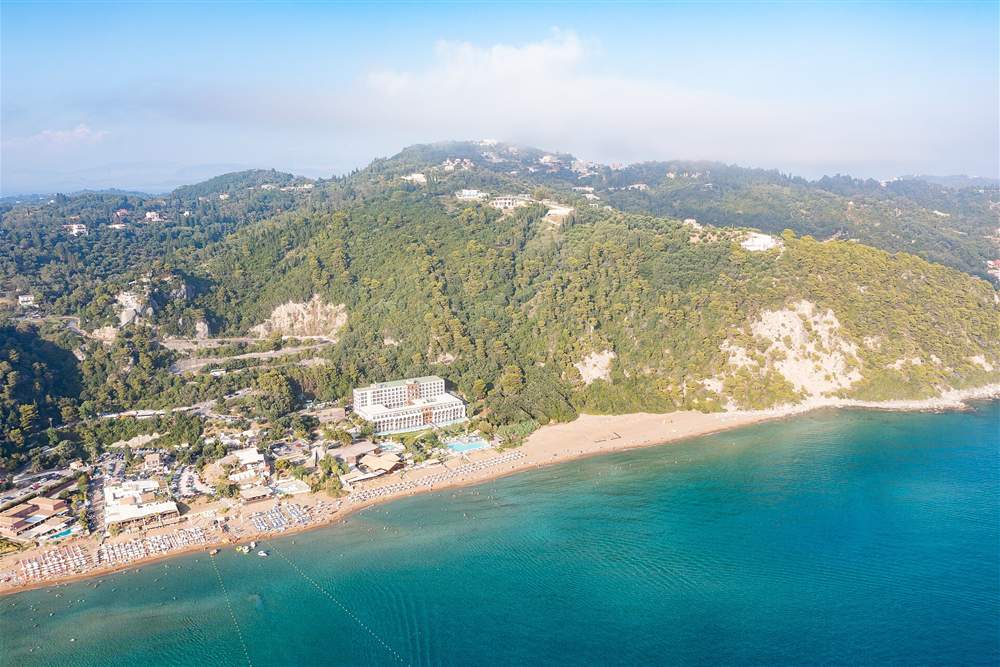
Long sandy beaches, the Issos dunes, the Korission lagoon and the resort of Kavos at the tip line the south coast of Corfu, with Lefkimmi as the main town. The south coast flights of Corfu paragliding show this flat, sandy side of the island.
Lefkimmi is the main town of south Corfu, and the Corfu paragliding and paramotor flight on sale there starts in this quieter corner of the island. The land here is lower and flatter than in the north and west, with farmland and olive groves running down to the sea. A paramotor suits this shape, because it climbs from flat ground and follows the long shoreline under engine power.
From the air, the Issos dunes show as pale ridges of sand behind the beach, and the Korission lagoon spreads as a sheet of calm water cut off from the sea by a strip of sand. At the southern tip, Kavos is the busiest resort of the south. Check the Corfu paragliding listing for the exact route of each south coast flight, since the path follows the wind on the day.
When are wind and weather right for Corfu paragliding?
Corfu paragliding runs only in suitable wind, and the morning and late afternoon give the smoothest air. Spring to autumn is the main season. Operators move flights when the wind is too strong or from the wrong direction.
Wind decides every flight. A paraglider launches into a light, steady breeze that blows up the slope, and the pilot waits when the wind turns gusty, too strong or crosswise. On the west coast, sea breezes build during the day as the land warms, so the middle of the day brings stronger and rougher air. Morning and late-afternoon Corfu paragliding slots give the smoothest ride for a first flight.
The season runs from spring to autumn, when the island has long days, warm air and settled weather. Summer brings heat, so an early slot avoids the midday sun on an open hill. Rain, storms and strong winds ground flights at any time of year. Operators reschedule for weather, so check the cancellation terms on the listing and book Corfu paragliding early in a stay to leave spare days.
Who can take a tandem or paramotor flight?
Travellers with no experience can fly, since the pilot does all the flying. Weight and age limits apply and differ between listings, so check the listing. Corfu paragliding is not advised for pregnant travellers or people with serious back, neck or heart conditions.
Fitness needs are low for Corfu paragliding. Nervous first-timers fly as well, and the pilot talks them through each stage on the ground before launch. A paramotor launch on flat ground asks for the same short run as a hill launch. Travellers who can walk and jog a few metres without trouble meet the physical side of the flight, and the pilot handles the rest.
The limits on Corfu paragliding exist for safety. The tandem wing is rated for a set combined weight, and the pilot needs the passenger to run at launch and hold a steady seat in flight. Pregnant travellers and people with serious back, neck or heart conditions are advised against flying, since take-off and landing put brief loads on the body. Tell the operator about any recent injury when booking.
- Walking – a short walk to the take-off point.
- Running – a few steps at launch.
- Sitting – a steady seat in the harness in flight.
- Listening – attention to the pilot’s calls.
What do you wear and bring on flight day?
For Corfu paragliding, wear sturdy closed shoes, long trousers and a light jacket, and bring sunglasses with a strap and sunscreen. Closed shoes protect the feet on the take-off run, and the jacket blocks the cooler air aloft.
The take-off run crosses grass, dirt or stones, so sandals and flip-flops stay at the hotel. Long trousers protect the legs from scrapes on launch and landing. Air moves fast past the harness in flight, and it feels cooler than on the ground even on a hot summer day, which is why a light jacket or long-sleeved top comes along on Corfu paragliding flights.
Sunglasses with a strap cut the glare off the sea and stay on the head when the wind catches them. Sunscreen matters because the harness puts the passenger in full sun for the whole flight. Leave bags, loose hats and unstrapped phones with the operator on the ground or in the car. A hair tie keeps long hair out of the face and away from the lines.
- Shoes – sturdy closed shoes with grip.
- Clothes – long trousers and a light jacket.
- Eyes – sunglasses with a strap.
- Skin – sunscreen on face, neck and hands.
Do Corfu paragliding tours include photos, video and flexible booking terms?
Photos and video depend on the operator, so check the Corfu paragliding listing for what is included. Booking terms also differ: check the cancellation terms on the listing, since operators reschedule flights when the wind is not suitable.
Tandem pilots film flights in two main ways: a camera on a pole held out in front of the pair, or a camera fixed to the pilot’s harness. The footage shows the take-off run, the coast below, the passenger’s face and the landing. Some listings include photos and video with the flight and others offer them as an add-on, so check the listing before booking.
Book Corfu paragliding a few days ahead in July and August, when demand peaks, and pick a flight early in the stay. That way a weather delay still leaves time to fly on another day. Check the listing for pickup from hotels, the meeting point, weight limits and the cancellation terms. Bring the booking confirmation on a phone and arrive on time for the safety briefing.
How does Corfu paragliding compare with parasailing and other Corfu adventures?
Corfu paragliding is an untethered flight under a wing steered by a pilot, while parasailing is a ride under a canopy towed behind a boat. Quad tours, horse riding and boat tours fill the rest of an active Corfu day.
Corfu parasailing keeps the rider on a line behind a speedboat, so the height and path follow the boat, and the ride starts and ends on the boat deck or the water. Corfu paragliding has no line: the pilot steers the wing through the air, launches from a hill or flat ground and lands on solid ground. Travellers who enjoy the flight can try paragliding on Crete on a later island trip.
A flight takes a short part of the day, so it pairs well with a second activity. A morning flight above Pelekas leaves the afternoon free for a quad tour of Corfu or horse riding on Corfu. A south coast flight fits before a swim on the sandy beaches near Kavos, and one of the Corfu boat tours makes a good plan for the next day.
Is Corfu paragliding worth it?
Corfu paragliding is worth it for travellers who want to see the island from the air with no experience. A certified pilot flies, the gear is provided, and the flights cover the west coast above Pelekas and the sandy south coast.
The flight gives a view no road or boat gives: the full sweep of a coastline, the colours of the sea over sand and rock, and the villages and olive groves inland. It asks little of the body beyond a short run, and the pilot handles the wing from launch to landing. For a first taste of flying, Corfu paragliding is one of the simplest ways in.
The two limits on Corfu paragliding are wind and health. Flights run only in suitable wind, so keep spare days in the plan, and travellers with serious back, neck or heart conditions or a pregnancy stay on the ground. Choose the Pelekas flight for the west coast and the Kaiser’s Throne view, or a south coast flight for the paramotor ride over dunes, lagoon and long beaches.
Frequently Asked Questions
Do you need experience for Corfu paragliding?
No experience is needed for Corfu paragliding. A certified tandem pilot controls the wing from take-off to landing, and the passenger sits in a harness in front of the pilot. The passenger takes a few running steps at take-off and follows the pilot’s instructions.
Where do Corfu paragliding flights take place?
The flights on sale take place above Pelekas town on the west coast and at Lefkimmi in south Corfu, plus a paramotor flight over the south coast. The west coast view takes in Glyfada beach, and the south view takes in long sandy beaches.
How does a paramotor differ from a paraglider?
A paraglider takes off from a hill by running downhill into the wind. A paramotor adds a small engine and propeller on the pilot’s back, so it takes off from flat ground and flies along a coastline without a hill. Both Corfu paragliding options are tandem flights.
What happens if the wind is wrong?
Operators fly only in suitable wind, so a flight moves to another slot when the wind is too strong or blows from the wrong direction. Check the cancellation terms on the listing before booking, and keep a spare day in the Corfu trip plan.
Can a flight be combined with a beach day?
Yes. The Pelekas flight sits above the west coast, with Glyfada beach below the hill, and the south coast flights sit near the long sandy beaches, the Issos dunes and Kavos. A Corfu paragliding flight in the morning leaves the rest of the day for the beach.