
Thessaloniki Painting Class
A Thessaloniki painting class is an instructor-led art session in Greece’s second city, where complete beginners go from a blank surface to a finished, signed piece in one sitting. Every Thessaloniki painting class on Greece Tours follows one of three formats: a studio workshop with coffee or tea, a sip-and-paint session on canvas, mug or plate, or a painting morning with breakfast.
The city supplies the subjects: the White Tower on the waterfront, sunsets over the Thermaic Gulf and the walled lanes of Ano Poli. Acrylic on canvas dries fast and travels home the same day, while a painted mug or plate needs a kiln firing first. A Thessaloniki painting class also makes a calm plan for a rainy day.
What is a Thessaloniki painting class?
A Thessaloniki painting class is a hands-on art session led by an instructor, in which each guest paints one finished piece, such as a canvas, a mug or a plate, from the first sketch to the final signature.
The class turns sightseeing into making. Instead of photographing Thessaloniki, guests pick up brushes and create a picture of their own, following an instructor who demonstrates each stage first. The finished piece becomes a souvenir with a story, because the person who carries it home also made it. A Thessaloniki painting class needs no drawing skill: the instructor breaks each picture into simple shapes, colour blocks and layers that beginners copy at their own pace.
The setting matters. Thessaloniki is Greece’s second city, spread along the Thermaic Gulf, with the White Tower on its waterfront, a walled upper town above it and Byzantine churches decorated with mosaics and frescoes across the centre. That scenery and that history give a Thessaloniki painting class a ready supply of local subjects, from open sea to old stone walls. The Thessaloniki travel hub covers the city’s neighbourhoods, sights and transport in full.
Which formats does a Thessaloniki painting class come in?
Thessaloniki painting classes come in three formats: a studio workshop with coffee or tea, a sip-and-paint session on a canvas, mug or plate, and a painting session with breakfast. Each format runs from first sketch to finished piece.
The formats differ in the surface and in what is served alongside. The workshop with coffee or tea keeps the focus on technique, with a drink beside the brushes while each layer dries. The sip-and-paint format adds a choice of surface, so guests pick a canvas for the wall or a mug or plate for the kitchen. The breakfast format adds a morning meal to the session, so painting and eating share one booking.
Choosing a format comes down to the souvenir the trip calls for. A canvas suits travellers who want a picture to hang at home, while a mug or plate becomes an object for daily use once the studio fires it. The drink or meal matters too: coffee and tea suit an afternoon break, and breakfast suits an early start. Each Thessaloniki painting class listing states its own session length, so check the tour listing before booking.
Who is a painting class in Thessaloniki suited to?
A Thessaloniki painting class suits beginners, couples, friends, families and solo travellers, because no experience is needed and the instructor leads every step. It also works as a calm indoor plan when rain or summer heat keeps people off the streets.
Beginners form the core audience. The class assumes no drawing or painting background, and the instructor shows each move before guests try it, so nobody faces a blank surface alone. Patience matters more than talent in a Thessaloniki painting class, and first-time painters leave with a piece that looks complete rather than a practice sketch. That result gives new painters the confidence to keep a sketchbook going on the rest of the trip.
Couples and groups of friends turn the session into a shared activity that ends with a piece for each person, and the finished works make a matching pair or set. Solo travellers use a Thessaloniki painting class to meet other visitors in the same session. Families paint side by side, and the tour listing confirms any age rules for children. For more family plans, see things to do in Thessaloniki with kids.
How does a Thessaloniki painting class session run?
A Thessaloniki painting class session runs in five stages: choosing a subject, sketching the outline, mixing the colours, building the picture with brush work and finishing with a signature. The instructor demonstrates each stage, and guests repeat it on their own piece.
The session opens with the subject. Some classes set one scene for the whole group, while others let each guest pick a view, a still life or a pattern for a mug. The instructor then paints a short demonstration, showing where to place the horizon, where the light falls and which shapes to block in first. Guests copy the approach in pencil or thin paint, which keeps the early sketch easy to correct.
Two simple rules carry beginners through the rest of the session: work from background to foreground, and from large shapes to small details. The sky and sea go down first in broad strokes, then buildings, boats and railings arrive with finer brushes. The last minutes of a Thessaloniki painting class go to highlights, a step back to check the balance and a signature in the corner of the finished piece.
- Subject – choose or receive the scene, pattern or object to paint.
- Sketch – draw the main shapes lightly so changes stay easy.
- Colour – mix lighter and darker tones for sky, sea and stone.
- Brush work – fill large areas first, then add texture and detail.
- Signature – add highlights, check the picture and sign it.
Do you paint on canvas, a mug or a plate?
A Thessaloniki painting class uses acrylic paint on canvas and ceramic paint on a mug or plate. Acrylic is water-based and dries fast, which suits beginners, while ceramic paint stays fragile until a kiln firing fixes it for daily use.
Acrylic behaves well for first-time painters. Thin layers dry within minutes, which lets guests paint a second colour over the first without muddying it, and a mistake disappears under the next coat. Brushes clean in water, and no solvents or strong smells fill the room. Thick layers stay soft for longer, so raised highlights go on near the end. Once dry, acrylic turns flexible and water-resistant, which protects the picture.
Ceramic painting works differently. Guests decorate a plain mug or plate with ceramic paint, and the colours stay fragile until the studio fires the piece in a kiln. The heat fuses the colour to the surface and makes the object ready for use. Firing happens after the session, so the mug or plate stays behind at the studio, and each Thessaloniki painting class listing explains how collection or delivery works.
Where do you find subjects to paint in Thessaloniki?
The main painting subjects in Thessaloniki are the White Tower, the Nea Paralia waterfront and its Umbrellas sculpture, Thermaic Gulf sunsets, the lanes of Ano Poli, colourful Ladadika and Aristotelous Square. Each suits a different surface and skill level in a Thessaloniki painting class.
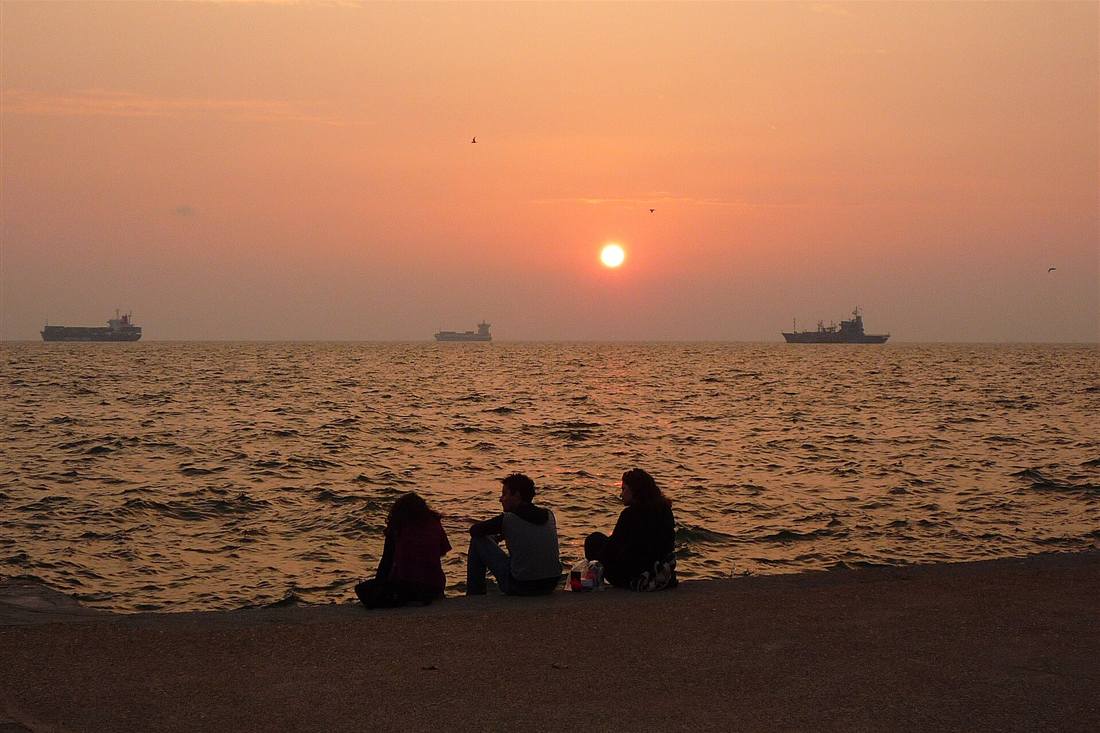
The White Tower is the city’s waterfront landmark and a simple first subject: one round tower, a strip of promenade and open water behind it. Along Nea Paralia, the landscaped seafront promenade, George Zongolopoulos’s Umbrellas sculpture lifts a group of open umbrellas on tall poles, a strong silhouette against a pale sky. At sunset the Thermaic Gulf fills with warm colour, and on clear days Mount Olympus rises across the water.
Higher up, Ano Poli is the upper town inside the Byzantine walls, with the Heptapyrgion fortress at the top and narrow lanes of old houses below it. Down by the old port, Ladadika’s colourful restored warehouses give a Thessaloniki painting class bright facades and shop fronts. Aristotelous Square opens onto the waterfront, and the matching buildings on both sides frame the view toward the gulf, which gives beginners clear lines for practising perspective.
- White Tower – simple shapes that suit a first canvas.
- Umbrellas sculpture – bold outlines that suit a mug or plate design.
- Gulf sunset – soft blends that suit colour-mixing practice.
- Ano Poli lanes – walls and doorways that suit detail work.
Why does Byzantine art matter to painters in Thessaloniki?
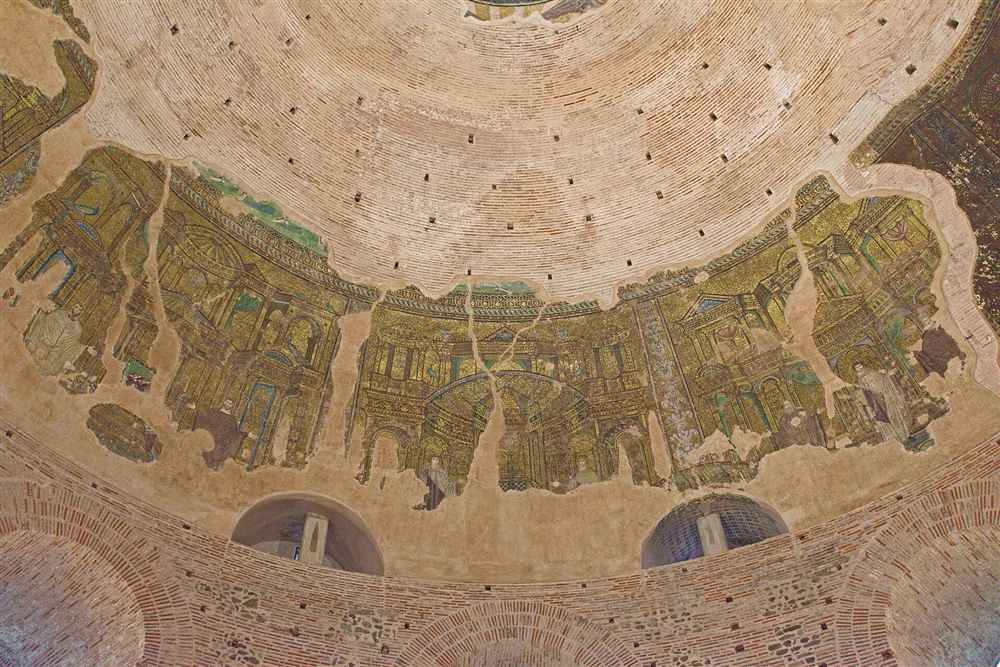
Byzantine art matters because the city’s churches hold Early Christian and Byzantine mosaics and frescoes from the Paleochristian and Byzantine Monuments of Thessaloniki, a UNESCO World Heritage Site. A Thessaloniki painting class draws on that tradition.
The Rotunda, Hagios Demetrios and Hosios David hold some of the oldest church art in the city. Their mosaics were set from small cubes of coloured glass and stone pressed into plaster, and their frescoes were painted onto wet plaster so the colour bonded with the wall. Standing inside these churches shows beginners how Byzantine artists used flat colour, strong outlines and gold backgrounds to make each figure stand out.
The Museum of Byzantine Culture shows the same tradition up close, with icons, mosaics and wall paintings. Icons reveal the method in miniature: layers of egg-based tempera built up on a wooden panel, from dark base colours to light highlights. A visit before a Thessaloniki painting class gives beginners ideas for colour and pattern, especially for a mug or plate design, and explains why deep blues, reds and gold recur in local art.
The tradition continues in modern form. Contemporary art centres now fill the restored warehouses of the old port, and murals and graffiti cover walls across the city. The street art of Thessaloniki shows how local artists use colour at building scale, on facades, walls and shutters. Murals give a Thessaloniki painting class fresh ideas for bold shapes and strong contrasts, the same tools the mosaic makers used on church walls centuries earlier.
How do coffee and breakfast fit a painting class in Thessaloniki?
Coffee and breakfast are built into two of the three formats: the workshop serves coffee or tea, and the morning session comes with breakfast. Both tie a Thessaloniki painting class to the city where the frappé was first made and bougatsa is the classic breakfast.
The frappé, a foamed iced coffee whipped from instant coffee and cold water, was first made in Thessaloniki in the 1950s and remains a summer staple. Greek coffee, boiled in a small pot called a briki, is the other classic order. The city’s coffee culture favours long, slow sittings, and a workshop with coffee or tea follows the same rhythm: paint a layer, sip while it dries, then return to the brushes with fresh eyes.
Bougatsa is the city’s classic breakfast pastry: thin layers of filo baked around a filling of semolina cream or cheese, with sugar and cinnamon on the sweet version. It is served warm and cut into small squares, with a coffee on the side. A Thessaloniki painting class with breakfast follows the same local habit of eating first and starting the day slowly. Check the tour listing for what the breakfast includes.
Can you take your painting home the same day?
Yes for canvas, no for ceramics. An acrylic canvas from a Thessaloniki painting class leaves with its painter once dry to the touch, while a painted mug or plate needs a kiln firing first, so check the listing for collection or delivery before booking.
A canvas feels dry on the surface soon after the last brushstroke, but thick paint stays soft underneath for longer. Carry the picture flat and face up, away from bags that press against the paint. At the hotel, leave it open overnight before packing. That routine keeps the colours clean and stops fabric from sticking to the surface, and a sheet of baking paper over the front adds protection in the suitcase.
Ceramic pieces follow a different path. The studio fires them in a kiln after the session, and the listing explains when a mug or plate is ready to collect back at the studio or how delivery works. Delivery options differ from studio to studio, so read the details before relying on them. Book a Thessaloniki painting class with ceramics early in the stay, so the firing finishes before the flight home.
- Loose canvas – roll it painted side out around a cardboard tube.
- Framed canvas – pack it flat in a suitcase between soft clothes.
- Fired ceramics – wrap each piece in clothes in the centre of a suitcase.
When and how do you book a Thessaloniki painting class?
Book a Thessaloniki painting class online through its tour listing before the trip, and read the listing in full before choosing a date, because start times, session length, group size and inclusions differ from class to class.
Timing shapes the rest of the day. The breakfast format opens the morning and leaves the afternoon free, while a studio workshop fills a rainy day or the hottest hours of a summer afternoon. Hot summers and cool, wet winters make a Thessaloniki painting class a useful plan in any season, from July heat to January rain. Confirm the date as soon as the travel plan is set, so the chosen format and day are secured.
Dress for paint. Dried acrylic does not wash out of fabric, so wear clothes that can take a splash. Bring a phone with photos of the White Tower, the gulf or Ano Poli, in case the class lets guests choose their own subject. A flat bag or folder keeps the finished canvas safe on the walk back. Each Thessaloniki painting class starts at a set time, so arriving early leaves time to settle in before the first demonstration.
- Length – the listing states how long the session runs.
- Group size – the listing shows the maximum number of guests.
- Language – the listing names the language of instruction.
- Inclusions – the listing names the materials, drinks and any breakfast.
- Meeting point – the listing gives the address and start time.
What else can you combine with a painting class in Thessaloniki?
A Thessaloniki painting class combines well with a museum visit, a food experience and a walk through the upper town or along the waterfront, which balances making art with seeing it, tasting the city and walking its streets.
Museums make a natural partner. The Rotunda and Hagios Demetrios stand in the city centre, so a church visit and a Thessaloniki painting class fit into one day without long transfers. The Museum of Byzantine Culture suits a rainy afternoon, and its icons look different once a guest has built up layers of colour by hand. Travellers with two free days split the plan, with churches on one day and the class on the next.
Food and walking complete the plan. A cooking class in Thessaloniki adds a second hands-on skill to the trip, and a bougatsa or frappé stop keeps the local theme going between activities. A walk from the White Tower along Nea Paralia to the Umbrellas, or up through Ano Poli to the Heptapyrgion, passes the views that painters turn into subjects. Evening light on the gulf suits a last walk before the canvas goes into the suitcase.
- Morning – a painting session with breakfast.
- Midday – the Rotunda and Hagios Demetrios, then lunch in Ladadika.
- Afternoon – the Museum of Byzantine Culture or a street art walk.
- Evening – a sunset walk on Nea Paralia to the Umbrellas.
Is a Thessaloniki painting class worth it?
Yes, a Thessaloniki painting class is worth it for travellers who want a handmade souvenir, a calm break from sightseeing and a new skill in one session. Thessaloniki supplies the scenery, and the finished canvas, mug or plate carries the trip home.
The reward lies in what stays after the trip. A phone photo of the White Tower disappears into a camera roll, while a painting of it hangs on a wall and holds the memory of the day it was made. A Thessaloniki painting class also changes how travellers see the city: after a session spent mixing sea blues, the Thermaic Gulf looks different on the walk back along the promenade.
The three formats match different days: coffee or tea for a studio session, a canvas, mug or plate for a sip-and-paint, and breakfast for a morning start. Beginners, couples, friends, families and solo travellers all fit the same class, because the instructor sets the pace and no experience is needed. Check the tour listing for session length, group size, language and inclusions, then book the Thessaloniki painting class that fits the travel dates.
Frequently Asked Questions
Do you need experience for a Thessaloniki painting class?
No painting experience is needed. The instructor demonstrates every stage, from the first sketch to colour mixing and the final signature, and beginners copy each step at their own pace until the canvas, mug or plate looks finished.
What is included in a Thessaloniki painting class?
Inclusions follow the class title: coffee or tea with the studio workshop, a canvas, mug or plate with the sip-and-paint session, and breakfast with the morning format. Check the tour listing for the full list of materials and extras before booking.
How long does a Thessaloniki painting class last?
Session length differs by format and studio, so check the tour listing for the exact duration of each Thessaloniki painting class. A canvas session ends with a finished piece to carry home, while ceramic pieces stay behind for kiln firing after the session.
Can children join a Thessaloniki painting class?
Families book painting classes in Thessaloniki together, with children painting alongside their parents where the listing allows it. Age rules differ from class to class, so check the tour listing for the minimum age before booking a family session.
When can you use a mug or plate painted in Thessaloniki?
A painted mug or plate is ready for use only after the studio fires it in a kiln, which happens after the session ends. Check the Thessaloniki painting class listing for the collection date or delivery option, and book early in the trip to allow for firing.