
Thrace tours cover the north-east corner of Greece, between the Nestos and the Turkish border: the old town of Xanthi under the Rhodope, Komotini with its Ottoman bazaar, the port of Alexandroupoli and its lighthouse, the silk town of Soufli, the Byzantine castle of Didymoteicho, the vulture forest of Dadia and the wetlands of the Evros delta and Porto Lagos. Plan the rest of the trip with Greece Tours.
This page covers the Thrace tours you can book from Kavala and Alexandroupoli, what each regional unit holds, the ancient cities of the coast, the birds of the forests and lagoons, the food and the wine, the communities and the history that drew the borders, and how the roads, the ferries and the seasons shape the route.
What do Thrace tours cover?
Thrace tours cover the north-east corner of Greece: the old town of Xanthi under the Rhodope, Komotini and its Ottoman quarter, the port of Alexandroupoli with its lighthouse, the silk town of Soufli, the Dadia vulture forest, the Evros delta and the lagoons at Porto Lagos.
Greek Thrace, also called Western Thrace, holds three regional units: Xanthi, Rhodope and Evros, and Evros includes the island of Samothrace. With the Macedonian units of Drama, Kavala and Thasos it forms the administrative region of East Macedonia and Thrace. Alexandroupoli, with 71,751 people, is its largest city and its port. Thrace tours cross all three units in a long weekend.
The region is bounded by the Nestos in the west, the Evros in the east and the Thracian Sea in the south, with the Rhodope mountains along the Bulgarian border. It alternates between enclosed basins and deep river valleys, and its mountains hold one of the two brown bear populations in Greece. Thrace tours run the coast road and turn inland for the mountains.
Which formats do Thrace tours take?
- Small-group days from Kavala to Porto Lagos and Lake Vistonida, the gateway to Thrace.
- City walks in the old towns of Xanthi and Komotini.
- Birdwatching trips to the Dadia forest and the Evros delta with a guide.
- Silk route visits at Soufli, with the cocoon museums and the mulberry workshops.
- Archaeological days at Abdera, Maroneia and the Thracian coast.
- Ferry trips from Alexandroupoli to Samothrace and its sanctuary.
Our page on Macedonia tours covers the region west of the Nestos, and Greece Tours sets out the rest of the country.
Which regional units make up Greek Thrace?
Greek Thrace holds Xanthi, Rhodope and Evros. Xanthi runs from the Nestos to Porto Lagos, Rhodope holds Komotini and the Vistonida lagoons, and Evros runs from Alexandroupoli up the Turkish border to Orestiada and takes in Samothrace.
The three units divide the region by river. The Nestos separates Thrace from Macedonia in the west; the Evros separates Greece from Turkey in the east and gives its name to the unit and to the delta. Between them the coast runs in lagoons and sandbars, and the Rhodope rises behind it to the Bulgarian frontier. Thrace tours follow that order from west to east.
- Xanthi – the old town, the tobacco mansions, Abdera, Porto Lagos and the Nestos gorge.
- Rhodope – Komotini, Maroneia, Fanari and the Pomak villages of the mountains.
- Evros – Alexandroupoli, Soufli, Didymoteicho, Orestiada, the Dadia forest and the delta.
- Samothrace – part of Evros, with the Sanctuary of the Great Gods and Mount Fengari.
- Kavala and Thasos – the Macedonian units that share the administrative region.
- Drama – the northern unit with the Nestos gorge and the Falakro ski centre.
Thrace tours work the coast road between Kavala and Alexandroupoli, 160 km, and turn inland for the mountains and the border towns. Our page on North Aegean islands tours covers Samothrace and its neighbours.
Which Thrace tours run from Kavala and Alexandroupoli?
Thrace tours run small-group days from Kavala to Porto Lagos and Lake Vistonida, private tours along the Apostle Paul route through Philippi and Lydia, city tours of Kavala by tuk-tuk, beach days at Ammolofoi, and from Alexandroupoli the delta boats and the Samothrace ferry.
Kavala is the practical gateway. It has the airport at Chrysoupoli, the Egnatia motorway and the hotel base, and the region east of it holds few organised tours, so most guided days start there. “Kavala: Porto Lagos, Lake Vistonida Small Group Experience” crosses the Nestos into Thrace for the lagoon, the monastery on the water and the birds. Thrace tours start there for the western half.
Alexandroupoli runs the eastern half. Boats leave for the Evros delta with a guide and a telescope, the ferry crosses to Samothrace in about two hours, and the roads north lead to Soufli, Didymoteicho and the Dadia forest. The city’s own sights, the lighthouse of 1880 and the Ethnological Museum, take a morning. Thrace tours base the delta and border days on it.
Thrace tours also work as a self-drive route. The Egnatia motorway runs the length of the region from Kavala to the Turkish border at Kipoi, and the old coast road drops to the lagoons at Fanari, Porto Lagos and Makri, which is where the birds and the beaches are.
Our page on things to do in Kavala covers the gateway city.
What do Thrace tours see in Xanthi?
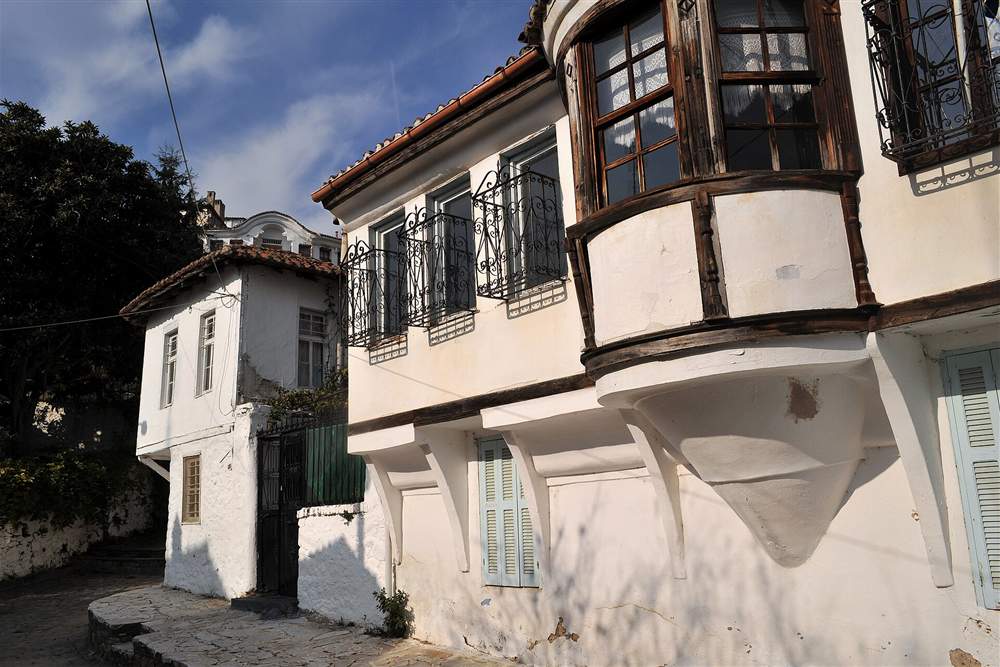
Thrace tours in Xanthi see the old town on the slope of the Rhodope, with Byzantine churches, neoclassical tobacco mansions of the 18th and 19th centuries and Ottoman mosques in the same streets, the Kosynthos river through the middle, and the spring carnival that fills the city.
Xanthi is the capital of its regional unit and the handsomest town in Thrace. The old quarter, Palia Poli, climbs in narrow lanes above the modern centre, and its houses were built by tobacco merchants who made fortunes on the crop that still grows on the plain below. Their mansions carry painted ceilings, courtyards and overhanging upper floors. Thrace tours give the old town a morning.
The town is called the lady of Thrace for that architecture. Its Folklore Museum occupies one of the merchant houses, the Archaeological Museum of Abdera holds the finds of the ancient city 25 km south, and the covered market and the Saturday bazaar draw the whole region. Thrace tours walk its lanes and its market together.
The Xanthi carnival is the biggest in northern Greece. More than forty cultural associations take part, and the programme before Lent runs through concerts, theatre, street games, a cycling event and the re-enactment of old customs, ending with a parade and the burning of the effigy.
North of the city the Kosynthos runs out of the Rhodope through the Xanthi gorge, with the Pomak villages of Echinos and Myki in the hills above. Thrace tours climb that road for the mountain villages and the view back over the plain.
What do Thrace tours see in Komotini and the Rhodope?
Thrace tours in Komotini see the Imaret and the old bazaar, the Byzantine walls, the archaeological and ecclesiastical museums, and in the Rhodope above it the Pomak villages, the Nymfaia forest and the border ridge towards Bulgaria.
Komotini is the capital of Rhodope and the administrative seat of the whole region. Its centre keeps a bazaar of low shops that has traded since Ottoman times, the Imaret, a charitable kitchen of the 14th century, and the remains of the Byzantine fort that the town grew around. The Archaeological Museum holds the gold funeral mask from Maroneia and the finds of the Thracian coast. Thrace tours take the bazaar and the museum in one stop.
The town is the most mixed in Greece. Its population is Christian and Muslim, and the minority protected by the Treaty of Lausanne of 1923, which exempted it from the exchange of populations, holds Turkish, Pomak and Roma communities. Mosques, madrasas and churches stand in the same streets, and both calendars run through the year. Thrace tours meet both calendars in the same street.
Behind it the Rhodope rises to the frontier. Nymfaia, 7 km up, keeps a forest and a ruined fort with a view over the plain to the sea; the road continues to the Pomak villages of Organi and Kechros, where tobacco and chestnuts are the crops and the language is a Slavic dialect. Brown bears, wolves and wild boar live in the same forest.
Thrace tours take Komotini in a morning and the mountain in an afternoon, and the two make the standard day out of Xanthi or Alexandroupoli.
What do Thrace tours see in Alexandroupoli?
Thrace tours in Alexandroupoli see the lighthouse of 1880 on the waterfront, the long promenade and fish tavernas, the Ethnological Museum of Thrace in a 1899 mansion, the Saturday market, and the port with the ferries to Samothrace.
The city is young. It grew from the fishing village of Dedeagac, which the Ottomans settled in the 19th century and which became a trading centre on the railway; Greece took it in 1920 and renamed it for King Alexander. That history explains its grid plan, its low 19th-century houses and the absence of an old town. Thrace tours use it as the eastern base.
The lighthouse is its emblem, built in 1880 at the centre of the seafront and still working, with the promenade running each way from it. The Ethnological Museum of Thrace, in a neoclassical building of 1899, holds the costume, the silk, the metalwork and the farming tools of the region and explains the communities that made them. Thrace tours walk the front from it at dusk.
The port serves the whole north-east. Ferries cross to Samothrace in about two hours, coastal boats work the delta, and the fishing fleet supplies the tavernas along the front, where the local catch is sardines, mussels and the mydopilafo, the mussel rice of the city.
East of the town the coast runs to the Evros delta and the Turkish border at Kipoi, 40 km away; west it runs through Makri and Dikella to Maroneia. Thrace tours use Alexandroupoli as the base for both directions.
What do Thrace tours see at Soufli and Didymoteicho?
Thrace tours at Soufli see the silk town on the Evros with its cocoon houses and two silk museums, and at Didymoteicho the Byzantine castle on its rock and the wooden-domed Bayezid mosque of 1420, the largest Ottoman mosque in the Balkans.
Soufli lived on silk. The town stands 65 km north of Alexandroupoli, 500 m from the river, and in the 19th century its mulberry groves and rearing houses supplied raw silk to Europe; the koukoulospita, tall buildings with open upper floors for the silkworm trays, still line the streets. The Silk Museum in the Kourtidis mansion and the Art of Silk Museum show the whole cycle from egg to thread. Thrace tours take both museums in an hour.
Didymoteicho, 30 km further north, was a Byzantine fortress town and briefly an Ottoman capital. Its walls and towers stand on a double hill above the Erythropotamos, and the mosque of Bayezid I, begun in 1395 and finished in 1420, carries a pyramidal wooden roof over a square hall, the oldest and largest of its kind in the Balkans; it has been under restoration since a fire in 2017. Thrace tours climb to the walls for the river view.
- Soufli silk museums – the Kourtidis mansion and the Art of Silk collection.
- Koukoulospita – the tall cocoon houses along the town’s streets.
- Didymoteicho castle – Byzantine walls, towers and cisterns above the river.
- Bayezid mosque – the wooden-domed Ottoman hall of 1420.
- Orestiada – the planned town of 1923, built by refugees from Karagatch.
- Evros border – the river road north to Ormenio and the Bulgarian frontier.
The road follows the Evros the whole way, with Turkey on the far bank and Edirne visible from the hills. Thrace tours take Soufli and Didymoteicho as a long day from Alexandroupoli.
What do Thrace tours see in the Dadia forest and the Evros delta?
Thrace tours in the Dadia forest see the only place in Europe where all four European vulture species occur, in 7,290 hectares of oak and pine with an observatory and marked trails, and in the Evros delta the wintering geese, pelicans and eagles of one of the great wetlands of the continent.
Dadia lies inland from Soufli, a managed protected area that takes about 35,000 visitors a year. Black vultures, griffon vultures, Egyptian vultures and bearded vultures have all been recorded here, with imperial eagles and short-toed eagles nesting in the same forest; a feeding station and an observation hide put them within reach of a telescope. Thrace tours book the hide with a guide.
The wildfire of August 2023 burned about 73,000 hectares around Alexandroupoli, the largest recorded in the European Union at that date, and took just over half of the Dadia forest. Eighteen people died. The recovery is measured in decades, and the trails that survived run through a mix of burnt and standing woodland.
The Evros delta at the river mouth is the other half of the birdwatching. Its lagoons, reedbeds and mudflats hold more than 300 species, with wintering white-fronted geese, pygmy cormorants, Dalmatian pelicans, spoonbills and white-tailed eagles; boats and 4×4 trips run from the information centre at Loutra Traianoupolis. Thrace tours run the delta boats from the information centre.
Thrace tours for birds work from October to April, when the wintering flocks arrive, and in spring for the raptor passage. Binoculars and a guide make the difference, since the distances across the flats are long.
What do Thrace tours see at Abdera, Maroneia and the ancient coast?
Thrace tours on the ancient coast see Abdera, the city of Democritus and Protagoras, with its walls, theatre and museum, Maroneia with its theatre, sanctuary of Dionysos and the cave named for Polyphemus, and the Roman spa of Traianoupolis near the delta.
Greek colonists took this coast early. Abdera was founded from Klazomenai and refounded from Teos in the 6th century BC, and it produced Democritus, who proposed that matter is made of atoms, and Protagoras, the sophist who said man is the measure of all things. The site, 25 km south of Xanthi, keeps two circuits of wall, a theatre and houses, with its finds in the museum at Xanthi. Thrace tours follow that coast from Abdera to Maroneia.
Maroneia, under Mount Ismaros east of Komotini, was the richest city of the coast and gave Odysseus the wine with which he made Polyphemus drunk in the Odyssey. Its theatre, sanctuary of Dionysos, house of the mosaic and long walls run down to the sea, and the cave above the shore carries the Cyclops name.
- Abdera – walls, theatre and the birthplace of Democritus and Protagoras.
- Maroneia – theatre, sanctuary of Dionysos, mosaic house and the Polyphemus cave.
- Porto Lagos – the lagoon with the chapel of Agios Nikolaos on the water and the Vistonida birds.
- Traianoupolis – the Roman thermal town on the Egnatia, with its Ottoman hamam.
- Zone and Mesimvria – the Samothracian colony west of Alexandroupoli, with its temple of Apollo.
- Via Egnatia – the Roman road that crossed the whole region from Kavala to Constantinople.
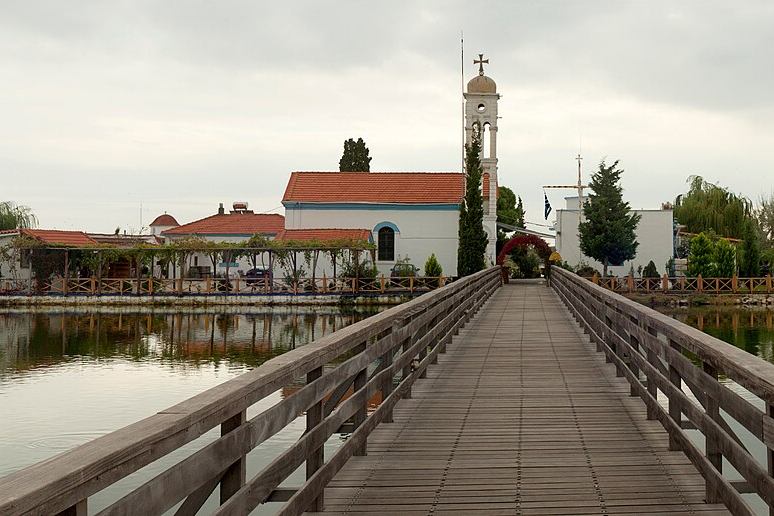
Thrace tours link these along the coast road between Xanthi and Alexandroupoli, with Porto Lagos as the midpoint. The lagoon monastery, a dependency of Vatopedi on Athos, stands on two islets joined by a causeway and is the picture that sells the region.
Which beaches and lagoons do Thrace tours reach?
Thrace tours reach Fanari and Arogi on the Rhodope coast, Erasmio and Mangana west of Porto Lagos, Makri and Dikella near Alexandroupoli, Agios Charalampos below Maroneia, and the lagoons of Vistonida, Ismarida and the Evros delta behind them.
The Thracian coast is flat, shallow and quiet. Sandbars separate the sea from a chain of lagoons, which is what makes the birdwatching and keeps the resorts small; the beaches run in long strips with dunes and tamarisk, and the water warms early because it is shallow. Thrace tours pick the lagoon beaches for that reason.
- Fanari – the main resort of Rhodope, with a marina, sand and tavernas.
- Makri and Dikella – the beaches west of Alexandroupoli, with the Neolithic cave of Makri above them.
- Erasmio and Mangana – long sand west of Porto Lagos in Xanthi.
- Agios Charalampos – the shore below Maroneia, under Mount Ismaros.
- Porto Lagos and Vistonida – the lagoon system with the monastery islets.
- Evros delta – the reedbeds and mudflats at the river mouth, for birds rather than swimming.
Samothrace, an hour and a half offshore, adds the mountain and the waterfalls that the mainland lacks. Thrace tours in summer pair a lagoon morning with a beach afternoon, since the two sit within twenty minutes of each other.
What do Thrace tours eat and drink?
Thrace tours eat kavourmas, the potted meat of the region, soutzouki sausage, mussels from the Vistonida and Thermaic lagoons, the syrup sweets of Xanthi and Komotini, and drink the wines of Maroneia and Avdira and the tsipouro of the mountain villages.
The kitchen carries three traditions at once: the Greek of the coastal towns, the Ottoman of the bazaars and the Pontic and Asia Minor of the refugees of 1922. That mix produces kavourmas, meat cooked and set in its own fat, sarmades in vine leaves, peppers stuffed with rice, and a strong line in pies made with thin hand-rolled pastry. Thrace tours eat all three in one town.
- Kavourmas – potted meat, sliced cold or fried with eggs.
- Soutzouki and pastourmas – the cured sausages of the Thracian towns.
- Mussels – farmed in the lagoons, cooked as saganaki or with rice.
- Syrup sweets – the baklava and kadaifi of Xanthi and Komotini.
- Maroneia and Avdira wines – the modern estates on the ancient wine coast.
- Tsipouro and raki – distilled in the Rhodope villages after the vintage.
The wine is the oldest claim. Maroneian wine is the drink Homer gives Odysseus in the cave of Polyphemus, and the estates that work the same slopes today bottle under the Maronia and Avdira names. Thrace tours book the cellars with the archaeological stop, since both sit on the same coast road. Our page on the Kavala food tour covers the table of the gateway city.
What history do Thrace tours tell?
Thrace tours tell of the Thracian tribes and the Greek colonies of Abdera and Maroneia, of Persian and Macedonian conquest, of the Via Egnatia and Byzantium, of Ottoman rule from the 14th century, and of the borders drawn between 1912 and 1923 that left the region as it is.
The name is the oldest in Europe. Thrake first meant the land of the Thracians, and the word Europe was used for this region before it covered the continent. Greek colonists settled the coast from the 7th century BC while the Thracian kingdoms held the interior, and the Odrysian kings ran the largest of them. Thrace tours begin from that fact.
Persia took the region in the late 6th century BC, Athens contested the coast, Philip II annexed it, and Rome laid the Via Egnatia through it from Dyrrachium to Byzantium. Byzantium ruled it as a theme and prospered on its position beside Constantinople. After the civil war of 1352 to 1357 the Ottomans took it, and Edirne, across the modern river, became their capital.
The modern borders came in three steps. The Balkan Wars of 1912 and 1913 moved the region between Bulgaria, Greece and back; the First World War and the Treaty of Neuilly gave it to Greece in 1920; and the Treaty of Lausanne in 1923 exchanged populations across Greece and Turkey but exempted the Muslims of Western Thrace and the Greeks of Istanbul, which is why the minority communities remain.
Thrace tours read that record in the buildings: a Thracian tumulus, a Greek theatre, a Roman road, a Byzantine castle, an Ottoman mosque and a 1920s refugee quarter within a few kilometres.
Which festivals do Thrace tours meet?
Thrace tours meet the Xanthi carnival before Lent, the Xanthi Old Town Festival at the end of summer, the Soufli silk festival in June, the Kavala Cosmopolis festival and the village panigyria of the Rhodope through August.
The Xanthi carnival is the largest event in the region. Over forty associations join the programme, which runs for two weeks before Lent with parades, concerts, street games and a closing bonfire, and it fills every room in the city and beyond it. Thrace tours in February plan around it.
The Old Town Festival in late August and early September fills the lanes of Palia Poli with concerts, exhibitions and food, with the merchant houses opened for the occasion. Soufli marks its own trade with a silk festival in June, where the cocoon houses, the looms and the weavers are shown working.
The mountain villages keep their saints’ days through August with three-day panigyria, gaida bagpipes and zournas, and the coastal towns hold fish and mussel festivals in the same months. Thrace tours in carnival season or in late August book the rooms months ahead.
How do visitors reach Thrace, and when do the tours run?
Visitors reach Thrace through Alexandroupoli airport, through Kavala airport at Chrysoupoli in the west, by the Egnatia motorway from Thessaloniki in three hours, and by train from Thessaloniki to Alexandroupoli. The tours run through the year, with birds in winter and the coast in summer.
The Egnatia Odos is the spine. It runs from Thessaloniki through Kavala and Xanthi to Komotini, Alexandroupoli and the Turkish border at Kipoi, and it has cut the drive across the region to about two hours. Alexandroupoli airport takes flights from Athens and seasonal European services, and the ferry from its port reaches Samothrace in about two hours. Thrace tours drive it end to end in two hours.
- Thessaloniki to Xanthi – about two and a half hours on the Egnatia.
- Thessaloniki to Alexandroupoli – about three and a half hours.
- Kavala to Xanthi – 55 km, about 45 minutes.
- Alexandroupoli to Soufli – 65 km north on the Evros road.
- Alexandroupoli to Samothrace – about two hours by ferry.
- Alexandroupoli to the Turkish border – 40 km east to Kipoi and Edirne beyond it.
Winter brings the geese and the eagles to the delta and the coldest weather on the mainland; spring brings the raptor passage and the carnival; summer fills the lagoon beaches; and autumn takes the vintage and the chestnut harvest in the Rhodope. Thrace tours therefore run in every season, which few Greek regions manage. Our page on the Kavala walking tour covers the first stop on the way in.
Frequently Asked Questions
Where is Greek Thrace?
In the north-east corner of Greece, between the Nestos river and the Turkish border at the Evros, with Bulgaria to the north and the Thracian Sea to the south. It holds the regional units of Xanthi, Rhodope and Evros.
Which is the largest city in Thrace?
Alexandroupoli, with 71,751 people, the port and commercial centre of north-east Greece. Komotini is the administrative seat of the region and Xanthi the third city.
How long do Thrace tours take?
A day for Xanthi and Porto Lagos, a day for Komotini and the Rhodope villages, a day for Soufli and Didymoteicho, and four to five days for the region with the Dadia forest and the Evros delta.
Why is Soufli known for silk?
Its mulberry groves and rearing houses supplied raw silk to Europe in the 19th century. The tall cocoon houses still stand, and two museums show the cycle from egg to thread.
What is the Dadia forest?
A protected area of 7,290 hectares of oak and pine in Evros, the only forest in Europe where all four European vulture species occur. The wildfire of August 2023 burned just over half of it.
Where do you watch birds in Thrace?
In the Evros delta, with wintering geese, pelicans and white-tailed eagles, at Dadia for vultures and eagles, and in the lagoons of Porto Lagos, Vistonida and Ismarida along the coast.
Who was Democritus?
The philosopher who proposed that matter is made of atoms, born at Abdera on the Thracian coast in the 5th century BC. Protagoras, the sophist, came from the same city.
What is Porto Lagos?
A lagoon on the coast between Xanthi and Komotini, with the chapel of Agios Nikolaos on islets joined by a causeway, a dependency of Vatopedi on Mount Athos, and flamingos and pelicans on the water.
Why does Thrace have a Muslim minority?
The Treaty of Lausanne of 1923 exempted the Muslims of Western Thrace and the Greeks of Istanbul from the exchange of populations. The communities are Turkish, Pomak and Roma, and they live across the three units.
Which food is Thrace known for?
Kavourmas, the potted meat of the region, soutzouki and pastourmas, mussels from the lagoons, hand-rolled pies and the syrup sweets of Xanthi and Komotini.
How do you get to Thrace?
By the Egnatia motorway from Thessaloniki, about three and a half hours to Alexandroupoli, by air to Alexandroupoli or Kavala, or by train from Thessaloniki. The ferry to Samothrace leaves Alexandroupoli.
When is the best time for Thrace tours?
October to April for the wintering birds of the delta, spring for the raptor passage and the Xanthi carnival, summer for the lagoon beaches and autumn for the vintage and the chestnuts of the Rhodope.