
A Kavala walking tour climbs the lanes of the Panagia quarter to the Byzantine castle, passes the Imaret and the aqueduct, and comes back down to the harbour. Plan the rest of the trip with Greece Tours.
What does a Kavala walking tour cover?
The Archaeological Museum, the two-storey Kamares aqueduct, the walls of the old town, the Imaret, the house where Mehmet Ali was born, the Byzantine castle on the Panagia hill, the old port with its fishing boats, and the tobacco warehouses.
Walks stay mostly in the lower town.
The castle is seen from below on the shore walks.
The guided city walk climbs to the castle.
The central tower gives views to Thassos.
Samothrace is visible in good weather.
The city page sits at Things to do in Kavala.
How long does a Kavala walking tour take?
About one and a half hours for the guided city walk, two and a half hours for the private shore-excursion walk with the museum and aqueduct, and two and a half hours for the self-guided audio route.
Free time follows the private walks.
Museums add time after the walk.
The walk ends in the city centre.
Lunch follows at a harbour taverna.
Audio walks run at any pace.
Where does a Kavala walking tour start?
At the port of Kavala, where guides meet guests next to the ship on the shore excursions, ending in the city centre, with the audio route starting at the Archaeological Museum.
Walks finish near the market and tavernas.
The city centre is walkable from the port.
Guides suggest how to get back to the ship.
A passport or ID is useful to carry.
Meeting points are confirmed at booking.
What is the Kamares aqueduct?
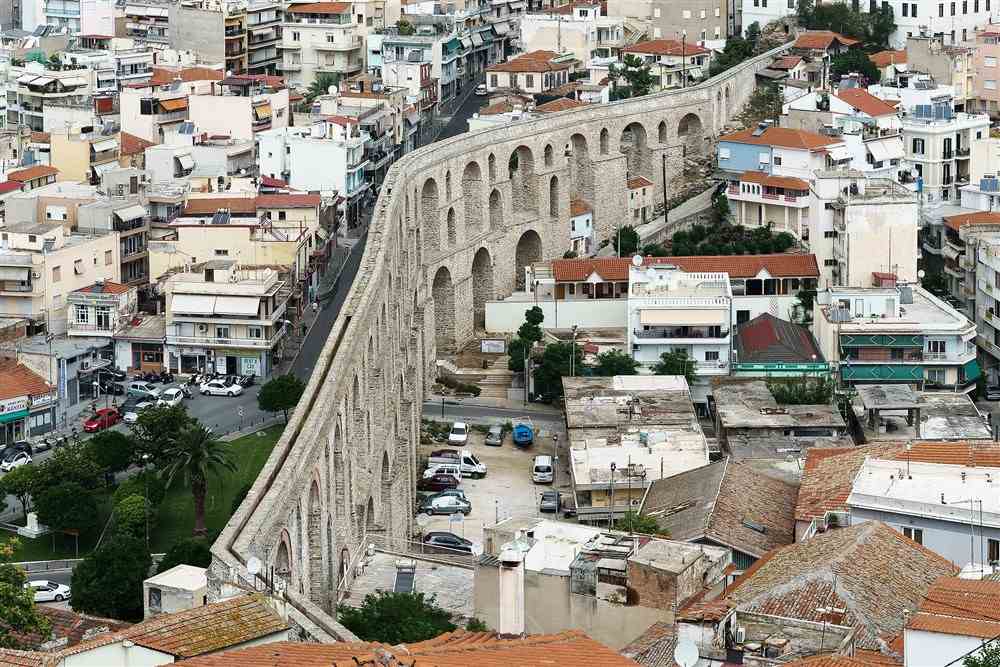
The two-storey aqueduct in the centre of Kavala, rebuilt in the 16th century by Ibrahim Pasha during Ottoman rule to supply the castle on the Panagia hill with water, and one of the best known sights of the city centre.
It links the old and new parts of the city.
Walks pass under its arches.
It is one of the most recognisable landmarks of Kavala.
It is a stop on the private walks.
Photographs frame it with the castle above.
What is the Imaret?
An Ottoman-period complex in the old town of Kavala built by Mehmet Ali, the Kavala-raised founder of the dynasty that ruled Egypt, and a fixed stop on the private walks between the old port and the house where he was born.
The Imaret sits by the old port.
Walks stop outside it.
Guides tell the story of Mehmet Ali here.
It is part of the old town route.
What is the house of Mehmet Ali?
The house in the old town of Kavala where Mehmet Ali was born, visited on the private walks as the birthplace of the founder of the dynasty that ruled Egypt, a short walk from the Imaret he built.
The house stands in the Panagia quarter.
Walks pair it with the Imaret.
Guides tell his rise from Kavala to Egypt.
The old town lanes lead there.
What is the castle of Kavala?
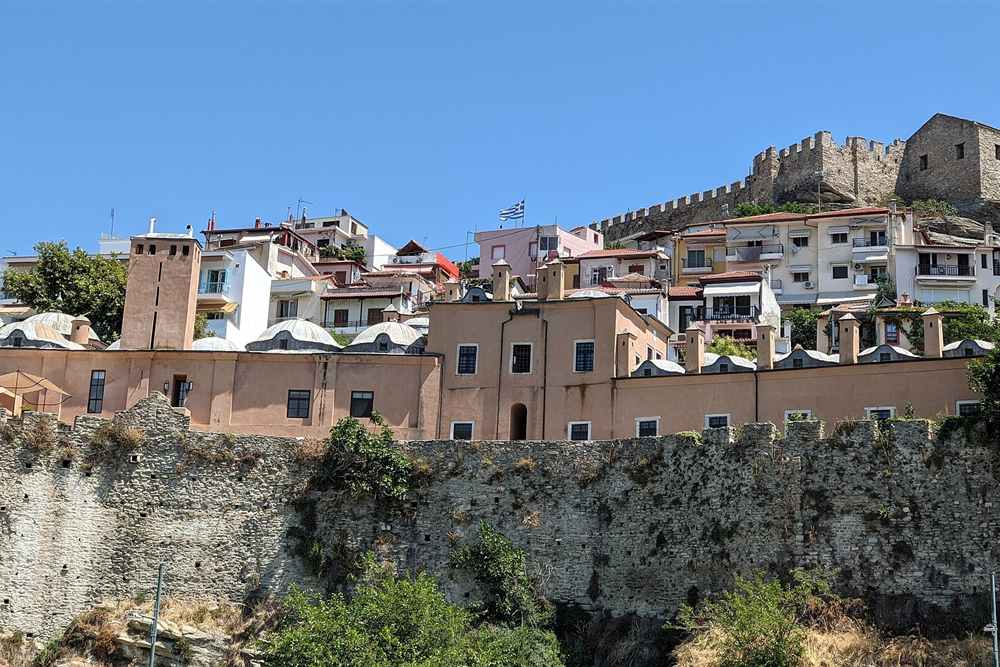
The Byzantine fortress on the hill of Panagia, extended by the Ottomans, a medieval castle with towers whose central tower is the highest point of the city and looks over Kavala, the Aegean and the island of Thassos.
The Ottomans extended the Byzantine fortress.
The castle is one of the city’s symbols.
The climb follows cobbled streets.
Shore walks view it from below.
The guided city walk goes up.
The view reaches Samothrace in good weather.
What is Panagia, the old town?
The old town of Kavala on the hill above the port, one of the three town walks the municipality recommends, with cobbled streets climbing to the castle past the Imaret, the house of Mehmet Ali and the old town walls.
The lanes are steep in places.
Comfortable shoes help.
The old town overlooks the port.
Walks cross it from the port to the castle.
What are the tobacco warehouses?
The grand buildings of Kavala’s former tobacco trade, including the pink Municipal Tobacco Warehouse on Kapnergatis Square built in 1910 by tobacco merchant Kiazim Emin, and a modern-looking warehouse that now houses the Tobacco Museum.
Tobacco once made Kavala rich.
The audio walk stops at both buildings.
Kapnergatis means tobacco worker.
The Tobacco Museum tells the trade’s story.
The buildings line the modern centre.
Walks connect them with Kyprou Street.
What is Kyprou Street?
The smallest street in Kavala, just 350 metres long, which the audio route says hides the city’s modern history in its buildings, running from Kapnergatis Square as one of the municipality’s recommended town walks.
It is paved and pedestrian.
Its buildings date from the tobacco era.
It is a stop on the audio walk.
It links the squares of the centre.
Cafes line the route.
It suits a short evening stroll.
What does the Archaeological Museum show?
The museum that opens the private walks and starts the free audio route, holding finds from ancient Neapolis and the region around Kavala, the city whose ancient goddess Parthenos is still its symbol.
Ancient Neapolis worshipped the goddess Parthenos.
The private walks include a museum visit.
The audio route begins here.
Tickets are paid separately.
What is the history of Kavala?
Justinian fortified the city in the 6th century.
The name Kavala dates from the 16th century.
Its nickname is the cyan city.
Philippi is a UNESCO World Heritage Site nearby.
Where do you eat after the walk?
At the famous fish tavernas by the old port, where the wooden fishing boats tie up, with local specialities and a glass of ouzo, which is how the private shore-excursion walks close their route through the old town.
Private walks end near the tavernas.
Guides suggest places to eat.
The promenade has cafes.
The market sells local products.
Food walks cover the street food side.
The food side sits at Kavala food tour.
Is a Kavala walking tour good for cruise passengers?
Yes: private shore-excursion walks of two and a half hours start at the port, cover the museum, the aqueduct, the Imaret and the old port, and leave free time before the ship sails, with Philippi tours as the longer option.
Walks can be customised.
Philippi tours run from the port too.
What do you bring on a Kavala walking tour?
Comfortable walking shoes for the cobbled old town lanes, a hat and water for the climb to the castle, a charged phone for the free audio route, and cash for museum tickets and a taverna snack at the old port.
The castle climb is uphill.
The old town lanes are cobbled.
Water helps on warm days.
Museum tickets are paid on the day.
A phone holds the audio guide.
Tavernas wait at the old port.
How do you book a Kavala walking tour?
Request the guided city walk at least a week ahead, book private shore excursions with your ship name and date, download the free audio route to walk alone, or book street food and tuk-tuk tours online.
The guided walk runs only on prior request.
Shore excursions confirm the meeting time.
Audio walks need a phone.
Tuk-tuk tours offer city and evening routes.
Groups book further ahead.
Day trips across Northern Greece sit at Thessaloniki day trips.
What does a Kavala walking tour see in Panagia?
The old quarter on the headland, with wooden Ottoman houses, narrow lanes climbing to the Byzantine castle, and the Imaret below it.
The Imaret is one of the largest Ottoman buildings in Greece and was built as a religious school complex.
The quarter sits between the two harbours on a rock above the sea.
The lanes are steep and paved in stone.
What does a Kavala walking tour see at the aqueduct?
The Kamares, a double-tier stone aqueduct that carries across the saddle between the old town and the modern city on tall arches.
It brought water to the headland from the hills behind.
The arches stand over a busy street today.
The structure is the symbol of the city.
What does a Kavala walking tour see at the castle?
The Byzantine fortress at the top of the Panagia quarter, with a round keep, a courtyard used for concerts and a wall walk that looks over the gulf to Thasos.
The climb from the harbour takes about fifteen minutes.
The island of Thasos sits across the water to the south.
The walls enclose the highest point of the headland.
What else does a Kavala walking tour cover?
The tobacco warehouses of the lower town, the house of Mehmet Ali on the headland, the fishing harbour and the seafront promenade.
Kavala grew rich on tobacco, and the warehouses still stand in the centre.
Mehmet Ali, the founder of the Egyptian dynasty, was born in the city.
His statue stands on horseback beside his house.
How long does a Kavala walking tour take?
Two to three hours on foot, with the climb into the Panagia quarter and the castle making up most of the effort.
The lower town is flat along the waterfront.
Groups stop in the castle courtyard and on the wall.
The route ends back at the harbour.
When does a Kavala walking tour run?
Morning and late afternoon, avoiding the middle of the day in summer when the stone lanes hold the heat.
Spring and autumn are the most comfortable seasons.
The castle courtyard is used for events in summer evenings.
Winter brings rain and wind off the gulf.
Frequently Asked Questions
How long is a walking tour of Kavala?
About one and a half hours for the guided city walk and two and a half hours for the private shore-excursion walk or the free audio route.
What is the symbol of Kavala?
The Kamares aqueduct, the two-storey aqueduct rebuilt in the 16th century to carry water to the castle, is the landmark most walks pass under.
Is Kavala walkable from the cruise port?
Yes. The city centre is walkable from the port, and the private shore-excursion walks start there.