
A Nikopolis tour is a three to four hour guided visit to the Roman City of Victory that Octavian founded after the battle of Actium, seven kilometres north of Preveza, covering the walls, theatre, mosaics and museum, priced from 35 euros a head. Plan the rest of the trip with Greece Tours.
This page covers the tour: what it costs, the history, the walls, the theatre and odeon, the Actian Games, the victory monument, the basilicas, the museum and how to book.
What does a Nikopolis tour cost?
From 35 to 60 euros a head for a guided half day of the site and the museum from Preveza, 150 to 280 for a private half day, 280 to 450 for a private full day adding the Acheron river, and 90 to 140 for the day trip from Lefkada with a boat ride.
The price covers the guide and the transport, and site entry is separate on most listings. A Nikopolis tour is booked around it.
Site and museum entry runs 4 to 8 euros depending on the season. A Nikopolis tour settles this at pickup.
Private tours quote by the party and set their own pace.
Full-day products add lunch at a taverna by the Acheron or in Preveza.
Children under 18 enter the site free.
Pickup is included from Preveza hotels and the Aktion airport area.
What is Nikopolis?
The City of Victory, founded by Octavian in 31 BC on the isthmus north of Preveza to commemorate his win over Antony and Cleopatra at Actium, which grew into the largest Roman city in western Greece and covers 14 square kilometres today.
Octavian populated it by moving the people of surrounding Greek towns into it. Every Nikopolis tour is routed around this.
The city became the capital of the Roman province of Epirus. The Nikopolis tour route is set by it.
Saint Paul wintered here and wrote of it in his letter to Titus.
The philosopher Epictetus ran his school at Nikopolis from about AD 93.
Goths, Slavs and earthquakes brought the city down by the eleventh century.
Most of the ancient city lies open ground and olive groves beside the modern road.
What was the battle of Actium?
The sea battle of 2 September 31 BC at the mouth of the Amvrakikos Gulf, where Octavian’s fleet under Agrippa defeated Mark Antony and Cleopatra, ended the Roman Republic’s civil wars and opened the way to the Empire.
Octavian’s camp stood on the hill of Michalitsi where Nikopolis was later built. The Nikopolis tour listing states it plainly.
Cleopatra’s ships broke out and fled to Egypt with Antony following. Guides raise it early on a Nikopolis tour.
Octavian became Augustus, the first Roman emperor, four years later.
The battle site lies eight kilometres south of the ruins.
Guides tell the battle from the monument hill looking over the gulf.
Nikopolis exists because of that afternoon.
What does a Nikopolis tour cover?
The Byzantine walls and gate, the Roman theatre and odeon, the Doumetios and Alkyson basilicas with their mosaics, the stadium, the Augustus victory monument on Michalitsi hill, the aqueduct and the archaeological museum.
The site is spread over three to four kilometres and the tour moves between points by vehicle. This is what a Nikopolis tour delivers.
The odeon and the basilicas sit inside the Byzantine walls. It decides which Nikopolis tour suits the party.
The theatre, stadium and monument lie north of the walls near the modern road.
The museum sits at the southern edge of the site.
A half-day tour covers all of it at a guided pace.
Self-drivers need a car to link the separate areas.
What are the walls on a Nikopolis tour?
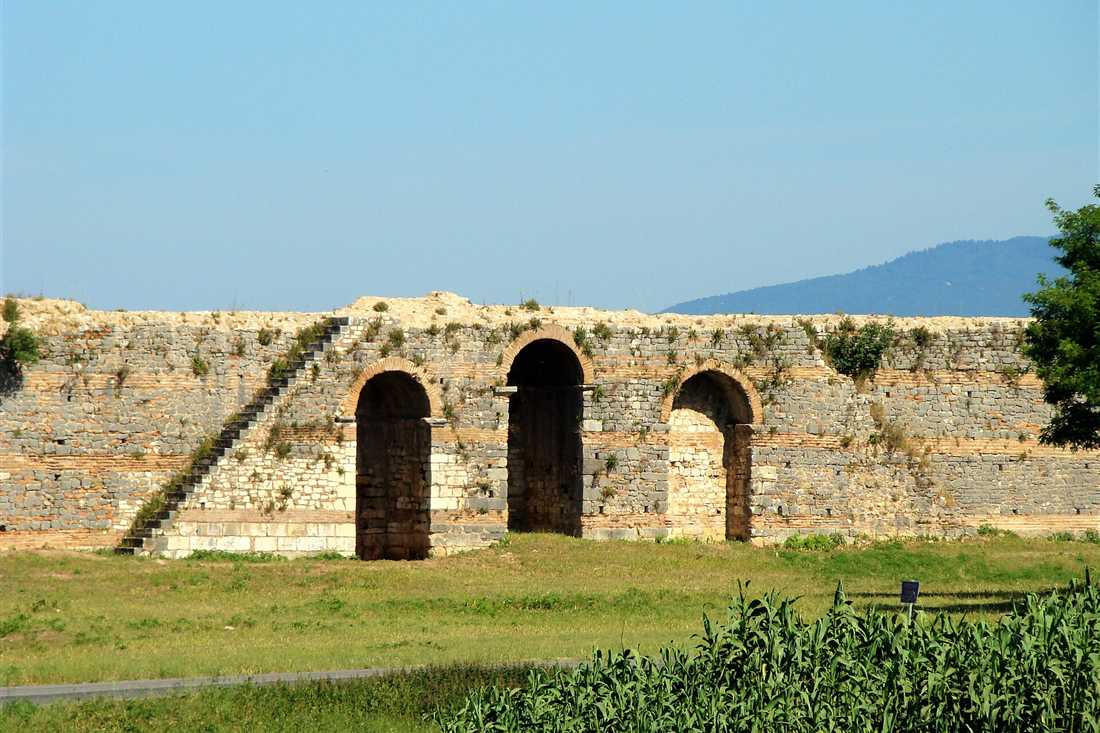
A Byzantine circuit of the sixth century built by Justinian, enclosing a smaller city inside the vast Roman one, standing up to ten metres high with towers and a monumental gate, and the best-preserved structure on the site.
The Byzantine walls enclose about a sixth of the Roman city’s area. Nikopolis tour guides prepare for it.
Roman blocks and columns were reused inside the wall fabric. The Nikopolis tour price reflects it.
The main gate is walked through on every tour.
Earlier Roman walls ran far wider and survive only in fragments.
The circuit stands beside the Preveza-Arta road.
Restoration has stabilised long stretches in recent years.
What are the theatre and the odeon?
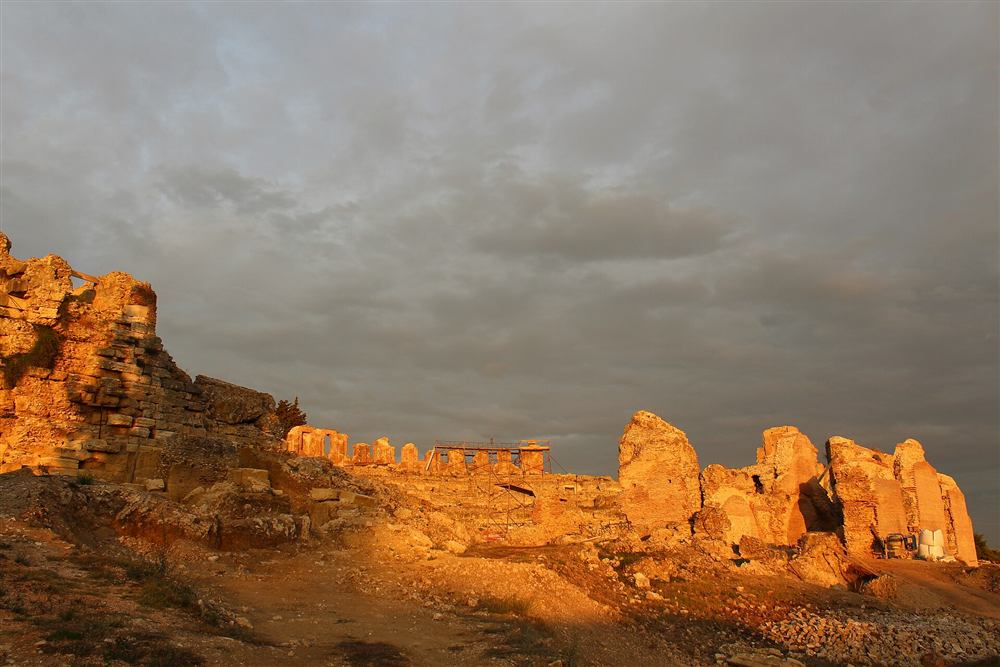
A large Roman theatre on the slope of Michalitsi hill seating about 10,000 for the Actian Games, and a smaller odeon inside the city restored for summer performances, seating around 1,000 under the olive trees.
The theatre’s upper arches still stand above the modern road. A Nikopolis tour settles this at pickup.
Its restoration has run for years and parts are fenced. A Nikopolis tour fills first on that count.
The odeon hosts concerts and plays on summer evenings.
Both were built in the first century AD.
The odeon’s seating was rebuilt from original blocks.
The theatre is the structure most visible from the passing road.
What were the Actian Games?
Games founded by Augustus at Nikopolis to celebrate Actium, held every four years with athletics, horse races, music and a regatta, ranked alongside Olympia, Delphi, Isthmia and Nemea as a sacred festival.
The stadium stands north of the city beside the theatre. The Nikopolis tour route is set by it.
Its U-shaped track and embankments are still clear in the ground. The Nikopolis tour calendar is shaped by it.
A gymnasium and the theatre formed one complex with the stadium.
The regatta was raced on the gulf where the battle had been fought.
The games ran for about three centuries.
Guides link the stadium to the battle story on the same stop.
What is the Augustus victory monument?
The monument Octavian built on Michalitsi hill on the site of his tent, a terrace with a stoa and a long retaining wall that once carried the bronze rams of 35 captured warships, looking down over the battle waters.
The sockets that held the rams are still cut into the wall. Guides raise it early on a Nikopolis tour.
A dedicatory inscription to Neptune and Mars ran along the terrace. Guests meet it within the first Nikopolis tour hour.
The monument is one of the earliest of Augustus’s victory memorials.
The view covers the Ionian, the gulf mouth and Preveza.
It sits two kilometres north of the walled city.
Visitors reach it by car on a short side road.
What are the basilicas and mosaics?
Early Christian basilicas of the fifth and sixth centuries inside the Byzantine walls, above all the Doumetios basilica and the Alkyson basilica, with large floor mosaics of animals, birds, trees and a cosmic map of land and sea.
The Doumetios mosaic shows the earthly world framed by the ocean. It decides which Nikopolis tour suits the party.
Many mosaics were lifted and conserved in the museum. That is the Nikopolis tour advantage over a hire car.
Some floors are kept covered with sand for protection outside the season.
Nikopolis was a bishopric and its churches were large and rich.
The basilicas are the Christian layer of the tour after the Roman one.
Guides time the visit to see the mosaics that are on display.
What is the aqueduct?
A Roman aqueduct bringing water about 50 kilometres from the springs of the Louros river, with arches still standing across the plain near Ammotopos and a nymphaeum fountain at its end inside the city.
The arches at Agios Georgios on the Louros are the best-preserved stretch. The Nikopolis tour price reflects it.
A tunnel section cuts through the hills on the route. A Nikopolis tour covers the walls around it.
The water supply fed baths, fountains and the whole Roman city.
The standing arches are a separate stop 25 kilometres north.
Full-day tours add them on the way to the Acheron.
They are the most photographed remains of the Nikopolis water system.
What is in the Nikopolis museum?
The archaeological museum opened in 2009 at the edge of the site, holding portrait sculpture including Agrippa and Livia, the mosaics lifted from the basilicas, grave monuments, coins and daily objects from the Roman city.
The portrait of Agrippa is the collection’s best-known piece. A Nikopolis tour fills first on that count.
Rooms follow the city’s history from foundation to the Byzantine end. The Nikopolis tour season turns on this.
Entry is covered by the combined ticket with the site.
A visit takes 45 minutes to an hour.
The museum is air-conditioned and the natural first stop in summer.
It sits seven kilometres north of Preveza.
How long does a Nikopolis tour take?
Three to four hours for the guided site and museum, five with the aqueduct arches, and a full day of eight hours when the tour adds the Acheron river springs or the Zalongo monument.
The museum takes an hour and the scattered site takes two to three. The Nikopolis tour calendar is shaped by it.
Driving between the site areas takes ten minutes in total. A Nikopolis tour is booked around it.
Morning starts avoid the midday heat on the open ground.
Half-day tours from Preveza return by lunch.
The Lefkada day trip combines Nikopolis with Parga in nine to ten hours.
Anyone driving alone needs a morning for it.
What are the entry prices and hours?
A combined site and museum ticket of 4 to 8 euros depending on the season, free for under 18s, with the museum open 08:30 to 15:30 in winter and to 20:00 in summer and parts of the site open freely.
The walled city, the odeon and the basilicas sit inside the ticketed area. Guests meet it within the first Nikopolis tour hour.
The theatre and the monument hill are reached from the public road. Every Nikopolis tour is routed around this.
Free-entry days fall on the first Sunday of each month from November to March.
Hours shift through the shoulder months and the guides check them.
Cards are accepted at the museum desk.
Parking is free at the museum and along the road.
How do you get to Nikopolis?
Seven kilometres north of Preveza on the road to Arta, 15 minutes from Aktion airport through the undersea tunnel, 45 minutes from Parga, 30 minutes from Lefkada over the causeway, and four hours from Athens.
KTEL buses between Preveza and Arta stop beside the site. That is the Nikopolis tour advantage over a hire car.
Taxis from Preveza run 12 to 20 euros each way. The Nikopolis tour listing states it plainly.
Car hire at Aktion airport runs 35 to 70 euros a day.
The Ionia Odos motorway puts Ioannina at an hour.
The site lies on both sides of the main road and is signposted.
Most visitors arrive on a tour from Preveza, Parga or Lefkada.
Can you combine it with the Acheron river?
Yes, and the full-day private tours do: Nikopolis in the morning, lunch by the river, then the Acheron springs at Glyki where the mythical river of the dead rises from a gorge, 45 minutes north.
The Acheron was the river Charon ferried the dead across. A Nikopolis tour covers the walls around it.
The springs are waded upstream into the gorge in summer.
The Necromanteion of Ephyra, the oracle of the dead, stands near the river mouth.
Zalongo’s monument to the Souliot women sits on a cliff on the same route.
Full days run eight hours from Preveza.
The Acheron day sits at Parga Acheron river.
What is the day trip from Lefkada?
A nine to ten hour coach and boat day from Lefkada that visits Nikopolis and Preveza in the morning, crosses to Parga, and adds a boat ride along the Parga coast, priced from 90 to 140 euros a head.
The coach crosses the Lefkada causeway and the Preveza tunnel. The Nikopolis tour season turns on this.
Nikopolis gets one to two hours of the day on this format.
Parga’s Venetian castle and harbour fill the afternoon.
The boat ride runs along the coves south of Parga.
Pickup covers Lefkada town, Nidri and Vassiliki.
It is the longest and busiest of the Nikopolis products.
When is the best time for a Nikopolis tour?
April to June and September to October, with 20 to 28 degrees and the olive groves green in spring. July and August reach 34 degrees on open ground with little shade.
Spring brings wildflowers through the ruins and the walls. A Nikopolis tour is booked around it.
Summer visits start at opening and move to the museum by noon.
The odeon performances run in July and August evenings.
Winter is mild and wet with shorter hours and no crowds.
The site is never busy by comparison with Delphi or Olympia.
A day ahead is enough to book in any month.
Is a Nikopolis tour good for families?
Yes for children who walk and like a story: a battle, a victory city, a stadium and a Roman theatre, with free entry for under 18s and a museum that works as the shaded break.
The site is spread out, so the vehicle does the long distances. Every Nikopolis tour is routed around this.
The walls and the gate are the parts children climb around.
Shade is scarce outside the museum and the olive groves.
Half-day tours suit families better than the full day.
Pushchairs manage the museum and the main paths only.
Preveza’s beaches are 15 minutes away for the afternoon.
What do you bring on a Nikopolis tour?
Walking shoes for uneven ground, a hat and sun cover, water, cash or a card for the entries, and a camera for the walls and the monument view.
The ground is grass, gravel and fallen stone between the monuments. The Nikopolis tour listing states it plainly.
Water is sold at the museum and not inside the walled area.
Summer mornings heat up fast on open ground.
Insect repellent helps in the olive groves in the evening.
Guides carry water in the vehicle.
Sandals fail on the rougher paths to the theatre.
What are the common Nikopolis tour mistakes?
Visiting only the museum and missing the walls and monument, driving past the site on the main road without stopping, going at midday in August, and skipping the Augustus monument because it sits outside the walls.
The museum explains the city and the ruins show its scale. This is what a Nikopolis tour delivers.
Thousands of drivers pass the walls on the Preveza road every day.
Open ground and summer heat make noon visits hard.
The victory monument is the reason the city exists and the best view on the site.
The fifth is going without a guide to a site with few signs.
A morning half day with a guide avoids all of it.
How do you book a Nikopolis tour?
Book a day or two ahead in summer and on the morning itself out of season. Shared half days cap at eight to fifteen, and private and full-day versions confirm the route and the Acheron add-on at booking.
Operators confirm the pickup by message the evening before. Nikopolis tour guides prepare for it.
Free cancellation up to 24 hours ahead is standard on the platform listings.
Entries are named on the listing where they are included.
Groups of four or more take a private quote rather than separate seats.
Lefkada and Parga pickups are stated on the ticket.
The Preveza boat day sits at Preveza dolphin watching cruise.
Who visited Nikopolis in its Roman centuries?
Germanicus stopped at Nikopolis on his way to Syria, Herod the Great funded its public buildings and Nero won the chariot race at its Actian Games. Arrian studied there under Epictetus and wrote down the lessons that survive as the Discourses.
Emperor Domitian expelled the philosophers from Rome, and Epictetus moved to Nikopolis. He taught there until his death.
Nero toured Greece and competed in its great festivals. Coins struck at Nikopolis record his chariot victory at the Actian Games.
Under the reforms of Diocletian, Nikopolis became the capital of the smaller province of Epirus Vetus. Its bishops appear in the records from the reign of Constantine.
Which ancient towns were emptied to fill Nikopolis?
Octavian filled Nikopolis with the people of nearby towns, among them Cassope in the hills, Orraon to the north and Anactorium on the Ambracian Gulf. Cassope, 25 km from Preveza near Kamarina, keeps one of the best-preserved Greek street grids in the country.
Cassope was the capital of the Cassopaeans, a branch of the Thesprotians. Its straight streets follow a Hippodamian grid. At its peak it held 8,000 to 10,000 people.
Its theatre sits on the southern slopes of the Zalongo range. The view covers the Ionian Sea, the Ambracian Gulf, Lefkada and the Acarnanian coast.
Anactorium stood near modern Vonitsa, 13 km south-east of Preveza, where a Venetian fortress crowns the hill.
What is the Zalongo monument near Nikopolis?
The Zalongo monument stands on a cliff above the monastery of Agios Dimitrios, reached by 410 steps. It honours about 60 Souliot women who went over the edge with their children in 1803 rather than surrender to Ottoman troops.
Tradition says the women danced and sang as they went over the cliff one after the other. The story is known as the Dance of Zalongo, and a folk-style song carries its name.
The Souliotes were an Orthodox community from the mountains of Souli in Epirus. Their confederation held up to 4,500 people and resisted Ottoman rule for decades. They fought Ali Pasha first and became his allies later.
Full-day routes pair Zalongo with the Acheron, set out on the Acheron river rafting and kayaking page.
What lives in the Ambracian Gulf beside the Actium battle site?
Bottlenose dolphins live in the Ambracian Gulf, and sea turtles appear in it regularly. The shallow water holds grey mullet, sole, eel and the large local shrimp called gabari. A Nikopolis tour looks over the gulf from the Augustus monument.
The gulf is about 40 km long and 15 km wide. It ranks among the largest enclosed gulfs in Greece and is a national park. A channel about 700 m wide joins it to the Ionian between Aktio and Preveza.
The Louros and Arachthos rivers drain into it, so its water is warmer and less salty than the open sea. Marshes break the northern shore into an estuary system.
A family-run dolphin-watching cruise sails from Preveza and lasts about 5 hours. Sailing yachts explore the gulf from the Preveza marina, covered on the Preveza yacht charter page.
What does Preveza town show after a Nikopolis tour?
Preveza shows a Venetian tower with a sundial, the old square of Saitan Pazar, the castles of Pantokrator and Saint George, the Ottoman baths of Ali Pasha and a pedestrian seafront lined with cafes on one side and yachts on the other.
The sunset over Pantokrator castle is the best-known view in town. Narrow alleys run from the seafront into the old centre, and the town keeps an Italian look from its centuries of links with Venice.
In 1538 the Ottoman fleet of Hayreddin Barbarossa defeated a Christian fleet under Andrea Doria off Preveza. In 1912 the Greek army took the town after the Battle of Nikopolis, and Preveza joined Greece.
The poet Kostas Karyotakis spent his last days in Preveza, and one of his best-known poems bears its name. His statue and last residence stand in the town.
What food does Preveza serve?
Preveza serves grilled sardines, gabari shrimp from the gulf and large white fish opened and cooked flat in the local petali style, with wine, tsipouro or ouzo on the side. The sardine festival fills the town each August.
Fishermen moor on the quayside and sell their catch along the seafront. Tavernas with outdoor tables line the alleys of the old centre and the square of Saitan Pazar.
Agios Thomas, a 5-minute drive from Preveza, has simple fish tavernas on a small square. At Kanali beach, seaside restaurants face the sunset. A guided food walk through the town ends at a seafood tavern, and a Preveza wine tasting runs as a separate outing.
Which beaches lie near Nikopolis?
Monolithi beach lies on the Ionian coast west of the ruins, with the Monolithi forest behind it. Kanali, Kastrosykia, Mytikas, Kiani Akti and Loutsa continue to the north. The beaches are long and sandy, with deep water off the shore.
Kanali is a seaside village 13 km north of Preveza. The sunsets at Kanali and Monolithi are the best known in the area. Kastrosykia, 6 km north-west of Kanali, stands on the site of an ancient city.
Beach bars rent sunbeds, and some days are windy. Alonaki Fanariou, near the Necromanteion to the north, has golden sand and shallow water for young children.
What does Arta add to a Nikopolis tour?
Arta adds the site of ancient Ambracia, where Pyrrhus of Epirus made his capital, an Ottoman stone bridge over the Arachthos river, a castle and the Byzantine church of the Panagia Parigoritissa. The Ambracian Gulf takes its name from the ancient city.
The bridge was rebuilt more than once on older foundations. For decades its highest point marked the border between the Ottoman Empire and the Kingdom of Greece.
A folk ballad tells of 45 masons and 60 apprentices whose work fell down every night until a human sacrifice was made. Greek proverbs about endless delays come from its line about building all day and watching it fall at night.
The Despot Nikephoros I Komnenos Doukas built the Parigoritissa. The Arta tours cover the town in full, and the road north continues to the capital of Epirus on the Ioannina tours.
Frequently Asked Questions
What does a Nikopolis tour cost?
From 35 to 60 euros a head for a guided half day from Preveza, 150 to 280 for a private half day, 280 to 450 for a private full day adding the Acheron river, and 90 to 140 for the day trip from Lefkada. Entry is 4 to 8 euros.
Why was Nikopolis built?
Octavian founded it in 31 BC on the hill where his camp stood, to commemorate defeating Antony and Cleopatra at Actium. It grew into the largest Roman city in western Greece and hosted the Actian Games.
How far is it from Preveza?
Seven kilometres north on the road to Arta, 15 minutes from Aktion airport through the undersea tunnel, 30 minutes from Lefkada and 45 from Parga. KTEL buses between Preveza and Arta stop beside the site.