
A Halkidiki olive oil tasting runs 90 minutes to three hours at a grove or a mill, walking the trees before a guided tasting of three to six oils from a blue glass, served with bread, tomato and cheese, and ending with a bottle to take home. Plan the rest of the trip with Greece Tours.
This page covers the seminar in full: where the tastings take place, the Chalkidiki olive and the oil varieties beside it, how a professional tasting is run and what defects it teaches, the price bands, the plate, the harvest, the mill process, the day tours from Thessaloniki, and how to book a Halkidiki olive oil tasting.
What is a Halkidiki olive oil tasting?
A Halkidiki olive oil tasting is a 90-minute to three-hour seminar held inside a grove or a mill, combining a walk among the trees, a guided sampling of three to six oils from blue glasses, bread, tomato and cheese, and a bottle to carry home.
The session opens outdoors. A grower walks the group between rows of trees spaced eight to ten metres apart, points out the difference between a table-fruit canopy pruned open for hand picking and a Koroneiki block trained low for mechanical shaking, and explains why the stony red soil of the Sithonia and Kassandra interior drains fast enough to stress the roots. Trees of eighty to two hundred years stand in the same block as plantings of fifteen years. The Halkidiki olive oil tasting hosts state this at booking. A Halkidiki olive oil tasting fills first on that count in August.
Inside the mill the hardware carries the second half of the story. A hopper, a leaf blower, a washing drum, a hammer crusher, a malaxer holding the paste at 25 to 27 degrees for 30 to 45 minutes, and a two-phase horizontal decanter spinning at roughly 3,000 revolutions per minute. Guides name the temperature threshold of 27 degrees that separates a cold-extracted oil from a warm one, and show the stainless tanks blanketed with nitrogen. A Halkidiki olive oil tasting is planned around it. Guests at a Halkidiki olive oil tasting meet it in the first half hour.
The tasting table follows. Each visitor receives a cobalt blue tulip glass with a watch-glass lid, a jug of water, a plate of green apple slices and a stack of sparkling water for palate cleansing. Oils arrive in flights ordered from mild to intense, so a delicate Chalkidiki-variety oil precedes an early-harvest Koroneiki carrying 500 milligrams of polyphenols per kilogram. The guide reads the chemistry sheet aloud: free acidity, peroxide value, K232 and K270. The Halkidiki olive oil tasting room is set up for it.
Food enters only after the technical flight closes. Barley rusk broken by hand, tomato halves salted at the table, feta cut from a tin, cracked green olives and thyme honey give each oil a carrier and show how heat, salt and acid shift the perception of bitterness. A Halkidiki olive oil tasting run this way separates the analytical part from the pleasure part rather than blending the two into one plate. The Halkidiki olive oil tasting timetable is built on it.
Closing ritual is consistent across the mills of Metaggitsi, Nikiti and Arnaia. Participants receive a printed certificate naming the oils sampled, a 250 or 500 millilitre bottle of the estate’s current pressing, and a price list for shipping cases of six or twelve bottles to European addresses. Groups run from two people to twenty-five, and English-language delivery is standard from April through to the end of November. It decides which Halkidiki olive oil tasting to take.
Where do the tastings take place across Halkidiki?
Tastings run at Metaggitsi and Nikiti in the Sithonia hinterland, at Afytos and Kassandra on the western peninsula, at Arnaia, Polygyros and Ierissos toward Mount Athos, and at Vourvourou, all between 45 and 110 minutes by road from Thessaloniki.
Metaggitsi sits 95 kilometres from Thessaloniki, inland from the Sithonia coast at an altitude near 300 metres, and holds the densest concentration of family mills on the peninsula. Drive time from the city centre by the Nea Moudania and Polygyros route is 95 to 105 minutes. The village groves mix century-old Chalkidiki trees with newer Koroneiki blocks, and two mills there open their pressing floor to visitors through the whole crush. Every Halkidiki olive oil tasting works to that rule. The Halkidiki olive oil tasting season turns on this.
Polygyros, the administrative capital at 68 kilometres out, is reached in 60 minutes and serves as the crossroads for every inland route. Arnaia lies 25 kilometres further northeast at 600 metres altitude, surrounded by the chestnut and oak forest of Mount Holomontas, and pairs its olive sessions with cheese and honey producers. Ierissos, on the Athos gulf 118 kilometres from Thessaloniki, adds sea-view groves that run to within 200 metres of the shoreline. This is what a Halkidiki olive oil tasting delivers at the bench. The Halkidiki olive oil tasting flight is set by it.
On the western arm, Afytos overlooks the Toroneos gulf from a stone-built terrace 70 kilometres from the city, a 70-minute drive, and hosts tastings in restored stone warehouses rather than industrial mills. Programmes across Kassandra pair the seminar with a beach stop at Kallithea or Possidi, which suits families travelling with children who lose patience after the technical flight. A Halkidiki olive oil tasting starts with this settled.
Nikiti, 100 kilometres out at the neck of Sithonia, functions as the commercial centre of the Chalkidiki table-olive trade and holds packing plants alongside the mills. Vourvourou, 12 kilometres beyond Nikiti on the eastern Sithonia coast, combines a shorter 90-minute session with boat departures to the Diaporos islets. A Halkidiki olive oil tasting booked in Vourvourou compresses the mill visit so the afternoon stays free for the water. That detail shapes a Halkidiki olive oil tasting from the first glass.
Transfer logistics matter for anyone without a car. The Halkidiki KTEL bus network reaches Polygyros, Nikiti and Ierissos daily from the Chalkidiki terminal in Thessaloniki, but no service stops at the mills themselves, which sit two to six kilometres outside the villages. Producers in Metaggitsi and Arnaia collect guests from the village square by prior arrangement, and organised coach tours handle door-to-door pickup from hotels in the city and the resort strip. The Halkidiki olive oil tasting price reflects it.
What is the Halkidiki olive and why does it carry its own designation?
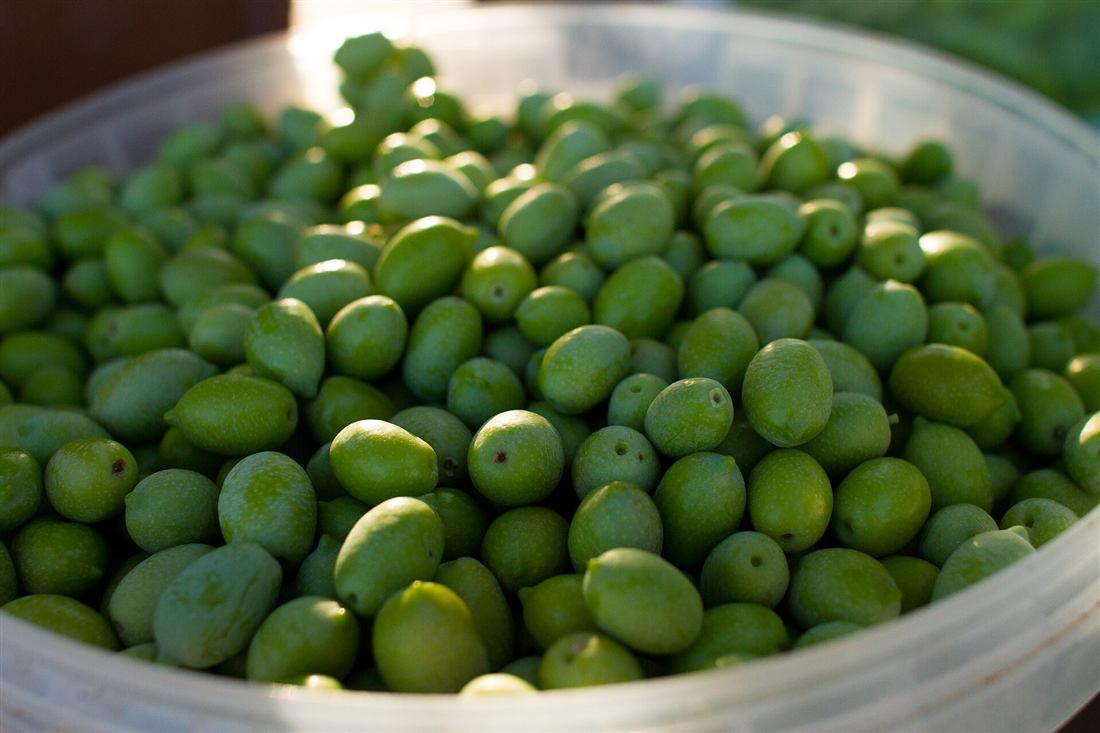
The Chalkidiki olive is a large green table variety protected as Prasines Elies Chalkidikis PDO, prized for crisp flesh, a small stone and a pulp-to-stone ratio near nine to one, sold whole, cracked in brine, or stuffed with almond and red pepper.
Fruit weight runs from 6 to 12 grams, with premium grades sorted at 90 to 110 fruits per kilogram and the largest calibres at 60 to 80. The stone stays slender relative to that mass, which is precisely why the variety became a pitting and stuffing olive rather than an oil olive. Skin holds firm through lye treatment and lactic fermentation, so the fruit keeps its snap after months in brine at 6 to 8 percent salt. A Halkidiki olive oil tasting is planned around it. Guests at a Halkidiki olive oil tasting meet it in the first half hour.
The protected designation covers fruit grown in the regional unit of Halkidiki plus defined zones near Thessaloniki, with the tree standing on registered parcels and the fruit harvested by hand into shallow crates. Growers pick from mid-September while the skin is still grass green, because a table olive picked at colour change bruises during processing. Roughly 40,000 tonnes of table fruit leave the region in a strong season. The Halkidiki olive oil tasting room is set up for it.
Three preparations dominate the table. Whole green olives in brine, debittered by the Spanish-style lye method and fermented for four to six months. Cracked olives, tsakistes, split with a wooden mallet and steeped in water changed daily for eight to ten days, then held in brine with lemon, garlic and fennel. Stuffed olives, pitted mechanically and filled with almond, red pepper paste, garlic clove or orange peel. The Halkidiki olive oil tasting timetable is built on it.
Confusion between the table fruit and the oil fruit is the point most seminars address first. The Chalkidiki variety yields only 15 to 18 percent oil against 22 to 27 percent for Koroneiki, and its oil profile leans grassy and mild with lower polyphenol counts. Growers press it from windfalls, from fruit rejected at the sorting line for calibre or blemish, and from designated oil blocks rather than from the crates bound for the packing plant. It decides which Halkidiki olive oil tasting to take.
That economic split shapes every grove in the region. A hectare of table trees returns three to five times the gross value of a hectare of oil trees, so the best-drained, most accessible parcels go to the table crop and the steeper, stonier ground carries the oil varieties. Tastings walk both blocks in sequence, which makes the contrast in canopy shape, spacing and fruit load visible within a single 300-metre loop. A Halkidiki olive oil tasting fills first on that count in August.
Which olive varieties go into the oil poured at a Halkidiki olive oil tasting?
Three cultivars supply the bottles: Chalkidiki for mild grassy oils, Koroneiki for high-polyphenol intensity, and Adramytini for a soft almond-toned oil. Mills sell single-variety pressings and blends, with harvest running from late October to late December depending on the cultivar.
Koroneiki carries the region’s chemistry. Fruit weighs 0.5 to 1 gram, oil yield reaches 22 to 27 percent, and early-harvest pressings in the last week of October register 400 to 700 milligrams of total polyphenols per kilogram. Those pressings taste green, peppery and astringent, with a cough-triggering finish in the throat that comes from oleocanthal. Free acidity at bottling sits at 0.15 to 0.30 percent, well below the 0.80 ceiling for extra virgin. This is what a Halkidiki olive oil tasting delivers at the bench. The Halkidiki olive oil tasting flight is set by it.
Chalkidiki-variety oil enters the flight as the mild pole. Pressed from oil-block fruit and sorting-line rejects in November, it delivers polyphenol counts of 150 to 280 milligrams per kilogram, tomato-leaf and artichoke aromatics, and a bitterness that fades within eight seconds rather than building. Cooks in Afytos and Nikiti reach for it on fish, on boiled greens and in cake batters where a Koroneiki oil overwhelms the other ingredients. A Halkidiki olive oil tasting starts with this settled.
Adramytini, the cultivar carried across from the Ayvalik coast by refugee families after the population exchange, holds ground around Ierissos and the Athos side. Harvest falls in the middle of November. The oil shows almond, banana skin and a rounded mouthfeel with polyphenols near 200 milligrams per kilogram, and it oxidises faster than Koroneiki, so producers bottle it in dark glass and label a 14-month best-before rather than 18. That detail shapes a Halkidiki olive oil tasting from the first glass.
Blending happens for economic and sensory reasons alike. A 70 percent Chalkidiki and 30 percent Koroneiki blend lands at 250 to 300 milligrams per kilogram, which clears the European health claim threshold for hydroxytyrosol derivatives at 5 milligrams per 20 grams of oil while staying palatable to buyers who dislike heavy bitterness. Every serious Halkidiki olive oil tasting pours the blend between the two single-variety extremes to demonstrate the arithmetic on the palate. The Halkidiki olive oil tasting price reflects it.
Chemistry sheets sit on the table beside the glasses. Peroxide value under 10 milliequivalents of oxygen per kilogram, K232 under 2.50, K270 under 0.22, and the polyphenol figure from an HPLC laboratory in Thessaloniki or Athens. Guides explain that polyphenols fall by 30 to 50 percent over eighteen months in the bottle, which is why the harvest date printed on the back label carries more weight than the best-before date. The Halkidiki olive oil tasting season turns on this.
How is a professional Halkidiki olive oil tasting actually conducted?
Tasters use a cobalt blue tulip glass that masks colour, warm 15 millilitres in the palm to 28 degrees, sniff under a watch glass, then draw the oil across the palate with a sharp aerating slurp, scoring fruity, bitter and pungent intensities before naming defects.
The blue glass exists to remove bias. Colour tells nothing reliable about quality, since a deep green oil merely carries more chlorophyll from leaves in the crush while a pale gold oil from ripe fruit performs identically in the laboratory. The vessel holds a narrow rim and a wide bowl, standardised by the International Olive Council, and a watch glass sits on top to trap volatiles while the sample warms between two cupped hands for 30 seconds. The Halkidiki olive oil tasting room is set up for it. A Halkidiki olive oil tasting keeps the glasses for it.
Aroma assessment comes next. The lid lifts, three short sniffs follow, and the taster records descriptors: cut grass, green tomato, artichoke, almond, apple, banana, fig leaf. Warming to 28 degrees releases the light aldehydes and hexenals responsible for those notes, which stay locked at room temperature. Panels break for 60 seconds between samples and cleanse with green apple and sparkling water to reset the receptors before the next glass. The Halkidiki olive oil tasting timetable is built on it.
The slurp, strappaggio in the Italian panel vocabulary, is the technical core. The taster takes a small sip, holds it at the front of the mouth, then draws air through clenched teeth in short bursts so the oil emulsifies and volatiles travel retronasally to the olfactory bulb. Bitterness registers on the back and sides of the tongue within four seconds. Pungency arrives later, as a burn in the throat, and prompts the involuntary cough that marks a high-oleocanthal oil. It decides which Halkidiki olive oil tasting to take.
Scoring uses a ten-centimetre intensity scale for each attribute. An extra virgin requires a fruity median above zero and a defect median of exactly zero, judged by a panel of eight trained tasters whose results are statistically checked for robust coefficient of variation. Commercial categories follow: robust oils score above six for bitterness and pungency, medium three to six, delicate below three. Visitors mark identical sheets at a Halkidiki olive oil tasting and compare their scores against the panel result. A Halkidiki olive oil tasting fills first on that count in August.
Sequence discipline governs the flight. Mild before intense, filtered before unfiltered, current harvest before the previous one, and no more than six samples before palate fatigue distorts everything after. Coffee, mint, perfume and smoking are excluded for one hour beforehand. Sessions run in the morning, between 10:00 and 12:30, because sensory acuity drops measurably after a heavy lunch and the mills prefer visitors before the afternoon delivery rush. Guests at a Halkidiki olive oil tasting meet it in the first half hour.
What defects does a taster learn to identify in the glass?
Four faults dominate: fusty from fruit heaped before crushing, musty from damp mouldy storage, winey-vinegary from fermentation, and rancid from oxidation. Muddy sediment adds a fifth. A defect median above zero strips an oil of extra virgin status regardless of its laboratory figures.
Fusty, atrojado in the trade, develops when harvested fruit sits in piles or sacks for two to four days before pressing. Anaerobic fermentation sets in at the centre of the heap, temperatures climb, and the resulting oil smells of sweaty cheese, damp sock and overripe fruit. Mills in Metaggitsi and Nikiti counter it by crushing within eight to twenty-four hours of picking and by storing fruit in ventilated plastic crates 40 centimetres deep. A Halkidiki olive oil tasting starts with this settled. The mill confirms it when a Halkidiki olive oil tasting is booked.
Musty-humid arises from mould on fruit held in humid conditions, and the nose reads cellar, mushroom and wet cardboard. Winey-vinegary comes from acetic and ethyl acetate formation during fermentation, giving a sharp nail-polish edge that most novices detect faster than the subtler faults. Frostbitten oil, from fruit caught by a hard freeze on the tree before picking, shows a wet-wood note and appears after cold December nights in the Holomontas foothills. That detail shapes a Halkidiki olive oil tasting from the first glass.
Rancidity is the fault every consumer meets at home. Oxidation breaks unsaturated fatty acids into aldehydes and ketones, producing the smell of crayons, old walnuts, putty and stale nuts. Light, heat and oxygen drive it, which explains dark glass, filled headspace and storage below 18 degrees away from the stove. An oil left in a clear bottle on a sunny windowsill for three months turns measurably rancid even if it left the mill at 0.18 percent acidity. The Halkidiki olive oil tasting price reflects it.
Muddy sediment develops in unfiltered oil where fine solids and residual vegetation water settle at the bottom of the tank and ferment over two to four months. Producers who sell unfiltered bottles for their cloudy appearance and green intensity accept a shorter shelf life, and honest labels state a nine to twelve month window. Racking the oil off its lees three times through the winter reduces the risk substantially. The Halkidiki olive oil tasting season turns on this.
Practice samples make the lesson concrete. Mills keep spiked reference oils in sealed vials so visitors smell fusty, musty, winey and rancid in isolated, exaggerated form before returning to the clean flight. That single exercise reshapes supermarket buying more than any other part of the seminar, because the faults sit in bottles labelled extra virgin across the whole European market and go unnoticed by shoppers who never learned the vocabulary. The Halkidiki olive oil tasting flight is set by it.
What does a Halkidiki olive oil tasting cost?
A mill seminar with a guided flight runs 20 to 45 euros per person. Programmes adding a grove walk and a full meal cost 60 to 110 euros. Full-day tours departing Thessaloniki with transport, tasting and a swim stop reach 120 to 190 euros.
The entry tier, 20 to 45 euros, covers 90 minutes: the pressing floor, the equipment explanation, three to four oils in blue glasses, rusk, tomato and feta, and a 100 to 250 millilitre bottle to take away. Mills at Metaggitsi, Nikiti and Polygyros run this format twice daily from May to October at 11:00 and 17:00, with a minimum of two participants and children under twelve admitted free. The Halkidiki olive oil tasting timetable is built on it. The Halkidiki olive oil tasting hosts state this at booking.
The middle tier, 60 to 110 euros, extends to two and a half or three hours. It adds the walk through the grove with pruning and harvest demonstration, a flight of five or six oils including an early-harvest Koroneiki and an unfiltered bottling, and a seated meal of six to eight dishes cooked with the estate’s own oil. Half a litre of wine per person and a 500 millilitre bottle of oil are folded into that fare. It decides which Halkidiki olive oil tasting to take.
Full-day departures from the city sit at 120 to 190 euros. That price buys an air-conditioned minibus for eight to sixteen passengers, hotel pickup between 08:30 and 09:15, a 90 to 110 minute drive each way, the mill seminar, lunch, and two to three hours at a beach such as Kavourotrypes or Lagomandra. A guided Halkidiki day trip from Thessaloniki structured this way returns to the city by 19:30. A Halkidiki olive oil tasting fills first on that count in August.
Private bookings carry a different arithmetic. Producers quote a flat 150 to 250 euros for a group of two to four in the low season of March, April and November, which works out higher per head but secures the mill owner rather than a seasonal guide. Groups of ten or more negotiate 15 to 25 percent off the published rate, and cruise passengers arriving at Thessaloniki port book four-hour condensed versions at 95 to 130 euros. Guests at a Halkidiki olive oil tasting meet it in the first half hour.
Costs excluded from the fare are worth checking before booking. Shipping a case of six 500 millilitre bottles to Germany or the Netherlands costs 25 to 40 euros. Additional bottles at the mill sell at 9 to 18 euros for 500 millilitres of single-variety Koroneiki and 6 to 11 euros for the blend. A Halkidiki olive oil tasting rarely includes transfers from Kassandra or Sithonia hotels, priced separately at 40 to 90 euros per vehicle. A Halkidiki olive oil tasting keeps the glasses for it.
What food is served alongside the oil at the table?
The standard plate holds barley rusk, halved tomatoes, feta, cracked and stuffed Chalkidiki olives, thyme honey from Holomontas and walnuts, poured with local wine. Longer programmes finish with a cooked meal of six to eight dishes built around the estate’s own pressing.
Barley rusk, the kritharokouloura baked hard in Arnaia and Ierissos village ovens, carries the oil without adding fat or sugar. Producers sprinkle it briefly with water, crush a ripe tomato over the surface, add coarse salt and oregano, then pour 15 millilitres of oil across the top. The rusk absorbs slowly, which stretches the tasting of a single oil over two minutes and shows how bitterness softens against tomato acid and salt. That detail shapes a Halkidiki olive oil tasting from the first glass. Every Halkidiki olive oil tasting works to that rule.
Cheese comes from the immediate hinterland. Feta matured in tins for at least three months, batzos from sheep milk with its firm salted body, and the graviera and kefalotyri wheels of Arnaia, where cheesemakers work the milk of flocks grazing the Holomontas oak slopes. Fat coats the palate and blunts pungency, so guides serve cheese after the analytical flight closes rather than during it, keeping the scoring sheets uncontaminated. The Halkidiki olive oil tasting price reflects it.
Olives appear in both regional preparations. Cracked tsakistes steeped with lemon, garlic and fennel seed, and stuffed fruit filled with almond or red pepper paste, both from the same PDO Chalkidiki cultivar growing outside the window. Thyme honey harvested in July from hives moved onto the Holomontas thyme slopes goes onto walnut halves and onto plain thick yoghurt, where the resinous sweetness sits against a peppery Koroneiki oil. The Halkidiki olive oil tasting season turns on this.
Wine service reflects the peninsula’s own vineyards. Ktima Porto Carras on the Sithonia coast pours Malagousia, Assyrtiko and the red Limnio grown on 475 hectares, and Tsantali’s Metoxi vineyards on the Athos side supply Athiri and Cabernet blends. Producers pour 150 to 250 millilitres per person during the meal, and pace it after the sensory work because alcohol dulls the receptors that register bitterness and throat pungency. The Halkidiki olive oil tasting flight is set by it.
The full meal on the three-hour programmes stretches across six to eight dishes. Fava from Feneos or Santorini finished with raw oil, briam of oven-baked courgette, potato and tomato, wild greens boiled and dressed at the table, keftedes, grilled octopus, and a dessert of walnut cake or honey-soaked loukoumades. Every dish uses the same oil poured in the flight, which closes the loop between the analytical vocabulary and the kitchen. The mill confirms it when a Halkidiki olive oil tasting is booked.
When does the harvest run and how does a Halkidiki olive oil tasting change during it?
Table olives come off the trees from mid-September to mid-October. The oil harvest runs from late October into late December, mills press day and night through November, and tastings during that window pour unfiltered oil straight from the decanter at hours old.
Table picking starts first because the fruit must stay grass green. Crews of eight to fifteen pick by hand into shallow crates from mid-September, working the cooler hours from 07:00 to 13:00, and deliver to the packing plants of Nikiti, Polygyros and Gerakini within hours so lye treatment begins the same day. Wage rates and crate counts drive the pace, with a skilled picker filling 120 to 180 kilograms in a shift. It decides which Halkidiki olive oil tasting to take. A Halkidiki olive oil tasting is planned around it.
Oil harvest opens in the last days of October with early Koroneiki, picked at colour change for maximum polyphenols and minimum yield. Growers accept 14 to 16 percent oil extraction at that stage against 22 percent three weeks later, trading volume for the green intensity and 500 to 700 milligram polyphenol readings that command 16 to 18 euros per 500 millilitre bottle. Adramytini follows in mid-November, and Chalkidiki oil fruit closes the run in December. A Halkidiki olive oil tasting fills first on that count in August.
Mills switch to continuous operation once the crates arrive. Two-phase decanters in Metaggitsi and Arnaia handle one to three tonnes of fruit per hour, and lines run from 07:00 until past midnight through the first three weeks of November. The pressing floor turns loud, warm and crowded with growers waiting for their lot, and visitors watch the paste move from crusher to malaxer to decanter in a single 45-minute cycle. Guests at a Halkidiki olive oil tasting meet it in the first half hour.
Fresh oil changes what reaches the glass. Agourelaio drawn from the tank at 26 or 27 degrees, cloudy with suspended solids, tastes sharper and more astringent than the same oil filtered and rested for six weeks. Pungency provokes a genuine cough, and bitterness lingers past twenty seconds. A Halkidiki olive oil tasting in November therefore delivers the strongest sensory contrast between tank sample and bottled product. A Halkidiki olive oil tasting keeps the glasses for it.
Practical conditions shift too. Sea temperature off Sithonia holds at 19 to 20 degrees through early November, coastal hotels in Kassandra begin closing after 25 October, and mill owners run tastings around the crush schedule rather than at fixed hours, so bookings are confirmed 48 hours ahead. Prices hold steady, road traffic drops sharply, and a Halkidiki olive oil tasting arranged in that month puts visitors inside a working season rather than a demonstration. The Halkidiki olive oil tasting hosts state this at booking.
How is the oil actually made at a Halkidiki mill during a halkidiki olive oil tasting?
Fruit reaches the mill within four hours of picking, passes a defoliator and wash, a hammer mill crusher, then a malaxer held under 27°C for 30 to 45 minutes before a two-phase decanter centrifuge separates the oil.
The process starts on the delivery ramp, where crates of Chalkidiki and Koroneiki fruit are weighed and tipped into a hopper. Mills around Nikiti, Ormylia and Polygyros press within four to six hours of picking because fermentation begins in a stacked crate at 18°C the same afternoon. The defoliator blows out leaves and twigs, and a water bath removes dust, grit and the residue of the nets laid under the trees. The Halkidiki olive oil tasting price reflects it. This is what a Halkidiki olive oil tasting delivers at the bench.
Crushing happens in a stainless hammer mill turning at 2,800 to 3,000 rpm, driving the fruit and stone against a grid of 5 to 7 mm holes. The paste that drops out is warm to the touch and green-grey. Older mills on the Kassandra peninsula still hold granite wheels for demonstration, and hosts run them for ten minutes during a tasting so visitors compare the coarse stone paste against the hammer mill output side by side. The Halkidiki olive oil tasting season turns on this.
The malaxer is the stage that decides quality. Ribbon paddles turn the paste slowly in a jacketed trough while water circulating at 24 to 26°C keeps the mass under the 27°C threshold that the cold extraction rule sets. Thirty minutes suits early November fruit; 45 minutes suits riper December fruit that releases oil slowly. Past 27°C the volatile aroma compounds boil off and the oxidation clock speeds up sharply. The Halkidiki olive oil tasting flight is set by it.
A two-phase Alfa Laval or Pieralisi decanter spins the paste at 3,200 rpm, throwing the pomace out and drawing the oil through the centre. A vertical separator polishes out the last water at 6,000 rpm. Oil runs out at 20 to 24°C, cloudy with fine particles, straight into a tasting glass held under the spout. That first pour, unfiltered and 15 minutes old, is the reference point of the whole visit. The mill confirms it when a Halkidiki olive oil tasting is booked.
Storage completes the chain. Mills fill stainless tanks of 1,000 to 10,000 litres, then blanket the headspace with food-grade nitrogen so no oxygen sits on the surface through the winter. Polyphenol counts of 300 to 700 mg per kilogram survive that treatment; oil left in an open plastic drum loses a third of them by March. A halkidiki olive oil tasting explains this tank room in fifteen minutes, torch in hand. Every Halkidiki olive oil tasting works to that rule.
What does the grove walk show before the tasting bench?
The grove walk shows tree spacing of six to eight metres, trunks aged 60 to 300 years, drip lines running along each row, ground cover left between rows, harvest nets folded at the trunks, and yellow fruit fly traps hanging in the canopy.
Hosts start at the edge of a block, where the geometry reads clearly. Chalkidiki table-olive trees stand six to eight metres apart on a square grid, roughly 200 to 280 trees per hectare. Koroneiki blocks planted for oil sit tighter. The spacing exists so a picking crew of four works a tree from all sides, and so November light reaches the lower branches that carry next season’s wood. A Halkidiki olive oil tasting fills first on that count in August. The Halkidiki olive oil tasting room is set up for it.
Trunks tell the age. A 60-year-old trunk stays cylindrical and smooth; a 300-year-old trunk in the groves behind Arnaia splits into three or four fused columns with a hollow core wide enough to hold a crate. Growers date them by grafting records and by the terrace walls around them. The oldest trees still crop 40 to 60 kilograms of fruit and are pruned every second winter rather than every winter. Guests at a Halkidiki olive oil tasting meet it in the first half hour.
Pruning cuts are the second lesson. The vase form keeps three or four scaffold limbs and an open centre. Guides point at a fresh cut sealed with copper paste, then at a stub cut left too long that dried back into the limb. Fruit forms on one-year-old wood, so the goal is a canopy renewing itself annually, not a dense dome. The cut brush is chipped and returned to the rows. A Halkidiki olive oil tasting keeps the glasses for it.
Water and soil come next. Black 16 mm drip lines run at tree height or on the ground, with two to four emitters per tree delivering 4 litres per hour from June to September. Between the rows, growers leave vetch, wild oat and chamomile through winter and mow in April, which holds the slope during the 400 to 600 mm of rain that falls on Sithonia between October and March. The Halkidiki olive oil tasting hosts state this at booking.
Pest control finishes the circuit. Yellow McPhail and delta traps hang on the south side of the canopy, baited with ammonium salts against Bactrocera oleae, checked weekly from July. A grower counting more than three flies per trap per day sprays a bait treatment. Nets in 6 by 12 metre panels lie folded at the trunks from late October. A halkidiki olive oil tasting that skips this walk loses the link between the field and the glass. A Halkidiki olive oil tasting is planned around it.
What is the difference between extra virgin, virgin and lampante oil?
Extra virgin holds free acidity at or under 0.8 percent with no sensory defect; virgin allows up to 2.0 percent and slight defect; lampante exceeds 2.0 percent or carries a clear defect and requires refining before any human consumption.
Free acidity measures oleic acid released when fruit cell walls break down through bruising, fly damage or delay between picking and pressing. Mill samples from Halkidiki pressed within six hours of harvest test at 0.15 to 0.35 percent. The number is chemistry, not flavour: a tasting host draws a sample, titrates it in front of the group in eight minutes, and writes the figure on the bottle label. The Halkidiki olive oil tasting season turns on this. A Halkidiki olive oil tasting starts with this settled.
Peroxide value runs parallel. It counts primary oxidation products in milliequivalents of oxygen per kilogram, capped at 20 for extra virgin. Fresh Halkidiki oil in a nitrogen-blanketed tank tests at 4 to 8. Oil sitting in a clear bottle on a shelf beside a shop window climbs past 20 within a year. Ultraviolet absorbance readings, K232 and K270, catch refined oil blended into a supposed virgin lot. The Halkidiki olive oil tasting flight is set by it.
Grade also depends on a panel. Eight trained assessors work in separate booths with cobalt-blue glasses at 28°C, scoring fusty, musty, winey, muddy and rancid defects. A single median defect above zero removes the extra virgin grade regardless of a 0.2 acidity result. That rule explains why chemistry alone never settles the question, and why the sensory hour of a halkidiki olive oil tasting matters to a buyer. The mill confirms it when a Halkidiki olive oil tasting is booked.
Supermarket bottles and mill samples diverge for structural reasons. A supermarket lot blends oils from three or four countries, sits in clear glass under 800 lux of shop lighting, and carries a best-before date 18 months out. A mill sample comes from one grove, one press date and one tank. The harvest date printed on a Halkidiki tin, not the best-before date, is the figure that predicts flavour. Every Halkidiki olive oil tasting works to that rule.
The practical takeaway travels home. Buyers learn to look for harvest year, a single origin, dark glass or tin, an acidity figure on the label, and a polyphenol count above 250 mg per kilogram. They learn to warm 15 ml in the palm, cup it, inhale, sip with air, and register the peppery throat catch of oleocanthal. Bitterness and pungency read as freshness, not fault. This is what a Halkidiki olive oil tasting delivers at the bench.
Which day tours from Thessaloniki include a halkidiki olive oil tasting?
Three programmes run regularly: a Sithonia day pairing a swim stop with a grove and mill visit, an Arnaia and Ierissos route through the Athos foothills, and a Metaggitsi mill seminar, all departing Thessaloniki between 08:00 and 09:00.
The Sithonia day covers 110 km south to Nikiti, then follows the west coast road through Neos Marmaras. The group walks a grove for 40 minutes, watches the mill floor for 30, tastes four oils across 45 minutes, and takes a swim stop of 90 minutes at Kalogria or Lagomandra before the return. Vehicles are 8-seat minivans or 19-seat minibuses, and the day closes in Thessaloniki by 19:00 or 19:30. Guests at a Halkidiki olive oil tasting meet it in the first half hour. The Halkidiki olive oil tasting timetable is built on it.
The Arnaia and Ierissos programme heads east on the Egnatia road, 95 km to Arnaia, a stone and timber village at 600 metres with a weaving tradition and terraced groves of 200-year-old trees. Lunch sits in Ierissos on the Athos border, with a view down the isthmus that Xerxes cut. The tasting runs in a family mill outside Stagira, four oils plus honey and cheese, finishing by 18:00. A Halkidiki olive oil tasting keeps the glasses for it.
The Metaggitsi seminar is the most technical option. Metaggitsi lies 15 km inland from Vourvourou, on the neck of Sithonia. The mill there runs a two-hour classroom module: acidity titration, peroxide explanation, blind tasting of three samples in blue glasses, and a defect exercise using a deliberately fusty sample. Groups run from four to sixteen people, and the format suits cooks, sommeliers and food writers. The Halkidiki olive oil tasting hosts state this at booking.
Pickups follow a fixed pattern. Central hotels around Aristotelous Square and the White Tower load between 08:00 and 08:30; airport pickups add 20 minutes. Drive time to the Kassandra neck at Nea Moudania is 55 minutes, to Nikiti 90 minutes, to Ierissos 100 minutes. Private groups set their own start, and a 07:30 departure buys an extra hour of grove time in October and November. A Halkidiki olive oil tasting is planned around it.
Prices land between 75 and 130 euros per person for a shared day with transport, tasting and guide, and 320 to 600 euros for a private vehicle of up to six. A halkidiki olive oil tasting booked as a standalone mill visit, with the traveller driving, costs 15 to 35 euros per head. Harvest season from mid-October to mid-December carries the working mill, and demand rises accordingly. The Halkidiki olive oil tasting room is set up for it.
Can a tasting combine with a beach day or a boat trip?
Yes. A 09:30 mill seminar finishes by 12:00, leaving an afternoon at Vourvourou or Kalogria, and an Athos cruise returning to Ormos Panagias at 15:00 pairs with a 16:30 tasting at a mill 20 minutes inland at Metaggitsi.
Geography makes the pairing simple. Sithonia measures 50 km from the neck at Nikiti to the tip at Kalamitsi, and the fingers sit close together by road. Nikiti to Vourvourou takes 20 minutes over the ridge, Vourvourou to Ormos Panagias 12 minutes, Nikiti to Kalogria 25 minutes. Crossing from Kassandra to Sithonia, Kallithea to Nikiti, takes 55 to 60 minutes on the coastal and inland roads. The Halkidiki olive oil tasting flight is set by it. That detail shapes a Halkidiki olive oil tasting from the first glass.
The morning slot suits the sensory work. Palates read cleanly before lunch, the mill floor sits at 18 to 20°C rather than the 33°C of a July afternoon, and the tasting room stays out of direct sun, which degrades sample oils in an open glass within 30 minutes. Hosts pour four samples at 28°C in blue glasses, and the whole exercise closes before the beach fills. The mill confirms it when a Halkidiki olive oil tasting is booked.
Boat days work in the opposite order. Cruises to the Athos peninsula leave Ormos Panagias at 10:30, run 3.5 to 4 hours along the monastery coast past Simonopetra and Dionysiou, and dock again by 15:00. Travellers comparing schedules for Halkidiki boat tours build the tasting into the late slot, when the mill runs its second pressing shift of the day. Every Halkidiki olive oil tasting works to that rule.
Vourvourou adds a second water option. Diporto and the nine islets off the bay sit 15 minutes by small boat, Karydi beach with its wind-shaped rocks lies at the south end of the bay, and the shallow water holds 26 to 27°C through August. Kalogria, on the west coast below Nikiti, offers pine shade to the waterline and a 400-metre sand arc facing the Toroneos gulf sunset. This is what a Halkidiki olive oil tasting delivers at the bench.
Timing discipline holds the day together. A grove walk in July runs before 11:00 or after 18:00, because ground temperature between the rows reaches 38°C at midday. In late October the schedule inverts: the sea holds 21°C, the swim shortens to 30 minutes, and the mill runs full shifts, so the halkidiki olive oil tasting expands to three hours with the press in continuous operation. A Halkidiki olive oil tasting starts with this settled.
Who does a halkidiki olive oil tasting suit best?
It suits couples on a slow Sithonia week, food travellers tracking single-origin producers, families with children over eight, private groups of six to twenty on mill seminars, home cooks buying at the door, and cruise passengers holding a nine-hour Thessaloniki call.
Couples take the two-hour format: grove walk, press room, four samples, bread, table olives and a glass of Assyrtiko or local Limnio. Mills near Nikiti and Ormylia run these for two people from 15 to 35 euros a head with 48 hours notice. The pace stays slow, the host stays at the table, and the visit fits between a late breakfast and an afternoon at Lagomandra. A Halkidiki olive oil tasting keeps the glasses for it. It decides which Halkidiki olive oil tasting to take.
Food travellers come for provenance. Halkidiki produces the large green Prasines Elies Chalkidikis under PDO protection, alongside Koroneiki grown for oil, and a single grove yields a distinct profile from one 3 km valley to the next. Buyers compare an early-harvest October oil at 600 mg polyphenols against a December oil at 280, then track the harvest date on every tin they carry home. The Halkidiki olive oil tasting hosts state this at booking.
Families work with an age line at eight. Younger children taste bread, olives and honey while the adults cup the oil, since raw oil at 28°C reads harsh to a child’s palate. Mills keep the press room behind a rail and hand out ear protection when the decanter runs at 3,200 rpm. Grove walks hold attention for 30 minutes, and net-laying demonstrations hold it longer. A Halkidiki olive oil tasting is planned around it.
Groups of six to twenty book the seminar format at Metaggitsi and Arnaia, with a titration demonstration, a blind flight of three oils and a defect sample. Active groups pair the morning seminar with an afternoon on the water, and divers arranging Halkidiki scuba diving off Sithonia keep the tasting to the non-diving day, since a strong palate exercise and a 30-metre dive sit poorly in the same six hours. The Halkidiki olive oil tasting room is set up for it.
Cruise passengers dock at Thessaloniki port with eight to ten hours ashore. Nea Moudania sits 65 km south, 55 minutes each way, which leaves four hours for a grove, a mill and lunch. Operators run 19-seat coaches on that clock and return by 16:30 for a 17:30 all-aboard. A halkidiki olive oil tasting fills that window better than a longer drive down either peninsula. The Halkidiki olive oil tasting timetable is built on it.
What do visitors buy at the mill and how does it travel home?
Mills sell 250 ml and 500 ml dark glass bottles at 8 to 18 euros, 3 and 5 litre tins at 25 to 60 euros, and vacuum-packed table olives at 4 to 10 euros, all of which travel in checked luggage only.
The 250 ml bottle serves as the tasting souvenir and the gift. The 500 ml dark glass bottle of early-harvest Koroneiki, pressed in late October and labelled with the harvest date and an acidity figure near 0.2, sits at 12 to 18 euros. The 5 litre tin, the format the local kitchens use, runs 45 to 60 euros and works out near 9 to 12 euros per litre. The mill confirms it when a Halkidiki olive oil tasting is booked. The Halkidiki olive oil tasting price reflects it.
Table olives leave alongside the oil. Prasines Elies Chalkidikis come whole, cracked, stuffed with almond or red pepper, or ladolia in oil, vacuum-sealed in 250 g to 1 kg pouches. Vacuum packing survives a hold hour at low cabin-hold pressure without leaking; a brine jar does not. Mills near Ormylia also sell olive paste, olive leaf tea, thyme honey from Athos and soap pressed from the pomace. Every Halkidiki olive oil tasting works to that rule.
Air rules decide the packing. Liquids over 100 ml stay out of hand luggage, so every bottle and tin goes into checked baggage. Thessaloniki Makedonia airport and the shops around it sell bubble film and cling wrap; mills wrap bottles on request. A 5 litre tin weighs 4.6 kilograms and eats a quarter of a 23 kg allowance. Two 500 ml bottles inside shoes and a sealed bag survive most handling. This is what a Halkidiki olive oil tasting delivers at the bench.
Customs limits stay generous for personal quantities inside the European Union. Travellers to the United Kingdom and the United States carry oil and sealed olives without duty at personal volumes, declaring food on the arrival form where required. Couriers ship 5 to 20 litre orders from Nikiti and Polygyros to European addresses for 25 to 60 euros, arriving within five to eight working days. A Halkidiki olive oil tasting starts with this settled.
Storage advice closes the sale. Dark glass or tin, a cupboard at 14 to 18°C away from the cooker, a tight cap after every pour, and use within 12 to 18 months of the harvest date. Refrigeration clouds the oil without harming it. A halkidiki olive oil tasting sends buyers home knowing that heat, light and oxygen, not time alone, are what strip out the polyphenols. That detail shapes a Halkidiki olive oil tasting from the first glass.
How does a halkidiki olive oil tasting get booked, and what are the policies?
Bookings run two to five days ahead from June to September and seven days ahead in the October to December harvest, with group minimums of two to four, free cancellation to 24 hours before start, and tastings hosted in Greek, English and German.
Lead time follows the season. July and August fill the Sithonia and Kassandra mills with hotel guests, so a Saturday morning slot books out two to three days ahead. The harvest window from mid-October to mid-December brings working presses and food groups, and a week of notice secures the seminar format. January to March runs on request, with mills opening for four or more people. The Halkidiki olive oil tasting hosts state this at booking. A Halkidiki olive oil tasting fills first on that count in August.
Minimums protect the format. A grove and press visit runs from two people; a full seminar with titration and blind flight needs four. Where a booking falls short, mills merge it with another party or move the date. Maximum group size sits at sixteen for the classroom seminar and 24 for the walk-and-taste, above which hosts split the party and run two rotations of 45 minutes. A Halkidiki olive oil tasting is planned around it.
Cancellation follows the standard tour policy: free to 24 hours before the start time, full charge inside that window, full refund where the mill cancels for a power failure or a harvest surge. Rain rarely cancels anything, since the press room and tasting table sit indoors, though a grove walk on wet clay at Arnaia shortens to fifteen minutes. Reschedules inside the same week carry no fee. The Halkidiki olive oil tasting room is set up for it.
Language coverage is broad. Greek and English run as standard at every mill from Nikiti to Ierissos. German comes with notice at the larger operations around Nea Moudania, and Bulgarian, Serbian and Romanian appear on request in summer, reflecting the drive market crossing at Promachonas and Kulata. Written tasting notes come in English, and the technical vocabulary is translated on the sheet. The Halkidiki olive oil tasting timetable is built on it.
Access and diet get handled at booking. Mill floors are poured concrete at ground level, and the tasting rooms at Metaggitsi and Ormylia admit wheelchairs, while grove terraces at Arnaia hold loose stone and a 10 percent slope. Gluten-free bread, nut allergies, vegan accompaniments and no-alcohol pairings are noted on the reservation form, and a halkidiki olive oil tasting adjusts the food board accordingly. It decides which Halkidiki olive oil tasting to take.
What do visitors wear and bring, and what does the host supply?
Visitors wear closed shoes for the grove, a hat and one litre of water in summer, and a jacket for the November mill floor, and arrive without perfume. Hosts supply glasses, apple slices, water, bread, written notes and a certificate.
Footwear matters on the terraces. Grove soil holds loose limestone, irrigation lines and pruning stubs at ankle height, and net panels lie folded across the rows from late October. Closed trainers or light boots handle all of it; sandals do not. The mill floor stays wet with wash water and paste, and a rubber sole with tread beats a smooth one on the tiles beside the decanter. Every Halkidiki olive oil tasting works to that rule. The Halkidiki olive oil tasting season turns on this.
Summer clothing follows the July and August heat, which reaches 33 to 36°C inland at Metaggitsi and Polygyros. A brimmed hat, sunglasses, a long-sleeved cotton shirt and one litre of water per person cover a 40-minute grove walk. From late October the numbers invert: the press room sits at 14 to 17°C with open doors and running water, so a fleece or light jacket makes the 90-minute mill segment comfortable. This is what a Halkidiki olive oil tasting delivers at the bench.
Scent discipline is the one strict rule. Perfume, aftershave, scented sunscreen and hand cream carry into the glass and wreck the aroma reading for the whole table, since assessors work with volatiles measured in parts per billion. Hosts ask groups to skip fragrance on the morning of the visit and to avoid coffee, mint gum and cigarettes in the 30 minutes before the first pour. A Halkidiki olive oil tasting starts with this settled.
The host supplies the technical kit. Cobalt-blue tasting glasses with watch-glass covers, warmed to 28°C on a heating block, hide colour so judgement rests on aroma and taste. Green apple slices and still water at room temperature reset the palate between samples. Plain bread arrives for the accompaniment stage, after the blind flight, alongside Chalkidiki table olives, feta from Serres and thyme honey. That detail shapes a Halkidiki olive oil tasting from the first glass.
Paperwork travels home with the oil. Hosts hand out a scoring sheet listing fruitiness, bitterness and pungency on a ten-point scale, the acidity and polyphenol figures for each sample, and the harvest date of the tank. Seminar formats at Metaggitsi and Arnaia add a signed certificate of attendance. A halkidiki olive oil tasting closes at the shop counter, where the sampled tank fills the bottles directly. The Halkidiki olive oil tasting price reflects it.
Frequently Asked Questions
What does a Halkidiki olive oil tasting cost?
From 20 to 45 euros per person for the seminar and tasting at the mill, 60 to 110 euros for the versions with a grove walk and a full meal, and 120 to 190 euros for the day tours from Thessaloniki with transport and a swim stop.
Where can you taste olive oil in Halkidiki?
At Metaggitsi in the Sithonia hinterland, at Afytos and across Kassandra, at Arnaia and Ierissos on the Athos side, and at mills around Vourvourou, Nikiti and Polygyros, 45 to 110 minutes from Thessaloniki.
How is olive oil tasted properly?
From a blue tulip glass that hides the colour: the oil is warmed in the palm, sniffed under a cover, then drawn across the palate with air. Tasters score fruity, bitter and pungent, and name any defect.