
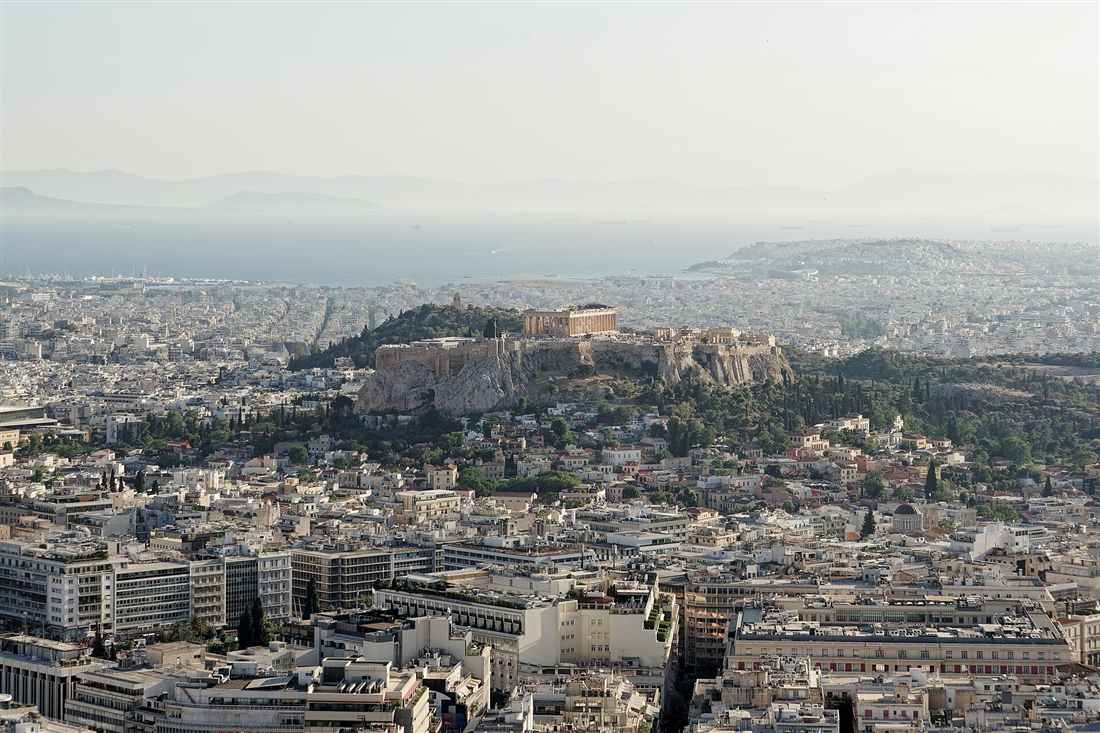
An Athens helicopter tour is a twenty to fifty minute sightseeing flight over the Acropolis, Lycabettus Hill, the port of Piraeus and the coastline of the Athens Riviera, flown in a Bell 206, Bell 407 or Bell 505 with four to six passenger seats. Plan the rest of the trip with Greece Tours.
This guide covers the whole range: what each flight length reaches, the aircraft and their seat counts, the route over the ancient city and down the coast to Cape Sounion, the one-way transfer flights to Mykonos, Santorini and the other islands, the price ranges, the weight and luggage limits, the light and the timing, and how far ahead to book.
What is an Athens helicopter tour and what does the flight cover?
An Athens helicopter tour is a private sightseeing flight that lifts off from the coast south of the city and traces the capital’s landmarks from the air — the Acropolis, Lycabettus Hill, the Panathenaic Stadium, Piraeus port and the Riviera shoreline — inside twenty to fifty minutes.
Summer haze moves an Athens helicopter tour to the first or last slot of the day. An Athens helicopter tour lifts off for twenty, thirty or fifty minutes in the air. Every departure runs as a closed charter. One booking party fills the cabin, the pilot flies with that group alone on board, and no stranger joins the flight. Athens air traffic control clears a fixed sightseeing corridor before start-up, and the aircraft holds an altitude that keeps the archaeological core in clean view while it respects the noise ceiling written over the historic centre and the residential districts beneath the route.
Booking an Athens helicopter tour ahead secures the aircraft and the hour you want. An Athens helicopter tour reads the ancient city and the modern one in one pass. Coverage widens with duration rather than with aircraft type. The short flights concentrate on the port, the western bays and the ancient core. The long flight adds the entire Riviera run and the marble headland at Cape Sounion. A transfer flight drops sightseeing altogether and carries passengers straight across the Aegean to an island helipad, which turns the same machine into a point-to-point air taxi.
Cruise passengers fit an Athens helicopter tour inside a single day in port. Luggage on an Athens helicopter tour is capped by weight and by the size of the hold. The flight reads the city as one connected map. Passengers watch the Sacred Rock, the harbour basins, the coastal strip and the mountain wall of Hymettus and Parnitha resolve into a single frame that no ground viewpoint delivers. Travellers assembling a wider itinerary start from our complete Athens travel guide and drop the flight into a half day with hours to spare on either side.
What flight lengths are on offer and what does each one reach?
Three sightseeing lengths run out of Athens. The twenty-minute hop covers the port and the near coast, the thirty-minute circuit adds the Acropolis and the city centre, and the fifty-minute flight extends down the Riviera to Cape Sounion and the Temple of Poseidon.
Photographers take the window seat on an Athens helicopter tour for a clean frame. The city leg of an Athens helicopter tour passes the Acropolis and the Parthenon. The twenty-minute flight is the entry option. It climbs off the coastal pad, turns north over the harbour mouth of Piraeus, crosses the container terminals and the cruise berths, then swings back along the bays of Palaio Faliro and Alimos. It suits a cruise call with a tight all-aboard time or a layover with a fixed return to the terminal.
An Athens helicopter tour is weighed at check-in, because the load sets the fuel. Business travellers use an Athens helicopter tour to reach an island the same morning. The thirty-minute circuit is the workhorse of the fleet and sells in two aircraft versions. The route pushes inland from the coast, lines up on the Acropolis, passes Lycabettus Hill and the Panathenaic Stadium, then returns over the Olympic complex and the southern suburbs. Thirty minutes buys the full landmark set with time for a second pass on the Sacred Rock.
Couples book an Athens helicopter tour for proposals and for anniversary flights. Duration is measured from lift-off to touchdown, and the coastal pad position means almost none of it is spent in transit. A thirty-minute booking delivers close to twenty-eight minutes of landmarks, which is the figure to compare against tour products elsewhere that count taxi time and a long outbound leg inside the same headline number.
An Athens helicopter tour is rescheduled rather than flown when the cloud base drops. The fifty-minute flight adds the whole southern coastline. After the city circuit the pilot turns south, runs the beach chain at low cruise, rounds the cliffs at Sounion for the temple, and returns over the open water of the Saronic Gulf. Photographers and honeymoon couples book this length because the light on the return leg falls across the sea.
Which helicopter types fly these routes and what is the passenger capacity of each?
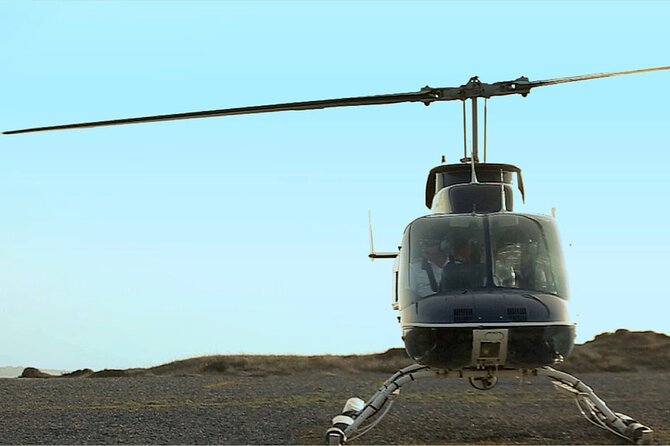
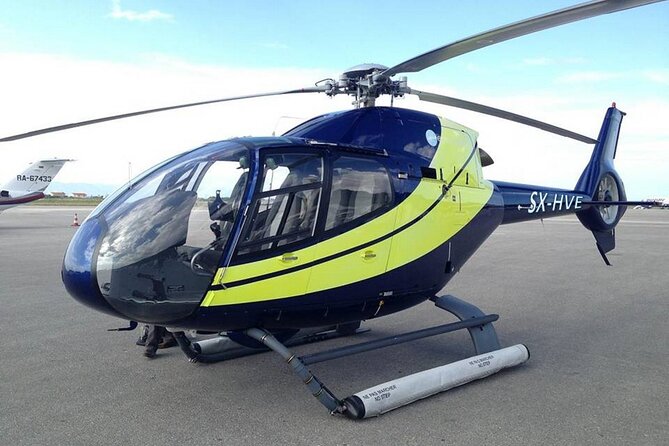
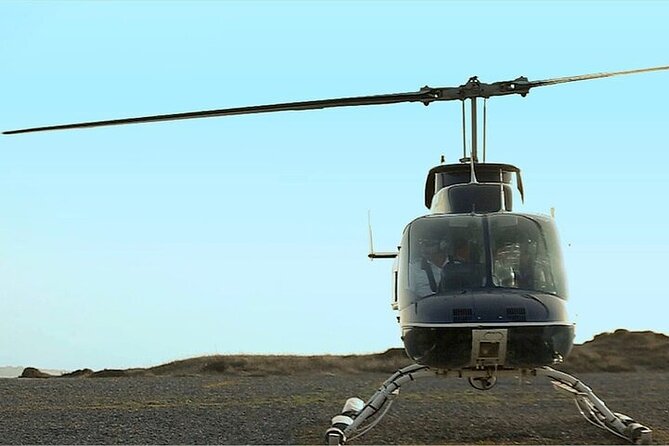
Four families work the Athens routes. The Bell 206 JetRanger carries four passengers, the Bell 407 carries six, the Bell 505 Jet Ranger X carries four, and the Airbus fleet fields the single-engine H125 for five and the twin-engine H135 for six.
Summer haze moves an Athens helicopter tour to the first or last slot of the day. Lycabettus Hill and the Panathenaic Stadium fall under an Athens helicopter tour early in the route. The Bell 206 is the light option and the cheapest way into the air. Its cabin seats two in front beside the pilot and two behind, and the smaller airframe books faster on short notice because operators hold more of them on the coastal pads. Families of three and couples travelling with a photographer fit it without a weight problem.
Booking an Athens helicopter tour ahead secures the aircraft and the hour you want. An Athens helicopter tour lifts off for twenty, thirty or fifty minutes in the air. The Bell 407 is the six-seat machine and the one that carries a full group in a single lift. A wider cabin, four large windows in the rear compartment and a stronger climb rate make it the choice for a party of five or six who refuse to split across two departures. The rear bench holds three abreast.
An Athens helicopter tour reads the ancient city and the modern one in one pass. Turbine power is the common thread across the fleet. Each of these types runs a single or twin turboshaft engine rather than a piston engine, which delivers a smoother cabin, a quieter cruise under the headset and a reserve of power for a hot summer departure off a sea-level pad with a full load of passengers aboard.
Luggage on an Athens helicopter tour is capped by weight and by the size of the hold. The Bell 505 Jet Ranger X is the newest airframe on the list, built with a flat cabin floor, a glass cockpit and panoramic side glass that runs deep toward the skids. It flies as a private charter only. The Airbus H125 handles hot-and-high work along the mountain edge, and the twin-engine H135 covers long overwater legs to the far islands.
Where do the flights depart from and what is the transfer from central Athens?
Sightseeing departures leave from the coastal helipads in the Piraeus and Alimos zone, south-west of the centre. The drive from Syntagma runs twenty-five to forty minutes in traffic, and the run from Athens International Airport takes fifty to sixty-five minutes across the Attiki Odos.
Couples book an Athens helicopter tour for proposals and for anniversary flights. The coastal leg of an Athens helicopter tour follows the Riviera past Glyfada and Vouliagmeni. The coastal position exists for a reason. A pad on the water clears the departure straight over the sea, which keeps the climb outside the built-up corridors and gets the aircraft into the sightseeing track within two minutes of lift-off. Passengers gain flight minutes over the city rather than losing them to a long transit from an inland field.
An Athens helicopter tour is rescheduled rather than flown when the cloud base drops. The city leg of an Athens helicopter tour passes the Acropolis and the Parthenon. Check-in opens twenty to thirty minutes before the slot. Ground staff weigh the party, run the safety brief, fit the headsets and walk the group to the aircraft with the rotors already turning on the shorter turnarounds. Late arrival shortens the flight rather than delaying it, because the slot sits inside a controlled sequence held by the tower.
Photographers take the window seat on an Athens helicopter tour for a clean frame. Business travellers use an Athens helicopter tour to reach an island the same morning. Road transfer to the pad is arranged separately from the flight. Operators quote a private car from the hotel, and passengers landing the same morning combine the pad run with our Athens airport transfer service so the luggage travels to the hotel while the party heads straight for the coast.
What does the Acropolis and Parthenon leg look like from the air?
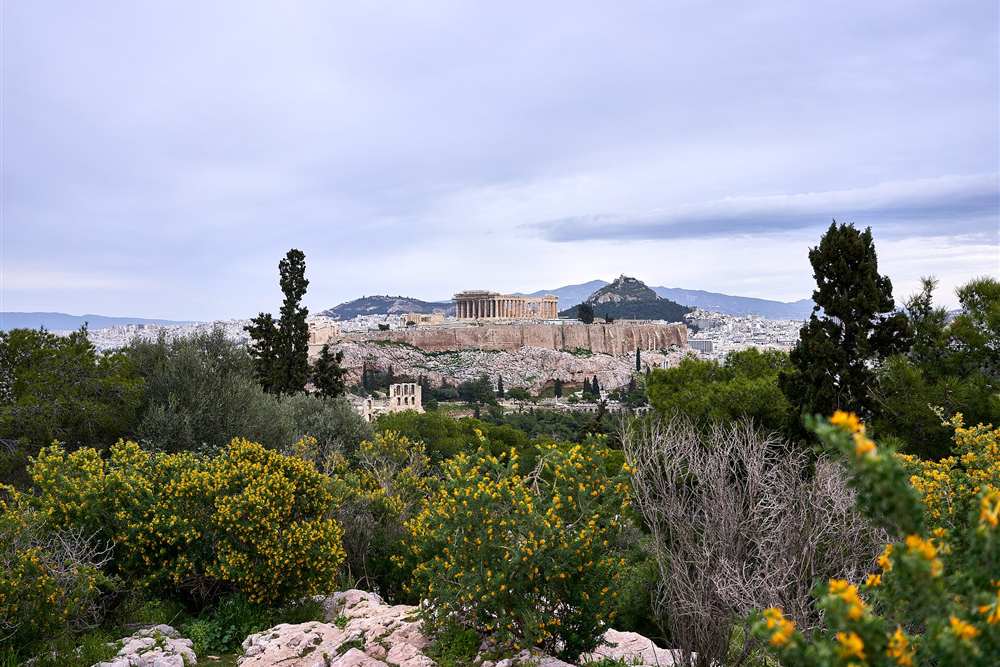
The Acropolis leg passes the Sacred Rock at a controlled offset, so the Parthenon, the Erechtheion, the Propylaia and the Temple of Athena Nike appear as one plan on the limestone plateau, with the Odeon of Herodes Atticus cut into the southern slope beneath them.
An Athens helicopter tour reads the ancient city and the modern one in one pass. The long format of an Athens helicopter tour reaches Cape Sounion and the Temple of Poseidon. Height changes the reading of the monument entirely. From the ground a visitor sees columns; from the air the same visitor sees the geometry — the axis of the Parthenon, the stepped platform, the odd asymmetry of the Erechtheion porch, and the scar of the ancient processional route running down toward the Agora and the Kerameikos cemetery.
Luggage on an Athens helicopter tour is capped by weight and by the size of the hold. Lycabettus Hill and the Panathenaic Stadium fall under an Athens helicopter tour early in the route. Flight rules keep the aircraft clear of the archaeological perimeter, so the pilot lines up a lateral pass instead of a direct overflight. That offset is an advantage for photography. A side angle throws the columns into relief against the marble platform, while a vertical shot flattens the whole hill into a grey outline with no depth at all.
Summer haze moves an Athens helicopter tour to the first or last slot of the day. An Athens helicopter tour lifts off for twenty, thirty or fifty minutes in the air. The pilot narrates the pass over the intercom and names the buildings as they cross the window. Readers who want the monument’s full sequence of construction, siege, conversion and restoration find it laid out in our history of the Acropolis before they climb aboard.
Which other landmarks fill the city circuit?
The city circuit strings together Lycabettus Hill, the Panathenaic Stadium in white Pentelic marble, the Temple of Olympian Zeus, the Zappeion and the National Garden, Syntagma Square with the Parliament building, and the Olympic complex at Maroussi with its steel roof arches.
Business travellers use an Athens helicopter tour to reach an island the same morning. The Bell 407 on an Athens helicopter tour carries six passengers, the Bell 206 four. Lycabettus rises as a sharp cone straight out of the apartment grid, and the chapel of Saint George on its summit marks the highest natural point inside the city. From the air the hill loses the illusion of remoteness it holds at street level and reveals itself as a small green island surrounded on every side by Kolonaki rooftops.
Couples book an Athens helicopter tour for proposals and for anniversary flights. The coastal leg of an Athens helicopter tour follows the Riviera past Glyfada and Vouliagmeni. The Panathenaic Stadium reads as a perfect horseshoe of marble tiers, the only stadium on earth built entirely from the material, restored on the footprint of the ancient running track and used for the first modern Olympic Games. Next to it the Zappeion sits inside its arc of gardens, and the columns of the Temple of Olympian Zeus stand in an open field.
An Athens helicopter tour is rescheduled rather than flown when the cloud base drops. The city leg of an Athens helicopter tour passes the Acropolis and the Parthenon. North of the centre the Olympic complex spreads across Maroussi, where the tension roof over the main stadium curves in two white steel arches visible from a long way out. The circuit closes over the dense grid of the western suburbs, with Mount Parnitha filling the horizon and the Attica basin laid out edge to edge.
What does the Athens Riviera coastal leg cover?
The coastal leg runs the shoreline south from Alimos through Glyfada, Voula, Kavouri and Vouliagmeni to Varkiza. Marinas, the pine headlands, the deep-blue circle of Lake Vouliagmeni and the sand crescents of the peninsula pass under the aircraft in a continuous ribbon.
An Athens helicopter tour lifts off for twenty, thirty or fifty minutes in the air. A private Athens helicopter tour is chartered whole, so the cabin belongs to your party. Glyfada opens the run with its marina, its golf course and the long grid of shopping streets set back from the water. The old airport site beside it forms a vast flat green rectangle on the coast, now the largest coastal park in the region, with the disused runway still legible as a pale line through the middle of it.
An Athens helicopter tour reads the ancient city and the modern one in one pass. The long format of an Athens helicopter tour reaches Cape Sounion and the Temple of Poseidon. Kavouri and Vouliagmeni deliver the strongest colour on the whole flight. Pine forest runs down to rock, the water shifts from turquoise over sand to indigo over depth in the space of a few metres, and the thermal lake sits in its cliff bowl a short distance inland from the sea, fed from below by warm springs.
Luggage on an Athens helicopter tour is capped by weight and by the size of the hold. Lycabettus Hill and the Panathenaic Stadium fall under an Athens helicopter tour early in the route. Passengers who want the same coastline at ground level pair the flight with a swimming day and pick a stretch from our guide to the best beaches on the Athens Riviera. Seen from the air the whole strip resolves into a single decision map of bays, marinas, beach clubs and headlands.
Why does the fifty-minute flight continue to Cape Sounion and the Temple of Poseidon?
Cape Sounion sits sixty-nine kilometres from the centre at the southern tip of Attica, and the Temple of Poseidon stands on the cliff edge above a sheer drop to the sea. The helicopter reaches it in fifteen minutes against a road drive of ninety minutes each way.
The city leg of an Athens helicopter tour passes the Acropolis and the Parthenon. The price of an Athens helicopter tour tracks the aircraft type and the minutes flown. The temple keeps fifteen of its original Doric columns standing on a promontory that falls away on three sides. From the air the setting explains itself instantly: the sanctuary was raised as a marker for sailors, and the white marble catches light against the dark rock long before a ship rounded the headland. No ground photograph carries that geometry.
Business travellers use an Athens helicopter tour to reach an island the same morning. The Bell 407 on an Athens helicopter tour carries six passengers, the Bell 206 four. The approach crosses the mining coast at Lavrio, the offshore islet of Patroklos and the strait toward Kea. On a clear afternoon the outline of Kea, Kythnos and the northern Cyclades stacks up on the horizon, which turns the leg into a preview of the island chain rather than a simple out-and-back run down the coast.
Couples book an Athens helicopter tour for proposals and for anniversary flights. The coastal leg of an Athens helicopter tour follows the Riviera past Glyfada and Vouliagmeni. Travellers who prefer the temple at sunset with time on the ground book the road version instead, our Cape Sounion sunset half-day trip, and keep the helicopter for the city circuit. The two formats answer different questions: the flight delivers the setting, the drive delivers the site itself.
What does the leg over Piraeus port and the Saronic islands show?
The Piraeus leg crosses the largest passenger port in the Mediterranean — the ferry gates, the cruise berths, the container terminal at Neo Ikonio and the yacht basins of Zea and Mikrolimano — then opens onto the Saronic Gulf with Aegina, Agistri and Poros ahead.
Lycabettus Hill and the Panathenaic Stadium fall under an Athens helicopter tour early in the route. Morning air gives an Athens helicopter tour the steadiest ride and the clearest view. Piraeus works as a live diagram of Greek travel. Ferries fan out from the gates on the hour toward the Cyclades, the Dodecanese and Crete, and from a thousand feet the whole traffic pattern is visible at once. The ancient harbours of Zea and Mounichia hold their perfect oval shape from the classical period, ringed now by restaurants and moored sailing yachts.
An Athens helicopter tour lifts off for twenty, thirty or fifty minutes in the air. A private Athens helicopter tour is chartered whole, so the cabin belongs to your party. West of the port the Salamis strait carries its own weight of history as the water where the Greek fleet broke the Persian navy. The channel is narrow, the island sits close, and the geography of the battle becomes obvious from the air in a way that no map conveys on the page.
An Athens helicopter tour reads the ancient city and the modern one in one pass. The long format of an Athens helicopter tour reaches Cape Sounion and the Temple of Poseidon. The Saronic islands close the view to the south. Aegina shows its pistachio terraces and the columns of the Temple of Aphaia, Agistri holds a dense pine cover, and Poros faces the Peloponnese across a channel a few hundred metres wide. The same water is reachable at sea level through our Athens cruise and boat tours.
Which islands does a private helicopter transfer from Athens reach, and what are the flight times?
Private transfers depart Athens for Mykonos in fifty to fifty-five minutes, Santorini in sixty-five to seventy-five, Paros in forty-five, Sifnos in forty, Hydra in twenty-five, Spetses in thirty-five and Crete in ninety to one hundred and ten minutes.
The city leg of an Athens helicopter tour passes the Acropolis and the Parthenon. The port of Piraeus and the Saronic islands open out on an Athens helicopter tour. The transfer product carries no sightseeing route. The aircraft lifts from the Athens pad, climbs on course, crosses the Aegean at cruise altitude and lands at the destination helipad or airport apron. Ground handling meets the aircraft on arrival, and the party is in a car within minutes of shutdown rather than queueing through a terminal building.
Business travellers use an Athens helicopter tour to reach an island the same morning. The price of an Athens helicopter tour tracks the aircraft type and the minutes flown. Island infrastructure sets the arrival point. Mykonos, Santorini, Paros and Crete accept helicopters at their airports. Hydra, Spetses and Sifnos work from dedicated helipads close to the harbour, which cuts the road leg on the far end to near zero. Operators confirm the exact landing point at booking, since a private pad requires a permission filed in advance.
The Bell 407 on an Athens helicopter tour carries six passengers, the Bell 206 four. The crossing itself doubles as scenery at no extra cost. A Mykonos leg tracks over Kea, Kythnos and Syros, and a Santorini leg passes Naxos, Paros and Ios on the way south. Passengers watch the Cycladic chain assemble beneath the aircraft, which turns a transfer sector into a survey of the archipelago rather than an hour of blank water.
The coastal leg of an Athens helicopter tour follows the Riviera past Glyfada and Vouliagmeni. One-way legs are the standard sale. A party flies out to the island at the start of a holiday and returns by ferry or scheduled flight, or reverses that order to protect a tight connection at the end of a trip. Multi-island routing runs on the same aircraft, with an island-to-island leg priced as its own sector.
How does a helicopter transfer compare with the ferry and the scheduled flight?
A helicopter to Mykonos takes fifty-five minutes door to door against five hours by fast ferry and three hours by scheduled flight once check-in, security and both road legs are counted. The trade is time and luggage allowance against a much higher fare.
The long format of an Athens helicopter tour reaches Cape Sounion and the Temple of Poseidon. The transfer version of an Athens helicopter tour flies on to Mykonos, Santorini or Crete. The ferry wins on price and loses on rigidity. A sailing leaves on a published timetable from Piraeus or Rafina, the road leg to the port runs an hour in traffic, boarding closes thirty minutes ahead, and a cancelled sailing in strong meltemi wind removes the entire day. Vehicle decks and unlimited baggage remain the ferry’s real advantages.
Lycabettus Hill and the Panathenaic Stadium fall under an Athens helicopter tour early in the route. Morning air gives an Athens helicopter tour the steadiest ride and the clearest view. The scheduled flight looks fast on paper and slow in practice. Thirty-five minutes in the air sits inside a chain of airport transfer, bag drop, security, gate wait, taxi and baggage reclaim, and the aggregate rarely falls under three hours. Island airports also run short summer schedules that fill months ahead at peak dates.
An Athens helicopter tour lifts off for twenty, thirty or fifty minutes in the air. A private Athens helicopter tour is chartered whole, so the cabin belongs to your party. The helicopter compresses that chain to a car ride, a briefing and a flight. It departs on the party’s chosen hour, not the airline’s, and it lands close to the villa rather than at a terminal. The limits are hard weight caps, soft-bag-only luggage and a fare that runs into four figures for the sector.
What do the flights cost, and what drives the price?
Researched market ranges run from €600 to €900 for a twenty-minute flight, €1,000 to €1,900 for a thirty-minute circuit depending on airframe, €2,200 to €3,000 for the fifty-minute Sounion flight, and €1,800 to €8,500 for a one-way island transfer sector.
The Bell 407 on an Athens helicopter tour carries six passengers, the Bell 206 four. Every Athens helicopter tour opens with a pilot briefing and a headset check. Prices quote per aircraft, not per head, on the private products. A couple and a party of six pay the same figure for the Bell 407 circuit, so the cost per person falls sharply as the cabin fills. That single fact reshapes the decision for families and for two couples travelling together on the same dates.
The coastal leg of an Athens helicopter tour follows the Riviera past Glyfada and Vouliagmeni. The port of Piraeus and the Saronic islands open out on an Athens helicopter tour. Four inputs move the number. Airframe class comes first, since a six-seat turbine burns more fuel and carries a higher hourly rate than a light four-seater. Sector length comes second. Season comes third, with peak summer weekends priced above shoulder dates. Positioning comes fourth, because an aircraft based away from the pad charges for its repositioning legs.
The city leg of an Athens helicopter tour passes the Acropolis and the Parthenon. The price of an Athens helicopter tour tracks the aircraft type and the minutes flown. Transfer sectors follow distance. Hydra and Spetses sit at the low end of the band, Mykonos, Paros and Sifnos in the middle, Santorini above them and Crete at the top. Landing fees, handling and any overnight crew cost are stated in the quote. Confirm the final figure with the operator at booking rather than treating a published range as a fixed rate.
What separates a per-seat booking from a whole-aircraft charter?
A per-seat booking sells one place on a departure and fills the remaining seats with other travellers. A whole-aircraft charter buys the entire cabin for one party, which fixes the departure hour, the seating and the route conversation with the pilot.
A private Athens helicopter tour is chartered whole, so the cabin belongs to your party. Cruise passengers fit an Athens helicopter tour inside a single day in port. Athens sightseeing sells almost entirely as whole-aircraft charter. The operator quotes the flight, the party decides who sits where, and the aircraft departs on the booked slot regardless of whether two seats stay empty. Nobody waits for strangers to fill the cabin, and no departure collapses because a second couple cancelled the night before.
The long format of an Athens helicopter tour reaches Cape Sounion and the Temple of Poseidon. The transfer version of an Athens helicopter tour flies on to Mykonos, Santorini or Crete. Per-seat pricing appears on the longer scenic products at quiet dates and on shared island shuttle legs. It lowers the entry cost for a solo traveller or a couple, at the price of a fixed route, a fixed hour and a seat allocation decided by the weight-and-balance sheet rather than by preference.
Lycabettus Hill and the Panathenaic Stadium fall under an Athens helicopter tour early in the route. Morning air gives an Athens helicopter tour the steadiest ride and the clearest view. The arithmetic settles the choice. A thirty-minute Bell 407 circuit at the middle of its range divides to a modest figure across six passengers and to a steep one across two. Groups of four and above take the charter without hesitation; couples chasing the lowest total price look at the Bell 206 or the twenty-minute product instead.

What weight, passenger and luggage limits apply on board?
Each seat carries a declared passenger weight, and the total load is capped by the aircraft’s weight-and-balance calculation. Sightseeing flights allow a camera bag and personal items. Transfer flights allow soft bags at roughly fifteen kilograms per passenger, with no rigid suitcases.
The price of an Athens helicopter tour tracks the aircraft type and the minutes flown. An Athens helicopter tour is weighed at check-in, because the load sets the fuel. Every passenger declares an accurate weight at booking. The figure is not a formality: the pilot builds a load sheet that positions people around the aircraft’s centre of gravity, and a wrong declaration forces a re-seat on the ramp or, in the worst case, offloads a passenger. Ground staff re-weigh the party at check-in on the transfer products.
The Bell 407 on an Athens helicopter tour carries six passengers, the Bell 206 four. Every Athens helicopter tour opens with a pilot briefing and a headset check. A single passenger above one hundred and ten kilograms is accommodated by buying an extra seat or by moving up to the larger airframe. Operators state this openly and price it as a seat rather than a surcharge. The Bell 407 and the H135 absorb heavier loads than the Bell 206 because of their higher maximum take-off mass.
The coastal leg of an Athens helicopter tour follows the Riviera past Glyfada and Vouliagmeni. The port of Piraeus and the Saronic islands open out on an Athens helicopter tour. Luggage rules follow the baggage compartment shape. Soft holdalls compress into the hold; hard-shell cases do not. Island transfer passengers pack a duffel for the flight and send the rigid cases ahead by ferry freight or by car. Sports equipment, surfboards and oversized cases require written confirmation before the day of the flight.
What safety rules, licensing and briefing stand behind the flight?
Commercial helicopter operators in Greece hold an Air Operator Certificate issued by the Hellenic Civil Aviation Authority under European aviation safety rules. Pilots fly with a commercial licence and a type rating, and every passenger receives a safety briefing and an intercom headset before start-up.
Morning air gives an Athens helicopter tour the steadiest ride and the clearest view. Booking an Athens helicopter tour ahead secures the aircraft and the hour you want. The pre-flight briefing covers the same points on every operator’s pad: how to approach the aircraft from the front and never from the tail, how the harness fastens and releases, where the emergency exits sit, how the life jacket deploys on the overwater legs, and how to speak on the intercom without blocking the pilot’s radio calls.
A private Athens helicopter tour is chartered whole, so the cabin belongs to your party. Cruise passengers fit an Athens helicopter tour inside a single day in port. Maintenance runs on a scheduled programme with recorded flight hours and mandatory inspections at fixed intervals. Turbine helicopters of this class are maintained to a strict cycle, and the operator grounds an airframe rather than flying it past a due item. Insurance certificates and the operating certificate are documents a passenger can request and read.
The transfer version of an Athens helicopter tour flies on to Mykonos, Santorini or Crete. Weather is the decisive safety filter in Attica. The pilot cancels for low cloud, poor visibility or wind above the operating limit, and that decision holds even when the sky at the hotel looks clear. A cancellation for weather is not a lost booking; it is the system doing what it exists to do.
When is the best time of day to fly for light and calm air?
The first two hours after sunrise and the last two before sunset give the strongest light and the smoothest air. Morning flights hold the clearest visibility over the basin, while the late slot throws long gold light across the Acropolis marble and the Riviera water.
The port of Piraeus and the Saronic islands open out on an Athens helicopter tour. Photographers take the window seat on an Athens helicopter tour for a clean frame. Attica heats hard through the middle of the day in summer. Rising thermals over the dry hills produce mild turbulence between eleven and four, and the same heat lifts haze off the basin that softens the horizon and dulls the contrast in photographs. A midday flight still shows the whole city; it shows it through a thinner, whiter atmosphere.
The price of an Athens helicopter tour tracks the aircraft type and the minutes flown. An Athens helicopter tour is weighed at check-in, because the load sets the fuel. The sea breeze follows a daily pattern along the coast. It builds through the afternoon, peaks in the early evening and drops away after sunset. Early departures beat the breeze entirely, which matters on the coastal leg where a headwind slows the ground track and shortens the distance covered inside the booked minutes.
Every Athens helicopter tour opens with a pilot briefing and a headset check. Winter and shoulder dates reverse the advice slightly. Cool clear air after a north wind delivers visibility that summer never matches, with Aegina, the Peloponnese mountains and the Cycladic outline all sharp on one horizon. Book the late-morning slot on those dates and let the ground warm enough to clear any low cloud off the hills.
How far in advance does a booking need to be made, and what happens in bad weather?
Peak summer slots fill two to four weeks ahead, and sunset departures fill first. Shoulder-season flights confirm within a few days. Weather cancellations by the operator carry a full refund or a free reschedule, and passenger cancellations follow a tiered notice window.
The transfer version of an Athens helicopter tour flies on to Mykonos, Santorini or Crete. Summer haze moves an Athens helicopter tour to the first or last slot of the day. Lead time tracks demand rather than aircraft availability. Cruise-ship call days, public holidays and summer weekends concentrate requests into the same handful of hours, so the golden-hour slot on a Saturday in high season disappears long before a Tuesday morning slot in the same week. Island transfer sectors book earlier still, because the aircraft has to be positioned.
Morning air gives an Athens helicopter tour the steadiest ride and the clearest view. Booking an Athens helicopter tour ahead secures the aircraft and the hour you want. Cancellation terms sit in a tiered structure. Free cancellation up to twenty-four hours before departure is the common standard on the sightseeing products, tightening to seventy-two hours or a non-refundable deposit on private charter and transfer sectors where the operator has committed crew and a slot. Read the specific terms on the product page before paying.
Cruise passengers fit an Athens helicopter tour inside a single day in port. Weather decisions come from the pilot on the morning of the flight. The operator contacts the party, offers a later slot the same day, a different date or a refund, and holds the aircraft while the front passes. Build the flight into the first half of a trip rather than the last day, so a reschedule has somewhere to go.
Who does an Athens helicopter tour suit, and who is served better by a bus tour or a boat?
The flight suits marriage proposals, short layovers, cruise calls with a fixed all-aboard hour, aerial photographers, and business travellers converting dead time into sightseeing. Ground tours serve visitors who want to walk the sites, read the inscriptions and stand inside the monuments.
Every Athens helicopter tour opens with a pilot briefing and a headset check. An Athens helicopter tour is rescheduled rather than flown when the cloud base drops. Proposals and anniversaries account for a large share of the private bookings. The cabin holds one party, the pilot cuts the narration on request, and the aircraft holds a slow orbit over the chosen point while the moment happens. Operators arrange champagne on the pad after landing and coordinate quietly with a photographer on the ground.
The port of Piraeus and the Saronic islands open out on an Athens helicopter tour. Photographers take the window seat on an Athens helicopter tour for a clean frame. Cruise passengers and layover travellers buy the flight for its precision. A twenty or thirty-minute slot with a fixed car transfer either side fits inside a five-hour window in port with margin left over, and it delivers the whole city rather than one site reached through traffic. The same window by coach covers the Acropolis alone.
An Athens helicopter tour is weighed at check-in, because the load sets the fuel. The flight is a poor substitute for a site visit. It gives no inscription, no museum, no shaded walk through the Agora and no lunch in Plaka. Visitors on a first trip with a full week in the city walk the sites and add the flight as an overview. Anyone who dislikes heights or confined cabins skips it entirely.
What do passengers wear and carry on board?
Wear dark, plain clothing to cut window reflections, closed flat shoes for the ramp walk, and a light layer for the cooler cabin at altitude. Carry sunglasses, a camera and a phone on a wrist strap. Leave loose hats, scarves and long dresses behind.
Cruise passengers fit an Athens helicopter tour inside a single day in port. Luggage on an Athens helicopter tour is capped by weight and by the size of the hold. Dark colours matter more than passengers expect. A white shirt reflects off the inside of the cabin glass and prints itself across every photograph taken through that window. A navy, black or deep-green top removes the reflection completely and turns an average phone shot into a clean one. Photographers on these flights dress in black as standard practice.
The transfer version of an Athens helicopter tour flies on to Mykonos, Santorini or Crete. Summer haze moves an Athens helicopter tour to the first or last slot of the day. Footwear is a ramp rule, not a style rule. The walk to the aircraft crosses a live pad with rotor downwash, and open sandals, heels and flip-flops are refused by ground staff at the pad. Flat closed shoes handle the surface and the wind, and they hold on the step up into the cabin.
Booking an Athens helicopter tour ahead secures the aircraft and the hour you want. Loose items are a genuine hazard around a turning rotor. Hats lift off heads, scarves fly, and light stoles pull toward the disc. Stow anything loose in the cabin or in the hold before walking out. Sun cream, water and a jacket for the return car ride complete the list; nothing else needs to travel out to the pad.
What rules cover photography, window seats, children, pets and step-free access?
Photography is permitted throughout the flight with phones and cameras held inside the cabin. Window seats are allocated by the weight-and-balance sheet. Children fly with an adult and a declared weight, small pets travel in a carrier by arrangement, and step-free boarding requires advance notice.
An Athens helicopter tour is weighed at check-in, because the load sets the fuel. Couples book an Athens helicopter tour for proposals and for anniversary flights. Every passenger sits at a window in these airframes, so the real question is which window faces the landmark. Front-left beside the pilot gives the cleanest forward view and the least reflection; the rear bench in the Bell 407 gives the widest side glass. The load sheet decides the final seating, and the pilot banks the aircraft to give both sides a pass at the Acropolis.
Every Athens helicopter tour opens with a pilot briefing and a headset check. An Athens helicopter tour is rescheduled rather than flown when the cloud base drops. Windows stay closed in flight, and nothing is held outside the aircraft at any point. Drones, selfie sticks and detachable lens hoods stay in the car. Professional shoots with an open door or a removed door are a separate charter category, quoted with a harness, a briefing and a dedicated pilot rather than sold as a sightseeing flight.
Photographers take the window seat on an Athens helicopter tour for a clean frame. Children travel on a seat of their own with a declared weight, and infants are handled case by case under the operator’s rules rather than on a lap by default. Small pets in an approved carrier fly by prior arrangement on private charters. Passengers with reduced mobility board with assistance when the operator is told in advance, since the step into the cabin is high and unassisted wheelchair access to the airframe does not exist.
Frequently Asked Questions
What is the length of an Athens helicopter tour?
Twenty, thirty or fifty minutes in the air. The twenty minute flight covers the city core. The thirty minute flight adds the Riviera coast. The fifty minute flight reaches Cape Sounion and the Temple of Poseidon.
What does an Athens helicopter tour cost?
The thirty minute private flight runs from about 900 to 1,700 euros for the aircraft, and the fifty minute flight from about 1,600 to 2,800 euros. Island transfer legs price separately by distance.
What is the passenger capacity of an Athens helicopter tour?
Four passengers in the Bell 206, five in the Bell 505 and six in the Bell 407, all seated beside or behind the pilot. The operator weighs the party at check-in, because the total load sets the fuel.