
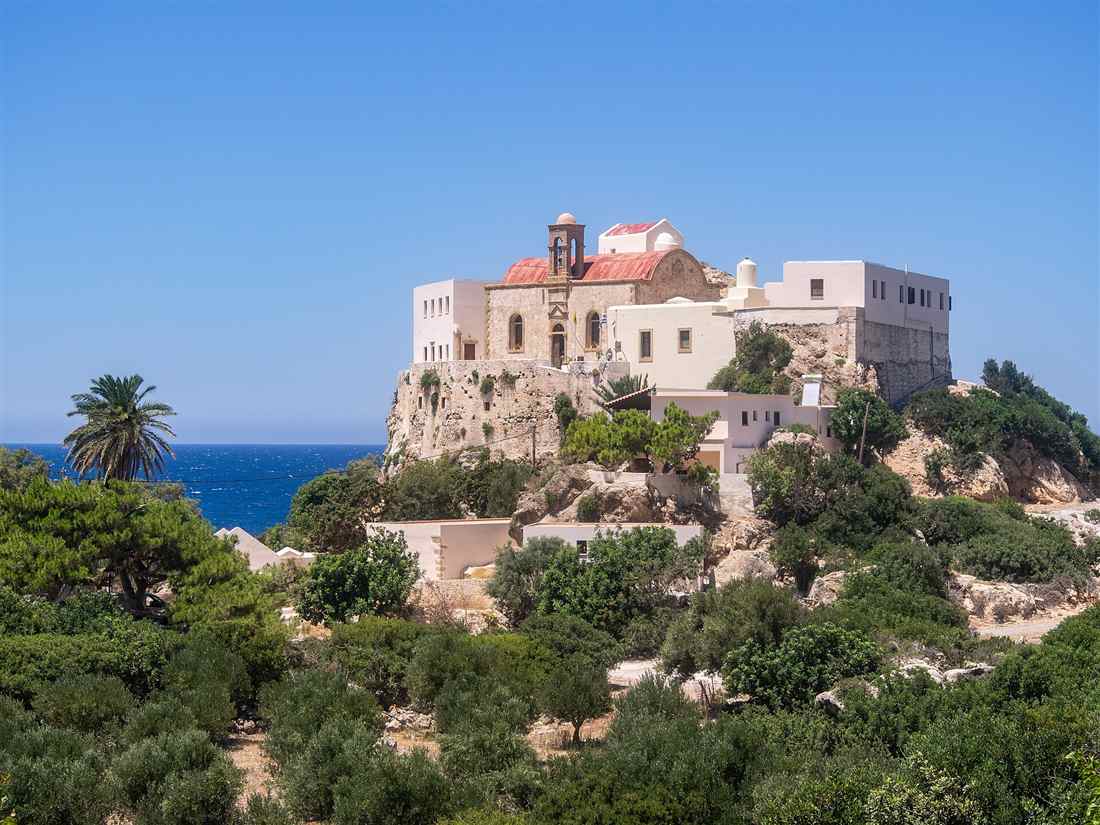
To get from Chania to Chrysoskalitissa, drive west on the national road toward Kissamos, then south through the Topolia gorge and the villages of Elos and Vathi to the south-west coast, about 75 kilometres in 1.5 to 1.75 hours, reaching the white monastery on its sea rock 5 kilometres north of Elafonisi. The trip from Chania to Chrysoskalitissa crosses the far south-west. Plan the whole trip with Greece Tours.
This guide covers the trip from Chania to Chrysoskalitissa in full: where it is, how to get there by car and by seasonal bus, the dazzling white monastery on its 35-metre rock, the 90 steps and the legend of the golden step, the visiting hours, dress and the climb, the pink-sand Elafonisi lagoon 5 kilometres south, and whether this far south-west trip is worth it.
Where is Chrysoskalitissa and how far is it from Chania?
Chrysoskalitissa Monastery stands on the far south-west coast of Crete, in the Chania regional unit, 75 kilometres from Chania town and 5 kilometres north of the Elafonisi lagoon. The white monastery crowns a 35-metre rock that rises straight from the Libyan Sea.
The Chania to Chrysoskalitissa drive rewards the effort with the sight at the end of it. Planning Chania to Chrysoskalitissa by the light and the heat makes the most of the visit. The trip from Chania to Chrysoskalitissa pairs with the sights around it on the same route. Every east-Crete itinerary that includes Chania to Chrysoskalitissa gains a memorable leg. The Chania to Chrysoskalitissa journey ends at a place that repays the distance. A car makes Chania to Chrysoskalitissa a flexible leg of a wider Crete plan. The drive from Chania to Chrysoskalitissa is a set piece of an east-Crete plan. Panagia Chrysoskalitissa, “Our Lady of the Golden Step”, sits at the south-western tip of Crete, in the Selino district of the Chania regional unit. The site faces open water on three sides, with the Libyan Sea filling the horizon to the south and the rocky headlands of the Kissamos peninsula stretching north behind it. This is the last built landmark before the island runs out into the sea, and the position gives the monastery its isolation and its light.
The 75-kilometre distance from Chania measures the full road route, not a straight line. The drive threads west along the north coast, then cuts south across the mountainous interior of the Selino region, dropping to the coast at the monastery. The straight-line distance is shorter, but the terrain of gorges and ridges forces the road into long bends, so the driving figure is the number that matters for planning a visit. Chrysoskalitissa is one of the classic day trips from Chania, paired almost always with the pink sand of Elafonisi 5 kilometres to the south.
The monastery and its immediate surroundings form a compact cluster of landmarks. Elafonisi lagoon lies 5 kilometres south, the wild cedar-backed beach of Kedrodasos sits between the two, and the villages of the Selino region \u2014 Elos, Vathi, Chrysoskalitissas hamlet \u2014 dot the valleys inland. From the courtyard on top of the rock the view runs unbroken to the Libyan Sea, with the low islet of Elafonisi picked out to the south. Placing the monastery against these fixed points makes the geography clear: a coastal shrine on a sea rock, ringed by beaches and mountain villages, at the extreme south-west corner of the largest Greek island.
How do you drive from Chania to Chrysoskalitissa?
Drive west from Chania on the national road toward Kissamos, turn south toward Elos and the Topolia gorge, and follow the mountain road through Elos and Vathi to the south-west coast. The route runs 75 kilometres and takes 1.5 to 1.75 hours, ending on a winding road above the sea.
Every east-Crete itinerary that includes Chania to Chrysoskalitissa gains a memorable leg. The Chania to Chrysoskalitissa journey ends at a place that repays the distance. A car makes Chania to Chrysoskalitissa a flexible leg of a wider Crete plan. The drive from Chania to Chrysoskalitissa is a set piece of an east-Crete plan. For a first visit, the Chania to Chrysoskalitissa drive is the straightforward choice. The time from Chania to Chrysoskalitissa holds steady outside the peak-season traffic. Travellers who plan the trip from Chania to Chrysoskalitissa reach it within the times given. The drive splits into two clear halves. The first half is fast: leave Chania heading west on the E65 national road that hugs the north coast toward Kissamos and Kastelli. This stretch is wide, well-surfaced and quick, carrying traffic past Maleme, Tavronitis and the Kissamos plain. From this coastal road a signed turn points south toward Elos and Elafonisi, and at that junction the character of the drive changes completely. The road narrows, climbs, and enters the mountains of the Selino interior.
The second half is the memorable part. The route passes through the Topolia gorge, where the road runs under a tunnel cut through the rock and beside sheer limestone walls. Beyond the gorge it climbs into the chestnut-shaded village of Elos, then bends through Vathi and the smaller hamlets before the final descent to the coast. This closing stretch is a winding mountain road, tight and steep in places, with switchbacks that drop toward the sea and open onto sudden views of the Libyan coast. Drivers hold a steady pace here; the bends reward patience over speed.
Fuel and provisions belong at the start of the trip. Fill the tank in Chania or Kissamos, because filling stations thin out fast once the road turns inland toward Elos. The mountain villages sell coffee, water and food, but a full tank and a stocked cooler prevent any detour. The road surface is paved the whole way to the monastery car park, so a standard rental car handles the route; the discipline the drive asks for is caution on the bends, not a special vehicle. Start early from Chania to reach the coast before the midday heat and the arrival of tour coaches.
Timing shapes the day. The 1.5 to 1.75-hour drive each way means a full day out from Chania, and pairing the monastery with Elafonisi 5 kilometres on turns the trip into a single loop of shrine and beach. Setting off by 8 in the morning puts a car at the monastery before the crowds and leaves the whole afternoon for the lagoon and the return over the mountains.
How do you reach Chrysoskalitissa by bus?
A seasonal KTEL bus links Chania with Elafonisi through high summer and passes the Chrysoskalitissa Monastery on the way. The bus runs only in the peak months; outside that window no public service reaches the south-west coast, so a car becomes the practical route.
The drive from Chania to Chrysoskalitissa is a set piece of an east-Crete plan. For a first visit, the Chania to Chrysoskalitissa drive is the straightforward choice. The time from Chania to Chrysoskalitissa holds steady outside the peak-season traffic. Travellers who plan the trip from Chania to Chrysoskalitissa reach it within the times given. The distance from Chania to Chrysoskalitissa is covered on well-built roads. Fitting Chania to Chrysoskalitissa into a full day leaves room for one nearby stop. The route from Chania to Chrysoskalitissa follows the main road for the fast section. The public transport option exists, but on a narrow calendar. During the high-summer season KTEL, the regional bus operator, runs a direct coach from the Chania bus station to Elafonisi. The route follows the same roads a driver takes \u2014 west along the coast, then south through the Topolia gorge and the Selino villages \u2014 and it passes the monastery, which sits on the road just before the final approach to the lagoon. Travellers set on the monastery ask the driver about the stop and confirm the return departure before boarding, because the service runs a fixed daily rhythm out and back.
The seasonal limit is the point to plan around. The Elafonisi bus operates for the summer holiday months and stops entirely outside that window. In spring, autumn and winter the south-west coast has no scheduled bus at all, and the monastery is reached only by private car, taxi or an organised tour. Anyone visiting in the shoulder or off-season treats the car as the default and does not count on public transport.
The bus suits a specific kind of visitor: a traveller without a car who wants the beach as the main event and the monastery as the stop along the way. It carries a single fixed schedule, so the day is built around the outbound and return times rather than a free itinerary. For flexibility \u2014 an early start, a long stop on the rock, a detour to Kedrodasos, a slow return through the mountain villages \u2014 a rental car remains the stronger choice, and it is the only choice once the summer service ends.
What is the Chrysoskalitissa monastery?
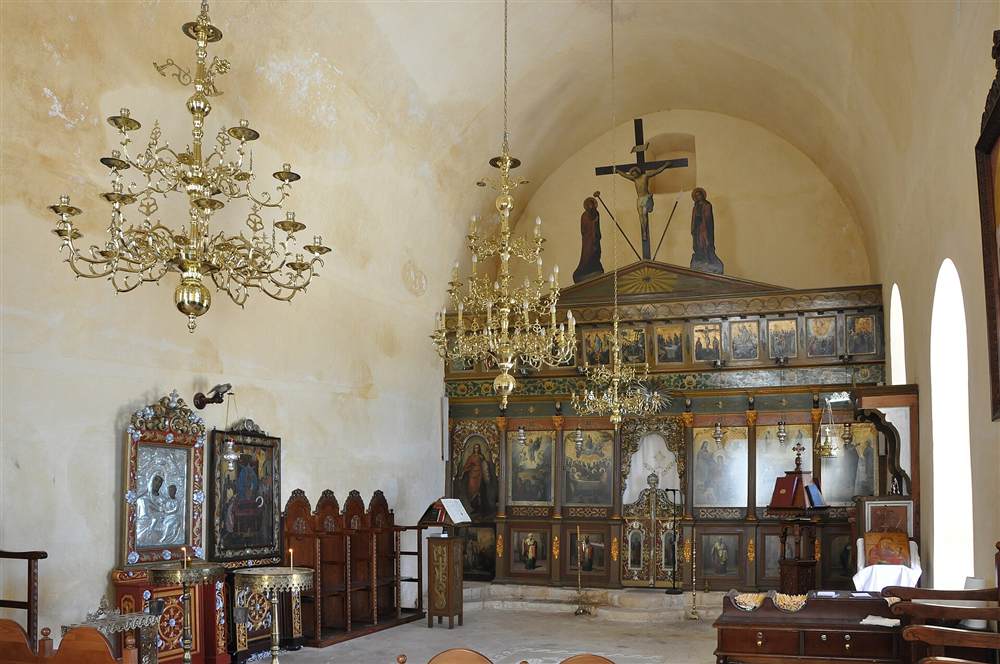
Chrysoskalitissa is a dazzling white monastery built on top of a 35-metre rock that rises straight from the sea, reached by a flight of 90 steps. A small white church, a bell tower, monks’ cells and a courtyard crown the rock, with wide views over the Libyan Sea.
Travellers who plan the trip from Chania to Chrysoskalitissa reach it within the times given. The distance from Chania to Chrysoskalitissa is covered on well-built roads. Fitting Chania to Chrysoskalitissa into a full day leaves room for one nearby stop. The route from Chania to Chrysoskalitissa follows the main road for the fast section. Setting out early on the Chania to Chrysoskalitissa run beats both the heat and the crowds. The road from Chania to Chrysoskalitissa is paved and signed the whole way. Anyone weighing the journey from Chania to Chrysoskalitissa sees the distance clearly on the map. The monastery reads as a single white mass against blue sea and sky, and that first sight from the road is the reason it draws visitors from across west Crete. The whitewashed walls climb the natural rock so tightly that the building and the stone read as one form, a bright vertical shape lifted 35 metres above the water. A flight of 90 steps cut and built into the rock carries visitors from the base to the courtyard at the top, and the climb is the physical act that gives the place its name and its meaning.
The complex is small and self-contained. At its heart is a compact white church dedicated to the Panagia, the Mother of God, with a second chapel honouring Agios Nikolaos, the patron of sailors \u2014 fitting for a shrine that stares out over the Libyan Sea. A bell tower rises above the courtyard, monks’ cells line the inner walls, and a paved terrace opens the view south across open water. A shop within the walls sells hand-painted icons, candles and local produce, and the donations left by visitors sustain the working community.
Chrysoskalitissa is a living monastery, not a museum ruin. It follows the daily round of an Orthodox religious house, with services, upkeep and the quiet routine of its residents, and visitors move through as guests of a functioning shrine. The setting \u2014 a white monastery on a sea rock at the edge of the island \u2014 has made it one of the signature images of west Crete, printed on postcards and fixed in the memory of everyone who climbs the steps. Its combination of dramatic position, working faith and open-sea view is what sets it apart from the chapels scattered across the Cretan coast.
What is the golden step legend and the story of the rock?
Legend holds that one of the 90 steps up to the monastery is made of pure gold \u2014 the chrysi skala, or golden step, that gives Chrysoskalitissa its name. The gold is visible only to those who are pure of heart, so no ordinary visitor sees which step it is.
The route from Chania to Chrysoskalitissa follows the main road for the fast section. Setting out early on the Chania to Chrysoskalitissa run beats both the heat and the crowds. The road from Chania to Chrysoskalitissa is paved and signed the whole way. Anyone weighing the journey from Chania to Chrysoskalitissa sees the distance clearly on the map. The Chania to Chrysoskalitissa route is best driven with a full tank and an early start. Drivers on the Chania to Chrysoskalitissa route follow the national road out of the city. The run from Chania to Chrysoskalitissa rewards an early start in the summer months. The name Chrysoskalitissa translates directly as “Our Lady of the Golden Step”, and the whole identity of the shrine hangs on the legend of the stair. The story tells that among the flight of steps carved into the rock, one single step is solid gold. The catch is written into the tale: the golden step reveals itself only to a visitor free of sin, pure in heart and conscience. Every climber who reaches the top and admits to seeing no gold confirms, by the logic of the legend, an ordinary human soul \u2014 and so no one ever names the step.
The legend does practical work beyond charm. It turns the climb into a small act of self-examination, and it gives the plain flight of steps a weight it holds nowhere else. Pilgrims count the treads on the way up and think on the story at the top, and the tale binds the physical effort of the ascent to the spiritual purpose of the visit. The rock itself carries an older story too: local tradition holds that the site sheltered worship long before the present monastery, and that the community grew on the strength of the rock’s natural defence above the sea.
The rock is as much the attraction as the legend. It stands 35 metres of bare stone dropping to the water, and the monastery sits on its crown like a lighthouse of faith facing the Libyan Sea. From below, the white walls appear to grow straight out of the cliff; from the courtyard above, the sea fills the view to the horizon and the low shape of Elafonisi shows to the south. The pairing of a hard, defensible rock with a soft, luminous legend of a golden step is the exact combination that fixes Chrysoskalitissa in the mind of every visitor.
What do you need to know about visiting Chrysoskalitissa and Elafonisi nearby?
Entry is free with a donation, the monastery opens through the day, and modest dress is required \u2014 shoulders and knees covered, with wraps lent at the door. The climb up the 90 steps is short but steep. Elafonisi’s pink-sand lagoon lies 5 kilometres south.
Anyone weighing the journey from Chania to Chrysoskalitissa sees the distance clearly on the map. The Chania to Chrysoskalitissa route is best driven with a full tank and an early start. Drivers on the Chania to Chrysoskalitissa route follow the national road out of the city. The run from Chania to Chrysoskalitissa rewards an early start in the summer months. The Chania to Chrysoskalitissa trip suits a base at the eastern end over a day return. The Chania to Chrysoskalitissa trip is one of the more memorable runs on the island. On a map, Chania to Chrysoskalitissa traces a long line across the island. The practical rules are simple and firm. There is no admission charge; visitors leave a donation, which supports the working community and the upkeep of the church and shop. The monastery keeps its doors open through the daytime hours, so a mid-morning or afternoon arrival finds the church, the courtyard and the shop accessible. The one strict requirement is dress: as an active Orthodox shrine, Chrysoskalitissa asks that shoulders and knees stay covered inside the church. Wraps and shawls are lent at the door for visitors in beach clothes, so a swimsuit-and-shorts arrival from the coast is no barrier \u2014 but a light layer packed in the bag saves the wait.
The climb deserves a word. The 90 steps rise steeply from the base to the courtyard, and the ascent is short in distance but demanding in gradient, taking a few minutes of steady effort. Sturdy footwear beats flip-flops on the stone treads, and a bottle of water helps in the summer heat, since the rock offers little shade on the way up. The reward at the top is the courtyard terrace and its unbroken view over the Libyan Sea. Inside the walls the shop sells icons, candles, honey, herbs and other local produce, and buying from it is one more way visitors support the shrine.
The monastery rarely travels alone on an itinerary. Elafonisi, 5 kilometres to the south, is the pink-and-white lagoon that draws crowds to this corner of Crete, its shallow turquoise water and rose-tinted sand making it one of the best-known beaches in Greece. Between monastery and lagoon lies Kedrodasos, a quieter cove backed by wild juniper and cedar, reached on foot for travellers who want space away from the Elafonisi crowds. Inland sit the stone villages of the Selino region, and the wider west coast strings out beaches and coves along the road back toward Chania. The natural plan is a single loop: the shrine on its rock in the morning, the lagoon and coast in the afternoon.
Is the trip to Chrysoskalitissa worth it and when is the best time to go?
The trip rewards the drive. A dazzling white monastery on a sea rock, a golden-step legend, and the pink lagoon of Elafonisi 5 kilometres on make one of the finest days out from Chania. Late spring and early autumn bring the best light and the thinnest crowds.
The run from Chania to Chrysoskalitissa rewards an early start in the summer months. The Chania to Chrysoskalitissa trip suits a base at the eastern end over a day return. The Chania to Chrysoskalitissa trip is one of the more memorable runs on the island. On a map, Chania to Chrysoskalitissa traces a long line across the island. The Chania to Chrysoskalitissa drive rewards the effort with the sight at the end of it. Planning Chania to Chrysoskalitissa by the light and the heat makes the most of the visit. The trip from Chania to Chrysoskalitissa pairs with the sights around it on the same route. The value question answers itself once the shape of the day is clear. The 75-kilometre, 1.5 to 1.75-hour drive delivers three distinct rewards in one loop: the mountain scenery of the Topolia gorge and the Selino villages on the way out, the monastery on its rock with its legend and its Libyan-Sea view at the far end, and the pink sand of Elafonisi 5 kilometres beyond. Few day trips in west Crete stack a working shrine, a dramatic natural setting and a world-famous beach so close together. The drive is long by Cretan standards, and the pairing of monastery and lagoon is precisely what turns that distance into a day worth its miles.
Timing within the day matters as much as the season. An early start from Chania \u2014 on the road by 8 in the morning \u2014 puts a car at the monastery before the tour coaches arrive and before the midday sun beats on the exposed steps. The cool of the morning suits the climb and the church; the heat of the afternoon suits the water at Elafonisi. Reversing the order \u2014 beach first, monastery on the way back \u2014 works for late risers, though the light on the white walls is at its brightest in the softer hours of morning and late afternoon.
Season sets the whole tone of the visit. Late spring and early autumn are the strongest windows: warm sea, mild air, long daylight, and far fewer visitors than the peak summer weeks, when Elafonisi’s fame packs the coast and the parking. High summer brings the seasonal bus and the busiest lagoon, so drivers who go then set off early to beat both the crowds and the heat. Winter turns the trip quiet and green, the mountains lush after rain, the monastery serene and near-empty \u2014 but the summer bus is gone, so a car is the only way in. For the balance of good weather, open sea and breathing room on the rock, the shoulder months on either side of summer are the sweet spot for the run from Chania to Chrysoskalitissa.
Frequently Asked Questions
How do you get from Chania to Chrysoskalitissa?
From Chania to Chrysoskalitissa, drive west on the national road toward Kissamos, then south through the Topolia gorge and the villages of Elos and Vathi to the south-west coast, 75 kilometres in 1.5 to 1.75 hours. A seasonal KTEL Elafonisi bus passes the monastery in high summer; outside the season a car is needed.
How far is Chrysoskalitissa from Chania?
The Chrysoskalitissa Monastery lies 75 kilometres from Chania on the far south-west coast of Crete in the Chania regional unit, 5 kilometres north of the Elafonisi lagoon. The drive from Chania to Chrysoskalitissa takes 1.5 to 1.75 hours.
Is the trip from Chania to Chrysoskalitissa worth it?
The trip from Chania to Chrysoskalitissa rewards visitors with a dazzling white monastery on a sea rock, the legend of the golden step, wide Libyan Sea views, and the Elafonisi lagoon 5 kilometres south. The far south-west distance suits a day paired with Elafonisi.