
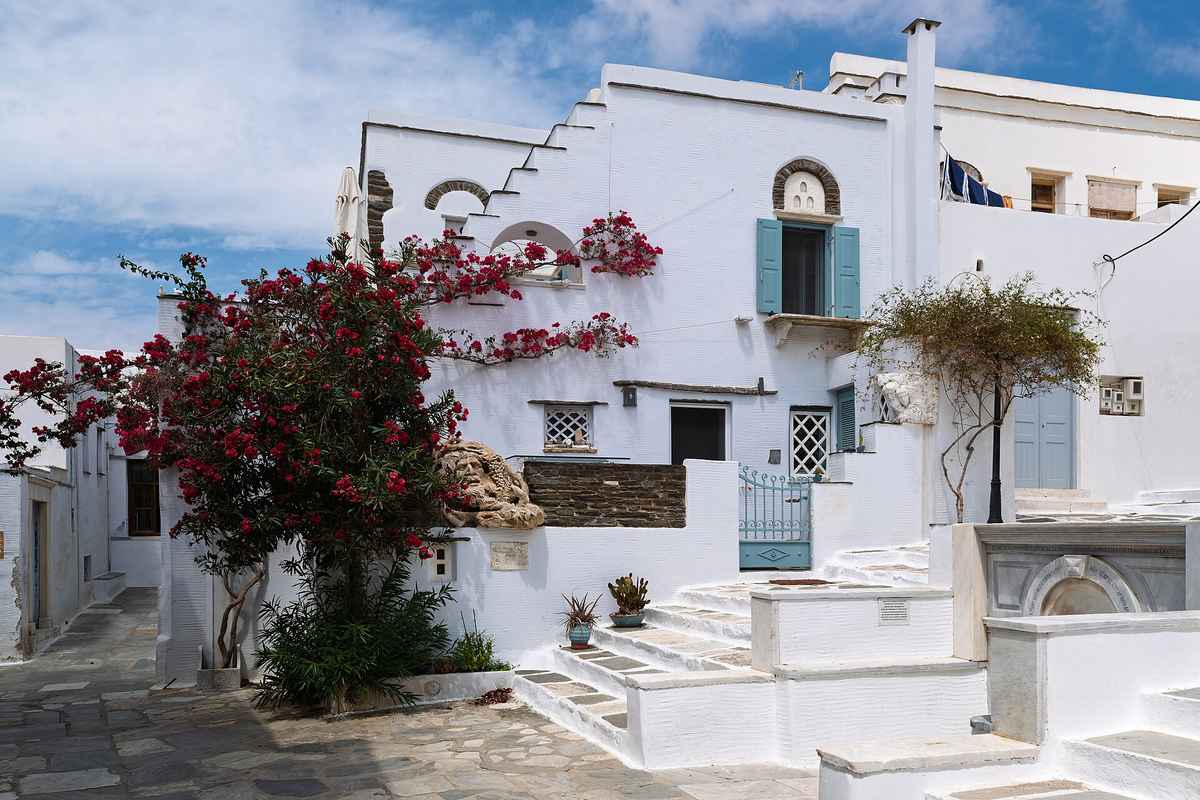
Tinos is a Cycladic island where marble-carving villages, a famous pilgrimage church, wind-swept beaches and a serious food culture sit within a 30-minute drive of each other. The best things to do in Tinos combine sightseeing, swimming and craft tourism on one compact island of 194 square kilometres. This guide ranks every activity by what it delivers and links each one to the page that books it. Plan the whole trip with Greece Tours.
Tinos belongs to the northern Cyclades, beside Mykonos and Andros, and rewards travellers who want authentic Greece over party crowds. The island holds more than 40 villages, over 50 beaches, more than 600 dovecotes, and an unbroken tradition of marble sculpture recognised by UNESCO. Use the sections below to build a plan, then open each linked guide for ferries, beaches, tours and stays.
What are the best things to do in Tinos?
The best things to do in Tinos are visiting the Church of Panagia Evangelistria, touring the marble village of Pyrgos, swimming at Kolimbithra and Agios Sostis, walking the boulder-ringed village of Volax, and tasting artichokes, louza and T-Oinos wine.
These five experiences cover faith, craft, coast and cuisine across two to four days. Tinos packs distinct activity types into a short distance, which lets a single day mix a church visit, a mountain village and an afternoon swim. Cultural sights centre on the pilgrimage church and the Museum of Marble Crafts. Outdoor activities include hiking 150 kilometres of marked paths, windsurfing at Kolimbithra, and island-hopping by boat. Food experiences run from village tavernas to organised cooking classes and vineyard tastings. The list below names the headline activities, and each detailed section follows.
- Visit the Church of Panagia Evangelistria, the holiest Marian shrine in Greece.
- Explore Pyrgos, the marble village and home of the island’s sculpture school.
- Wander Volax, a village ringed by giant round granite boulders.
- Swim at Kolimbithra, Agios Sostis and Agios Ioannis beaches.
- Taste louza, kopanisti cheese, artichokes and T-Oinos wine.
- Hike the dovecote trails between Tarambados, Volax and Falatados.
- Sail on a boat trip to Delos, Mykonos or Andros.
Each activity connects to the next through short drives, so the island reads as one itinerary rather than scattered stops. The sections below sort the things to do in Tinos by theme, from the headline sights to the practical questions of transport, timing and where to sleep. The first decision every visitor makes is the ferry, so the trip starts at the port.
How do you get to Tinos?
You reach Tinos by ferry from the Athens ports of Rafina and Piraeus, or from Mykonos in about 30 minutes. The Mykonos crossing costs €10 to €17; the Athens crossing takes up to 5 hours and costs €35 to €53.
Tinos has no airport, so every visitor arrives by sea. Mykonos sits closest, with 7 to 10 ferries daily in summer, which makes a Tinos add-on easy for travellers already in the Cyclades. Rafina lies nearest to Athens International Airport, which shortens the transfer from the plane to the boat to under an hour by road. Piraeus serves travellers staying in central Athens but adds time on the water. Ferry operators on these routes include Fast Ferries, Golden Star Ferries, Blue Star Ferries and SeaJets, mixing conventional vessels with high-speed catamarans. Book July and August sailings weeks ahead, because cabins and deck seats sell out during the peak pilgrimage season. The full route table, durations and operator list sit in the dedicated guide to how to get to Tinos. Once the ferry docks at Tinos Town, the island’s top sight stands a five-minute walk uphill.
Why is the Church of Panagia Evangelistria the top sight in Tinos?
The Church of Panagia Evangelistria ranks as the top sight in Tinos because it safeguards a wonder-working icon of the Mother of God and hosts the largest Orthodox pilgrimage in Greece each August 15.
The marble basilica sits above Tinos Town and gives the island its identity as a sacred destination. A nun named Pelagia saw visions that led to the icon’s discovery in the early 19th century, and the church rose on the spot soon after. Builders carved it from Tinian and Parian marble, with a courtyard of mosaic pebbles and a crypt that marks the find. On the feast of the Dormition of the Virgin, tens of thousands of pilgrims walk from the harbour to the altar, some on their knees along a carpeted lane. The complex also holds chapels, a museum of offerings and an art gallery, which reward an hour beyond the main nave. The Kechrovouni Monastery, where Pelagia lived, stands inland and forms a natural second stop for visitors tracing the pilgrimage. The church anchors the religious side of Tinos; the marble that built it points to the island’s defining craft.
What makes the marble craft of Tinos worth seeing?
The marble craft of Tinos is worth seeing because the island produced generations of master sculptors whose work fills Greek churches and squares, and UNESCO lists Tinian marble craftsmanship as intangible cultural heritage.
Pyrgos village holds the sculpture school and the Museum of Marble Crafts, which makes it the centre of the tradition. Marble shaped Tinos for centuries, from fanlights above village doorways to fountains, tombstones and church altar screens. Pyrgos, the largest village in the north, trained sculptors who carried the craft across Greece, and its main square, café tables and cemetery double as an open-air gallery. The Museum of Marble Crafts explains quarrying, tools and technique, then connects each method to objects you can find on the island yourself. Master carvers including Yannoulis Chalepas, whose work reached national museums, learned the trade in these workshops. The UNESCO recognition confirms the tradition as living rather than historical. Travellers who want a hands-on encounter can book a studio workshop through Tinos tours and guided experiences. Pyrgos is one of many villages, and the surrounding hills hold the rest.
Which villages should you explore in Tinos?
You should explore Pyrgos, Volax, Kardiani, Isternia and Panormos in Tinos. Pyrgos centres the marble tradition, Volax sits among giant granite boulders, Kardiani and Isternia hang over the sea, and Panormos runs a fishing harbour.
Tinos counts more than 40 inland and coastal villages, each marked by whitewashed lanes, dovecotes and bougainvillaea. Volax surprises visitors with a moonscape of rounded rocks and a surviving basket-weaving trade, and its potters and weavers still sell from workshop doorways. Kardiani and Isternia deliver the island’s best sunsets from terraces stacked above the Aegean, linked by a marble footpath. Panormos pairs its harbour with two nearby beaches, which makes it a lunch-and-swim stop with seafood at the quay. Falatados and Steni, on the central plateau, anchor the raki and cheese trade. A village-hopping day links four or five of these settlements by a single mountain road in under three hours of driving. The full route, parking notes and walking loops appear in the guide to the villages of Tinos. After the villages, the coastline calls.
Where are the best beaches in Tinos?
The best beaches in Tinos are Kolimbithra for surfing, Agios Sostis and Agios Ioannis for organised sand, Pachia Ammos and Santa Margarita for quiet swimming, and Kionia for proximity to Tinos Town.
Tinos has over 50 beaches split by the meltemi, the strong summer north wind. Kolimbithra, on the exposed north shore, turns that wind into surfable waves and stands as the island’s only reliable surf spot, with a beach bar and board rentals. Agios Sostis and Agios Ioannis Porto, on the sheltered south, offer sunbeds, tavernas and easy parking that suit families with children. Pachia Ammos and Santa Margarita reward a short drive with thinner crowds and clear water. Kionia, three kilometres from the capital, suits travellers without a car and sits beside the ruins of a sanctuary of Poseidon. Rochari and the coves of Panormos Bay add bohemian beach bars for travellers who want a scene. Conditions, access and facilities for every shore appear in the guide to the best beaches in Tinos. The sea also opens the route to neighbouring islands.
What boat tours and day trips depart from Tinos?
Boat tours from Tinos reach Delos, Mykonos, Andros and Syros, plus private charters around the island’s own coves. A day cruise pairs swimming stops with sightseeing, while a private charter lets a group set its own route.
Tinos sits at the centre of the northern Cyclades, which makes it a strong base for island-hopping by sea. Day trips by fast ferry reach Mykonos in 30 minutes and Syros in 40 minutes, allowing a half-day visit and a return the same evening. Private charters from Tinos Town and Panormos circle hidden beaches reachable only by water, and many include snorkelling gear, drinks and a captain for four to eight guests. A sailing day toward Delos connects the trip to the most important archaeological site in the Cyclades, the mythological birthplace of Apollo. Larger groups can split the cost of a catamaran for a sunset cruise off the west coast, with dinner and swimming built into the route. Andros, the green island to the north, makes a quieter day trip for travellers who want hiking and waterfalls rather than crowds. Booking a charter in advance secures the best captains during the July and August peak, when demand from Mykonos spills over to Tinos. Routes, operators and booking links sit in the guide to Tinos boat tours and island-hopping day trips. Land-based experiences run on a similar booking model.
What guided tours and experiences can you book on Tinos?
On Tinos you can book marble-village tours, food and wine tastings, cooking classes, jeep safaris and guided hikes. Each experience pairs a local guide with a single theme, which turns a drive between sights into a structured half-day.
Guided experiences solve the island’s main logistical problem, because public buses run a limited schedule and many villages sit off the main road. A marble-village tour links Pyrgos, the museum and a working studio under one guide who explains each carving. A culinary tour combines a cheese maker, a charcuterie producer and a vineyard such as T-Oinos in one afternoon. Cooking classes put visitors at the table with a local cook to prepare artichoke pie and louza meze. Jeep safaris reach the dovecote valleys, remote chapels and unpaved viewpoints that rental cars avoid. My Greece Tours arranges private versions of each, reachable on +30 697 236 4387 for a tailored itinerary. Compare the full range in the guide to Tinos tours and guided experiences. Food sits at the heart of most of them.
What food and wine should you try in Tinos?
In Tinos you should try louza cured pork, kopanisti spicy cheese, fresh artichokes, sun-dried tomatoes, local honey and raki, paired with wine from T-Oinos. The island runs festivals for its artichokes, raki and honey.
Tinos earns a reputation as a Cycladic food island through small producers rather than big brands. Louza, a thin air-cured pork seasoned with pepper and savory, appears on every meze plate beside a glass of raki. Kopanisti delivers a sharp, fermented punch that spreads on barley rusks. Volax and Komi grow artichokes celebrated at a summer festival, and the island’s terraced fields supply tomatoes, capers and wild oregano. T-Oinos, planted among granite boulders near Falatados, produces wines that reach Athens fine-dining lists and welcome visitors for tastings. Tinos Town and Pyrgos hold tavernas that cook the day’s catch and the season’s vegetables without fuss. Pastry shops sell galaktoboureko and amygdalota, the almond sweets tied to the church feasts. Local honey, thyme-scented from the island’s hills, fills jars in every village shop and tops the morning yoghurt. A food tour ties these producers together, but independent travellers can build their own trail from a cheese maker in Steni to the T-Oinos cellar near Falatados. The dishes, producers and tavernas appear in the guide to the food and wine of Tinos. Walking off a long lunch leads naturally to the trails.
Where can you hike in Tinos?
You can hike Tinos on a 150-kilometre network of marked footpaths that link villages, dovecote valleys, chapels and the Venetian fortress hill of Exomvourgo. Trails run from a 40-minute stroll to a half-day ridge walk.
Hiking exposes the parts of Tinos that cars miss, including the dovecote valley of Tarambados and the boulder fields above Volax. The path from Volax to Falatados crosses open country dotted with chapels and ends at a village known for its raki distillers. Exomvourgo, the rocky peak crowned by a ruined Venetian castle, gives the widest view on the island after a steady climb of about an hour. The old marble route between Kardiani and Isternia stays shaded and nearly level, which suits a gentle afternoon. Spring covers the slopes in wildflowers and keeps temperatures mild, which makes April to June the prime walking window. Most paths stay marked and shaded by stone terraces, so a sun hat and water cover the essentials. Distances, difficulty grades and trailheads appear in the guide to the hiking trails of Tinos. Many of these paths pass the structures that define the Tinian landscape.
What are the dovecotes of Tinos?
The dovecotes of Tinos are ornate two-storey stone pigeon houses built by Venetian landowners and local masons, decorated with geometric marble latticework. The island holds more than 600, the densest concentration in the Cyclades.
Dovecotes served a practical purpose, because pigeons supplied meat and fertiliser to terraced farms with thin soil. Masons turned that function into folk art, arranging thin slate and marble plates into suns, cypresses and triangles that filter light and let the birds pass. Tarambados valley holds the best-preserved row, viewable from a short marked path off the main road. The structures date mostly to the Venetian and Ottoman centuries, and many still house pigeons today. The dovecotes link the island’s farming past to its marble craft, and they recur across the hiking routes and village drives. They photograph best in the low light of late afternoon, which is also the start of the island’s quietest, coolest hours.
What festivals and cultural events happen in Tinos?
Festivals in Tinos run from the two great Marian feasts on March 25 and August 15 to the summer Tinos Jazz Festival and World Music Festival, plus village panigyria for artichokes, raki and honey. The events spread across the whole island.
Cultural events give a visit a fixed anchor and a reason to choose a date. The Dormition pilgrimage on August 15 fills the church and the streets with the largest crowd of the year. The Tinos Jazz Festival stages free concerts in village squares through the summer, and the World Music Festival adds international acts in the same setting. Village panigyria, the open-air feasts tied to a local saint or harvest, serve food, wine and live music until late, and welcome any traveller who turns up. Komi celebrates its artichokes, Falatados its raki, and several villages their honey and cheese. These gatherings show the island’s living culture rather than a staged version. Festivals reward travellers who plan around the calendar, and the next practical question is how to move between the venues.
How do you get around Tinos?
You get around Tinos by rental car or scooter for full freedom, by KTEL bus on the main village routes, or by guided tour for the off-road sights. A car opens the inland villages and remote beaches that buses skip.
Transport choice decides how much of the island a trip can cover. A rental car or ATV from Tinos Town reaches every village and beach, with the drive to Pyrgos taking about 40 minutes on a good road. KTEL buses run from the harbour to Pyrgos, Panormos, Kionia, Porto and Falatados, but they keep a thin timetable that suits flexible travellers rather than tight schedules. Taxis are few and best pre-booked for the airport-style ferry rush. Guided jeep tours handle the unpaved tracks to dovecote valleys and hilltop chapels, which removes the stress of narrow lanes. Cyclists and walkers manage the area around Tinos Town, though the mountainous interior demands gears and stamina. The right transport pairs with the right base, which sets up the accommodation decision.
What historical landmarks and museums can you visit in Tinos?
You can visit the Archaeological Museum of Tinos, the ruined Venetian capital at Exomvourgo, the Sanctuary of Poseidon and Amphitrite at Kionia, and the fortified Kechrovouni Monastery. These four sites cover the island’s ancient, medieval and Orthodox past.
Historical landmarks add depth between the beaches and the tavernas. The Archaeological Museum in Tinos Town displays finds from Exomvourgo and the Kionia sanctuary, including pottery, sculpture and a large sundial. Exomvourgo carried the island’s medieval capital under Venetian rule, and its ruined walls reward the climb with a 360-degree view. The Sanctuary of Poseidon and Amphitrite at Kionia drew ancient pilgrims much as the modern church does, and its foundations sit beside the beach. Kechrovouni Monastery, among the largest in Greece, preserves the cell of Saint Pelagia and a fortified village of whitewashed lanes. The Cultural Foundation of Tinos in Tinos Town adds rotating exhibitions of painting and sculpture for travellers who want modern Greek art. Loutra, a hill village near Exomvourgo, preserves a Jesuit monastery and a folklore museum that explain the island’s Catholic minority, a legacy of Venetian rule. Tinos holds one of the largest Roman Catholic communities in Greece, and its Catholic and Orthodox villages sit side by side across the interior. These landmarks reward travellers who want context for the living traditions on display elsewhere on the island. The sites cluster within short drives, which keeps a history day efficient.
When is the best time to visit Tinos?
The best time to visit Tinos is May, June, September and early October, when the sea is warm, the meltemi wind is moderate, and the August pilgrimage crowds have thinned. July and August bring the hottest, busiest conditions.
Tinos follows a Cycladic climate of dry, bright summers and mild, green winters. June offers long days, swimmable water near 22°C, and festivals without the August squeeze. September keeps the sea warm into the high 20s while hotels drop their rates and the light softens for photography. The meltemi blows hardest in July and August, which suits windsurfers at Kolimbithra but unsettles ferry schedules and exposes north-coast beaches. August 15 fills every bed on the island for the Dormition pilgrimage, so book months ahead or avoid the date entirely. Winter closes many tavernas and hotels, leaving the island to its residents and the church. Month-by-month detail sits in the guide to the best time to visit Tinos. The right season pairs with the right base.
Where should you stay in Tinos?
You should stay in Tinos Town for ferries, dining and the church, in Kionia or Agios Sostis for beach access, and in Pyrgos for marble-village calm. Tinos Town suits a first visit best.
Accommodation on Tinos runs from boutique hotels to family guesthouses and self-catering apartments. Tinos Town keeps everything within walking distance, which helps travellers without a car reach the port, the tavernas and the basilica on foot. Kionia and Agios Sostis put guests on the sand with tavernas at the door and an easy drive to the capital. Pyrgos and the northern villages trade beach access for quiet lanes, sunset terraces and a slower rhythm. A car widens every option, because the best beaches and villages sit a short drive from the capital. Booking early matters most around August 15, when the pilgrimage absorbs the island’s rooms. Areas, hotel types and traveller-profile matches appear in the guide to where to stay in Tinos. The length of the stay decides how much of this list fits.
How many days do you need in Tinos?
You need at least two days in Tinos for the church and one marble village, four days to add beaches, hiking and a food tour, and seven days to combine the whole island with a boat trip. Four days suits most visitors.
A two-day visit covers Tinos Town, the Church of Panagia Evangelistria and Pyrgos at a relaxed pace. Four days adds two beach afternoons, a village-hopping drive and a wine or cooking experience without rushing. Seven days opens the trails, the quieter northern coast and a day-trip sail to Delos or Mykonos. Each plan sequences the same attractions in a different order, which keeps drives short and afternoons free for swimming. Travellers arriving from Mykonos can fold Tinos into a wider Cyclades route as a two-night highlight. Day-by-day routes for all three lengths sit in the Tinos itinerary for 2, 4 and 7 days. The wider context for every activity sits in the complete Tinos travel guide.
Frequently Asked Questions
Is Tinos worth visiting?
Tinos is worth visiting for travellers who want marble villages, authentic food and uncrowded beaches over nightlife. The island offers the largest Orthodox pilgrimage in Greece, a UNESCO-listed sculpture tradition, and over 50 beaches, all within a compact area beside Mykonos.
How many days should you spend in Tinos?
You should spend four days in Tinos to cover the church, the marble villages, two beaches and a food or boat experience. Two days suit a short stopover from Mykonos, while seven days add hiking and an island-hopping day trip.
What is Tinos famous for?
Tinos is famous for the Church of Panagia Evangelistria and its wonder-working icon, for marble sculpture centred on Pyrgos, and for more than 600 ornate dovecotes. The island also draws food travellers for louza, kopanisti cheese and T-Oinos wine.
Can you do a day trip to Tinos from Mykonos?
You can do a day trip to Tinos from Mykonos, because the ferry crossing takes about 30 minutes and runs 7 to 10 times daily in summer. A day allows the church, Tinos Town and one beach before an evening return.
Do you need a car in Tinos?
You need a car or a guided tour in Tinos to reach the inland villages, the dovecote valleys and the quieter beaches, because public buses run a limited schedule. Tinos Town itself works on foot for ferries, dining and the church.
Is Tinos good for families?
Tinos is good for families thanks to calm south-coast beaches such as Agios Sostis, short drives between sights, and hands-on experiences like marble workshops and cooking classes. The island’s relaxed pace suits children better than the party islands nearby.
What is the best beach in Tinos?
The best beach in Tinos is Kolimbithra for surfers and beach-bar atmosphere, while Agios Sostis ranks first for families thanks to shallow water and easy parking. Pachia Ammos and Santa Margarita win for travellers who want quiet sand away from the crowds.
Is Tinos better than Mykonos?
Tinos is better than Mykonos for culture, food and quiet beaches, while Mykonos wins for nightlife and luxury resorts. The two islands sit just 30 minutes apart by frequent summer ferry, so many travellers pair the calm culture of Tinos with the lively nightlife of Mykonos in a single Cyclades trip.