
To get from Chania to Elounda, drive east on the E75/A90 national road about 150 kilometres through Rethymno and Heraklion to Agios Nikolaos, then the coast road north to the upmarket resort on the Gulf of Mirabello, about 2.5 to 3 hours. Plan the whole trip with Greece Tours.
This guide covers the trip from Chania to Elounda in full: where it is, how to get there by car and bus, the drive time, the town on the Mirabello gulf, the boat to the Spinalonga island fortress, the sunken city of Olous, Agios Nikolaos and the Lasithi coast nearby, and whether this long east-Crete trip is worth it or better as a stay.
Where is Elounda from Chania?
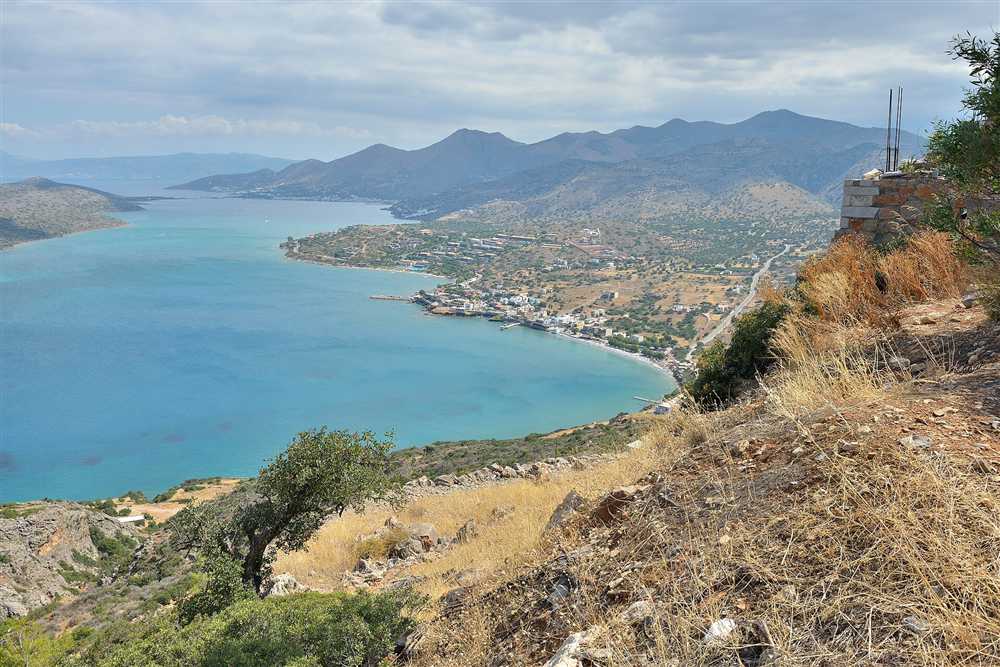
Elounda is an upmarket resort town in east Crete, in the Lasithi region, on the Gulf of Mirabello about 10 km north of Agios Nikolaos and about 150 km east of Chania. It sits on a sheltered bay facing the Spinalonga island fortress.
Chania anchors the far west of Crete; Elounda sits near the east end of the same north coast. The two towns occupy opposite ends of the island, separated by the regional units of Rethymno and Heraklion. A traveller crossing from one to the other passes the length of the north coast, from the Venetian harbour of Chania to the Mirabello bay of Lasithi.
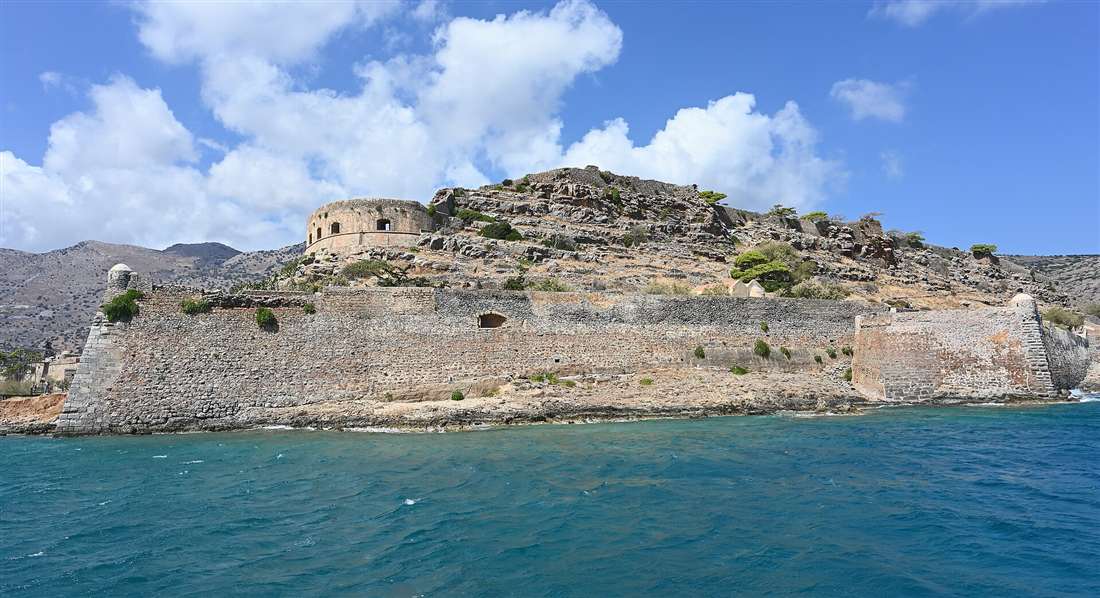
Elounda wraps around a calm, shallow bay protected by the Spinalonga peninsula and the fortified islet that shares the name. Luxury hotels line the waterfront and the slopes above the gulf, and the harbour sends small boats across to the Spinalonga fortress, the Venetian sea-castle that later served as a leper colony. The setting places Elounda among the most exclusive addresses on Crete.
Below the surface of the causeway that links Elounda to the Kolokytha peninsula lie the ruins of Olous, a sunken ancient city whose walls and mosaics rest in clear shallow water. Agios Nikolaos, the regional capital 10 km south, adds a working town with its bottomless Lake Voulismeni, restaurants and shops, and the road network that ties Elounda to the rest of the island.
How do you get from Chania to Elounda?
Drive east on the E75/A90 national road along the north coast through Rethymno and Heraklion to the Agios Nikolaos exit, then take the short coast road north to Elounda, a journey of about 2.5 to 3 hours. A hire car is the most direct route; the KTEL bus plus a local connection is the alternative.
The self-drive route follows a single spine. From Chania the A90 national road runs east past Georgioupoli, through the Rethymno bypass, on to the Heraklion ring road, and continues east toward Lasithi. The exit for Agios Nikolaos leaves the main road; from the town centre the signposted coast road climbs north 10 km to Elounda. Fuel stations, service areas and tavernas line the route the whole way.
Public transport uses the KTEL intercity network. Buses depart Chania KTEL station for Heraklion, where travellers change to an east-Crete service to Agios Nikolaos. From the Agios Nikolaos bus station a frequent local bus covers the final 10 km to Elounda, and taxis wait at the rank for the same short hop. The through trip runs about 3.5 to 4 hours end to end.
Private transfers and pre-booked taxis cover the door-to-door distance in one vehicle, useful for travellers arriving with luggage or in a group. Chania International Airport (CHQ) and the port of Souda both feed the same A90 corridor east, so a transfer collected at either point joins the identical route through Rethymno and Heraklion to the Mirabello coast.
How long does it take to drive from Chania to Elounda?
The drive covers about 150 km and takes about 2.5 to 3 hours. The A90 national road runs fast and straight east past Rethymno and Heraklion for most of the distance; the final stretch from the Agios Nikolaos exit to Elounda is a slower winding coastal road of 10 km.
Distance splits into two parts. The long first leg, roughly 140 km, stays on the A90 dual-standard national road from Chania to the Agios Nikolaos junction, holding a steady pace across open country and coastal plain. The short second leg, 10 km, leaves the national road for the twisting road north above the Gulf of Mirabello into Elounda, where the pace drops through bends and villages.
Timing shifts with traffic through the built-up sections. The Rethymno and Heraklion bypasses carry the heaviest load, and the Heraklion ring road slows at peak hours. A departure outside the morning and evening rush holds the trip near the 2.5-hour mark; a mid-day crossing through the two cities pushes it toward 3 hours.
The road climbs and descends across the island’s north edge rather than running dead flat, so the coastal final 10 km into Elounda adds time out of proportion to its length. Drivers budget a rest stop near Rethymno or Heraklion, both of which sit close to the halfway line and offer fuel and food directly off the national road.
Can you reach Elounda by bus from Chania?
Yes. The KTEL intercity bus links Chania to Agios Nikolaos, changing at Heraklion, in about 3.5 to 4 hours. From Agios Nikolaos a frequent local bus covers the final 10 km to Elounda. The bus trip runs long, so a hire car or a private transfer suits travellers on a tight schedule.
The bus journey runs in stages. KTEL services depart Chania’s central bus station east to Heraklion along the same A90 corridor a car uses. At Heraklion travellers transfer to an east-Crete departure bound for Agios Nikolaos. The two legs together fill about 3 to 3.5 hours before the final local connection to Elounda.
From the Agios Nikolaos station the town’s local bus runs the 10 km north to Elounda at short intervals through the day, and taxis at the rank cover the same distance direct. Adding the transfer wait at Heraklion and the last local hop, the full Chania-to-Elounda door time reaches 3.5 to 4 hours by public transport.
Timetables tighten outside the peak season, and the connection at Heraklion depends on the onward departure. Travellers check the current KTEL schedule for both the Chania-Heraklion and Heraklion-Agios Nikolaos legs before setting out, confirm the last local bus time to Elounda, and weigh the fixed bus route against the flexibility of a car or a booked transfer that runs the whole 150 km in one vehicle.
What is Elounda town like?
Elounda is an upmarket resort on the sheltered Gulf of Mirabello in east Crete, built around a working harbour and a paved central square. Five-star hotels and private villas line the calm, shallow bay, and waterfront tavernas frame a slow, high-end base.
The town sits 11 km north of Agios Nikolaos on the Lasithi coast, wrapped by the Mirabello gulf that keeps the water flat and warm. The harbour holds fishing boats and excursion caiques side by side, and the square behind it fills with cafes, bakeries and tavernas that serve grilled fish and Cretan meze at tables a few metres from the sea. The scale stays small: a strip of shorefront, a church, and lanes climbing to the villas above.
Elounda’s luxury reputation rests on the resorts spread along the headlands to the south, where suites open onto private pools and the bay. The shallow, sheltered water suits families and swimmers who want calm rather than surf, and the beaches are compact coves rather than long sand. The tone is quiet and residential, geared to guests who settle in for a week rather than passing through.
A narrow causeway crosses to the Kolokytha peninsula, and beside it lie the submerged ruins of Olous, the sunken Roman-Greek city whose walls and mosaic floors sit just under the surface of the channel. Swimmers snorkel over the outlines of the old town, and an early-Christian mosaic pavement survives on the shore. The causeway walk, the sunken city and the harbour together make Elounda a base with more than hotels.
How do you visit Spinalonga from Elounda?
Boats leave Elounda harbour for Spinalonga through the day in season, crossing the Mirabello gulf in about 20 minutes. The Venetian sea fort and former leper colony, made famous by the novel The Island, is walked in a loop around its fortified walls and abandoned old town.
Spinalonga guards the mouth of the Elounda bay, a rock island ringed by Venetian ramparts raised to hold the harbour against Ottoman fleets. Ticket boats depart from the Elounda quay and from Plaka village opposite, with the shortest crossing running from Plaka in under 10 minutes and the Elounda run taking about 20. Departures repeat through the day in the warm months, so a visit slots into a morning or an afternoon.
The island later served as a leper colony, and the stone houses, church and hospital of that community still line its single street. Victoria Hislop’s novel The Island set its story here and drew readers to the site, and the walk traces the sea gate, the ruined dwellings and the fortress bastions on a loop of about 45 minutes. A ticket covers landing and entry to the archaeological zone.
Guides on the boats and on the island explain the Venetian defences and the colony’s history, and the fortified circuit gives long views back across the gulf to Elounda and Plaka. Sturdy shoes handle the uneven stone, and the exposed rock carries little shade, so a hat and water travel well. The crossing and the loop together fill roughly two to three hours from harbour to harbour.
What else is near Elounda?
Agios Nikolaos, the lively harbour town with Lake Voulismeni at its centre, sits 11 km south. Plaka village faces Spinalonga, the Mirabello beaches ring the gulf, and the Lasithi plateau with the Dikteon cave lies inland, making Elounda a hub for east Crete.
Agios Nikolaos wraps around Lake Voulismeni, a round pool linked to the sea by a short channel and lined with tavernas and bars, and its harbour, town beaches and shops give Elounda a busier neighbour a short drive away. Plaka, 5 km north, is a fishing village of tavernas looking straight across the water to Spinalonga, and its short boat crossing makes it the quickest launch to the fortress.
The coast around the gulf holds a string of beaches: the sheltered coves near Elounda, the sand at Almyros and Ammoudara south of Agios Nikolaos, and the pebble shores along the headlands. The calm Mirabello water suits swimming and paddling, and the small scale keeps the beaches within easy reach of the resort.
Inland, the Lasithi plateau spreads across a ring of mountains 900 metres up, a bowl of orchards and old stone windmills reached by a climbing road. The Dikteon cave on its edge, the mythological birthplace of Zeus, drops past stalactites to an underground chamber. The plateau, the cave and the coast together make east Crete’s landscape reachable from an Elounda base.
What is the sunken city of Olous at Elounda?
Olous is a sunken ancient city beside Elounda, its walls, streets and harbour resting just under the clear shallow water by the causeway to the Kolokytha peninsula. An early-Christian mosaic pavement survives on the shore, and swimmers snorkel over the outlines of the old town.
Olous was a Greek and Roman coastal city that stood on the low isthmus where the causeway now crosses to Kolokytha. The land sank over the centuries as the coastline shifted, and the town slipped beneath the surface of the Poros channel, leaving its stone foundations and harbour walls in water shallow enough to read from the surface. The site gives Elounda a layer of antiquity beneath its modern resort face.
The clearest remains sit right beside the causeway, where the straight lines of ancient walls and the blocks of the old quay show through the turquoise water. Snorkellers float over the submerged street grid, and the calm, shallow channel makes the ruins easy to see without diving gear. A short walk along the causeway reaches the spot from the Elounda waterfront.
On the shore beside the sunken city, a fenced early-Christian basilica floor preserves a mosaic of fish and geometric patterns, a fragment of the later town that stood here. Together the underwater walls, the harbour and the mosaic turn the causeway into an open-air site, and the walk out to Kolokytha pairs the ruins with a quiet swimming cove at the far end.
Is the trip from Chania to Elounda worth it?
Yes for travellers set on east Crete: Elounda delivers the luxury bay, the Spinalonga fortress and Agios Nikolaos in one place. The trade-off is the 150 km drive across the island, so Elounda rewards a stay of a few nights rather than a day trip from Chania.
The distance is the deciding factor. Chania and Elounda sit at opposite ends of Crete, and the drive covers about 150 km on the national road, close to two and a half hours each way. A same-day return burns five hours in the car for a few hours at the coast, which strips the calm that draws people to the gulf in the first place. Booking two or three nights turns the crossing into the start of a separate east-Crete leg.
What waits at the end justifies the move for the right traveller: the sheltered Mirabello water, the five-star headlands, the boat to Spinalonga, the sunken city of Olous and the lake at Agios Nikolaos. Those with a week on the island split it, basing in the west for the Samaria gorge and the pink-sand beaches, then shifting east to Elounda for the fortress and the resort bay.
If the base stays in the west, the shorter day trips from Chania use the drive-time better, and the Chania old town, harbour and nearby coast fill the days without the cross-island haul. Travellers still routing to the region first will find the arrival options set out in the guide on how to get to Chania, and from there the choice between a western base and an eastern move to Elounda comes down to the number of nights the trip holds.
Frequently Asked Questions
How do you get from Chania to Elounda?
From Chania to Elounda, drive east on the E75/A90 national road about 150 kilometres through Rethymno and Heraklion to the Agios Nikolaos exit, then the coast road north 10 kilometres to Elounda, about 2.5 to 3 hours. The KTEL bus runs via Heraklion and Agios Nikolaos in about 3.5 to 4 hours.
How far is Elounda from Chania?
Elounda lies about 150 kilometres east of Chania, at the opposite end of Crete on the Gulf of Mirabello in the Lasithi region, 10 kilometres north of Agios Nikolaos. The drive takes 2.5 to 3 hours on the A90 national road; the bus runs longer with a change at Heraklion.
Is the trip from Chania to Elounda worth it?
The trip from Chania to Elounda rewards visitors with a luxury resort bay, the Spinalonga island fortress, the sunken city of Olous and the town of Agios Nikolaos. The 150-kilometre cross-island drive is the trade-off, so Elounda suits a stay of a few nights rather than a day trip from Chania.