
To get from Chania to the Imbros Gorge, drive about 57 kilometres south over the Askifou plateau to Imbros village and the gorge entrance in about 1 to 1.25 hours, or take the KTEL bus towards Chora Sfakion, then walk the 8 kilometres down to Komitades. Plan the whole trip with Greece Tours.
This guide covers the trip from Chania to the Imbros Gorge in full: where the gorge is, how to get there by car and bus, how long and how hard the walk is, Imbros versus the Samaria Gorge, what you see in the narrows, the exit at Komitades, and whether this short, family-friendly day trip from Chania is worth it.
Where is the Imbros Gorge from Chania?
The Imbros Gorge sits in the Sfakia region of south-west Crete, about 57 km south of Chania. The top entrance stands at Imbros village on the road to Chora Sfakion, around 780 m altitude, and the ravine descends about 8 km south to Komitades near the coast.
Imbros village lies at the southern edge of the Askifou plateau, a high bowl of farmland ringed by the White Mountains. The gorge cuts through the limestone ridge that separates this plateau from the Libyan Sea, funnelling walkers from the cool uplands down to the warm south coast of Crete. The northern trailhead sits beside the main road, so the entrance is reached by car and by bus without a separate approach walk.
The gorge belongs to the Sfakia district, the most mountainous corner of the island, where the peaks rise above 2,000 m within a few kilometres of the shore. Chora Sfakion, the small port that serves the region, lies about 4 km east of the gorge exit. Frangokastello, with its Venetian fort on the coastal plain, stands about 12 km to the east.
From Chania on the north coast, the route runs due south across the island’s width. The city sits at sea level on the Cretan Sea; Imbros sits at 780 m on the far side of the mountains. That climb and the descent through the gorge give the trip its full character, and the position places Imbros among the closest gorge walks to Chania. See the wider Chania hub for the region’s other routes south.
How do you get from Chania to the Imbros Gorge?
Drive south on the Chania to Chora Sfakion road over the Askifou plateau to Imbros village and the gorge entrance, about 1 to 1.25 hours. The KTEL bus from Chania towards Chora Sfakion stops at Imbros. Walk down to Komitades, then take a taxi or bus back.
By car the road leaves Chania, climbs through Vryses, and winds up onto the Askifou plateau before dropping to Imbros. The distance is 57 km and the drive takes 1 to 1.25 hours on a paved mountain road with tight bends and steady gradients. Parking sits at the northern trailhead by the village, and drivers park a second car at Komitades or return by taxi to collect the first.
By public transport the KTEL bus runs from Chania bus station towards Chora Sfakion and halts at Imbros on request. The journey covers the same 57 km in about 1.5 hours with the plateau stops. Walkers ride to Imbros, descend the gorge to Komitades, and pick up the onward bus or a taxi at the exit. Buses to and from Chora Sfakion link with the ferry timetable along the south coast.
The one-way descent is the standard plan: enter at Imbros at 780 m and finish at Komitades near sea level. A taxi covers the 4 km from Komitades to Chora Sfakion, where the coastal bus returns to Chania. Booking a guided transfer removes the two-car logistics, and this gorge features among the organised day trips from Chania.
How long and how hard is the Imbros Gorge walk?
The Imbros Gorge walk covers about 8 km and takes 2.5 to 3 hours downhill. It is a moderate, easy route on a clear path, far shorter and gentler than the Samaria Gorge. The narrows close to 2 m at the tightest point. Wear sturdy shoes; the gorge is family-friendly.
The path drops from 780 m at Imbros to near sea level at Komitades, a descent of roughly 780 m over 8 km. The gradient stays steady rather than steep, and the trail follows the dry riverbed on packed earth and stone. There are no ladders, chains, or scrambles. Walkers of mixed fitness complete the route at a relaxed pace with breaks.
Timing runs 2.5 to 3 hours for the full descent, plus stops to photograph the narrows and rest in the shade. The path has no water fountains along its length, so carry 1.5 to 2 litres per person and refill at the tavernas at the exit. A hat and sun cover matter, as the upper section carries direct sun before the walls close in.
The moderate grade and the short distance make Imbros a strong choice for families with children and for walkers new to Cretan gorges. Sturdy shoes with grip handle the loose stone underfoot, and the single downhill direction removes any route-finding. The gorge stays open across the warm months while higher routes close for weather.
Is Imbros or Samaria the better gorge from Chania?
Imbros is shorter at 8 km against Samaria’s 16 km, easier, closer to Chania, and open when Samaria closes. Samaria is longer, more dramatic, and more famous. Imbros suits families and a half-day; Samaria fills a full day. The choice turns on time and energy.
Imbros runs 8 km and takes 2.5 to 3 hours, so the walk fits a half-day and leaves the afternoon free for the coast. The trailhead sits right on the road, the descent is gentle, and the logistics stay simple. The gorge opens across a longer stretch of the year than the Samaria National Park route, which keeps a fixed operating season.
Samaria runs 16 km and takes 5 to 7 hours from the Omalos plateau down to Agia Roumeli on the Libyan Sea. It is the longest gorge in Crete and draws the largest crowds, with the celebrated Iron Gates narrows and a boat transfer at the finish. The full day includes an early start, the long descent, and the ferry and bus back to Chania.
For a first Cretan gorge with children, limited time, or a preference for an easier grade, Imbros is the match. For the landmark full-day trek with the widest walls and the deepest reputation, the Samaria Gorge holds the title. The two pair well across a longer stay, one gorge per day.
What will you see in the Imbros Gorge?
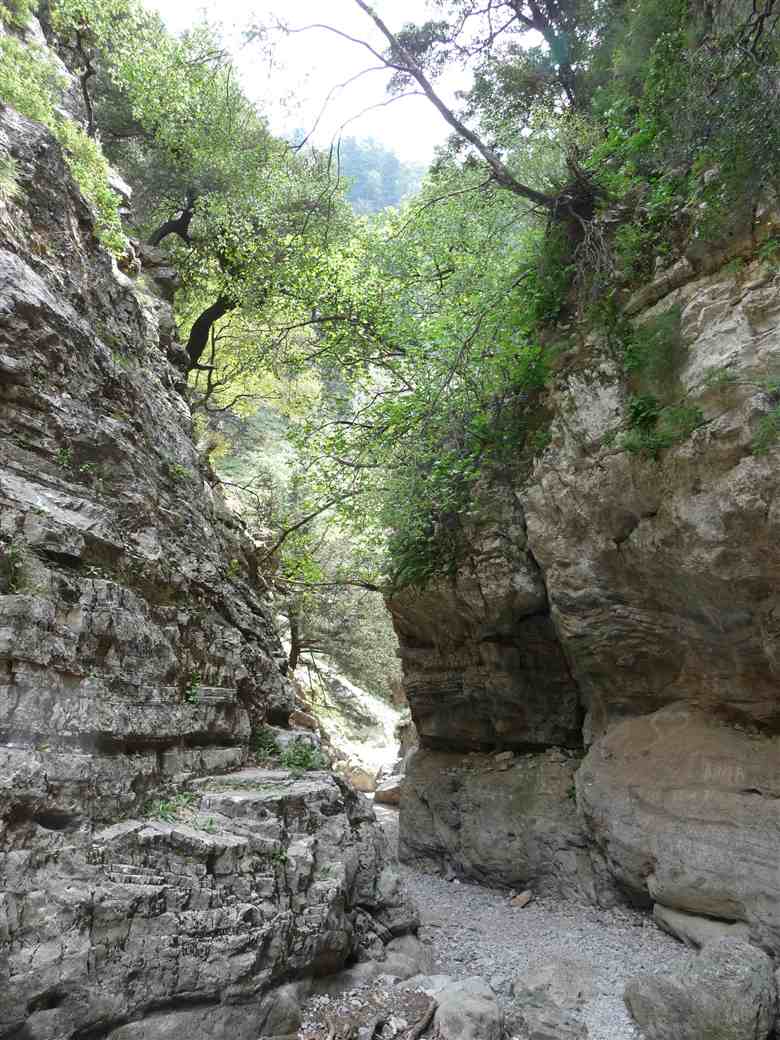
The Imbros Gorge shows narrows where the walls close to 2 m, an old stone arch, and the ruins of the wartime path. Cypress and holm oak line the route, caves open in the cliffs, and the Sfakia mountains frame the descent. The gorge exits at Komitades with its tavernas.
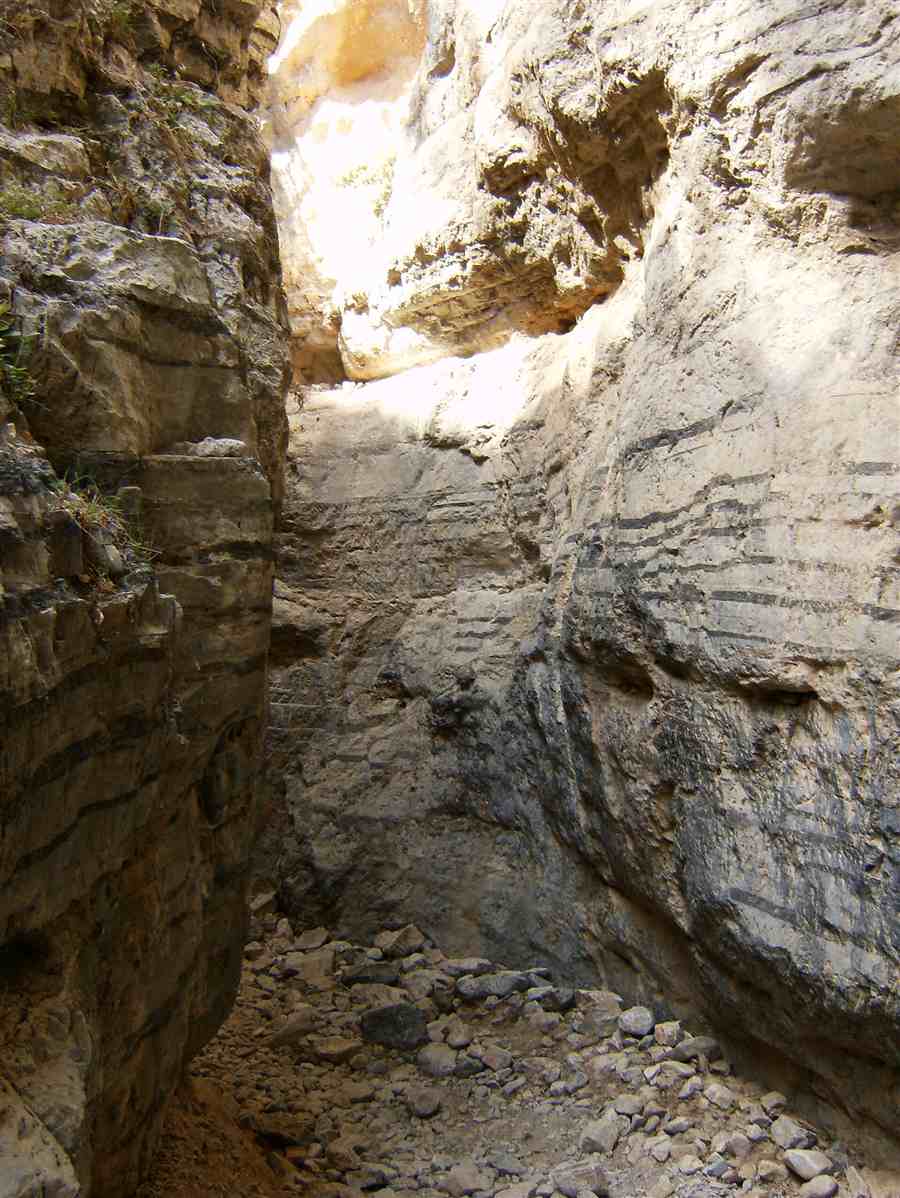
The signature feature is the narrows, where sheer limestone walls draw together to a gap of about 2 m with the rock rising more than 300 m overhead. The path threads directly through this cleft, and the temperature drops in the shade of the tightest sections. A carved stone arch spans the trail at one point, a marker of the old track that once carried mules and people between the plateau and the coast.
The gorge carries the memory of the wartime evacuation, when soldiers crossed this ravine on the way to the south coast for withdrawal by sea. Sections of the old built path survive along the route. Vegetation shifts with the descent: cypress and holm oak take root on the slopes, oleander lines the bed, and caves and rock overhangs break the cliff faces.
At the foot of the gorge the walls open onto the Komitades plain, where tavernas serve Sfakian dishes at the exit. From here the Libyan Sea lies a short distance south, with Chora Sfakion 4 km west and Frangokastello and its fortress on the coast to the east.
Is the trip from Chania to the Imbros Gorge worth it?
Yes. The trip delivers a short, scenic, family-friendly gorge walk under an hour and a quarter from Chania, the easy alternative to the Samaria Gorge. Combine the descent with Frangokastello or Chora Sfakion, and treat it as the gentle entry to the White Mountains of Sfakia.
The value sits in the ratio of reward to effort. A 1 to 1.25 hour drive and a 2.5 to 3 hour downhill walk reach the narrows, the stone arch, and the wartime path, then finish at a coastal taverna. The route asks no technical skill and no full day, which places it within reach of families and of visitors on a single free afternoon.
The south coast extends the trip. Frangokastello, 12 km east, holds a Venetian fort above a shallow sandy bay. Chora Sfakion, 4 km west of the exit, offers a working port with harbour tavernas and the ferry line along the Libyan Sea. Either turns the gorge into a half-day route with a swim and a meal to close it.
As a route from Chania, Imbros is the practical companion to the region’s marquee walk. Pair it with the wider set of day trips from Chania and with the Samaria Gorge across a longer stay, and the Imbros descent earns its place as the accessible gorge of the Sfakia coast.
Frequently Asked Questions
How do you get from Chania to the Imbros Gorge?
Drive south from Chania on the Chora Sfakion road over the Askifou plateau to Imbros village and the gorge entrance, about 57 kilometres in 1 to 1.25 hours, or take the KTEL bus towards Chora Sfakion that stops at Imbros. Walk the 8 kilometres down to Komitades.
How long is the Imbros Gorge walk?
The Imbros Gorge walk covers about 8 kilometres and takes 2.5 to 3 hours downhill from Imbros at 780 metres to Komitades near the coast. It is a moderate, easy route on a clear path, far shorter and gentler than the Samaria Gorge.
Is Imbros or Samaria the better gorge from Chania?
Imbros is shorter at 8 kilometres, easier, closer to Chania and open when Samaria closes; Samaria is longer at 16 kilometres, more dramatic and more famous. Imbros suits families and a half-day, Samaria a full day.