
To get from Chania to Preveli, drive about 100 kilometres south-east on the national road to Rethymno then over the mountains through the Kourtaliotiko gorge to the clifftop above the palm beach, or take the boat from Plakias. Plan the whole trip with Greece Tours.
This guide covers the trip from Chania to Preveli in full: where the palm beach is, the three ways to reach it, the drive time, the cliff steps down, the boat from Plakias, Preveli Monastery, the palm river, the day tour, the cost, the parking, the Kourtaliotiko gorge, the Cretan date palm, the best time, families, what to do, the nearby beaches, and whether this day trip to Preveli beach is worth it.
Where is Preveli beach from Chania?
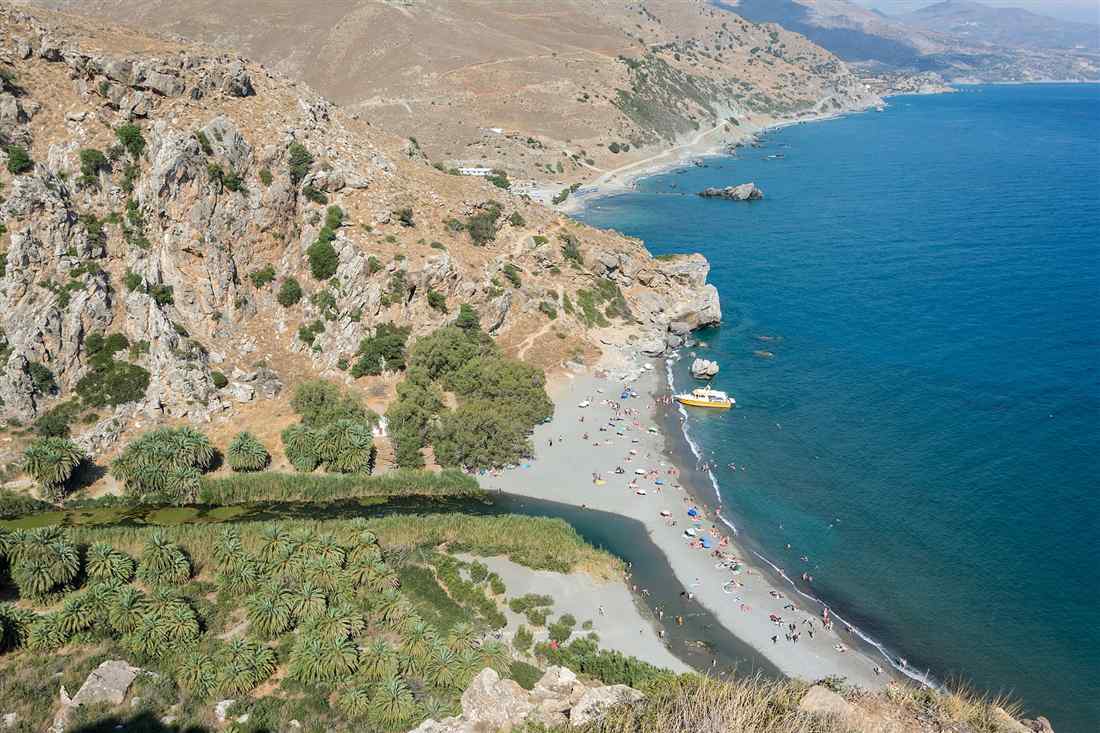
Preveli beach, also called Palm Beach or Phoenix Beach, sits on the south coast of Crete in the Rethymno region, about 100 km south-east of Chania. It lies below Preveli Monastery, where the Megalopotamos river of the Kourtaliotiko gorge meets the Libyan Sea.
The beach marks the mouth of the Megalopotamos, the river that drains the Kourtaliotiko gorge and empties into the Libyan Sea at the southern edge of the island. Chania stands on the north-west coast, facing the Cretan Sea, so a trip to Preveli crosses the width of western Crete from the north shore to the south shore. The straight-line distance is close to 45 km, but the mountains of the interior push the road distance out to about 100 km.
Administratively, Preveli belongs to the Rethymno regional unit, not Chania. The nearest resort town is Plakias, roughly 10 km to the west along the coast, and the small resort of Agia Galini sits to the east. The beach itself carries three names in common use: Preveli after the monastery on the cliff above, Palm Beach after the date-palm forest at the river mouth, and Phoenix Beach after Phoenix theophrasti, the Cretan palm that gives the valley its shade.
The setting is a river-mouth lagoon backed by a gorge. Freshwater runs down from the Kourtaliotiko gorge, spreads into a shallow lagoon behind the sand bar, and drains across the beach into the salt water of the Libyan Sea. Steep cliffs frame both sides of the cove, and the white Preveli Monastery stands on the headland to the east, about 3 km from the sand by road. This combination of gorge, palm forest, river and open southern sea fixes Preveli firmly on the south coast, a full mountain crossing away from Chania on the north.
How do you get from Chania to Preveli?
Three routes link Chania to Preveli: a hire car east on the E75/A90 to Rethymno then south over the mountains to the clifftop car park and steps, a boat from Plakias or Agia Galini along the coast, or an organised coach day tour. The drive runs about 1.75 to 2 hours.
The direct route is a hire car. From Chania the road heads east on the E75/A90 national road along the north coast to Rethymno, a fast dual-carriageway stretch of about 60 km. At Rethymno the route turns inland and south, climbing away from the coast on provincial roads that thread through the Kourtaliotiko gorge towards Plakias and the Preveli headland. The tarmac ends at an upper car park on the cliff, and the beach lies below at the foot of a stone stairway.
The second route uses the sea. Excursion boats and taxi-boats depart Plakias to the west and Agia Galini to the east, tracing the south coast and landing passengers directly on the sand at Preveli. Travellers pair this with a drive or bus to the departure port, then swap to the boat for the final coastal leg, which removes the cliff descent entirely.
The third route is an organised day tour. Coach operators run scheduled excursions out of Chania and the surrounding resorts, combining Preveli beach with Preveli Monastery and, on longer itineraries, the Kourtaliotiko gorge waterfall. The coach handles the driving and the mountain bends, drops passengers at the upper car park, and allows a fixed window on the beach before the return. Each route ends at the same cove, and the choice turns on whether a traveller drives, sails, or rides.
How long does it take to drive from Chania to Preveli?
Driving from Chania to Preveli takes about 1.75 to 2 hours over roughly 100 km. The route runs east on the national road to Rethymno, then south through the Kourtaliotiko gorge towards Plakias, ending at the upper car park above the beach. The final stretch is winding mountain road.
The first half of the journey is quick. The E75/A90 national road from Chania to Rethymno covers about 60 km of dual carriageway along the north coast, a run of 45 to 55 minutes at open-road speed. Traffic thins outside the two city edges, and the road holds a steady pace across the north of the island. This leg accounts for more than half the distance in a fraction of the total time.
The second half is slower by design. South of Rethymno the road leaves the coast and climbs into the hills, narrowing as it enters the Kourtaliotiko gorge. The tarmac twists through tight bends, passes the trailhead for the gorge waterfall, and descends towards the Plakias and Preveli turn-off. This 35 to 40 km inland section takes 50 to 60 minutes because of the gradients and the curves, so it consumes almost as much time as the faster coastal run despite covering less ground.
The road ends above the beach, not at it. Drivers reach an upper car park on the clifftop where the vehicle stops for good; the sand lies below at the foot of the descent. Adding a margin for the mountain driving and the final approach, the door-to-car-park total settles at 1 hour 45 minutes to 2 hours. Setting off early beats both the midday heat on the return climb and the competition for the limited clifftop parking spaces.
How do you get down to Preveli beach?
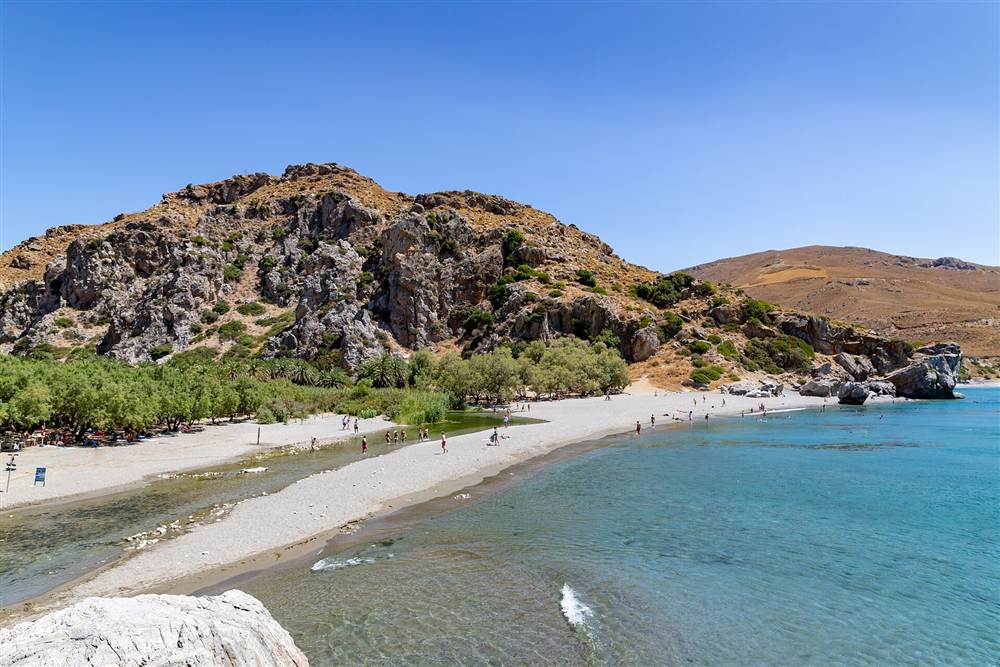
From the upper car park a stone stairway and path descend the cliff to the sand, a walk of 10 to 15 minutes down and a steeper climb back up. An alternative path from a lower car park cuts the effort, and the boat lands passengers on the beach with no steps at all.
The main descent starts at the upper car park on the clifftop. A built stone stairway and a rocky path zig-zag down the face of the cliff to the river mouth, dropping about 150 metres of height over 10 to 15 minutes. The steps are uneven in places and exposed to the sun, so sturdy footwear and water carry weight here. The return leg reverses the same route uphill and takes longer, 15 to 20 minutes at a steady pace, because of the constant gradient.
A second, gentler option exists. A lower car park sits closer to the beach along a rough track, and the path from there shortens the walk and softens the climb. This route suits travellers who prefer to trade a longer, rougher drive for a shorter descent on foot. Signage at the turn-off marks the split between the upper and lower approaches.
The no-steps option is the boat. Travellers who avoid the cliff descent entirely take a taxi-boat or excursion boat from Plakias or Agia Galini, which noses onto the sand and lands passengers at sea level. This removes both the downward stairway and the uphill return, a decisive advantage for anyone carrying young children, travelling with limited mobility, or unwilling to face the climb in the afternoon heat. Whichever path down a visitor picks, the beach, the river mouth and the palm forest wait at the bottom.
Can you take a boat to Preveli beach?
Yes. Excursion boats and taxi-boats run from Plakias and Agia Galini along the south coast to Preveli, landing directly on the sand. The boat bypasses the cliff steps and suits travellers unable to manage the descent, and it delivers a scenic approach along the Libyan Sea.
The main departure ports are Plakias, about 10 km west of Preveli, and Agia Galini to the east. Taxi-boats and scheduled excursion boats leave through the day in the warm season, cross the open water of the Libyan Sea, and pull up onto the beach at the river mouth. The crossing from Plakias runs 20 to 30 minutes depending on the sea state, and the return sailings space out through the afternoon so passengers set their own time on the sand.
The boat exists for a practical reason: it removes the cliff. Passengers who step off onto the beach skip the 150-metre stairway down and the steep climb back up, which makes Preveli reachable for older travellers, families with small children, and anyone who prefers to save their legs for swimming and walking the river. The vessel handles the height loss that the footpath demands.
The approach itself is part of the trip. From the water the palm forest, the river mouth and the cliffs of the cove open up in a single view that the clifftop path never frames the same way. Sailings hold to the calmer morning and midday hours, and strong afternoon winds off the Libyan Sea halt the boats when the swell rises, so travellers relying on the sea route confirm the day’s timetable at the harbour before committing.
What is Preveli Monastery above the beach?
The Holy Monastery of Preveli, or Moni Preveli, stands on the cliff above the beach. This historic Cretan Orthodox monastery sheltered Allied soldiers after the Battle of Crete in the Second World War and helped them escape by submarine. It holds a museum, a memorial, and views over the Libyan Sea.
Moni Preveli sits about 3 km by road from the beach, on a headland facing the Libyan Sea. The complex splits into two parts: the older Lower Monastery of Saint John, now in ruins beside the river, and the working Rear Monastery of Saint John the Theologian on the cliff, which receives visitors. Whitewashed buildings, a church, and a courtyard look south over the open water towards Africa, and the site remains an active centre of Cretan Orthodox monastic life.
Its fame rests on the Second World War. After the Battle of Crete, the monks of Preveli hid Allied soldiers left behind by the retreat, fed them, and organised their evacuation from the beach below, where a British submarine surfaced offshore to carry them to safety in Egypt. The monastery paid for this: occupying forces looted and damaged the buildings in reprisal. A memorial on the grounds marks the rescue and names the monks and soldiers tied to it.
The monastery museum holds the record of that history and of the community’s older life. Displays gather ecclesiastical treasures, silverwork, vestments, manuscripts and icons, alongside the wartime memorial that draws visitors up from the beach. From the terrace the ground falls away to the Libyan Sea, and the view stretches across the water and back towards the palm-lined river mouth below, tying the monastery on the cliff to the beach at its foot.
What is Preveli palm beach and the river like?
Preveli palm beach sits where the Megalopotamos river runs out through a forest of Theophrastus date palms to a lagoon behind the sand. Visitors swim in the cool river and the sea and walk upstream under the palms. The forest recovered after a fire, forming a rare palm-lined river mouth.
The defining feature is the meeting of fresh water and salt. The Megalopotamos flows down the Kourtaliotiko gorge and reaches the coast at Preveli, where it slows, spreads into a shallow lagoon behind the sand bar, and drains across the beach into the Libyan Sea. Bathers cross from the warm salt water of the sea into the cool fresh water of the river within a few steps, and the lagoon gives calm shallows sheltered from the open-sea swell.
The palm forest lines the river banks. Phoenix theophrasti, the Cretan date palm named after the ancient botanist Theophrastus, grows in a dense grove along the Megalopotamos, arching over the water and casting shade on the walk inland. This is one of the largest natural palm stands in Europe, and the river-mouth setting, a palm forest at the edge of the sea, is a rarity on the Mediterranean coast. A footpath follows the river upstream beneath the fronds towards pools and rock ledges.
The grove carries a mark of survival. A wildfire tore through the valley and burned much of the palm forest, blackening the trunks and stripping the canopy, but the palms regenerated from their fire-resistant stems and the grove grew back green along the banks. Today the recovered forest shades the river as before, and the beach draws swimmers, walkers and boats to the point where gorge, palm grove, river and Libyan Sea meet in a single cove. No other beach in Crete gathers a gorge river, a European palm forest, a freshwater lagoon and the open Libyan Sea into one cove, which is what carries visitors across the width of the island from Chania to reach it.
Is there a Preveli day tour from Chania?
Yes. Organised full-day coach tours run from Chania town and the west-coast resorts to Preveli, and the strongest itineraries pair the palm beach with the Kourtaliotiko gorge and a swim stop at Plakias or Damnoni, with hotel pick-up included.
A typical Preveli coach tour collects passengers from Chania and the resort strip between Agia Marina and Platanias early in the morning, then drives east along the north coast to Rethymno before turning south through the mountains. The route crosses the Kourtaliotiko gorge, where the coach halts at the roadside viewpoint above the river and the small chapel of Saint Nicholas. From the gorge the road drops to the Preveli Monastery, and the beach lies at the foot of the cliff below.
Two formats reach the sand. The coach-and-steps format parks at the upper car park and sends walkers down the cut stone staircase to the river mouth, a descent of roughly 400 steps. The coach-and-boat format drives instead to the small harbour of Plakias or Agia Galini, where a passenger boat runs along the Libyan Sea coast and lands directly on Preveli beach, sparing the cliff descent and adding a stretch of open water to the day.
Book the tour ahead of the travel date, because the Preveli boats and the licensed coaches sell their seats in blocks and the palm beach caps its visitor numbers to protect the river forest. A guided day trip removes the parking, the mountain driving and the return timing from the traveller, and the guide adds the monastery history and the gorge geology that a self-drive visit skips. Browse the wider set of day trips from Chania to compare Preveli against the other south-coast options before you reserve.
How long is the day from Chania to Preveli?
A Preveli day from Chania runs 10 to 12 hours door to door. The drive takes about 2 hours each way, and the cliff descent, the swimming, the river walk and the return climb fill the middle of the day, so an early start beats both the heat and the midday crowds.
The driving distance from Chania to the Preveli upper car park is 98 kilometres, and the road splits into two halves. The first hour runs fast along the north-coast national road to Rethymno. The second hour slows through the Kourtaliotiko gorge and the winding descent to the coast, where the last 12 kilometres tighten into hairpins above the Libyan Sea. Add the two hours back and the transport alone accounts for four hours of the day.
The cliff staircase adds its own time. The walk down from the upper car park to the river mouth takes 15 to 20 minutes, and the climb back up in the afternoon heat takes 25 to 30 minutes with rests. Between the two comes the reason for the trip: a swim in the Libyan Sea, a walk upstream under the palms to the freshwater pools, and a stretch of time on the sand. Three to four hours at the beach leaves the day unhurried.
Leave Chania by 8 in the morning to reach the beach before the sun sits high over the exposed staircase and before the boat groups land from Plakias around midday. An early arrival buys shade on the descent, cooler stone underfoot and an empty stretch of river before the crowds gather. Plan the return climb for late afternoon, when the cliff falls into shadow and the temperature drops off the rock.
What is the Kourtaliotiko gorge on the way to Preveli?
The Kourtaliotiko gorge is the deep river canyon the road threads through on the way from Rethymno to Preveli. The Megalopotamos river runs down it to Preveli beach, and a roadside chapel and a footpath lead to the gorge waterfalls and pools below the cliffs.
The gorge cuts a steep-walled corridor through the mountains south of Rethymno, its limestone faces rising sheer above the river. The road to Preveli runs along its rim and crosses it, so the drive delivers the gorge as a natural stop on the way to the beach. Griffon vultures ride the thermals along the walls, and the rock towers close in on both sides of the river.
The name comes from the wind. Sudden gusts funnel through the narrows with a sound like a thunderclap, “kourtala” in the local dialect, which gives the Kourtaliotiko gorge its name. At the roadside stands the chapel of Agios Nikolaos, from where a built stone stairway descends to the river, the waterfalls and the deep green pools at the foot of the cliffs.
The walk down and back takes about 30 to 40 minutes and reaches the pools where the Megalopotamos gathers before its run to Preveli. The cold fresh water and the shaded rock basins make the gorge a cooling break on the drive south, and the same river that fills these pools reaches the sea through the palm forest at Preveli beach an hour later downstream.
Where do you park at Preveli beach?
Preveli has two car parks above the beach: an upper car park at the top of the main cliff stairway, and a lower car park along a rough track that shortens the walk down. Both fill from mid-morning in high summer, so an early arrival secures a space.
The upper car park sits on the clifftop at the head of the cut-stone staircase, the standard stop for the coaches and most cars. From here the beach lies about 150 metres below at the foot of the descent. The car park charges a small daily fee, collected at the entrance in the warm season, and its spaces are the first to fill as the tour coaches arrive towards midday.
The lower car park lies along a rougher unpaved track that branches off before the clifftop, closer to the river mouth and the beach. The walk down from here is shorter and gentler, which suits families and older visitors, at the cost of a slower, bumpier drive to reach it. Signage at the junction marks the split between the upper and lower approaches.
Both car parks empty of spaces by late morning through July and August, when the day-trippers and the coach tours converge on the beach. An arrival before 10 in the morning finds room in either car park and the staircase still in partial shade; a midday arrival competes for the last spaces and faces the descent in full sun. The boat from Plakias sidesteps the parking entirely.
What does a visit to Preveli beach cost?
Preveli beach itself is free to enter. The costs are the clifftop car park’s small daily fee, sunbed and umbrella hire on the sand, the canteen for food and drinks, the passenger-boat fare from Plakias, and the entry ticket to Preveli Monastery on the cliff above.
The sand carries no entrance charge; the beach is open to all. The car park levies a modest daily fee per vehicle in the warm season, and sunbeds with umbrellas hire out by the day from the front of the beach for those who want shade and a base rather than a towel on the open sand.
The canteen on the beach sells water, cold drinks, snacks and light food through the day, and pedal boats hire by the hour for the run up the river under the palms. Travellers arriving by sea pay the passenger-boat fare from Plakias or Agia Galini, a round-trip ticket bought at the harbour that covers the coastal crossing each way.
Preveli Monastery on the headland charges a small entry ticket that admits visitors to the museum, the church and the wartime memorial. The monastery keeps set opening hours through the day and closes over a midday break, so a stop there fits either before the descent to the beach or after the climb back up, and the ticket supports the upkeep of the site and its protected palm valley.
What is the Cretan date palm forest at Preveli?
The palm forest at Preveli is a natural grove of Phoenix theophrasti, the Cretan date palm, one of the largest wild palm stands in Europe. It lines the Megalopotamos river behind the beach, a protected habitat that recovered its green canopy after a wildfire swept the valley.
Phoenix theophrasti is a wild date palm native to Crete and the south-east Aegean, named after Theophrastus, the ancient Greek botanist who first described the island’s plants. Unlike the ornamental palms planted along resort fronts, this species grows here in a natural forest, rooted along the freshwater river where it meets the sea, and the Preveli grove ranks among the largest of its kind on the continent.
The forest is a protected habitat. The palms shade the Megalopotamos as it runs to the lagoon, holding the riverbanks and sheltering the freshwater pools upstream, and the whole valley carries protected status that bars building on the sand and keeps the grove intact. The monastery’s guardianship of the land is part of why the beach stays free of hotels.
The grove carries the scar and the recovery of a wildfire that tore through the valley, blackening the trunks and stripping the canopy along the river. The Cretan date palm regenerates from fire-resistant stems, and the forest grew back green along the banks within a few seasons, its fronds once again arching over the water. The walk upstream beneath the recovered canopy is the signature of a Preveli visit.
Is Preveli beach worth the trip from Chania?
Yes. Preveli is a rare palm-forest river beach where a freshwater stream meets the Libyan Sea beneath a historic monastery, and the combination of lagoon, palm grove and open sea places it among the finest day trips in western Crete, worth the long drive and the cliff steps.
The setting is unlike the rest of the island. The Megalopotamos river runs out of the Kourtaliotiko gorge and reaches the sea through a dense grove of Cretan date palms, one of the largest natural palm stands in Europe. At the river mouth the fresh water pools into a shallow lagoon behind the sand, so a single spot holds a cool river swim, a warm sea swim and the green wall of the palm forest all within a few steps.
The history sits above the beach. Preveli Monastery sheltered Allied soldiers during the wartime evacuation of Crete and organised their escape by submarine from this coast, and the monastery museum records that story alongside its icons and manuscripts. The monastery keeps the beach and its palms as a protected site, which is why the sand carries no hotels and the forest stays intact.
The trade-off is honest: the drive is two hours each way and the cliff staircase is a real climb in summer heat. Set against that, the reward is a landscape that no north-coast resort beach matches. For travellers weighing the effort, Preveli earns its place on any shortlist of Chania day trips, and the detailed guide to Preveli beach sets out the descent, the parking and the river walk in full.
When is the best time to visit Preveli?
Late spring to early autumn is the season for Preveli, and early morning is the hour. The river runs cool through the summer, the palm forest is greenest in spring, and an arrival before 10 beats the heat on the exposed staircase and the tour crowds that land at midday.
The beach opens to its full appeal from May to October, when the Libyan Sea warms and the canteen on the sand runs its full service. Spring brings the palm forest to its brightest green and the river to its fullest flow after the winter rains, so a May or June visit pairs a lush grove with a strong freshwater stream. Late September and early October hold warm sea temperatures with thinner crowds and softer light on the cliff.
The time of day matters as much as the month. The stone staircase faces south and takes direct sun from mid-morning, so the descent turns hot by 11 and the afternoon climb back up is the toughest part of the day in July and August. An arrival between 8 and 10 in the morning finds the steps in partial shade and the sand nearly empty before the Plakias boats deliver their passengers.
Avoid the middle of the day on the exposed rock. Between noon and 3 in high summer the staircase and the open sand carry the full heat with no shade, and the freshwater river becomes the relief that draws every visitor at once. The river holds its cool temperature through the hottest weeks because it runs straight out of the shaded Kourtaliotiko gorge, so a morning arrival wins the coolest water and the quietest palm walk.
Is Preveli beach good for families?
Yes, with one caveat. The river and the lagoon give children shallow, calm fresh water away from the sea waves, and pedal boats run upstream under the palms. The cliff staircase is the challenge with young children, so families with toddlers take the boat from Plakias instead.
The freshwater river is the reason Preveli suits children. Behind the sand the Megalopotamos pools into a shallow lagoon with a gentle current and no waves, so young swimmers paddle in cool, calm water while the open sea stays a few steps away for stronger swimmers. The riverbed is soft and the depth stays low for the first stretch upstream, which keeps small children within easy reach on the bank.
The beach carries the practical support a family day needs. A canteen on the sand sells water, snacks and cold drinks, sunbeds and umbrellas line the front of the beach for shade, and pedal boats hire out by the hour for a trip up the river under the palm canopy. The pedal-boat run upstream to the pools is the highlight for children, a short paddle through the green forest to the shaded rock basins.
The staircase is the single obstacle. The 400-step cut-stone descent and the afternoon climb back are hard work for a family carrying a toddler and beach gear in the heat. Families with very young children take the passenger boat from Plakias, which lands straight on the sand and removes the cliff entirely, turning the visit into a level walk from the water’s edge.
What is there to do at Preveli beach?
Preveli fills a full day of river and sea. Swim in the Libyan Sea and the freshwater lagoon, walk upstream under the palms to the rock pools, hire a pedal boat on the river, snorkel the rocky headlands, and climb to the monastery and its wartime museum on the cliff above.
The water is the first draw. The sand fronts open Libyan Sea for a salt swim with clear blue depth off the beach, and the river lagoon behind it holds cool fresh water for a second, calmer swim. The two sit a few metres apart at the river mouth, so a single afternoon alternates between warm sea and cold stream without moving far along the sand.
The palm walk defines the place. A footpath follows the Megalopotamos river inland from the beach, threading beneath the Cretan date palms to a chain of freshwater pools and small waterfalls carved into the rock. The walk runs 20 minutes to the first pools through deep shade, and the pools give a quiet swim away from the beach crowd. Pedal boats hired on the sand cover the same route by water for those who prefer to paddle.
Above the beach the monastery adds a cultural stop, its museum holding icons, manuscripts and the record of the wartime submarine evacuations organised from this coast. On the drive in, the Kourtaliotiko gorge offers a short walk down to the river chapel and the gorge waterfalls, and the rocky headlands at each end of Preveli beach give clear snorkelling over stone and posidonia. Together the river, the sea, the palms, the pools and the monastery make Preveli a full day rather than a single swim.
Which beaches are near Preveli?
Preveli anchors a south-coast beach cluster in the Rethymno region. Plakias, Damnoni, Schinaria and Ammoudi lie a short drive to the west, and the resort of Plakias makes the natural base, so a Preveli morning pairs neatly with a Plakias-area beach in the afternoon.
Plakias sits 9 kilometres west of Preveli and works as the hub for the whole coast. Its long sandy bay carries tavernas, sunbeds and the harbour where the Preveli passenger boats depart, and the town gives the one cluster of rooms, shops and car hire on this stretch of the Libyan Sea. A base in Plakias puts Preveli, the gorge and three more beaches within a 15-minute drive.
The smaller bays fan out from Plakias. Damnoni is a sheltered sandy cove 3 kilometres east with calm water and a taverna, Schinaria is a wide clear-water bay favoured by snorkellers and divers a little further on, and Ammoudi is a compact sandy beach between the two with quiet water for families. Each holds a different character, so the coast rewards a base rather than a single stop.
Because the beaches sit so close together, a Preveli day extends into a two-beach afternoon with ease: the palm river in the morning, then a level swim at Damnoni or Plakias once the cliff climb is done. Travellers building a west-Crete swimming itinerary set this south-coast cluster against the north-coast options in the guide to Chania beaches, and use the Chania hub to plan the routes between them.
Frequently Asked Questions
How do you get from Chania to Preveli?
From Chania to Preveli, drive about 100 kilometres south-east on the E75/A90 national road to Rethymno then south over the mountains through the Kourtaliotiko gorge to the clifftop car park, take the boat from Plakias, or join an organised coach day tour. The drive runs 1.75 to 2 hours.
How far is Preveli from Chania?
Preveli beach lies about 100 kilometres south-east of Chania by road, on the south coast in the Rethymno region. The drive takes 1.75 to 2 hours: fast national road to Rethymno, then a winding mountain road south through the Kourtaliotiko gorge to the beach.
Is the trip from Chania to Preveli worth it?
The trip from Chania to Preveli rewards visitors with a rare palm-forest river beach where a freshwater lagoon meets the Libyan Sea beneath a historic monastery. The long drive and the cliff steps are the trade-off, eased by the boat from Plakias.