
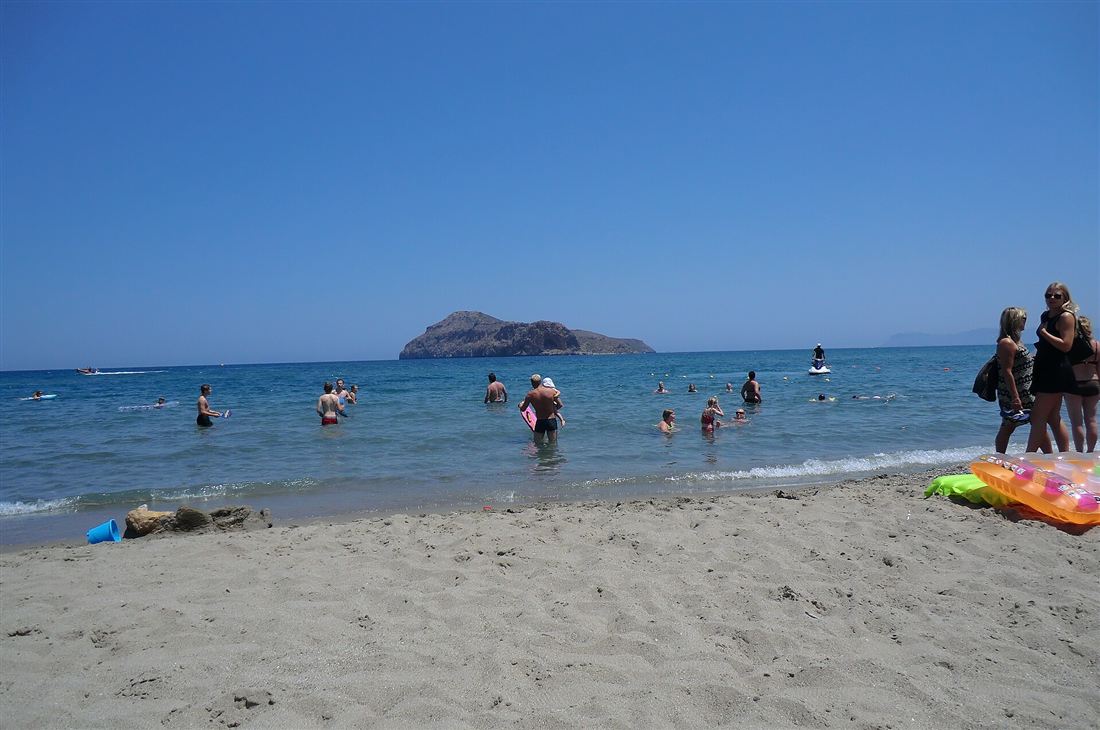
Platanias is a lively beach resort town 11 kilometres west of Chania on the north coast of Crete, strung along a long sandy beach facing the Agioi Theodoroi island, with an old village on the hill above and a busy summer nightlife. Plan the whole trip with Greece Tours.
This guide covers Platanias in full: what and where the resort is, the beach and the offshore island, what there is to do, the old hill village and its wartime tunnels, the nightlife, the tavernas, whether it suits families or couples, where to stay, the beaches and day trips nearby, the airport transfer, the best time to come, and whether Platanias is worth visiting.
What is Platanias in Crete?
Platanias is the lively beach resort town on the north coast of Crete, 11 km west of Chania. It joins a long sandy beach, a dense strip of bars and clubs, and an old stone village on a wooded hill above the shore.
Platanias sits in the Chania regional unit at the western end of Crete. The name comes from the plane trees (platania in Greek) that shade the old village and the riverbed that reaches the sea here. The modern resort runs along the coast road, while the historic settlement climbs the hill behind it. The two halves give the town a double identity: a fast, seasonal beach strip below and a slow, stone-built village above.
The resort draws visitors who want a full beach holiday with distances kept short. The main beach fronts a continuous line of hotels, apartments and tavernas. The nightlife district concentrates into a single walkable stretch of the coast road. The old village delivers Venetian-era lanes, sea views and a network of tunnels dug into the rock. Chania old town, the harbour and the covered market lie a quarter of an hour east by bus or car.
Platanias forms a natural base for the whole of western Crete. The road west leads to Kolymvari, Kissamos and the Gramvousa peninsula. The road inland climbs toward the Lefka Ori, the White Mountains, and the gorges that cut down to the Libyan Sea. The airport at Chania and the ferry port at Souda both stand within a short transfer, which keeps arrivals and departures simple.
Where is Platanias and how far is it from Chania?
Platanias lies on the north coast of Crete, 11 km west of Chania town along the coastal road through Agia Marina. The drive takes 20 minutes. The Chania town bus and the KTEL regional buses both serve the strip through the day.
The route from Chania runs west past Kalamaki and Agia Marina before reaching Platanias, following the shoreline the whole way. The road is the old national road, a slow coastal route lined with hotels, shops and beach access rather than a motorway. The New National Road (E75) runs parallel just inland for drivers who want a faster link to Kissamos or east toward Rethymno and Heraklion.
Public transport reaches the resort at a high frequency in the summer season. The blue Chania town buses run the coastal line from the central bus station and the Agora market area out to Platanias and Kato Stalos, stopping along the strip. KTEL Chania-Rethymno buses on the Kissamos route also halt at Platanias. A taxi from Chania town centre reaches the resort in around 15 minutes. For a wider picture of the area and its transport links, the guide to Chania sets out how the coast and town connect.
The position west of Chania puts Platanias between the town and the wild beaches of the far west. Balos lagoon and Falassarna sit on the road onward; Elafonisi lies south-west across the peninsula. This placement turns the resort into a launch point for day trips in three directions: east to Chania old town, west to the lagoons, and south to the mountains and gorges.
What is Platanias beach like?
Platanias beach is a long stretch of grey-gold sand and fine shingle, fully organised with sunbeds, umbrellas and water sports. It faces the small goat island of Agioi Theodoroi offshore and earns a Blue Flag for its clean water and facilities.
The beach runs for kilometres, merging with Agia Marina to the east and Gerani to the west into one near-continuous coastal band. The sand is coarse toward the waterline and mixes with pebbles in places, and the seabed shelves gently, which keeps the shallows calm for wading and swimming. Sunbed-and-umbrella sets line the front of the beach bars, and free stretches of open sand sit between them for towels and mats.
Water sports operators work the busier sections through the summer. The line-up runs to jet skis, pedal boats, canoes, stand-up paddleboards, banana rides and inflatable tubes. Showers, changing points and lifeguard cover back the main organised zones. Beach bars serve drinks and light food to the loungers, and the promenade behind the sand carries a steady flow of walkers, joggers and cyclists.
Directly offshore stands Agioi Theodoroi, a rocky islet also called Thodorou. The island is a protected reserve for the kri-kri, the wild Cretan goat, and a cave at its western end forms a shape islanders name the Dragon’s Mouth. Landing is restricted to guard the wildlife, but the islet frames every view from the shore and marks the seascape at Platanias apart from the flatter horizons east of Chania. The wider Chania beaches guide places Platanias among the region’s leading coastal spots.
What is there to do in Platanias?
Platanias delivers a beach day, a nearby water park, boat trips to the islands and coves, the old hill village with its tunnels, and a nightlife strip after dark. Watersports, tavernas and shops fill the hours between sea and sunset.
The beach anchors the day. Swimmers, sunbathers and watersports riders fill the shore from morning, and the beach bars keep the loungers supplied through the afternoon. The Limnoupolis water park stands a short drive inland at Varypetro, south of Chania, with slides, pools and a lazy river for a break from the salt water. Boat trips depart from the Chania and Kissamos harbours nearby, running to Balos lagoon, the Gramvousa fortress island and the coves along the coast.
The old village of Platanias rewards a climb up the hill. Its lanes lead to viewpoints over the whole bay, a shaded platia under the plane trees, and the entrances to wartime tunnels bored into the rock. Cycling and walking the coastal promenade links the resort to Agia Marina and Gerani on foot or by bike. Shops along the strip stock beachwear, Cretan produce, olive oil, honey and leather goods.
Evenings turn the strip into the entertainment core of western Crete. The bars fill first, the clubs later, and the beach venues run music nights beside the sand. Between the daytime beach and the after-dark scene, the resort keeps a full programme from breakfast to the early hours.
What is the old village of Platanias on the hill?
The old village of Platanias is the Venetian-era settlement on the wooded hill above the resort. Stone houses and narrow lanes climb to viewpoints over the bay, a plane-shaded square holds tavernas, and tunnels dug in the Second World War run through the rock beneath.
The hill village predates the coastal strip by centuries. Cretans built their homes on high ground away from the shoreline for defence against raiders from the sea, and Platanias followed the pattern. The lanes twist between tall stone fa\u00e7ades, small churches and courtyards heavy with bougainvillea and vines. The central square sits under the plane trees that give the town its name, and the tavernas around it serve food with the bay spread out below.
The panorama is the draw. From the top of the village the view takes in the full sweep of the coast, the offshore island of Agioi Theodoroi and, on a clear day, the outline of the Rodopou peninsula to the west. Sunset over the sea from the hill ranks among the finest along this coast.
Beneath the streets runs a network of tunnels cut by German forces during their wartime occupation of Crete, part of the defences built after the Battle of Crete on the plains and beaches nearby. The passages honeycomb the hill and open onto the village at points along the climb. The old settlement, then, layers a defensive past onto a resort present, and a short walk up from the beach delivers both the history and the best view in the district.
What is the nightlife in Platanias like?
Platanias holds the busiest nightlife on the Chania coast. The strip along the coast road packs cocktail bars, dance clubs and beach venues into a walkable stretch that runs from late evening to the early hours through the summer season.
The nightlife concentrates into the central section of the resort, where the coast road turns into a near-solid line of bars and clubs. The evening starts slow, with drinks on the terraces and beach bars as the sun drops. As the night deepens, the music venues take over and the crowd moves between them along the strip. Greek and international DJs work the larger clubs, and open-air venues run parties beside the sand.
The scene draws a young, energetic crowd from the surrounding resorts, and Platanias serves as the after-dark hub for Agia Marina, Gerani, Maleme and the coast west of Chania. The venues cluster tightly enough to walk the whole night on foot, which keeps the district compact and lively rather than spread thin.
Away from the central strip the tone changes. The eastern and western ends of the resort, and the old village on the hill, stay quiet, with tavernas and low-key bars rather than clubs. This split lets the town serve both a party crowd and visitors who want a calm evening a few hundred metres from the noise, all within the same resort.
Where do you eat in Platanias?
Platanias feeds visitors at beachfront tavernas, hill-village kitchens and coast-road grills. The menus run to Cretan classics: dakos, grilled fish, lamb, snails, cheeses and horta, backed by local olive oil, raki and wine from the Chania vineyards.
The beachfront tavernas serve the sea-view seats, with tables set close to the sand and menus built around fresh fish, grilled octopus, calamari and Cretan meze. The old village kitchens on the hill cook slower, traditional food away from the strip, with wood-oven dishes, wild greens and roast lamb, and a view over the bay from the terrace. The coast road carries grills, gyros counters and family tavernas for quick meals between beach and bar.
Cretan cooking rests on the island’s own produce. Dakos, the barley rusk topped with grated tomato, soft cheese and olive oil, opens most meals. Dishes of horta (boiled wild greens), gigantes (baked butter beans), kalitsounia (cheese and herb pastries) and grilled sardines fill the tables. Cretan graviera cheese, thyme honey and the extra-virgin olive oil of the Chania plain carry the local flavour, and a carafe of raki closes the meal by tradition.
The resort also stocks international kitchens for the summer crowd, from pizzerias to Asian and grill houses along the strip. Bakeries and caf\u00e9s serve breakfast and Greek coffee through the morning, and the tavernas of the old village stay open for late dinners under the plane trees. Between the beach terraces and the hill kitchens, the town covers the full range from a quick beach lunch to a long evening feast.
Is Platanias good for families?
Platanias suits families well. The long organised beach shelves gently into calm shallows, the resorts run pools and kids’ facilities, the Limnoupolis water park sits a short drive inland, and shops, tavernas and medical services stand within walking distance of the sand.
The beach is the strongest draw for children. The seabed slopes gradually, keeping the water shallow and calm near the shore, and lifeguards cover the main organised zones through the season. Sunbeds, umbrellas, showers and beach bars line the front, so a family day needs no long walk for shade, drinks or a snack. The pedal boats and inflatables give older children a watersports option a few steps from the towels.
The resorts and apartment complexes gear their facilities toward families, with swimming pools, children’s pools, play areas and self-catering kitchens across the accommodation. The Limnoupolis water park at Varypetro, a short drive inland toward Chania, adds slides, pools and a lazy river for a full day out of the sun’s glare. Supermarkets, pharmacies, bakeries and a health centre sit along the strip for everyday needs.
Distances stay short, which matters with young children. Chania old town, with its harbour, market and maritime museum, lies 20 minutes east for a change of scene. The flat coastal promenade suits pushchairs and small bikes, and the calm ends of the resort keep the beach day away from the nightlife strip. Platanias, then, works as a family base that keeps beach, town and attractions all within a tight radius.
Is Platanias good for couples and nightlife seekers?
Platanias fits couples and nightlife seekers on both counts. The central strip holds the liveliest bars and clubs on the Chania coast, while the quiet old village and the calm ends of the resort deliver sunset dinners and slow evenings a short walk from the noise.
For a nightlife holiday the resort concentrates the action. The bars and clubs pack into one walkable strip, so an evening runs from cocktail terraces to dance floors without a taxi. The beach venues host summer parties beside the sea, and the crowd from the surrounding resorts gathers here after dark, which keeps the district full through the season. The energy peaks in high summer and continues into the early hours.
For couples who want romance over volume, the town keeps a second gear. The old village on the hill serves candlelit dinners under the plane trees with the bay lit below, and sunset from the top ranks among the best views on the coast. The eastern and western fringes of the beach stay calm, with quiet tavernas and low-key wine bars. A couple books a beachfront room for the sea view and walks ten minutes for either the party or the peace.
The mix is the point. Few resorts on Crete put a hard-charging nightlife strip and a romantic stone village within the same five minutes’ walk. Platanias lets a couple tune the trip: a big night out one evening, a quiet hilltop dinner the next, with the beach and the sea view constant between them.
Where do you stay in Platanias?
Platanias offers beachfront resorts, mid-range hotels, self-catering apartments and studios, and quiet rooms in the old village on the hill. The beachfront puts guests on the sand and near the nightlife; the village trades sea steps for calm, views and lower prices.
The beachfront and coast-road accommodation runs from large resort hotels with pools and all-inclusive boards to family-run apartments and studios. These places put guests within steps of the beach, the watersports and the strip, which suits visitors who want the sea and the nightlife on the doorstep. Prices climb toward the central section near the clubs and ease toward the quieter eastern and western ends of the resort.
The old village on the hill holds a different kind of stay. Restored stone houses, small guesthouses and rooms above the tavernas offer quiet nights, bay views and a village atmosphere a short walk uphill from the beach. This choice trades the immediate sand for calm and character, and the rates tend to sit below the beachfront.
The choice comes down to priority: sea and nightlife on the beachfront, or peace and views in the village, with self-catering apartments across both for families and longer stays. For a fuller breakdown of the districts and how they compare, the guide to where to stay in Chania sets Platanias against the town and the other coastal resorts.
What day trips and beaches are near Platanias?
Platanias reaches the west of Crete with ease. Balos lagoon and Falassarna lie west, Elafonisi south-west, Agia Marina and Gerani beaches sit next door, and Chania old town stands 20 minutes east. Boat trips and buses run to each through the season.
Balos lagoon, on the Gramvousa peninsula an hour west, ranks among the most photographed beaches in Greece, with turquoise shallows over white sand and the Venetian fortress island of Gramvousa offshore. Boat cruises depart from Kissamos port, and a rough road plus a walk reaches Balos overland. Falassarna, on the west coast, delivers a long open sandy beach and celebrated sunsets over the Libyan Sea. Elafonisi, the pink-sand lagoon in the south-west, makes a full day out by car or tour bus.
Closer to base, the beaches string along the coast on both sides. Agia Marina lies immediately east, sharing the same organised sand and facing the same island of Agioi Theodoroi. Gerani and Maleme continue the coast to the west, quieter and backed by the wartime airfield and German cemetery at Maleme. The whole strip walks or cycles as one from Platanias.
Chania old town, 20 minutes east, delivers the Venetian harbour, the lighthouse, the covered agora market and a maze of lanes for a half-day of sightseeing and shopping. Inland, the Therisso gorge and the foothills of the White Mountains open a mountain day, and the Samaria gorge trailhead at Omalos lies within reach for a longer excursion. From one resort, then, the day-trip menu covers lagoons, beaches, a historic town and a mountain range.
How do you get to Platanias from Chania airport?
Chania airport at Akrotiri lies about 25 km from Platanias, a 30-to-35-minute drive. A pre-booked private transfer runs door to door, a taxi covers the route on a fixed western-Crete tariff, and a bus link through Chania town connects for budget travellers.
The airport (Chania International, code CHQ) sits on the Akrotiri peninsula north-east of Chania town. The road to Platanias skirts the town or takes the ring road west, then follows the coast through Agia Marina to the resort. A private transfer booked ahead is the simplest route, with a driver meeting the flight and delivering guests to the hotel door in half an hour. Airport taxis wait outside arrivals and run the trip on a set tariff for the western resorts.
Public transport takes longer but costs less. The airport bus runs to the Chania central bus station, and a second bus, the blue town line toward Platanias and Kato Stalos, completes the journey along the coast. This route needs a change in town and suits light luggage and a flexible schedule rather than a late-night arrival.
The ferry port at Souda, the sea gateway to Chania, stands a similar distance from Platanias and connects to Piraeus on the overnight boats. Arrivals by sea reach the resort by the same transfers and taxis that serve the airport. Either way, the short distance keeps the transfer under 40 minutes and the resort within easy reach of both gateways.
When is the best time to visit Platanias?
The best time to visit Platanias runs from late May to early October. July and August bring the hottest weather, the fullest beaches and the peak nightlife. May, June, September and October deliver warm sea, thinner crowds and lower prices in the shoulder season.
High summer, July and August, is the resort at full pitch. Temperatures climb into the mid-thirties Celsius, the sea warms through, every sunbed fills, the watersports run flat out and the nightlife strip roars until dawn. This is the window for a party holiday and the guaranteed heat, at the cost of the highest prices and the densest crowds. Booking ahead matters most in these two months.
The shoulder months reward visitors who want the beach without the crush. June and September hold warm, settled weather and a sea heated by the summer, with the resort open and busy but not overrun. May and early October cool a little and quieten further, with green landscapes in spring and the last of the warmth in autumn, plus the sharpest drop in accommodation rates.
Winter closes much of the resort. From November the beach hotels, clubs and watersports shut down, and Platanias reverts to a quiet local village where the old hill settlement lives on year-round while the strip sleeps. A visitor after sun, sea and nightlife targets the May-to-October window; a visitor after empty lanes and low prices takes the edges of it.
What shopping is there in Platanias?
Platanias lines its coast road with shops through the summer. Supermarkets, bakeries and pharmacies cover daily needs, while gift shops stock Cretan olive oil, thyme honey, herbs, leather sandals, ceramics and jewellery. A weekly street market brings fresh produce to the resort.
The strip serves the practical side first. Mini-markets and supermarkets supply self-catering apartments, and bakeries, butchers and a pharmacy stand within walking distance along the coast road. Beachwear shops, sunglasses stalls and souvenir stores fill the gaps between the tavernas and bars for the beach crowd.
The local produce carries the flavour of Chania home. Extra-virgin olive oil from the surrounding groves, thyme and pine honey, dried mountain herbs, graviera cheese and bottles of raki fill the gift shops. Leather sandals, woven textiles, ceramics and silver jewellery from Cretan workshops round out the buying, and the weekly market adds fruit, vegetables and cheese direct from the growers of the plain.
What is Agioi Theodoroi island off Platanias?
Agioi Theodoroi, also called Thodorou, is the small rocky island a short distance off Platanias beach. It is a protected nature reserve for the wild Cretan kri-kri goat, and a sea cave at its western tip forms the shape islanders name the Dragon’s Mouth.
The islet dominates the view from the whole Platanias shore and marks the seascape apart from the open horizons east of Chania. Its steep flanks rise straight from the water, and the ruins of a Venetian fort crown the high ground, a relic of the defences that once guarded the approach to Chania harbour from raiders and pirates.
The island now serves as a wildlife sanctuary. The kri-kri, the wild goat native to Crete, lives on its slopes under protection, and access to the land is restricted to guard the herd and the nesting birds. Boats pass close on coastal cruises for the view of the fort and the Dragon’s Mouth cave, and the islet frames every Platanias sunset from the beach and the hill village above.
What water sports run at Platanias beach?
Platanias beach runs a full water sports line-up through the summer season. Jet skis, banana rides, inflatable tubes, pedal boats, canoes and stand-up paddleboards operate from the organised zones, and diving and boat hire depart from the harbours along the coast.
The powered sports cluster at the beach bars in the central section, where operators launch jet skis, tow bananas and ringos, and rent pedal boats and canoes by the hour. The calm shallows near the shore suit stand-up paddleboarding and kayaking, and the gentle shelving of the seabed keeps beginners on their feet within wading depth. Instructors work the busier stretches for first-time riders.
The wider coast opens more of the water. Scuba diving schools around Chania run trips to reefs and wrecks off the north shore, and boat hire from the nearby ports puts a small craft within reach for a day on the water. Between the beach operators and the harbour trips, the resort covers everything from a pedal boat with children to a dive off the Chania coast.
Is Platanias worth visiting?
Platanias is worth visiting for a beach-and-nightlife holiday close to Chania. It combines a long Blue Flag beach, the liveliest bar strip on the coast, a historic hill village with sea views and tunnels, and a 20-minute reach to Chania old town.
The case for Platanias rests on its balance. The organised sandy beach and gentle shallows suit families and sun-seekers; the concentrated strip of bars and clubs draws the nightlife crowd; the old stone village on the hill adds history, quiet and the finest sunset view on the coast. The offshore island of Agioi Theodoroi frames the seascape, and the resort covers every need from breakfast to the early hours within a short walk.
The location seals the value. Chania old town and its Venetian harbour sit 20 minutes east, the wild lagoons of Balos and Falassarna lie to the west, the airport and ferry port stand within a half-hour transfer, and the beaches of Agia Marina and Gerani join the resort on either side. One base reaches town, lagoons, mountains and gorges across the whole of western Crete.
The verdict is yes for the right traveller. A visitor who wants a full beach day, a big night out and short distances to the sights takes Platanias without hesitation. A traveller after solitude and untouched coastline heads further west or south. For the beach-plus-nightlife holiday near Chania, Platanias stands as the definitive choice on this coast.
Frequently Asked Questions
What is Platanias in Crete?
Platanias is a lively beach resort town 11 kilometres west of Chania on the north coast of Crete. It has a long sandy beach facing the Agioi Theodoroi island, an old Venetian-era village on the hill, and a busy summer bar and club scene.
Is Platanias good for families or nightlife?
Platanias suits both. The shallow organised beach, the resorts and the nearby water park draw families, while the main strip runs bars, clubs and beach venues for nightlife. The quieter ends toward Gerani balance the lively centre.
How far is Platanias from Chania?
Platanias lies about 11 kilometres west of Chania town, a 20-minute drive or a frequent local bus along the coast road. Chania International Airport is about 25 kilometres east, a 30 to 40 minute transfer.