
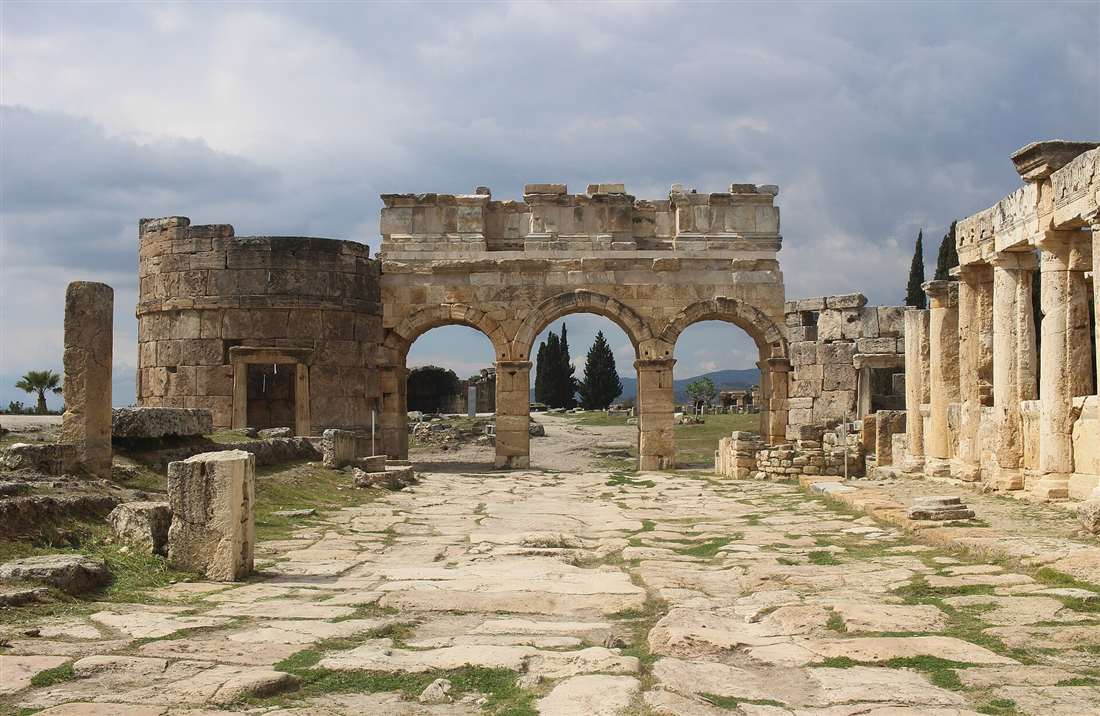
The Frontinus Gate is the monumental triple-arched north gate of Hierapolis at Pamukkale, flanked by two round towers, built in the first century AD by the proconsul Sextus Julius Frontinus and dedicated to the emperor Domitian. Plan the whole trip with Greece Tours.
This guide covers the Frontinus Gate in full: what it is and where it stands, who Frontinus was and whom the gate honoured, what the arches and towers look like, the colonnaded Frontinus Street that runs from it, when it was built, why the city needed a ceremonial gate, what survives today, and how it opens the walk down through Hierapolis from the necropolis.
What is the Frontinus Gate at Hierapolis?
The Frontinus Gate is the monumental triple-arched northern entrance to the ancient city of Hierapolis, flanked by two round defensive towers. Built of travertine and marble in the first century AD, it marks the ceremonial gateway into the Roman city.
The structure carries three round arches set within a single broad facade, the central arch wider and taller than the two side arches. Each end of the gate meets a solid circular tower, giving the monument the appearance of a fortified triumphal entrance rather than a plain city wall opening. The gate opens directly onto the paved colonnaded street that runs the length of the city.
Archaeologists also record the monument as the Gate of Domitian, after the reigning emperor named in the dedicatory inscription. It stands among the best-preserved gateways of Roman Asia Minor and anchors the northern edge of the excavated urban grid at Hierapolis, the thermal city above the white travertine terraces.
Where is the Frontinus Gate in Hierapolis?
The Frontinus Gate stands at the northern end of Frontinus Street, the colonnaded main street of Hierapolis. It sits directly beside the northern necropolis, so travellers arriving along the road from the burial grounds pass through the gate to enter the city.
The position is deliberate. The road from the north approaches the city past rows of tombs and sarcophagi, then reaches the twin towers and passes beneath the central arch. From that threshold the visitor steps onto the straight paved avenue that leads south through the heart of the settlement toward the southern gate.
This northern entrance connects to the wider Pamukkale site, where the calcite terraces and thermal pools draw travellers up the hillside. The gate marks the join between the world of the dead in the necropolis of Hierapolis and the living city that grew around the hot springs of Pamukkale.
Who was Frontinus and who was the gate dedicated to?
The gate is named after Sextus Julius Frontinus, the Roman proconsul of Asia who ordered its construction. The inscription across the facade dedicates the monument to the emperor Domitian, whose reign fixes the date of the building in the late first century AD.
Sextus Julius Frontinus governed the province of Asia as proconsul and left his mark on the city through this entrance. He is the same Roman official remembered for his written works on the aqueducts of Rome and on military strategy, and his name binds the monument to the imperial administration of the province.
The dedication to Domitian follows Roman practice, where a governor honoured the reigning emperor by inscribing his name and titles on a public monument. The double association gives the gate its two recorded names, the Frontinus Gate for its builder and the Gate of Domitian for the emperor it honours.
What does the Frontinus Gate look like?
The gate presents three arched openings within a broad travertine facade, the central arch the tallest, framed by two round towers of squared stone blocks. A carved Latin inscription runs across the upper course, recording the dedication to the emperor and the name of Frontinus.
The masonry uses large travertine blocks quarried from the local terraces, laid in regular courses that give the towers their solid cylindrical form. Marble fittings dressed the arches and the entablature. The three-bay design lets wheeled traffic and pedestrians move through the wide central passage while the flanking arches carry the weight and frame the entrance.
The two towers rise on either flank, each built as a rounded drum that reinforces the gate against the walls of the city. The whole composition reads as a formal facade, a piece of civic architecture designed to impress arriving travellers before they set foot on the main street.
The proportions balance width and height across the facade. The central bay carries the traffic and the sight-line down the avenue, while the flanking arches step down in scale and lead the eye toward the towers. Above the arches the plain frieze once held the painted and carved lettering that named the emperor and the builder to every visitor who looked up.
What is Frontinus Street?
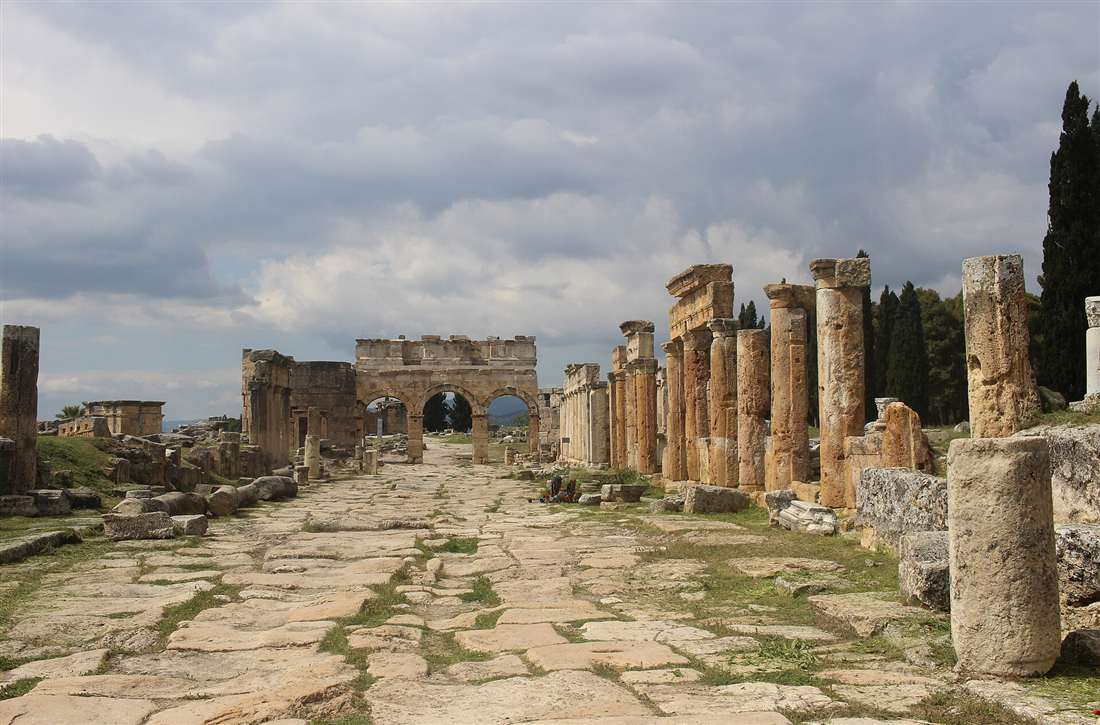
Frontinus Street is the colonnaded main avenue of Hierapolis, running straight from the Frontinus Gate in the north to the southern gate. Lined with columns, shops and public buildings, it forms the central spine of the Roman city and takes its name from the northern gate.
The street stretches for more than a kilometre through the urban grid, paved with stone slabs and bordered by colonnades that sheltered pedestrians and shopfronts. Public buildings, the agora and civic monuments open onto its length, so the avenue functioned as the commercial and social heart of the settlement.
Walking the street today traces the same line the Roman city followed. From the triple arches of the gate the avenue runs south, giving access to the latrine, the market square and the routes that climb to the theatre. The street organises the whole visit into a single north-to-south axis.
When was the Frontinus Gate built?
The Frontinus Gate was built in the late first century AD, during the reign of the emperor Domitian. The proconsul Sextus Julius Frontinus oversaw its construction, and the dedicatory inscription to Domitian dates the monument firmly within that imperial period.
The building belongs to a phase of Roman investment in Hierapolis, when the city expanded its public architecture along the newly laid main street. The gate and the colonnaded avenue form a single planned scheme, the entrance and the street conceived together as the northern approach to the city.
The dating rests on firm evidence rather than estimate. The inscription names Domitian by his imperial titles, and the proconsulship of Frontinus is recorded in the historical sources, so the two names together pin the construction to the closing decades of the first century AD.
Why did the city need a monumental gate?
Hierapolis needed a monumental gate to mark the formal entrance for pilgrims, traders and travellers arriving along the northern road from the necropolis. The triple arches announced the city, controlled the flow of traffic onto the main street and expressed the wealth of the Roman settlement.
The northern road carried a steady stream of visitors. Pilgrims came to the thermal springs and the sanctuary, traders brought goods to the agora, and mourners returned from the burial grounds. The gate gathered all of them onto one controlled threshold before releasing them onto the colonnaded avenue.
Beyond traffic, the monument served civic pride. A city measured its standing by the grandeur of its public architecture, and a triple-arched gate flanked by towers proclaimed the status of Hierapolis to everyone who entered. The dedication to the emperor tied that local pride to the authority of Rome.
What is there to see at the Frontinus Gate today?
Today the restored triple arches and the two round towers stand at the head of the paved Frontinus Street. Beside the gate the visitor finds the public latrine and the northern stretch of the main avenue, with the agora and civic buildings a short walk south.
Excavation and restoration returned the gate to a legible form, so the three arches and the flanking towers read clearly against the open ground of the necropolis behind them. The stone paving of the street survives in front of the gate, worn by centuries of traffic and marked by the ruts of ancient wheels.
Immediately inside the gate stands the latrine building, a long roofed structure that served travellers entering the city. Further along the avenue the market square, shopfronts and the line of columns give a full picture of how the northern quarter of the Roman city functioned.
How does the Frontinus Gate fit a Hierapolis visit?
The Frontinus Gate is the natural northern starting point for a walk through Hierapolis. From the arches the visitor follows Frontinus Street south past the latrine and agora toward the theatre and the central plaza, tracing the Roman city along its main axis in a single line.
Beginning at the gate orders the whole visit. The traveller arrives from the necropolis, passes beneath the central arch, and then walks the length of the colonnaded street, meeting each monument in the sequence the Roman planners intended, from the market quarter to the rising ground of the theatre.
The gate also links the archaeological city to the wider terraces of Pamukkale. A visit that starts at the northern arches and ends at the thermal pools joins the ruins and the white travertine into one route, and the Frontinus Gate stands as the formal doorway that opens the whole experience.
Starting in the north keeps the ground level and the route logical. From the gate the avenue descends gently, so the walk gathers the latrine, the agora, the plaza and the theatre in turn without doubling back. The Frontinus Gate fixes the beginning of that line and gives the visit a clear architectural opening.
Frequently Asked Questions
What is the Frontinus Gate at Hierapolis?
The Frontinus Gate is the monumental triple-arched north gate of Hierapolis, flanked by two round towers. Built in the first century AD and dedicated to the emperor Domitian, it opens the colonnaded Frontinus Street that runs through the city.
Who was the Frontinus Gate named after?
The gate takes its name from Sextus Julius Frontinus, the Roman proconsul of Asia who built it, and it carries a dedication to the emperor Domitian. It stands at the head of Frontinus Street, the main colonnaded avenue.
Where is the Frontinus Gate in Hierapolis?
The Frontinus Gate stands at the north end of the city, where the road from the necropolis enters Hierapolis. From the gate the colonnaded main street runs south past the latrine and agora toward the theatre and the plaza.