
Kaklik Cave is the “underground Pamukkale”, a collapsed-roof cave of white travertine terraces and sulphurous thermal pools near Denizli, about 45 kilometres from the surface terraces of Pamukkale, reached on a short detour from Denizli. Plan the whole trip with Greece Tours.
This guide covers Kaklik Cave in full: what it is and where it lies, why it is called the underground Pamukkale, how the sinkhole cave formed, the sulphur smell and thermal water, the terraces and pools inside, whether you bathe, the hours and ticket, how to get there, what else is around, the best time to visit, and whether it is worth the stop alongside Hierapolis.
What is Kaklık Cave?
Kaklık Cave is a collapsed sinkhole cavern near Denizli in south-west Turkey, famous for the white travertine terraces and warm thermal pools that fill its floor, earning it the nickname the “underground Pamukkale”.
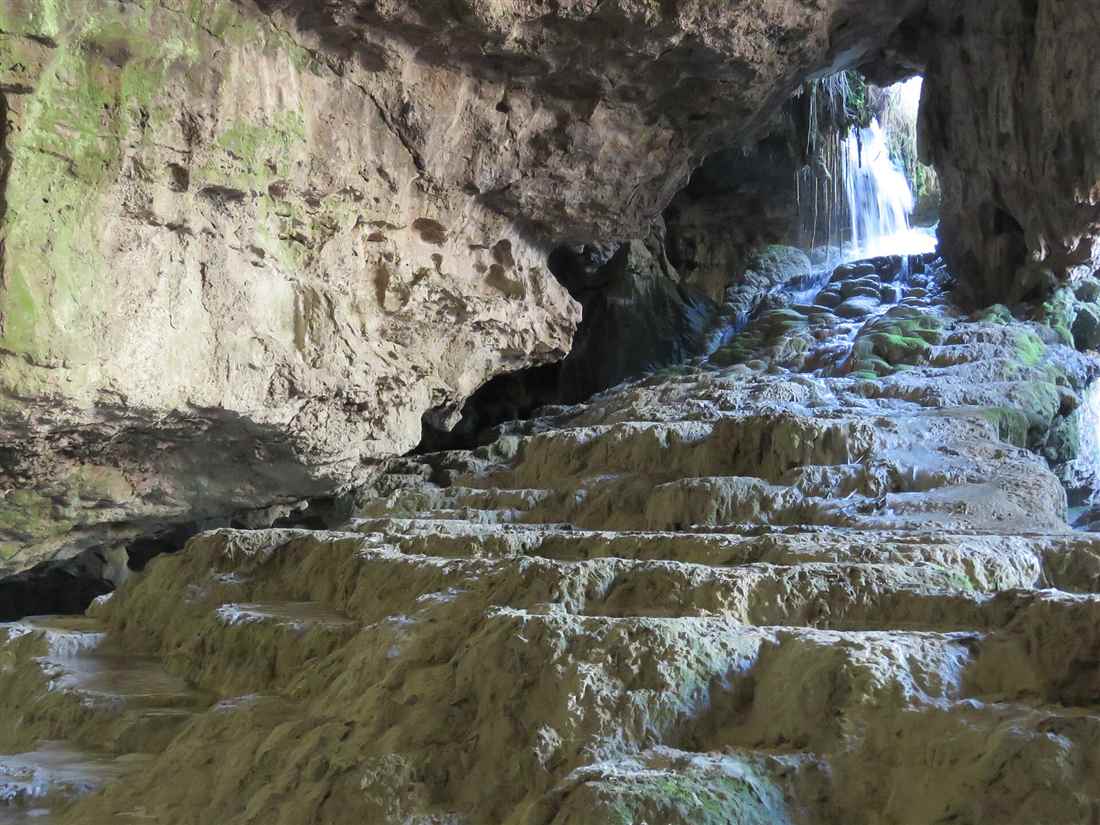
The cave sits inside a shallow depression in the ground, its roof partly fallen in, so daylight pours straight down onto the calcite formations below. Warm, mineral-rich water rises from a thermal spring at the base and spreads across the stone in a staircase of shallow basins. As the water flows and evaporates, it leaves behind layers of white calcium carbonate, the same chemistry that built the celebrated surface terraces at Pamukkale a short drive to the west.
Inside, the atmosphere shifts the moment you step down the walkway. The air turns humid and warm, the light softens through the broken roof, and a strong sulphurous smell announces the thermal water. Stalactites hang from the ceiling above the pools, dripping steadily onto the terraces beneath. The whole chamber measures roughly 14 metres deep, and a wooden walkway threads the visitor down through the formations and around the edge of the water. Above ground, a landscaped picnic park with tables and shade trees surrounds the entrance, making Kaklık a compact half-hour stop that pairs a natural wonder with a place to sit and rest.
Unlike the vast, glaring white expanse of Pamukkale, Kaklık is intimate and enclosed. The formations are visible at close range, the water gathers in reachable pools, and the geology that Pamukkale displays across an entire hillside is compressed here into one dramatic sunken room. For travellers touring the Denizli region, it delivers the same travertine spectacle in miniature, underground, and without the crowds of the headline attraction.
Where is Kaklık Cave and how far from Pamukkale?
Kaklık Cave lies beside Kaklık village in the Honaz district of Denizli Province, about 30 km east of Denizli city and roughly 45 km east of Pamukkale, set just off the main Denizli–Dinar road in south-west Turkey.
The cave belongs to the same limestone landscape that produced Pamukkale’s terraces and the ancient thermal city of Hierapolis. Denizli city acts as the regional hub, and Kaklık sits to its east, on the road that heads towards Dinar and Afyonkarahisar. The village itself is small, and brown tourist signs mark the turnoff towards the cave from the main highway, so drivers reach it without a long detour.
The drive from Pamukkale takes around 45 minutes to an hour, running first back towards Denizli and then eastward along the Dinar road. Because the two sites share the same geological story, tour operators sometimes bundle them together, treating Kaklık as the underground echo of the famous surface travertines. Independent travellers with a hire car reach it easily, and the wider Denizli area — including Pamukkale and the ruins of Hierapolis — puts the cave within a compact triangle of attractions.
Denizli itself connects to the rest of Turkey by rail, road and air, with an airport north of the city and long-distance coaches from Istanbul, Izmir and Antalya. From the city centre, the run out to Kaklık is straightforward, following the D320 corridor east. For a fuller picture of the surrounding region and its transport links, the guide to Denizli sets out how the pieces fit together.
Why is Kaklık Cave called the underground Pamukkale?
Kaklık earns the name “underground Pamukkale” because the same calcite-laden thermal water that built Pamukkale’s surface terraces deposits identical white travertine steps inside the cave, recreating the celebrated cascade of basins in a sunken, roofed-over chamber.
At Pamukkale, hot mineral water flows out across an open hillside, cooling and releasing dissolved calcium carbonate that hardens into brilliant white ledges and pools. Kaklık works by the exact same mechanism, but the stage is different. Here the water emerges inside a collapsed sinkhole, and the calcite builds up on the cave floor and walls instead of on an exposed slope. The result is a scaled-down travertine landscape, sheltered beneath a broken rock ceiling.
The visual likeness is immediate. The terraces form the familiar stepped rim pools, their edges scalloped and rounded, glowing white where the light reaches them and staining cream, ochre and grey where minerals and algae tint the stone. Water trickles from basin to basin exactly as it does on the surface at Pamukkale, following gravity down through the chamber.
The nickname also captures the sense of discovery. Pamukkale is enormous, world-famous and busy; Kaklık is small, hidden and quiet. Visitors who make the extra trip east find the same natural artistry in a private, enclosed setting, close enough to touch. That contrast — the grand open-air original and its intimate underground twin — is precisely why the comparison sticks, and why the cave draws travellers curious to see how the same geology plays out below ground.
How was Kaklık Cave formed?
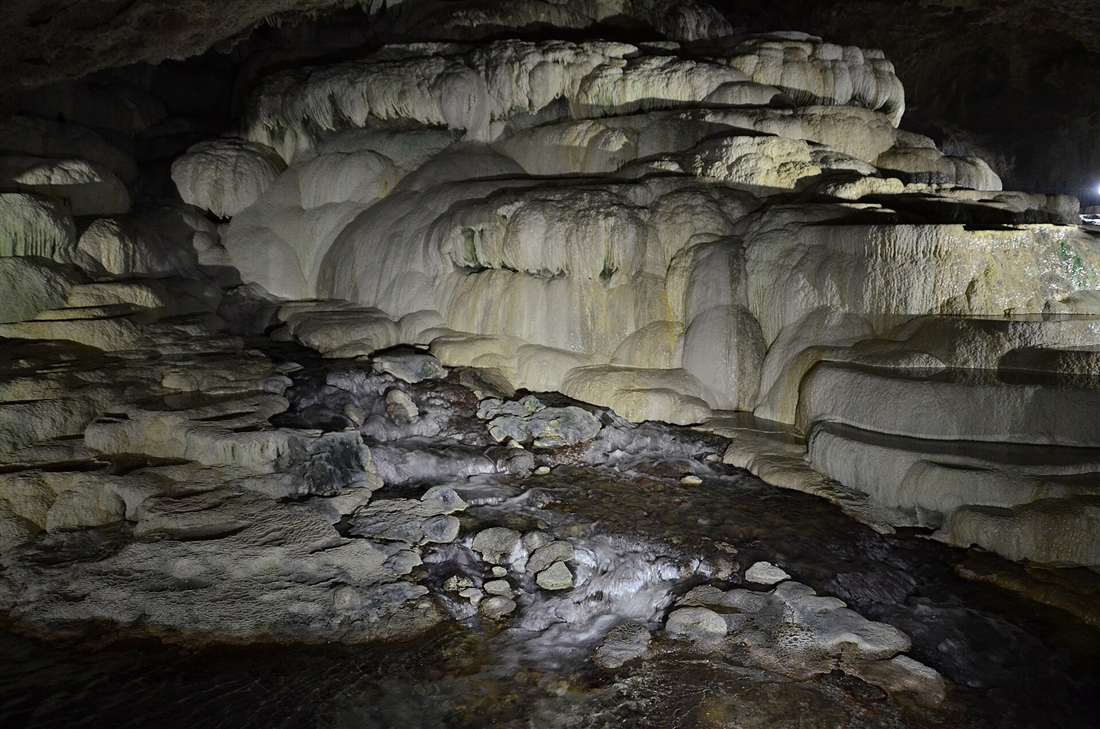
Kaklık Cave formed where an underground chamber’s roof collapsed into a sinkhole, exposing a thermal spring whose calcite-rich water then deposited travertine terraces across the floor while dissolved minerals built stalactites and layered stone on the surviving walls.
The story begins deep underground, in the soluble limestone bedrock of the Denizli region. Groundwater dissolved cavities within the rock over long geological spans, hollowing out a chamber. When the ceiling of that chamber weakened, part of it gave way and fell inward, creating the open sinkhole visitors see today. Daylight now enters through the collapsed roof, which is why the cave feels half-open rather than fully enclosed.
A thermal spring feeds the chamber from below, delivering warm water saturated with calcium carbonate and hydrogen sulphide. As this water reaches the surface of the cave floor and slows, it loses carbon dioxide and drops its dissolved calcite. Layer upon layer accumulates, forming the terraced basins and smooth flowstone that give Kaklık its Pamukkale-like appearance. The process continues in real time, so the formations grow rather than sit frozen.
Above the pools, water percolating through the ceiling deposits calcite drop by drop, building stalactites that hang over the terraces. Where those drips land on the floor, matching deposits rise to meet them. The combination of a fallen roof, an active thermal spring and steady calcite chemistry explains everything a visitor sees: the open pit of light, the white stepped pools, the dripping ceiling and the ongoing growth of the stone.
What do the sulphur smell and thermal water mean?
The strong sulphur smell at Kaklık comes from hydrogen sulphide dissolved in the thermal water rising through the cave, the same mineral chemistry credited across the region with skin and health benefits and central to the area’s long spa tradition.
Hydrogen sulphide gives the cave its distinctive rotten-egg odour, noticeable the moment visitors descend the walkway. The gas dissolves out of the warm groundwater as it emerges into the open chamber, and it signals that the water carries a heavy mineral load picked up deep underground. That same mineral content — calcium, sulphur compounds and other dissolved salts — drives the deposition of the white travertine and links Kaklık directly to the thermal heritage of the wider Denizli basin.
Across this region, sulphurous and calcite-rich springs feed a spa culture that stretches back to antiquity. The ancient city of Hierapolis, perched above Pamukkale, grew up precisely because pilgrims travelled there to bathe in and drink the thermal waters. Kaklık taps into the same underground reservoir of mineral heat, and local reputation holds that its warm sulphur water soothes the skin and eases aches, echoing the health claims attached to thermal sources throughout the province.
The smell fades from memory quickly once visitors adjust, and it becomes part of the sensory experience rather than an obstacle. The warmth of the water keeps the chamber humid and mild year-round, and the mineral vapour, the dripping stone and the muted underground light combine into an atmosphere unlike any dry cave. Understanding that the odour marks genuine thermal, mineral-laden water reframes it as the signature of the very process that made the terraces.
What is inside the cave — the terraces and pools?
Inside Kaklık, a wooden walkway descends past white travertine terraces filled with warm thermal water, stalactites drip from the collapsed roof onto the basins below, and a shaft of daylight lights the whole sunken chamber roughly 14 metres down.
The visit starts at ground level, where the picnic park gives way to the lip of the sinkhole. A stepped walkway leads down into the pit, and within a few paces the temperature climbs, the air thickens with humidity and the sulphur scent grows stronger. The path is built of timber decking and railings that carry visitors safely over and around the delicate calcite, keeping feet off the fragile terraces themselves.
The travertine forms a staircase of shallow, rounded pools clinging to the cave floor and one sloping wall. Warm water fills the basins and spills gently from one to the next, its surface rippling where drips fall from above. The stone shows a palette of colours — brilliant white on the freshest deposits, cream and honey where minerals stain it, and darker green-grey where damp shade lets algae take hold. Reflections of the terraces shimmer in the still water of the deeper pools.
Overhead, the broken roof frames a patch of sky and lets a column of daylight strike the formations, so the chamber is naturally lit rather than dependent on lamps. Stalactites hang from the surviving ceiling, glossy with moisture, releasing the steady drips that keep the whole system growing. The walkway loops through this scene, giving close views of the terraces, the pools and the dripping stone before returning visitors to the surface.
Do visitors swim or bathe at Kaklık Cave?
Bathing at Kaklık is restricted to protect the fragile travertine, so visitors keep to the wooden walkways above the terraces rather than swimming freely; the thermal pools serve as a spectacle to view up close, not an open bathing area like a full spa.
The calcite basins inside the cave are delicate and slow to form, and foot traffic across them damages the very terraces that draw people there. For that reason the site channels visitors along raised timber decking, keeping the fragile formations off-limits to walking and standing. The priority is preservation, so the pools stay intact for the water to keep building new stone.
Where controlled contact with the warm water is permitted, it happens at the edge under the site’s rules rather than as a free-for-all plunge. The management sets what is allowed, and those arrangements shift with conditions and season, so travellers hoping to dip in check on the day at the entrance. Anyone expecting a full swimming or spa experience is better served by the dedicated thermal pools of the Pamukkale and Hierapolis complex, where designated bathing areas exist for exactly that purpose.
The real reward at Kaklık is visual and atmospheric. The point of the visit is to stand on the walkway amid the dripping stalactites, watch the warm water thread through the white terraces, breathe the mineral air and see the underground version of Pamukkale at arm’s length. Treated as a natural monument to observe rather than a bathing pool to occupy, the cave delivers its full impact in a short, memorable stop.
What are the opening hours and entrance fee?
Kaklık Cave opens daily to visitors, with longer daylight hours through summer and shorter ones in winter, and it charges a small entrance ticket that grants access to the walkways inside the cave and the landscaped picnic park above.
The site keeps regular daytime hours, opening in the morning and closing in the late afternoon or early evening depending on the season. Through the long, bright summer months the gates stay open later, while in winter the closing time pulls earlier with the fading light. Because daylight streaming through the collapsed roof lights the terraces, a visit during open daytime hours shows the formations at their best.
Entrance costs a modest ticket, far below the price of the main Pamukkale and Hierapolis site, reflecting Kaklık’s status as a compact secondary attraction rather than a headline destination. The fee covers the walk down into the cave along the wooden decking and the use of the surrounding picnic park, with its tables, shade and open grassy areas. Facilities on site are simple, geared to a short visit rather than a full day.
Because the cave is small, the whole experience takes roughly half an hour to 45 minutes at an unhurried pace. That makes it easy to fit around a larger Denizli itinerary without dominating the day. Travellers confirm the current hours and ticket at the entrance or through a local tour operator, since seasonal timetables shift, but the essentials hold steady: daily opening, a small charge, and a quick, rewarding stop.
How do you get to Kaklık Cave?
Reach Kaklık Cave by driving east from Denizli or Pamukkale along the Denizli–Dinar road for about 30 to 45 km, following the signed turnoff at Kaklık village; guided day tours of the region include the cave as an optional stop.
Self-drivers have the simplest route. From Denizli city, head east on the main road towards Dinar and Afyonkarahisar, a journey of roughly 30 km that takes around half an hour. Brown tourist signs mark the junction for the cave near Kaklık village, and a short side road leads to the car park and entrance. From Pamukkale, the drive first loops back past Denizli before joining the eastbound road, adding up to a 45-minute to one-hour trip in total.
Travellers without a car reach the general area by dolmuş minibus or intercity coach along the Denizli–Dinar corridor, alighting near Kaklık village, though the final approach to the cave suits a taxi or a lift given the walk from the main road. A hire car out of Denizli remains the most flexible choice, since it links Kaklık with Pamukkale, Hierapolis and the ancient city of Laodicea in one loop.
Organised tours offer the hands-off alternative. Operators based in Pamukkale and Denizli run regional excursions that fold Kaklık in alongside the surface travertines, and a guide handles the driving, timing and entrance logistics. For an independent traveller building a route, the wider Denizli transport network — airport, rail station and coach terminal — feeds the city, from which the eastbound run to the cave is short and well signposted.
What else is around Kaklık Cave?
Around Kaklık Cave sits a landscaped picnic park for resting, and within easy reach lie Pamukkale’s surface travertines, the ancient thermal city of Hierapolis, the ruins of Laodicea and Denizli city, making the cave one stop on a rich regional itinerary.
Directly above the sinkhole, the picnic park wraps the entrance with tables, shade trees and open lawns. Families and coach groups pause here to eat and relax before or after the descent, turning the quick cave visit into a longer break. The park’s calm, green setting contrasts with the humid, mineral chamber below and gives the stop a pleasant rhythm.
The star neighbour is Pamukkale, whose blazing white terraces and warm pools sit around 45 km to the west. Pairing the two shows the same travertine geology at opposite scales — the grand open hillside and the hidden underground twin. Crowning Pamukkale’s ridge, Hierapolis spreads its Roman theatre, colonnaded streets, temple ruins and vast necropolis across the plateau, a full archaeological site that rewards a half-day on its own.
Closer to Denizli city stand the ruins of Laodicea, a major ancient metropolis with restored streets, temples and a stadium, reached in minutes from the city centre. Denizli itself supplies hotels, restaurants, a bustling bazaar and the region’s transport links. Strung together, these sites — cave, terraces, thermal city, ancient metropolis and modern hub — form a compact and varied circuit, with Kaklık providing the offbeat underground highlight that most visitors to the famous surface terraces never see.
When is the best time to visit Kaklık Cave?
Kaklık Cave rewards a visit year-round because the thermal water holds the chamber at a mild, constant temperature, and the ideal window falls in the morning or late afternoon, sidestepping the midday coach groups and the harsh overhead sun on the terraces.
The warm spring keeps the cave humid and temperate in every season, so winter cold and summer heat both fade the moment visitors step down into the pit. That steady microclimate makes the site a dependable stop at any point in the calendar, unlike outdoor attractions that turn bleak in poor weather. Rain above ground barely touches the sheltered chamber, and the daylight through the collapsed roof lights the terraces whenever the gates are open.
Timing within the day shapes the experience more than the season does. Organised coaches converge on the region around midday, and the small chamber feels tight when a group crowds the walkway. Arriving in the early morning or the later afternoon delivers a quieter visit, with room to linger over the pools and photograph the formations without a queue on the decking.
Light matters too. The shaft of sun through the broken roof strikes the white travertine at an angle in the morning and evening, throwing the terraces into relief and lifting their colour, whereas flat midday light washes them out. Combining an off-peak arrival with soft, angled daylight turns the short visit into its most striking form, and it slots neatly around a Pamukkale trip timed for the golden hours on the surface terraces.
How long do you need at Kaklık Cave?
Kaklık Cave takes half an hour to 45 minutes to see properly, with the walk down through the terraces and back up the wooden decking accounting for the core visit, and extra time in the picnic park above stretching the stop to an hour.
The cave is compact, and the walkway route through it is short. Descending the timber steps, looping past the travertine pools and the dripping stalactites, pausing for photographs and climbing back to the surface fills roughly 20 to 30 minutes at an unhurried pace. Visitors who linger to watch the water thread through the basins or wait for the light to shift add a few minutes more, but the underground portion rarely demands longer.
The picnic park above adds the rest of the time. Families spread out at the tables, eat under the shade trees and rest before moving on, turning a quick natural sight into a relaxed break of an hour. That brevity is part of Kaklık’s appeal: it slots into a busy Denizli day without swallowing it, leaving ample time for Pamukkale, Hierapolis and Laodicea in the same outing.
Because the stop is short, planners treat Kaklık as a bridge between larger sites rather than a destination in its own right. A morning at Pamukkale’s terraces, a midday drive east to the cave, a picnic in the park and an afternoon back at Hierapolis form a natural sequence. Anyone building a tight schedule budgets 45 minutes to an hour for Kaklık and finds it comfortable.
What do you bring and wear to Kaklık Cave?
Bring sturdy, non-slip footwear for the damp wooden walkways, a camera for the lit terraces, and drinking water, and wear light layers, since the cave stays warm and humid while the picnic park above shifts with the outdoor season.
The decking inside the cave carries a film of moisture from the thermal humidity and the dripping ceiling, so shoes with grip matter more than anything else. Flat, closed footwear keeps footing secure on the steps down into the sinkhole and around the pools. The formations sit close to the path, and the combination of wet timber and low light rewards care with each step.
Clothing works best in light layers. Down in the chamber the warm, moist air makes the space feel mild whatever the weather outside, while the picnic park above tracks the ordinary temperature of the day. Peeling off or adding a layer between the sunken cave and the open park keeps a visitor comfortable across both. A hat and sun protection help in the exposed park during summer.
A camera or phone captures the highlight, since the shaft of daylight on the white terraces makes the cave a rewarding subject. Drinking water is worth carrying, because facilities on site stay simple. Anyone hoping the site permits a dip in the warm water packs a towel and checks the rules at the entrance, though the walkway-and-view format defines the standard visit.
Is Kaklık Cave suitable for families and children?
Kaklık Cave suits families well, pairing a short, safe walkway route through the terraces with an open picnic park above for children to run and rest, though parents keep a hand on younger ones around the wet steps and pool edges.
The scale of the site works in a family’s favour. The cave is small, the walk is brief, and the wooden decking with its railings guides children through the formations without a demanding climb. The novelty of descending into a lit underground pit, spotting stalactites and watching warm water trickle through white pools holds young attention in a way a long ruin walk struggles to match.
Safety centres on the damp surfaces. The walkways carry moisture, the steps drop into the sinkhole, and the pool edges sit close to the path, so parents supervise closely on the descent and around the water. Strollers do not suit the stepped route, so a carrier serves infants better. The strong sulphur smell surprises children at first, then fades from notice as the family moves through.
Above ground, the picnic park is the family clincher. Tables, shade and open grass give children room to move and parents a place to eat and regroup, turning the stop into a proper break rather than a rushed march. Combined with the quick, engaging cave below, that makes Kaklık one of the easier and more entertaining stops on a Denizli-region itinerary for travellers with children.
How does Kaklık Cave compare to Pamukkale’s terraces?
Kaklık Cave and Pamukkale share identical travertine geology but differ in scale and setting: Pamukkale is a vast, open-air white hillside crowded with visitors, while Kaklık is a small, enclosed underground chamber with the same stepped pools seen quietly and up close.
Both sites owe their white terraces to calcite-laden thermal water depositing calcium carbonate as it cools and flows. That shared chemistry is why Kaklık earns the “underground Pamukkale” label. Where they part is in presentation. Pamukkale spreads its dazzling ledges and pools across an entire cliff face under open sky, visible for miles, drawing crowds from around the world onto its bright cascades and up to the ruins of Hierapolis above.
Kaklık compresses that spectacle into one sunken room. The terraces are the same shape and the same brilliant white, but they cover the floor and one wall of a collapsed sinkhole rather than a hillside. Daylight enters through the broken roof instead of flooding an open slope, and stalactites hang overhead, a feature the surface site lacks entirely. The result feels intimate and hidden where Pamukkale feels grand and public.
The two reward different things. Pamukkale delivers scale, fame and the option to bathe in designated thermal pools, all wrapped in a major archaeological site. Kaklık delivers rarity, quiet and close contact with the formations in a fraction of the time and cost. Seeing both in one trip shows the same natural process at two extremes, and that pairing is the strongest reason to add the cave to a Pamukkale visit.
What makes Kaklık Cave a good place for photographs?
Kaklık Cave photographs strongly because a natural shaft of daylight through the collapsed roof spotlights the white travertine terraces against the dark chamber, while the still thermal pools mirror the formations and the hanging stalactites frame the scene.
The lighting drives the best images. Instead of relying on artificial lamps, the cave receives a column of sunlight through its broken ceiling, which strikes the pale stone and separates it dramatically from the shaded rock around it. That contrast between the lit terraces and the dim chamber gives photographs depth and drama that a fully enclosed cave never delivers.
Reflections add a second layer. The deeper thermal pools hold still, glassy water that mirrors the terraces, the stalactites and the patch of sky above, doubling the composition. Photographers frame the stepped basins in the foreground with the drip-glossed ceiling behind, and the range of colours in the calcite — white, cream, honey and green-grey — rewards close detail shots as much as wide views.
Timing sharpens the result. Angled morning or late-afternoon light rakes across the terraces and lifts their texture, whereas flat midday sun washes the white stone out. An off-peak arrival also clears the walkway of coach groups, opening clean sightlines down the chamber. Steady hands or a small support help in the low interior light, and the humid air calls for a lens wipe between the warm cave and the cooler world above.
Is Kaklık Cave worth visiting?
Kaklık Cave is worth the short detour east of Denizli, delivering an unusual underground version of Pamukkale’s travertine terraces in half an hour, at a fraction of the crowds and cost, as a memorable contrast to the world-famous surface springs.
The case for the cave rests on its rarity. Travertine terraces are strange enough on an open hillside; seeing them form inside a collapsed sinkhole, lit by a shaft of daylight and dripping from stalactites overhead, is a sight almost no other place offers. For travellers already visiting Pamukkale, the drive out to Kaklık completes the geological picture, showing the same calcite chemistry building the same white pools underground.
The practical appeal is just as strong. The visit is brief, the ticket is small, the walkways are well built, and the picnic park gives a place to rest. Because the site stays off most package itineraries, it holds a quiet, discovered feel that the packed main attraction lacks. Slotted into a Denizli circuit alongside Hierapolis and Laodicea, it adds variety without demanding much time.
Set expectations correctly and the reward lands. Kaklık is not a swimming spa or a vast cavern system; it is a compact, atmospheric natural wonder to view from the walkway. Judged on that footing — the mineral air, the terraced pools, the underground light and the direct link to Pamukkale’s geology — the cave repays the detour and stands out as one of the Denizli region’s most distinctive short stops.
Frequently Asked Questions
What is Kaklik Cave?
Kaklik Cave is a collapsed-roof sinkhole cave near Denizli where thermal spring water deposits white travertine terraces underground, earning it the name “underground Pamukkale”. Wooden walkways lead down past the calcite basins and the sulphurous pools.
How far is Kaklik Cave from Pamukkale?
Kaklik Cave lies about 45 kilometres east of Pamukkale and 30 kilometres from Denizli, near Kaklik village on the Denizli-Dinar road. A short drive or a stop on a tour reaches the cave and its picnic park.
Why does Kaklik Cave smell of sulphur?
Kaklik Cave smells of sulphur because its thermal water carries hydrogen sulphide and sodium bicarbonate from the spring. The same minerals build the white travertine terraces and give the water its reputed spa qualities.