
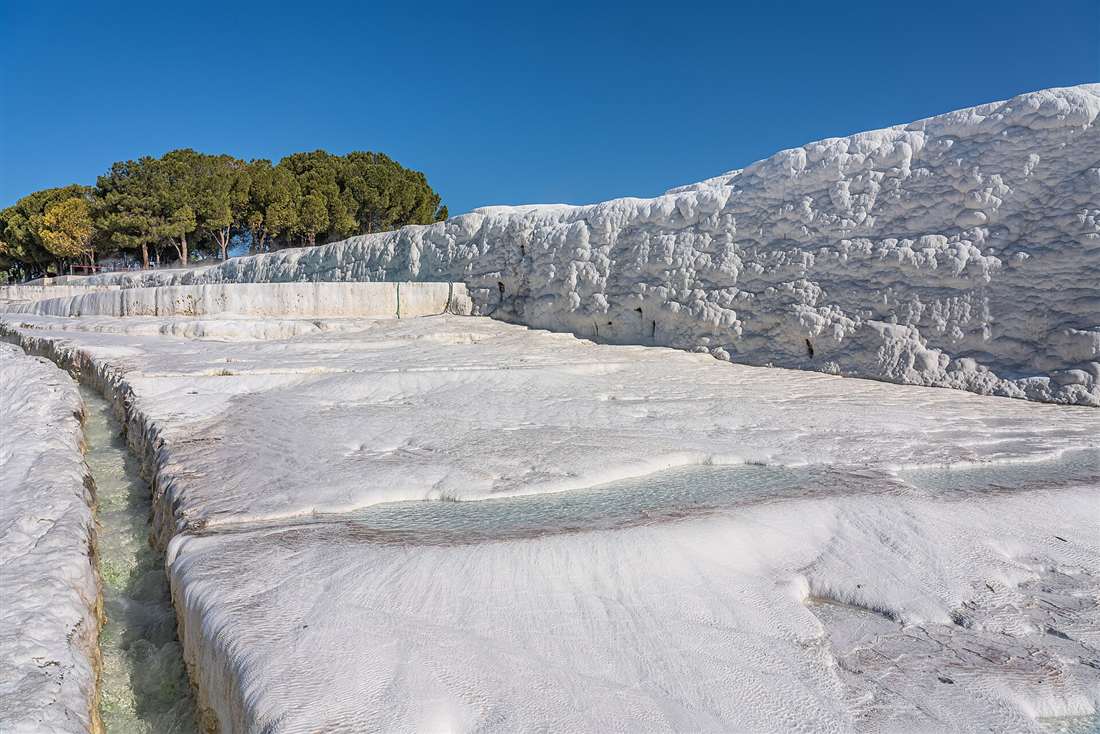
Pamukkale lies about 200 kilometres north-east of Fethiye, a three-hour drive over the mountains. A guided day tour with hotel pickup is the direct way to reach the travertines and Hierapolis, with the bus via Denizli and self-drive as the alternatives. Plan the whole trip with Greece Tours.
This guide covers getting to Pamukkale from Fethiye in full: the distance and journey time, the guided day tour, the bus, self-drive, the trip from Oludeniz, whether the day trip is worth it, what a tour includes, the Salda Lake stop, the day-trip-versus-overnight choice, the cost, and what you see on the mountain drive.
How do you get from Fethiye to Pamukkale?
Three routes link Fethiye to Pamukkale across ~200 km of mountain road, a ~3-hour drive north-east. A guided day tour with hotel pickup is the simplest, an intercity bus to Denizli plus a local connection is the cheapest, and a hire car gives full control of the timing.
Fethiye sits on the Turquoise Coast of south-west Turkey, and Pamukkale lies inland in Denizli Province. The road climbs away from the sea, crosses the pine-forested ranges of the western Taurus, and drops into the Menderes valley where the white travertine terraces of Pamukkale and the ruins of Hierapolis stand above the plain. The direct driving distance runs to roughly 200 km, and the ascent and descent through the mountains hold the journey time near three hours each way.
The guided day tour is the choice that removes every logistics decision. A coach collects travellers from hotels in Fethiye, Ölüdeniz and Hisarönü, carries a licensed guide, includes the Hierapolis-Pamukkale site entry, and adds a buffet lunch near the terraces. The full round trip fills roughly twelve hours door to door. The intercity bus route splits the trip into two legs: Fethiye otogar to Denizli otogar on a scheduled coach, then a free servis shuttle or a dolmuş minibus north to Pamukkale village. Self-drive uses the D350 and connecting mountain roads, delivers the scenery of the Gölhisar plateau, and parks at the travertine gates.
The decision turns on priorities. Travellers who want the terraces, the ancient theatre, the antique pool and lunch handled in a single fixed price take the tour. Travellers on a tight budget who accept a change of vehicle take the bus. Drivers who want to stop for photographs on the pass, reach the terraces at opening, and stay until the sunset light hits the white travertine take the car.
Season shapes the trip as much as mode. Summer heat on the Denizli plain climbs high in the middle of the day, so an early arrival at the terraces beats both the crowds and the fiercest sun. Spring and autumn deliver mild air on the coast and comfortable walking temperatures at Hierapolis. Winter thins the tour schedule, and the mountain road holds patches of morning frost on the high passes, which rewards a later start for self-drivers and a warmer layer for the barefoot walk across the calcium pools.
What is the distance and journey time from Fethiye to Pamukkale?
Fethiye to Pamukkale covers ~200 km and takes about 3 hours by car or private transfer. The mountain road via Gölhisar and Tavas is the direct line; the road through Denizli city runs a touch longer at around 220 km and suits bus travellers making the transport-hub change.
The 200 km figure describes the road distance, not a straight line. Fethiye and Pamukkale sit only about 130 km apart as the crow flies, but the terrain forces the road to wind through valleys and over passes, adding kilometres and holding the average speed down. The climb out of the coastal belt into the Taurus foothills, the crossing of the Gölhisar and Tavas uplands, and the final descent into the Denizli basin each demand careful driving on curved sections, so the three-hour estimate reflects real conditions rather than an optimistic motorway pace.
Two practical lines connect the towns. The mountain route heads north-east from Fethiye on the D350 towards Korkuteli, branches through Gölhisar and Tavas, and reaches Pamukkale from the south-west. The Denizli route swings through the provincial city of Denizli, the region’s transport hub, and approaches Pamukkale from the south. The mountain line is the shorter, more scenic drive; the Denizli line matters to anyone travelling by scheduled coach, because the intercity network terminates at Denizli otogar and the last stretch to the terraces runs as a separate local service.
Journey time shifts with the mode. A private transfer or a determined self-drive holds close to three hours. A guided coach adds a comfort stop and a slower loaded pace, stretching the one-way run past three hours. The intercity bus to Denizli alone runs about four hours because it serves intermediate towns, and the Denizli-to-Pamukkale connection adds thirty minutes on top. Building the day around the ~3-hour car figure, and treating the bus figure as four-plus, keeps expectations accurate.
The elevation profile explains the timing. Fethiye sits at sea level on the coast, while Pamukkale village stands near 350 metres and the Denizli plain around it holds higher still. Between the two the road tops passes above 1,000 metres in the western Taurus. That vertical range — from the shore, up over the ridges, and down into the inland basin — is the reason a distance that looks modest on the map turns into a full three-hour drive. The return leg mirrors the climb and descent, so the round trip commits six hours of road time before a single terrace is walked.
How does a guided day tour from Fethiye to Pamukkale work?
A guided day tour starts with a morning hotel pickup in Fethiye, Ölüdeniz or Hisarönü, runs an air-conditioned coach with a licensed guide over the mountains, includes Hierapolis-Pamukkale entry and a buffet lunch, and returns in the evening after a full day of roughly twelve hours.
The pickup window opens early, near 04:30 to 06:00, because the road demands three hours before the group even reaches the gates. The coach loops through the resort belt, collecting travellers from hotel lobbies and pre-arranged meeting points, then joins the mountain road inland. A comfort stop breaks the outbound leg at a roadside facility with toilets, tea and snacks. The guide uses the driving time to set out the history of Hierapolis, the geology that built the travertine terraces, and the plan for the day on site.
At Pamukkale the group enters the Hierapolis-Pamukkale archaeological zone on an included ticket. The guide leads a walking circuit of the white calcium terraces, the barefoot pools where water still runs, the vast Roman theatre carved into the hillside, the necropolis, and the colonnaded main street of the ancient city. The antique pool, where fluted marble columns lie submerged in warm spring water, sits inside the zone as a paid extra for a swim. A buffet lunch near the terraces refuels the group before the return drive.
The price bundles transport, guiding and entry into one figure, with lunch included and the antique pool swim charged separately on the day. Per-person rates for a Fethiye-based Pamukkale day tour run in a broad range depending on group size and season. The return coach retraces the mountain road, and drop-off returns travellers to their hotels in the evening, closing a day that fills close to twelve hours from the first pickup to the last drop.
What to bring turns the guided day from good to easy. A swimsuit worn under clothes readies a traveller for the antique pool without a scramble for a changing room. A hat, sunglasses and high-factor sun cream guard against the glare bouncing off the white calcium. The terraces demand a barefoot walk, so shoes come off and go into a bag at the entrance to the travertine path. A refillable water bottle, a light snack and a modest amount of cash for the pool ticket and drinks round out the kit for the twelve-hour circuit.
How do you get from Fethiye to Pamukkale by bus?
Travel by bus in two legs: a scheduled intercity coach from Fethiye otogar to Denizli otogar, a run of about 4 hours, then a free servis shuttle or a dolmuş minibus north to Pamukkale village, a final leg of roughly 30 minutes over ~20 km.
Fethiye otogar, the main bus station east of the town centre, is the departure point. Intercity operators run coaches to Denizli through the day, so buying a ticket at the counter or through an operator app secures a seat on a comfortable long-distance vehicle with air conditioning and a steward serving tea. The coach follows the inland road, stops at intermediate towns, and pulls into Denizli otogar after about four hours. Denizli is the provincial capital and the transport hub for the whole Pamukkale area, so all connections funnel through this station.
The final leg from Denizli to Pamukkale runs as a local service. Most intercity operators include a free servis, a connecting shuttle that carries ticket holders from Denizli otogar onward to Pamukkale, so the onward ride costs nothing beyond the coach fare. The servis desk sits inside the arrivals concourse, and staff match each ticket to the branded minibus bound for the village. Travellers whose operator provides no servis take a dolmuş, the shared minibus that departs from the lower level of Denizli otogar for Pamukkale village every twenty to thirty minutes, for a small cash fare. The dolmuş drops passengers in the village at the foot of the travertine terraces, a short walk from the lower entrance gate, where the ticket booth and the barefoot path up the white calcium cliff begin the visit to Hierapolis proper.
The bus route is the budget line. The intercity fare plus the dolmuş fare total far below a guided tour price, and the timetable gives independence over how long to stay at the terraces. The trade-off is time and effort: the four-hour coach leg, the change at Denizli, and the onward connection add up, so an early departure from Fethiye is the key to a full day at Hierapolis and a return the same evening.
Timing the return matters as much as the outbound. The last dolmuş from Pamukkale village back to Denizli otogar departs in the early evening, and the final intercity coach from Denizli to Fethiye leaves before the night deepens. A traveller who lingers on the terraces until closing risks the connection, so checking the return timetable at Denizli on arrival, and noting the last dolmuş time posted in Pamukkale village, secures the trip home. Booking the return coach seat in advance at the Denizli counter removes the worry of a full bus on a busy day.
Is a self-drive from Fethiye to Pamukkale practical?
Drive it in about 3 hours over ~200 km on well-surfaced roads that climb from the coast through the western Taurus and descend into the Denizli plain. Hire cars are available in Fethiye and at Dalaman airport, the mountain route rewards the effort with scenery, and free parking waits at the terrace gates.
The self-drive route leaves Fethiye on the inland road towards Korkuteli, then branches north through Gölhisar and Tavas before reaching Pamukkale from the south-west. The alternative line runs through Denizli city and approaches the terraces from the south. Both are paved throughout, signposted for Pamukkale and Denizli, and free of tolls on the mountain sections. The road surface holds up well, though the gradients and curves through the passes ask for steady, unhurried driving rather than a fast cruise.
Car hire starts in Fethiye town, at agencies along the marina and main streets, and at Dalaman airport about 50 km west, where the international arrivals hall hosts the major rental desks. Daily rates sit in a moderate range for a compact car, with fuel on top. A full tank covers the round trip with margin, and fuel stations line the D350 at the main towns along the mountain route for a top-up on the way back. Turkish roads drive on the right, an international driving permit alongside a home licence satisfies the rules, and the mountain sections reward an early start before the day’s heat and traffic build.
At Pamukkale, car parks sit beside the southern and northern gates of the Hierapolis-Pamukkale zone, and parking is free for site visitors. Arriving in a private car unlocks the two advantages a coach cannot match: reaching the terraces close to opening, before the tour groups arrive, and staying into the late afternoon when the low sun turns the white travertine gold. Photo stops on the Gölhisar plateau and the mountain passes turn the drive itself into part of the trip.
Two gates serve the zone, and a driver picks the one that fits the plan. The southern gate at the top of the plateau opens onto Hierapolis, the theatre and the antique pool, then leads down across the terraces on foot. The northern gate enters through the necropolis and the colonnaded street. The lower village gate at the foot of the white cliff starts the climb up the travertine itself. Driving the car between the upper and lower gates saves the return trudge back up the terraces at the end of a long day on the site.
How do you get from Oludeniz to Pamukkale?
Ölüdeniz sits just 14 km south of Fethiye, so the journey to Pamukkale follows the same ~200 km mountain road and takes about 3 hours plus the short hop up to Fethiye. Guided day tours pick up directly from Ölüdeniz and Hisarönü hotels; independent travellers transfer to Fethiye otogar first.
Ölüdeniz, the lagoon resort famed for its blue waters and paragliding launches off Babadağ, lies at the southern end of the Fethiye conurbation. The road to Pamukkale is identical to the Fethiye route once past the town — the extra distance is only the fourteen kilometres of coastal road that link Ölüdeniz to Fethiye and its otogar. That short leg adds twenty to thirty minutes to the front of any independent journey, and nothing at all to a guided tour that collects from the resort directly.
Guided Pamukkale day tours treat Ölüdeniz and neighbouring Hisarönü as standard pickup zones. The coach loops through the resort hotels in the early morning before joining the inland road, so travellers based at the lagoon board at their own lobby without a separate transfer. This makes the guided tour the most frictionless option from Ölüdeniz, since the whole logistics chain — pickup, drive, entry, lunch, return — closes at the resort itself.
Independent travellers from Ölüdeniz reach Pamukkale through Fethiye. A dolmuş runs frequently between Ölüdeniz and Fethiye otogar for a small fare, dropping passengers at the bus station where the intercity coach to Denizli departs. From there the route matches the standard bus journey: Denizli otogar, then the servis or dolmuş to Pamukkale village. A hire car collected in Ölüdeniz or at Dalaman airport covers the whole distance in one vehicle, folding the fourteen-kilometre link into the three-hour mountain drive.
The early pickup carries extra weight from Ölüdeniz. Because the resort sits at the far end of the coach loop, the collection time from an Ölüdeniz or Hisarönü hotel falls at the front of the pickup window, near 04:30 to 05:30. That early board buys the group the full drive north with time to reach the terraces for the morning light. Travellers who prefer a lie-in weigh this against the fixed schedule, while those chasing the clearest photographs of the white travertine welcome the head start the resort’s position on the route delivers.
Is there a direct route or do you change at Denizli?
Guided tours, private transfers and self-drive run direct from Fethiye to Pamukkale without a change. Scheduled bus travellers change at Denizli, the region’s transport hub: the intercity coach terminates at Denizli otogar, and a servis shuttle or dolmuş covers the final ~20 km to Pamukkale.
Denizli is the pivot of all public transport to Pamukkale. No intercity coach runs into the village itself, because Pamukkale is a small settlement beside the terraces while Denizli is the provincial capital with the region’s main otogar. Every scheduled bus from Fethiye, and from cities across Turkey, terminates at Denizli, and the last twenty kilometres to the travertines are served by local vehicles. So a bus traveller changes once, at Denizli, without exception.
The change is straightforward. Denizli otogar organises the Pamukkale connection on its lower level, where dolmuş minibuses line up for the village and depart every twenty to thirty minutes. Ticket holders whose intercity operator provides a free servis wait for the branded shuttle instead, which carries them onward at no extra cost. Either way the final leg fills about thirty minutes and ends in Pamukkale village at the foot of the white terraces, within walking distance of the lower gate.
Direct door-to-door travel belongs to the private modes. A guided tour coach drives from the Fethiye resorts to the Hierapolis-Pamukkale gates with no vehicle change, the guide handling entry on arrival. A private transfer carries a small party directly to the terraces on a fixed price. A self-drive car runs the whole ~200 km in one go and parks at the gate. The Denizli change is the price of the low bus fare, and it is the single decision point that separates the budget route from the direct ones.
Denizli adds value beyond the connection for travellers with time. The city holds its own otogar restaurants, a covered bazaar, and the reputation of its native fighting rooster, and Denizli Çardak airport 60 km east links the region by air for anyone arriving from Istanbul or another Turkish city rather than driving from the coast. A traveller flying in lands at Çardak, transfers to Denizli otogar, and takes the same final dolmuş leg to Pamukkale, so the Denizli hub anchors both the bus route from Fethiye and the air route from across Turkey. For the Fethiye day-tripper, though, Denizli is simply the point where the coach ends and the shuttle to the white terraces begins.
Is a Pamukkale day trip from Fethiye worth it?
A Pamukkale day trip from Fethiye rewards a long day on the road with two world-class sights in one visit: the white travertine terraces and the ruined Roman city of Hierapolis. The 3.5-to-4-hour drive each way pays off in full.
The day starts before dawn. Coaches leave Fethiye between 05:00 and 06:30, cross the pine-clad mountains of the interior, and reach the terraces mid-morning. That early departure delivers you to the white cliffs while the light is soft and the crowds thin, and it leaves the full afternoon for the ruins and the thermal pool before the return leg.
The reward justifies the hours. The travertines of Pamukkale form a cascade of calcite pools that glow bright white above the plain of Denizli, and the warm mineral water still trickles across the terraces you walk barefoot upon. Above them stretches Hierapolis, a Greco-Roman spa city with a theatre, a colonnaded street, and a vast necropolis. Read the full picture of the terraces on the dedicated Pamukkale guide before you commit to the route.
The single caveat is the distance. Fethiye sits on the Mediterranean coast and Pamukkale lies inland, so the trip is a genuine full day of 14 to 16 hours door to door. Travellers who want the terraces without the driving fatigue book the guided coach and sleep on the road; those who prize the sight over the effort finish the day certain it earned its place.
The double bill sets this trip apart from a single-attraction day out. Pamukkale and Hierapolis share one gate and one ticket, so the 4-hour drive buys a natural wonder and an ancient city on the same hilltop. The terraces occupy the lower slope and the Roman ruins crown the ridge above, which turns a single walk into a full afternoon of white calcite, marble columns, and a Roman theatre carved into the hillside.
What does a Pamukkale tour from Fethiye include?
A standard Pamukkale tour from Fethiye includes hotel pickup, an air-conditioned coach, a professional guide, entry to the Pamukkale-Hierapolis site, and lunch near the terraces. Extended versions add the Cleopatra Pool and Salda Lake to the itinerary.
Pickup runs from Fethiye hotels and the nearby resorts of Ölüdeniz, Hisarönü, and Çalış Beach in the pre-dawn window. The coach carries you inland with a comfort stop en route, and a licensed guide narrates the history of the Roman spa city and the geology of the calcite terraces. The site entry fee is bundled into the tour price, so no separate ticket queue slows the group at the gate.
On arrival the guide leads a walk across the travertine terraces, where you remove your shoes to protect the calcite, then up into Hierapolis for the theatre, the Temple of Apollo, and the colonnaded Frontinus Street. A buffet lunch at a restaurant beside the site anchors the middle of the day. The theatre and necropolis of the ruined city form the core of the archaeological stop, detailed on the Hierapolis guide.
Extras separate the tiers. The Cleopatra Antique Pool, where warm spring water bubbles among submerged marble columns, carries its own entry charge of 10 to 15 euros and is optional at the site. Combined tours fold in Salda Lake, the white-shored crater lake on the road, and package it into the same day for a modest supplement. Confirm which inclusions your operator lists before booking, because the lunch, the pool, and Salda vary between agencies.
Group size shapes the day as much as the inclusions. Large-coach tours carry 40 passengers at the lowest price, while small-group minibus tours cap the number at 12 to 16 and reach the terraces ahead of the big vehicles. The premium buys a lighter footprint at each stop and more of the guide’s attention, and it trims the boarding time that a full coach adds at every pickup point along the coast.
Do Fethiye to Pamukkale tours stop at Salda Lake?
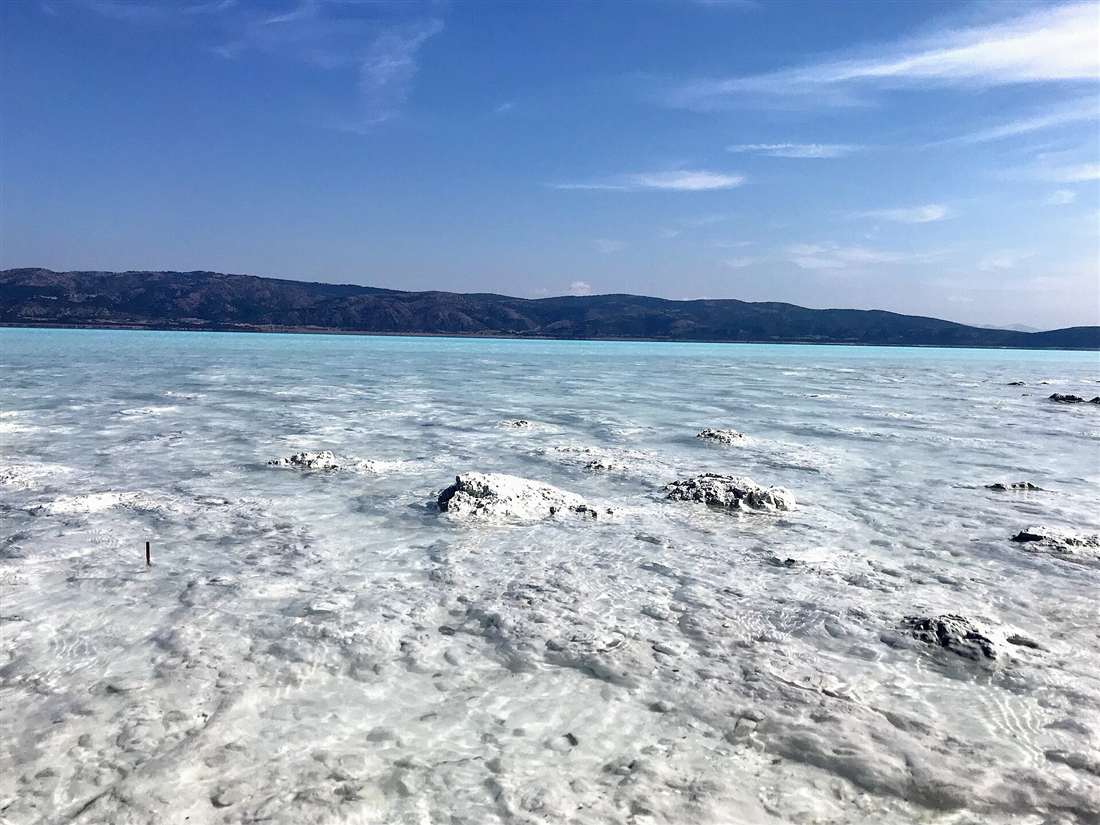
Combined Fethiye to Pamukkale tours stop at Salda Lake, a turquoise crater lake ringed by bright white mineral sand roughly 50 kilometres before Pamukkale. Standard single-destination tours skip it, so the Salda addition is booked as a specific package.
Salda Lake sits in the Yeşilova district of Burdur province, directly on the inland route from the coast. Its white shoreline and deep blue water draw a comparison to the Maldives, and the mineral-rich sand mirrors the composition studied on Mars, which lifted the lake to national fame. The stop lasts 45 minutes to an hour, enough for a walk on the white beach and a swim in the shallows during the warm months.
The combined Salda-and-Pamukkale itinerary trades depth for breadth. Folding a second natural wonder into the day lengthens the total to 16 hours and shortens the time at the terraces, so travellers focused on Hierapolis pick the single-destination tour, while those chasing the widest sweep of scenery choose the combined run. Verify the Salda stop appears in writing on your booking, because the two tour types share near-identical titles and depart at the same hour.
Swimming access at Salda depends on protection status. The lake is a protected natural park, and the authorities restrict entry to a designated beach zone to guard the white mineral sediment from erosion. Bring a towel and water shoes, respect the roped boundaries, and treat the stop as a scenic swim rather than a resort beach. The white sand stains clothing, so a change of footwear keeps the coach clean for the final push to the terraces.
What is the best way to get from Fethiye to Pamukkale?
The best way to get from Fethiye to Pamukkale is a guided day-tour coach for ease, or a self-drive hire car for freedom. The guided coach suits first-time and solo travellers; the car suits families and photographers who want to control the timing.
The guided tour removes every logistical burden. A single price covers pickup, the 250-kilometre drive each way, site entry, a guide, and lunch, and you sleep through the dark early hours while a professional handles the mountain roads. This route wins for travellers without a driving licence, for solo visitors, and for anyone who prefers the history narrated rather than read from a board.
Self-drive trades convenience for control. A hire car from Fethiye costs 30 to 55 euros a day, the drive runs 3.5 to 4 hours on the D350 and O-31 roads, and you set your own departure, linger at Salda Lake as long as you like, and stay at the terraces until closing. This route rewards families with young children, photographers chasing the golden hour, and independent travellers who resent a fixed schedule.
The verdict splits by type. Book the tour if you want a fixed price, zero driving, and a guide; hire the car if you want to overnight in Pamukkale village, choose your own lunch, and photograph the terraces in the empty first hour. Public buses via Denizli exist as a third option but demand two changes and a full day of connections that erode the value of the trip.
Driver fatigue decides the self-drive question. The 8-hour round trip on mountain roads, added to a full walk of the terraces and ruins, stretches the driver across a 14-hour day. Pairs who share the wheel absorb this comfortably; a lone driver faces the dark return leg tired, which tips the balance toward the guided coach where a professional handles every kilometre and the passenger rests.
Is Pamukkale a day trip or an overnight stay from Fethiye?
A day trip from Fethiye covers Pamukkale in one long push and returns the same night; an overnight in Pamukkale village unlocks the sunrise over empty terraces, a relaxed Cleopatra Pool swim, and a second morning at Hierapolis without the 4-hour dawn drive.
The day trip is the default for a reason. It costs less, demands no extra hotel booking, and returns you to your Fethiye base the same night, which protects the rest of a coastal holiday. The trade-off is time on the ground: the coach reaches the terraces mid-morning as the tour buses converge, and it leaves by mid-afternoon, so the visit lands in the busiest window of the day.
The overnight rewrites the experience. Staying in Pamukkale village, a five-minute walk from the lower gate, puts you at the travertines the moment they open at sunrise, before the coaches arrive from the coast. A room in the village runs 25 to 60 euros a night, and the morning light on the empty white terraces is the image that draws photographers back year after year.
The choice tracks your priorities. Pick the day trip to guard your coastal days and your budget; pick the overnight to own the terraces at dawn, swim the thermal pool without a crowd, and drive the mountain road in daylight rather than darkness. Couples on a scenery-first trip lean to the overnight, while families anchored to a Fethiye resort keep the single long day.
The overnight also opens the wider region. A second day frees time for the ancient site of Laodicea a short drive from Pamukkale, the Karahayıt red springs on the edge of the village, and a slower lunch in a village restaurant away from the tour-group menus. The morning terrace walk followed by an afternoon at these lesser-visited sites turns a rushed stop into a considered two-day loop from the coast.
When is the best time to travel from Fethiye to Pamukkale?
The best time to travel from Fethiye to Pamukkale is spring, from April to June, and autumn, from September to October. Mild temperatures of 20 to 28 degrees make the barefoot terrace walk comfortable and the mountain drive scenic, and the crowds thin outside the peak summer weeks.
Summer bakes the interior. Denizli province sits away from the sea breeze, and July and August push the daytime figure past 35 degrees, which turns the white terraces into a glare and the midday walk into a test of endurance. The early tour departure blunts the heat by delivering you before the worst of it, yet the afternoon at Hierapolis still lands in the full inland sun.
Spring and autumn balance the day. April brings wildflowers to the roadside and snowmelt volume to the terrace pools, October holds warm-enough water for the Cleopatra Pool with a fraction of the summer visitor numbers, and both shoulder seasons keep the drive across the pine mountains crisp and clear. Winter drops the interior to single digits and shortens the light, though a clear December day rewards the traveller who accepts the cold with near-empty terraces.
The departure hour is fixed year-round. Whatever the season, the coach leaves Fethiye between 05:00 and 06:30 to fit the 8-hour round drive plus the site visit into a single day, so the early start is a constant of the route rather than a seasonal variable. Book the shoulder months to pair that early rise with the mildest conditions on the ground.
How much does a Fethiye to Pamukkale trip cost?
A guided Fethiye to Pamukkale day tour costs 35 to 65 euros per person including pickup, coach, guide, entry, and lunch. A self-drive trip runs 60 to 110 euros total for a hire car, fuel, and two site tickets. The public bus route costs 15 to 25 euros each way.
The guided tour is the fixed-price option. The 35-to-65-euro band covers the transport, the site entry, and a buffet lunch, and the only extras are the optional Cleopatra Pool at 10 to 15 euros and a tip for the guide. Combined tours that add Salda Lake sit at the top of that range or a little above, reflecting the longer day and the second destination.
Self-drive costs stack up differently. A hire car runs 30 to 55 euros a day, the 500-kilometre round trip burns 20 to 35 euros of fuel, and two adult tickets to Pamukkale-Hierapolis add 20 to 30 euros, so a couple splitting a car matches or undercuts the tour price while gaining full control of the schedule. Parking at the terrace gates carries a small charge of 3 to 5 euros, and the fuel figure holds steady whether one traveller or four share the car, which sharpens the saving for a group.
The public bus is the budget floor and the time ceiling. A coach from Fethiye otogar to Denizli costs 15 to 25 euros, a local dolmuş from Denizli to Pamukkale village adds 2 to 4 euros, and the site ticket is extra, but the two changes and the connection waits consume the whole day and leave little time at the terraces. The bus wins only for travellers staying overnight who unhurry the journey across two days.
Hidden costs close the gap between the options. The guided tour’s single price absorbs the entry fee, the lunch, and the fuel that a self-driver pays separately, so the headline 35-to-65-euro figure buries no surprises beyond the optional pool and a tip. The self-drive traveller adds the parking charge, the lunch, and a night in the village if the day extends, which lifts the real outlay above the sticker rate of the hire car alone.
What do you see on the drive from Fethiye to Pamukkale?
The drive from Fethiye to Pamukkale climbs from the Mediterranean coast through pine-forested mountains, past highland lakes and orchards, across the farmland plateau of the interior, and into the industrial city of Denizli before the final approach to the white terraces.
The first stretch leaves the sea behind. The road out of Fethiye winds up through the Taurus foothills, where dense pine forest cloaks the slopes and the temperature drops with the altitude. Roadside stalls sell honey, pine cones, and fresh almonds, and the switchbacks open onto valleys planted with cotton, tobacco, and pomegranate as the route levels onto the plateau.
The middle of the drive delivers water and farmland. Combined tours detour to Salda Lake, whose white mineral shore and turquoise water break the inland green, and the standard route passes reservoirs and irrigation canals that feed the cotton fields the region is named for. Villages of red-tiled roofs and minarets punctuate the flat farmland, and the Menderes river valley carries the road toward Denizli.
Denizli marks the final leg. The provincial capital is a working city of textile mills and apartment blocks, and the coach threads its edge before the last 20 kilometres to Pamukkale, where the white cliffs appear across the plain like a snowfield above the fields. That first sight of the terraces from the approach road is the moment the long drive resolves into its reward.
The changing light rewards the window seat. The dawn departure means the early kilometres pass in darkness, and sunrise breaks over the pine ridges as the coach climbs the first pass. By the time the plateau opens out the day is bright, the cotton fields glow, and the return leg carries the traveller back through the same mountains as the afternoon sun drops behind the peaks toward the coast.
Frequently Asked Questions
How far is Pamukkale from Fethiye?
Pamukkale is about 200 kilometres north-east of Fethiye, a three-hour drive over the mountains. A guided day tour covers the round trip with pickup, entry and lunch in a 12-hour day; the bus runs via Denizli.
Is a Pamukkale day trip from Fethiye worth it?
The Fethiye to Pamukkale day trip rewards the long mountain drive with the white travertine terraces, the ruins of Hierapolis and a swim option at Cleopatra”s Pool, and most tours add the turquoise Salda Lake on the way.
Do Fethiye to Pamukkale tours stop at Salda Lake?
Most Fethiye to Pamukkale day tours stop at Salda Lake, the white-sand turquoise lake known as the Turkish Maldives, pairing the travertines of Pamukkale with a lakeside break on the long inland loop.