
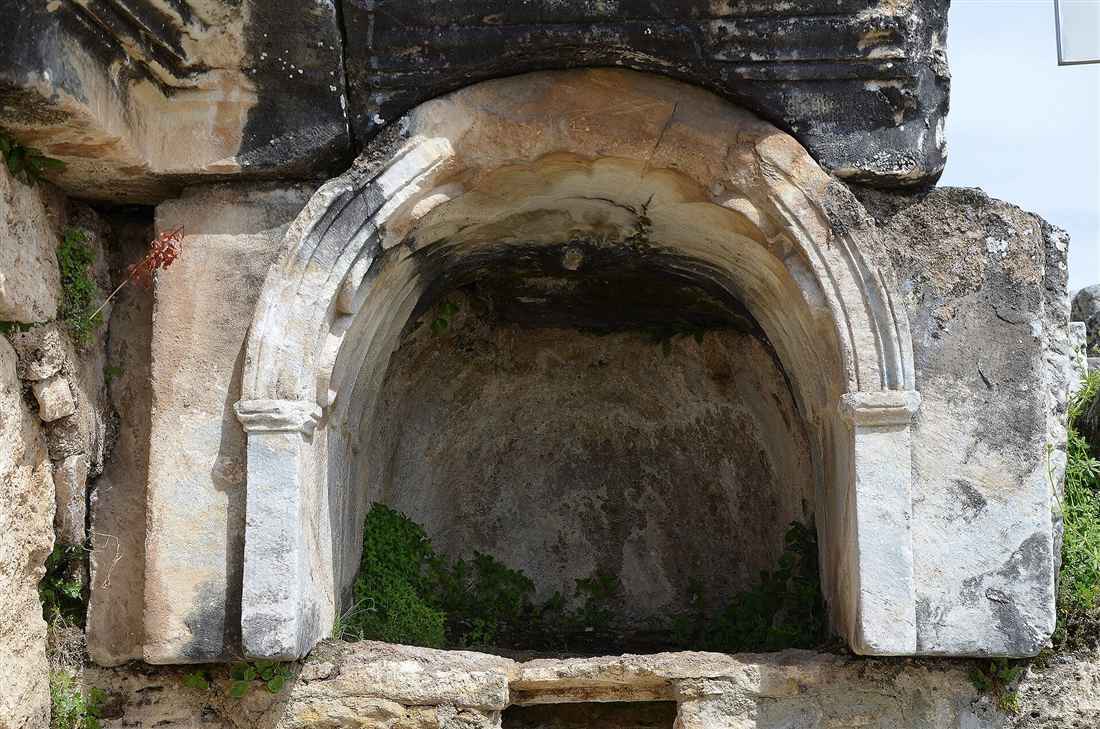
The Plutonium of Hierapolis is the Ploutonion, the sanctuary of Pluto known as the “gate to hell”: a cave beside the Temple of Apollo that vents lethal carbon-dioxide gas from the fault beneath the plateau of Pamukkale. Plan the whole trip with Greece Tours.
This guide covers the Plutonium of Hierapolis in full: what it is and where it stands, why the ancients called it the gate to hell, the toxic gas from the fault, how the priests of Cybele survived it, Strabo’s eyewitness account, what the sanctuary looked like, whether it is dangerous today, and what is left to see beside the theatre.
What is the Plutonium at Hierapolis?
The Plutonium, or Ploutonion, is the ancient sanctuary of Pluto at Hierapolis: a small cave venting toxic carbon-dioxide gas, worshipped as a physical gateway to the underworld and served by a priesthood dedicated to the god of the dead.
The Greeks and Romans named the shrine after Plouton, the ruler of the underworld the Romans called Pluto. The site pairs a natural geological hazard with organised cult worship. A dark opening in the rock breathes out an invisible, deadly vapour, and the ancient community built an enclosed precinct around that opening, treating the lethal breath of the earth as the exhalation of the god himself.
The sanctuary belonged to the wider religious landscape of Hierapolis, the Roman spa city on the Pamukkale plateau in south-western Turkey. Pilgrims travelled to the shrine to witness the power of the god, to watch animals die at the mouth of the cave, and to buy small birds and beasts for sacrifice. The Plutonium stands as one of the clearest surviving links between a real seismic phenomenon and an ancient theology of death.
Where is the Plutonium in Hierapolis?
The Plutonium sits directly beside the Temple of Apollo, near the centre of the ancient city on the Pamukkale plateau, on the high ground above the white travertine terraces and a short walk from the Roman theatre.
Hierapolis crowns the ridge above the calcium-carbonate pools of Pamukkale. The Ploutonion occupies the sacred quarter, immediately adjacent to and just below the podium of the Temple of Apollo, the chief god of the city. This placement is deliberate: Apollo, the oracular and solar deity, presides above ground, while the entrance to Pluto’s realm opens at his feet, binding the two cults into a single sacred axis.
Visitors reach the shrine by walking through the archaeological park from the travertine edge toward the theatre. The Plutonium is set into the hillside where a fault line crosses the site, and warm mineral water still flows through the pool in front of the cave. A trip to the broader destination is set out on the Pamukkale guide, which places the shrine within the layout of the plateau.
Why is the Plutonium called the gate to hell?
Ancient people called it the gate to hell because the cave killed every bird and animal that approached its mouth. The instant, invisible death convinced them the opening was a true entrance to the underworld, breathing out the air of the dead.
To an observer without knowledge of gas chemistry, the effect looked supernatural. A healthy bull led to the threshold collapsed and died within moments, yet the priest who led it walked away unharmed. Birds released into the vapour dropped from the air. The only rational conclusion for the ancient mind placed the cause in the divine: the earth had opened a mouth into the kingdom of the dead, and its breath carried death upward.
The phrase “Pluto’s Gate” captured that belief in a single image. The shrine functioned as a stage where the boundary between the living world and the underworld thinned to nothing. Worshippers understood the deaths at the cave mouth as proof that Pluto ruled the space, and the priesthood interpreted the god’s power for the crowds who gathered to watch.
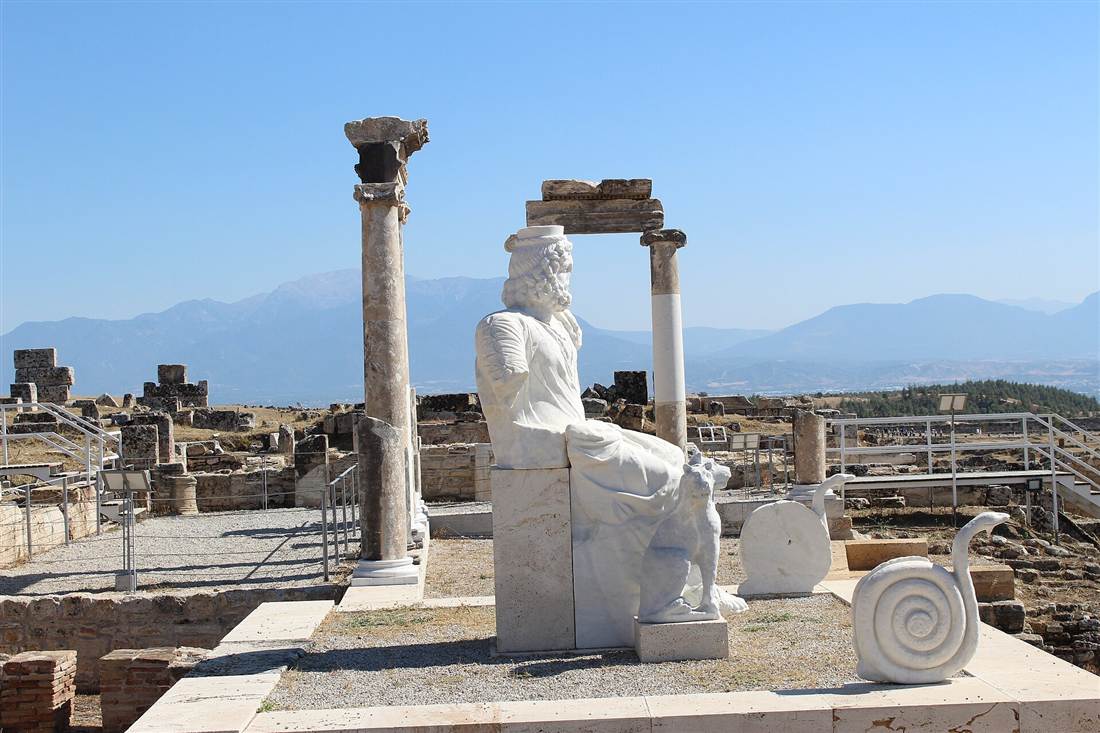
What is the toxic gas at the Plutonium?
The lethal vapour is carbon dioxide rising from the deep seismic fault beneath Hierapolis. The gas is heavier than air, so it pools in an invisible layer along the cave floor and the sunken forecourt, suffocating anything that breathes at ground level.
The Babadag fault system channels magmatic and geothermal carbon dioxide upward through fractured limestone, the same geology that feeds the hot springs and builds the white terraces. At the Ploutonion the gas escapes in concentrated form. Because carbon dioxide has greater density than the surrounding air, it does not disperse into the wind at head height; it settles and accumulates in a shallow, deadly blanket over the stone.
Modern measurement confirms the ancient reports. Concentrations at the cave floor climb to lethal strength at dawn and after still nights, when the gas builds without a breeze to break it up. A creature the height of a bird or a small mammal breathes pure asphyxiant at that level and dies of oxygen starvation in seconds, exactly as the ancient writers recorded, while a tall human standing upright breathes clean air above the layer.
How did the ancient priests survive the Plutonium?
The eunuch priests of Cybele survived by standing upright above the shallow gas layer, keeping their heads in the clean air, holding their breath, and stepping onto raised stones when they leaned into the vapour. The crowd read their survival as a miracle granted by the goddess.
The Galli, the castrated priests of the mother goddess Cybele, staged the ritual as living proof of divine protection. They led sacrificial bulls into the cave mouth and stood beside the dying animals unharmed. Their trick rested on physics they did not name: the carbon dioxide sat below chest height, so a standing adult breathed safe air while a bull with its head near the floor breathed poison.
The priests reinforced the spectacle by claiming that their devotion to Cybele held the god’s breath at bay. They controlled the timing, working when the gas layer was thin and stepping back before overexposure dizzied them. To the watching pilgrims the performance proved that the servants of the goddess held power over death itself, and the shrine earned income from the animals sold for the display.
What did Strabo and ancient writers say about the Plutonium?
The geographer Strabo left an eyewitness account describing the opening as small, the vapour as thick and deadly, and sparrows dying the instant he threw them in. He recorded that the castrated priests entered unharmed, and Cassius Dio and Pliny echoed the phenomenon.
Strabo, writing in the early imperial era, described a space large enough for a person and filled with a mist so dense that the floor stayed hidden. He tested the effect himself, tossing sparrows toward the mouth and watching them fall dead at once. His report grounds the legend in direct observation and remains the primary written source for how the shrine worked.
Cassius Dio and the elder Pliny added the wider tradition of deadly earth-openings, listing Hierapolis among the places where the ground exhaled fatal air. Their combined testimony fixes the Ploutonion as a documented ancient wonder rather than a later myth. The written record and the modern gas readings match so closely that the site stands as a rare case where classical text and field science confirm one another.
What did the sanctuary of Pluto look like?
The sanctuary centred on an arched marble doorway set into the hillside, opening onto a small vaulted chamber that vented the gas. A thermal pool lay in front of the gate, and tiered stone seating rose around the forecourt for spectators to watch the sacrifices.
Excavation uncovered the framed entrance built from cut stone, with the fatal cave behind it and an inscription dedicating the shrine to Pluto and Kore. Warm mineral water filled a pool in the paved court before the arch, and channels carried the spring across the sacred area. The architecture turned a raw fissure in the rock into a designed religious theatre.
Rows of seats climbed the slope facing the gate, giving pilgrims a place to sit and observe the ritual killings at a safe height above the gas. The layout treated death as public liturgy: an audience, a stage, a doorway to the underworld, and a priesthood performing the drama of survival. The remains show a compact but fully organised precinct rather than a bare natural cave.
Is the Plutonium dangerous to visit today?
The gas at the Plutonium remains lethal at ground level today, so the cave mouth stands fenced off. Visitors view the shrine from a safe raised platform behind barriers and warning signs, and the still-deadly fumes stay contained within the guarded enclosure.
The fault has not stopped venting carbon dioxide, and the concentration at the floor of the forecourt reaches killing strength in calm conditions. Site authorities enclose the immediate area with railings and signage precisely because the hazard is active, not historical. Dead insects and the occasional small animal still collect in the deadly layer as evidence that the ancient reports describe a live phenomenon.
From the viewing point above the barrier the danger is nil, because the gas stays low and disperses harmlessly at standing height in daylight breeze. Visitors observe the arch, the pool and the seating in full safety while respecting the fence. Nobody enters the sunken court, and the warning to keep out is a genuine precaution rooted in the same physics the ancient priests exploited.
What is there to see at the Plutonium now?
Today the site presents a reconstructed arched gate, the excavated steps and seating of the sacred forecourt, the thermal pool, and dedicatory inscriptions. The shrine sits beside the great Roman theatre and a short walk from the Hierapolis Archaeology Museum housed in the ancient baths.
Archaeologists re-erected the framed doorway and cleared the tiered stone benches, so the ground plan of the ancient spectacle reads clearly on the ground. The mineral pool still bubbles with escaping gas, giving a direct sense of the force the ancient worshippers witnessed. Inscriptions naming Pluto and Kore confirm the identity of the god served here.
The Plutonium forms one stop on a walking route through the sacred quarter. The Temple of Apollo stands immediately above, the monumental theatre rises on the slope nearby, and the museum displays sculpture and finds recovered across the city. The Hierapolis guide sets out how the shrine links to the temple, the theatre and the necropolis on a single itinerary.
How does the Plutonium fit a Hierapolis visit?
The Plutonium anchors the sacred core of Hierapolis, set on the plateau between the Temple of Apollo above it, the Roman theatre to the east, the Nymphaeum fountain nearby, and the museum in the old baths, so a visit threads the shrine into one continuous archaeological walk.
A typical route climbs from the travertine terraces onto the plateau, reaches the sacred quarter, and takes in the Ploutonion, the temple podium and the monumental fountain house of the Nymphaeum in a tight cluster. The theatre, with its carved stage building, stands just uphill, and the colonnaded main street and the vast necropolis extend the ground to the north and south for a full day of exploration.
Placing the Plutonium within this sequence turns a curiosity into the intellectual centre of the trip. The shrine explains why the ancients built a spa city on a deadly fault, why Apollo and Pluto share a single sacred axis, and how geology drove theology. Paired with the hot springs of the plateau, the shrine gives a visit to Hierapolis its most vivid encounter with the ancient understanding of the earth.
Guides pace the sacred quarter to reward a slow pass. The stone seating rewards a pause to picture the ancient audience, the pool rewards a close look for the rising bubbles of gas, and the inscriptions reward a reading of the god’s name cut into the marble. The Plutonium, more than any single monument on the ridge, fixes in the mind why Hierapolis grew where a deadly fault meets a healing spring.
Frequently Asked Questions
What is the Plutonium at Hierapolis?
The Plutonium of Hierapolis is the Ploutonion, a sanctuary of Pluto built over a cave that vents toxic carbon-dioxide gas from the fault below. The ancients knew it as the gate to hell, the entrance to the underworld.
Why is the Plutonium called the gate to hell?
The Plutonium earned the name gate to hell because the carbon-dioxide gas pooling at its mouth killed birds and sacrificed animals on the spot. The ancients read the lethal fumes as the breath of the underworld god Pluto.
Is the Plutonium at Hierapolis dangerous today?
The Plutonium still vents lethal carbon-dioxide gas at ground level, so the mouth is fenced off. Visitors view the reconstructed gate and temple steps from a safe distance beside the theatre without entering the gas.