
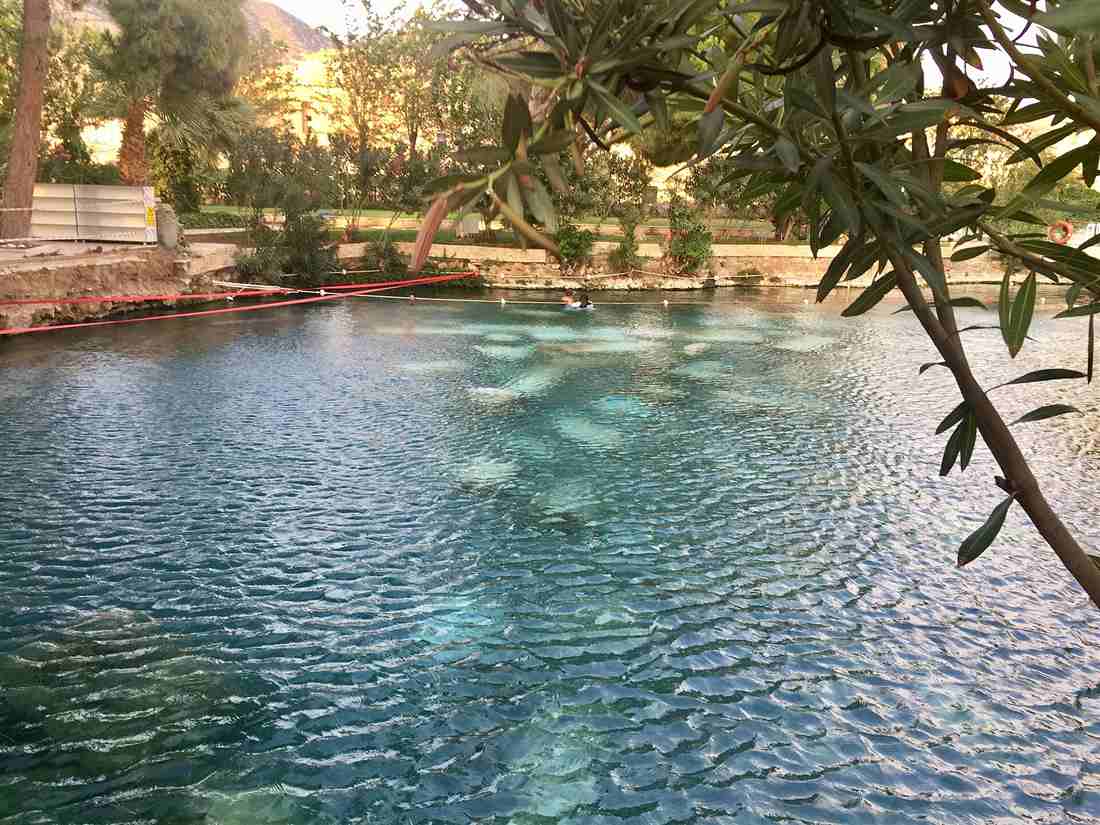
Cleopatra’s Pool, the Antique Pool of Pamukkale, is a thermal spring inside ancient Hierapolis where visitors swim in warm mineral water among the fallen marble columns of the Temple of Apollo, toppled into the water by an earthquake. Plan the whole trip with Greece Tours.
This guide covers Cleopatra’s Pool in full: what it is and where it sits, why it carries Cleopatra’s name, how the ancient columns came to lie in the water, the temperature and minerals, whether and how you swim there, the entry fee and hours, the health reputation, what to bring, and how it fits a day at Pamukkale.
What is Cleopatra’s Pool at Pamukkale?
Cleopatra’s Pool, also named the Antique Pool, is a natural thermal spring at Hierapolis in Pamukkale, Turkey, where warm mineral water fills a swimming basin strewn with fallen marble columns and carved blocks from the ancient Temple of Apollo.
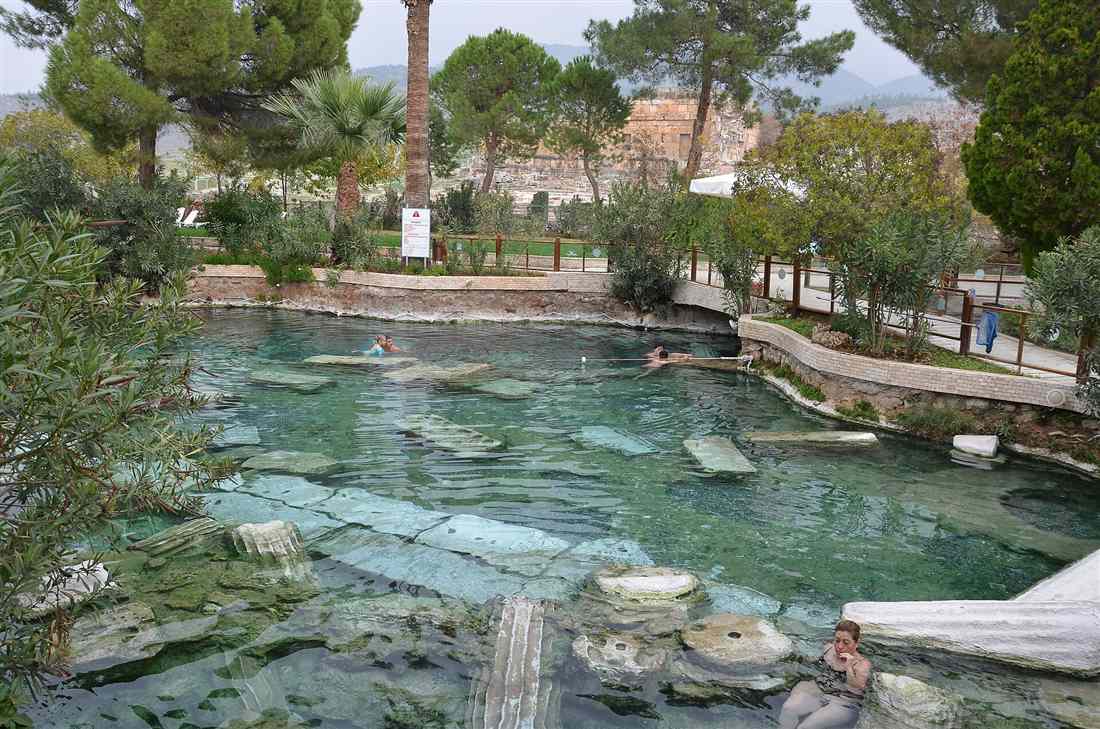
The pool sits at the very heart of the ancient city, on the ground where the sacred spring of Hierapolis rose for close to two thousand years. Bathers wade into water the colour of pale jade and rest against fluted column drums, Corinthian capitals and cornice fragments that lie submerged across the sandy floor. The marble is real Roman stonework, toppled by earthquake and left where it fell, so a swim here is a swim through the wreckage of a temple portico.
The basin measures close to seventy metres across at its widest and reaches a depth of three metres over the deepest column beds, shelving to a metre and a half at the shallow entry steps. Water enters warm and gas-charged from below, keeping the surface in gentle motion and dressing the shoulders of swimmers in fine bubbles. Reeds and oleander frame the edge, and a modern deck with sunloungers rings the water, yet the columns beneath the surface anchor the whole experience firmly in antiquity.
The site draws travellers who arrive first for the white travertine terraces of Pamukkale and then discover that the single most memorable act of the day is lowering themselves into the same heated water the Romans channelled into their bath-house. Nowhere else in Turkey offers an open-air swim directly among standing and fallen temple marble in living thermal water.
The name Antique Pool is the plain descriptive title used on the site’s signage, while Cleopatra’s Pool is the romantic name that travel guides carry. Both point to the same basin, fed by the same source that surfaces at the rate of hundreds of litres a second. The spring built the sanctuary above it, the bath-house beside it and the terraces below it, and the modern pool is the last working chamber of a water cult that shaped the entire city.
Where is Cleopatra’s Pool?
Cleopatra’s Pool lies inside the Hierapolis-Pamukkale archaeological site in Denizli Province, western Turkey, at the top of the white travertine terraces, a short walk beside the Hierapolis Archaeology Museum and the theatre.
Visitors reach the pool by entering the protected site through one of the three gates — the south gate above the town of Pamukkale, the north gate near the necropolis, or the travertine gate at the foot of the white cliffs. From the crest of the travertines the walk to the pool crosses a paved plaza past souvenir stalls and the museum, which occupies the restored Roman bath complex. Signposts marked Antik Havuz and Antique Pool guide the way from every direction.
The wider setting is the ruined city of Hierapolis, a Greco-Roman spa town founded in the second century before the common era and rebuilt in marble under Roman rule. The theatre climbs the hillside to the north, the colonnaded Frontinus Street runs to the monumental gate, and the vast necropolis spreads beyond the walls. The pool occupies the exact spot where the city’s holy spring surfaced, which is why the temple, the baths and the sanctuary of Apollo all clustered around it.
Pamukkale itself stands about nineteen kilometres north of Denizli city, roughly a three-hour drive inland from the Aegean coast at Kuşadası and close to two hundred kilometres east of the resort strip. The travertines, the ruins and the pool share one entrance and one core ticket, so the thermal basin is reached on foot from the same gates that admit visitors to the terraces. The wider destination is set out on the Pamukkale guide.
Why is it called Cleopatra’s Pool?
The pool carries Cleopatra’s name from a tourist-era legend that Mark Antony gave the thermal spring to the Egyptian queen as a gift, and that she bathed here for its beauty-preserving waters. The historical record ties her to Egypt and Rome, not to Hierapolis.
The romantic story took hold because Hierapolis flourished under Roman patronage in the first century before the common era, the same era in which Antony ruled the eastern provinces and shared his life with Cleopatra VII. Storytellers linked the celebrated spa town to the most famous couple of the age, and the name stuck to the spring that fed the city’s baths. Travel brochures and local guides carried the title forward until Antik Havuz and Cleopatra’s Pool became interchangeable.
Historians place Cleopatra’s documented movements in Alexandria, Rome, Tarsus and the Actium campaign, with no surviving source recording a visit to Phrygian Hierapolis. The name is folklore rather than epigraphy, an attribution invented to dress a genuine ancient spring in a glamorous legend. The waters were prized in antiquity on their own merit, feeding a sanctuary that drew pilgrims from across Asia Minor long before and long after the queen’s lifetime.
The legend endures because it fits the setting so neatly. A queen renowned for beauty rituals, a warm spring reputed to soften the skin, and a ruin of imperial marble together make a story travellers repeat with pleasure. The title is understood today as a marketing name of long standing, embraced by the site itself, while the honest history of the spring rests on its Roman engineering and its role in the cult of Apollo.
How did the ancient columns end up in the pool?
An earthquake in the seventh century of the common era toppled the marble portico of the Temple of Apollo and the surrounding colonnades directly into the spring basin. The fallen drums, capitals and architrave blocks sank where they landed and remain submerged in the water today.
Hierapolis sat on the Babadağ fault, and seismic shocks struck the city repeatedly across its history. The tremor that reshaped the sanctuary sent the temple’s front columns crashing down the slope into the pool that lay at the foot of the sacred precinct. Rather than clear the debris, later inhabitants and the passage of centuries left the marble in place, and the constant flow of mineral-rich water preserved the stone under a protective film.
The submerged pieces read as a fallen building rather than scattered rubble. Column drums lie end to end in the alignments they held when standing, fluted shafts rest at angles across the sandy floor, and carved cornice fragments and a Corinthian capital sit within touching distance of the swimming lanes. The arrangement lets a bather trace the outline of a collapsed portico simply by moving from one stone to the next.
The thermal water has guarded the marble for close to fourteen centuries. The travertine-forming minerals that whiten the terraces also coat the submerged stone, sealing its surface and slowing decay. The result is an underwater ruin in near-original position, protected by the same chemistry that built Pamukkale’s cliffs, and open to anyone who slips beneath the surface with a mask to look. The wider ruins are catalogued in the Hierapolis guide.
The Temple of Apollo stood on a terrace just above the spring, its front facing the sacred water and its cult tied to the Plutonium, the gas-venting shrine beside it. When the portico fell, the ritual heart of the city fell with it into the pool it had watched over. The marble that a swimmer touches today is the fabric of the god’s own house, delivered into the water by the earth that the ancients believed the god commanded.
What is the water like — temperature and minerals?
The spring delivers thermal water at a steady 36 °C year-round, the temperature of warm blood, charged with dissolved carbon dioxide that rises as fine “champagne” bubbles. The mineral load carries calcium, magnesium, bicarbonate, sulphate and a trace of radon.
The constant warmth comes from deep geothermal heating, so the pool holds its 36 °C reading through winter frost and summer heat alike. Swimmers describe an enveloping softness rather than the sharp shock of an unheated pool, and the water stays clear over the pale sandy floor. Because the source is a live spring, the basin refreshes continuously, and the surface never sits still.
The dissolved carbon dioxide is the signature sensation. Gas escapes from solution the moment it meets the warm open air, coating skin and swimwear in a veil of tiny bubbles that tickle and fizz, which earns the pool its “champagne” nickname. The same carbonation drives the faint prickle that bathers notice around the chest and shoulders as they float among the columns.
The mineral chemistry is the engine behind Pamukkale itself. Calcium bicarbonate saturates the water, and as it flows across the terraces it precipitates as brilliant white travertine, the very rock that forms the cliffs below the pool. In the basin the balance of calcium, magnesium, bicarbonate and sulphate gives the water its slick, silky feel, while the trace of radon and the mild acidity from the carbon dioxide complete the profile that made Hierapolis a celebrated spa in the ancient world.
The pale green tint of the water comes from this same mineral saturation scattering the light over the white travertine sediment on the floor. Depth deepens the colour to a soft turquoise above the column beds, and the fine bubble film catches the sun as a silver sheen across the surface. The scent carries a faint mineral tang rather than the chlorine of an ordinary pool, a direct reminder that the source is geological rather than treated.
Is swimming allowed in Cleopatra’s Pool?
Yes, swimming is permitted and encouraged. Cleopatra’s Pool operates as a public thermal bathing pool with a separate entry fee, changing rooms, showers and lockers, and bathers swim freely among the submerged marble columns within posted safety rules.
Entry runs through a turnstile at the pool building, where staff check the extra ticket and direct visitors to the changing block. Bathers descend broad steps into the shallow end, then swim out over the deeper column beds toward the far side. The marble on the floor is smooth and rounded, and the shelving depth lets confident swimmers reach the three-metre sections while others stay in the waist-deep margins.
The rules protect both bathers and the antiquities. Diving and jumping are prohibited to guard against the shallow stone, standing or sitting on the submerged columns is forbidden, and glass, food and suncream are kept out of the water to preserve its clarity. Lifeguards supervise the basin during opening hours, and a roped lane keeps non-swimmers to the shallower side.
The atmosphere is that of a busy open-air lido wrapped around a ruin. Deck loungers ring the water, a café and a snack kiosk sit under shade to one side, and the changing rooms handle a steady turnover of day-trippers. First-timers pause at the steps to take in the sight of temple marble beneath clear warm water before wading out to float above the fallen sanctuary of Apollo.
Non-swimmers share in the sight without entering the deep water, resting on the shallow steps where the warm current washes over the legs and the column beds lie within arm’s reach. Families with children stay to the roped shallow margin, and the buoyant, gas-charged water supports a relaxed float for bathers content to drift rather than swim laps. The pool rewards a slow soak far more than vigorous exercise.
How much does Cleopatra’s Pool cost and what are the hours?
Swimming in Cleopatra’s Pool carries a separate charge on top of the Hierapolis-Pamukkale site entry. The pool ticket runs in the region of ten to seventeen euros for adults, with a reduced child rate, and the basin opens through the daylight hours.
The core site ticket admits visitors to the travertines and the ruins of Hierapolis, and the pool is fenced off within that ground as a paid extra. The pool fee is collected in Turkish lira at the turnstile, and the euro-equivalent shifts with the exchange rate, so the guide figure is a range rather than a fixed price. A child ticket at a lower rate covers younger bathers, and lockers add a small deposit charge.
Opening hours track the seasons. Through the warmer half of the year the pool runs from early morning until the evening, closing near eight in the evening at the height of summer, while the cooler months bring an earlier close in the late afternoon as daylight shortens. The last admission falls short of the final closing time, so late arrivals are turned away before the gate shuts.
Time in the water is not rationed by the ticket, so a swim lasts as long as a bather wishes within the opening window. The busiest stretch runs from late morning to mid-afternoon, when tour coaches converge on the site, and the calmest swim is the first hour after opening. Buying the pool ticket at the same time as the site entry, or online in advance, cuts the queue at the turnstile on a crowded day.
Are the waters of Cleopatra’s Pool good for health?
The spring holds a spa reputation stretching back more than two thousand years, and its warm mineral water is used in traditional balneology. The dissolved calcium, magnesium, bicarbonate and carbon dioxide describe a classic thermal profile, though a swim here is a wellness ritual rather than a medical treatment.
Hierapolis was founded as a healing sanctuary, and pilgrims travelled to the sacred spring to bathe in its heated water and honour the gods of health. Roman physicians praised the springs of Phrygia, and the city’s economy rested on the reputation of its waters alongside its wool and textile trade. That heritage frames the pool as one of the oldest continuously used thermal baths in the world.
Balneology, the study of bathing in mineral water, associates warm carbonated springs with muscular relaxation and improved surface circulation as the heat and dissolved gas act on the skin. The 36 °C temperature eases tension in the same way a warm bath does, and the bicarbonate content gives the water its soft, cleansing feel. Bathers step out reporting supple skin and loosened joints after a long float.
Prudence still applies at a live thermal spring. The trace of radon and the carbon dioxide load mean pregnant visitors, heart patients and anyone advised against hot bathing take medical guidance before entering, and no bather stays submerged past the point of comfort in the warm water. The honest account is a mineral spa of genuine antiquity and pleasant effect, offered as recreation and heritage, not as a cure.
Hydration matters in the warm water under the strong inland sun, so bathers drink fresh water before and after the soak and limit a single immersion to a comfortable stretch rather than a marathon. Rinsing under the poolside showers after the swim clears the mineral film from the skin and hair. Treated this way, the spring delivers the restorative calm that drew ancient pilgrims to Hierapolis, grounded in warmth, buoyancy and clean mineral water.
What to bring and know before swimming?
Bring swimwear worn under clothing, a quick-dry towel, water shoes for the marble floor, and a padlock or coin for the lockers. Arrive in the first opening hour to swim before the midday coaches, and pack a waterproof bag for valuables.
Swimwear is compulsory for the pool, and changing under the open sky is not permitted, so wearing a costume beneath outer clothes saves time in the busy changing block. Water shoes protect the soles against the rounded marble and the sandy floor, and a mask or goggles turn an ordinary swim into a close inspection of the submerged columns. A towel and a dry change of clothes complete the kit, since the deck offers shade but limited seating on a full day.
The lockers take a padlock or a coin deposit, and phones, wallets and passports stay locked away rather than left on a lounger. A waterproof pouch lets a bather carry a phone to the water’s edge for photographs of the columns without risking it. Suncream is applied after the swim rather than before, because the rules keep oils out of the water, and a hat and drinking water guard against the strong inland sun.
Timing shapes the whole experience. The site opens early, and the first hour delivers clear water, empty steps and unhurried photographs before the tour groups arrive from Denizli and the coast. The stretch from late morning to mid-afternoon fills the deck and the water alike, so early birds and late-afternoon swimmers win the calmest conditions. A visit of forty-five minutes to an hour in the water suits most bathers, leaving the rest of the ticket-day for the travertines and the ruins.
Is Cleopatra’s Pool worth it?
Yes. A swim among genuine Roman temple columns in living thermal water is a singular experience with no equal elsewhere, and it rewards the extra fee for travellers who value the setting. The verdict rests on how much a bather prizes the antiquity over the crowd.
The case in favour is straightforward. Nowhere else lets a visitor float above the fallen portico of an ancient sanctuary in warm carbonated spring water, tracing column drums with a fingertip while bubbles rise around the shoulders. The combination of archaeology, geology and bathing is unrepeatable, and the memory outlasts the modest ticket price. For a traveller who has walked the white travertines above, the swim closes the day at the exact source of the water that built them.
The case against is honest about the setting. The deck fills to capacity from late morning, the changing rooms turn over a heavy crowd, and the fee sits on top of the site entry. A bather expecting a tranquil private spring finds a busy open-air lido instead, and the columns share the water with a press of fellow swimmers at peak hours.
The balance tips clearly for those who arrive early or late and treat the pool as heritage rather than a resort. First light delivers clear water and space among the marble, and the fee buys access to a two-thousand-year-old spa in continuous use. Travellers set on a serene wilderness soak weigh the crowds carefully, but for a once-in-a-lifetime swim through antiquity the pool earns its place on the itinerary.
How does Cleopatra’s Pool fit a Pamukkale visit?
Cleopatra’s Pool, the white travertine terraces and the ruins of Hierapolis share one entrance and one ticket-day, so the swim slots naturally into a full circuit of the site — terraces first, ruins next, and a thermal float to finish.
A well-paced day starts at the travertine gate in the cool of early morning, climbing the barefoot path up the white calcium terraces as the low sun lights the pools. From the crest the route crosses to Hierapolis proper, taking in the theatre carved into the hillside, the colonnaded street, the monumental gate and the vast necropolis of stone tombs beyond the walls. The pool sits at the centre of this loop, beside the museum, so the swim is reached without leaving the paid ground.
Sequencing the swim to the middle or end of the day pays off. Bathers who tour the terraces and ruins first, then swim, wash off the dust of the walk in warm mineral water and rest their legs among the columns before the return. Those set on the emptiest water reverse the order, swimming in the first opening hour and touring the ruins as the pool fills.
The full circuit fills a half-day to a day depending on pace, and the pool adds forty-five minutes to an hour of swimming plus changing time. A single ticket-day therefore delivers three distinct experiences on one site — the geology of the travertines, the archaeology of Hierapolis, and the thermal bathing of Cleopatra’s Pool — each drawn from the same spring, and each a reason travellers rate Pamukkale among the great sights of Turkey.
Frequently Asked Questions
What is Cleopatra’s Pool at Pamukkale?
Cleopatra’s Pool is the thermal Antique Pool inside Hierapolis at Pamukkale, where visitors swim in warm ~36 °C mineral water over the fallen marble columns of the Temple of Apollo, toppled into the spring by an ancient earthquake.
Can you swim in Cleopatra’s Pool?
Visitors swim in Cleopatra’s Pool for a separate entry fee on top of the Hierapolis-Pamukkale ticket. Changing rooms and lockers sit beside it, and swimmers float among the submerged Roman columns in the carbonated thermal water.
Is Cleopatra’s Pool worth it?
Swimming among two-thousand-year-old marble columns in warm mineral water makes Cleopatra’s Pool a rare experience worth the extra fee. Going early beats the midday crowds that fill the pool after the coach tours arrive.