
Ephesus in the Bible is one of the great cities of the New Testament: the Apostle Paul preached here for three years, the Apostle John lived and wrote here, and Ephesus stands first among the Seven Churches addressed in the Book of Revelation. Plan the whole trip with Greece Tours.
This guide covers Ephesus in the Bible in full: why the city matters in scripture, Paul’s long stay and the riot of the silversmiths, the Epistle to the Ephesians, Timothy’s leadership, the Apostle John, the Seven Churches of Revelation and the message to Ephesus, the Virgin Mary tradition, and the biblical sites you visit at Ephesus today.
Why is Ephesus important in the Bible?
Ephesus stands as the leading Christian centre of the New Testament, tied directly to the Apostle Paul, the Apostle John, the Virgin Mary and the Book of Revelation. No other city outside Jerusalem gathers this cluster of biblical figures and events into one place.
In the first century AD, Ephesus was the capital of the Roman province of Asia and the third-largest city of the empire after Rome and Alexandria, with a population near 250,000. Its harbour, its marble streets and its Temple of Artemis drew traders, pilgrims and travellers from across the Mediterranean. This concentration of people made the city the natural hub from which the Christian message spread through Asia Minor. Guided Greece Tours across the wider region trace this same apostolic route.
The New Testament names Ephesus more than twenty times. The Apostle Paul lived here for about three years, longer than in any other city on his journeys. The Epistle to the Ephesians, First and Second Timothy, and the opening message of the Book of Revelation all address this church. Christian tradition places the Apostle John here in his later years and the Virgin Mary in a house on the nearby hills.
- Paul preached in the hall of Tyrannus for two years, reaching all of Asia.
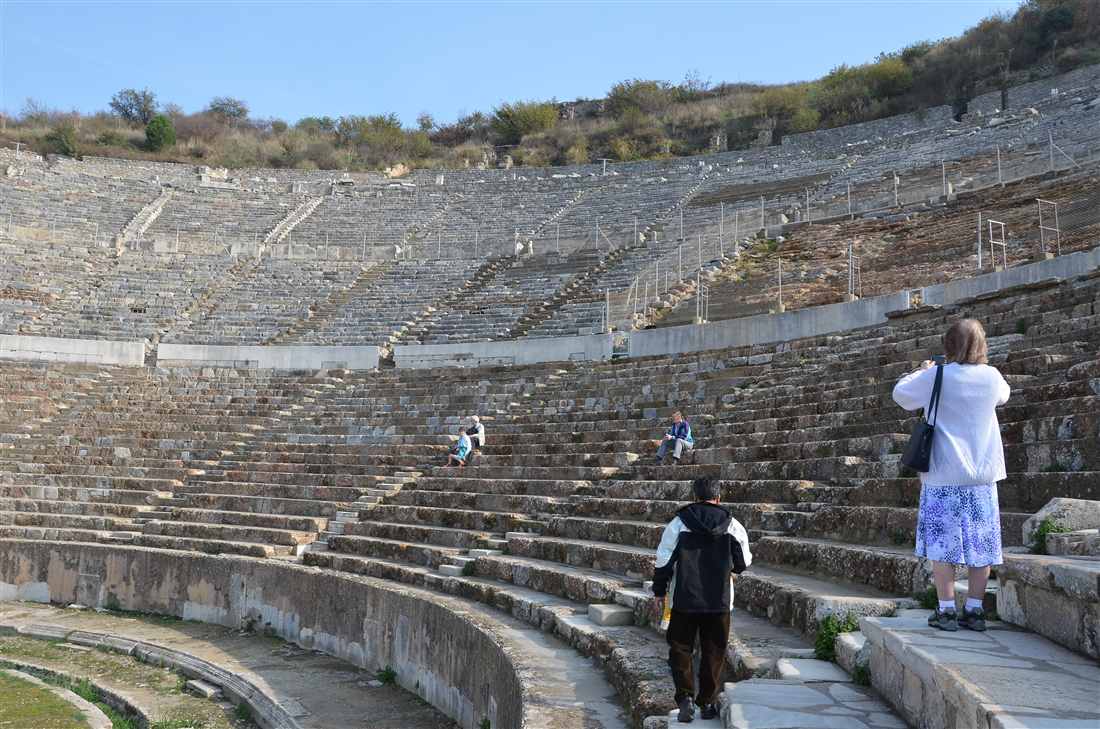
- The silversmiths’ riot filled the Great Theatre with a crowd shouting for Artemis.
- Timothy led the Ephesian church under Paul’s instruction.
- The Apostle John wrote and died here, and his tomb crowns Ayasoluk hill.
- Ephesus is the first of the Seven Churches of Revelation.
The ruins of Ephesus near modern Selçuk in western Turkey preserve the streets, the theatre and the basilica that these events describe. Walking the site places the reader inside the Acts of the Apostles and the letters of the New Testament, where the printed page becomes stone, marble and open sky.
When did the Apostle Paul come to Ephesus?
Paul settled in Ephesus during his third missionary journey, staying about three years between AD 52 and 56. The Acts of the Apostles records that he taught daily in the hall of Tyrannus, and the whole province of Asia heard the word of the Lord through his work.
Paul first touched Ephesus at the end of his second journey, leaving Priscilla and Aquila in the city and promising to return. On his third journey he made the city his base. Acts chapter 19 reports that he entered the synagogue and spoke boldly for three months about the kingdom of God. When opposition hardened, he withdrew the disciples and moved his teaching to the lecture hall of a man named Tyrannus.
For two years Paul reasoned in that hall, and the account states that all who lived in Asia, both Jews and Greeks, heard the word of the Lord. Extraordinary miracles accompanied his preaching. Handkerchiefs and aprons that had touched him were carried to the sick, and diseases left them. Practitioners of magic burned their scrolls in public, and the value of the destroyed books reached fifty thousand pieces of silver.
- Paul baptised about twelve disciples who had known only the baptism of John.
- He spoke three months in the synagogue before moving to the hall of Tyrannus.
- His teaching there lasted two years and reached the entire province of Asia.
- The church he founded became the mother church of the region.
From Ephesus, Paul wrote his First Letter to the Corinthians, sending greetings from the churches of Asia. He organised a collection for the believers in Jerusalem and directed the growth of congregations across the province. This long residence explains why the Ephesian church held such authority in the decades that followed, and why the New Testament returns to the city again and again.
What was the riot of the silversmiths at Ephesus?
The riot of the silversmiths, recorded in Acts chapter 19, erupted when a craftsman named Demetrius saw Paul’s preaching threaten the trade in silver shrines of Artemis. An angry crowd seized Paul’s companions and packed the Great Theatre, shouting “Great is Artemis of the Ephesians” for two hours.
Demetrius made silver models of the Temple of Artemis and employed a guild of workers who earned their living from this trade. He gathered the craftsmen and warned them that Paul had turned people away from gods made by human hands, both in Ephesus and across Asia. He argued that their business faced ruin and that the temple of the great goddess stood to lose its honour. His speech set the city in an uproar.
The crowd rushed into the theatre, dragging with them Gaius and Aristarchus, two of Paul’s travelling companions from Macedonia. Paul wished to enter and address the assembly, but the disciples and friendly provincial officials held him back. Confusion filled the meeting, and most of the people did not even know why they had come together. When the crowd recognised that a man pushed forward was a Jew, they raised one voice and chanted their cry to Artemis for two full hours.
- Demetrius led the silver guild that profited from Artemis shrines.
- Gaius and Aristarchus, Paul’s Macedonian companions, were seized by the mob.
- The crowd filled the Great Theatre, which seated about 25,000 people.
- The chant “Great is Artemis of the Ephesians” rang out for two hours.
The city clerk finally quieted the assembly. He reminded the people that Ephesus guarded the temple of Artemis, that the courts and proconsuls stood open for lawful complaints, and that Rome punished cities for unlawful riots. With that warning he dismissed the crowd. The episode reveals the clash between the new faith and the economy built on the goddess, and the theatre where it played out still stands today.
The account preserves the name of the city clerk’s office and the presence of Asiarchs, the provincial officials who counted Paul as a friend and warned him to stay clear of the theatre. Luke, the author of Acts, records these details with precision, and inscriptions unearthed at Ephesus confirm the titles he uses. The riot marks the moment when Paul’s mission collided head-on with the commercial power of the Artemis cult, and it forced his departure from the city soon afterward toward Macedonia and Greece.
What is the Epistle to the Ephesians?
The Epistle to the Ephesians is Paul’s letter to the church at Ephesus, written from prison around AD 60 to 62. Across six chapters it sets out the themes of grace through faith, the unity of Jew and Gentile in one body, and the armour of God for spiritual struggle.
Paul wrote the letter while held under guard, and he names himself a prisoner for the sake of the Gentiles. The first three chapters unfold the plan of salvation. Paul declares that believers are saved by grace through faith, and not by works, so that no one boasts. He teaches that Christ broke down the dividing wall between Jew and Gentile, joining both into one new humanity and one household of God, built on the foundation of the apostles and prophets.
The final three chapters turn to conduct. Paul urges the readers to walk worthy of their calling, to keep the unity of the Spirit in the bond of peace, and to build up the body of Christ. He addresses marriage, children, parents and the relationship of servants and masters, framing each in terms of mutual love and reverence for Christ.
- Salvation by grace through faith, the gift of God apart from works.
- The union of Jew and Gentile into one body and one temple.
- Instructions for household life, marriage and honest work.
- The armour of God: the belt of truth, the breastplate of righteousness, the shield of faith, the helmet of salvation and the sword of the Spirit.
The letter closes with its most famous passage, the call to put on the whole armour of God to stand against spiritual forces. Tychicus carried the letter to its readers. The Epistle to the Ephesians ranks among the most quoted books of the New Testament, and its language of grace and unity shaped Christian teaching for the centuries that followed.
Was Timothy connected to Ephesus?
Timothy led the church at Ephesus as Paul’s appointed representative. Paul left him in the city to guard sound teaching, and the two New Testament letters First Timothy and Second Timothy give him instructions for pastoral care, church order and personal endurance in that role.
Timothy came from Lystra in Asia Minor, the son of a Greek father and a Jewish mother named Eunice, with a devout grandmother named Lois. Paul recruited him early and treated him as a spiritual son. Timothy travelled with Paul across Greece and Asia, carried messages to the Corinthians and the Thessalonians, and shared in the founding of the churches. Paul trusted him with the weightiest assignments.
In the First Letter to Timothy, Paul writes that he urged Timothy to remain at Ephesus so that he command certain people to teach no false doctrine. The letter directs Timothy to appoint elders and deacons, to correct error, to care for widows, and to guard the deposit of faith entrusted to him. It sets out qualifications for church leaders that congregations still apply.
- Timothy came from Lystra, raised in faith by Eunice and Lois.
- Paul stationed him at Ephesus to hold back false teaching.
- First Timothy addresses elders, deacons, widows and sound doctrine.
- Second Timothy, Paul’s final letter, urges Timothy to endure and preach the word.
The Second Letter to Timothy reads as Paul’s farewell, written from a Roman prison near the end of his life. Paul asks Timothy to come to him quickly, to bring his cloak and his scrolls, and to fulfil his ministry. He declares that he has fought the good fight, finished the race and kept the faith. Early tradition records that Timothy served as the first bishop of Ephesus and died in the city, binding his name to it for good.
How is the Apostle John connected to Ephesus?
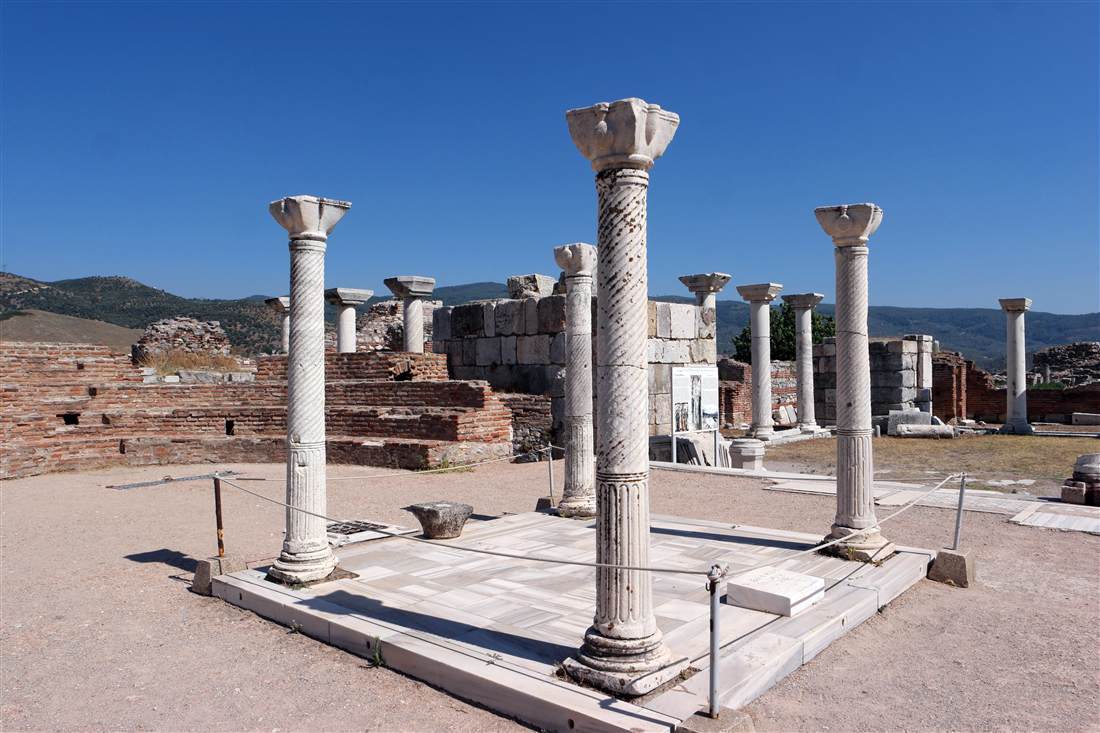
Christian tradition holds that the Apostle John spent his final decades at Ephesus, that he wrote his Gospel and letters here, and that he died and was buried in the city. His tomb lies on Ayasoluk hill, and a great basilica rose over it in the Byzantine centuries.
John, the son of Zebedee and one of the twelve apostles, moved to Ephesus after the events in Jerusalem, according to the writings of the early church fathers. Irenaeus, who learned from Polycarp, records that John lived at Ephesus into the reign of the emperor Trajan. Polycrates, a later bishop of Ephesus, names John as a witness and teacher who rests in the city. This chain of testimony places the beloved disciple firmly in Ephesus.
From the city, according to tradition, John composed the fourth Gospel, the three Letters of John and, during an exile to the nearby island of Patmos, the Book of Revelation. He is remembered as the guardian of the churches of Asia, guiding the congregations that Paul had planted a generation earlier and defending the faith against early distortions.
- Irenaeus records that John lived at Ephesus into old age.
- Tradition credits him with the Gospel, three letters and the Book of Revelation.
- His exile to Patmos, off the coast, produced the visions of Revelation.
- His tomb crowns Ayasoluk hill above modern Selçuk.
The emperor Justinian raised the Basilica of St John over the tomb in the sixth century AD, a vast structure with six domes and a marble nave. Its ruins remain one of the most visited Christian sites in Turkey. The presence of John gave Ephesus a second apostolic anchor beside Paul, and confirmed the city as the spiritual capital of early Asian Christianity.
Is Ephesus one of the Seven Churches of Revelation?
Yes. Ephesus is the first of the Seven Churches of Revelation, the seven congregations of Asia Minor that receive letters in chapters two and three of the Book of Revelation. It heads the list ahead of Smyrna, Pergamum, Thyatira, Sardis, Philadelphia and Laodicea.
The Book of Revelation opens with a vision in which the risen Christ dictates messages to seven churches, each represented by a lampstand and a star. The order follows a natural travel route through the province of Asia, and Ephesus, the leading city and gateway port, stands at the front. A messenger carrying the scroll reached Ephesus first and move north and inland to the others.
Each of the seven letters follows the same pattern. Christ names a title for himself, states what he knows of the church, offers praise, delivers a rebuke, gives a command, and closes with a promise to the one who overcomes. The seven together form a portrait of the Christian communities of Asia Minor at the close of the first century AD, with their strengths and their failings laid bare.
- Ephesus, the first church, praised for endurance and tested doctrine.
- Smyrna and Philadelphia, the two churches that receive no rebuke.
- Pergamum, Thyatira and Sardis, warned over compromise and spiritual sleep.
- Laodicea, rebuked as lukewarm, neither hot nor cold.
The seven cities lay within about 160 kilometres of one another, forming a rough circle across western Asia Minor. Their ruins today draw pilgrims who trace the route of the letters. As the first named church and the home of both Paul’s and John’s ministries, Ephesus holds the place of honour at the head of the seven, and its message carries the weight of that leadership.
What does Revelation say to the church of Ephesus?
Revelation chapter two, verses one to seven, praises the Ephesian church for hard work, patient endurance and rejection of false apostles. It then rebukes the church for forsaking its first love and calls it to repent, closing with the promise of the tree of life in the paradise of God.
The letter opens with Christ described as the one who holds the seven stars and walks among the seven golden lampstands. He commends the Ephesians for their toil and perseverance. He notes that they tested those who claimed to be apostles and found them false, and that they hated the practices of the Nicolaitans, a group whose teaching Christ himself opposes. The church had defended sound doctrine at real cost.
Yet the praise gives way to a sharp charge. Christ declares that the church has abandoned the love it held at first. The zeal and warmth of its early years had cooled into duty without devotion. He calls the Ephesians to remember the height from which they had fallen, to repent, and to return to the works they did at the beginning. Failure to repent carries a warning that their lampstand faced removal from its place.
- Praise for hard work, endurance and the testing of false apostles.
- Approval of their rejection of the Nicolaitans.
- Rebuke for abandoning their first love.
- A call to remember, repent and return to their first works.
The letter ends with a promise. To the one who overcomes, Christ grants the right to eat from the tree of life, which stands in the paradise of God. This image reaches back to the Garden of Eden and forward to the new creation described at the close of Revelation. The message to Ephesus balances high praise with a solemn warning, and its call to renew a fading love speaks far beyond the ancient city.
How is the Virgin Mary connected to Ephesus?
Tradition holds that the Apostle John brought the Virgin Mary to Ephesus after the crucifixion, in keeping with Christ’s charge from the cross to care for his mother. A house on Bülbül Dağı is honoured as her final home, and the Council of Ephesus in AD 431 defined her title Mother of God.
The Gospel of John records that Jesus, dying on the cross, entrusted his mother to the beloved disciple, saying “Behold your mother”, and from that hour the disciple took her into his own home. Since early tradition places John at Ephesus, the same tradition brings Mary with him to the city. Believers hold that she lived her final years on the wooded slope of the mountain now called Bülbül Dağı, south of the ancient city.
The House of the Virgin Mary, a small stone chapel on that hill, marks the traditional site. The Roman Catholic Church has honoured it as a place of pilgrimage, and popes have visited it. Pilgrims of Christian and Muslim faith alike come to pray at the spring below the house and to tie their written petitions to the wall beside it.
- Christ entrusted Mary to John from the cross, in the Gospel of John.
- Tradition brings Mary to Ephesus in John’s care.
- The House of the Virgin Mary on Bülbül Dağı marks her final home.
- The Council of Ephesus met in AD 431 in a church dedicated to Mary.
Ephesus also hosted the Third Ecumenical Council in AD 431, held in the Church of Mary within the city. That council affirmed the title Theotokos, “God-bearer” or Mother of God, for the Virgin Mary, settling a central doctrine of the incarnation. The choice of Ephesus for this council reflects the city’s deep association with Mary, and it fixed her place in both the theology and the sacred geography of early Christianity.
What biblical sites do you visit at Ephesus today?
The ruins of Ephesus near Selçuk preserve the key biblical landmarks in walking distance: the Great Theatre of the silversmiths’ riot, the Basilica of St John over the Apostle’s tomb, the House of the Virgin Mary on the hill, and the Cave of the Seven Sleepers on the slopes of Mount Pion.
The Great Theatre dominates the ancient city, carved into the western slope of Mount Pion with seating for about 25,000. This is the exact place where the crowd chanted for Artemis against Paul’s companions, described in Acts chapter 19. Visitors climb the tiers and look down the Harbour Road that once led to the sea. A short walk north stands the marble-paved main street and the reconstructed façade of the Library of Celsus.
On Ayasoluk hill above modern Selçuk rise the ruins of the Basilica of St John, built by the emperor Justinian over the tomb of the Apostle. A marble slab in the centre of the nave marks the traditional burial place. Nearby stand the İsa Bey Mosque and the single remaining column of the Temple of Artemis, once counted among the Seven Wonders of the ancient world.
- The Great Theatre, site of the riot in Acts chapter 19.
- The Basilica of St John, raised over the Apostle’s tomb.
- The House of the Virgin Mary on Bülbül Dağı.
- The Cave of the Seven Sleepers, a Christian and Islamic burial and legend site.
- The Church of Mary, where the Council of Ephesus met in AD 431.
The House of the Virgin Mary sits about seven kilometres from the main ruins, reached by a winding road up the pine-clad mountain. On the northern edge of the site lies the Cave of the Seven Sleepers, a rock-cut necropolis linked to the legend of youths who slept for two centuries. Together these landmarks turn a visit to Ephesus into a journey through the pages of the New Testament, where scripture and stone meet in one ancient landscape.
Frequently Asked Questions
Why is Ephesus important in the Bible?
Ephesus was a leading centre of early Christianity: the Apostle Paul spent three years there, the Apostle John lived and died there, the Virgin Mary is linked to it by tradition, and it heads the Seven Churches of the Book of Revelation.
What happened at the riot of the silversmiths in Ephesus?
The silversmith Demetrius, who sold shrines of Artemis, stirred a crowd against Paul that filled the Great Theatre, shouting “Great is Artemis of the Ephesians” for two hours until the city clerk calmed them, as told in the Acts of the Apostles.
Is Ephesus one of the Seven Churches of Revelation?
Ephesus is the first of the Seven Churches of Revelation. The letter in Revelation praises its endurance and rejection of false teachers, then rebukes it for forsaking its first love and warns that its lampstand faced removal.