
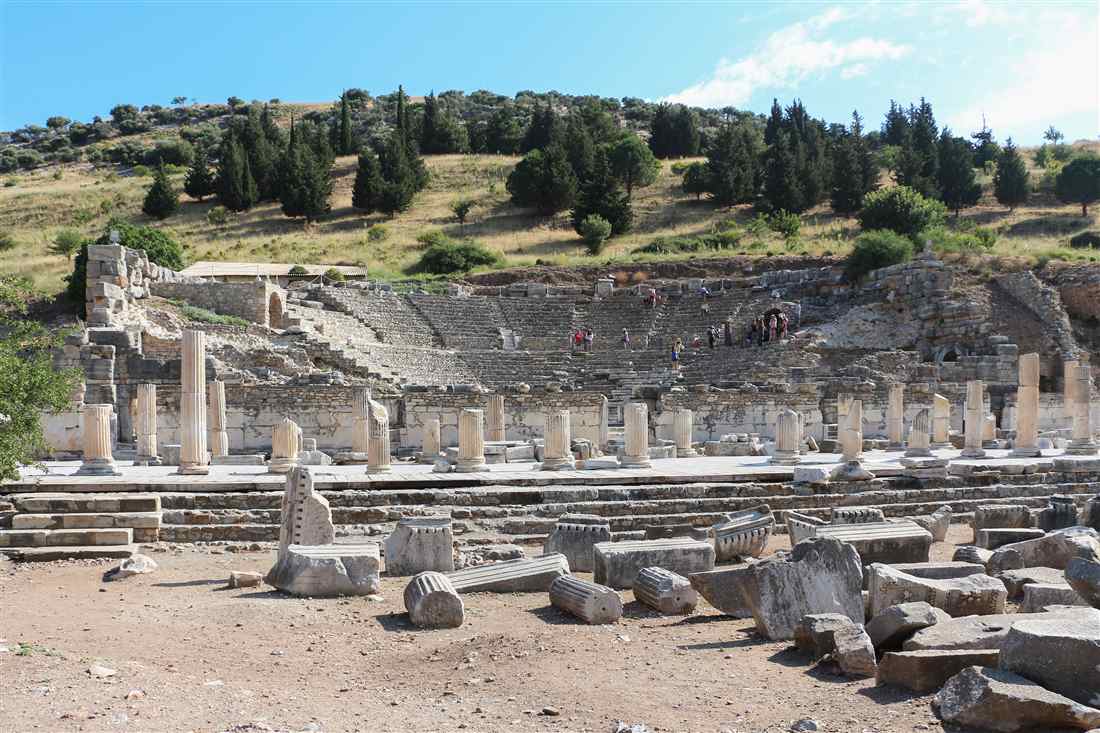
Ephesus tickets cover entry to the ancient city near Selcuk, with a separate ticket for the Terrace Houses and another for the Ephesus Museum. You buy them at the two gates or online, and the price sits in the mid-range of Turkey’s major sites. Plan the whole trip with Greece Tours. Read the full guide to Ephesus alongside this ticket planner.
This guide covers Ephesus tickets in full: how much the main entrance costs, the tickets you need, the separate Terrace Houses ticket, the Museum Pass, where to buy them, the opening hours, the discounts and free-entry categories, guided versus self-guided entry, the best time of day to go in, and what your ticket covers on a full visit.
How much is a ticket to Ephesus?
The main entrance ticket to the ancient city of Ephesus sits in a mid-price band of roughly €35–€45 (or the equivalent in Turkish lira) at the gate. The Turkish Ministry of Culture and Tourism sets the price, and it rises at each seasonal review.
Ephesus is a first-tier archaeological site, so its entrance fee stands above smaller ruins near Greece Tours itineraries and Aegean day-trip stops. The single adult ticket admits one person to the open-air excavation zone: the Library of Celsus, the Great Theatre, the Curetes Street colonnades, the public latrines, the agoras, and the marble streets that thread the whole valley together.
The gate price is quoted in Turkish lira on the official board and converts to a euro band that shifts with the exchange rate. Payment in lira by card gives the cleanest rate. The euro and US dollar figures printed on third-party booking pages carry a booking margin on top of the state fee, so the number online runs above the raw gate number.
Three cost facts frame the budget for a visit:
- The base site ticket covers the main excavation and its standing monuments — one flat adult fee.
- The Terrace Houses carry a second, separate fee that doubles the entry outlay for the two-ticket combination.
- The state reprices the fee at each seasonal review, so the printed band moves upward over time rather than holding steady.
Prices change at every official review, and the board at the turnstile is the single authoritative figure on the day of the visit. Treat any euro number quoted in advance as a guide band, not a fixed quote. The lira amount on the gate sign is the real charge; the euro equivalent floats with the day’s exchange rate. Budget for the mid-band adult fee plus the Terrace Houses supplement, and carry a card, since the ticket booths process contactless payment faster than cash and avoid change disputes over the lira total.
What tickets do you need for Ephesus?
A full Ephesus visit uses three distinct tickets: the main archaeological-site entry, the separate Terrace Houses ticket bought inside on Curetes Street, and the Ephesus Museum ticket in Selçuk town. Each is priced and sold on its own; no single ticket bundles all three.
Visitors treat these as one destination, but the ticketing splits them into three transactions. Understanding the split before arrival prevents the common mistake of paying at the main gate and assuming everything inside is included. The Ephesus site, the roofed Terrace Houses complex, and the town museum each guard their own turnstile.
The three tickets and what each unlocks:
- Main site entry — the open excavation: Library of Celsus, Great Theatre, Curetes and Marble Streets, the two agoras, the Odeon, the Temple of Hadrian façade, and the public fountains and latrines.
- Terrace Houses ticket — a separate roofed enclosure of Roman residences with intact frescoes and mosaic floors, entered from a gate on Curetes Street inside the main site.
- Ephesus Museum ticket — the archaeological museum in Selçuk, a short drive or bus ride from the ruins, holding the finds lifted from the excavation, including the two Artemis statues and the friezes.
The main site ticket and the Terrace Houses ticket are bought on-site the same day. The museum sits outside the fenced excavation in Selçuk centre, a separate stop reached after leaving the ruins. A thorough itinerary buys all three across a single day, ordering them site first, then the museum in the afternoon once the outdoor heat peaks. The Terrace Houses reward the extra fee with the best-preserved domestic interiors on the whole Aegean coast, so skipping that second ticket strips the visit of its most detailed rooms. Plan the wallet for two on-site tickets plus a third across town.
Do you need a separate ticket for the Terrace Houses?
Yes. The Terrace Houses require a second, separate ticket beyond the main site entry, sold at a booth beside the covered entrance on Curetes Street. The main gate ticket alone does not open the roofed residential complex; the supplement adds a lower mid-price band on top.
The Terrace Houses — called the “houses of the rich” — form a hillside block of Roman townhouses opposite the Temple of Hadrian. A modern roof and raised walkways protect the frescoed walls, marble panelling, and mosaic floors. That conservation shelter is why the state fences it separately and charges its own fee: the funds route to the ongoing restoration of the fragile painted plaster.
Key facts about the second ticket:
- It is bought inside the archaeological site, at the booth by the covered walkway entrance, not at the main outer gate.
- The supplement runs at a lower band than the main entry, adding a moderate sum rather than a second full fee.
- The Turkey Museum Pass and the Aegean regional pass include this entry, so pass holders walk in without paying twice.
- Card payment works at the interior booth, matching the outer gate terminals.
The complex demands the extra outlay for a concrete reason: the interiors preserve wall paintings, glass mosaics, and marble revetment at a level the open ruins lost to weather centuries ago. Elevated glass walkways carry visitors above the excavation levels, past dining rooms, courtyards, and heated bath suites. Skipping the ticket removes the single richest indoor experience on the site and leaves the visit weighted toward roofless colonnades. Anyone holding a Museum Pass presents it at the interior booth and enters free; anyone on a standalone site ticket buys the supplement at the same booth before stepping onto the walkways.
What is the Museum Pass and is it worth it for Ephesus?
The Turkey Museum Pass and its regional Aegean version are multi-day cards that bundle Ephesus main entry, the Terrace Houses, the Ephesus Museum, and nearby sites into one prepaid card. For a visitor pairing Ephesus with the Terrace Houses and neighbouring ruins, the pass undercuts buying tickets one by one.
The pass is a plastic card, activated at the first turnstile it touches, valid for a fixed run of days from that first swipe. The Aegean edition covers the western coast cluster; the countrywide edition adds Istanbul and Cappadocia sites. Both carry Ephesus, its Terrace Houses, and the Selçuk museum, plus the Temple of Artemis surrounds and St John’s Basilica in the same town.
The maths that decides worth:
- Ephesus main entry plus the Terrace Houses supplement plus the museum already stacks three fees into one day — the pass price sits near that combined total on its own.
- Adding a second regional site, such as Priene, Miletus, or Didyma, tips the pass into clear saving territory.
- The pass grants one entry per site and skips the ticket queue at the turnstile, a time gain on cruise-heavy mornings.
- A single-site visitor who skips the Terrace Houses and the museum draws no benefit — the standalone ticket wins that narrow case.
The pass rewards the traveller who treats the Aegean coast as a multi-stop route rather than one afternoon of ruins. A base near Selçuk or a slow drive down the coast racks up covered sites fast, and the card turns each turnstile into a swipe with no repeated payment. The decision hinges on stop count: two sites and the museum push the pass ahead of pay-as-you-go, while a lone dash through the main gate does not clear the pass price. Buy it at the first site’s entrance or online before travel, and activate it at the busiest gate to bank the queue-skip on the day it counts most.
Where do you buy Ephesus tickets — at the gate or online?
Ephesus tickets sell at two on-site booths — the Lower (Magnesia) Gate and the Upper Gate — and through official and third-party online channels. Gate booths take card and lira cash; online skip-the-line and guided options bundle a timed entry with a margin above the state fee.
The archaeological site runs two entrances at opposite ends of the sloping valley. Buying at either booth is straightforward outside cruise-peak hours, and card terminals move the line faster than cash windows. Online purchase suits travellers who value a locked entry slot and a printed or phone-stored voucher over a small saving.
The buying channels compared:
- Gate booths — both the Lower and Upper gates hold ticket windows selling the main entry and, inside, the Terrace Houses supplement; card and lira accepted.
- Official state e-ticket — the Ministry’s online portal issues the same state-priced ticket as a QR voucher scanned at the turnstile.
- Skip-the-line resellers — third-party platforms sell timed-entry vouchers at a booking margin, useful on cruise-arrival mornings.
- Guided-tour tickets — a tour operator bundles entry, transfer, and a licensed guide into one price, entry included in the package.
Payment at the physical booths favours card in lira for the cleanest exchange rate; the terminals process contactless and chip cards without a surcharge. Cash in lira works, though the windows return change slowly during rushes. Online vouchers store as a QR code that the turnstile scanner reads straight from a phone screen, no paper required. A traveller arriving on a fixed cruise window locks a timed online slot to sidestep the mid-morning queue; an independent traveller with a flexible clock buys at the booth on arrival and saves the online margin. Both routes admit through the same turnstiles at both gates.
What are the opening hours of Ephesus?
Ephesus opens daily. In the high season the site runs roughly 08:00 to 18:30 or 19:00; in the low season it closes earlier, around 17:00. Last entry falls 30 to 60 minutes before the posted closing time at both the Lower (Magnesia) and Upper gates.
The site keeps two seasonal timetables, switched at the spring and autumn changeovers set by the Ministry. The long summer window stretches the visiting day well into the evening light, while the winter window shuts before dusk. Both gates follow the same schedule, so entry choice rests on route preference, not hours.
The hours to plan around:
- High season — daily from around 08:00, closing near 18:30–19:00, with the last ticket sold up to an hour before the gate shuts.
- Low season — daily from around 08:00, closing near 17:00, last entry pulled forward accordingly.
- Terrace Houses — the covered complex follows the main site clock and stops admitting at the same last-entry cutoff.
- Two gates, one schedule — the Upper Gate near Magnesia and the Lower Gate toward Selçuk open and close together.
The last-entry rule matters for the Terrace Houses: arriving at the outer gate minutes before closing leaves no window to buy the supplement and walk the elevated paths before the interior booth stops selling. Plan the outdoor circuit and the roofed houses inside the final hour, not at it. The two gates sit at opposite ends of the descending valley — the Upper Gate delivers a downhill walk past the Odeon and Curetes Street toward the Library and Theatre, while the Lower Gate reverses that into an uphill finish. Both entrances post the day’s exact hours and last-entry time on a board at the turnstile, the authoritative timetable for the visit.
Is Ephesus free at any time, and are there discounts?
Ephesus is not free for standard adult visitors at any hour. Children under a set age enter free, students and Turkish seniors receive reduced or free entry with valid ID, and Museum Pass and Museum Card holders enter without paying at the gate. There is no universal free day.
The Ministry structures concessions by category rather than by time slot, so no free-entry morning or evening exists. The exemptions attach to who the visitor is and what card they hold, verified by ID or pass at the turnstile. Foreign adult tourists pay the full state fee regardless of arrival time.
The concession categories:
- Young children — under the posted age threshold, free with a guardian; the exact cutoff sits on the gate board.
- Students — reduced or waived entry against a valid international or Turkish student card presented at the window.
- Turkish citizens 65 and over — free entry to state sites with national ID.
- Museum Pass / Museum Card holders — entry included, no separate ticket, one swipe at the turnstile.
- Licensed guides and site staff — admitted on credentials, outside the ticketing.
The Terrace Houses supplement follows the same concession logic: pass holders enter the roofed complex free, while standalone-ticket adults pay the interior fee. Foreign students carry an internationally recognised student card to claim the reduction, since a home-country library card draws a refusal at the window. The free-child threshold is a fixed age published on the ticket board, not a loose judgement at the gate, so a family carries ID for a borderline-age child to avoid a dispute. No promotional free days rotate through the calendar; the reliable route to zero-cost entry is a valid concession category or a prepaid Museum Pass, both confirmed by ID or card scan at the turnstile.
Should you book a guided tour or buy tickets alone?
A guided tour bundles entry, transport, and a licensed guide who reads the ruins aloud; a solo ticket costs less and moves at the visitor’s pace with an audio guide filling the narrative. Cruise passengers arriving at Kusadasi port lean on tours for the transfer and the timed return to the ship.
The choice splits on logistics and depth. A guide turns roofless colonnades into a legible city — naming the Prytaneion, the brothel, the medical school, and the Library’s trick façade — while a self-guided walk with a downloaded audio track delivers the same facts without the group pace. The Ephesus from Kusadasi route is the decisive factor for cruise travellers, since the port sits a short drive from the ruins and a tour handles the shuttle both ways inside the ship’s window.
What each option carries:
- Guided tour ticket — site entry, round-trip transfer from Kusadasi port or a hotel, a licensed guide, and a fixed timetable that guarantees the return to the ship.
- Self-guided entry — the state ticket alone, a phone audio guide, and full freedom over route and dwell time.
- Terrace Houses — the supplement stacks onto either route; premium tours fold it into the package price.
- Transport — Kusadasi port to the site runs by tour shuttle, taxi, or the Selçuk dolmuş minibus for independent travellers.
The port distance drives the decision for anyone off a cruise ship. Kusadasi’s terminal sits close to the ruins, and a tour transfer removes the taxi-negotiation and the anxiety of a missed sailing by pinning the return to a schedule. Independent land-based travellers staying in Selçuk skip the tour, ride the local minibus to the gate, and buy the ticket on arrival. The depth trade is real: a licensed guide surfaces detail a silent walk misses, while a self-guided visitor with a good audio track and the Terrace Houses ticket covers the same monuments for a lower total. Match the route to the arrival mode — ship passenger toward a bundled tour, Selçuk-based traveller toward a solo ticket.
What is the best time of day to enter Ephesus with your ticket?
Enter at opening, around 08:00, or in the late afternoon after 16:00. The early slot beats the cruise-group wave and the midday heat; the late slot clears once tour buses depart. The 11:00–14:00 window stacks the thickest crowds and the harshest sun on the marble.
The site’s crowd curve tracks cruise arrivals and coach tours, both of which land mid-morning and clog the Library forecourt and the Great Theatre by late morning. The marble streets hold and radiate heat with no shade, so the temperature peak and the crowd peak overlap in the same midday hours. Timing entry to the edges of the day dodges both at once.
The daily rhythm to exploit:
- 08:00 opening — the gate is quiet, the light is soft on the Library façade for photographs, and the air holds the night’s cool.
- 11:00–14:00 — cruise coaches and tour groups peak, the Curetes Street bottlenecks, and the sun sits directly on the exposed marble.
- After 16:00 — buses head back to port, the crowd thins, and the low sun warms the stone for a second strong photo window.
- Last entry hour — the emptiest stretch, though the Terrace Houses booth stops selling before the gate shuts.
The early slot wins on three fronts at once: an uncrowded Library of Celsus, cool walking temperatures, and morning light angled across the façade. The late-afternoon slot trades the cool start for a thinned crowd, as the cruise ships pull their passengers back for the evening sailing and the coaches empty the valley. The midday middle loses on every count — peak heat on shadeless marble and peak group density in the narrowest streets. Anyone entering after 16:00 confirms the Terrace Houses last-entry cutoff first, since that interior booth closes ahead of the main gate and a late arrival forfeits the roofed rooms. Carry water and a hat whatever the hour; the valley offers almost no shade end to end.
How do Ephesus tickets fit a full visit — what does your ticket cover?
The main site ticket covers the entire open excavation and every roofless monument in it; the Terrace Houses need the separate interior ticket; the Ephesus Museum in Selçuk needs its own. Plan a downhill route from the Upper Gate, add the Terrace Houses mid-walk, and close at the museum.
The base ticket is generous in scope for what it opens outdoors. From the turnstile it admits the visitor to the full monument set without further payment inside — the exception being the roofed Terrace Houses, which stand behind their own booth. A route planned around the ticket structure walks the whole city in one descending line and slots the paid interior at its natural mid-point.
What the main ticket opens, free to roam:
- The Great Theatre, the Odeon, and the Bouleuterion council chamber.
- Curetes Street and Marble Street with their colonnades and shopfronts.
- The Library of Celsus façade, the Temple of Hadrian front, and the Fountain of Trajan.
- The Upper and Lower Agoras, the public latrines, and the Gate of Mazeus and Mithridates.
What needs the extra tickets:
- The Terrace Houses — the second on-site supplement, bought at the interior booth on Curetes Street.
- The Ephesus Museum — a third ticket in Selçuk town, holding the excavated statues and friezes.
The efficient plan starts at the Upper (Magnesia) Gate and walks downhill, so gravity carries the visitor past the Odeon, along Curetes Street, into the Terrace Houses at the mid-slope booth, then down to the Library and the Theatre near the Lower Gate. That order buys the two on-site tickets at their natural points — the main entry at the top, the Terrace Houses halfway down — and finishes at the exit closest to Selçuk for the museum stop. Reversing from the Lower Gate turns the same walk into an uphill grind in the heat. The three tickets fit one full day: outdoor city first at opening, roofed houses at the mid-point, and the museum’s cool galleries in the hot afternoon once the ruins bake.
Frequently Asked Questions
How much is a ticket to Ephesus?
The main Ephesus entrance ticket sits in the upper band of Turkish site fees, bought at the gate or online. The Terrace Houses and the Ephesus Museum in Selcuk each require a separate ticket beyond the main entry.
Do you need a separate ticket for the Terrace Houses?
The Terrace Houses need an extra ticket bought on Curetes Street, on top of the main Ephesus entrance. It opens the covered walkways above the frescoed Roman homes, and the mosaics reward the added fee.
What are the opening hours of Ephesus?
Ephesus opens daily, with long summer hours and shorter winter hours, and a last entry before closing. The Upper Gate at Magnesia and the Lower Gate near the harbour both admit ticket holders.