
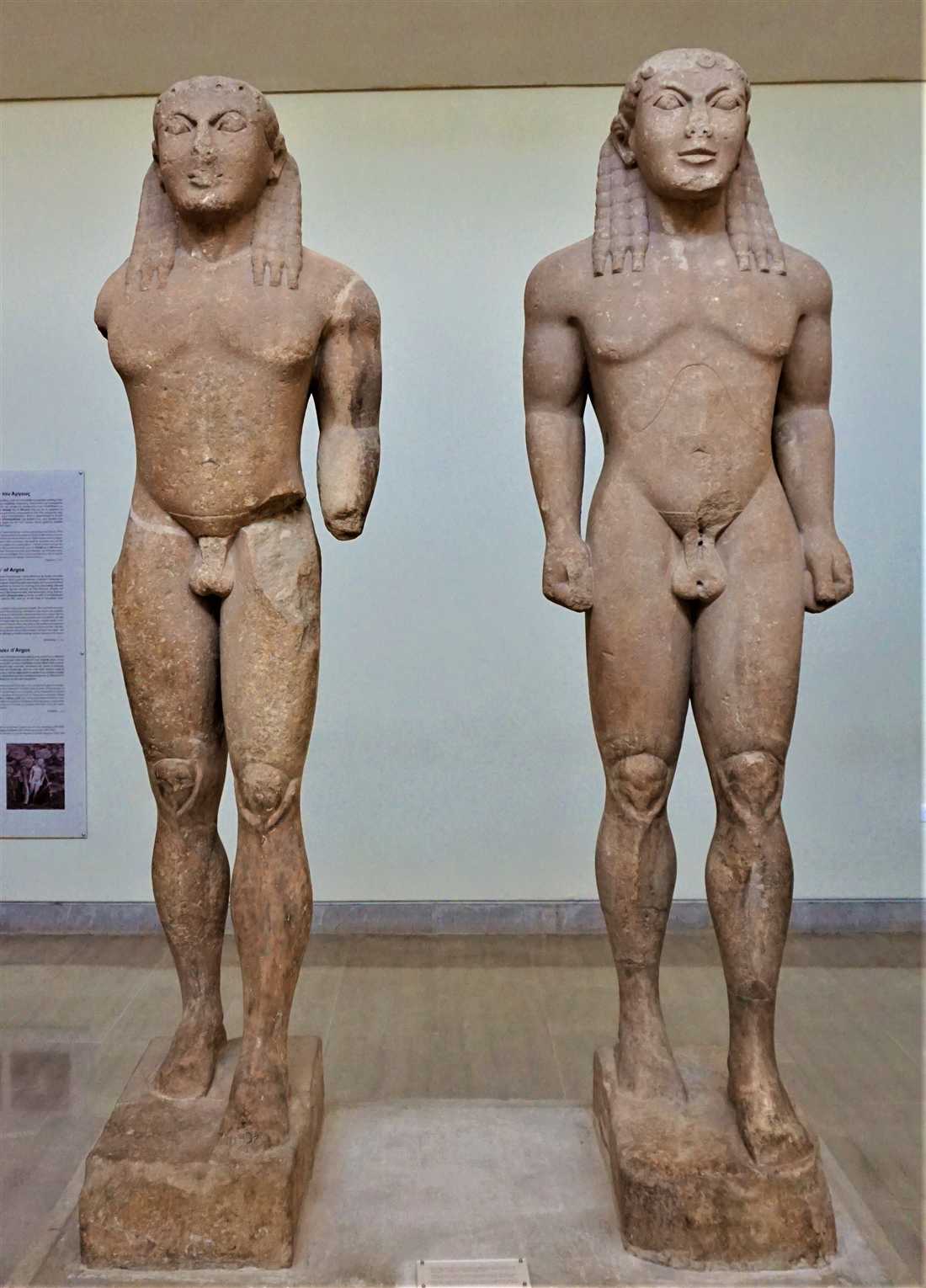
Kleobis and Biton are twin brothers of Argos honoured with two Archaic marble kouroi found at Delphi and now displayed in the Delphi Archaeological Museum, among the earliest and best-preserved monumental Greek statues, carved in the early sixth century BC. Plan the whole trip with Greece Tours.
This guide covers Kleobis and Biton in full: who they were, the story Herodotus tells of the young men who pulled their mother’s cart and received the best gift a mortal can be given, why the city of Argos dedicated the pair at Delphi, what the statues look like, who carved them and how they are dated, and why they matter and where you see them today.
The pair sit at the crossroads of Greek art and Greek moral thought. As sculpture they are textbook kouroi, the rigid standing youths that opened the story of Greek statuary before the Classical breakthrough toward naturalism. As a story they carry the lesson Solon pressed on Croesus, that a peaceful death at the height of honour outweighs a king’s gold, and that no life is called happy until its final day. Statue, inscription and legend together make Kleobis and Biton one of the fixed reference points of the Archaic age.
Who are Kleobis and Biton?
Kleobis and Biton are twin brothers of Argos honoured with two Archaic marble kouros statues found at Delphi and now displayed in the Delphi Archaeological Museum. They rank among the earliest and best-preserved monumental Greek statues, carved in the early sixth century BC.
The two figures stand as a matched pair of kouroi, the standing nude male statue type that defines Archaic Greek sculpture. Each youth steps forward with the left foot, holds the arms straight at the sides with clenched fists, and fixes the face in the frontal, wide-eyed stare of the period. The heavy musculature, the broad shoulders, and the plaited hair falling down the back mark them as products of an Argive workshop working in island marble.
Both statues carry inscriptions on their bases that name the sculptor and the brothers, tying the marble directly to the story told about them. The identification rests on those carved letters, which record the pair as the sons whom Argos chose to commemorate. The surviving bases and the fragmentary lettering give epigraphers a fixed anchor for dating Argive sculpture of the Archaic age.
The brothers form part of the sculptural wealth that the sanctuary of Delphi gathered from cities across Greece. Visitors reach them today inside the sanctuary of Delphi, where the pair share galleries with the Charioteer, the Sphinx of Naxos, and the friezes of the Siphnian Treasury. Their scale, their condition, and their documented backstory make them one of the fixed points in any study of early Greek monumental art.
What is the story of Kleobis and Biton?
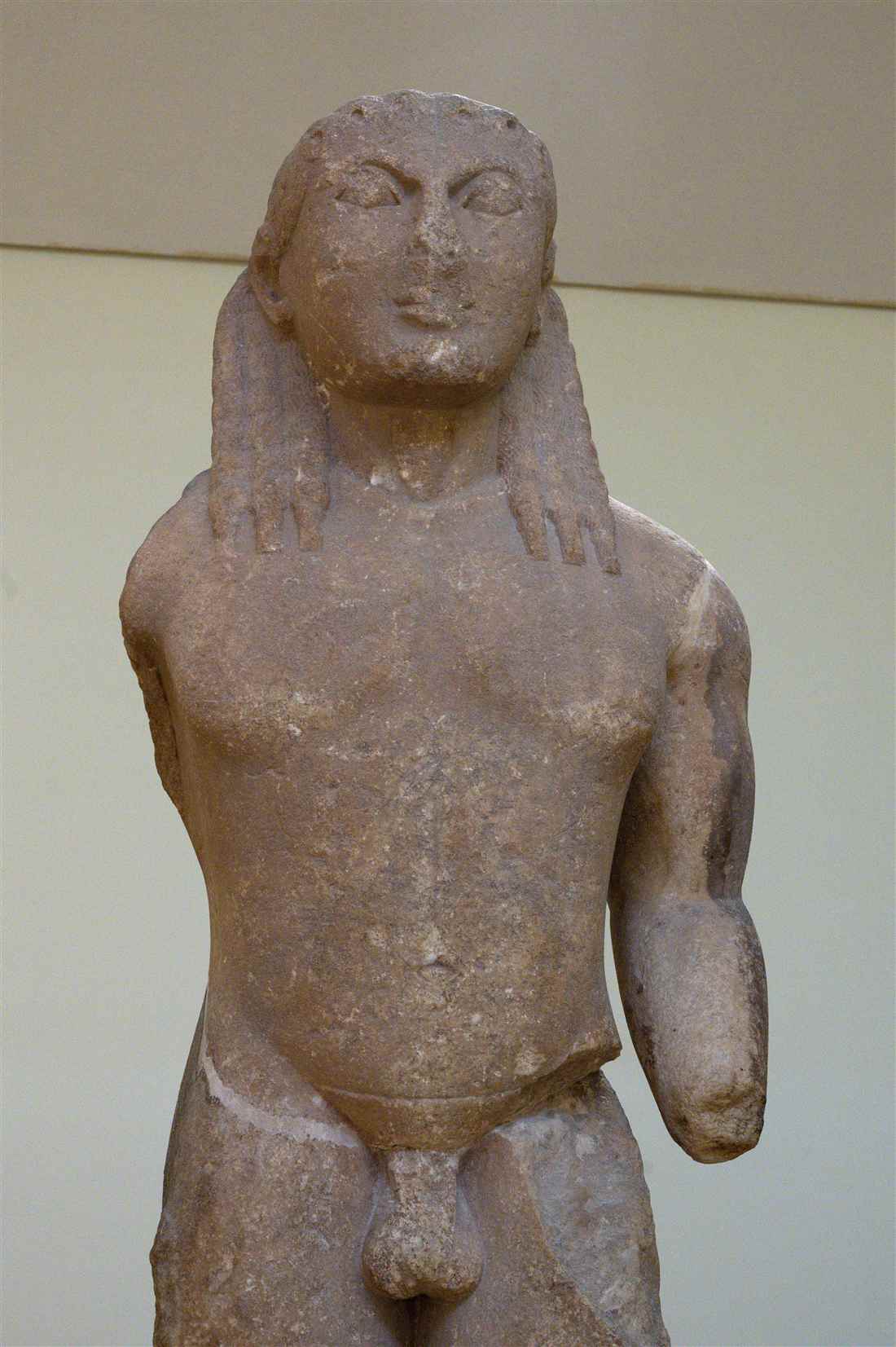
Herodotus places the story in the mouth of the Athenian sage Solon before King Croesus of Lydia. When the oxen failed to arrive, the two brothers yoked themselves to their mother’s cart and hauled it many miles to the sanctuary of Hera for the goddess’s festival.
Their mother served as a priestess of Hera at Argos, and the festival required her to reach the temple by cart. With the plough oxen still in the fields and the hour pressing, Kleobis and Biton put their own necks under the yoke and dragged the loaded wagon along the road to the sanctuary. The assembled crowd praised the strength of the young men, and the women of Argos blessed the mother for the sons she had raised.
Overcome with pride and gratitude, the mother stood before the statue of Hera and prayed that the goddess grant her sons the best thing a mortal can receive. After the sacrifice and the feast, the two youths lay down to sleep inside the temple itself and never rose again. They died there in their sleep, at the summit of their honour, and the goddess answered the prayer through a gentle and painless death.
Solon holds the pair up to Croesus as proof that a peaceful death at the height of public esteem outranks the wealth of a king. In the logic of the tale, the brothers reached the best fate a human life can hold precisely because it ended while their name stood highest. The Argives carried that judgement further by turning the two young men into stone and setting them among the gods.
The moral folds into the wider Herodotean lesson that no mortal life counts as blessed until its final day. That lesson runs alongside the pronouncements of the Oracle of Delphi, whose warnings to Croesus shape the same stretch of the narrative. The death of Kleobis and Biton gives the abstract teaching a human face carved in marble.
Why did the Argives dedicate the statues at Delphi?
The city of Argos honoured the brothers with statues set up at the Panhellenic sanctuary of Delphi to broadcast the story and the city’s piety across the entire Greek world. Delphi drew pilgrims from every Greek state, which turned the pair into a permanent advertisement for Argive virtue.
Delphi functioned as the shared meeting ground of the Greek cities, a place where rival states competed to display their wealth, their victories, and their devotion. A dedication planted there reached an audience far wider than any monument set up at home in the Argolid. By choosing Delphi over their own agora, the Argives placed Kleobis and Biton in front of the whole Hellenic community.
The dedication served several concrete purposes for the city:
- It fixed the fame of the brothers in durable marble at the most visited sanctuary in Greece.
- It proclaimed the piety of Argos toward Hera, the city’s patron goddess.
- It set an Argive monument beside the treasuries and offerings of competing states.
- It gave physical form to the moral that Solon later drew from the tale.
The choice also reflects the standing of Hera’s cult at Argos, since the sanctuary of the goddess outside the city ranked among the oldest and richest in the Peloponnese. Honouring two young men who died in her service linked the reputation of the city to the reputation of its chief deity. The statues declared that Argos bred sons willing to spend their strength and their lives for the gods.
Set within the crowded terraces of the sanctuary, the pair joined a landscape of dedications that turned Delphi into a museum of the Greek world long before the modern museum existed. Every pilgrim who climbed the Sacred Way passed monuments raised by dozens of cities, and the Argive brothers held their place among them. Their survival into the present lets modern visitors read that ancient act of civic pride in the original stone.
What do the Kleobis and Biton statues look like?
Kleobis and Biton survive as a pair of nearly life-size marble kouroi, standing frontally in the rigid Archaic pose with the left leg advanced, arms held to the sides with clenched fists, and the fixed “Archaic smile.” Their broad shoulders, heavy thighs and compact, powerful build match the two athletic brothers.
Each figure stands upright and symmetrical, the weight shared evenly on both feet even as the left leg steps forward. The heads face directly ahead, the eyes set wide and level, and the corners of the mouth lift into the taut smile that Archaic sculptors carved onto every kouros. The hair falls in a mass of stylised beaded strands down the back and frames the brow in a band of tight, regular curls.
The anatomy reads as blocky and schematic rather than naturalistic. The chest divides into flat planes, the abdomen shows a stylised grooved pattern, and the thighs swell with a muscular heaviness that gives the pair their stocky, wrestler-like proportions. This dense, grounded physique separates the brothers from the slimmer, more elongated kouroi of Athens and the Cycladic islands, and it fits the story of two young men strong enough to pull a wagon.
The two statues are close to identical, carved as a matched set, and both stood on an inscribed base that named them. Fragments of that base carry the letters that record the dedication and the sculptor’s signature, and the join between figures and inscription anchors the identification. The stone is worn and both bodies carry breaks and losses, yet the pair keep the frozen, staring dignity that defines the earliest phase of Greek monumental sculpture.
Who carved Kleobis and Biton, and how are they dated?
The inscription on the base carries the sculptor’s signature, read by many scholars as [Poly]medes of Argos, placing the pair in the Argive school of Archaic sculpture. The style and the letter forms date the figures to the early sixth century BC, and debate continues over whether they are the twins or the Dioscuri.
The signature marks these statues as products of Argos, the same city Herodotus names as the brothers’ home. Argive sculptors of the Archaic period worked in a hard local stone and favoured the dense, muscular proportions seen here, and Kleobis and Biton stand as the school’s finest surviving witnesses. The naming of the maker on the base is itself notable, because signed works from this early date are rare.
Dating rests on two lines of evidence that agree. The letter shapes cut into the base belong to the archaic Argive alphabet of the early sixth century BC, and the sculptural style, with its rigid frontality, beaded hair and schematic torso, matches that same horizon. Together they fix the pair near the opening decades of the century, among the earliest large-scale kouroi to survive intact enough to study.
Scholars divide over exactly whom the figures represent. Several factors drive the debate:
- The Herodotus narrative names Kleobis and Biton, the Argive brothers who hauled their mother to the sanctuary of Hera.
- The surviving base inscription is fragmentary, and its restored words leave the identity open to more than one reading.
- Some scholars read the twinned, matched figures as the Dioscuri, the divine brothers Castor and Pollux, whom Argos also honoured.
- The find spot at Delphi, far from Argos, complicates any single reading of why the pair travelled there.
Why do Kleobis and Biton matter, and where can you see them?
Kleobis and Biton rank among the finest surviving Archaic kouroi and serve as a benchmark for early Greek sculpture. They carry the moral weight of Solon’s lesson on true happiness, and they stand today in the Delphi Archaeological Museum beside the Charioteer and the sanctuary’s other treasures.
As sculpture, the pair document the moment Greek artists first carved the human body at monumental scale. Their frontal stance, clenched fists and schematic muscles set the template that later kouroi refined toward naturalism, so scholars measure the progress of Archaic art against them. Because both figures survive and both keep their inscribed base, they give a securely dated, securely located fixed point that few other early kouroi provide.
Their fame also rests on the story Herodotus attaches to them. In that account the Athenian lawgiver Solon names the two brothers as an example of human happiness, ranking a good death after a pious act above the wealth of King Croesus. The statues therefore carry a lesson as much as a form, and visitors read them as an emblem of devotion rewarded, filial duty, and the Greek idea that a life is judged by its close.
Both figures now stand in the Delphi Archaeological Museum, which gathers the finds excavated across the sanctuary of Apollo. They share the galleries with the bronze Charioteer of Delphi, the twin sphinx of the Naxians, the Siphnian treasury friezes and the sanctuary’s votive offerings. Seeing the two kouroi in that setting places them within the wider display of Archaic and Classical art that draws visitors to Delphi.
What do Kleobis and Biton tell us about Archaic Greek sculpture and the kouros?
Kleobis and Biton belong to the kouros type, the standard Archaic Greek statue of a nude standing youth. The pair fix an early stage in Greek sculpture, holding the rigid frontal pose and geometric proportions that later generations loosened toward naturalism.
The kouros dominated Greek monumental sculpture through the sixth century BC. Sculptors carved the figure standing upright, arms held straight at the sides with fists clenched, the left leg advanced while the weight stays evenly balanced. This posture derives from Egyptian standing statues, which Greek carvers studied and adapted. Kleobis and Biton keep the closed, blocklike stance, the broad shoulders, the belted waist, and the schematic hair rendered as beaded rows.
The pair mark an early point in the type’s development. Their anatomy stays diagrammatic: the knees, the shins, and the abdominal muscles read as engraved patterns rather than modeled flesh. Across the following decades sculptors softened these divisions, turned the head, shifted the weight onto one leg, and arrived at the relaxed contrapposto of the Classical period. The Argive twins document the departure point of that hundred-year progression.
Kouroi served fixed public functions across the Greek world. Communities raised them as votive offerings in sanctuaries and as markers over graves, and the same rigid type filled all these roles:
- Votive dedications \u2014 offerings set up in sanctuaries such as Delphi and Delos to honor a god.
- Grave markers \u2014 statues raised over burials to commemorate the dead youth.
- Athletic and civic honors \u2014 figures erected for victors and prominent citizens.
Delphi drew such dedications from every corner of Greece, and the sanctuary preserves the record of that traffic in stone. The nearby Sphinx of Naxos shows the same Archaic ambition in a different form, and the surviving monuments together explain why Delphi is worth visiting for anyone tracing the roots of Greek art.
Were Kleobis and Biton real people or the Dioscuri?
Scholars debate two identifications. The traditional reading names the statues as the Argive brothers of the Herodotus and Cicero story. An alternative reads the same pair as the Dioscuri, the divine twins Castor and Polydeuces. The inscription anchors the argument, and the question stays open.
The base carries an inscription that names the figures, but the letters suffered damage, and the surviving text admits more than one restoration. Under the traditional reading the names spell out Kleobis and Biton, the sons of the priestess of Hera at Argos who yoked themselves to their mother’s cart. Herodotus records the tale in his Histories, and Cicero repeats it in Latin, which ties the Delphi statues directly to that Argive legend.
The alternative reading restores the damaged inscription to name the Dioscuri instead. Castor and Polydeuces were the twin sons of Leda, worshipped across the Greek world as protectors and horsemen, and Argos held a strong cult of the pair. Supporters of this reading point to the matched twin form of the statues and to the prominence of the Dioscuri in Argive religion as grounds for the divine identification.
The evidence divides. The Herodotus and Cicero narrative gives the Argive-brothers reading a firm literary anchor that the Dioscuri reading lacks, while the worn state of the inscription denies either side a decisive text. The two matched youths carved by the same Argive workshop fit both a pair of mortal brothers and a pair of divine twins, so the sculpture itself settles nothing. The identification rests on the contested letters, and the reading of those letters remains the heart of the dispute.
Frequently Asked Questions
Who are Kleobis and Biton?
Kleobis and Biton are twin brothers of Argos commemorated by two Archaic marble kouros statues at Delphi, carved in the early sixth century BC and now in the Delphi Archaeological Museum. They rank among the earliest and best-preserved monumental Greek sculptures.
What is the story of Kleobis and Biton?
When the oxen failed, the two brothers yoked themselves and pulled their mother, a priestess of Hera, on her cart to the goddess’s festival. She prayed for the best gift a mortal can receive, and the youths died peacefully in their sleep at the height of their honour.
Where are the Kleobis and Biton statues?
The two kouroi stand in the Delphi Archaeological Museum, displayed among the sanctuary’s finest works beside the bronze Charioteer, the Sphinx of Naxos and the Siphnian Treasury frieze.
Who carved Kleobis and Biton, and how old are they?
An inscription on the base names the sculptor, read by many scholars as Polymedes of Argos, and the pair belong to the Argive school of Archaic sculpture. They are carved in the early sixth century BC, dated from the kouros style and the letter forms of the inscription.