
The Siphnian Treasury
The Siphnian Treasury is a small marble treasury on the Sacred Way at Delphi, raised by the island of Siphnos in the late sixth century BC to hold its offerings to Apollo. It is famed for the two standing marble maidens that replaced columns in its porch and for the continuous sculpted frieze, one of the masterpieces of Archaic Greek art, that ran around all four sides. Plan the whole trip with Greece Tours.
This guide covers the Siphnian Treasury in full: what it is, who built it and why the rich island of Siphnos raised it, what the building looked like, what the four sides of its frieze show, why the frieze matters in the history of Greek sculpture, where you see it today, what became of Siphnos, and how the treasury compares with the others on the Sacred Way.
What is the Siphnian Treasury?
The Siphnian Treasury is a small marble treasury building on the Sacred Way at Delphi, raised by the Cycladic island of Siphnos in the late sixth century BC to hold its offerings to Apollo, famed for two standing marble maidens that replaced columns in its porch and for a continuous sculpted frieze that ran around all four sides.
A treasury at Delphi is a house-shaped strongroom, and the Siphnian building performs that role in miniature. It stands beside the Sacred Way as pilgrims climb toward the temple of Apollo, guarding gold, silver, bronze plate and dedicated statuettes that the people of Siphnos sent to the oracle. The plan is compact: a single closed chamber, the naos, entered through a shallow columned porch, the pronaos.
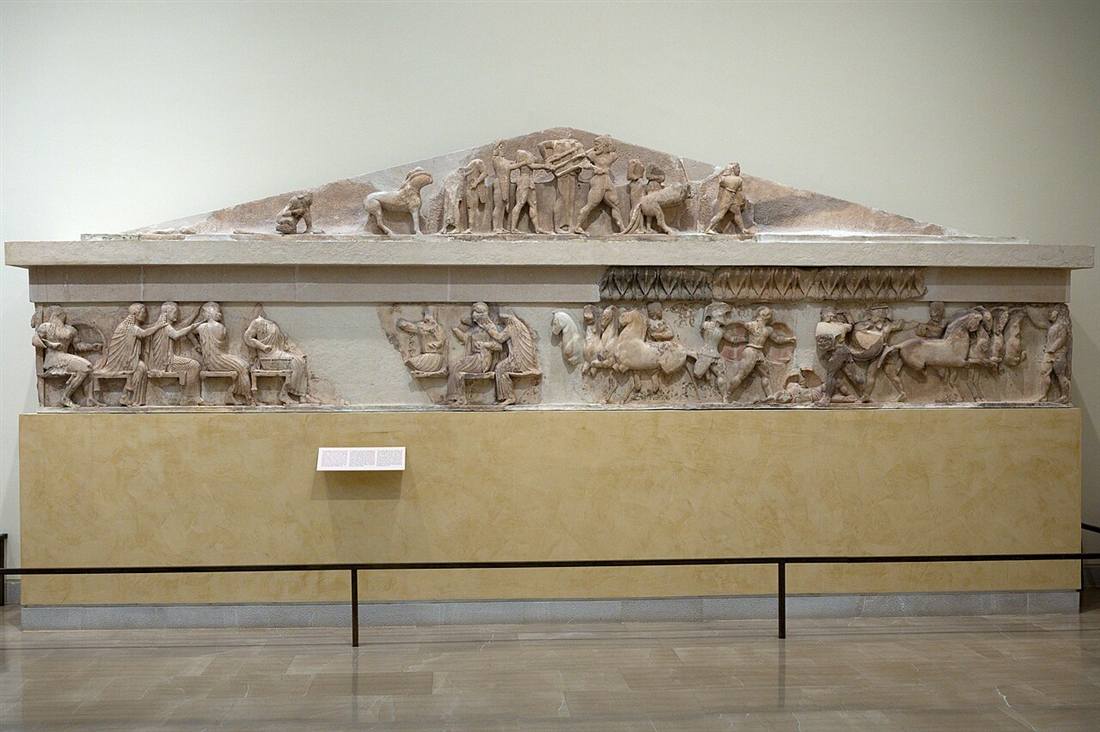
The building carries more sculpted decoration for its size than any other structure at the sanctuary. In place of two front columns stand two korai, draped maidens carved in the round who bear the entablature on their heads. Above them a carved pediment fills the gable, and below the roof a narrow band of relief, the Ionic frieze, wraps the north, south, east and west faces in an unbroken ribbon of figures.
The Siphnian Treasury dates to the years around the closing decades of the sixth century BC, which places it among the earliest fully sculpted marble buildings of the Greek world. Its remains, recovered by French excavators, now stand reassembled in the Delphi Archaeological Museum, where the frieze slabs and the surviving kore anchor one of the museum’s central rooms. The treasury is a fixed stop on any serious visit to Delphi.
Who built the Siphnian Treasury, and why?
The island of Siphnos built the treasury. Made rich by gold and silver mines, the Siphnians dedicated a tenth of their mining income to raise the building as a display of wealth and piety, and the offering won them prestige and the right of promanteia, the privilege of consulting the oracle before other Greeks.
Siphnos, a small island in the Cyclades, drew its fortune from mines that yielded gold and silver directly from the ground. The historian Herodotus records that the Siphnians were the wealthiest of the islanders in their generation, and that they resolved to send a tithe of the metal to Delphi. That tithe paid for Parian marble, for master sculptors, and for the carving that covers the building.
The motive combined devotion and diplomacy. A treasury at a Panhellenic sanctuary broadcast a city’s name to every Greek who walked the Sacred Way, so the Siphnians used the building to convert private mineral wealth into public standing. Delphi rewarded generous benefactors with tangible honors, and the Siphnians secured promanteia, the right to put their questions to the Pythia ahead of rival states.
The benefaction rested on a single revenue stream, and that stream failed. Herodotus reports that the sea broke into the Siphnian workings and drowned the mines, ending the flow of gold and silver that had funded the island’s splendor. The treasury outlasted the mines it was built from, standing at Delphi long after the source of Siphnian wealth had gone under the water.
What did the Siphnian Treasury look like?
The Siphnian Treasury was a small Ionic building in white Parian marble, with two caryatid maidens standing in place of columns to support the porch, a carved pediment showing gods and heroes quarrelling over the Delphic tripod, and a continuous relief frieze wrapping all four exterior walls below the roofline.
The material set the tone. The Siphnians imported white Parian marble, a fine translucent stone prized for sculpture, and built the whole structure from it rather than the local limestone used elsewhere at the sanctuary. Traces of paint survive on the carved surfaces, evidence that the figures once carried red, blue and gilded color against the pale ground of the marble.
The front distinguished the building. Instead of plain columns, two korai, marble maidens in richly folded Ionic dress, rose between the corner pilasters and carried the porch entablature on capitals set atop their heads. The design turns structural supports into figures, so the load of the roof passes through the bodies of the maidens. Above the porch, the eastern pediment framed the contest between Apollo and Herakles for the sacred tripod of Delphi, with Zeus intervening at the center.
The four faces of the building carried the treasury’s masterwork:
- North frieze — the battle of gods and giants, the Gigantomachy, with ranks of deities driving chariots against the giants.
- East frieze — the gods seated in council on Olympos beside a scene of combat before Troy.
- South frieze — a procession and a scene of the rape of the Leukippidai, more worn than the rest.
- West frieze — the judgement of Paris, with goddesses arriving in chariots to be judged.
The frieze ran as one continuous band, an Ionic feature that carries figures around every side without the interruption of the metopes and triglyphs of a Doric building. The carving stands in high relief, with overlapping bodies, deep undercutting and drilled detail that separate the sculpted forms from the background. This unbroken sculpted ribbon, the caryatid porch and the crowded pediment together make the Siphnian Treasury the richest surviving showcase of late sixth-century BC marble sculpture at Delphi.
What does the frieze of the Siphnian Treasury show?
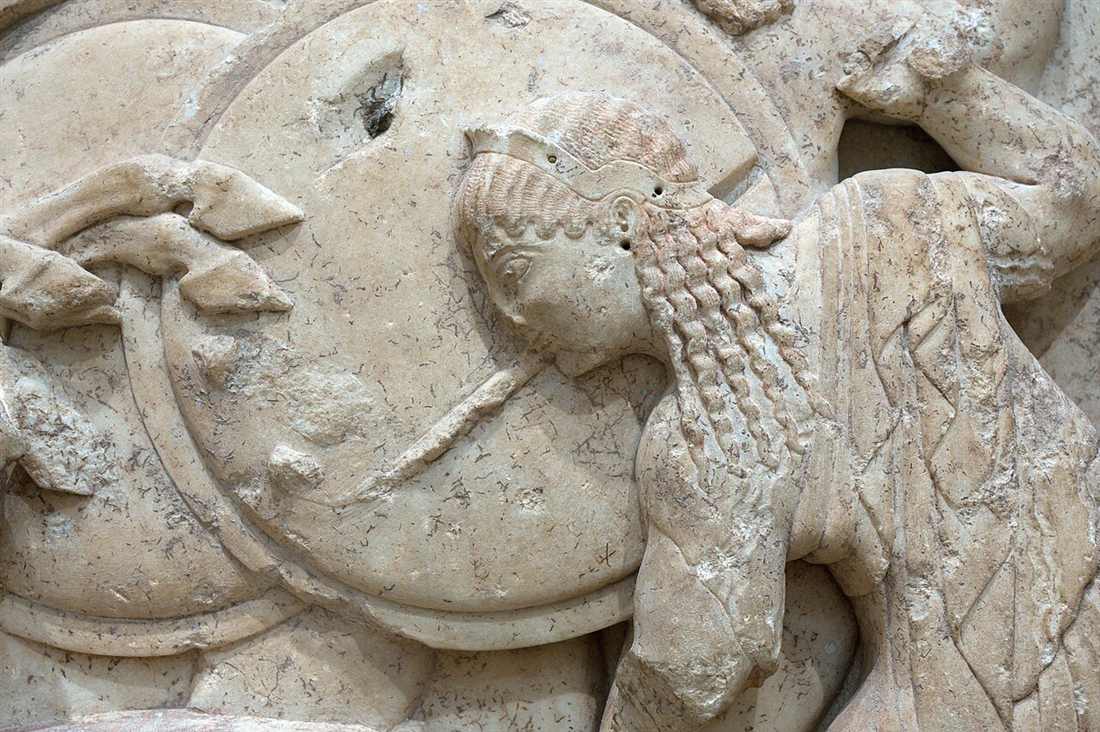
The continuous Ionic frieze wraps all four sides of the building with mythological narrative: the Gigantomachy on the north, an assembly of the gods above the Trojan War on the east, the Judgement of Paris on the west, and the abduction of women on the south.
The frieze runs as a single unbroken band around the top of the exterior walls, carved in high relief so the figures stand almost free of their background. Each side tells its own story, and together the four faces present a compressed anthology of Greek myth that a visitor reads while walking the Sacred Way. The north and east faces carry the densest and most crowded compositions, packed with overlapping bodies, chariots, and animals.
- North frieze — the Gigantomachy: the battle of the Olympian gods against the giants, with lions from Cybele’s chariot tearing into a giant, Apollo and Artemis advancing together, and the war god pressing forward against a wall of shields.
- East frieze — the Trojan War: the gods sit in two facing groups, one favouring the Trojans and one the Greeks, while below them Achilles and Memnon fight over a fallen warrior as the deities debate the outcome.
- West frieze — the Judgement of Paris: Hermes leads Athena, Hera, and Aphrodite before the Trojan prince, the moment that sets the whole Trojan cycle in motion.
- South frieze — the abduction of women: a scene of chariots and seized figures, read as the carrying-off of the Leucippides by the twin Dioscuri.
The narrative logic rewards the pilgrim’s route. The east face greeted worshippers climbing toward the Temple of Apollo, so its subject, the gods presiding over human war, carries the greatest weight and the finest carving. The Gigantomachy on the north asserts the triumph of divine order over chaos, a theme Delphi’s other dedications echoed. The reliefs name their protagonists through inscribed labels cut beside the figures, so the shield of a giant or the chariot of a goddess identifies its owner directly to the reader.
Depth of cutting drives the drama. The sculptors set some figures fully in the round and others in low relief behind them, building three or four planes of action into a band a little over half a metre high. Chariot horses surge diagonally, spears cross the field, and fallen fighters twist underfoot, so the flat wall reads as a churning mass of bodies rather than a row of profiles.
Why is the Siphnian Treasury frieze important?
The frieze ranks as a masterpiece and a near-complete survival of Archaic Ionic relief sculpture, capturing the transition toward the Classical style. Traces of paint, inscribed labels, and clear differences in carving prove two distinct sculptors worked the four sides.
Few Archaic friezes survive in this state. Most temple sculpture of the period reaches us in isolated fragments, but the Siphnian bands come down substantially intact, giving scholars an almost unbroken paragraph of narrative relief rather than scattered words. That completeness makes the frieze a fixed anchor for dating and for tracing how Greek sculptors moved from stiff, frontal Archaic figures toward the naturalism and depth that define the Classical era.
The carving itself records that shift in progress. On the east and north faces the drapery falls in richer folds, the poses turn in space, and overlapping bodies create real recession, while the west and south faces stay flatter and more schematic. That contrast is not an accident of preservation. The east frieze carries an inscription in which the sculptor asks to be remembered, and the difference in hand between the sides shows that a second, more conservative artist carved the remaining faces. The frieze therefore documents two working sculptors side by side, one pushing the style forward.
Colour and text complete the evidence. Surviving pigment shows the reliefs were painted, with backgrounds and details picked out so the crowded scenes read clearly from the ground, and the inscribed names beside the figures turn the frieze into a labelled narrative that names gods, heroes, and giants outright. Together the paint, the labels, and the twin-sculptor signature make the Siphnian frieze one of the richest single documents of Archaic Greek art, a benchmark that sits alongside the nearby Treasury of the Athenians in any study of Delphic dedications.
Where can you see the Siphnian Treasury today?
The building’s foundations remain in place on the Sacred Way at Delphi, just below the Temple of Apollo, while the reconstructed frieze, the pediment, and one of the caryatid maidens stand in a dedicated room of the Delphi Archaeological Museum.
On the site, the treasury occupies a prominent terrace early on the zig-zag climb of the Sacred Way, so visitors pass its footprint soon after entering the sanctuary. The marble superstructure is gone, but the foundation blocks and the position mark exactly where the small Ionic building faced the processional route. Interpretive signs on the terrace connect the empty foundations to the sculpture now housed indoors, so the walk up the sanctuary and the museum visit form a single continuous reading of the monument.
The sculpture lives a short distance away in the Delphi Archaeological Museum, where a purpose-built gallery reassembles the frieze on a reconstruction of the building’s proportions. The four faces are mounted at their original relative heights, so the Gigantomachy, the Trojan War assembly, the Judgement of Paris, and the abduction scene appear in sequence as they once ran around the walls. The east pediment, showing a dispute over the Delphic tripod, and one surviving caryatid, the draped maiden who stood in place of a column at the porch, occupy the same room.
Seeing both halves matters, because neither tells the whole story alone. The foundations fix the scale and the setting among Delphi’s crowded treasuries, and the museum gallery restores the carving, the pediment figures, and the caryatid that the bare terrace no longer holds. A visit that pairs the terrace on the Sacred Way with the dedicated museum room recovers the Siphnian Treasury as its builders intended it: a jewel-box of painted marble narrative set at the heart of the sanctuary.
What happened to Siphnos and its treasury?
Siphnos funded its treasury from gold and silver mines that later flooded when the sea broke into the workings, ending the island’s wealth. The ancients read the ruin as Apollo’s punishment for withholding his tithe, and the building itself collapsed across the centuries.
The mines sat on the eastern and southern edges of Siphnos, and their metal made the small island one of the richest states in the Aegean. Herodotus records that the Siphnians paid a tenth of their annual mine income to Delphi, and that the treasury on the Sacred Way stood as the visible sign of that offering. The prosperity paid for marble shipped from the Cycladic quarries, sculptors of the first rank, and a building faced entirely in stone rather than the poros of its neighbours.
The sea ended the metal. Salt water broke through the seaward galleries and drowned the productive levels, and the veins that remained lay beyond reach of the island’s methods. The islanders came to Delphi to ask why the flow had stopped, and the tradition that grew around the oracle tied the disaster to a broken promise: the Siphnians had sent a gilded stone instead of the gold tithe they owed, and the god closed the mines in answer. The story fixed Siphnos in later memory as a byword for wealth lost through bad faith.
The treasury outlasted the mines by a long span, then fell in its turn. Earthquake, the weight of centuries, and the general ruin of the sanctuary brought the walls and roof down, and the sculptured blocks tumbled into the debris that buried the terrace. The French School at Athens uncovered the site during the great Delphi excavation, and the diggers recovered the frieze slabs, the pediment figures and the caryatid columns from the fill where they had lain. What the sea took from Siphnos, the earth kept at Delphi, and the recovered marble now carries the whole record of the island’s brief supremacy.
How does the Siphnian Treasury compare with the other treasuries at Delphi?
The Siphnian Treasury is the richest and most lavishly decorated of the treasuries lining the Sacred Way. Its Ionic marble luxury, carved on every surface, stands against the plainer Doric of the Athenian Treasury and the bare foundations of Sikyon, Thebes and the rest.
Delphi held a long row of these small buildings, each raised by a city or people to house the offerings it sent to Apollo and to advertise the giver’s standing. They crowded the Sacred Way as it climbed toward the temple, and their variety turned the road into a display of rival wealth and rival taste. The Siphnian building took the front rank in ornament. Its architects replaced the usual porch columns with two marble maidens, ran a continuous sculptured frieze around all four sides, and filled the pediment with figures, so that carving covered the structure from base to gable.
The contrast with its neighbours reads clearly on the ground and in the museum. Set the Siphnian work beside the others that survive:
- The Doric Treasury of the Athenians, restored and standing, plain in its columns and reserved in its decoration, faced in Parian marble but severe in line.
- The Treasury of the Sikyonians, reduced to foundations, its earlier metopes lifted into the museum apart from the walls that once held them.
- The Treasury of the Thebans and the other city foundations, marked now by low courses of stone that give the plan without the elevation.
The difference is one of language as much as expense. The Doric buildings speak in restraint, trusting mass and proportion, while the Siphnian building speaks in the Ionic manner, dense with figure and pattern. That density made it the showpiece of the terrace, and it made the treasury the single richest sculptural monument on the Sacred Way. Visitors who weigh whether the whole site rewards the climb find their answer in this stretch of the road, where the treasuries turn abstract history into stone; the case for the visit is set out in full at is Delphi worth visiting.
How do you find and see the Siphnian Treasury on a visit to Delphi?
Find the foundations of the Siphnian Treasury on the Sacred Way as you climb from the entrance toward the Temple of Apollo, on the bend where the road turns. Then walk to the museum, where the frieze, pediment and caryatid stand gathered in one room.
The ruins come first. Enter the archaeological site at the lower gate, take the Sacred Way as it starts its zigzag ascent, and watch the left side of the road as it approaches the sharp turn below the temple terrace. The treasury’s foundations sit there among the ranked platforms of the other city offerings, close to the restored Athenian Treasury, which makes the best landmark for locating the plainer Siphnian courses beside it. The ground plan gives the footprint of the porch and the cella, and standing on the terrace fixes the scale and the position that the sculpture once crowned.
The sculpture comes second, in the Delphi Archaeological Museum a short walk from the site entrance. The frieze slabs, the pediment groups and the surviving caryatid are set together in their own gallery, mounted at a height that lets the eye follow the carved processions and battles across the blocks. Seeing the empty foundations and then the assembled marble in a single visit joins the two halves of the monument: the terrace shows where it stood on the Sacred Way, and the gallery shows what rose above the stones.
Plan the route so the ruins and the museum sit in one loop. The site and the museum share a ticket and a car park, and the same road that carries you up to the temple carries you past the temple of Athena at the sanctuary below, so a full Delphi visit takes in the treasury terrace, the temple, the theatre and the stadium above, and the round tholos on the way in. Pair the Siphnian foundations and their gathered sculpture with a stop at the Sanctuary of Athena Pronaia, and the treasury sits inside the larger picture of the site rather than apart from it. The order that works best keeps the sculpture until last, so the carved frieze reads against the bare terrace you have just left.
What are the caryatid maidens of the Siphnian Treasury?
The caryatid maidens are two sculpted korai that stood in place of columns on the treasury porch, each carrying the entablature on her crowned head. They gave the small marble building a female-figured front that replaced plain shafts with standing women.
Each maiden wears a pleated Ionic chiton that falls in fine vertical folds to the feet, gathered and belted at the waist. Over the chiton runs a diagonal himation, and the carved cloth reads as thin, clinging fabric. On the head sits the polos, a tall cylindrical crown, and the polos doubles as the load-bearing capital that meets the beam above.
Traces of paint survive on the marble: red and blue pigment marked the drapery bands, the hair, and the border patterns, so the maidens once stood in strong colour against the white stone. The eyes, lips, and jewellery carried added detail that the plain marble now conceals. The face type matches the Archaic smile seen on the korai of the same generation, the same period that produced the bronze Charioteer of Delphi.
The female support-figure that the Siphnians raised at Delphi runs on into later Greek building. The tradition reaches its most famous form in the caryatids of the Erechtheion at Athens, the six maidens of the south porch, and the term caryatid attaches to both. One Siphnian maiden survives in the Delphi Archaeological Museum, reassembled from fragments beside the treasury frieze.
- Form: a standing kore substituting for an Ionic column on the porch.
- Dress: a pleated Ionic chiton with a diagonal himation.
- Crown: the polos, which serves as the weight-bearing capital.
- Survival: one maiden on display in the Delphi museum.
When was the Siphnian Treasury built, and how is it dated?
The Siphnians built the treasury in the late sixth century BC, around 525 BC, at the height of the island’s mining wealth. Three strands fix the date: the Archaic Ionic style, an inscription on the building, and the account of the historian Herodotus.
The style places the treasury in the closing decades of the sixth century BC. The Ionic order of the porch, the deep relief of the frieze, and the Archaic smile of the caryatids all belong to that generation of Delphi sculpture. Scholars read the carving as the work of the late Archaic phase, ahead of the severe style that followed at the start of the fifth century BC.
An inscription cut on the treasury names the dedication and confirms Siphnos as the builder, anchoring the monument to the island rather than to a rival state. The epigraphic letter forms match the same late sixth-century BC bracket, so the text and the sculpture agree on the period.
Herodotus supplies the historical frame. He records that Siphnos grew rich from its gold and silver mines and that the islanders tithed a tenth of the yield to Delphi, and that wealth funded the marble treasury. The mines flooded and the Samians raided the island soon after, which caps the building date near the peak Herodotus describes. Visitors who plan a trip around the best time to visit Delphi reach the museum where the frieze and one caryatid now stand.
Frequently Asked Questions
What is the Siphnian Treasury?
The Siphnian Treasury is a small marble treasury on the Sacred Way at Delphi, built by the island of Siphnos in the late sixth century BC. It held the island’s offerings to Apollo and is famed for its caryatid maidens and its continuous Archaic frieze.
What does the Siphnian Treasury frieze show?
The continuous frieze shows the Gigantomachy, the battle of gods and giants, on the north; an assembly of gods watching the Trojan War on the east; the Judgement of Paris on the west; and an abduction of women on the south, all carved in fine Ionic relief.
Where is the Siphnian Treasury now?
The foundations of the treasury stand on the Sacred Way at Delphi below the Temple of Apollo, while the reconstructed frieze, pediment and a caryatid maiden are displayed together in a dedicated room of the Delphi Archaeological Museum.