
The Corycian Cave
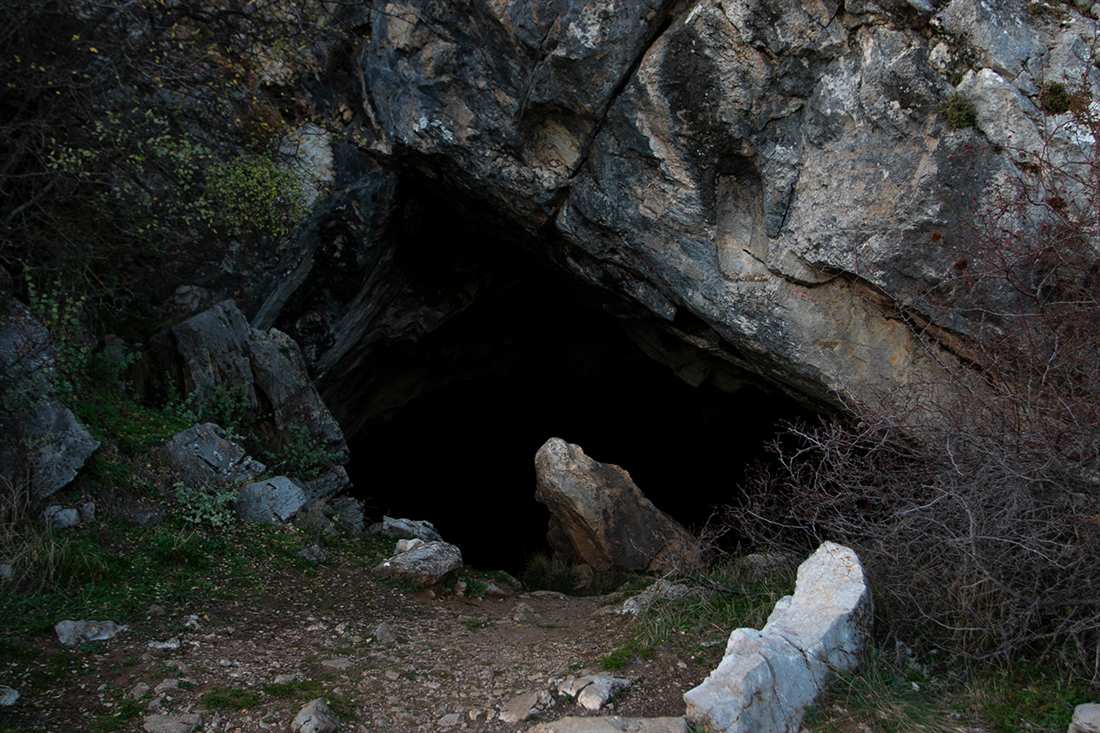
The Corycian Cave is a large stalactite cavern high on the plateau of Mount Parnassus above Delphi, around 1,370 metres up, sacred in antiquity to the god Pan and the Corycian Nymphs. A cult cave rather than a built shrine, it drew worshippers up the mountain from the sanctuary of Delphi for well over a thousand years, from the Neolithic age to the close of antiquity. Plan the whole trip with Greece Tours.
This guide covers the Corycian Cave in full: what it is and where it stands on Parnassus, the myth and cult of Pan and the Nymphs, how to hike up to it from Delphi, what you see inside, its history and archaeology, what the excavated finds reveal, the best time to make the climb, what else the mountain holds, what to bring, how it was formed, why it carries the name Corycian, and how to combine the cave with a visit to the sanctuary of Delphi below.
What is the Corycian Cave?
The Corycian Cave is a large stalactite cavern high on the plateau of Mount Parnassus above Delphi, near 1,370 metres up. Sacred in antiquity to the god Pan and the Corycian Nymphs, it served as a cult cave rather than a built shrine, and takes its name from the nymph Corycia.
The cave opens as a broad natural chamber inside the limestone mass of Mount Parnassus, its roof hung with stalactites and its floor descending in wide terraces of rock. Ancient sources, among them the geographer Pausanias in his Description of Greece, name it the fairest of the many caves he saw and record that the people of Delphi held it sacred to Pan and to the Nymphs. The name Korykion derives from Korykia, one of the Naiad nymphs of the mountain.
Unlike the marble temples of the sanctuary below, the Corycian Cave carries no architecture. The worship happened in the raw space of the rock: pilgrims climbed the mountain, entered the dim interior, and left their offerings on the cave floor and in the crevices of the walls. Excavation of that floor recovered the physical trace of the cult across many centuries, from the archaic period through Roman times.
The cave belongs to the wider religious landscape of Delphi. Where the oracle of Apollo governed the sanctuary on the slope, the upland cave governed the cult of Pan, the Nymphs, and the winter mysteries of Dionysus. A visit to the cave completes the picture of ancient Parnassus as a mountain worshipped from its foot to its high plateau.
Where is the Corycian Cave, and how high is it?
The Corycian Cave sits on the Parnassus plateau north of and above the Delphi sanctuary and the town of Arachova, at roughly 1,370 metres. A marked mountain trail climbs to it from Delphi, and a rough vehicle track reaches it from the plateau, through fir forest and open upland pasture.
From the archaeological site of Delphi the classic approach follows a footpath that switchbacks up the steep slope above the stadium, gaining more than a kilometre of height on the way to the plateau. The route forms part of the long-distance E4 European trail and passes the Kroki spring before it emerges onto the open tableland the ancients called the Livadi. The full walk up covers a demanding ascent and rewards the climber with the cave mouth set into a rock face at the plateau edge.
Drivers reach the cave by a dirt road that branches from the Arachova–Parnassus ski-centre road and crosses the upland to a small parking spot below the entrance. From there a short marked path leads to the mouth. The track is rough, and the final stretch demands care, so many visitors combine the drive with the last section on foot.
The setting shapes the experience. Fir forest covers the lower plateau, thinning into rock and grazing land near the cave, and the air stays cool even in high summer while snow closes the approach through the coldest months. Standing at the entrance, a visitor looks back down toward the gulf of Corinth far below, the same view that framed the climb of ancient worshippers.
What are the myth and cult of the Corycian Cave?
The Corycian Cave belonged to Pan and the Corycian Nymphs, the Korykiai, daughters of the river Kephisos. In winter the Thyiades, the maenads of Dionysus, climbed from Delphi to hold his rites here. Excavation of the floor recovered thousands of clay figurines, knucklebones, and lamps left as offerings.
The cult joined three divine presences on one mountain. Pan, the goat-footed god of the wild, ruled the cave as his upland haunt. The Corycian Nymphs, spirits of the springs and the rock, drew their name and their parentage from Kephisos, the river of the plain below. Dionysus claimed the winter half of the sacred year, when the god of Delphi shifted from Apollo to Dionysus and his female worshippers took to the heights.
Those worshippers were the Thyiades. Ancient testimony describes bands of women who ascended Parnassus from Delphi in the depth of winter to dance for Dionysus around the cave and the plateau, enduring the cold and the snow of the mountain. The rite tied the high cave to the sanctuary below in a single religious rhythm that ran through the turning year.
The offerings recovered from the cave floor record the reach and the length of the cult. The finds included:
- Clay figurines of Pan, the Nymphs, and dancing worshippers, numbering in the thousands.
- Astragaloi, the knucklebones of sheep and goats, used in play and in divination.
- Terracotta lamps that lit the dark interior for the rites.
- Bronze rings, coins, and small votive plaques pressed into the crevices of the rock.
Together the deposits span from the archaic centuries into the Roman period, marking the cave as one of the longest-worshipped rural sanctuaries of central Greece. The knucklebones in particular link the site to Pan and the Nymphs as givers of oracles by lot, a humbler counterpart to the great spoken oracle of Apollo on the slope beneath.
How do you hike to the Corycian Cave from Delphi?
You hike to the Corycian Cave from Delphi on a steep waymarked trail that climbs from the ancient sanctuary through fir forest to the Parnassus plateau, gaining more than 900 metres of height across roughly nine kilometres and three to four hours of ascent.
The route starts at the archaeological site and follows the old stone-paved path above the theatre and stadium, then joins the modern waymarked trail that carries the E4 European long-distance markers. The path passes the Kroki spring, one of the few reliable water points on the mountain, and rises through dense stands of Kefallinian fir. Walkers gain height fast: the sanctuary sits near 570 metres and the cave opens at about 1,360 metres on the plateau, so the climb is sustained and demands real fitness.
The ancient pilgrims used the same broad line of ascent, and stretches of cut rock steps and terracing survive along the way. The upper section flattens onto the karst plateau of Livadi, a high pasture ringed by peaks, where the trail turns north-east toward the cave mouth. Snow closes the top of the mountain in winter, so most walkers climb between late spring and autumn; the page on the best time to visit Delphi sets out the same seasonal window that governs the higher trail.
Walkers who prefer a shorter effort drive most of the height on the rough forest track that leaves the Delphi–Arachova road and climbs toward Livadi. The track ends within a walkable distance of the cave, and the final stretch crosses the plateau on foot over broken limestone. Sturdy boots, water, and a printed track matter on either approach, because phone signal drops on the high ground and the karst surface turns ankles.
What can you see inside the Corycian Cave?
Inside the Corycian Cave you see a wide, low entrance opening into a large main chamber more than 60 metres long with a high domed ceiling, ranks of stalactites and stalagmites, and dark inner galleries that run deep into the limestone and demand a torch.
The entrance faces the plateau as a broad horizontal slot in the rock, framing daylight that reaches only the front of the cavern. Beyond it the floor drops into the principal hall, a single great space where the roof lifts far overhead and natural pillars of calcite join floor to ceiling. Water seeping through the Parnassus limestone built these formations across long ages, and the drip continues, so the surfaces stay wet and the stone glistens where a beam catches it.
Past the lit zone the cave splits into deeper passages that thread back into the mountain. These galleries narrow and turn, the air stays cool and still, and the daylight fails entirely, so a headtorch is essential to move safely over the uneven, slick floor. The chamber carries sound: a voice or a footfall rings against the high vault, and the acoustic gave the ancient rites their setting.
The scale of the cavern reads clearly from the entrance threshold. Visitors take in several distinct features as they move inward:
- the wide low mouth that admits the last of the daylight;
- the vast main chamber with its high, curved ceiling;
- the calcite columns where stalactites and stalagmites meet;
- the seep-fed formations that still grow on the walls;
- the black inner galleries running deep past the reach of light.
What is the history and archaeology of the cave?
The cave’s history runs from the Neolithic and Bronze Age through the classical cult of Pan and the Nymphs to later centuries of refuge, and French School excavation on the plateau recovered thousands of votive offerings that fix its long, unbroken use.
The earliest layers hold Neolithic pottery and stone tools, evidence that herders and hunters sheltered on the plateau long before Delphi rose below. Bronze Age material follows in the same deposits, so occupation of the high ground carried through the prehistoric millennia. When the sanctuary of Apollo grew in the classical centuries, the cave became a mountain shrine of Pan and the Nymphs, and pilgrims climbed from the oracle to leave gifts in the dark.
Archaeologists of the French School of Athens dug the site and its forecourt and lifted a dense record of dedications: terracotta figurines, lamps that once lit the rites, bronze rings, iron tools, astragals or knucklebones used in divination games, and inscribed offerings naming the Nymphs and Pan. The finds span from the archaic centuries through the Roman period, which shows the cult held its ground for the better part of a thousand years while the fortunes of Delphi shifted below.
The mountain kept its role as a hideout long after the pagan rites ended. Its remoteness and the cover of its inner galleries made it a refuge in troubled centuries, and during the Second World War resistance fighters used the plateau and the cave as a mountain hideout above the occupied valley. That same isolation that drew the ancient pilgrims, the height, the distance, and the concealing rock, tied the cave to the springs and shrines below, from the Castalian Spring where pilgrims purified before the climb to the oracle they came to consult.
When is the best time to hike to the Corycian Cave?
Spring and autumn deliver the strongest hiking conditions: mild daytime temperatures, firm dry trails, and clear air across the Parnassus plateau. Summer adds long daylight but bakes the lower slope, while winter snow buries the plateau path and closes the upper route for months.
From April into June the high meadows above Delphi carry running water, cool mornings, and stable footing on the limestone track. Late spring brings crocus, grape hyacinth, and mountain tulip across the Livadi grassland, and the wildflowers thicken as the snowline retreats past the 1,300-metre contour. The rock underfoot stays dry, and the ascent from the trailhead to the cave mouth stays firm from start to finish.
September and October return the same firm ground after the summer heat breaks. Daytime temperatures on the plateau sit in the mild band, the light turns sharp against the grey crags, and the crowds thin on the path up from Arachova. Autumn hikers gain settled weather and empty trails, though daylight shortens through October and the descent runs into dusk on a late start.
Summer trades comfort for daylight. The sun clears the ridgelines before six and holds past eight, but the lower slope above the ancient sanctuary radiates heat through the middle of the day, and the exposed switchbacks offer no shade. Hikers start at dawn, reach the cave before the heat peaks, and turn back down the mountain by early afternoon.
Winter shuts the high route. Snow settles across the Livadi plateau from December, drifts fill the karst hollows around the cave, and the marked path vanishes under a metre of cover. The Corycian Cave sits above 1,300 metres, and the approach demands winter mountaineering skill once the snowpack builds, so the walking season runs from the spring melt to the first heavy autumn snowfall.
What else is on Mount Parnassus near the Corycian Cave?
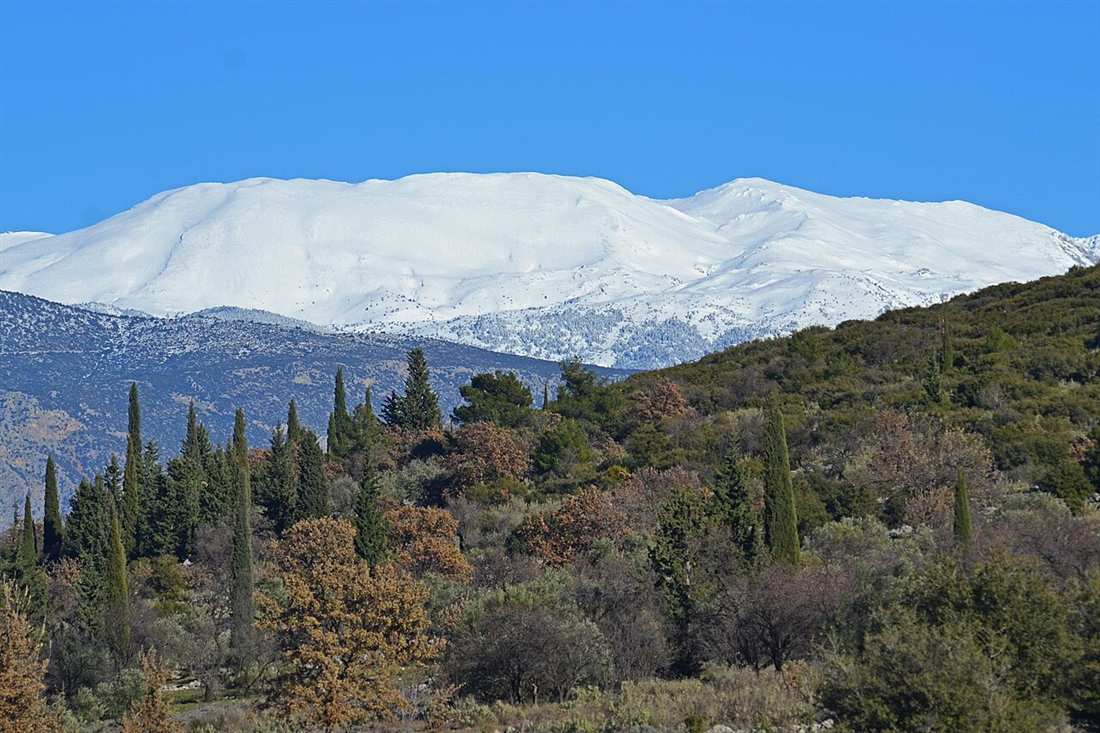
Mount Parnassus holds the Livadi grazing plateau, the Parnassos ski centre, the Liakoura summit, the town of Arachova on its southern flank, and the sanctuary of Delphi at the foot of the trail — a full mountain of destinations around the cave.
The Livadi plateau spreads north of the cave as a broad upland meadow ringed by peaks. Shepherds graze flocks across its grass through the warm months, springs feed the hollows, and the flat basin gives the mountain its widest open ground. The plateau links the cave route to the higher trails and marks the transition from forest to bare alpine rock.
The Parnassos ski centre sits on the northern slopes at Kelaria and Fterolakka, with lifts reaching past 2,250 metres. It ranks among the largest ski areas in Greece, draws winter crowds from Athens up the mountain road, and turns the same slopes that hikers cross in summer into groomed pistes once the snow arrives. Liakoura, the mountain’s highest summit at 2,457 metres, rises to the north as the roof of central Greece and a target for experienced ridge walkers.
Arachova clings to the southern flank below the cave, a stone town of steep lanes, weaving workshops, and tavernas at 950 metres. It serves as the base for both the ski centre and the mountain trails, and its formaela cheese and red wine carry the local name. The town connects by road to Delphi in fifteen minutes and anchors the whole southern approach to Parnassus.
The sanctuary of Delphi rests at the foot of the trail where the mountain drops toward the Pleistos valley. The oracle, the Temple of Apollo, the theatre, and the stadium climb the slope below the twin Phaedriades cliffs, and the ancient pilgrims who climbed to the Corycian Cave started from this same sacred ground. A Delphi guided tour pairs the archaeological site with the mountain that towers above it.
What to know before visiting the Corycian Cave?
Carry ample water, a torch, sturdy boots, warm layers for the altitude, and a map or GPS track. The cave has no facilities, no lighting, and no water source, and the plateau route rewards preparation with a safe ascent and descent across open mountain ground.
The hike climbs from the Delphi area to above 1,300 metres, so the temperature at the cave runs cooler than the valley even in high summer, and the wind crosses the plateau unbroken. The interior stays dark past the entrance chamber, and the floor turns slick where water drips onto the rock. A reliable light source and firm footwear carry a visitor through the passages that open beyond the daylight zone.
Pack the essentials before the trailhead:
- Two litres of water per person, refilled at Arachova or Delphi, because the mountain offers no safe drinking source on the route.
- A headtorch or handheld torch with spare batteries for the unlit cave interior.
- Sturdy boots with grip for the loose limestone and the wet cave floor.
- Warm layers and a windproof shell for the exposed plateau at altitude.
- A paper map or a loaded GPS track, since the upper path fades across open grassland.
Navigation demands attention on the higher ground. The marked trail follows the ancient Kaki Skala steps up from the sanctuary, then crosses the plateau where the path thins to a faint line through the meadow. A GPS track holds the route where cairns run sparse, and an early start leaves daylight in reserve for the return leg down the mountain.
A local guide turns the walk into a briefed ascent. Guides from Arachova and Delphi read the weather, hold the line across the plateau, and open the mythology of the Nymphs and Pan that fills the cave’s record. The Corycian Cave rewards a self-reliant party that carries water, light, and warm kit, and a guided group gains the mountain’s history alongside the safe passage up and back.
What do the archaeological finds from the Corycian Cave reveal?
The finds reveal unbroken worship from prehistory to the classical age: tens of thousands of astragaloi, terracotta figurines of Pan and dancing Nymphs, bronze rings and iron tools, clay lamps, and Neolithic pottery all layered together on the cave floor.
The single most abundant find is the astragalos, the knucklebone of a sheep or goat. Excavators counted tens of thousands of them across the cave floor. Worshippers used astragaloi two ways: as pieces in a game of skill, and as lots cast for divination. Pilgrims threw them to read the will of Pan and the Nymphs, and the numbers on the floor mark a shrine where people came to ask and to answer.
The terracotta figurines fix the identity of the cult. They show Pan with his horns and pipes and rows of Nymphs caught mid-dance, hand in hand. Alongside them the excavators recovered metalwork and lamps that record the daily act of offering.
- Astragaloi (knucklebones) in the tens of thousands, for games and for drawing lots in divination
- Terracotta figurines of Pan and of dancing Nymphs
- Bronze rings, iron and bronze objects, and other worked metal
- Clay lamps that lit the dark chamber for night rites
- Neolithic pottery from the earliest use of the cave
The Neolithic pottery sits at the bottom of the sequence, thousands of years before Pan received his figurines. Above it the layers climb through the Bronze Age into the classical centuries without a break. That stacked record is the true value of the site: a single cave where the offerings never stop, tracing one continuous line of worship from the first farmers of Parnassus to the pilgrims who walked up from the Oracle of Delphi below.
How do you combine the Corycian Cave with a visit to Delphi?
Pair them in one full day or split them across two. Tour the sanctuary and museum in the morning, then climb to the cave in the afternoon; or base yourself in Delphi or Arachova and give the ascent its own unhurried day with time on the plateau.
The full-day plan starts early at the archaeological site. Walk the Sacred Way, the temple of Apollo, the theatre and the stadium, then cross to the museum for the Charioteer and the treasury sculptures. After lunch in Delphi village you drive up to the trailhead near the plateau of Livadi and hike in to the cave. This packs the sanctuary and the sacred cave into a single circuit, and it rewards an early alarm and a steady pace.
The two-day plan trades the rush for room. Base in Delphi or in Arachova, give the ruins and museum a full morning and afternoon, and keep the climb for the next day. The ascent gains real height on the flank of Parnassus, and the reward matches the effort: the cool sacred chamber of Pan at the top and the long views over the Livadi plateau and the folded ridges beyond. Splitting the days lets you linger on the plateau instead of watching the clock. To pick a base, see where to stay in Delphi.
Guided hikes suit anyone who wants the route and the mythology handled. A guide carries the map, sets the pace on the rougher stretches above the tree line, and tells the story of Pan and the Nymphs on the ground where the astragaloi fell. Whether you go alone with a good track or with a guide, treat the climb as the point of the day, not an add-on, and start it with the light.
How was the Corycian Cave formed, and how big is it?
The Corycian Cave is a karst cavern dissolved out of the limestone of Mount Parnassus by water over geological ages. The main hall spans about 60 metres by 26 metres, and deeper galleries run more than 130 metres back into the mountain.
Parnassus is built of thick beds of grey limestone laid down under an ancient sea. Rainwater and snowmelt seep into cracks in this rock, absorb carbon dioxide from the soil, and turn mildly acidic. That acidic water dissolves calcium carbonate along the joints and bedding planes, widening hairline fissures into passages and passages into chambers. The Corycian Cave is the product of this slow chemistry, opened at an altitude near 1,360 metres on the flank of the mountain.
The cave opens into a vast entrance hall that swallows the daylight within a few paces. Beyond the first chamber, narrower galleries descend and branch deeper into the rock, so the mapped floor extends well over a hundred metres from mouth to farthest recess. The floor drops and rises across breakdown blocks and old flowstone, and the ceiling climbs high enough overhead to darken above the reach of a torch.
Dripwater still builds the cave’s mineral decoration, redepositing the dissolved calcite grain by grain. The formations divide into clear types:
- Stalactites hang from the ceiling where each drop leaves a ring of calcite.
- Stalagmites rise from the floor beneath the drip points.
- Columns stand where a stalactite and a stalagmite meet and fuse into a single pillar.
The interior holds a cool, damp microclimate that stays steady while the mountain outside bakes in summer and freezes in winter. The rock walls sweat moisture, the air smells of wet stone, and the temperature sits far below the heat of the exposed plateau. That constant chill and darkness explain why the ancient worshippers treated the chamber as a threshold into the earth.
Why is it called the Corycian Cave, and are there other Corycian caves?
The cave takes its name from the nymph Corycia and the Corycian Nymphs of Parnassus, the spirits worshipped inside it. A second, larger Corycian Cave stands in Cilicia in Asia Minor, tied to the myth of Zeus and the monster Typhon.
Corycia was a naiad of Parnassus, loved by Apollo and mother of a son who gave his name to the region around Delphi. The Greeks called the nymphs of the mountain the Corycian Nymphs after her, and the cave that held their cult carried the same name. The title fixes the place to its owners: this is the hall of Corycia and her sisters, a shrine of nymphs rather than a plain hole in the rock. Visitors who climb from the sanctuary below reach it as a natural extension of the sacred landscape described on is Delphi worth visiting.
The name reaches beyond Greece. A far larger Corycian Cave lies in Cilicia, on the southern coast of Asia Minor, a huge collapsed sinkhole and cavern that ancient writers ranked among the wonders of that coast. Greek myth set the fight between Zeus and Typhon there: the monster seized the sinews of Zeus and hid them in the Cilician cave before Hermes and Pan recovered them and the sky god destroyed his enemy. The two caves share a name across the sea, and the Cilician one carries its own dark reputation for the storm-giant buried near it.
The repeated name marks a wider Greek habit of consecrating caves to nymphs and gods. A cavern gave shelter, water, and a clear boundary between the daylight world and the powers below, so the Greeks filled such places with offerings and attached divine owners to them. Corycian caves in Parnassus and Cilicia both answer this pattern, and the Parnassian one still rewards the traveller who pairs the climb with the itinerary on one day in Delphi.
Frequently Asked Questions
What is the Corycian Cave?
The Corycian Cave is a large stalactite cave on the plateau of Mount Parnassus above Delphi, around 1,370 metres up, sacred in antiquity to the god Pan and the Corycian Nymphs. Worshippers climbed to it from the Delphi sanctuary across more than a thousand years.
Can you hike to the Corycian Cave from Delphi?
Yes. A waymarked mountain trail climbs from the Delphi sanctuary through fir forest to the Parnassus plateau and the cave, a walk of several hours each way to above 1,300 metres. Sturdy boots, water and a torch are essential, and winter snow closes the route.
What was found in the Corycian Cave?
Excavations recovered tens of thousands of astragaloi, the knucklebones used for games and divination, along with terracotta figurines of Pan and the Nymphs, bronze rings, clay lamps and Neolithic pottery, showing worship at the cave running unbroken from prehistory into the classical age.