
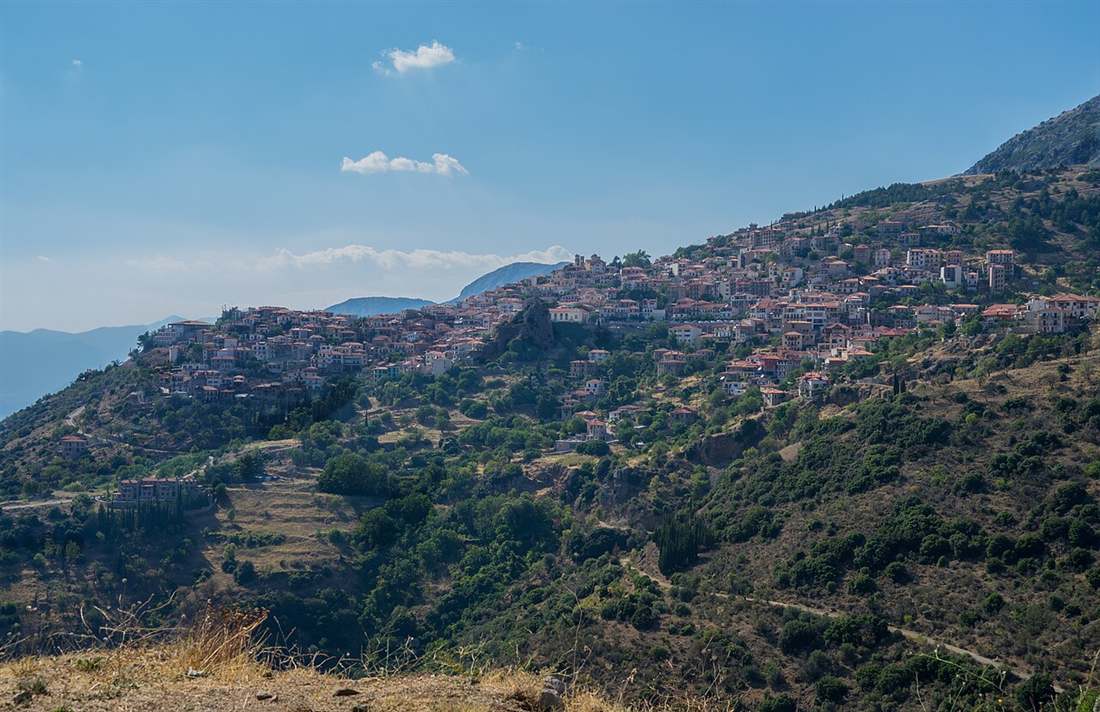
Arachova, Greece
Arachova is a stone-built mountain town on the south slope of Mount Parnassus, twelve kilometres east of Delphi at about 950 metres. It is Greece’s premier winter and ski resort and a cool summer mountain base, known for its landmark clock tower, its handwoven rugs, and the cosmopolitan tavernas and nightlife stacked up its grey stone lanes. Plan the whole trip with Greece Tours.
This guide covers Arachova in full: what the town is and why to visit, how to get there from Athens and Delphi, what it is like in winter and summer, the top things to do, the Parnassos ski centre above it, the food and woven products it is known for, the sights nearby, where to stay and eat, and the best time to visit and its festivals.
What is Arachova, and why visit it?
Arachova is a stone-built mountain town on the south slope of Mount Parnassus at about 950 metres, twelve kilometres east of Delphi. It ranks as Greece’s premier winter and ski resort and doubles as a cool summer mountain base for hikers and travellers crossing central Greece.
The town climbs the mountainside in tight tiers of grey-stone houses, red-tiled roofs, and narrow lanes that fold back on themselves along the contour of the slope. A landmark clock tower crowns the highest point above the settlement and marks Arachova’s silhouette from the Athens-Delphi road below. Stone staircases connect the upper neighbourhoods to the single main street that carries the town’s shops, tavernas, and bars.
Arachova built its name on three trades and holds all three today. Weavers here produce flokati rugs, woollen blankets, and hand-loomed textiles that hang across shopfronts along the main street. Producers sell local formaela cheese, mountain honey, thyme-scented spirits, and red wine pressed from Parnassus vineyards. A cosmopolitan tavern and nightlife scene fills the town on winter weekends, when visitors from Athens pack its restaurants and bars after the ski slopes close.
The town serves as a base for the wider Parnassus region. Skiers reach the Parnassos ski centre from here; walkers start trails onto the massif of Mount Parnassus; and travellers pair a night in Arachova with a day at the ancient sanctuary and museum of Delphi twelve kilometres to the west. Arachova gives the mountain a place to eat, sleep, and shop that the archaeological site itself lacks.
Where is Arachova, and how do you get there?
Arachova sits in the region of Boeotia in central Greece, on the main Athens-Delphi road. It lies about 165 kilometres and two and a half hours from Athens by car or KTEL bus, and stands as the last town before the Delphi sanctuary to its west.
By car from Athens, drivers take the national road toward Thebes and Livadeia, then climb the mountain road that rises to Arachova on the flank of Parnassus. The route runs west through Livadeia and the Boeotian plain before it ascends into the pine and fir belt of the mountain. The road passes directly through the town on its way to Delphi, so Arachova needs no detour from the main Delphi itinerary.
By public transport, KTEL Fokidas runs buses from the Liosion terminal in Athens toward Delphi and Amfissa, and these stop at Arachova on the main street. The bus covers the distance in roughly three hours with stops. Travellers without a car reach the town on the same service that carries visitors to Delphi, and many walk the twelve kilometres of road between the two on foot or split the leg by taxi.
Arachova’s position on the Athens-Delphi axis fixes its role in a central-Greece trip:
- Athens lies 165 kilometres east, the source of most weekend and day-trip traffic.
- Delphi lies 12 kilometres west, reachable in a short drive down the mountain.
- Livadeia, the Boeotian capital, sits on the approach road from the east.
- Distomo and the monastery of Hosios Loukas lie a short drive south of the main road.
- The Parnassos ski centre sits above the town, reached by the mountain road that climbs north.
What is Arachova like in winter compared with summer?
Arachova turns into a fashionable ski town in winter, packed at weekends when the Parnassos slopes open, and a cool, quiet mountain escape in summer, with hiking and clear air away from the lowland heat. The shoulder seasons of spring and autumn fall between the two.
Winter is the town’s high season. When snow covers the Parnassos ski centre, skiers and snowboarders fill Arachova’s hotels and guesthouses, and the main street runs at full pitch through the evening. Fireplaces burn in the tavernas, mulled drinks and grilled meat come off the kitchens, and the bars stay open late. Athenians drive up on Friday and return on Sunday, so Saturday nights bring the largest crowds of the year. Rooms book out on winter weekends well ahead.
Summer reverses the rhythm. The heat that settles on Athens and the Boeotian plain never reaches 950 metres, so Arachova stays cool while the coast bakes. Visitors come to walk the trails of Parnassus, breathe the mountain air, and use the town as a shaded stop on the road to Delphi. The crowds thin, the pace slows, and the tavernas serve at a quieter tempo. Families and hikers replace the winter ski set.
Spring and autumn mark the shoulder seasons. Spring brings wildflowers to the mountain meadows and meltwater to the ravines below the town. Autumn turns the beech and fir of the massif and cools the evenings ahead of the first snow. Both seasons draw walkers and drivers who want the town and its trails without the winter crush or the summer road traffic, and both keep the tavernas and weaving shops open along the main street.
What are the top things to do in Arachova?
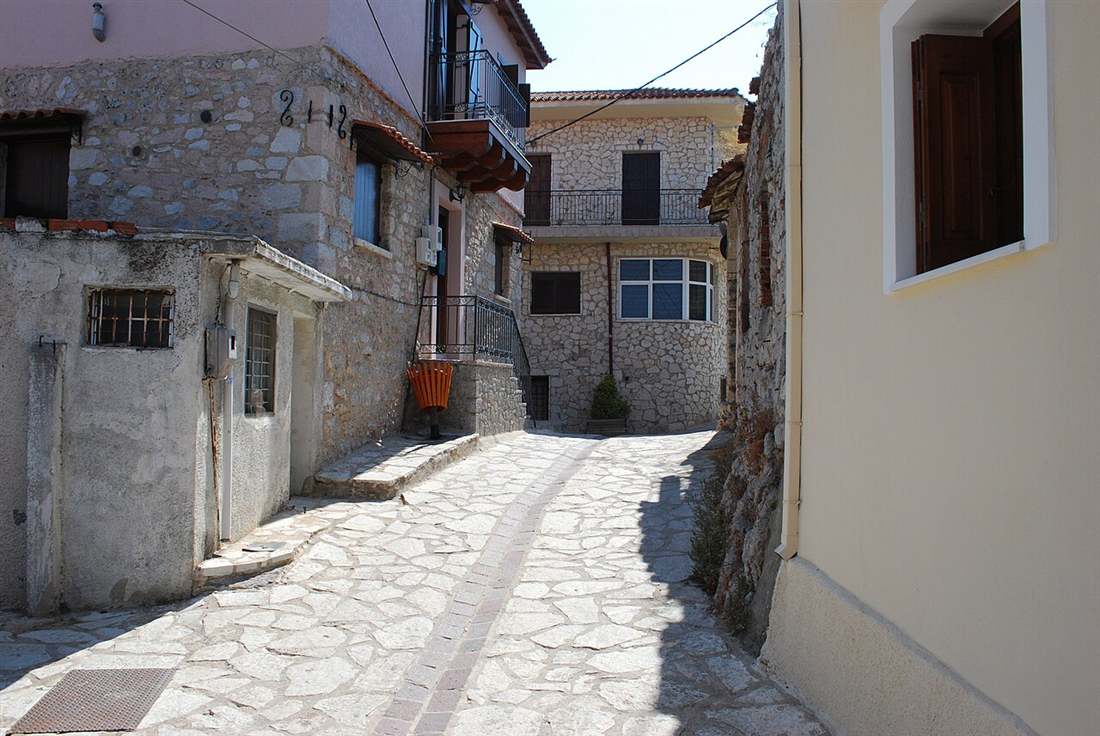
Walk the stone lanes and stairways of the old town, climb to the clock tower for the panorama over the Plistos valley, ascend the steps to the church of Agios Georgios above the rooftops, browse the shops for woven rugs, and settle into the tavernas along the main street.
The old town of Arachova stacks up the northern slope of Mount Parnassus in tiers of grey stone houses connected by narrow lanes and cut-stone stairways. The main road, Delphon Street, threads through the centre, and the side alleys branch off it uphill and downhill, opening onto small squares, fountains, and balconies that hang over the gorge. Walking these lanes on foot is the way to read the town, since cars stay on the through-road and the stairways carry the rest of the traffic.
The clock tower crowns a rock spur at the western edge of the settlement. The climb to it runs up a stepped path, and from the platform the view takes in the terracotta roofs of Arachova below, the Plistos valley falling away to the south, and the olive slopes that run down toward Delphi and the Gulf of Corinth. The church of Agios Georgios sits on the highest point above the houses, reached by a long flight of steps, and its forecourt hosts the town’s Panigyri festival with dancing and feasting.
Along Delphon Street the shopfronts display the products the town makes and sells: handwoven flokati rugs, woollen blankets, carpets, and textiles in dense stacks, alongside cheese, honey, and cured meats. The tavernas open onto the same street, their tables set out under the stone facades, serving grilled meats and mountain dishes to walkers coming off the trails. Travellers weighing a base for the wider region compare Arachova against nearby Delphi, and a guide to where to stay in Delphi lays out how the two towns divide the visitor traffic across the mountain.
What is the Parnassos ski centre near Arachova?
The Parnassos ski centre sits high on Mount Parnassus above Arachova, spread across two linked bases at Kelaria and Fterolakka, with runs and lifts reaching above 2,000 metres. Arachova serves as the base town, and the road climbs from it to the slopes in roughly half an hour.
The ski centre operates across two main sectors on the massif. Kelaria holds the larger cluster of lifts and the connection point to the upper slopes, while Fterolakka extends the terrain to the west and links back to Kelaria across the ridge. Between them the resort carries dozens of marked pistes graded from beginner runs to steep descents, served by chairlifts and surface tows that carry skiers from the base lodges up to the high points on the mountain.
The skiable terrain climbs well above the treeline, and the top stations open onto bare rock and snowfields with sightlines across central Greece. Snow covers the upper runs through the cold months, and the resort runs its lifts across the winter season while conditions hold. Skiers and snowboarders drive up from Arachova each morning, park at the base areas, and return to the town at the end of the day for food and lodging, since the mountain itself carries lodges and services but no settlement.
Arachova functions as the staging point for the whole operation. The town sits on the approach road, so the drive up passes through it, and its hotels, rental shops, and tavernas fill through the ski months with visitors who ski by day and stay in the stone houses by night. The pairing of the resort above and the town below is what fixed Arachova as a winter destination and pulled a stream of visitors up from Athens and the surrounding regions.
What food and local products is Arachova known for?
Arachova is known for formaela cheese grilled over coals, hilopites egg pasta, spit-roasted and stewed mountain meats, Parnassus honey, and local wine, alongside the handwoven flokati rugs and woollen textiles the town has produced across generations.
Formaela is the cheese that carries the town’s name, a firm cylinder of sheep’s and goat’s milk that Arachova has made on the Parnassus slopes for a long stretch of its history. Cooks slice it thick and grill it over charcoal until the outside browns and the inside softens, then serve it hot, often with a squeeze of lemon. It appears on the taverna tables the length of Delphon Street, and the cheese shops sell it whole to travellers to carry home.
The kitchens of Arachova run on mountain ingredients and slow cooking. The signature dishes and products of the town include:
- Formaela cheese seared over coals and finished with lemon
- Hilopites, the small square egg pasta cooked with meat or cheese
- Spit-roasted lamb and kid, and stewed goat in red sauce
- Parnassus honey drawn from the mountain’s herbs and flowers
- Red and white wine from vineyards on the surrounding slopes
The pastoral economy behind the food also produced the textiles. Arachova has woven wool for generations, and the town built its trade on flokati rugs, thick shaggy carpets shrunk in cold mountain water, along with blankets, kilims, and woven fabrics in bold patterns. The shops on the main street hang these goods across their fronts, and the craft ties directly to the sheep herds that supply both the wool and the milk for the cheese. Visitors planning the trip around markets, festivals, and open tavernas check the best time to visit Delphi, since the same seasons govern Arachova a short drive up the mountain road.
What is there to see near Arachova?
Arachova sits at the centre of a dense cluster of sights: the sanctuary of Delphi twelve kilometres west, the Corycian Cave high on Mount Parnassus above the town, the monastery of Hosios Loukas to the south-east, the Livadi plateau, and the Corinthian Gulf coast below.
The sanctuary of Delphi is the closest and largest draw. It lies twelve kilometres west along the main road, on the slope of Parnassus above the Pleistos valley. The site holds the Temple of Apollo, the theatre, the stadium, the Athenian Treasury, and the Sanctuary of Athena Pronaia with its round tholos. The Delphi Archaeological Museum stands beside the entrance and holds the bronze Charioteer, the twin kouroi of Kleobis and Biton, and the Sphinx of Naxos. A guided visit turns the ruins into a readable map of the ancient oracle; book a Delphi guided tour from Arachova and reach the gates in under fifteen minutes.
Above the town, the Corycian Cave opens on the Parnassus plateau at an altitude near 1,360 metres. Ancient worshippers dedicated the cave to Pan and the Nymphs, and thousands of small clay figurines and knucklebones were excavated from its floor. A marked track climbs from Arachova through fir forest to the entrance, a hike of several hours each way. The chamber runs deep into the rock, with stalactites hanging from a high ceiling.
To the south-east stands Hosios Loukas, a walled Byzantine monastery of the tenth and eleventh centuries. Its two linked churches, the Katholikon and the Church of the Theotokos, carry gold-ground mosaics, marble revetment, and a crypt with wall paintings. UNESCO lists the monastery as a World Heritage Site alongside Daphni and Nea Moni. The Livadi plateau spreads east of the town as a grazing meadow ringed by peaks, and the road drops south past the coast to the Corinthian Gulf.
Where do you stay and eat in Arachova?
Arachova offers stone-built boutique hotels and chalets with fireplaces and spas built for the ski trade, guesthouses on the slope with balconies over the ravine, and tavernas and grill houses along the main street serving Parnassus mountain cooking based on lamb, formaela cheese, and hilopites pasta.
The accommodation clusters on the steep hillside and along the ridge above the gorge. Owners built the newer hotels from local grey stone with timber interiors, log fireplaces in the lounges, and small spas with indoor pools and steam rooms for skiers returning from Parnassus. Family guesthouses fill the older lanes, many with wooden balconies that hang over the ravine and frame the valley toward Delphi. Rooms fill on winter weekends and during the August festival, and the shoulder weeks stay open and quiet.
The eating runs along the main street and the small squares that branch off it. Grill houses turn spit-roasted lamb and goat over charcoal, and tavernas plate slow-cooked kokoras with hilopites, wild greens gathered on the mountain, and formaela cheese seared in the pan and finished with lemon. The town makes formaela as a protected local cheese, and shops sell it beside jars of Parnassus honey, spoon sweets, and hard trachanas.
- Formaela cheese, pan-fried and squeezed with lemon
- Charcoal-grilled lamb and goat from the Parnassus flocks
- Kokoras (rooster) stewed with hilopites egg pasta
- Wild horta greens with olive oil and vinegar
- Parnassus honey, walnut spoon sweets, and trachanas to carry home
Bakeries open early for tsoureki and cheese pies, and the tsipouradika pour local tsipouro with plates of meze through the cold evenings. Prices sit below the resort hotels of the northern slopes, and the tables spread onto the pavement once the snow clears.
When is the best time to visit Arachova, and what festivals does it hold?
Visit Arachova on winter weekends for the Parnassus ski season, in summer for cool hiking above the heat of the plains, and in the quiet shoulder seasons of spring and autumn; the town holds its Panagia festival from 23 to 26 August with klarino music, costume parades, and communal feasting.
Winter drives the town. From December to March the Parnassos Ski Centre runs its lifts, and Athenian visitors pack the stone hotels on Friday and Saturday nights. Snow lies on the higher lanes, the fireplaces burn, and the bars along the main street stay loud past midnight. The season peaks around the Christmas and Carnival weeks, when the queues for rooms and tables run longest.
Summer turns the mountain into hiking country. The town sits at roughly 950 metres, so the air stays cool while the plains below bake, and the trails to the Corycian Cave and across the Livadi plateau open under clear skies. Spring brings wildflowers to the meadows and running water to the gorges, and autumn colours the fir and walnut slopes before the first snow returns. These shoulder weeks give empty trails and open tavernas without the winter crowds.
The Panagia festival is the peak of the local calendar. Held from 23 to 26 August around the Church of Panagia, it centres on the feast of the Dormition of the Virgin and honours the town’s patron. Men in traditional foustanella dress lead a procession up to the church of Agios Georgios, klarino clarinet and drum drive the dancing, and the whole town shares grilled meat and wine in the squares. The celebration blends religious rite with the old shepherds’ contest, and it draws families back from across Greece. From Arachova the road runs down to the Corinthian Gulf and the harbour of Galaxidi, a seaside detour that pairs the mountain with the coast in a single trip.
What is the history of Arachova?
Arachova has lived on the southern slopes of Mount Parnassus for centuries as a pastoral and weaving community, guarding the mountain pass on the road to Delphi. It repelled an Ottoman force during the Greek War of Independence and later grew into Greece’s leading winter resort.
The town rises in tiers above the gorge that carries the old route between the plain of Boeotia and the Sanctuary of Apollo. For generations its people raised sheep and goats on the high pastures, pressed cheese and tsipouro, and wove the thick wool rugs that made the town’s name. The flokati rug, a shaggy hand-woven wool blanket, came out of these looms and spread across Greece as the signature product of Arachova.
Position gave the town its strategic weight. Whoever held Arachova held the narrow pass on the way to Delphi, so armies moving through central Greece had to reckon with it. During the Greek War of Independence, Greek fighters under Georgios Karaiskakis trapped and defeated an Ottoman column here in the battle of Arachova, a victory that stiffened the revolt across the region and left the town with a lasting place in the national story.
The modern chapter turned the economy upside down. When the ski centre opened on Parnassus above the town, Athenians drove up for the snow, and Arachova rebuilt itself around them. Stone guesthouses replaced farm sheds, the main street filled with tavernas and boutiques, and the flokati looms that once clothed shepherds now sell rugs to weekend visitors. The pastoral base still shows in the cheese, the formaela, the honey and the wine, but the town now earns its living from the slopes.
How do you spend a weekend in Arachova?
Spend the first afternoon and evening in the town itself, walking the stone lanes up to the clock tower and eating on the main street. Give the second day to the mountain, skiing Parnassus in winter or hiking to the Corycian Cave in summer, then drive the short road down to Delphi.
Arrive after lunch and climb through the old quarter on foot. The lanes stack up the hillside in stone and tile, threading past small churches to the clock tower that crowns the town and looks out over the Parnassus ridge and the gorge below. As the light drops, the main street becomes the centre of the evening: tavernas fire up the grill, shops set out flokati rugs and jars of local honey, and the bars stay busy late, since Arachova keeps some of the liveliest winter nightlife in mainland Greece.
Give the second morning to the mountain. A weekend in Arachova balances three distinct experiences:
- The mountain town — stone lanes, the clock tower, tavernas and boutiques on the main street.
- The slopes — the Parnassus ski centre in winter, or the trail to the Corycian Cave through the fir forest in summer.
- The sanctuary — Delphi, a short drive downhill, with its temple terraces, theatre and museum.
In winter, drive up to the Parnassus ski centre at Kellaria for the runs, then warm up at the mountain lodge before heading back down. In summer, swap the pistes for the marked path to the Corycian Cave, the vast stalactite cavern high on the slope that ancient pilgrims tied to the god Pan and the nymphs. Either way, keep the afternoon for the descent to Delphi. The Delphi day trip from Athens runs through Arachova, and staying in town puts the sanctuary a short drive away instead of a long haul, so you reach the ruins early and beat the coaches.
Walk the Sacred Way up past the treasury foundations to the Temple of Apollo, climb to the theatre and the stadium above it, then cross to the museum for the bronze Charioteer. If you are weighing the stop, whether Delphi is worth visiting is answered by the site itself, spread across the Parnassus cliffs with the olive plain and the Gulf of Corinth below. Drive back up to Arachova for a last dinner, and the weekend closes with mountain town, slopes and sanctuary all folded into two days.
Frequently Asked Questions
Is Arachova worth visiting?
Yes. Arachova pairs Greece’s leading ski resort with a handsome stone mountain town of clock tower, weavers, and lively tavernas, twelve kilometres from Delphi. It works as a winter ski base, a cool summer escape, and an overnight beside the sanctuary.
How far is Arachova from Delphi?
Arachova lies twelve kilometres east of the Delphi archaeological site, about fifteen minutes by car along the mountain road. Many visitors base in Arachova and drive to the sanctuary at opening before the Athens coaches arrive.
How far is Arachova from Athens?
Arachova sits about 165 kilometres north-west of Athens, roughly two and a half hours by car or KTEL bus on the road through Livadeia. It is the last town before Delphi on the Athens road.
What is Arachova known for?
Arachova is known as Greece’s leading winter and ski resort, for its landmark clock tower and steep stone lanes, for the handwoven flokati rugs its looms have long produced, and for formaela cheese grilled over coals, Parnassus honey, and the lively tavernas and bars along its main street.