
Delphi Guided Tour
A Delphi guided tour walks the archaeological site and the museum with a state-licensed guide, who ties the Sacred Way, the Temple of Apollo, the theatre, the stadium and the bronze Charioteer into the single story of the oracle sanctuary on Mount Parnassus. It is the difference between reading scattered foundations and walking the sanctuary a pilgrim once climbed. Plan the whole trip with Greece Tours.
This guide covers the Delphi guided tour in full: what it includes, why a guide beats a solo visit, the tour types from an Athens day trip to a private on-site guide, the day-tour inclusions, the on-site itinerary and how long it runs, the cost by tier, the best time of day and year to go, what makes a good guide, how to combine Delphi with Meteora and the coast, and how to book.
What is a Delphi guided tour, and what does it cover?
A Delphi guided tour is a walk of the archaeological site and museum led by a licensed guide, tracing the Sacred Way up to the Temple of Apollo, the theatre and stadium, then the Charioteer and the Siphnian Treasury frieze in the museum, with the oracle story tying every stop together.
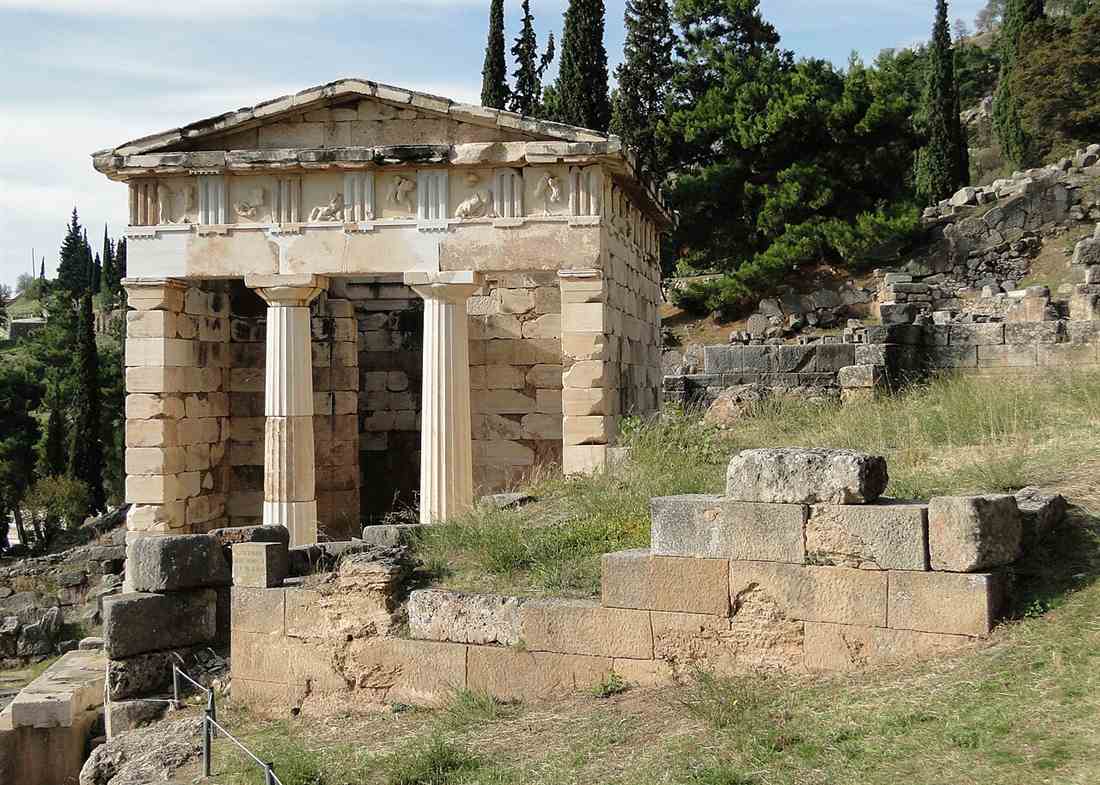
The tour starts at the lower gate and climbs the paved Sacred Way, the zig-zag path pilgrims once followed to consult the oracle. The guide names the votive monuments and treasuries that line the route, points out the polygonal retaining wall and its Greek inscriptions, and explains why each Greek city-state raised its own marble treasury here to display wealth and thanks to Apollo.
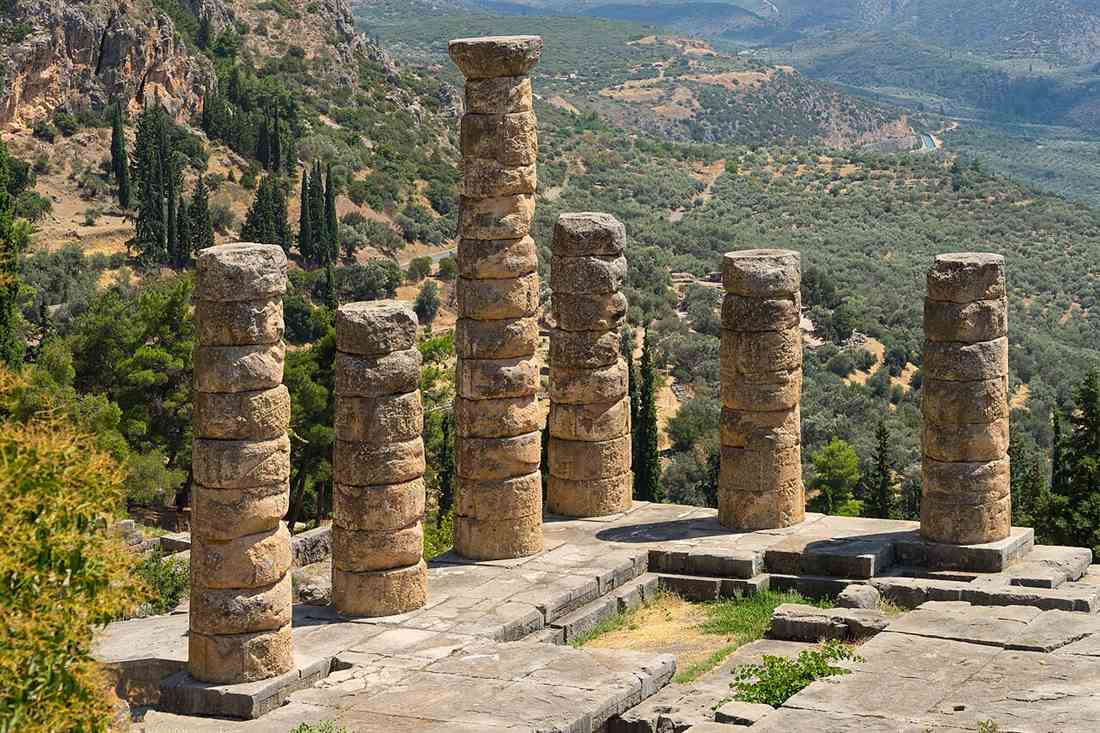
Higher up, the route reaches the Temple of Apollo, the sanctuary’s centre, where the Pythia delivered her prophecies from the inner chamber. Above the temple, the guide leads the group to the ancient theatre, which frames a wide view over the sanctuary and the olive valley toward the Gulf of Corinth, and then to the stadium that hosted the Pythian Games on the highest terrace of the site.
The second half of the tour moves into the Delphi Archaeological Museum, where the guide connects the ruins to their surviving sculpture. The bronze Charioteer of Delphi, the twin kouroi Kleobis and Biton, the Naxian Sphinx, and the carved frieze of the Siphnian Treasury stand as the highlights, each read against the spot on the site it came from. A guided walk of the Delphi archaeological site and sanctuary ends with the whole layout, from Sacred Way to museum, understood as one place.
Why take a guided tour of Delphi rather than visit alone?
A guided tour turns scattered foundations into a readable sanctuary: the guide names the treasuries, the polygonal wall, and the adyton where the Pythia sat, and reconstructs the climb a pilgrim once walked, so the low stone courses stand for the buildings and rituals they held.
Visited without narration, much of Delphi reads as broken column drums and rectangular footings on a steep hillside. Only a handful of structures, the reconstructed Athenian Treasury and the temple columns among them, stand tall enough to identify on sight. A licensed guide fills the gaps, marking where the Sibyl’s rock and the Castalian Spring sit in the ritual sequence and explaining the order in which a visitor in antiquity passed through them.
The guide also fixes the geography of the oracle. Standing at the Temple of Apollo, the guide shows where the adyton, the underground chamber, held the Pythia on her tripod above the sacred chasm, and describes how her spoken answers reached the pilgrim who paid for the consultation. The polygonal wall below the temple, its irregular blocks locked without mortar, carries carved manumission records that a guide translates on the spot.
A guided visit sets Delphi in its wider role as the religious centre the Greeks called the navel of the world, marked by the omphalos stone now in the museum. The narration answers the practical question of whether Delphi is worth visiting by making the climb legible: the same slope that tires an unguided visitor becomes the processional route to the oracle when a guide walks it stop by stop.
What types of Delphi guided tours are there?
Delphi guided tours run in five main formats: the guided day tour from Athens by coach, the private on-site licensed guide, the small-group tour, the official site audio guide, and the multi-day tour that pairs Delphi with Meteora. Each format matches a different budget, group size, and pace.
- Guided day tour from Athens by coach — a full-day round trip covering the three-hour drive each way, a licensed guide on site, and the sanctuary and museum in one visit, returning to Athens the same evening.
- Private on-site licensed guide — a guide hired for one group alone, meeting at the site entrance and setting the route and pace to the group’s interests, with no coach or fixed departure attached.
- Small-group tour — a capped group led by one guide, keeping the personal attention of a private walk while sharing the cost across a set number of travellers.
- Official site audio guide — the self-paced audio commentary rented at the site or run through an app, feeding stop-by-stop narration without a live guide for visitors who arrive on their own.
- Multi-day tour pairing Delphi with Meteora — a two- or three-day itinerary that combines the oracle at Delphi with the monasteries of Meteora, joining central Greece’s two headline sites in a single guided trip.
The coach day tour from Athens carries the most travellers and handles the driving, timing, and site entry as one package, which suits a first visit built around a single free day in the capital. It pairs a fixed itinerary with a licensed guide who takes over once the coach reaches the mountain.
The private and small-group options trade the coach’s scale for a route shaped to the group. A private guide answers questions in depth and adjusts the walk to the group’s stamina on the steep terraces, while a small-group tour holds that closeness at a lower price per head. The audio guide serves independent visitors who drive or take the intercity bus to Delphi and want narration without booking a person. The Delphi-and-Meteora multi-day tour stretches the visit across the region, giving the sanctuary its own unhurried morning before the road north to the rock-top monasteries.
What does a guided day tour from Athens to Delphi include?
A guided day tour from Athens to Delphi includes hotel or central pickup, an air-conditioned coach for the three-hour drive, a licensed guide, entrance to the archaeological site and the museum, and often lunch and an Arachova stop across a ten-to-twelve-hour round day.
Pickup starts at central Athens points or listed hotels in the early morning. The coach runs north-west through Boeotia, crosses the plain of Livadeia, and climbs the flank of Mount Parnassus to the sanctuary at roughly 600 metres. The licensed guide narrates the route, sets the meeting times, and holds the group ticket so nobody queues at the gate.
On arrival the guide walks the group up the Sacred Way, through the Temple of Apollo terrace, the ancient theatre, and the stadium, then leads the museum visit to the Charioteer and the twin kouroi. Entrance to both the site and the museum is inside the package price, which removes the ticket step covered on the Delphi tickets page.
Most operators add a stop at Arachova, the stone-built mountain town above Delphi, for lunch or free time among its weavers’ shops. The coach then returns to Athens by evening, closing a full day that pairs the sanctuary with the drive through the Parnassus landscape. This structure mirrors the standard Delphi day trip from Athens.
How long is a Delphi guided tour, and what is the itinerary on site?
A Delphi guided tour runs about two hours on the archaeological site, one hour in the museum, and short stops at the Castalian Spring and the Athena Pronaia sanctuary, ordered to climb the site before the coaches arrive and the midday heat builds.
The on-site walk begins at the lower gate and follows the Sacred Way uphill past the treasury foundations to the polygonal retaining wall and the Temple of Apollo. From the temple terrace the path continues to the theatre, which overlooks the whole sanctuary, and ends at the stadium on the highest terrace where the Pythian Games were held.
The museum hour concentrates on the bronze Charioteer, the Naxian Sphinx, the Siphnian Treasury frieze, and the omphalos stone that marked Delphi as the navel of the earth. The guide sequences the galleries so the objects connect back to the buildings the group just walked past on the terraces above.
A tight guided itinerary moves in this order:
- Castalian Spring, where pilgrims purified before consulting the oracle
- The Sacred Way and treasuries, climbing to the Temple of Apollo
- The ancient theatre and the stadium on the upper terraces
- The archaeological museum and the Charioteer
- The Athena Pronaia sanctuary and the round tholos below the road
Starting the climb early puts the group ahead of the arriving coaches on the narrow Sacred Way and clears the exposed upper terraces before the sun reaches them, so the theatre and stadium are reached in shade and open space rather than crowds.
How much does a Delphi guided tour cost?
A Delphi guided tour prices in three tiers: the full-day coach tour from Athens runs a mid-range per-person fare, a private licensed guide on site is a flat per-group fee added to entrance, and a small-group tour sits between the two on a per-person basis.
The full-day tour from Athens carries the highest all-in per-person figure because it bundles the round transfer, the guide, and both entrance tickets into one fare. Lunch and the Arachova stop lift the price on the versions that include them, while transport-plus-entry tours without a walking guide sit at the lower end of the day-tour band.
A private licensed guide engaged at Delphi itself is priced as a single flat fee for the whole group for a set number of hours, so the per-head cost falls as the group grows. That fee is separate from the entrance charge, which each visitor still pays at the gate or buys the combined site-and-museum ticket ahead of the visit.
Small-group tours cap the party size and charge per person above the large-coach fare but below a two-person private booking. Each tier includes the licensed guide and site narration; the day tour adds transport and tickets, the on-site guide adds only expertise, and the small-group option trades a lower headcount for a higher seat price.
What is the best time of day and year for a Delphi guided tour?
The best guided tour starts at first light, reaching the Sacred Way as the gate opens at 08:00 and clearing the upper terraces before the Athens coaches arrive near 11:00. April to June and September to October deliver mild air and thin crowds on the exposed mountain slope.
A morning departure is the mechanism behind a good Delphi tour. Guides schedule the coach to reach the ticket booth for the site’s opening hour, put the group on the Sacred Way while the paving still holds the night’s cool, and lead the climb past the Athenian Treasury and the Temple of Apollo before the midday heat builds on the south-facing terraces. The archaeological site and museum open at 08:00, and a tour that arrives then hands its group an empty Sacred Way, unobstructed sightlines up to the Temple of Apollo, and photographs free of other visitors. The coach convoy from Athens crests the mountain toward late morning, so the early start buys the quiet hour that the later arrivals miss. For the full seasonal breakdown, read our guide to the best time to visit Delphi.
The shoulder seasons carry the calendar. April, May and June bring wildflowers across the Phaedriades cliffs, daytime temperatures in the low twenties Celsius, and a slope that stays walkable through the afternoon. September and October repeat the mild pattern after the summer peak breaks, with warm stone, clear light over the Pleistos valley, and shorter queues at the museum entrance. Summer pushes midday temperatures past 35 degrees Celsius on the treeless terraces, which is the reason guided departures pull the walking segment into the cooler first hours. A guide who knows the site paces the ascent to the theatre and stadium before the sun clears the eastern ridge, then moves the group indoors to the museum as the heat peaks.
Winter rewards the visitor who accepts cold mornings and the chance of rain sweeping the gorge. Crowds thin to a handful, the mountain air sharpens the view toward the Gulf of Corinth, and the first Sunday of each winter month admits every visitor free of charge. A guided tour in this quiet stretch moves without competition on the Sacred Way, and the group lingers at the Charioteer and the omphalos without a second party pressing behind. The nearby settlement of Delphi village stays open through the low season, so a morning at the ruins pairs with a warm lunch and a walk along its terraced lanes above the olive sea. Book the earliest slot the operator offers, confirm the 08:00 arrival, and the tour delivers the site at its calmest in every season of the year.
What do you need to bring and wear on a Delphi guided tour?
Wear closed grippy shoes for the worn marble and the stepped, unshaded climb to the stadium, and pack water, a sun hat, high-factor sun protection, and a warm waterproof layer for the mountain air at 600 metres.
The archaeological site climbs the steep south face of Mount Parnassus, and the path rises from the entrance through the Sanctuary of Apollo to the stadium at the top. The route runs on polished ancient marble, uneven stone steps, and loose gravel. Closed shoes with a gripping sole hold that surface; open sandals and smooth soles slide on the worn stone. The climb to the stadium gains height on stepped terraces with no shade, so the ascent works the legs and the lungs together.
The terraces face the sun and hold the heat through the warm months. A refillable water bottle covers the exposed sections, a sun hat shades the head and neck, and high-factor sun protection guards the skin across the open ground. At 600 metres the mountain air turns cold when cloud crosses Parnassus, and winter brings rain to the site, so a warm layer and a waterproof keep the group moving through the sanctuary in poor weather. A small daypack carries the water, the layers, and the sun protection without filling the hands on the steps.
- Closed shoes with a gripping sole for marble, steps, and gravel
- A refillable water bottle for the exposed terraces
- A sun hat and high-factor sun protection for the warm months
- A warm layer and a waterproof for the mountain air and winter rain
- A small daypack to carry the water, layers, and camera
- The entrance ticket and a charged phone for photographs
The guided pace fits these needs. The guide sets a measured climb with stops at the Treasury of the Athenians, the Temple of Apollo, and the theatre, and each stop rests the legs before the next stretch of steps. The tour moves from the open site into the museum, where the covered galleries hold the Charioteer and the twin kouroi at a steady indoor temperature, so the daypack and the warm layer earn their place across the swing from the hot terraces to the cool halls. Many visitors add the Castalian Spring at the roadside below the sanctuary, and the same footwear and water carry across it. Reading how to get to Delphi before the day sets the arrival time that decides the heat and the light on the climb.
What makes a good Delphi tour guide?
A good Delphi guide holds a Greek state licence, speaks your language fluently, keeps the group small enough to hear every word, and commands the mythology, the excavation history and the workings of the oracle in equal measure.
The licence is the first mark of quality. Greece certifies its guides through a two-and-a-half-year state school of tourist guides, and the certificate grants exclusive legal permission to lead groups inside the archaeological site and the Delphi Archaeological Museum. An unlicensed escort walks visitors to the gate and stops there; a licensed guide takes them past the Treasury of the Athenians, up the Sacred Way, and into the museum hall where the bronze Charioteer stands. Fluency matters as much as the badge, because the value of the tour rests on the story delivered in clear speech rather than a memorised script.
Group size decides whether the narration reaches you. On the sloping terraces of the sanctuary, wind and distance swallow a guide’s voice across a crowd, so a manageable group of twelve to sixteen, or a private party of two to six, keeps every explanation audible. The depth of knowledge separates a competent guide from a memorable one: the Delphi story spans the myth of Apollo slaying the Python, the historical Pythia who delivered the oracles, the votive treasuries built by rival city-states, and the excavation that lifted the modern village of Kastri to expose the ruins beneath.
Confirm the credential at the point of booking. A reputable operator names the guide’s licence and states the certifying authority in the listing or answers a direct question about it before payment. The confirmation email states the guide’s name, the language of the tour, and the certification, so the licensed professional who meets you at the entrance matches the one described. When the operator lists the guide as “state-licensed” or “certified by the Greek Ministry of Tourism”, the escort inside the ruins carries the legal right to interpret them.
Can you combine a Delphi guided tour with Meteora, Arachova, or the coast?
Yes. A Delphi guided tour extends into a two-day Delphi and Meteora circuit, a stop in the stone town of Arachova beside the sanctuary, or a descent to Galaxidi and the Corinthian Gulf coast below, with the guide stretching a single site visit into a full regional route.
The two-day Delphi and Meteora tour is the most requested combination. Delphi fills the first day, the group overnights in the mountain town of Kalabaka, and the second day climbs to the monasteries perched on the rock pinnacles of Meteora. The two sites pair naturally: Delphi delivers the ancient sanctuary and its oracle, Meteora delivers the Byzantine monastic peaks, and a single guide carries the thread of Greek sacred geography across both. The overnight route suits travellers who want more than a rushed return to Athens in one day.
Arachova sits three kilometres from the sanctuary on the slope of Mount Parnassus. The stone town anchors many Delphi itineraries as a lunch stop, its narrow lanes lined with weavers selling woven rugs, tavernas serving the local formaela cheese, and terraces that look across the ravine toward the ruins. A guide who builds Arachova into the day frames the town as the modern face of the same mountain that fed the ancient oracle. Below the sanctuary, the land drops through the largest olive grove in Greece to the Corinthian Gulf, where the harbour village of Galaxidi offers seafood tavernas and captains’ mansions from the age of sail.
The regional extensions available to a guided party include:
- Delphi and Meteora, two days: the sanctuary, an overnight in Kalabaka, and the monasteries of the rock towers.
- Delphi and Arachova, one day: the ruins and museum in the morning, the stone town for lunch and craft shopping.
- Delphi and the coast: the descent through the olive grove to Galaxidi and the Corinthian Gulf shore.
- Delphi and Osios Loukas: the sanctuary paired with the eleventh-century monastery and its gold-ground mosaics nearby.
A guide converts these from a list of names into a coherent day. On the drive from the sanctuary to Arachova, the narration turns to Parnassus and its ski slopes; on the road down to Galaxidi, it turns to the sea route pilgrims once took to reach the oracle. The single-site visit becomes a regional story, and the traveller leaves with the sanctuary set in its landscape rather than isolated behind a fence.
How do you book a Delphi guided tour?
Book ahead in the high season, choose between an Athens day tour and an on-site private guide, and confirm four things before you pay: the guide’s Greek licence, the language of the narration, the group size, and the inclusions and pickup point stated in writing.
The high season from April through October fills licensed guides fast, and popular tours sell out days ahead, so early reservation secures a place and a confirmed language slot. The first decision is the format. An Athens day tour bundles the coach, the driver, and often the guide into one price and collects you from a central pickup point or your hotel; it suits travellers based in the capital who want the transport handled. An on-site private guide meets you at the Delphi entrance and leads only your party through the ruins and museum; it suits travellers who reach Delphi by rental car or their own coach and want depth over logistics. For the full day-tour picture, the guide behind one day in Delphi sets out how the two formats compare on the ground.
Confirm the licence in writing. A direct question to the operator — “Is the guide certified by the Greek Ministry of Tourism?” — draws a plain answer, and the booking confirmation names the certified guide. Confirm the language next, because a tour listed in English still runs in another tongue when demand fills the English group first; the confirmation states the language of your specific departure. Confirm the group size, since a coach tour packs forty passengers around one guide while a small-group tour caps at sixteen and a private tour serves your party alone.
Confirm the inclusions and the pickup point last. The listing states whether the price covers the site and museum entrance tickets, the transport, the licensed guide, and any meal, and it names the exact pickup location and time. A pickup billed as “central Athens” without an address leaves you searching at dawn, so the written confirmation carries the street or hotel and the departure minute. With the licence verified, the language locked, the group size set, and the inclusions and pickup fixed in the confirmation email, the tour that meets you at the sanctuary matches the one you reserved.
Frequently Asked Questions
Do you need a guide to visit Delphi?
A guide is not required for entry, but the ruins read as scattered foundations without one. A licensed guide names the treasuries, the polygonal wall and the adyton where the Pythia sat, and turns the climb into the sanctuary a pilgrim once walked.
How much does a private guide at Delphi cost?
A private licensed guide at Delphi is a flat fee for the whole group for a set number of hours, separate from the site and museum entrance each visitor pays. The per-head cost falls as the group grows, below the per-person rate of a coach day tour.
Is a Delphi guided day tour from Athens worth it?
Yes, for travellers based in Athens without a car. One booked day folds the three-hour mountain drive, the licensed guide, and entry to the site and museum into a fixed schedule, often with an Arachova stop, and removes the navigation and parking.