
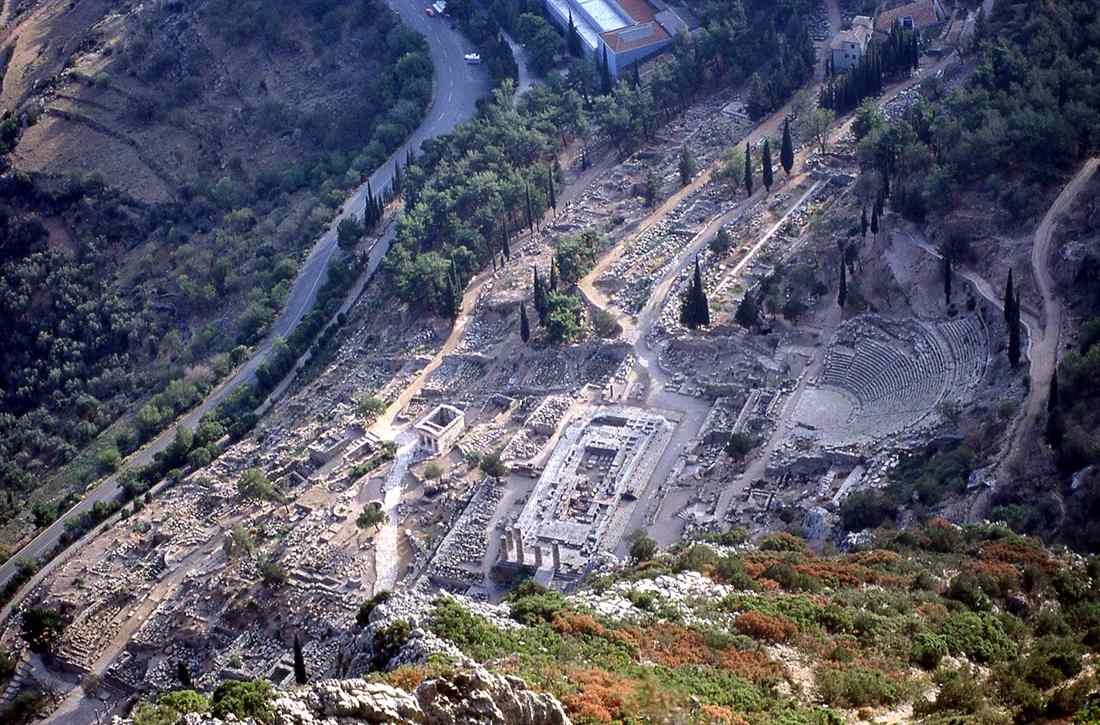
One Day in Delphi
One day in Delphi covers the whole sanctuary: the archaeological site at opening, the climb up the Sacred Way to the Temple of Apollo and the stadium, the museum with the bronze Charioteer, and the Castalian Spring and the Tholos of Athena Pronaia beside the road, with a village lunch and an afternoon in Arachova to close. Plan the whole trip with Greece Tours.
This guide lays out one day in Delphi hour by hour: how to spend the day, the best itinerary in order, how to reach the site from Athens, what to see first, how long the museum takes, whether one day is enough or an overnight is better, what to add nearby with spare time, where to eat, what to drop on a half day, and the tips that turn a rushed stop into a full circuit of the sanctuary.
How do you spend one day in Delphi?
Spend one day in Delphi by reaching the archaeological site at opening, climbing the Sacred Way to the temple of Apollo, touring the museum, then visiting the Castalian Spring and the Athena Pronaia sanctuary before lunch in the village and an afternoon in Arachova.
The day divides into four fixed blocks. The archaeological site takes the first two hours, because the Sacred Way rises 200 metres from the entrance to the stadium and the ascent rewards an unhurried pace and a cool start. The Delphi Archaeological Museum takes the next hour and holds the Charioteer of Delphi, the twin kouroi Kleobis and Biton, the Sphinx of Naxos, and the reconstructed Siphnian Treasury frieze. The Castalian Spring and the Athena Pronaia sanctuary, with its round tholos, sit a short walk east along the road and take a further 45 minutes together.
The choice of base sets the rhythm. Visitors driving from Athens leave the city before dawn to stand at the gate when it opens and to hold the full four-block plan. Visitors staying overnight in Delphi village or neighbouring Arachova walk to the site in ten minutes, gain the first light on the ruins, and turn the afternoon into a relaxed meal and a mountain drive rather than a race back to the capital.
Lunch anchors the middle of the day. The village of Delphi lines a single terrace above the Pleistos gorge, and its tavernas face the olive sea that runs down to the Gulf of Corinth. An afternoon extension to Arachova, 12 kilometres east on the slope of Mount Parnassus, adds a stone-built town of weavers and cheese-makers and closes the day on the drive back toward Athens.
What is the best one-day Delphi itinerary hour by hour?
The best one-day Delphi itinerary starts at the site gate at opening, climbs to the stadium and back, moves to the museum, then the Castalian Spring and Marmaria, breaks for a village lunch, and ends with Arachova on the drive out — roughly nine hours from first gate to departure.
The plan below runs the sequence in order and keeps the archaeological site first, while the stone holds morning shade and the crowds from the later tour buses have not arrived. Each block carries its own walking distance and gradient, so the timeline front-loads the climb and leaves flat walking and seated rest for the afternoon.
- At opening — Enter the archaeological site; walk the Sacred Way past the Athenian Treasury to the temple of Apollo.
- Mid-morning — Continue up to the theatre and the stadium at the top of the sanctuary, then descend the same path.
- Late morning — Cross to the Delphi Archaeological Museum for the Charioteer, the Sphinx of Naxos, and the Siphnian frieze.
- Before noon — Walk east to the Castalian Spring, then to the Athena Pronaia sanctuary and the tholos at Marmaria.
- Midday — Lunch in Delphi village on a terrace above the olive valley.
- Early afternoon — Drive 12 kilometres to Arachova for the stone lanes, the woven textiles, and the formaela cheese.
- Mid-afternoon — Begin the return drive toward Athens, or settle into the mountain town for a second night.
The stadium marks the turning point of the morning. It sits at the highest terrace of the sanctuary, 620 metres above sea level, and the climb from the entrance gains height on stone steps and a packed-earth path. Turning back down after the stadium returns the route to the museum without retracing new ground, and the descent takes half the time of the ascent.
The afternoon trims to fit the base. A visitor driving back to Athens holds the Arachova stop to 90 minutes and reaches the city by early evening. A visitor staying the night stretches Arachova into a long coffee and a walk to the clock tower above the town, then keeps the drive for the following morning.
Two tickets cover the paid blocks. A combined ticket admits the archaeological site and the museum, while the Castalian Spring, the Athena Pronaia sanctuary, and the village itself carry no gate. Carrying water, a hat, and firm shoes matches the plan to the terrain, since the Sacred Way and the stadium path run over uneven marble and stone.
How do you get to Delphi for a day trip?
Reach Delphi for a day trip by covering the 180 kilometres from Athens in under three hours, by rental car on the national road through Thebes and Livadeia, by KTEL intercity bus from Liosion terminal, by private transfer, or on a guided coach tour that leaves the city early.
The drive is the most flexible route and the one that protects the full itinerary. The car leaves Athens on the A1 motorway toward Thebes, turns west through Livadeia, and climbs the switchbacks past the Arachova ridge into Delphi. Leaving the city before dawn puts the car at the site gate at opening and holds the four-block plan intact. A Delphi day trip from Athens by rental car also opens the return route through Arachova and the option of a detour to the Monastery of Hosios Loukas.
The KTEL bus serves visitors without a car. Services depart from the Liosion Street terminal in Athens and run to Delphi village in about three hours, stopping at Livadeia and Arachova on the way. The bus reaches the village rather than the site gate, so passengers walk ten minutes down the road to the entrance and time the day around the fixed return departures posted at the terminal. Full timetables and boarding details sit in the guide on how to get to Delphi.
Private transfers and guided tours remove the driving and the timetable. A private transfer runs door to door from an Athens hotel, waits at the site, and returns on the visitor’s schedule. A guided coach tour departs central Athens in the early morning, carries a licensed guide through the sanctuary and museum, and returns in the evening, often with a lunch stop in Delphi or Arachova built into the price.
The early departure is the single fixed rule for every route. The 180-kilometre distance and the near-three-hour transit mean a late start loses the museum or the Marmaria block. Booking the bus seat, the transfer, or the tour the night before locks the departure and keeps the day trip on the timeline from the first gate to the return drive.
What do you see first at the archaeological site in one day?
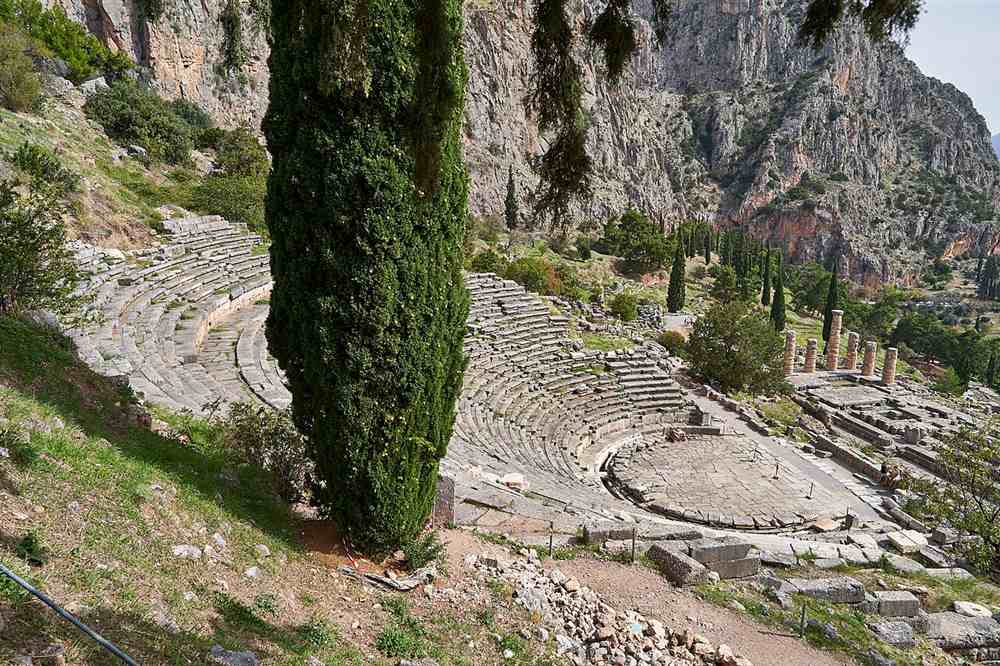
Enter at opening and climb the Sacred Way straight to the top. Pass the Treasury of the Athenians, reach the Temple of Apollo, continue to the theatre, then finish at the stadium. Walk back down afterwards. This order clears the summit before the coaches and the midday heat arrive.
The site opens at eight in the morning. The first coaches from Athens reach the entrance around ten, so the two hours between belong to walkers who arrive early. Buy the combined ticket at the booth, keep it for the museum, and start up the paved path that zigzags across the south slope of Mount Parnassus.
The Sacred Way rises past a corridor of treasury foundations. The Treasury of the Athenians stands rebuilt in white Parian marble on the first sharp bend, its blocks carved with hymns to Apollo. Above it the path reaches the polygonal retaining wall and the flat terrace of the Temple of Apollo, where six Doric columns mark the house of the oracle. This is the centre of the sanctuary and the point most groups crowd by late morning.
Keep climbing. The theatre sits directly above the temple and frames the whole valley of olive trees running down to the Gulf of Corinth. Its thirty-five rows of limestone seats held five thousand spectators for the musical contests of the games. A final stretch of path leads to the stadium on the highest terrace, where the athletic events of the Pythian Games were run and the stone starting line survives with grooves cut for the runners’ feet.
Descend by the same paved route. The downhill walk takes twenty minutes and returns you past the temple and the treasuries a second time, now from above, which reveals the tiered layout of the sanctuary in full. The arriving crowds push upward on the single path, so hold to the right and keep moving. You reach the entrance again with the museum next door and the whole afternoon still ahead.
How much time do you need at the Delphi museum in one day?
Budget one hour to ninety minutes for the museum. The Charioteer, the Sphinx of Naxos, the twin kouroi, the Siphnian Treasury frieze, and the omphalos anchor the visit. Time it for the middle of the day, when the outdoor site bakes and the air-conditioned halls give shade.
The Delphi Archaeological Museum stands beside the site entrance, so you cross from ruins to galleries in three minutes. Fourteen rooms run in chronological order across a single upper floor, which keeps the route linear and short. A focused visit covers the highlights in an hour; readers who study the labels stretch it to ninety minutes.
The Charioteer of Delphi holds the final hall alone. The bronze figure survives near-complete, with inlaid onyx eyes and copper eyelashes, cast to mark a chariot victory in the Pythian Games. Earlier rooms carry the Naxian Sphinx on its ten-metre column, the Siphnian Treasury frieze of gods and giants, the two archaic kouroi named Kleobis and Biton, and the carved omphalos stone that marked Delphi as the navel of the earth.
The frieze of the Siphnian Treasury rewards a slow pass. Carved in the sixth century before Christ, its panels run the battle of gods and giants along one wall and the assembly of Olympian gods along another, with the paint traces still visible on the marble. The Kleobis and Biton kouroi stand nearby, twin brothers of Argos cut in stiff frontal poses, their names inscribed on the base by the sculptor Polymedes.
Slot the museum into the hottest hours. After the summit climb the exposed terraces radiate heat by noon, and the galleries stay cool and covered. Move through in this order and you rest your legs, escape the sun, and see every headline object before the afternoon coaches fill the entrance hall.
Can you fit the Castalian Spring and Athena Pronaia into one day?
Yes. Both sit a short walk east of the main site along the road toward Arachova. The Castalian Spring fills a ravine between two cliffs, and the Sanctuary of Athena Pronaia with its round Tholos stands below at Marmaria. Reach both on foot without a car.
Leave the main entrance and walk east on the site road. In seven minutes the tarmac reaches the cleft of the Phaedriades, the two Shining Rocks, where the Castalian Spring runs from the gorge. Pilgrims washed here before consulting the oracle, and the carved niches and channels of the archaic and Roman fountains survive against the rock face.
Continue five minutes downhill and the Sanctuary of Athena Pronaia opens on a terrace called Marmaria. The circular Tholos stands here, three Doric columns and a section of entablature rebuilt on a marble base, the most photographed structure at Delphi after the Temple of Apollo. The precinct also holds two temples of Athena and the foundations of two treasuries, spread across a ledge above the olive plain.
The three stops chain together in a single eastward walk that adds under an hour to the day:
- Main site entrance to the Castalian Spring: seven minutes on foot.
- Spring to Athena Pronaia at Marmaria: five minutes downhill.
- Marmaria back to the modern village of Delphi: fifteen minutes along the road.
Walk this loop in the late afternoon, after the museum and after the coaches leave. The light drops behind the Gulf, the crowds thin, and you stand at the Tholos with the ravine and the plain to yourself before catching the evening bus back toward Athens or Arachova.
Is one day in Delphi enough, or is an overnight better?
One day in Delphi covers the archaeological site, the museum, the Castalian Spring and the Sanctuary of Athena Pronaia. An overnight adds the quiet opening hour before the coaches, the sunset over the ravine, and time for Arachova or Mount Parnassus.
A day trip from Athens reaches Delphi in three hours by road and returns the same evening. That window fits the four core nodes: the Sacred Way up to the Temple of Apollo and the stadium, the museum with the Charioteer, the spring at the foot of the Phaedriades cliffs, and the round tholos at Athena Pronaia below the road. Visitors who want the ruins, the bronzes and the setting complete the circuit in a single day.
An overnight in the modern village changes the rhythm. The site opens at eight, and guests who sleep in Delphi walk the terraces in the first hour, before the tour buses climb from Athens and Itea. The same guests watch the light drop across the Pleistos valley at dusk, when the ravine turns gold and the day crowd has gone. The extra hours open Arachova, twelve kilometres east, and the trails on Mount Parnassus above it.
The one-day plan suits travellers on a fixed Athens base who count Delphi as one entry in a wider Greece itinerary. The overnight suits photographers, hikers and anyone who wants the sanctuary in silence. Guests weighing the two options compare rooms and rates in the village at where to stay in Delphi, and set the visit against the seasons at the best time to visit Delphi.
What can you add near Delphi with extra time in the day?
Extra hours open Arachova twelve kilometres east, the seaside town of Galaxidi and the port of Itea below, and the monastery of Hosios Loukas. Each sits on a road that branches from the Delphi route, so the detour extends the drive rather than doubling back.
Arachova rises on the slope of Mount Parnassus, twelve kilometres east of the site on the road back toward Athens. The stone town stacks its houses up the mountainside above the highway, and its weavers sell rugs and formaella cheese along the main street. Guests returning to Athens pass straight through Arachova, so a stop there adds an hour without a separate leg.
Itea and Galaxidi lie below Delphi on the Gulf of Corinth. The port of Itea sits at the base of the olive plain that fills the valley, fifteen kilometres down the switchbacks from the sanctuary. Galaxidi extends the coast road west, a captains’ town of neoclassical mansions and a quiet harbour. Travellers who drive down to the water for lunch fold both into the seaward side of the day.
Hosios Loukas stands east of Delphi near Distomo, a walled Byzantine monastery with two churches and gold-ground mosaics under its domes. The turn-off leaves the Athens road and climbs into the hills of Boeotia. Guests who cut the detour into the return drive reach the monastery in forty minutes from the site and rejoin the main route afterward.
What are the tips for making the most of one day in Delphi?
Arrive at opening, buy the combined ticket in advance, climb straight to the stadium first, carry water and grippy shoes, keep the museum for the midday heat, and hold the return time. Six moves turn a rushed stop into a full circuit of the sanctuary.
The gate opens at eight, and the first hour on the Sacred Way runs cool and thin of crowds before the Athens coaches arrive. A combined ticket bought ahead covers both the archaeological site and the museum and skips the queue at the booth. The climb to the stadium at the top of the sanctuary drains the legs, so guests who take it first, while fresh, walk the Temple of Apollo and the theatre on the way back down.
- Arrive at opening: the eight o’clock gate gives an hour on empty terraces before the buses climb from Athens.
- Buy the combined ticket in advance: one pass covers site and museum and skips the booth queue.
- Climb straight to the stadium first: take the top of the sanctuary on fresh legs, then work back down through the temple and theatre.
- Carry water and grippy shoes: the Sacred Way is steep marble and stone with no shade on the upper terraces.
- Keep the museum for the midday heat: the Charioteer and the bronzes wait in air-conditioned halls when the sun peaks.
- Hold the return time: fix the departure so the Castalian Spring and Athena Pronaia stay in the plan.
Water and shoes with grip carry weight on the upper slope, where the path runs over polished stone and the terraces hold no shade. The museum earns the midday slot: its halls stay cool through the hottest hours, and the Charioteer, the twin kouroi and the Sphinx of Naxos reward a slow pass indoors while the sun sits high over the ruins.
The return time governs the last two nodes. The Castalian Spring sits between the site and the Athena Pronaia terrace, and the round tholos below the road closes the circuit. Guests who fix the departure hour reach both before leaving, rather than cutting them to catch the bus. A held schedule turns the day into a complete loop of the sanctuary, the spring and the museum.
What do you eat during one day in Delphi?
You eat mountain food. Delphi village lines a terrace above the Pleistos gorge, and its tavernas serve spit-roasted meats, wild greens, formaela cheese grilled over coals, Parnassus honey and local olive oil. Time lunch between the museum and the drive out.
The tavernas sit along the two main streets of Delphi village, and the ones on the outer edge open onto balconies that hang over the ravine. From those tables the view runs down the Pleistos valley across a sea of olive trees to the Gulf of Corinth. A window seat turns a plate of food into the second view of the day, after the ruins themselves.
The kitchen here is Parnassus cooking, not coastal. Lamb and pork turn on the spit, wild greens come dressed in olive oil pressed from the trees on the plain below, and formaela cheese from neighbouring Arachova arrives seared over coals with a squeeze of lemon. Sausages spiced with orange, bean stews, and grilled meats fill the menus, and Parnassus honey and thick yoghurt close the meal.
Order lunch after the museum and before the drive back. A midday table lets the legs recover from the climb through the sanctuary, keeps the heat of the open site off your plate, and puts the meal at the natural seam in the day. Pair the formaela and greens with local olive oil and honey, and the one-day visit gains a full mountain lunch without losing an hour on the archaeological ground.
What do you skip if you only have half a day in Delphi?
You skip the Castalian Spring and the Tholos at Athena Pronaia first. The archaeological site and the museum are the core of Delphi. With half a day, climb straight to the temple and stadium, keep the museum brief, and drop the two roadside stops.
The Castalian Spring and the Athena Pronaia sanctuary both sit east of the main gate along the road, so they cost walking time and a road crossing that a tight schedule cannot spare. The round Tholos is the postcard of Delphi, and leaving it out stings, but it stands apart from the main sacred precinct and adds a separate stop. When the clock is short, these two go first.
Put the hours into the sanctuary itself. Enter at the lower gate and climb the Sacred Way past the treasuries to the Temple of Apollo, the heart of the oracle. Carry on up to the theatre for the view back over the columns, then finish at the stadium on the top terrace, the best-preserved in Greece. That single vertical line covers the monuments that carry the site.
Keep the museum visit tight and targeted. The Delphi Archaeological Museum holds the Charioteer, the twin kouroi, the Sphinx of Naxos and the Siphnian frieze, and a focused walk past those pieces takes far less time than a full circuit of every room. Climb the site, see the temple and stadium, then stand in front of the bronze Charioteer, and a half-day in Delphi still delivers the monuments that made the place famous.
Frequently Asked Questions
Is one day enough for Delphi?
Yes. One day covers the archaeological site, the museum, the Castalian Spring and the Sanctuary of Athena Pronaia at a steady pace. An overnight adds the quiet opening hour before the coaches, the sunset over the ravine, and time for Arachova or Mount Parnassus.
What is the best time to arrive in Delphi for the day?
Arrive at the site gate at opening. The first hour on the Sacred Way runs cool and thin of crowds before the Athens coaches climb the mountain, and the low morning light rakes across the terraces of the temple and the treasuries.
Can you visit Delphi in one day from Athens?
Yes. Delphi sits about 180 kilometres from Athens, under three hours each way by car, bus, transfer or guided tour. An early start holds the full day: the site, the museum, the spring and Athena Pronaia, with the return in the afternoon.