
Away from the coast, Karpathos keeps a string of old villages across its mountainous interior, each built inland and uphill to escape the pirate raids that once plagued the shore. Menetes, Aperi, Volada, Othos and Piles line a green ridge above the capital. Mesochori and Spoa cling to the slopes further north. Each guards its own church, dialect quirks, recipes and view. A slow drive through them is one of the most rewarding things to do on the island. Plan the whole trip with Greece Tours.
This guide takes the central and western villages in turn, describing the character and sights of each and how they differ. Then explains how to link them on a village loop by car or bus. The far-northern village of Olympos, the most famous of all, has its own detailed guide. Read this beside the wider things to do in Karpathos to fit the villages into a trip.
What are the villages of Karpathos?
The villages of Karpathos line the mountainous interior above Pigadia: Menetes, Aperi, Volada, Othos and Piles on the central ridge, with Mesochori and Spoa to the north-west. Each was built inland for safety and keeps its own traditions.
Karpathos is a mountainous island, and its old villages sit not on the coast but inland and uphill. A legacy of the centuries when pirate raids made the shore dangerous to inhabit. A ridge of them strings across the middle of the island above the capital, Pigadia. More cling to the slopes to the north-west. Each a compact settlement of whitewashed and pastel houses gathered around a church.
The central villages, Menetes, Aperi, Volada, Othos and Piles, sit close together on good roads and are easily linked in a half-day loop. Further out, Mesochori and Spoa occupy dramatic positions on the western and central slopes, and beyond them the road climbs north to the isolated world of Olympos, the most traditional village of all, covered in its own guide to Olympos village.
What the villages share is a strong sense of continuity: each keeps its own feast day. Its own church. Often its own dialect quirks and recipes, a legacy of the isolation that once separated them. Green valleys of walnut, cypress and fruit trees soften the mountain setting, and the money sent home by emigrants who left for America is visible in the grand houses. The sections below take the main villages in turn.
Why visit Menetes in Karpathos?
Menetes, about seven kilometres from Pigadia, is one of the most picturesque villages on Karpathos, built amphitheatrically up a hillside in tiers of colourful houses. It has a folklore museum and a landmark church over the plain.
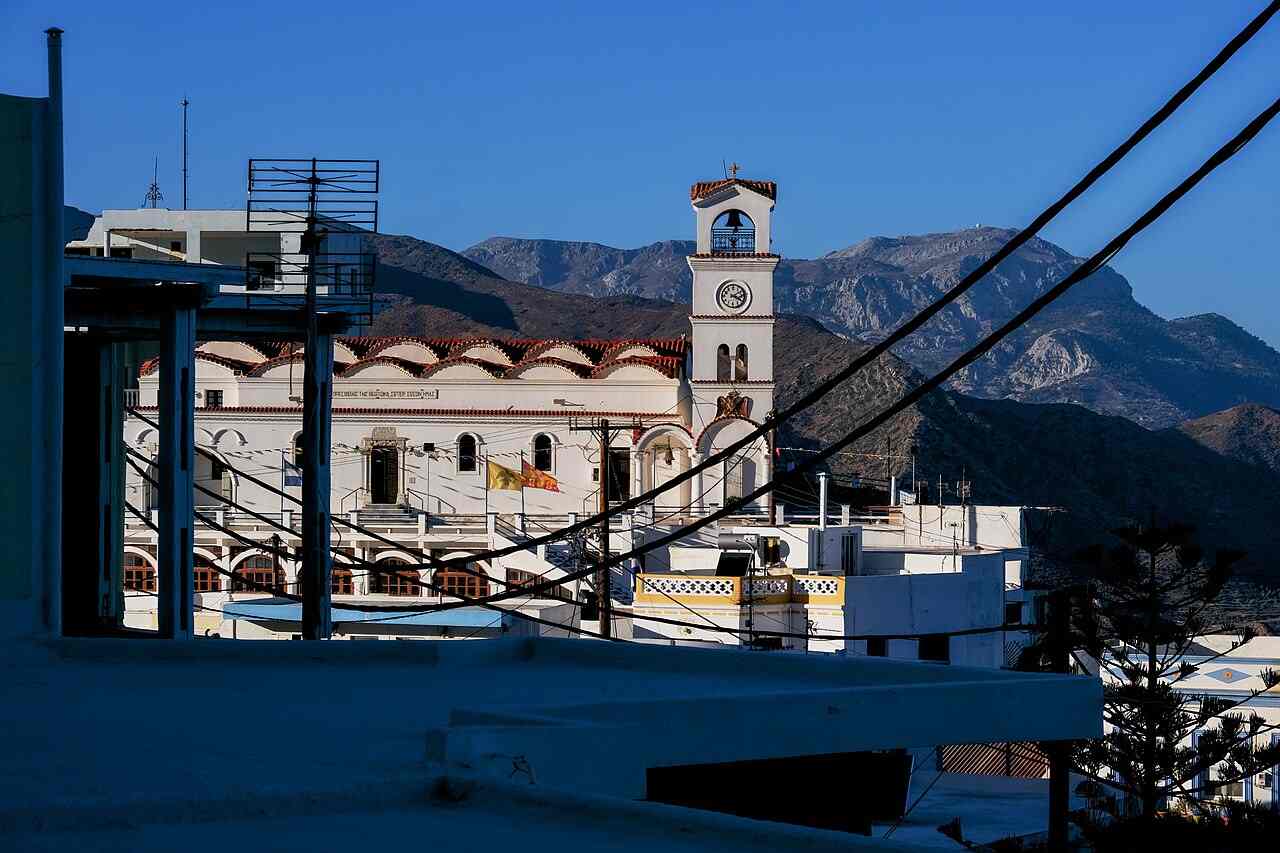
Menetes is the closest of the mountain villages to the capital, about seven and a half kilometres south-west of Pigadia, and one of the most photographed. It climbs a rock spur in tiers of white and pastel houses with flowered balconies. Its lanes so steep they run as stairways between the homes. The whole village reads as an amphitheatre facing out over the southern plain and the sea.
The most striking feature is the Church of the Assumption of the Virgin. Which stands at the edge of the settlement and looks out over the airport plain toward the sea, a landmark visible from far off. A small folklore museum in the village preserves the looms, costumes and household tools of traditional Karpathian life, giving a sense of how the community lived before tourism.
Menetes rewards a wander through its stepped lanes and a stop at a taverna on the platia, the small square where older residents gather. Its position on the road between Pigadia and the west coast makes it an easy first stop on a village loop. Its colourful. Tumbling houses and wide views make it a memorable one.
What is Aperi, the old capital of Karpathos?
Aperi was the former capital of Karpathos, built inland above Pigadia to escape pirate raids. It is known for the grand neoclassical mansions built by returning emigrants, a green valley setting and a noticeably quiet pace.
Aperi sits inland on the slopes above Pigadia and was for centuries the capital of the island, chosen for its hidden, defensible position away from the coast. Set amid a green valley of walnut and cypress, it has a prosperous. Dignified air that sets it apart from the other villages. It remains an important religious centre as the seat of the local bishop.
The village is best known for its architecture. The emigrants who left Aperi for America and returned, or sent money home. Built grand neoclassical mansions here. These handsome houses, unusual on a modest island, give the village a distinctive character. Their scale and detail speak to the wealth of the diaspora and the pride of a community that never forgot its home.
Aperi is quiet and green, a place to stroll among the mansions and churches, admire the views across the valley toward the sea. Eat at a taverna set above the slopes. Its combination of history as the old capital, striking houses and a peaceful setting makes it one of the essential stops on a tour of the central villages.
What is special about Othos in Karpathos?
Othos is the highest village on Karpathos at around 500 metres, known for its dark red wine, its wide mountain views, and a folk museum that recreates a traditional Karpathian home.
Crowning the central ridge at around 500 metres. Othos is the highest inhabited village on the island. Its elevation gives it sweeping views across the mountains and down to both coasts. It is a compact, traditional settlement of stone houses and narrow lanes, and its cool, high position makes it a refreshing stop on a hot day touring the interior.
Othos is best known for two things. The first is its wine: the village presses a dark, dry red from vines on the highland terraces. Poured young straight from the barrel in the tavernas, a pour that rarely leaves the island. The second is its folk museum, a house preserved and furnished as a traditional Karpathian home, with its loom. Hearth, painted chests and household goods, one of the best places to see how the villagers once lived.
A stop in Othos combines the museum, a glass of the local wine and the mountain views, and the village pairs naturally with neighbouring Volada and Piles on a loop. Its height, its wine and its strong sense of tradition make it a highlight of the central villages and a favourite among visitors exploring the interior.
What are Volada and Piles like in Karpathos?
Volada and Piles complete the central village ridge near Othos. Volada is a quiet stone village with the remains of a small Venetian castle, while Piles tumbles down a west-facing slope with gardens and fine sunset views.
Volada sits just below Othos on the central ridge, a quiet, traditional village of stone houses set among gardens and terraces. Above it stand the scant remains of a small medieval castle from the Venetian period. A reminder of the island’s layered history. The village makes a peaceful stop between Othos and the other settlements, with the same wide mountain views and unhurried pace.
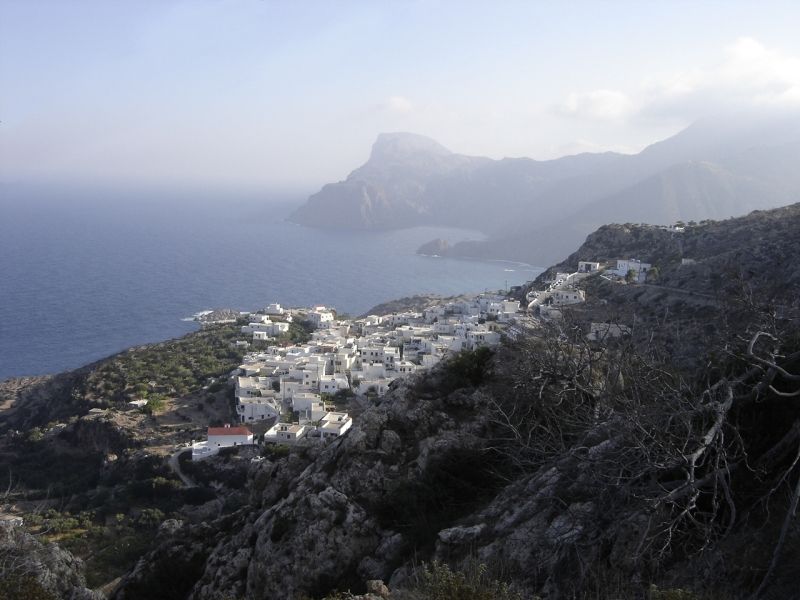
Piles, a little further along, tumbles down a west-facing slope toward the sea, its whitewashed houses set among gardens heavy with figs, pomegranates and vines. The westward aspect gives it some of the best sunset views of the central villages. Watched from a terrace as the sun drops toward the water. Its springs and greenery make it one of the prettier settlements.
Together with Othos, Volada and Piles form a tight cluster on the central ridge, only kilometres apart and easily linked on foot or by car. A slow circuit of the three, with a wine stop in Othos, a look at the castle in Volada and a sunset in Piles. Makes a rewarding half-day in the heart of the island.
What are Mesochori and Spoa in Karpathos?
Mesochori is a striking village on the west coast, built between the sea and a rocky slope with white houses, chapels and springs.
Mesochori occupies one of the most dramatic settings on the island, built on a slope between the sea and a wall of rock on the west coast. Its maze of narrow, stepped paths winds between whitewashed houses and small chapels. The village is known for its springs and the leafy square of the Panagia Vrysiani church. Where water runs from old fountains. The setting, poised above the sea, makes it one of the most photogenic villages on Karpathos.
Spoa stands further north, on the narrowest waist of the island, which gives it the unusual distinction of views to both the east and west coasts at once. It is a quiet mountain village in its own right. It also serves as the gateway to the east coast, since the road from here drops to the beach and fishing settlement of Agios Nikolaos on the eastern shore.
Both villages lie beyond the tight central cluster, so reaching them involves a longer drive through the mountains, but they reward the effort. Mesochori in particular is worth the trip for its setting and its springs. The two can be combined with a run up the west coast to Lefkos or a drop down to the east-coast beaches for a fuller day of exploring.
How do you visit the villages of Karpathos?
The central villages are best visited on a half-day driving loop from Pigadia, linking Menetes, Aperi, Volada, Othos and Piles on good roads.
The easiest way to see the villages is a driving loop from Pigadia. A good road climbs to the central ridge and links Menetes, Aperi, Volada, Othos and Piles within kilometres of each other. The core villages can be toured in a half-day. Ideally in the late afternoon when the light softens the stone and the tavernas open for the evening. Mesochori and Spoa add a longer western or northern leg for those with more time.
Public buses do serve the villages, running times a day from Pigadia to Piles via Aperi. Volada and Othos. To Arkasa via Menetes, which is enough for a single outing to one or two villages. For touring several in a day, though, a hire car or scooter is far more practical. Given how infrequent the buses are. It allows the unhurried stops that make the villages rewarding.
You travel, treat the villages as places to slow down rather than tick off. Park at the edge, since the lanes are narrow and stepped, and walk in to find the square, the church and a taverna. A wine stop in Othos, a sunset in Piles and a dinner in Menetes or Aperi turn a village loop into one of the most memorable evenings on Karpathos, and the wider Karpathos travel guide shows how the villages fit alongside the beaches and the north.
Frequently Asked Questions
What are the best villages to visit in Karpathos?
The best villages are the traditional mountain settlement of Olympos in the far north. The central ridge villages above Pigadia: Menetes. With its tiered colourful houses. Aperi, the old capital with grand mansions. And Othos, the highest village, known for its wine and folk museum. Volada, Piles, Mesochori and Spoa are also well worth a visit.
Which is the oldest capital village of Karpathos?
Aperi was the former capital of Karpathos, built inland on the slopes above Pigadia to escape pirate raids. It is known today for the grand neoclassical mansions built by returning emigrants, its green valley setting, and its role as the seat of the local bishop. It has a quiet, prosperous character distinct from the other villages.
How do you get to the villages of Karpathos?
The central villages of Menetes, Aperi, Volada, Othos and Piles are best reached on a driving loop from Pigadia, linked by good roads within kilometres of each other. Buses run times a day to Piles via the central villages and to Arkasa via Menetes. A hire car gives the freedom to tour villages at leisure.
What is the highest village in Karpathos?
Othos, at around 500 metres, is the highest inhabited village on Karpathos. It sits on the central ridge with sweeping views to both coasts. Is known for its dark red wine poured young from the barrel and for its folk museum. A house furnished as a traditional Karpathian home with its loom, hearth and painted chests.