
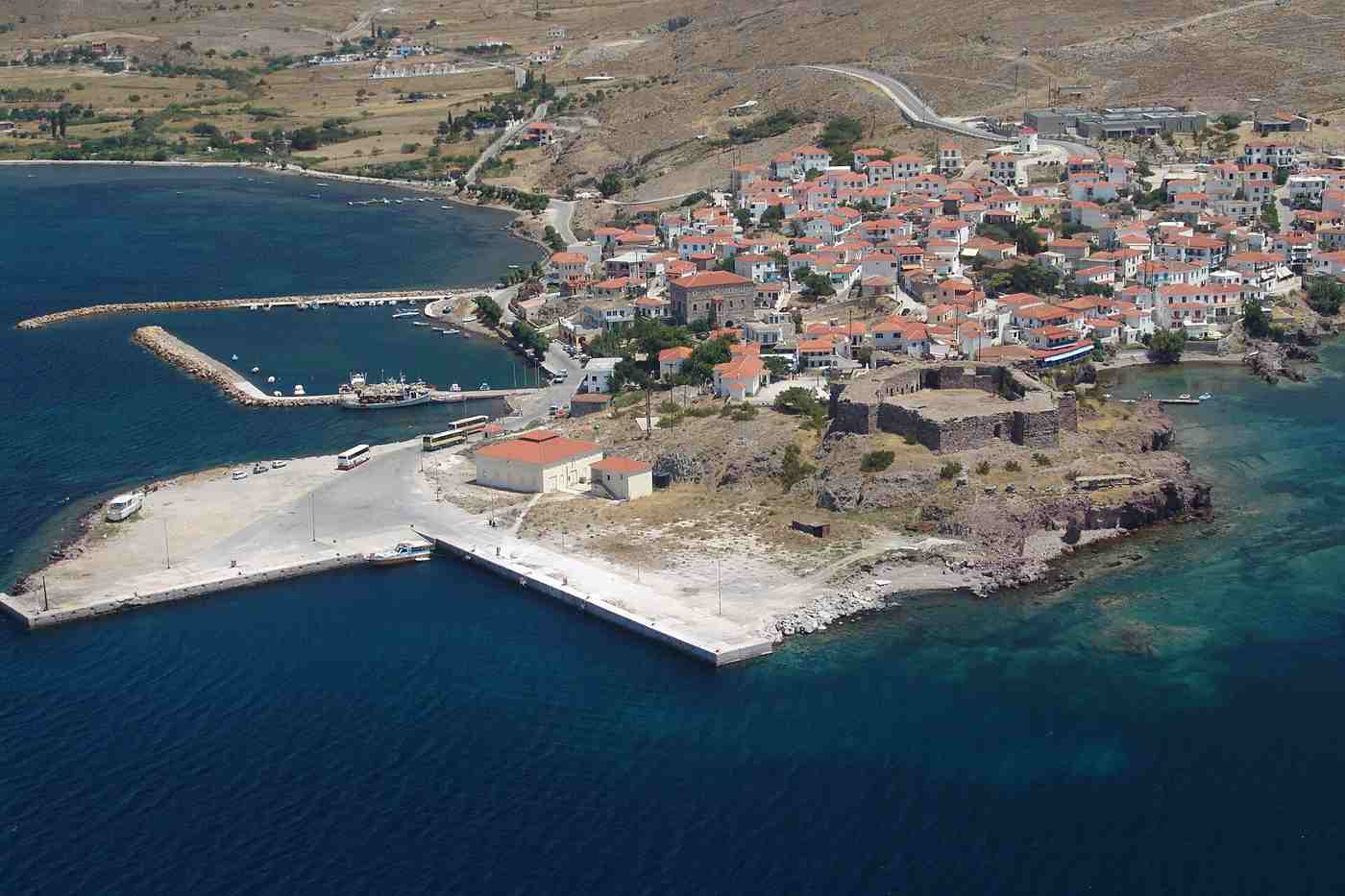
Sigri is a remote fishing village at the western tip of Lesbos, a peaceful harbour set among the bare volcanic hills that hold the island’s famous Petrified Forest. Sheltered by the islet of Nisiopi and guarded by an Ottoman castle of 1746. It is the largest natural harbour on Lesbos, its name derived from a Venetian word meaning safe. Today Sigri is best known as the gateway to the Petrified Forest, home to the excellent Natural History Museum that explains this fossilised woodland. As the base for boat trips to Nisiopi with its lighthouse and petrified trunks lying in the sea. Plan the whole trip with Greece Tours.
With unspoilt beaches, fresh seafood tavernas and a wild, end-of-the-world atmosphere, Sigri rewards those who make the long journey west. This guide covers the village, its castle, its lighthouse, the museum and how to visit.
Here you will find everything about Sigri on Lesbos: the remote fishing village and its harbour, the Ottoman castle, the Megalonisi lighthouse on the islet of Nisiopi. The Natural History Museum of the Petrified Forest, the beaches nearby. How to reach this village at the western tip of the island.
What is Sigri on Lesbos?
Sigri is a small, remote fishing village at the western tip of Lesbos, set among volcanic hills near the Petrified Forest.
Sigri is a small fishing village near the western tip of Lesbos, one of the most remote and peaceful settlements on the island. Its name derives from a Venetian word meaning safe, a reference to its sheltered position. For Sigri possesses the largest natural harbour on Lesbos, protected from the open sea by the long islet of Nisiopi lying just across its bay.
The village sits in a stark, treeless landscape of bare volcanic hills, the same geology that created the celebrated Petrified Forest nearby. Giving Sigri a wild, elemental character quite unlike the green north of the island. A cluster of white houses around a working harbour, it remains an authentic fishing community, its quaysides lined with boats and simple seafood tavernas.
For visitors, Sigri is above all the gateway to the Petrified Forest and the site of its acclaimed Natural History Museum. It is also a rewarding destination in itself. With an Ottoman castle, unspoilt beaches, a famous lighthouse offshore and an end-of-the-world atmosphere that draws travellers to the far west of Lesbos.
Where is Sigri and how do you get there?
Sigri lies at the far western tip of Lesbos, around ninety kilometres from the capital Mytilene, a drive of roughly ninety minutes through the volcanic hills.
Sigri occupies the western extremity of Lesbos, as far as it is possible to go from the capital and main port of Mytilene in the south-east. The distance is around ninety kilometres. The drive takes roughly an hour and a half along roads that wind west through Kalloni and then across the increasingly bare. Volcanic hills of the far west.
A hire car is by far the most practical way to reach Sigri, given its remoteness. The journey itself is part of the experience. Passing the clifftop Monastery of Ypsilou and the strange lunar scenery that holds the Petrified Forest. A limited bus service also connects Mytilene and Kalloni with the west, though timetables are sparse.
The long journey to this isolated corner of the island keeps Sigri quiet and unspoilt. It is often combined with a visit to the nearby Petrified Forest parks and the beach resort of Skala Eressou to the south. Planning your arrival and transport on Lesbos around a hire car makes reaching the far west straightforward.
What is the Sigri lighthouse and the islet of Nisiopi?
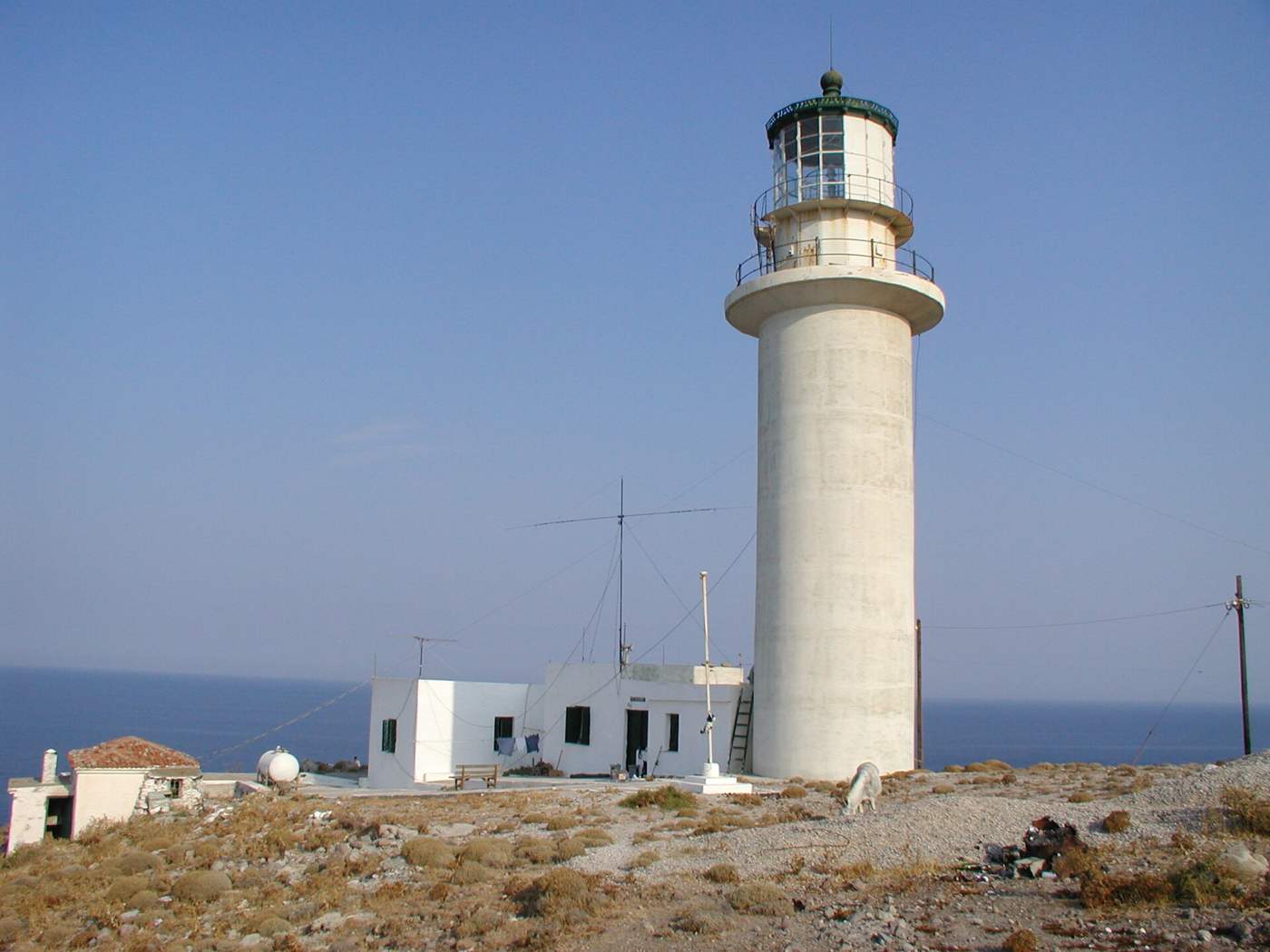
The Sigri lighthouse, properly the Megalonisi lighthouse, stands on the islet of Nisiopi just west of the village. Built in 1861, the thirteen-metre stone tower guards the harbour entrance.
Guarding the entrance to Sigri’s great natural harbour is the islet of Nisiopi, also called Megalonisi, and on it stands the lighthouse for which the area is known. Properly named the Megalonisi lighthouse, though often called the Sigri lighthouse, it was established in 1861, a circular stone tower rising some thirteen metres with an attached keeper’s house.
The islet lies about a kilometre and a half west of the village, sheltering the bay and giving Sigri its safe harbour. As well as the lighthouse, Nisiopi holds the chapel of Saint George and, remarkably, an extension of the Petrified Forest, with fossilised tree trunks lying both on the island and in the shallow sea around it.
Small boat trips run from Sigri harbour across to Nisiopi, allowing visitors to admire the lighthouse. Visit the chapel and see the underwater and shoreline petrified trunks, a highlight of a stay in the village. The short crossing and the islet’s wild scenery make this one of the most memorable excursions in the west of Lesbos.
What is the castle of Sigri?
The castle of Sigri is a small Ottoman fortress built in 1746, overlooking the village harbour and the islet of Nisiopi.
Dominating the waterfront of Sigri is its castle, a compact Ottoman fortress built in 1746 during the long period of Turkish rule over Lesbos. It was raised to defend the village’s harbour, one of the finest natural anchorages in the Aegean, which made Sigri a place of strategic importance despite its remoteness.
The square stone castle looks out over the bay and across to the long islet of Nisiopi. Although modest in scale it is well preserved and forms the historic centrepiece of the village. Its walls and setting recall the centuries when this sheltered harbour was contested and guarded against pirates and rival powers.
Standing beside the harbour where the fishing boats moor, the castle gives Sigri a sense of history to match its dramatic natural setting. It is easily visited on a stroll around the village, combining well with the harbour tavernas and the boat trip to the lighthouse on Nisiopi just offshore.
Why is Sigri the gateway to the Petrified Forest?
Sigri is the gateway to the Petrified Forest because the fossilised woodland lies in the volcanic hills around the village, and Sigri hosts its Natural History Museum, founded in .
Sigri is inseparable from the Petrified Forest, the vast fossilised woodland that lies in the barren volcanic hills surrounding the village and offshore around Nisiopi. Created when a volcanic eruption around twenty million years ago buried a subtropical forest in ash. It is one of the largest petrified forests on earth and a UNESCO Global Geopark.
The village is home to the acclaimed Natural History Museum of the Lesbos Petrified Forest, founded in to study, protect and present the fossil forest. With its displays of petrified trunks, fossils and reconstructions. The museum is the ideal starting point for understanding the geopark and is a highlight of any visit to the west of the island.
From Sigri, visitors can reach the open-air petrified parks in the surrounding hills. Where fossilised trunks stand and lie across the volcanic landscape, as well as the underwater trunks around Nisiopi. This makes the village the natural base for exploring the Petrified Forest and one of the leading nature destinations on Lesbos.
What are the beaches around Sigri?
The beaches around Sigri are quiet and unspoilt, backed by wild volcanic scenery. Sigri has a sandy beach beside the village, while the long, remote sands of Faneromeni lie a short distance to the north.
For all its remoteness, Sigri offers rewarding swimming at quiet, unspoilt beaches set against the dramatic volcanic coastline of western Lesbos. Beside the village itself is a sandy beach, sheltered within the bay, convenient for a dip after exploring the harbour, castle and museum.
A short distance north of the village stretches the long, wild beach of Faneromeni. A remote expanse of sand and pebble backed by empty hills, one of the least developed beaches on the island. Its isolation and clean, clear water make it a favourite for those seeking solitude and a sense of untouched nature.
These western beaches are far quieter than the resorts of the north and south, part of the appeal of the far west for independent travellers. With little development and visitors, the shores around Sigri offer a genuine escape and a fine complement to the area’s natural and historic sights.
Is Sigri worth visiting?
Yes, Sigri is well worth visiting for travellers drawn to nature, history and remoteness.
Sigri is unquestionably worth the journey for the right kind of traveller, offering an experience found nowhere else on Lesbos. Its combination of a remote fishing village, an Ottoman castle, the offshore lighthouse and chapel of Nisiopi. The acclaimed Petrified Forest museum and wild, empty beaches gives it a richness out of all proportion to its small size.
The village suits those who value nature, history and solitude over resort comforts and nightlife, and who enjoy the sense of reaching the very edge of the island. Its stark volcanic scenery, fresh seafood tavernas by the harbour and unhurried pace make it a memorable and authentic stop.
Combined with the Petrified Forest, the drive past the Monastery of Ypsilou and the nearby beach town of Skala Eressou, Sigri anchors a rewarding exploration of western Lesbos. For anyone with the time to venture this far, it is one of the most atmospheric and distinctive corners of the island and among the best things to do on Lesbos.
Frequently Asked Questions
How far is Sigri from Mytilene and the Petrified Forest?
Sigri lies at the far western tip of Lesbos, around ninety kilometres from the capital and main port of Mytilene in the south-east. A drive of roughly an hour and a half by road, which makes it the most remote major village on the island and one that rewards the effort of getting there. The route runs west from Mytilene through the central town of Kalloni. On its great gulf. Then across the increasingly bare and dramatic volcanic hills of the far west, passing the clifftop Monastery of Ypsilou along the way.
The Petrified Forest, by contrast, is right on Sigri’s doorstep: the fossilised woodland lies in the volcanic hills immediately around the village and offshore around the islet of Nisiopi. Sigri is home to the Natural History Museum of the Lesbos Petrified Forest. Founded in , which is the main visitor centre and starting point for exploring the geopark. The open-air petrified parks, where fossilised tree trunks stand and lie across the barren landscape. Are within a short drive of the village. Boat trips from the harbour reach the petrified trunks lying in the sea around Nisiopi.
Most visitors treat Sigri as the natural base for seeing the Petrified Forest, combining the museum, the parks and the boat trip in a single visit to the west. A hire car is strongly recommended for reaching Sigri and the surrounding sights. Given the distance from Mytilene and the sparse bus service to this isolated but fascinating corner of Lesbos.
Can you take a boat trip to the Sigri lighthouse?
Yes, one of the most popular things to do in Sigri is to take a small boat trip from the village harbour across to the islet of Nisiopi. Also known as Megalonisi, to see its lighthouse and other sights at close hand. The lighthouse, properly called the Megalonisi lighthouse though often referred to as the Sigri lighthouse. Was established in 1861 and is a circular stone tower rising around thirteen metres, with an attached keeper’s house, standing guard over the entrance to Sigri’s large natural harbour. The islet lies only about a kilometre and a half west of the village. The short crossing takes visitors to a wild. Uninhabited island whose attractions go well beyond the lighthouse itself.
On Nisiopi you can also visit the little chapel of Saint George and, most remarkably, see an extension of the famous Petrified Forest. With fossilised tree trunks lying both on the shore of the islet and in the shallow, clear water around it, a genuinely unusual sight that can be admired from the boat and the water’s edge. These boat excursions typically run from Sigri harbour in the summer season, when demand and weather allow. The combination of the historic lighthouse. The chapel and the underwater petrified trunks makes the trip one of the highlights of a visit to the far west of Lesbos.
It is well worth asking locally at the harbour about the current schedule and availability of boats when you arrive, as trips depend on the season and conditions.
Is Sigri a good place to stay on Lesbos?
Sigri can be a good place to stay for travellers who specifically want peace, nature and remoteness rather than resort facilities and nightlife, though it is a small, quiet village and its accommodation is limited compared with the main tourist centres of Lesbos. As a remote fishing community at the western tip of the island, Sigri offers a handful of small hotels, guesthouses, studios and rooms, along with seafood tavernas around its harbour, enough for a comfortable stay but on a modest, low-key scale that matches its unspoilt character.
Basing yourself in Sigri makes most sense if your priority is exploring the Petrified Forest and the wild west of the island in depth, since the village is the gateway to the fossil forest and its museum and is surrounded by dramatic volcanic scenery, empty beaches such as Faneromeni, the offshore lighthouse on Nisiopi and the historic Ottoman castle. It also gives easy access to the nearby beach town of Skala Eressou to the south. However, because Sigri is so far from the capital Mytilene and the northern resorts.
Many visitors choose instead to see it as a day trip or a short stop while touring the island, basing themselves somewhere more central or in the livelier north around Molyvos. For lovers of solitude, wild landscapes and authentic village life, though, a night or two in Sigri is a memorable and rewarding experience at the very edge of Lesbos.