
Kypseli is the second-largest village on Aegina, a traditional inland community just kilometres east of Aegina Town with a rich history and strong local character. Once home to prosperous sponge divers, whose wealth built the handsome neoclassical mansions that still line its streets, it sits amid fertile countryside famous for its pistachio groves. At its heart stands the large, silver-domed church of Evangelistria, and every autumn the village keeps alive the unique Leidinos festival, a folk celebration of the end of summer. Inhabited since ancient times and full of tradition, Kypseli offers a glimpse of authentic rural Aegina away from the tourist crowds. Plan the whole trip with Greece Tours.
This guide covers Kypseli on Aegina: where it is, what the village is known for, its landmark church of Evangelistria. Its long history, the traditional Leidinos festival, what the village is like to visit. How to get there.
Where is Kypseli on Aegina?
Kypseli is an inland village about three kilometres east of Aegina Town, and the second-largest settlement on the island.
Kypseli lies a short way inland from Aegina Town, around three kilometres to the east, set among the green, fertile countryside of the island’s interior. It is the second-largest village on Aegina after the town itself, with a substantial permanent population of around one and a half thousand people.
Its position, close to the capital yet firmly rural, gives Kypseli a settled, everyday character quite different from the coastal resorts. Surrounded by farmland and pistachio groves, and on the route towards the north-coast villages, it is easy to reach and offers an authentic taste of village life on the island.
What is Kypseli known for?
Kypseli is known for its sponge-diving heritage, which brought wealth that built its fine neoclassical mansions, and for its fertile land with important pistachio cultivation.
One of the things that most distinguishes Kypseli is its sponge-diving past. In the nineteenth and early twentieth centuries, sponge diving was an important local industry. The riches it brought allowed villagers to build many impressive two-storey neoclassical houses. A number of which still grace the village today and give it a dignified, historic air.
The village is also known for its rich, fertile land, which supports important cultivation of the island’s famous pistachios, as well as for its enduring traditions. Chief among these is the Leidinos festival, a distinctive folk custom celebrated each autumn, which sets Kypseli apart and draws visitors to share in an authentic piece of island culture.
What is the church of Evangelistria in Kypseli?
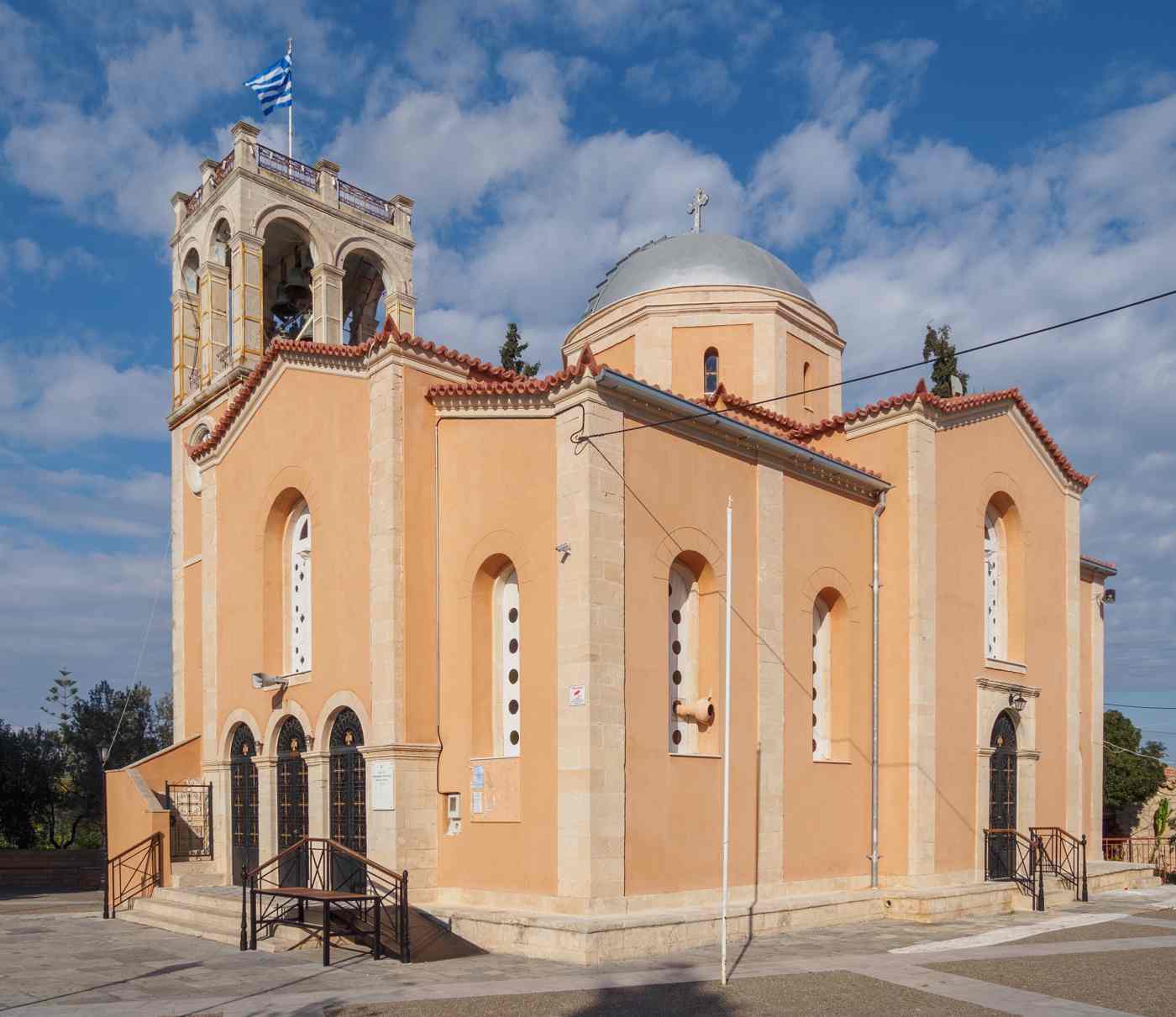
The church of Evangelistria is the large, Byzantine-style, silver-domed church that dominates the main square of Kypseli.
At the heart of Kypseli, on its main square, stands the imposing church of Evangelistria, the village’s most prominent landmark. Large and built in the Byzantine style, with a distinctive silver dome, it reflects the prosperity of the village during its heyday and forms the focal point of community life.
The church was constructed in the late nineteenth century, begun in 1875 and completed in 1880, in the era when the village’s sponge-diving wealth was at its height. Together with the surviving neoclassical mansions nearby, it gives the centre of Kypseli a handsome, historic character well worth a visit.
What is the history of Kypseli?
Kypseli has been inhabited since ancient times, as archaeological finds show.
Kypseli is far older than its neoclassical houses suggest, having been inhabited since antiquity. Archaeological evidence attests to this ancient past, most strikingly at the little church of Agios Nikolaos in the Moulos area. Which is built directly on the ruins of an ancient theatre, a vivid link between the village’s present and its distant history.
Further signs of its antiquity have been found nearby, including ancient tombs in the area of Leonti. These remains show that the fertile land around Kypseli has drawn settlers for thousands of years. Add an extra layer of interest to a village better known today for its more recent sponge-diving and agricultural heritage.
What is the Leidinos festival in Kypseli?
The Leidinos festival is a unique folk custom held in Kypseli each year on the fourteenth of September, marking the end of summer.
One of the most distinctive traditions on Aegina is the Leidinos festival, kept alive in Kypseli every year on the fourteenth of September. It marks the end of summer and its labours and the transition towards autumn and winter, a folk custom rooted in the agricultural rhythms of the island.
In the ceremony, the women of the village build the effigy of a man, filled with straw, that symbolises the harvest and the departing summer season. The occasion is celebrated with plenty of music and dancing. Making it a lively and colourful event. A notable chance for visitors to experience a genuine piece of Aeginean folk tradition.
What is the village of Kypseli like to visit?
Kypseli is a traditional, lived-in village rather than a resort, with a handsome main square, historic neoclassical mansions, the landmark Evangelistria church, and surrounding pistachio groves and countryside.
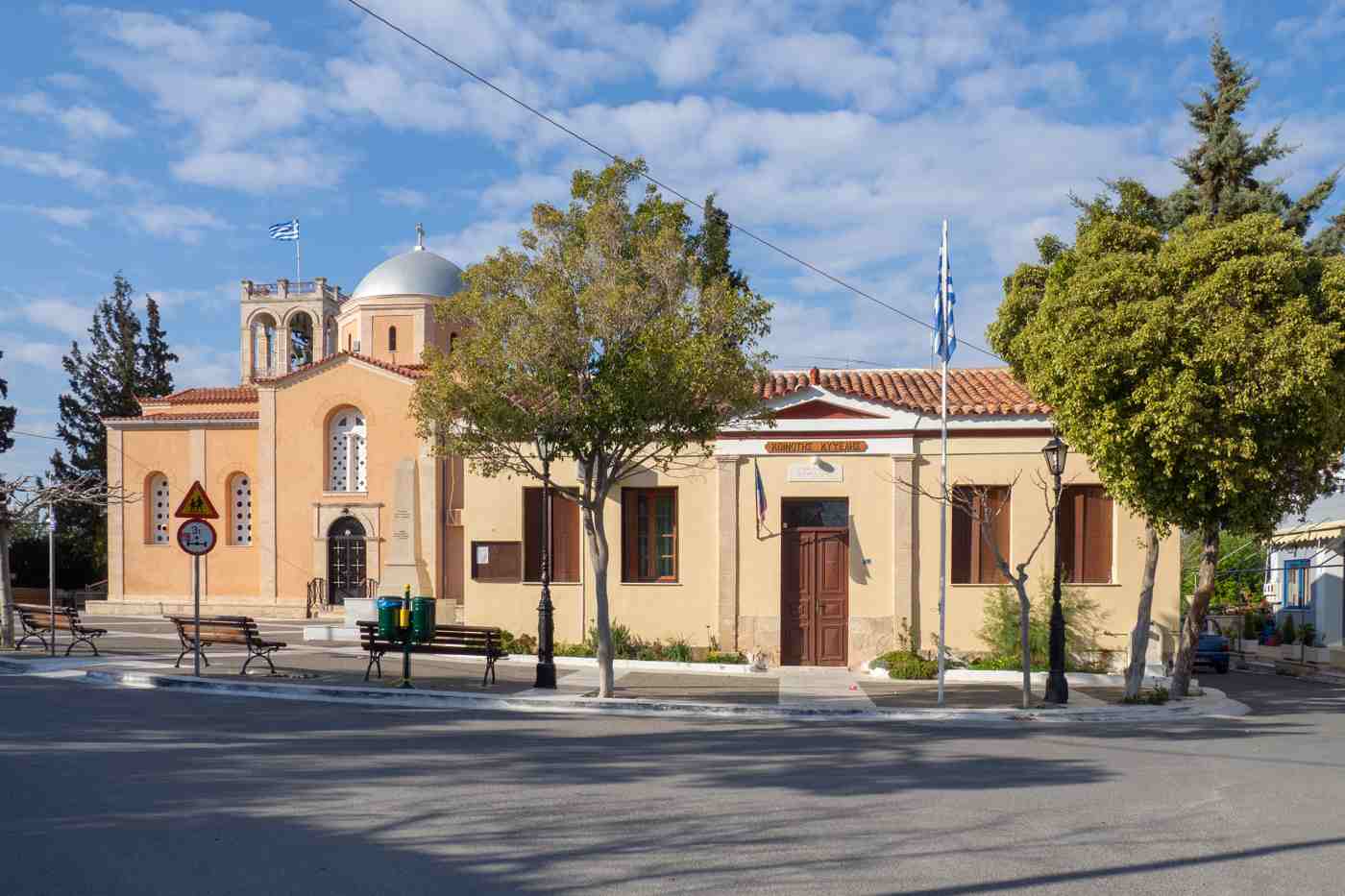
Visiting Kypseli feels quite different from the island’s beaches and resorts, offering instead the genuine atmosphere of a working Aeginean village. Its main square, with the great church of Evangelistria, the old village hall and a cultural centre. Is the heart of community life, while the surviving neoclassical houses recall its more prosperous past.
Around the village stretch fertile fields and pistachio groves, and the whole place has a settled, unhurried character rooted in farming and tradition. For travellers curious about everyday island life beyond the coast, a stroll through Kypseli, especially around its historic square, is a quiet but rewarding experience.
How do you get to Kypseli?
You reach Kypseli easily from Aegina Town, about three kilometres east, by car, scooter or local bus.
Getting to Kypseli is straightforward, as it lies only about three kilometres east of Aegina Town and is well connected by road. You can drive or take a scooter or taxi, or use the local bus that runs inland towards the north-coast villages, which passes through or near Kypseli.
Kypseli is easy to include in a day exploring that part of the island, combining a visit to the village with the coast beyond. It makes a rewarding cultural stop among the island’s many things to do.
Frequently Asked Questions
Why is Kypseli on Aegina famous for sponge diving?
Kypseli is associated with sponge diving because, in the nineteenth and early twentieth centuries, this was an important industry for the village. Its divers went out to harvest natural sponges from the sea, a demanding and often dangerous trade that was nonetheless highly profitable at the time. The wealth generated by sponge diving transformed the village. The prosperous families used their riches to build many impressive two-storey neoclassical mansions. A number of which still stand in Kypseli today and give it much of its historic, dignified character. This sponge-diving heritage is one of the things that most distinguishes Kypseli from other villages on Aegina, and it is visible in the fine old houses that line its streets.
The legacy of that prosperous era lives on in the architecture of the village, alongside its grand church of Evangelistria, making Kypseli a place where the story of the island’s more recent past is written in stone.
When is the Leidinos festival held in Kypseli?
The Leidinos festival is held in Kypseli every year on the fourteenth of September. It is one of the most distinctive folk traditions on Aegina, marking the end of the summer and its agricultural labours and the passage towards autumn and winter. As part of the custom, the women of the village make an effigy of a man stuffed with straw, which symbolises the harvest season and the summer that is drawing to a close. The event is celebrated with a great deal of music and dancing. Rooted in the farming rhythms of the island. The Leidinos festival is a colourful and lively occasion that keeps an old folk tradition alive.
It offers visitors a rare chance to witness an authentic piece of Aeginean village culture. For anyone on the island in mid-September, timing a visit to Kypseli for the festival is a notable way to experience the community spirit and traditions of rural Aegina. Quite different from the more familiar attractions of the beaches and ancient sites.
Is Kypseli worth visiting on Aegina?
Yes, Kypseli is worth visiting for travellers who want to experience a more authentic, traditional side of Aegina away from the beaches and tourist areas. As the island’s second-largest village, it has a genuine, lived-in character and a rich heritage, from its sponge-diving past and the fine neoclassical mansions that wealth built, to its long history stretching back to ancient times, evidenced by the church of Agios Nikolaos at Moulos, which stands on the ruins of an ancient theatre. Its handsome main square is dominated by the large, silver-domed church of Evangelistria, and the surrounding countryside is rich with the pistachio groves for which the island is famous.
Kypseli is also home to the unique Leidinos festival each September, one of the most distinctive folk customs on Aegina. While it is not a resort and has few conventional tourist facilities, a visit here offers a quiet, rewarding glimpse of everyday island life and tradition, making it a worthwhile cultural stop for those exploring beyond the coast, especially when combined with a trip to the nearby north-coast villages.