
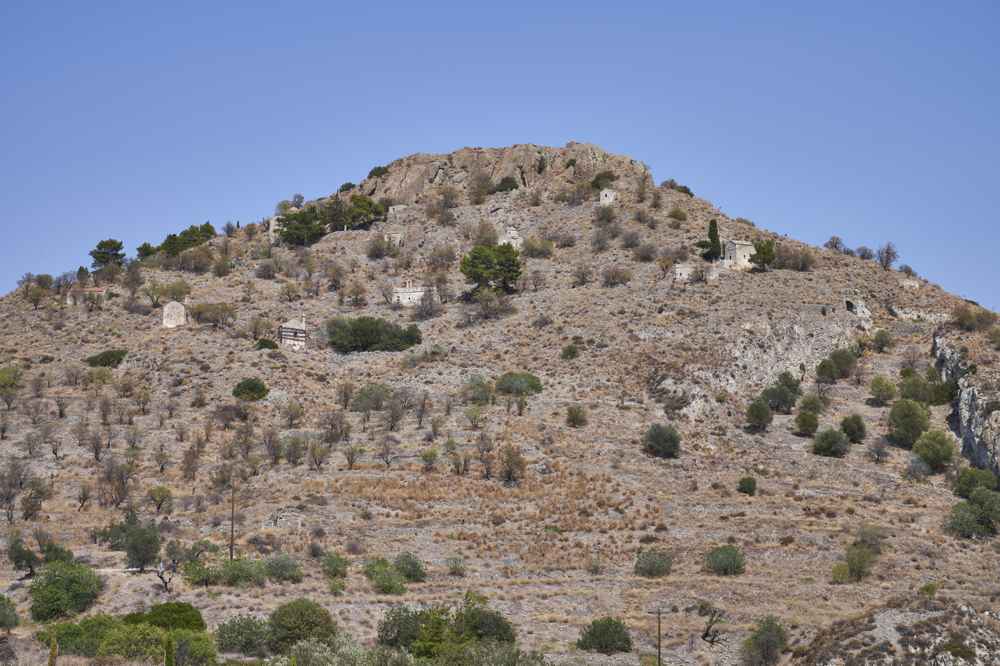
Paleochora is the abandoned medieval capital of Aegina, an atmospheric ghost town spread across a rocky hillside in the centre of the island. For around a thousand years this hidden settlement, built inland out of sight of the sea, was the heart of Aegina, a refuge from the pirates that plagued the coast. Today the houses have crumbled away. Dozens of small Byzantine churches still stand scattered over the slopes, dozens preserving old frescoes, giving Paleochora the feel of an open-air museum of medieval faith. Crowned by the ruins of a castle and set opposite the great Monastery of Agios Nektarios. It is one of the most evocative and rewarding places to visit on the whole island. Plan the whole trip with Greece Tours.
This guide covers everything about Paleochora on Aegina: what the site is, why it was built hidden inland, its remarkable churches and frescoes, the ones most worth seeking out. Its long history as the island’s capital, what it is like to explore today. Practical advice on how to visit this haunting medieval ghost town.
What is Paleochora in Aegina?
Paleochora is the abandoned medieval capital of Aegina, a ghost town on a hillside in the centre of the island.
Paleochora, whose name means old town, is the former medieval capital of Aegina, set on a rocky hill in the middle of the island. For centuries it was the island’s principal settlement, a walled town of houses, churches and a fortress. Hidden away from the coast for safety. Home to much of Aegina’s population during the dangerous medieval and later centuries.
The town lies abandoned and largely ruined, its houses reduced to scattered stones. What makes it extraordinary is that dozens of its little churches still stand across the hillside, most of them centuries old and preserving fragments of Byzantine wall painting. Walking among these silent chapels, beneath the ruined castle at the summit, is a uniquely moving experience and one of the great highlights of a visit to Aegina.
At its height Paleochora is thought to have held a population in the thousands and to have counted well over 300 churches. Today the survivors number around 35, spread across the slope. The contrast between that vanished town and the quiet ruins of the present day is what gives the site its haunting power. It explains why Paleochora ranks alongside the Temple of Aphaia and the Monastery of Agios Nektarios as one of the three unmissable historical sights of the island.
Why was Paleochora built hidden inland?
Paleochora was built inland, out of sight of the sea, to protect the islanders from the pirate raids that ravaged the Aegean coasts in the medieval period.
The reason for Paleochora’s unusual hidden position lies in the dangers of its age. Throughout the medieval and later centuries, the seas around Greece were plagued by pirates who raided coastal settlements, carrying off people and plunder. Coastal towns were terribly vulnerable, and across the Aegean islanders responded by abandoning the shore and building new capitals inland, safely out of sight of the sea.
On Aegina, this refuge became Paleochora. Established on a hill in the centre of the island where it not be seen from the coast and be more easily defended, crowned by a castle for protection. For around a thousand years the town served this purpose as the island’s stronghold and capital. Its very location a testament to the constant threat of piracy that shaped life in the Aegean for so long.
The town is generally thought to have been founded around the ninth century, in the depths of the medieval period, when raids were at their most relentless. Its hillside position, roughly 6 kilometres inland from the modern harbour and hidden behind higher ground. Meant that raiders landing on the coast find the shore settlements empty and the population safely gathered on the fortified hill above, an arrangement repeated on island after island across the Aegean during those dangerous centuries.
How churches are there at Paleochora, and what are they like?
Around thirty or more small churches survive at Paleochora, scattered across the hillside, out of the hundreds that once stood there.
The most striking feature of Paleochora is its astonishing number of churches. Although the houses of the town have vanished, roughly 35 chapels still stand across the slopes today, survivors of the more than 300 that once served the medieval community, giving the hillside the appearance of an open-air museum of Byzantine religious architecture.
Most of these churches are small, simple, single-aisled stone buildings, though there are also cross-in-square and twin churches among them. What makes certain of them truly special is the wall paintings they still contain: inside roughly a dozen of the chapels. Centuries-old frescoes survive, remarkably well preserved, depicting saints and religious scenes. These fragile, faded images are among the great treasures of Aegina and a moving link to the faith of the town’s medieval inhabitants.
The churches span the era from around the 13th to the 17th century. Their varied dates and styles record the long life of the town across the Byzantine, Venetian and Ottoman eras. Because families and monasteries each built and maintained their own chapels, the density is remarkable: at Paleochora churches outnumber almost everything else that survives. That the ruined capital is remembered today above all as a town of churches.
Which churches you see at Paleochora?
Among the churches at Paleochora, look out for the church of the Holy Cross near the entrance, the church of the Metamorphosis with its wall paintings, the church of Agios Nikolaos with its notable frescoes, and the small monastery.
With dozens of chapels dotting the hillside, it helps to know a handful of the most rewarding to seek out. Near the entrance to the site stands the church of the Holy Cross, or Stavros, one of the first that visitors encounter, while higher up the church of the Metamorphosis, the Transfiguration, preserves beautiful wall painting in its altar area.
Other notable churches include that of Agios Nikolaos, which retains remarkable frescoes dated to around 1330, and the small monastery of Agia Kyriaki with its church and monastic cells. Exploring these and the dozens of other chapels as you climb towards the castle is the essence of a visit to Paleochora, though part of its magic is simply wandering freely and coming upon one silent little church after another among the rocks and wild flowers.
A practical tip is that only a handful of the chapels are usually unlocked at any one time. You not be able to enter every one. But the finest, including the Metamorphosis and Agios Nikolaos, are among those most often open. Even from the outside, the little stone churches with their simple domes and apses are beautiful. Part of the pleasure is the treasure-hunt of climbing from one to the next. Each framed against the sea and hills beyond.
What is the history of Paleochora?
Paleochora served as the capital of Aegina for around a thousand years, from roughly the ninth century until the early nineteenth.
Paleochora’s history spans roughly a thousand years. Founded as an inland refuge during the early medieval period, it grew into the thriving capital of Aegina and remained so through centuries of Byzantine. Later Venetian and Ottoman. Rule, sharing the turbulent fortunes of the Aegean world while sheltering the island’s people from the perils of the coast.
Despite its hidden position, the town did not always escape disaster: in 1537 it was sacked by the notorious corsair Hayreddin Barbarossa. Who carried off much of the population. It suffered in other conflicts over the years. Eventually, as piracy declined and the threat receded, the islanders returned to the coast. By around 1826, when the modern harbour town was flourishing, Paleochora was left behind, gradually falling into the evocative ruins seen today. For the wider story, see our guide to Aegina’s history.
For a brief moment in the early nineteenth century, as Greece won its independence and Aegina served as the first capital of the new state. The old hillside town stood right at the edge of a new era before being finally deserted. That timing gives Paleochora a poignant place in the island’s story, as the medieval world it belonged to gave way. Almost overnight, to the modern Greek nation being born just down the road in Aegina Town.
What is it like to visit Paleochora today?
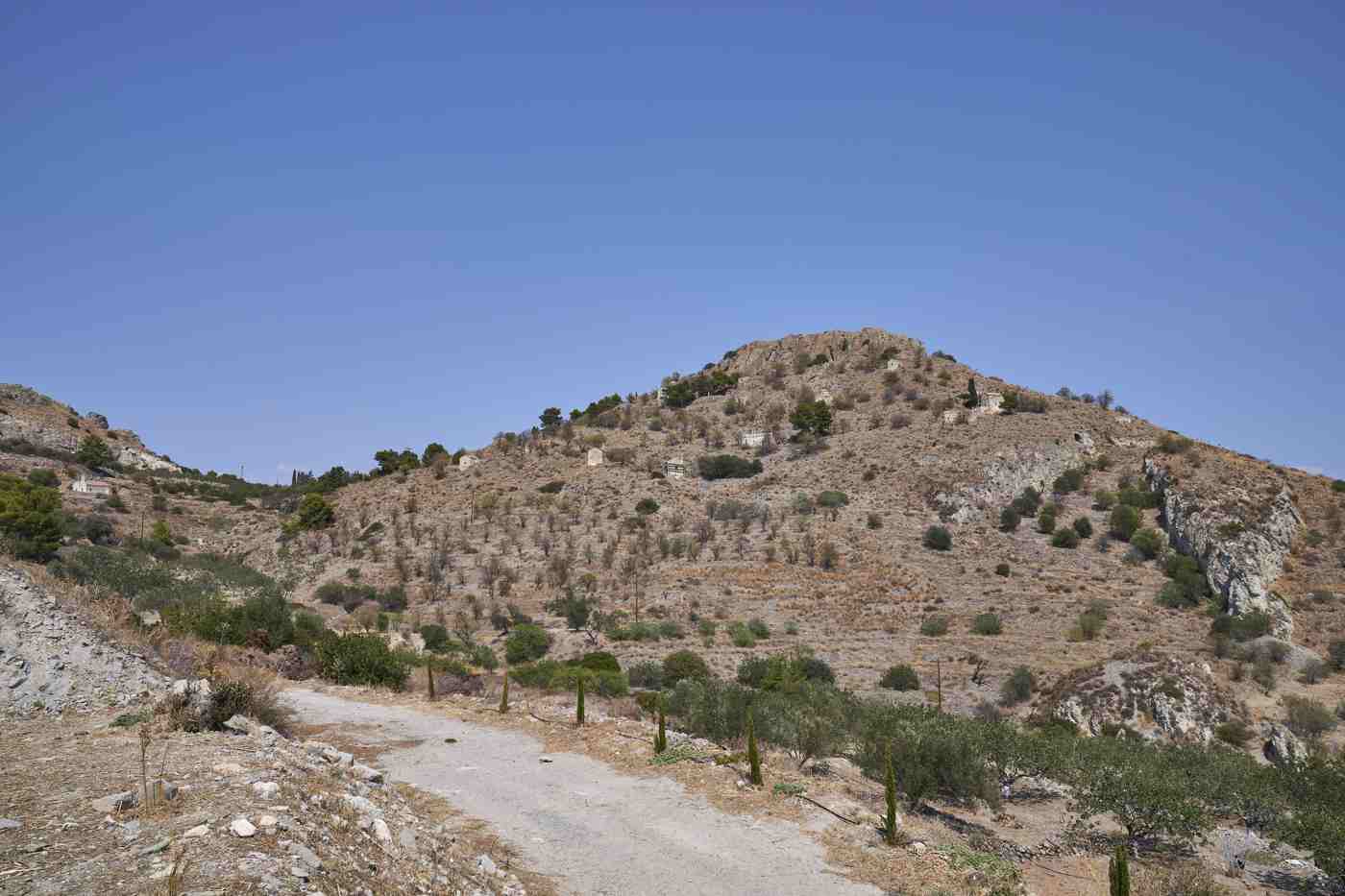
Visiting Paleochora today means walking up a peaceful hillside scattered with ruined houses and dozens of little churches, beneath the remains of a castle.
A visit to Paleochora is a gentle, contemplative experience. From the entrance, paths climb the hillside among the tumbled stones of the old houses and the scattered chapels, leading up towards the ruined castle that crowns the summit. The site is open and free to explore at your own pace. Much of its appeal lies in the quiet as you move between the silent churches. With only birdsong and the wind for company.
The setting is beautiful, with wild flowers among the ruins in spring and wide views over the surrounding countryside and hills. So rich is the concentration of Byzantine churches that Paleochora is often called the island’s own Mystras, after the famous Byzantine ghost city in the Peloponnese. Standing amid the ruins, it is easy to imagine the vanished town that once thrived here, making it one of the most memorable and reflective places on Aegina.
Allow around an hour to an hour and a half to explore properly, longer if you want to reach the castle at the very top and take in every chapel. The climb is moderate rather than strenuous, on stony paths. There is little shade, so the reward for an early start is both cooler walking and the soft morning light that brings out the colours of the old stone. Few visitors leave without a strong sense of having stepped into another age.
How do you get to Paleochora on Aegina?
Paleochora lies in the centre of Aegina, right beside the Monastery of Agios Nektarios on the road from Aegina Town towards the east of the island.
Paleochora is conveniently located in the middle of the island, directly opposite the great Monastery of Agios Nektarios, on the main road that runs from Aegina Town towards Agia Marina and the Temple of Aphaia. This makes it very easy to reach and natural to combine with a visit to the monastery, which lies just across the way. With the other sights along that route.
You can get there by local bus from Aegina Town, roughly a 15-minute ride, by taxi. Or with a rented car or scooter. From the road a short walk leads up into the site. It is best to visit in the morning, when the temperatures are cooler and the light is lovely on the old stones. To wear sturdy shoes for the stony paths and bring water and sun protection, as the hillside is exposed. With those simple preparations, exploring the ghost town of Paleochora is one of the most rewarding things to do on Aegina.
Paleochora fits neatly into a half-day that also takes in the monastery, the Temple of Aphaia and the beach at Agia Marina, all strung along the same route east of the town. Entry to the site itself is free. The only real cost is the short journey out. Which makes this remarkable medieval ghost town one of the best-value experiences on the whole island.
Frequently Asked Questions
Why was Paleochora abandoned?
Paleochora was abandoned mainly because the reason for its existence, protection from pirates, eventually disappeared. The town had been founded inland, hidden from the sea. During the medieval period precisely to shelter the people of Aegina from the pirate raids that made living on the exposed coast so dangerous. For around a thousand years it served as the island’s safe capital. By the early nineteenth century, however, piracy in the Aegean had declined and the seas had become far safer, removing the need for a hidden inland refuge. At the same time, as the modern Greek state was taking shape. The coastal harbour town of Aegina grew in importance.
It was more convenient for trade and daily life than a settlement perched on a hill in the interior. Gradually the islanders moved back down to the coast, and Paleochora was left behind, its houses falling into ruin while its churches survived. Today the abandoned town stands as an atmospheric ghost town, a haunting reminder of the centuries when fear of the sea shaped the way people lived on Aegina. The move down to the coast was gradual rather than sudden. Taking place over the early decades of the nineteenth century as security improved and the new harbour town grew. For a time the old and new towns coexisted before Paleochora was finally left empty.
Its churches were spared the fate of the houses largely because they continued to be venerated and cared for by the islanders even after the town itself was deserted. Which is why so much of its sacred heritage survives for visitors to see today.
What survives of Paleochora’s churches today?
Around thirty or more churches survive at Paleochora today, scattered across the hillside, though these are only a fraction of the hundreds that once served the medieval town in its heyday. Most of the survivors are small, simple, single-aisled stone chapels typical of the Byzantine period. There are also cross-in-square churches and twin churches among them. Certain of them dedicated to two saints. What makes certain of these chapels especially precious is the wall paintings they still contain: inside roughly a dozen of them. Centuries-old frescoes survive, depicting saints and religious scenes, remarkably well preserved despite the passage of time and the abandonment of the town.
This extraordinary concentration of churches on a single hillside is what gives Paleochora its unique character and has earned it comparison with Mystras. The famous Byzantine ghost city of the Peloponnese. For visitors, wandering among the chapels, stepping inside to glimpse a faded fresco. Climbing towards the ruined castle at the top is the essence of the experience. Offering a moving encounter with the deep religious heritage of medieval Aegina. The chapels are dedicated to a wide range of saints and feasts. A number are still used for occasional services and celebrated on their name days, so the site is not entirely frozen in the past but remains a living part of the island’s faith.
Seen together, this hillside of churches is one of the most important assemblages of small Byzantine chapels anywhere in Greece. Reason enough on its own to make the short trip out from Aegina Town.
Is Paleochora worth visiting on Aegina?
Yes, Paleochora is very much worth visiting and is one of the most memorable sights on Aegina, especially for those drawn to history, atmosphere and quiet, beautiful places. As the island’s abandoned medieval capital, it offers a hillside scattered with the ruins of an entire town and, above all, dozens of surviving Byzantine churches, dozens still preserving old frescoes, all set beneath a ruined castle with lovely views over the countryside. Its atmosphere is unlike anywhere else on the island: peaceful, contemplative and steeped in the past, so much so that it is sometimes called Aegina’s own Mystras. It is also very easy to include in a day out.
Lying right opposite the Monastery of Agios Nektarios in the centre of the island and close to the road leading to the Temple of Aphaia and Agia Marina. It combines naturally with the other main sights. The site is open and free to wander at your own pace. For its haunting beauty, its remarkable churches and its deep sense of history. A visit to Paleochora is a highlight of Aegina that rewards anyone willing to make the short climb. It appeals especially to those who love history. Byzantine art and photography. Even visitors with no particular interest in ruins are moved by the sheer atmosphere of the place and the beauty of its setting.
Arrive early, wear comfortable shoes, and give yourself time to wander, and Paleochora will likely prove one of the most memorable and atmospheric parts of your whole trip to the island. And a quiet, beautiful place that lingers in the mind long after you have left the island of Aegina and finally returned back home from your trip.