
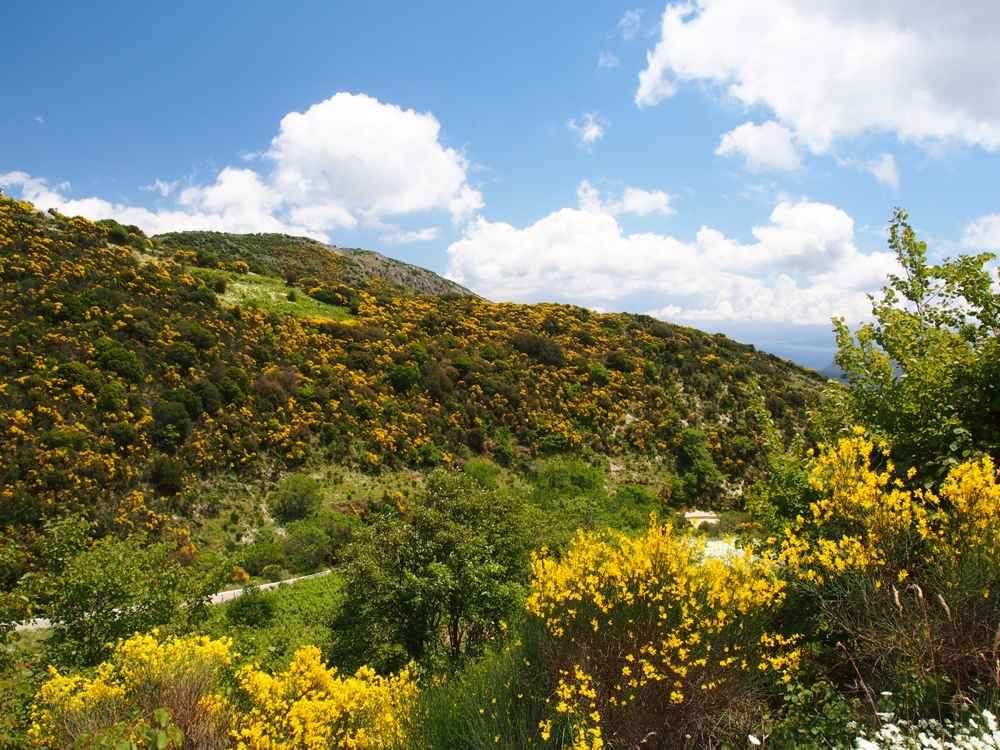
Englouvi is the highest village on Lefkada, set at around 730 metres in the mountains of the island’s interior. It is also one of the oldest settlements on the island, and its name reflects its position, hemmed in by the surrounding peaks. The village is best known across Greece for its lentils, the small faki of Englouvi grown for centuries on the upland plateau above it. Its stone houses, cool alpine air and quiet walking paths make it a marked change from the busy coast. The nearby village of Karya lies within easy reach of it. Plan the whole trip with Greece Tours.
Reaching Englouvi means a winding drive up from the coast, but the road is paved and the climb rewards visitors with wide views over the island. The village keeps its traditional look of two-storey stone houses with wooden ceilings, and old threshing circles and windmills stand on the ridges around it. Each summer it holds a lentil festival by the chapel of Agios Donatos, where the faki is cooked in great cauldrons and shared freely. This guide covers the village, its lentils, the festival and how to reach the mountain interior.
Where is Englouvi in Lefkada and how high is it?
Englouvi is the highest village on Lefkada, standing at around 730 metres in the mountainous interior. It is also one of the oldest settlements on the island.
Englouvi sits high in the central mountains of Lefkada, well away from the beaches that draw most summer visitors. At around 730 metres it is the highest village on the island, and one of the oldest, with a history reaching back centuries. Its name is thought to describe its very position, a settlement hemmed in by the surrounding peaks that rise on almost every side. The approach road climbs steadily from the coast in a series of bends, and the temperature drops noticeably as it gains height. From the village edge the land opens onto a broad upland plateau.
The setting explains the village’s character. Because it lies so far above the sea, Englouvi has always looked inward to farming rather than out to fishing or trade. The plateau around it has been worked by hand for generations. The high ground kept the community somewhat isolated, which helped preserve both its old buildings and its farming traditions. Views from the ridges take in long stretches of the interior, and on clear days the eye can follow the ranges that run the length of Lefkada. The air stays cool even when the coast below bakes in high summer heat.
For travellers planning things to do in Lefkada, Englouvi offers a very different experience from the resorts and the famous west-coast beaches. It is a place to walk quiet lanes, to taste a food that carries the name of the village, and to feel the cooler mountain climate. The drive up can be combined with other interior villages, and the whole route through the hills makes an easy half-day from the coast. Visitors who come mainly for the sea often add the mountains as a change of pace. The village rewards a slow, unhurried visit rather than a quick stop.
What makes the Englouvi lentils so famous?
Englouvi lentils are a small local landrace grown for centuries on the high plateau above the village. They are prized as the finest in Greece and are genetically distinct from commercial varieties.
The lentils of Englouvi, known locally as faki, are the reason the village is famous well beyond Lefkada. They are a landrace, an old local variety shaped over centuries by the specific soil and climate of the plateau rather than by modern breeding. The plants grow on the isolated upland between roughly 700 and 960 metres, where the thin mountain soil and cool air suit them. Genetic study has shown that they are distinct from the common commercial lentils sold elsewhere. That distinctness, together with their taste and texture, is what earns them their high reputation among cooks. Farmers still treat the crop with real care each season.
What sets the crop apart is the way it is grown, using methods that have changed little over generations. The lentils are cultivated without irrigation, relying only on the rain and the moisture held in the high ground. Farmers add no chemical fertiliser and no pesticide, so the plants depend entirely on the natural soil of the plateau. Yields from this hard, dry farming are small, and the work of sowing, tending and harvesting is largely done by hand. That low output is part of the reason the lentils are scarce and highly valued. Each harvest is gathered with patience.
The faki of Englouvi is cooked simply, in the plain island style that lets the flavour of the lentil come through. Many Lefkada restaurants serve a lentil soup or stew when the local crop is available, often dressed with good olive oil, and the dish appears at village tables across the interior. Because supply is limited, the genuine Englouvi lentils can be hard to find outside the island, and buying them near the source is the surest way. Cooks value them for holding their shape and for a soft, earthy taste. The village name has become a mark of quality in itself.
When is the Englouvi lentil festival held?
Englouvi holds its lentil festival each summer on the feast day in early August, by the chapel of Agios Donatos. The faki is cooked in great cauldrons and given free to visitors.
The high point of the village calendar is the lentil festival, held each summer on the feast day in early August. It takes place by the chapel of Agios Donatos, the small church that gives the celebration its date and its focus. Villagers cook large quantities of the local faki in great cauldrons over open fires, stirring the pots through the day. The cooked lentils are then given free to everyone who comes, served alongside sardines, olives and wine. Music, dancing and the gathering of families and returning islanders turn the day into one of the busiest of the year. Visitors are welcome to join.
The festival grew from the village’s long link to its most valued crop and to the church that marks the season. Cooking the faki in bulk and sharing it freely is a gesture of hospitality that also shows off the quality of the local harvest. For families with roots in Englouvi, the early August feast is the main reason to return each summer, and the population of the village swells for the day. The event has helped keep the reputation of the lentils alive, drawing visitors from across Lefkada and beyond. It ties the food, the faith and the community into a single celebration.
Anyone hoping to attend does well to plan around the early August date, as it is fixed to the feast of the saint rather than to a set weekend. The mountain road up to Englouvi grows busy on the day, so an early arrival helps with both parking and the cooler morning air. Beyond the food, the festival is a chance to see the village at its most lively, with stone lanes full of people and long tables set out in the open. The free faki, the sardines and the wine are offered in the same spirit each year. It remains a genuinely local occasion.
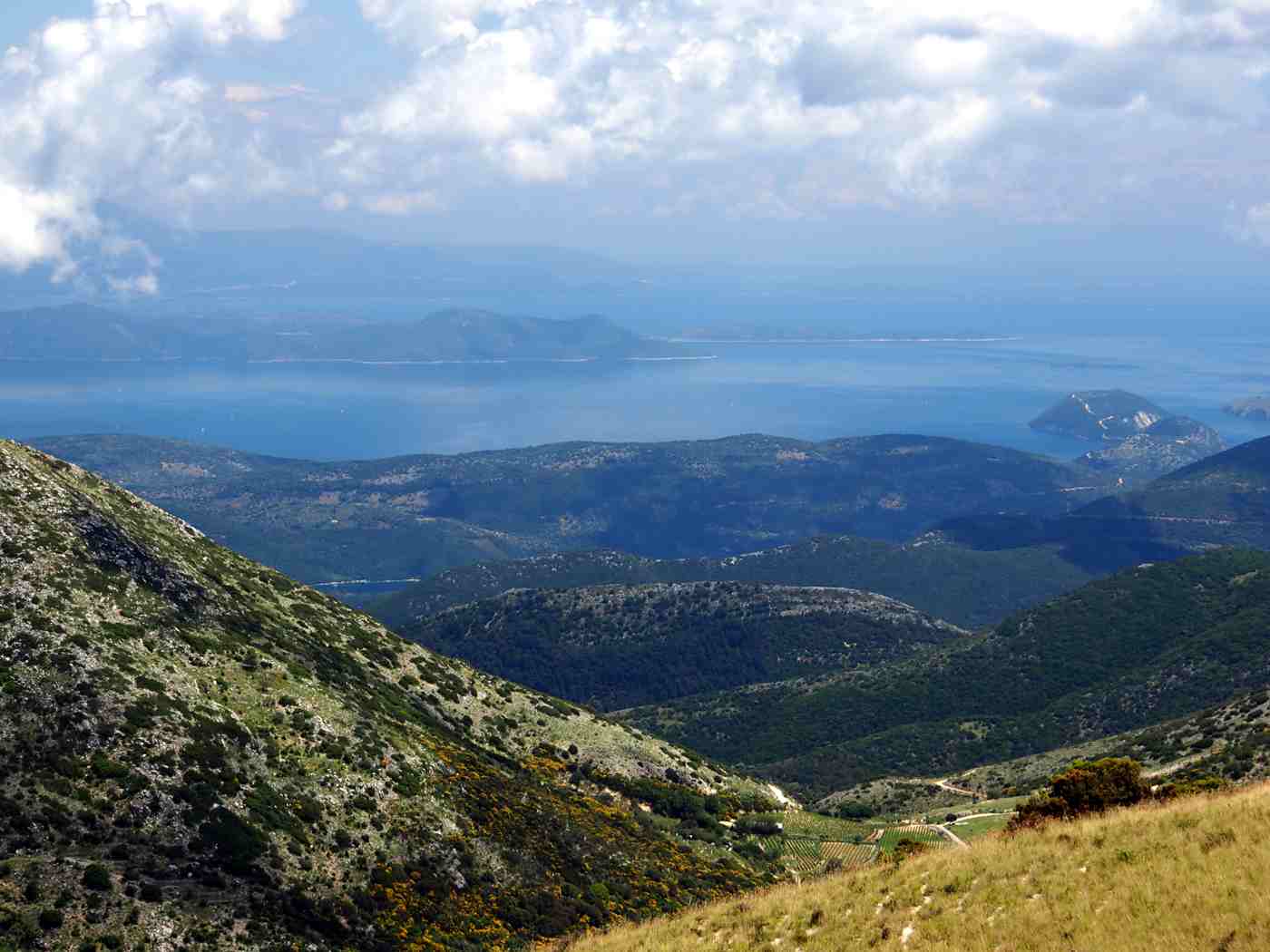
What does the village of Englouvi look like?
Englouvi keeps its traditional look of two-storey stone houses with wooden ceilings and courtyards full of fruit trees. Old stone threshing circles and windmills stand on the ridges around it.
Englouvi has kept its old character, unlike the coastal settlements reshaped by tourism. The houses are typically two storeys, built of local stone with wooden ceilings, and most have courtyards planted with fruit trees that give shade and colour through the year. Narrow lanes wind between the buildings, following the slope of the ground rather than any grid. Because the village stayed isolated for so long, this traditional form survived largely intact. Small churches and old fountains mark the corners of the settlement. Walking through it gives a clear sense of how an upland Lefkada village looked in earlier times.
On the ridges and open ground around the village stand reminders of its farming past. Old stone threshing circles, the flat paved rings where grain and pulses were once separated from their chaff, can still be seen on the higher ground. Nearby rise the stumps and shells of old windmills, built to catch the steady mountain wind and grind the harvest. These structures speak to a time when the community fed itself from the plateau and the surrounding slopes. Though no longer in use, a number remain as landmarks along the walking paths. They add to the strong sense of history that hangs over the whole village.
The stone architecture suits both the climate and the materials at hand on the mountain. Thick walls keep the interiors cool through the summer heat and hold warmth on cold winter nights at this height. Wooden ceilings and simple balconies are common features, and the fruit-tree courtyards gave each household its own small harvest of figs, walnuts and other produce. Houses have passed down through the same families for generations, and open only in summer when relatives return. The overall effect is a village that reads as a whole, with almost no modern intrusions. It repays a slow walk with camera in hand.
What is there to do around Englouvi in the mountains?
Englouvi offers cool alpine air, wide mountain views and walking paths through the surrounding hills. The high setting is a welcome relief from the coastal heat in high summer.
The greatest draw of Englouvi in high summer is simply its climate. At around 730 metres the air stays cool and fresh even when the beaches below swelter, and evenings on the mountain can feel genuinely crisp. This alpine quality makes the village a natural escape from the crowded coast during the hottest weeks. Sitting in the shade of a courtyard tree or walking the lanes in the late afternoon is a very different pleasure from the busy shore. Visitors climb up mainly to breathe the cleaner, cooler air. The change in temperature between coast and village is often striking.
Walking paths run out from the village into the surrounding hills, following old routes once used by farmers and herders. Tracks lead across the lentil plateau, others climb to the ridges with their threshing circles and windmills, and paths connect Englouvi to neighbouring villages of the interior. The going is generally over open, stony ground, with wide views opening at every rise. Early morning and late afternoon are the best times to set out, when the light is soft and the heat has eased. Sturdy footwear and water are sensible for the rougher stretches. The routes suit walkers who enjoy quiet, unmarked country.
Beyond walking, the appeal of the setting lies in its stillness and its long views over the heart of Lefkada. From the higher ground the land falls away toward the coast, and the ranges of the interior stand out clearly in the dry summer light. The plateau itself, green in spring and pale gold by late summer, forms the foreground to the scene. Birds of prey are often seen circling the ridges on the mountain air. For photographers and for anyone who values quiet, the hills around Englouvi reward time spent slowly. The place rewards patience more than a rushed visit.
Can Englouvi be combined with Karya and the interior?
Englouvi pairs naturally with Karya, which lies close by, and with the other mountain villages of the Lefkada interior. Together they make an easy driving route away from the coast.
Englouvi sits close to Karya, the largest of the mountain villages and a well-known centre of the island’s interior. The two are easily linked on a single outing, and visitors pair the lentil village with the traditions and shaded square of its larger neighbour. Karya is famous for its needlework and its lively main square, and it makes a natural base for exploring the uplands. From there the road threads on to other small settlements scattered across the hills. Together the interior villages offer a slower, more traditional side of Lefkada than the resorts. The whole loop can fill a relaxed day.
A common way to see this part of the island is to make a circular drive through the interior. Starting from the coast, a route can climb first to Karya, then continue up to Englouvi for the lentils and the views, before dropping back down by another road. Along the way lie old churches, olive groves and stretches of forest that break up the open mountain ground. The distances between villages are short, though the winding roads keep speeds low. Stopping for a meal in one of the mountain settlements is an easy addition to the day. Such loops show the quieter interior at its best.
Combining Englouvi with the interior also makes practical sense for a full day out. The cool upland air suits the middle of the day, when the coast is at its hottest, so the mountains work well as a midday escape. A morning on a beach, a drive up through Karya and Englouvi in the afternoon, and a return for the evening is a common pattern. The villages each add something different, from crafts to food to views, without long travel between them. For those staying on Lefkada for days, the interior deserves at least one full outing. It balances the beaches with real depth.
How do you reach Englouvi in Lefkada by car?
Englouvi is reached by car on a paved mountain road that climbs from the coast into the interior. The drive from Lefkada Town takes roughly half an hour to forty minutes.
The practical way to reach Englouvi is by car, as public transport into the high interior is limited. From Lefkada Town the road runs down the island and then climbs steadily into the mountains toward Karya and beyond. The route is paved throughout, though it narrows and twists as it gains height, so the drive calls for care rather than speed. The journey from the main town takes roughly half an hour to forty minutes, depending on stops and traffic. Signs point the way to the mountain villages at the main junctions. The climb itself is part of the experience, with views opening steadily.
Driving is straightforward for anyone used to mountain roads, but points help. The bends are frequent and stretches are narrow, so a slow, steady pace is wise, especially where the road hugs the slope. Parking in Englouvi is found at the edges of the village, since the inner lanes are narrow and best explored on foot. A hire car gives the freedom to combine the village with Karya and other interior stops on the same trip. Fuel is easier to find on the coast than in the mountains, so filling up before the climb is sensible. The road is generally quiet outside the festival.
The higher altitude and the winding approach mean the weather can differ from the coast, so it is worth checking conditions before setting out. In spring and autumn the mountain can be cooler and cloudier than the shore, while high summer brings clear, warm days and that welcome drop in temperature at the village. Winter visits are quieter still, with houses closed, though the drive remains open in normal weather. For most travellers the trip fits neatly into a day exploring the interior of Lefkada. A full tank, sturdy shoes and an early start make the mountain outing an easy one.
Frequently Asked Questions
Are the Englouvi lentils sold to buy?
Englouvi lentils are grown in small quantities on the upland plateau above the village, and because the harvest is limited they can be hard to find away from the island. The genuine local faki is a landrace, distinct from ordinary commercial lentils. It is most reliably bought at or near the source. Whether in the village itself or from producers in the surrounding interior. Demand often outstrips the modest supply, so the true Englouvi crop tends to be scarcer and more valued than mass-produced lentils. Buying near the source is the surest way to be certain of the origin.
Visitors buy them when they drive up to the village, treating a bag of the lentils as a practical souvenir of the mountain and its farming tradition.
Is Englouvi worth visiting outside the festival?
Englouvi rewards a visit at any time of year, not only during the early August lentil festival. The village keeps its traditional stone houses, its fruit-tree courtyards and the old threshing circles and windmills on the ridges throughout the seasons. These hold their interest whenever visitors come. In high summer the cool alpine air is the main draw, offering a genuine relief from the heat of the coast, while spring brings green slopes and autumn a quieter, softer light. Walking paths run out into the surrounding hills all year, and the long views over the interior of Lefkada are always present.
Away from the festival the village is calmer, making it easier to wander the lanes and take in the setting. For travellers, that quiet is part of the appeal of the place.
How long does a visit to Englouvi need?
Englouvi fits comfortably into a half-day trip from the coast, either on its own or combined with Karya and the wider interior. The village itself is small, so an hour or two is enough to walk its stone lanes. See the courtyards and reach the threshing circles and windmills on the higher ground. Adding one of the walking paths, a stop for a meal in a nearby village and the drive itself easily fills a relaxed half-day. During the early August festival visitors often stay longer, as the cooking, eating and celebrations run through the day and into the evening. Those keen on the mountains can extend the outing into a full day by linking the interior villages.
The winding drive up and back is best taken at an unhurried pace.