
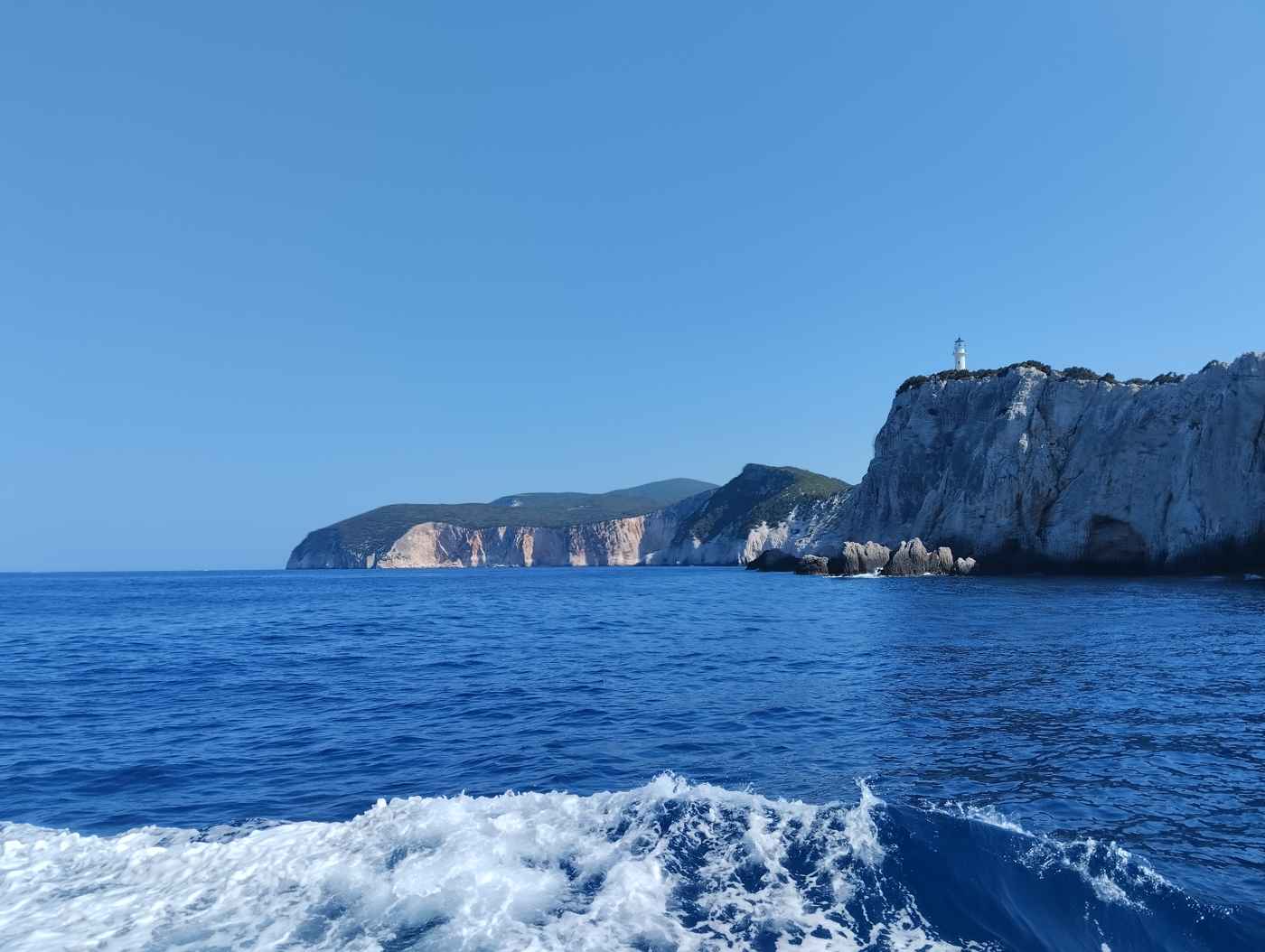
Cape Lefkatas is the southernmost point of Lefkada, a long, narrow rocky promontory of high white cliffs that ends at a lighthouse above the open Ionian Sea. The headland sits about 50 km from Lefkada Town and roughly 8 km beyond the village of Athani on the island’s southwest tip. It is also called Cape Doukato, and its sheer white walls drop straight into deep water. These pale rocks are the very feature that gave the island its name, since the Greek word for white is the root of Lefkada. The cape combines dramatic geography with layers of ancient myth and history. Plan the whole trip with Greece Tours.
The place is best known for the legend of Sappho’s Leap, the story that the lyric poet threw herself from these cliffs over an unrequited love. Long before that tale, the cape held a shrine to Apollo Lefkatas, god of light, where a notorious ritual leap is said to have been performed. Today the tip is quiet and exposed, reached by a rough road that runs down from Athani to a small car park a couple of hundred metres from the lighthouse. The same road passes Porto Katsiki and Egremni, two of the finest beaches on the island. Sunsets here rank among the best in Lefkada.
What is Cape Lefkatas in Lefkada and where is it?
Cape Lefkatas is the southernmost point of Lefkada, a narrow rocky promontory of white cliffs ending at a lighthouse. It lies about 50 km from Lefkada Town.
Cape Lefkatas, also known as Cape Doukato, forms the southern extremity of Lefkada in the Ionian Sea. The headland reaches out as a long, narrow spur of rock, and its western and southern faces fall away as high vertical cliffs of pale limestone. At the very tip stands a lighthouse that looks out over open water toward the neighbouring islands. The cape marks the point where the island’s rugged west coast finally runs out, and it is one of the most geographically distinct features of the whole island. Deep water surrounds the promontory on three sides, so the sense of arriving at the island’s edge is unusually strong here.
The distances involved help to place the cape on the map. It sits roughly 50 km south of Lefkada Town, the island’s capital at the northern end, and the journey covers most of the island’s length. From the small clifftop village of Athani, the last stretch runs about 8 km further south and west to reach the point itself. The road threads through the mountainous southwest of the island, where the landscape grows drier and more open with each kilometre. There are no settlements beyond Athani, so this corner of Lefkada feels genuinely remote compared with the busy resorts strung along the east coast.
The white rock is not just a visual detail; it is the source of the island’s name. Ancient sailors and later inhabitants recognised the pale cliffs of the cape from far out at sea, and the Greek word for white gave the island the name Lefkada. The cape therefore carries a special weight in the island’s identity, standing as the natural landmark from which the whole island takes its title. Few coastal features anywhere are so directly tied to the naming of the land behind them. That link gives the southern headland a symbolic role well beyond its modest size and its remote, wind-scoured position.
The setting is elemental rather than developed. There are no resorts, tavernas or crowds at the tip, only the rock, the wind and the sea stretching away to the horizon. Visitors reach a small car park and then walk the final short distance to the lighthouse across open, uneven ground. The combination of height, isolation and wide sea views gives the cape a stark and memorable character that stays with people. It is a place of geography and legend rather than facilities, and that plainness is a large part of its appeal for travellers exploring things to do in Lefkada and seeking the island’s wilder edges.
Why are the white cliffs of Cape Lefkatas so important?
The white cliffs give the island its name, since the Greek word for white is the root of Lefkada. They are high, vertical and drop straight into deep Ionian water.
The cliffs at Cape Lefkatas are the defining natural feature of the headland. They rise as sheer walls of pale limestone, worn smooth in places and broken into ledges in others, falling almost vertically to the sea below. Seen from a passing boat, the whiteness of the rock is striking against the deep blue of the Ionian. It marks the southern end of the island from a great distance. This is the landscape that ancient mariners knew as they rounded the point. The same brilliant colour still identifies the cape today for anyone approaching Lefkada by water from the south.
The link between the rock and the island’s name is direct and unusual. The Greek word for white forms the root of Lefkada, so the island is, in effect, named after the colour of these very cliffs at its southern tip. That etymology ties the whole island to its cape in a way that places can match. When travellers stand at the point and look along the pale walls, they are looking at the exact feature that generations of Greeks used to recognise and name the land, a rare case of a whole island taking its title from one headland.
The height and steepness of the cliffs also explain much of the cape’s legend and history. A wall of white rock plunging into deep water is a natural stage for stories of leaps and rituals, and the ancients clearly read it that way. The same verticality means the tip is not a place for casual scrambling near the edge, where the drop is severe and the footing uncertain. The ground is uneven, and strong winds are common at this exposed point, so real caution close to the cliff edge is sensible for anyone who walks out to admire the view.
Geologically the cape belongs to the limestone spine that runs down the western side of Lefkada. The rock here is hard and pale, and centuries of wind and salt spray have kept the exposed faces bright rather than weathered to grey. Below the cliffs the water is deep and clear, part of the open channel that separates Lefkada from Kefalonia and Ithaca to the south. The whiteness that named the island is therefore not a trick of the light but a genuine property of the stone that forms this dramatic southern headland. It endures season after season against the constant work of the sea.
What is the Doukato lighthouse at the tip of the cape?
The Doukato lighthouse stands at the end of Cape Lefkatas with a focal height of about sixty metres above the sea. It has guided ships since the late nineteenth century.
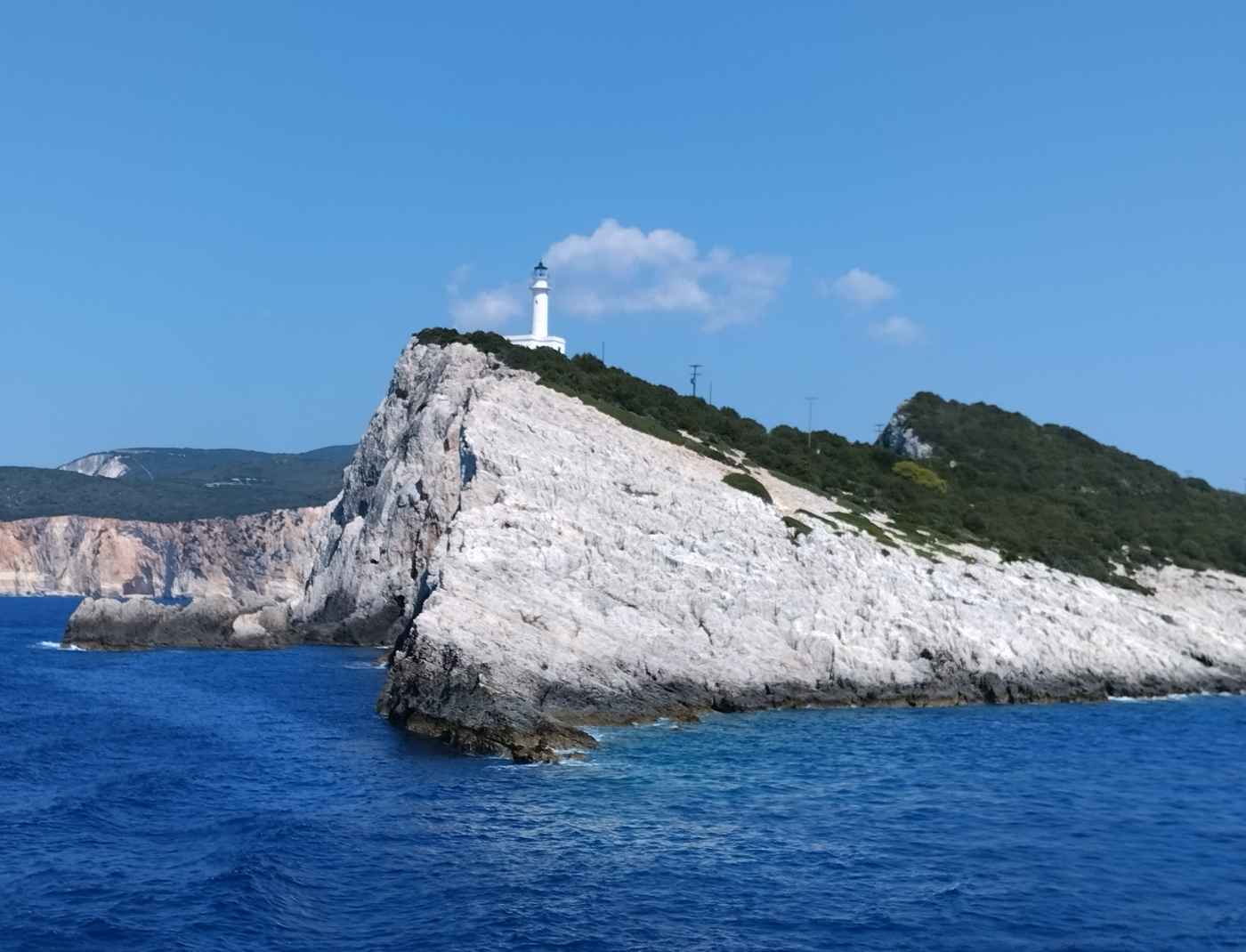
The lighthouse is the built landmark of Cape Lefkatas and gives the headland its alternative name of Cape Doukato. It sits at the very end of the promontory, a solid structure set back a little from the cliff edge on the highest ground. Its focal plane stands about sixty metres above the sea, so its light carries far across the open water toward the shipping lanes. For vessels passing between Lefkada and the islands to the south. It has long marked the southern corner of the island and the entrance to a busy stretch of the Ionian, a reference point in poor weather and after dark.
The lighthouse dates from the late nineteenth century, part of the wider network of lights built to guide shipping through Greek waters. Its position at the southern tip of Lefkada made it a natural point for such a beacon, since vessels rounding the cape needed a clear mark in poor visibility and heavy weather. Over the following decades it continued in service, weathering the strong winds and salt air of this exposed headland year after year. It remains the most prominent human structure at the cape and the natural focus of any visit to the tip, standing where the land finally gives way to open sea.
From the ground beside the lighthouse the views open out in every seaward direction. To the south and west lie Ithaca and Kefalonia, their long outlines rising across the channel, while beyond them stretches the open Ionian toward the horizon. The elevated position and the lack of any obstruction make the outlook exceptionally wide, taking in a great sweep of sea and neighbouring coastline. On clear days the islands stand out sharply against the water. The sense of standing at the very edge of Lefkada. With the sea falling away on three sides, is very strong at this southern point.
The lighthouse also anchors the cape’s reputation for sunsets. Facing west and south with an unbroken sea horizon, the tip catches the last light of the day directly and without interruption. As the sun sinks toward Kefalonia the sky and the pale cliffs take on warm colour, and the scene is often cited as among the finest on the island. Many visitors deliberately time their arrival for the late afternoon so they can watch the sun go down from beside the lighthouse. The drive back to Athani then follows in fading light, so it is worth planning the return before setting out.
What was the ancient temple of Apollo at Cape Lefkatas?
The cape held a shrine to Apollo Lefkatas, god of light, in antiquity. Ceremonies took place there, including a notorious ritual leap said to have been performed from the cliffs.
In antiquity Cape Lefkatas was a sacred place, home to a shrine dedicated to Apollo Lefkatas. Apollo was worshipped here as a god of light, a fitting association for a bright white headland facing the sunset over the open sea. The sanctuary drew worshippers and gave the cape a religious importance that reached well beyond the island itself. Ancient writers mention the site in their accounts. Its name became attached to the god in the epithet Lefkatas. Tying Apollo closely to this particular stretch of Ionian coast and marking the southern tip of Lefkada as a point of worship as much as a landmark.
The most striking rite connected with the sanctuary was a ritual leap from the cliffs. According to ancient sources, condemned people and scapegoats were sometimes made to jump from the high rocks into the sea far below. The act carried a purifying, expiatory meaning, as if the community’s misfortune be cast off the edge together with the person who leapt. Such a rite fits the dramatic setting closely, where the white cliffs drop straight into deep water and the fall itself becomes part of the ceremony. The cape thus served not only as a place of prayer but as a stage for a fearsome public ritual.
The leap was reputedly made survivable, at least in intention. Accounts describe birds and feathers being tied to those who jumped, so that their fall be slowed and partly broken before they reached the water. Boats were said to wait below to pick up any survivors and carry them clear. Whether these details are literal history or later elaboration is hard to know for certain. They show how strongly the idea of the leap was fixed to the cape in the ancient imagination. That reputation, half sacred and half terrifying, helped make Cape Lefkatas one of the most storied headlands in the Ionian.
Little of the sanctuary survives to be seen clearly today, and visitors come mainly for the geography and the legends rather than standing ruins. The importance of the temple lies in what it explains: why this remote headland gathered so stories. How the ritual leap prepared the ground for the later legend of Sappho. The cape’s sacred past turned a natural feature into a stage for myth, layering meaning onto the white cliffs. That inheritance is a large part of what still draws travellers to the southern tip of the island. Where the setting seems to invite exactly the kind of tale the ancients told about it.
What is the legend of Sappho’s Leap at Cape Lefkatas in Lefkada?
Sappho, the lyric poet of Lesbos, is said to have thrown herself from these cliffs over an unrequited love for Phaon. The cape became linked with a leap to cure hopeless love.
The legend that made Cape Lefkatas famous concerns Sappho, the celebrated lyric poet of the island of Lesbos. According to the story, she came to the southern tip of Lefkada and threw herself from the white cliffs into the sea below. The tale gave the headland its enduring nickname of Sappho’s Leap and drew the poet’s name into the long history of the cape. It is repeated in ancient and later literature across the centuries. It remains the single association most visitors carry with them to the site. Colouring the way they see the pale rock and the deep water at the tip.
The cause, as the legend tells it, was love. Sappho is said to have fallen hopelessly for a ferryman named Phaon, whose feelings were not returned. In despair at her unrequited passion, she is reputed to have sought out these very cliffs as a way to end her suffering. Whether any part of the story is historical is deeply uncertain, and scholars treat it as a later invention rather than fact, a tale grafted onto a real poet. Even so, the pairing of the poet, the ferryman and the fatal leap became one of the best-known love stories of the ancient world and clings to the cape still.
The leap also acquired a wider meaning as a supposed cure for hopeless love. Ancient tradition held that a jump from the cliffs of Cape Lefkatas, if survived, free a person from the torment of an unreturned passion. This idea grew naturally out of the earlier ritual leap connected with Apollo, blending religious purification with the pangs of the heart into a single act. The cape thus became, in legend, a place where the desperate gamble everything against the sea in the hope of emerging cured and free. The story and the setting reinforced each other, each making the other more memorable to those who heard it.
For modern visitors the value of the legend lies in atmosphere rather than proof. Standing at the windy tip, looking down the pale cliffs to the deep water, it is easy to see why the ancients chose to set such a story here. The setting supplies everything the tale needs: great height, deep isolation and a sheer drop into the unknown. The legend of Sappho’s Leap gives the cape a human and poetic dimension that its bare geography alone not provide, connecting the rock to one of antiquity’s great voices. It remains a defining part of any account of the southern point of the island and its long history.
How do you reach Cape Lefkatas from Athani?
Reaching Cape Lefkatas means driving from Athani down a rough road for about 8 km to a small car park roughly two hundred metres from the lighthouse. The tip is windy and exposed.
The approach to Cape Lefkatas runs through the village of Athani, the last settlement of any size in the mountainous southwest of the island. From Athani the road continues south and west toward the tip, covering roughly 8 km of increasingly remote and empty country. The surface deteriorates along the way, and the final section is a rough, unsurfaced track that demands careful, slow driving throughout. There are no other villages beyond Athani. Travellers be prepared for a bare. Exposed landscape with no facilities as they near the southern point of Lefkada and the ground opens out toward the sea.
At the end of the drive lies a small car park set a little back from the lighthouse. From there a short walk of a couple of hundred metres leads out to the tip, across open and uneven ground with no shade. The final approach is entirely on foot, and there is no shelter along the way from sun or wind. The car park is modest in size and can fill on a fine afternoon, particularly around sunset when visitors arrive within a short window. Beyond it the headland narrows to the promontory that carries the lighthouse at its outermost end above the cliffs.
Conditions at the tip are frequently windy, and this is the most important thing to plan for. The cape juts far out into the open Ionian, so it catches wind from directions with little around it to break the force. Loose clothing, hats and light items can easily be snatched away, and the exposed ground near the cliff edge calls for real caution at all times. Sturdy footwear helps on the rough track and the stony walk out to the lighthouse. It is wise to allow extra time for the slow final drive rather than rushing the last stretch.
The rewards for the effort are the views, the sunset and the sense of standing at the island’s very edge. Because the road is rough and the site remote, the cape never feels as crowded as the beaches nearby. There is space and quiet to take in the scene at leisure. Many travellers combine the trip with a stop in Athani itself, where the village serves as a natural base before the descent toward the tip. From the cape the return to Lefkada Town is a long drive, so planning the timing of a sunset visit carefully matters a great deal for a comfortable journey back.
How can you combine Cape Lefkatas with the west-coast beaches?
The road from Athani to Cape Lefkatas also serves the west-coast beaches of Porto Katsiki and Egremni. Visitors commonly pair the cape with a beach stop on the same drive.
Cape Lefkatas sits at the end of the same road system that reaches the island’s celebrated west-coast beaches, which makes combining them straightforward. Porto Katsiki, one of the most photographed beaches in Greece, lies along this southwestern stretch, backed by tall white cliffs of the same kind that form the cape. A visit that pairs the beach with the lighthouse turns a long drive out from Athani into a full and rewarding day. The shared geography of pale cliffs and deep blue water ties the two places together naturally. Travellers move from swimming below the rock to standing on top of it at the tip.
Egremni beach is the other great draw on this coast, a long strip of pale sand and shingle set below high cliffs. Reaching the sand involves a descent, and access arrangements have changed over the years, so travellers check current conditions before setting out for it. Together with the cape, Egremni beach and Porto Katsiki form a trio of dramatic destinations clustered around Athani in the island’s southwest. Many visitors devote a whole day to the area. Swimming at one of the beaches in the heat of midday and saving the exposed cape for the cooler late afternoon and the sunset that follows.
The village of Athani works well as the hinge for such a day out. Sitting above the coast, it gives travellers a point to pause. Take on supplies and orient themselves before the descents to the beaches or the run out to the lighthouse at the cape. From Athani the roads branch toward Porto Katsiki, toward Egremni beach and on to Cape Lefkatas at the southern tip. Building the day around the village keeps the driving manageable on rough roads and avoids repeated long returns toward Lefkada Town between each separate stop. Which saves both time and effort.
The wider southwest corner also connects to Vasiliki, the sailing and windsurfing bay at the foot of the island, which lies to the east of this beach coast. A loop that takes in Vasiliki, the west-coast beaches and Cape Lefkatas covers the most dramatic scenery on the island within a single circuit. For anyone weighing up things to do in Lefkada, the run out to the cape and its neighbouring beaches ranks among the most memorable drives on the island. It combines ancient myth, sheer white cliffs and some of the best swimming and sunsets that Lefkada has to offer along its rugged western edge.
Frequently Asked Questions
Is Cape Lefkatas the same as Cape Doukato?
Cape Lefkatas and Cape Doukato are two names for the same headland at the southern tip of Lefkada. The name Lefkatas links the cape to the ancient shrine of Apollo Lefkatas and to the white cliffs, since the Greek word for white gave the island its name. Doukato is the name commonly attached to the lighthouse that stands at the very end of the promontory, so the beacon is often called the Doukato lighthouse. Both names refer to the same place, a long, narrow spur of high white rock about 50 km from Lefkada Town and roughly 8 km beyond the village of Athani.
Travellers see either name on maps and signs, but they point to a single southern point of the island.
Did Sappho really leap from Cape Lefkatas?
Sappho is said to have leapt from Cape Lefkatas over her unrequited love for Phaon, but the story is legend rather than confirmed history. Sappho was a real lyric poet of the island of Lesbos. The tale of her death here appears in later sources and is treated by scholars as a myth attached to the cape. The idea grew out of the older tradition of a ritual leap from these cliffs. Once connected with the shrine of Apollo. The belief that such a jump cure hopeless love. The setting of white cliffs falling into deep water gave the story a natural home.
Visitors regard Sappho’s Leap as a powerful legend that shaped the cape’s fame rather than an established fact of the poet’s life.
How far is Cape Lefkatas from Lefkada Town?
Cape Lefkatas lies about 50 km from Lefkada Town, the island’s capital at its northern end. The drive runs down most of the length of the island toward the mountainous southwest. Passing through the village of Athani before the final stretch of roughly 8 km to the tip. That last section is a rough, unsurfaced road that ends at a small car park a couple of hundred metres from the lighthouse. Because of the distance and the poor final road, the journey takes considerably longer than the raw kilometres suggest, so travellers allow plenty of time. Many combine the trip with the west-coast beaches to make the long drive worthwhile.
Those timing a sunset visit plan carefully for the return toward Lefkada Town in fading light.
What can you see from the Doukato lighthouse?
From beside the Doukato lighthouse the views stretch across the open Ionian Sea in every seaward direction. To the south and west rise the long outlines of Ithaca and Kefalonia across the channel, and beyond them the open water reaches to the horizon. The lighthouse stands with a focal height of about sixty metres above the sea, and its elevated, unobstructed position gives an exceptionally wide outlook. The tip faces the sunset directly, so the late afternoon light over the neighbouring islands is a major reason people make the journey out to the cape. The white cliffs fall away below, deepening the sense of standing at the island’s edge.
On clear days the surrounding islands stand out sharply, making the lighthouse one of the finest viewpoints on Lefkada.
Is the road to Cape Lefkatas difficult to drive?
The final road to Cape Lefkatas is rough and demands care throughout. From the village of Athani the route runs about 8 km south and west toward the tip, and the surface deteriorates into an unsurfaced track along the way. Slow, careful driving is needed, and the journey takes longer than the distance alone suggests. At the end lies a small car park set back from the lighthouse, from which a short walk of a couple of hundred metres reaches the point on foot. The tip is exposed and frequently windy, so sturdy footwear and caution near the cliff edge are sensible. There are no facilities beyond Athani, so travellers carry water and set out prepared.
Timing the return is important, especially for anyone staying for the sunset.
Which beaches can you visit near Cape Lefkatas?
Cape Lefkatas sits at the end of the same southwestern road that serves the island’s most famous beaches, so pairing the two is easy. Porto Katsiki, backed by tall white cliffs like those of the cape, is one of the most photographed beaches in Greece and lies along this coast. Egremni beach is the other great draw, a long strip of pale sand below high cliffs, reached by a descent whose access has changed over the years. The village of Athani makes a natural hinge for a day taking in the beaches and the cape. Further east lies Vasiliki, the sailing and windsurfing bay at the foot of the island.
A loop linking these places covers the most dramatic scenery on Lefkada and ranks high among things to do in Lefkada.