
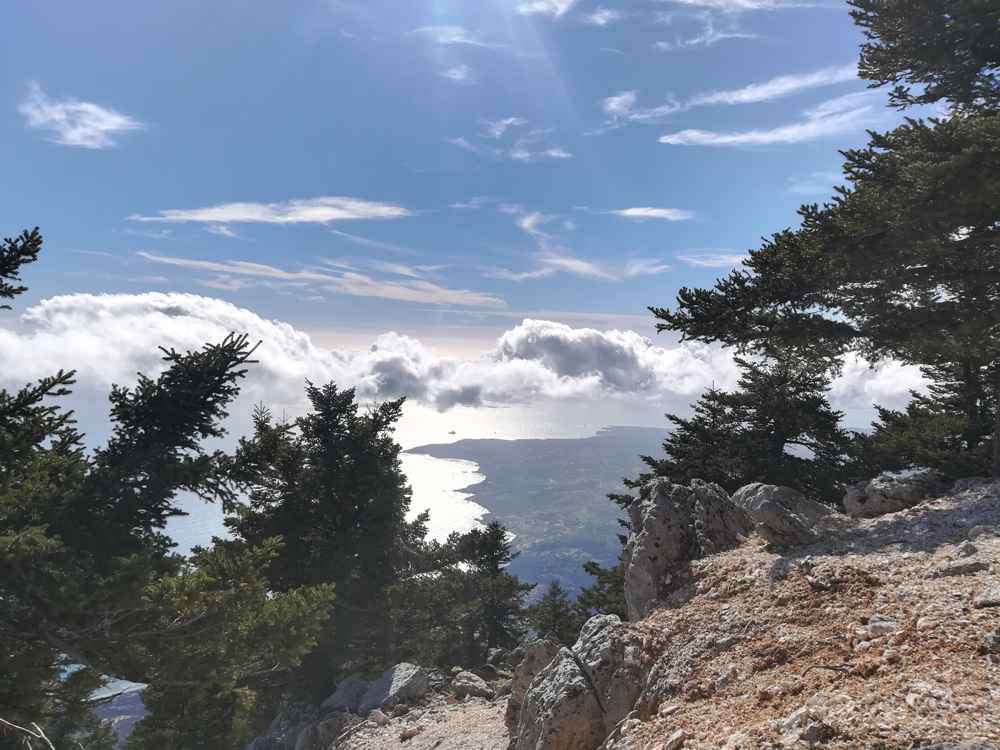
Katelios sits on the south coast of Kefalonia, about 8 km west of Skala and roughly 35 km southeast of Argostoli by road. The village divides into two parts: Ano Katelios on the hillside and Kato Katelios along the water. Fish tavernas stand on the seafront, supplied by boats drawn up on the shingle a short walk away. Behind the houses, olive groves and green hills climb toward the interior. The bay opens south toward the channel, and the light stays on the beach for most of the day. Plan the whole trip with Greece Tours.
Katelios trades activity for quiet. The bay carries no marina, no clubs and no organised strip of shops, and the beach shelves so gently that children wade far out before the water reaches their waists. East of the sand, the shoreline runs toward Mounda, one of the main loggerhead nesting beaches in Greece, where nests are marked and protected through the summer. This guide covers the village layout, the seafront tavernas, the beach, the turtle rules next door, who Katelios fits as a base, and how to reach it.
Where is Katelios on Kefalonia and what kind of place is it?
Katelios sits on the south coast of Kefalonia, about 8 km west of Skala and roughly 35 km from Argostoli. The village combines a hillside settlement above and a shore village along a shallow sandy bay.
Katelios lies on the southern shore of Kefalonia, facing open water across the channel toward the Peloponnese. The bay opens south, so the light falls on the beach through most of the day. Green hills and olive groves rise directly behind the shoreline, and the coast road runs above the houses. Argostoli, the island capital, sits roughly 35 km northwest by road, which places Katelios at the quiet end of the island rather than at its centre. The name covers both the shore settlement and the older hillside quarter above it.
The bay stretches for roughly 1.5 kilometres of sand and shingle, ending in low rock at each end. Fishing boats sit drawn up on the shingle near the middle of the seafront, close to the tavernas. Behind the beach runs a single road lined with houses, rooms to rent and small shops. No large hotel blocks stand on the front, so the skyline stays low. Street lighting along the shore road is limited. The bay falls dark early, once the tavernas along the water finish serving for the night.
Skala lies about 8 km east along the coast road and works as the practical centre for this stretch of the south coast. Katelios uses it for supermarkets, pharmacies, banking and evening bars, then returns to its own quiet. Poros, the east-coast ferry port, sits about 20 km northeast by the same road. The drive between the two villages takes about fifteen minutes and climbs over low hills covered in olive and cypress. Buses on the south-coast route run rarely, so a car makes the trip easier.
Katelios grew as a farming and fishing settlement rather than a resort, and the pattern still shows in its layout. Houses spread thinly along the shore and up the slope instead of clustering around a built harbour. The village has no marina, no clubs and no organised strip of shops. Visitor numbers rise from June to September, then the bay returns to the fishermen and the families who live there through the winter. That rhythm defines what Katelios offers and what it withholds from anyone expecting a resort.
What is the fishing harbour and taverna seafront like in Kato Katelios?
Small fishing boats work out of Katelios bay and land their catch on the shingle in front of the village. Fish tavernas line the seafront and cook what the boats bring in that morning.
Fishermen keep small open boats on the shingle at the centre of the bay, hauling them clear of the water with winches and rollers. Nets hang to dry on wooden frames beside them through the morning. The boats work close to shore for red mullet, bream, octopus and squid, depending on the season. Their catch reaches the tavernas along the same seafront within hours, which is the reason the village built its reputation on fish rather than on beach clubs or organised watersports.
Tavernas line the shore road, with terraces set directly above the sand and shaded by reed canopies. Menus stay short and centre on grilled fish sold by weight, alongside octopus, salads and island cooking. The price of fish follows the day’s catch, so the board changes rather than the printed card. Service runs late into the evening and slows to the pace of the tables. Nothing here works as a bar strip, and the volume stays low enough to hear the water on the shingle.
Eating in Katelios follows a simple order: choose the fish from the ice, agree the weight, then wait. Portions arrive whole and get shared at the table with lemon, oil and greens. Lunch runs long in the shade, and dinner starts around eight, later in high summer. The tavernas sit within a 400-metre walk of each other along the front, so comparing them costs nothing but a stroll. That short seafront holds the entire social geography of the village on any summer evening.
The fishing tradition ties the village to the wider south coast, where Skala and Poros keep small fleets of their own. Boats from Katelios work the shallow shelf that runs east toward Mounda, water also used by loggerhead turtles through the summer. Fishermen there follow local practice on nets and lights to reduce harm to nesting animals. The link between the working bay and the protected beach beside it shapes daily life here more than tourism does. Visitors notice it at first light, when the boats return.
What is the difference between Ano Katelios and Kato Katelios?
Ano Katelios stands on the hillside above the coast as the older farming settlement, while Kato Katelios occupies the shore beside the bay with the tavernas, rooms and beach access. About 2 km of road separates the two.
Ano Katelios occupies the slope above the coast road, a settlement of stone and rendered houses among olive terraces. Farming shaped it: the ground behind holds olive groves, vines and grazing land rather than beach plots. The village keeps a church, a square and views that reach across the bay to the open channel. Life there stays residential through the summer, with far fewer visitors than the shore. The height also brings a breeze in July and August that the beachfront rarely receives during the afternoon.
Kato Katelios spreads along the water for about one kilometre, a single line of tavernas, rooms, studios and small markets. The buildings sit low, one or two storeys, set back from the sand behind tamarisk and reed. Everything a visitor uses daily stands within that strip: breakfast, dinner, sunbeds, a bakery run and the boats. Parking works along the road rather than in built lots. Kato Katelios carries the whole visitor function of the village, and the hillside carries the older residential core.
The road between the two parts climbs about 2 km and gains roughly 90 metres, which takes four minutes by car and half an hour on foot. Walking up in the evening rewards the effort with light across the bay and the shelf of sea toward Mounda. The route passes olive terraces and stone walls built for the old farming plots. Cyclists use the same climb as a short training loop before dropping back to the shore for a swim in flat water.
The two settlements reflect a pattern repeated across the island: the old village sits inland and uphill, the newer one sits on the beach. Pirate raids and the poor value of coastal land kept builders away from the shore for centuries. The Ionian earthquake of the mid-twentieth century then flattened most of the island’s stone architecture, and rebuilding produced the low concrete forms visible in both parts of Katelios today. Fiskardo in the far north remains the main exception on Kefalonia.
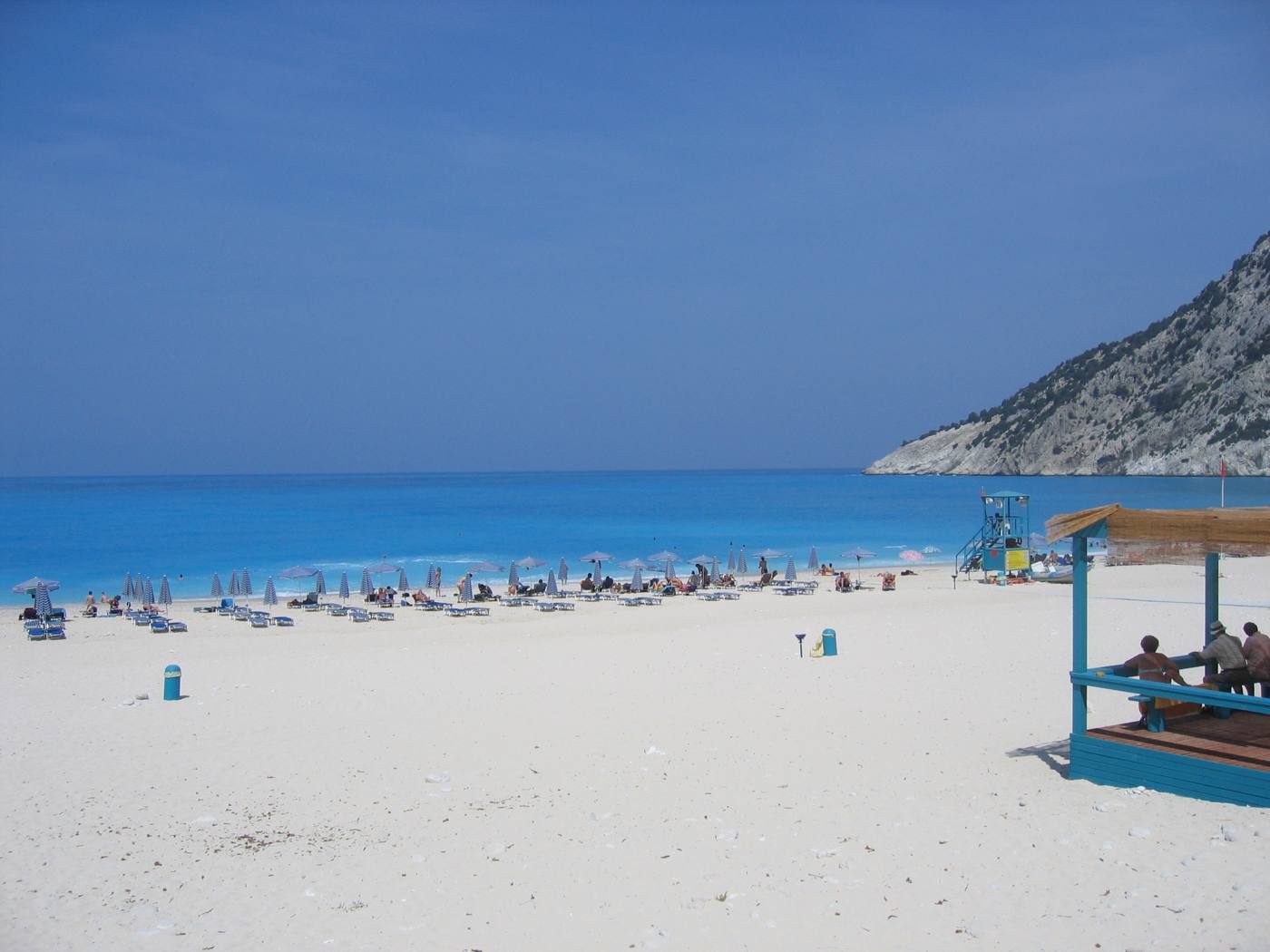
What is Katelios beach like and is the water shallow enough for children?
Katelios beach runs for roughly 1.5 kilometres of coarse sand mixed with shingle, and the seabed drops away slowly. Children stand in waist-deep water 20 metres out, which makes the bay one of the calmer south-coast options.
The shore alternates between coarse grey-gold sand and bands of small pebble, firmer underfoot near the water line. Entry stays gradual across the central section in front of the tavernas, where the seabed shelves for about 30 metres before deepening. Water shoes help on the pebble strips at either end. The sand darkens toward the eastern half, where the beach widens and the crowd thins out. Families concentrate near the village, and walkers find open space within a five-minute stroll east.
Katelios bay faces south, so afternoon wind builds waves on days when the south wind runs. Morning water usually stays flat, which suits swimming with children and snorkelling along the rock at the western end. No lifeguard service operates on the beach. Sunbeds and umbrellas appear only in front of the tavernas across the central stretch, and the rest of the shore stays free. Shade comes from tamarisk trees behind the sand rather than from any built structure along the front.
Katelios sits within reach of the strongest beaches on the south coast, which explains its use as a low-key base. Skala beach lies 8 km east, a longer stretch of sand with more facilities and shade from pine. Lourdas beach lies about 20 km west, backed by the slopes of Mount Ainos. Compared with the famous Kefalonia beaches of the northwest, such as Myrtos, the southern bays trade drama for shallow water and quiet. The contrast defines the choice for families.
Facilities on the beach stay minimal by design. Showers and organised sections do not run along the shore, and there are no watersports operators, no jet skis and no boat hire in the bay. Visitors bring water, shade and supplies from Skala or from the small shops on the front. Umbrellas at the tavernas come with a drink or a meal rather than a separate hire desk. That thin service layer is exactly what keeps the noise level of Katelios low.
Why is Mounda beach near Katelios important for loggerhead turtles?
Mounda beach, immediately east of Katelios, ranks among the main loggerhead nesting shores in Greece. Females come ashore at night through the summer to lay eggs in the sand, and volunteers mark and monitor the nests.
Mounda runs east from the Katelios shoreline toward Cape Mounda, a long, open sand beach with almost no building behind it. That emptiness is the reason the turtles use it: dark, wide sand with no lights, walls or hard structures at the back. Caretta caretta females crawl up at night from about the start of summer, dig a chamber, lay a clutch and return to the water before dawn. Hatchlings emerge weeks later and follow the brightest horizon, which over an undeveloped beach is the sea.
Katelios has a long involvement in protecting the sea turtles of Kefalonia, through local monitoring groups that patrol Mounda during the nesting period. Volunteers locate fresh tracks at dawn, mark each nest with a cage or frame, and record its position. The cages keep vehicles, dogs and sunbeds off the eggs without disturbing the sand above them. The same effort explains why the beach behind carries no sunbed lines. Argostoli harbour, about 35 km away, is the other well-known turtle site on the island.
Rules on Mounda stay simple. Visitors keep away from marked nests, avoid digging or driving stakes into the sand, and take all equipment off the beach at sunset. Lights, torches, flash photography and beach fires are prohibited at night, since artificial light draws hatchlings inland away from the water. Walking after dark is discouraged during the nesting months. Anyone finding a track, a nesting female or hatchlings reports the sighting to the monitoring group rather than approaching or handling the animals.
Turtles occasionally come ashore on the Katelios beach itself, since the sand is continuous between the two. Nests appear beyond the taverna strip where the shore widens and darkens. The practical result for a visitor is a beach with no floodlighting and no late music near the water. Boats from the village keep clear of marked areas and reduce speed across the shallow shelf. Protecting the nesting ground and running a fishing village on the same bay demands that balance every summer.
Who does Katelios suit as a base, and what does the village lack?
Katelios suits families, couples and returning visitors who want a quiet bay, walkable tavernas and an early night. The village lacks nightlife, large supermarkets, watersports operators and frequent public transport, so a rental car covers the gap.
Families choose Katelios for the shallow entry, the short walk from room to sand and the absence of traffic on the front. Couples choose it for long dinners over the water with no music competing across the terraces. Walkers use the hills behind, and the coast road east toward Mounda gives a flat 3-kilometre stretch. Anyone wanting clubs, a beach bar scene or organised excursions leaving from the village itself finds none of that in the bay.
Accommodation runs to studios, apartments and small family-run hotels rather than large complexes, most of them within 200 metres of the shore. Booking early matters for July and August because the total number of beds in the village stays small. Anyone comparing bases across the island alongside where to stay in Kefalonia weighs Katelios against Skala, Lourdas and Lassi. Skala offers more shops and evening life; Lassi sits closer to Argostoli and the airport; Katelios offers the quietest bay of the three.
A car turns Katelios from a beach into a base. Sami and the Melissani cave lie about 45 km north, roughly an hour by road. Argostoli, the De Bosset bridge and the Katavothres sea mills sit about 35 km northwest. Myrtos and Assos on the northwest coast take about 90 minutes each way, which works as a full day out. Poros ferries to Kyllini on the mainland leave 20 km up the coast, useful for anyone driving on to the Peloponnese.
The trade-offs deserve a clear statement. Katelios holds no bank, no petrol station and no large supermarket, so fuel and a full shop come from Skala. Medical services sit in Skala and Argostoli. Evening entertainment ends when the tavernas close, and the beach carries no lifeguard or watersports. Visitors who accept that list get an unpackaged fishing bay; visitors who want facilities on the doorstep find the compromise uncomfortable by the second evening of a stay.
How do you reach Katelios from Argostoli, Skala and Kefalonia Airport?
Drivers reach Katelios from Argostoli in about 45 minutes over roughly 35 km, and from Kefalonia Airport in about 35 minutes. Skala lies 8 km east, around ten minutes along the coast road.
The road from Argostoli runs southeast past the airport turn, crosses the farmland behind Lourdas and joins the south coast road toward Skala. The surface stays paved and two-lane the whole way, with bends through the foothills of Mount Ainos on the middle section. Signposting points to Skala rather than Katelios for most of the route, so drivers follow Skala and turn off at the marked junction. Allow 45 minutes without stops, and longer behind farm traffic in the morning.
Kefalonia Airport lies about 9 km south of Argostoli, which puts it roughly 30 km from Katelios by road. Transfer time runs about 35 minutes. Car hire desks operate at the terminal, and picking up on arrival makes sense given the thin bus service on the south coast. Taxis serve the route by arrangement rather than from a rank at the village end. Arriving after dark adds care on the final coastal section, where street lighting stops outside the settlements.
The 8 km link east to Skala takes about ten minutes and works as the daily errand run for supermarkets, pharmacies and bars. Poros sits 20 km northeast, with ferries to Kyllini on the mainland Peloponnese. Sami, the second port, lies about 45 km north and connects to Ithaca and the mainland. Anyone arriving by ferry into Poros drives the coast road southwest to Katelios in about 25 minutes, passing Katelios beach on the approach.
Public buses on the Argostoli to Skala route pass along the south coast, though departures run at a handful of fixed times each day and stop on the main road rather than in the village. Walking down from the junction to the shore adds about ten minutes. Cycling suits the flat coast strip east toward Mounda more than the climb inland. Renting a car or scooter for the stay removes every timing problem and opens the rest of the island.
Frequently Asked Questions
Is Katelios a good choice for a first visit to Kefalonia?
Katelios works for a first visit when the plan centres on beaches, food and a car rather than on nightlife or town life. The village gives a shallow bay, a seafront of fish tavernas and quick access east to Skala and Poros. Argostoli, Sami, Melissani and Myrtos all sit within a day’s driving, between 35 and 60 km away. Visitors without a car find the base restrictive, because the bus service along the south coast runs at a handful of fixed times. A first-time visitor wanting museums, shops and a harbour promenade every evening does better in Argostoli or Lassi. A first-time visitor wanting quiet water and long dinners finds Katelios direct and simple.
How far is Katelios from Skala and from Argostoli?
Katelios lies about 8 km west of Skala along the south coast road, which takes around ten minutes by car. Argostoli sits roughly 35 km northwest, about 45 minutes of driving through the farmland behind Lourdas and the foothills of Mount Ainos. Kefalonia Airport, about 9 km south of Argostoli, sits roughly 30 km from the village and takes about 35 minutes. Poros, the east-coast ferry port for Kyllini, lies 20 km northeast, about 25 minutes away. Sami, the port for Ithaca and the caves, is about 45 km north. Those distances make Skala the practical service town for daily needs and put the island’s main sights within a single day trip in each direction.
Can you see turtles at Katelios and Mounda beach?
Loggerhead turtles nest on Mounda beach immediately east of Katelios, so sightings happen, though nesting itself takes place at night and stays off-limits to casual watching. Swimmers occasionally see adults in the shallow water off the bay during the summer, since the shelf here is a feeding and mating area. Nests on Mounda are located at dawn by monitoring volunteers and marked with cages that must be left untouched. Visitors keep off the marked sand, remove equipment at sunset, and use no torches, flash or fires at night, because artificial light sends hatchlings inland instead of to sea.
Argostoli harbour, about 35 km away, offers the most reliable daytime views of loggerheads on Kefalonia, near the fishing boats on the waterfront.
Does Katelios have nightlife, shops and supermarkets?
Katelios has no nightlife in the club or beach-bar sense. Evenings run through the seafront tavernas, which serve late and then close, leaving the bay dark and quiet. The village keeps small markets and a bakery for basics, plus taverna terraces that double as the meeting point. Full supermarkets, pharmacies, banking and bars sit 8 km east in Skala, about ten minutes by car, and that is where most visitors do the weekly shop. Argostoli, 35 km northwest, covers everything larger, including medical services and chain retail. Anyone staying in Katelios plans a supply run rather than expecting a shop on the corner, and treats the absence of noise as the reason for choosing the village.
What is the best time of year to visit Katelios?
June and September give the best balance at Katelios: warm sea, open tavernas and far fewer people than in the peak weeks. July and August bring the highest temperatures, the fullest rooms and the strongest afternoon south wind on the bay. May and early October stay quiet, with pleasant walking weather in the hills behind Ano Katelios, though the sea feels cool in May and part of the accommodation has not opened. Winter empties the shore entirely, and the village returns to farming and fishing. Turtle nesting on Mounda runs through the summer months, so visitors in that period share the coast with marked nests and follow the night-time restrictions on lights and beach use.
Do you need a car to stay in Katelios?
A car is close to essential for a stay in Katelios. The village itself is walkable end to end, and the beach, tavernas and rooms all sit within a few hundred metres of each other. Everything beyond that needs wheels: Skala at 8 km, Poros at 20 km, Argostoli at 35 km. Sami and the Melissani cave at about 45 km. Myrtos on the northwest coast at roughly 90 minutes each way. Buses on the Argostoli to Skala route pass on the main road at a handful of fixed times daily and stop above the village. Hiring at Kefalonia Airport on arrival is the simplest arrangement, since local hire in Katelios is limited.