
Lixouri faces Argostoli across the Gulf, about 4 kilometres of water and a 20 to 30 minute ferry ride from the capital of Kefalonia. The town is the island’s second settlement and the centre of the Paliki peninsula, a farmed, low-lying quarter in the southwest that most visitors see only from the opposite shore. Its streets were rebuilt low after the earthquake, its square opens straight onto the quay, and its market still supplies the villages behind it. Beaches of red-orange sand and white pebbles lie within 12 kilometres of the square in either direction, north and south. Plan the whole trip with Greece Tours.
This guide covers what Lixouri is and where it sits. The bay ferry, the seafront square and the market follow. Later sections take in the Iakovatios Library and its roughly 20,000 volumes, plus the beaches of the Paliki coast. The last two cover who the town suits as a base and how to move around the peninsula. Distances, durations and practical trade-offs appear throughout. A visitor planning a half-day trip finds the same detail as one booking a fortnight, and can weigh the ferry against the road. Named beaches, roads, distances and driving durations anchor each answer below.
Where is Lixouri in Kefalonia and what kind of town is it?
Lixouri stands on the east coast of the Paliki peninsula in western Kefalonia, facing Argostoli across a wide bay. The town is the island’s second settlement, with around 3,000 residents and a low, rebuilt centre.
Lixouri sits about 4 kilometres across the water from Argostoli, on the sheltered eastern shore of the Paliki peninsula. That peninsula forms the southwestern arm of Kefalonia, cut off from the rest of the island by the Gulf of Argostoli. Low hills of soft clay and gypsum rise behind the town, and the ground drops to the sea in flat terraces. The centre spreads back from a long waterfront, with streets laid on a grid and buildings rarely above two floors. Vineyards, olive groves and grain fields cover the land north and west of the built area.
The town works as the service centre for the whole Paliki peninsula. Farmers from Mantzavinata, Soulari and Katogi bring produce to the Lixouri market, and the schools, health centre, banks and municipal offices serve villages spread over roughly 130 square kilometres. Fishing boats tie up along the quay each morning, and the ferry ramp handles cars, trucks and foot passengers through the day. Population sits near 3,000 in winter and multiplies in July and August, when houses owned by families from Athens and abroad fill again. The rhythm of the place stays local rather than resort-driven.
Lixouri carries a long reputation for writers, satirists and musicians. Andreas Laskaratos, the satirical poet who quarrelled with the church of his day, was born here, and a bronze statue of him stands on the seafront square. The town produced philologists, doctors and lawyers whose private libraries survive in local collections today. Choirs still sing kantades, the Ionian serenade tradition shaped by centuries of Venetian rule, in the squares on summer evenings. This intellectual streak explains the rivalry with Argostoli, a competition over culture, dialect and pride that residents of both towns describe with humour rather than heat.
The setting reads differently from the island’s northern coasts. Paliki has no high cliffs like those above Myrtos, and no pine-covered headland like the one at Assos. The land is open, farmed and dry, with wide horizons toward the sea and low ridges inland. Sunsets fall over the western coast at Petani and Atheras, while the eastern side facing Argostoli catches morning light across the water. Distances stay short: no village on the peninsula lies more than about 25 kilometres from the town. Lixouri works as a base for the entire southwestern quarter of the island.
How does the ferry from Argostoli to Lixouri work?
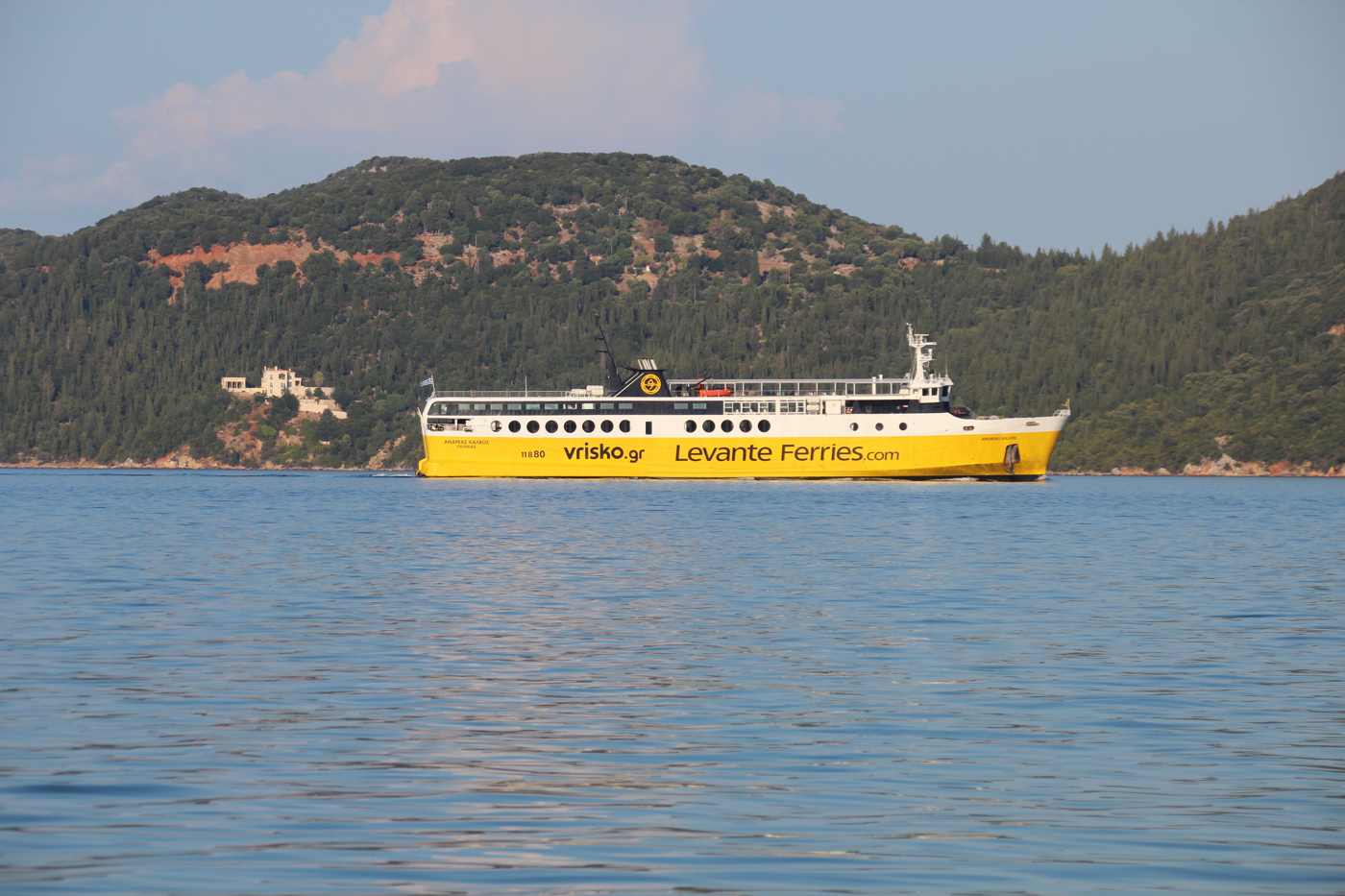
The ferry crosses the Gulf of Argostoli between the two town waterfronts in about 20 to 30 minutes, carrying cars, motorbikes and foot passengers. Boats run through the day in summer, on a reduced winter schedule.
The crossing links the Lixouri quay directly with the waterfront of Argostoli, landing beside the capital’s cafes and shops. Both ramps sit in the middle of each town, so passengers walk off into the centre without a transfer. The road around the head of the bay covers about 35 kilometres and takes around 45 minutes by car, climbing through Kardakata and Livadi. The boat saves roughly half that time and most of the fuel. Drivers queue on the quay, board in order and stay with the vehicle or climb to the open deck for the short passage.
Tickets are bought at the kiosk on the quay or on board, and the foot-passenger fare stays low, with a higher rate for a car and driver. Boarding opens about ten minutes before departure. Sailings repeat through the summer day at intervals of about half an hour to an hour, from early morning until late evening, and the winter list is far shorter. Strong southerly winds occasionally suspend the service, and traffic then diverts to the long road around the Gulf. Checking the day’s board at the quay avoids a wasted trip to the ramp.
The passage gives the clearest view of the Argostoli lagoon and the mountains behind it. Boats pass the mouth of the bay where the De Bosset stone bridge crosses shallow water, and Mount Ainos rises inland at about 1,628 metres. Loggerhead turtles surface in the harbour near the fishing boats, and gulls follow the wake. Ten minutes out, Lixouri appears low against the Paliki hills, spread along the shore rather than climbing it. Passengers with cameras stay on the upper deck for the whole crossing, which is short enough to spend standing at the rail.
The ferry shapes daily life on both sides of the bay. Students, nurses and shop workers commute across each morning, and capital residents cross for lunch on the Lixouri seafront at weekends. Visitors staying in the capital use the boat as an easy half-day trip: cross at ten. Walk the square and the market, eat by the water and return in the afternoon. Cyclists take bikes aboard and ride from the quay toward Lepeda within 20 minutes. The crossing also matters for anyone driving to Petani, which is far faster to reach from the Lixouri side.
What is there to see on the Lixouri seafront and central square?
The seafront square opens directly onto the quay, ringed by cafes, tavernas and plane trees, with the statue of Andreas Laskaratos at its centre. A covered market, bakeries and small shops fill the streets one block behind.
The square works as the town’s living room from morning until late. Coffee tables spread under the trees by eight, filled with residents reading papers and talking. Children ride bicycles across the paving in the evening while older men play cards at the corner tables. Tavernas set out chairs facing the water and the lights of Argostoli, about 4 kilometres across the bay. The buildings around the square stand low, so the space feels wide and open to the sky. The sea breeze cuts the July heat after about six, when the square fills again.
Shopping in Lixouri stays concentrated in three or four streets behind the quay. The market sells island produce: thyme honey, olive oil from Paliki groves, feta, sun-dried tomatoes and Robola wine from the Omala valley. Bakeries turn out mandoles, the almond sweet in red sugar, and rusks for riganada. A bookshop, hardware stores and a pharmacy line the same blocks, and the fish stall opens beside the quay when the boats come in. Visitors planning things to do in Kefalonia often start a Paliki day here, buying food before driving west toward the beaches at Xi and Megas Lakkos.
Evening life follows a fixed pattern. Families walk the volta along the waterfront between about seven and nine, greeting neighbours the whole length of the quay. Ouzeries and mezedopoleia open around the square, serving grilled octopus, kreatopita meat pie and salt cod with skordalia. Music bars sit at the northern end near the marina, and the volume stays below the nightlife of Argostoli or Skala. Festivals fill the square through August. Wine and folk events draw crowds from Mantzavinata and Havriata, and dancing runs past midnight in the open air. The square then holds the largest crowd of the year.
Beyond the square, the grid of streets rewards a slow walk of about 40 minutes. The church of Agios Charalambos and the Panagia of Pantanassa hold icons rescued from older buildings, and small shrines stand at street corners. The town beach of Lepeda lies about 2 kilometres south, reached in 5 minutes by car, with red rock formations and shallow water. North of the quay, the marina takes yachts crossing between Kefalonia, Ithaca and Lefkada. Cyclists follow the flat coastal road toward Kounopetra, and the whole route out of town stays level, which is unusual on an island as mountainous as this one.
Why is the Iakovatios Library important to Lixouri?
The Iakovatios Library occupies one of the few Lixouri mansions that survived the earthquake, and holds roughly 20,000 volumes, manuscripts and church documents gathered by the Typaldos-Iakovatos family. The building also serves as the town museum.
The library stands in a two-storey neoclassical mansion set back from the seafront, built by the Typaldos-Iakovatos family in the century before the earthquake. Georgios Typaldos-Iakovatos, a scholar and politician of the Ionian State, assembled the core collection, and his brother added to it. The house passed to the Greek state and now works as a public library and museum together. Rooms hold bound volumes in Greek, Italian, Latin and French, along with maps, portraits and period furniture. The stone walls held during the earthquake while the streets around collapsed, which makes the building itself part of the exhibit.
The collection matters because so little written material from Paliki survived. Manuscripts, ecclesiastical codices and printed books from the Venetian and British periods record land ownership, church affairs and the debates of Ionian intellectuals. Editions of Andreas Laskaratos sit alongside the works he argued against. A reading room serves researchers, and display cases show the oldest bindings to visitors. Entry costs little and a walk through takes about 30 to 45 minutes. Staff explain the Ionian Academy connection and the town’s role in nineteenth-century Greek letters, which visitors expect from a town of 3,000 people.
The earthquake defines everything standing in Lixouri today. The shock levelled the town along with Argostoli and most other island settlements within seconds. The rebuilding that followed used low concrete frames of one or two floors, wide streets and open squares designed against collapse. The result is a plain townscape rather than a Venetian one, unlike Fiskardo in the far north, which survived the shock almost intact. Reading the town means noticing what is missing: the arcades, bell towers and tall facades recorded in old photographs displayed inside the library and the town hall on the square.
Other heritage sites cluster within a short drive. The monastery of Kipoureon clings to the cliff edge on the west coast about 15 kilometres from town, with a drop of roughly 90 metres to the sea below. The Palaiochora ruins above Soulari mark a medieval settlement, and village churches around Havriata keep carved woodwork and icons. Katogi and Chavdata retain stone doorways from houses that fell in the earthquake. These fragments, together with the library, give the Paliki peninsula a documented past that the rebuilt streets on their own do not show. The drive between them takes about 40 minutes.
Which beaches lie near Lixouri on the Paliki peninsula?
Xi, Megas Lakkos and Lepeda line the south coast within about 8 kilometres of Lixouri. Petani faces west across the peninsula, roughly 12 kilometres away by road over the central ridge.
Xi lies about 8 kilometres south of Lixouri and reads unlike any other bay among the Kefalonia beaches. The sand is red-orange, coloured by the clay cliffs behind it, and the water stays shallow for about 40 metres out, which suits families with small children. White gypsum cliffs rise at the western end, and bathers coat themselves in the clay as a skin treatment. Sunbeds, two tavernas and a watersports base occupy the central stretch, while the eastern end stays open. The beach faces south, so it holds sun until evening. Parking sits behind the taverna row, about 100 metres from the sand.
Petani sits on the west coast about 12 kilometres from town, reached by a winding road down from Kontogenada. The bay is a long curve of white pebbles under steep green slopes, with deep blue water that drops away within about three metres of the shore. Comparisons with Myrtos are common, and the scale is similar without the crowds. Two tavernas stand at the north end, and parking is limited to the roadside above. The western aspect makes Petani the strongest sunset beach on the peninsula, with the sun setting into open sea. The drive from Lixouri takes about 20 minutes.
Megas Lakkos runs west of Xi along the same south-facing coast, separated by a headland of soft cliffs. The sand carries the same reddish tone, the crowds thin out, and one taverna serves the beach. Erosion keeps changing the cliff line, so the sand strip widens and narrows from year to year. Further west, Kounopetra marks the rock that rocked with the swell until the earthquake stopped its movement, and a small bay beside it takes swimmers. Vatsa, on the southern tip near Akrotiri, gives a sheltered anchorage with a taverna and protected water about 15 kilometres from town.
The western and northern coasts of Paliki stay wilder. Atheras curves into a green bay about 20 kilometres north of Lixouri, with a fishing hamlet, one taverna and shallow water. Porto Atheras and Platia Ammos need care, since the long stair down to Platia Ammos was damaged and access changes with the cliffs. Roads narrow to single track and signposting fades, so a small car and a full tank help. Swimmers who want an empty beach in August find it here, within about 40 minutes of the town, rather than at Xi or Petani, which fill by eleven.
Who does Lixouri suit as a base in Kefalonia?
Lixouri suits travellers who want a working Greek town with beaches close by, low prices and a short ferry link to the capital. Families, returning visitors and long-stay guests choose the Paliki side most often.
Accommodation on Paliki runs to apartments, studios and small family hotels rather than large resorts, and rates sit below the equivalent in Fiskardo or Assos. Most beds cluster in the town itself, along the Lepeda road and behind Xi beach. Anyone comparing districts across the island and weighing where to stay in Kefalonia gains a quieter base here, with the trade-off of the ferry or the 35-kilometre road when heading east. Bookings for August fill early, since the same families return each year and hold the same apartments for the same fortnight. Studios outnumber hotel rooms across the peninsula.
The town suits self-catering travel. A bakery, two supermarkets, butchers and the produce market sit within a 10-minute walk of most rentals, and prices for food and coffee run below those in the capital. Parking is free and easy along the streets away from the square, which removes a daily problem faced in Argostoli. Beaches at Lepeda and Xi are 5 and 15 minutes away by car. Evenings stay calm, with restaurant service until about eleven and no large clubs, so sleep comes easily for anyone travelling with children. A kitchen also cuts the cost of a fortnight sharply.
Lixouri works less well for a first short visit built around the island’s headline sights. Myrtos, Assos, Fiskardo, Melissani and Antisamos all lie on the far side of the Gulf. Each sits between 45 minutes and 2 hours away by car, once the ferry or the ring road is counted. Travellers with three nights and a checklist do better from Argostoli, Sami or Agia Efimia. A stay of a week or more changes that arithmetic, since two or three long driving days cover the north and the remaining time stays local. The ferry timetable then matters less than the beach list.
Longer stays reward the choice. Renters settle into the market rhythm, learn which taverna cooks fish on which day and swim at a different Paliki beach each morning. The peninsula holds Xi, Megas Lakkos, Lepeda, Petani, Atheras and Vatsa within 25 minutes of the centre, so a fortnight passes without repetition. Shoulder-season visitors find the town still functioning, with shops and cafes open when resort villages close entirely between November and April. Prices in the market drop once the August crowd leaves. That year-round working life is the main practical argument for staying on the Paliki side.
How do you reach Lixouri and get around the Paliki peninsula?
Two routes reach Lixouri: the ferry from Argostoli in about 20 to 30 minutes, or the road around the Gulf, roughly 35 kilometres and 45 minutes. A car covers the peninsula best.
Arrivals by air land at Kefalonia Airport, about 9 kilometres south of Argostoli. Lixouri lies roughly 50 kilometres away by road, or about 25 minutes to the ferry ramp plus the crossing. Ferries from Kyllini on the Peloponnese reach Poros and Argostoli, and boats from Astakos and Patras serve Sami on the east coast. Taxi transfers run from the airport to the Argostoli quay in about 15 minutes. Car hire desks operate at the airport and in both towns, and taking a hire car aboard the bay ferry is standard practice with no extra formality.
A car remains the practical way to see Paliki. Public buses connect Lixouri with Argostoli by the long road and reach the villages on a schedule built around school and market times rather than beaches. The road network on the peninsula is paved to Xi, Petani, Atheras and Mantzavinata, and turns to gravel on the western headlands near Kipoureon and Platia Ammos. Distances are short, with nowhere on Paliki more than about 25 kilometres from the town, so fuel costs stay low even with a different beach every day. Petrol stations stand on the Lixouri waterfront and the Mantzavinata road.
Scooters and bicycles work well on the flat southern half. Rental outlets on the Lixouri waterfront hire both, and the ride to Xi takes about 20 minutes on a scooter or 45 by bicycle along a level coastal road. The climb over the ridge to Petani is steep, with about 200 metres of ascent, which rules out casual cycling. Taxis wait at the square and cover beach runs, and drivers agree the fare before departure. Walking suits the town centre, Lepeda and the marina, all within about 30 minutes on foot from the square. Helmets come with every scooter hire.
Day trips from Lixouri follow the ferry. Cross with the car in the morning. The Katavothres sea mills, the De Bosset bridge and the Napier Garden fill about three hours. Myrtos and Assos lie another 45 minutes north. Sami, Melissani and Antisamos, on the east coast, sit around 1 hour 15 minutes from the Argostoli quay. Returning by the last evening boat needs planning, since the road around the bay adds about 45 minutes. Checking the final sailing before leaving the peninsula keeps the day simple. Most drivers aim for a boat an hour before the final crossing.
Frequently Asked Questions
How long does the ferry from Argostoli to Lixouri take?
The crossing takes about 20 to 30 minutes, depending on the boat and the wind. Ferries leave from the middle of each waterfront, so passengers walk straight into the centre of either town without a connecting bus or taxi. Sailings repeat through the day in summer, from early morning until late evening, and the winter list is far shorter. Tickets are sold at the quay kiosk or on board, with a low foot-passenger fare and a higher rate for a car and driver. Boarding opens about ten minutes before departure. Strong southerly winds occasionally suspend the service, and traffic then takes the road around the head of the Gulf, about 35 kilometres and 45 minutes.
Checking the day’s board at the quay before planning a return keeps the trip predictable.
Is Lixouri worth a day trip from Argostoli?
A day trip from Argostoli to Lixouri works well and needs about five hours. Cross on a morning ferry and walk the seafront square, with its plane trees and the Laskaratos statue. Spend 30 to 45 minutes in the Iakovatios Library among its roughly 20,000 volumes. Buy thyme honey, olive oil and mandoles at the market behind the quay. Eat lunch at a taverna facing the water, then take a taxi or hire car to Xi beach, 8 kilometres south, for a swim on the red-orange sand. Return on an afternoon or evening boat. Adding Petani on the west coast stretches the day to about eight hours and calls for a car.
Foot passengers without transport keep the visit to the town, Lepeda beach and the marina.
Xi or Petani: which beach near Lixouri fits which visitor?
Xi and Petani answer different needs, so the choice follows the kind of swim wanted. Xi, 8 kilometres south of Lixouri, has red-orange sand, water that stays shallow for about 40 metres and clay cliffs whose mud bathers spread on their skin. Sunbeds, two tavernas and watersports sit on the central stretch, and the south-facing aspect holds sun late. Petani, 12 kilometres west over the ridge, is a curve of white pebbles below steep slopes, with deep blue water that drops away within about three metres of the shore. It faces west, which makes it the sunset beach of the peninsula. Families with small children choose Xi, while swimmers and photographers choose Petani.
Visiting both in one day takes about 40 minutes of driving between them.
Can visitors go inside the Iakovatios Library in Lixouri?
The Iakovatios Library opens to visitors as a public library and museum in a surviving mansion near the Lixouri seafront. The collection holds roughly 20,000 volumes, manuscripts, ecclesiastical codices and documents assembled by the Typaldos-Iakovatos family, with editions in Greek, Italian, Latin and French. Display cases show old bindings, maps and portraits, while a reading room serves researchers. A walk through takes about 30 to 45 minutes, and entry costs little. The building matters twice over: for the collection, and because its stone walls stood through the earthquake that levelled the streets around it. Photographs inside record the town before that collapse.
Opening hours follow the pattern of small Greek museums, with mornings the reliable window and one closed day in the week, so a call ahead saves a wasted walk.
Is Lixouri a good base for families in Kefalonia?
Families gain a strong base in Lixouri, mainly because of Xi beach and the flat town centre. Xi lies 8 kilometres south, and its water reaches about 40 metres out before it deepens, which suits small children. Lepeda beach sits 2 kilometres from the square, close enough for a late-afternoon swim. The town is level, so pushchairs and bicycles work along the whole waterfront, and free street parking removes a daily search. Two supermarkets, a produce market, bakeries and a pharmacy sit within a 10-minute walk of most rentals, and self-catering apartments cost less than hotels in Fiskardo or Assos. Evenings stay quiet, with restaurants serving until about eleven and no large clubs.
The trade-off is the ferry or the 35-kilometre road whenever the family heads north.
Do you need a car in Lixouri and on Paliki?
A car makes the difference on the Paliki peninsula, though the town itself works on foot. Walking covers the square, market, library, marina and Lepeda beach within about 30 minutes each way. Buses link Lixouri with Argostoli by the long road and reach the villages on timetables built around schools rather than beaches, which leaves the coast hard to use without transport. Xi is 8 kilometres away, Petani 12 over a ridge with about 200 metres of climb, and Atheras about 20 kilometres north. Scooters cover the flat southern half and cost less to hire than a car. Taxis wait at the square and run beach trips with the fare agreed before departure.
Taking a hire car onto the bay ferry is routine, so an airport rental crosses without extra paperwork.